REVIEW 2 major objections 4 minor 37 references
Linker-mediated self-assembly of mobile DNA-coated colloids
T0 review · 2 major / 4 minor · reviewed 2026-08-14 · deepseek-v4-flash
Pith's one-line read The paper establishes that at infinitely strong linker–receptor binding, the effective interaction between linker-mediated mobile DNA-coated colloids stops growing and is set by linker entropy and concentration, not by temperature.
desk verdict Useful mean-field theory for linker-mediated mobile DNA-coated colloids, but the entropy-dominated strong-binding plateau is an unsupported extrapolation from a regime the theory itself says it does not cover. read the letter →
The pith
A machine-rendered reading of the paper's core claim, the machinery that carries it, and where it could break.
The reading
What carries the argument
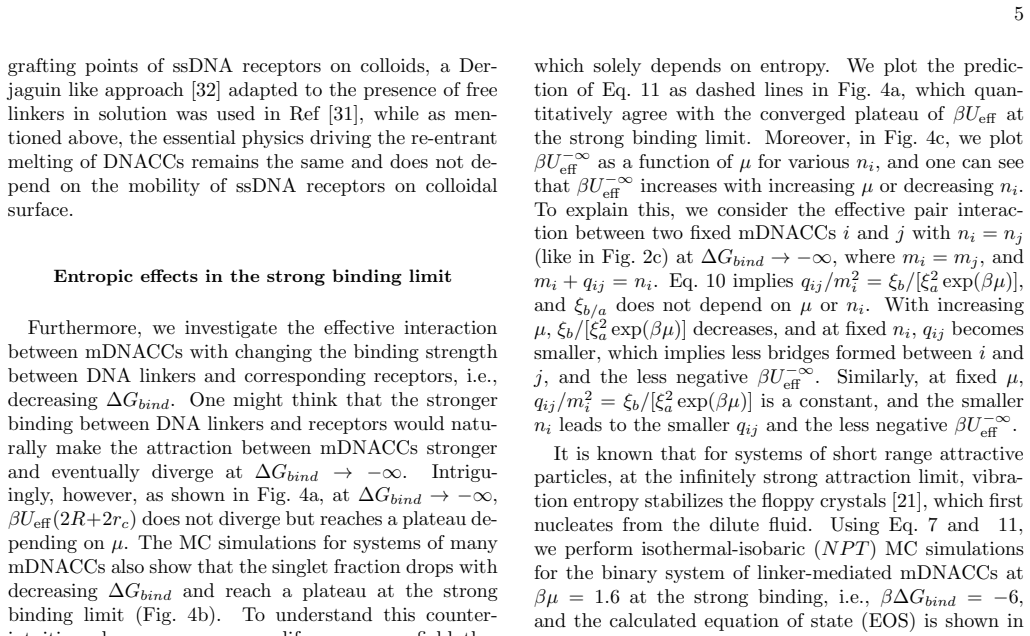
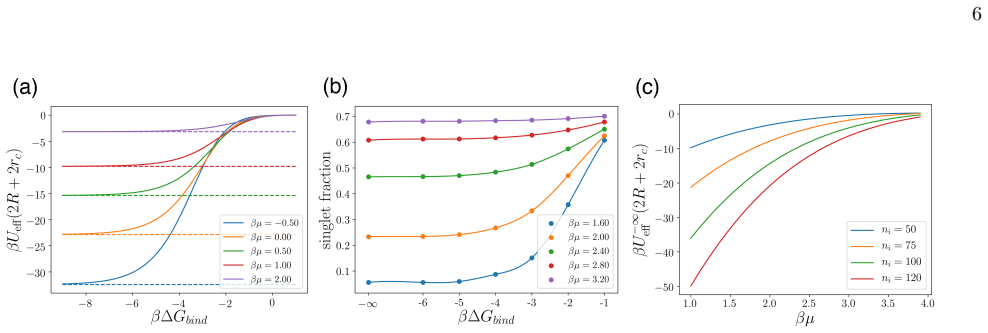
The central object is the partition function $Z$ for bonded linkers on colloids, summed over the occupation numbers $m_i$ (linkers attached by one end) and bridge numbers $q_{ij}$ (linkers attaching two colloids), together with a saddle-point approximation to evaluate it. This yields self-consistent equations for $\bar p_i$, the probability that a receptor on particle $i$ is unbound, and the effective interaction $U_{\rm eff}$ of Eq. (7). At $\Delta G_{\rm bind}\to -\infty$, all receptors are occupied ($\bar n_i=0$), and the enthalpic binding term becomes a configuration-independent constant; what remains is the entropy counting of how $n_i$ bound linkers are distributed among singly bound and bridging states, giving Eq. (11), whose finite plateau is controlled by $V_{a'}$, the configurational volume of a reference singly bound linker, the linker chemical potential, and the depletion term $U_{\rm dep}$. This entropy-counting identity is what prevents the attraction from diverging.
What would settle it
Perform explicit-linker Monte Carlo simulations (or two-colloid experiments) at strongly negative $\Delta G_{\rm bind}$ and measure $\beta U_{\rm eff}(2R+2r_c)$ as a function of temperature and of waiting time: if the interaction keeps growing as temperature drops, or changes with thermal history, rather than settling onto the concentration-dependent plateau of Eq. (11), the central claim fails.
Extended reading notes
Core claim
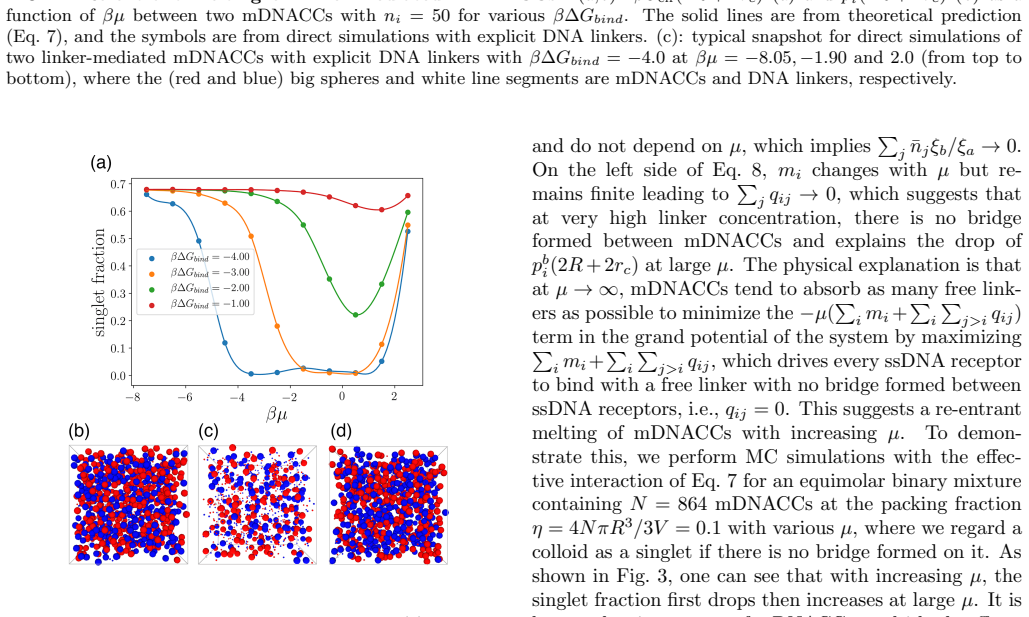
The paper establishes that in linker-mediated mobile DNA-coated colloids (mDNACCs), where free linkers with two sticky ends bridge mobile single-stranded receptors on colloids, the effective pair interaction at the strong-binding limit $\Delta G_{\rm bind}\to -\infty$ remains finite. With all receptors occupied, forming or breaking a bridge no longer changes the binding enthalpy of the system, so the configuration-dependence of the free energy comes only from linker entropy; the resulting interaction, Eq. (11), depends on the linker chemical potential $\mu$ (equivalently concentration $\rho$) and on the number of receptors per colloid, and not on $\Delta G_{\rm bind}$. The paper verifies this plateau against Monte Carlo simulations with explicit linkers and shows that the interaction first strengthens and then weakens as linker concentration rises, producing re-entrant melting in a many-body system. The same entropy-dominated saturation is generalized to multicomponent systems with arbitrary connectivity between colloid types.
Load-bearing premise
The argument assumes that linkers bind and unbind fast enough for local chemical equilibrium to hold even at infinitely strong binding; if the bonds become so long-lived that unbinding is slower than colloidal motion, the entropy plateau is kinetically inaccessible and the temperature-insensitivity claim no longer applies.
Editorial extensions
If this is right
- At low temperature where $\Delta G_{\rm bind}$ is very negative, the attraction between linker-mediated mDNACCs saturates, so cooling further does not strengthen binding; linker concentration becomes the practical control parameter.
- The effective attraction is non-monotonic in linker concentration: too few linkers give few bridges, while too many occupy all receptors and suppress bridging, producing a re-entrant melting transition.
- In multicomponent systems, the same entropy-dominated plateau appears, and encoding all pairwise interactions needs only one distinct receptor sequence per particle type rather than one per pair.
- Because free linkers can be added or removed in situ, individual specific interactions can be switched on or off during assembly without changing temperature.
Reading between the lines
- The local-equilibrium premise implies a kinetic boundary: once binding is so strong that unbinding is slower than colloidal diffusion, the entropy plateau should become history-dependent; direct measurements of bond lifetimes versus $\Delta G_{\rm bind}$ could locate that boundary.
- Measuring the depletion term separately, with non-sticky linkers of the same length, would let an experiment isolate the entropy term of Eq. (11) and test the predicted dependence on $\log \rho$ and $n_i$.
- Because the theory's analytic forms assume stiff rod linkers, repeating the two-colloid measurement with semi-flexible DNA linkers tests whether the plateau is a generic entropy effect or an artifact of the rod geometry; the paper indicates the framework carries over once $\xi_a$ and $\xi_b$ are computed numerically.
Signed reviews
Editorial analysis
A structured set of objections, weighed in public.
Referee Report
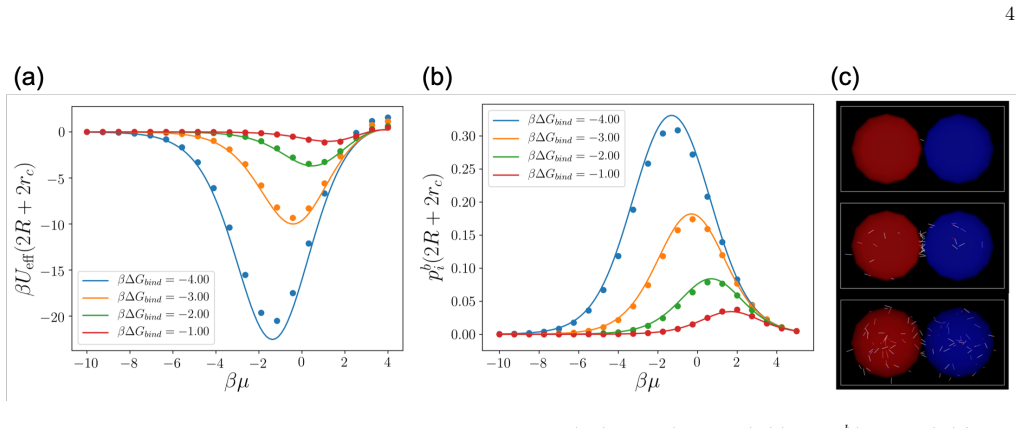
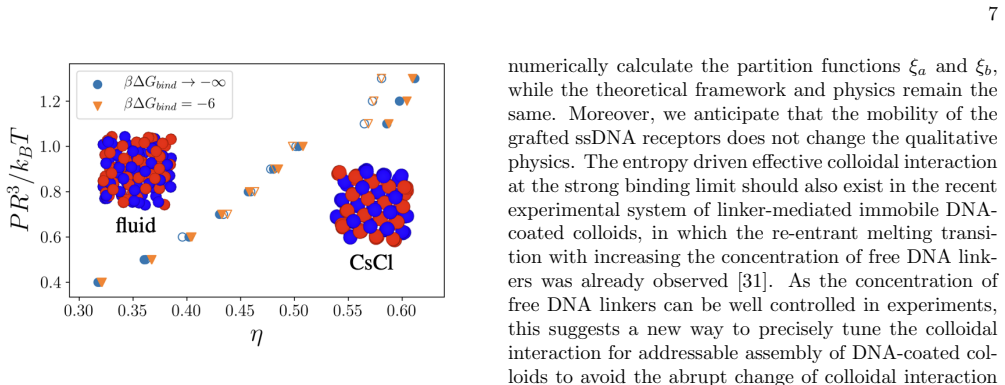
Summary. The paper proposes a linker-mediated variant of mobile DNA-coated colloids (mDNACCs), in which free DNA linkers in solution bridge complementary mobile ssDNA receptors on different colloids. The authors formulate a mean-field/saddle-point theory for the free energy of the bonded linker network, obtaining an effective colloid-colloid interaction, Eq. (7), that includes both the entropy of bound linkers and a depletion term. They validate this expression against explicit-linker Monte Carlo simulations for two colloids at moderate binding strengths (Fig. 1c, Fig. 2). Using the theory, they predict a re-entrant melting transition as a function of linker chemical potential (Fig. 3), and they argue that in the strong-binding limit, βΔG_bind → −∞, the effective interaction does not diverge but instead reaches a finite, entropy-dominated plateau, Eq. (11), tunable by linker concentration (Fig. 4). The theory is then generalized to multicomponent systems, and NPT simulations at βΔG_bind = −6 are used to suggest CsCl crystallization at finite pressure (Fig. 5).
Significance. If correct, the strong-binding plateau is a significant result: it would make specific colloidal interactions in DNA-coated colloid systems temperature-insensitive and tunable by linker concentration, directly addressing the well-known problem of abrupt temperature sensitivity in conventional DNACCs. The paper has clear strengths: the mean-field derivation is self-contained and parameter-free, the effective potential is tested against explicit-linker two-particle simulations at moderate binding, and the multicomponent generalization is a useful extension. The re-entrant melting prediction is also falsifiable and physically well motivated. However, the central strong-binding claim rests on an extrapolation of the mean-field theory into a regime that the paper itself identifies as requiring kinetic considerations, and it is not independently verified by explicit-linker simulations. The significance of the plateau claim therefore remains conditional on resolving that gap.
major comments (2)
- [Model and mean field theory, after Eq. (7); Strong binding limit, Eq. (11)] The paper's own validity criterion excludes the regime of the central claim. Immediately after Eq. (7) the authors state that the mean-field approach is "only meaningful if ΔG_bind is on the scale of a few k_BT" and that otherwise kinetic effects need to be taken into account, with the suggested check t_diffusion ≫ t_on + t_off. No such check is performed anywhere in the manuscript. In the limit ΔG_bind → −∞ used for Eq. (11), the unbinding rate scales as exp(βΔG_bind) → 0, so bond lifetimes can become long compared to colloidal diffusion and the local-equilibrium assumption underlying Eq. (3) and the saddle-point free energy is not guaranteed. Because the abstract and teaser advertise temperature-insensitive interactions, the paper must either provide a kinetic estimate or explicit kinetic simulation showing that the plateau is dynamically accessible, or substantially qualify the claim as an equilibrium prediction that may be kinetically unrealizable.
- [Strong binding limit, Fig. 4; Numerical verification, Fig. 1c and Fig. 2c] The strong-binding plateau is not independently verified. Explicit-linker simulations are reported at moderate binding strengths (Fig. 1c with βΔG_bind = −3; Fig. 2c with βΔG_bind = −4), and I found no explicit-linker test near the strong-binding plateau. In Fig. 4a, the dashed lines from Eq. (11) are compared with the extrapolated solid lines from Eq. (7), so the "converged plateau" is an internal consistency check of the same mean-field theory rather than a test against explicit linkers. The many-particle singlet fraction in Fig. 4b and the NPT equation of state in Fig. 5 use the effective potential of Eqs. (7) and (11), not explicit linkers, and the βΔG_bind = −6 value used in Fig. 5 is outside the stated validity range of the theory. The central claim would be substantially strengthened by explicit-linker simulations at larger |ΔG_bind|, or at least by a controlled demonstration that the saddle-point result remains valid in that limit.
minor comments (4)
- [Model and mean field theory, definition of ξ_b] The definition "ξ_b = ξ_a′ exp[−β(ΔG_bind + F_cnf)]" appears to omit a factor of 2 in front of ΔG_bind; Eq. (10) is consistent with ξ_b ∝ exp(−2βΔG_bind), so the text should be corrected.
- [Generalization to multicomponent systems] In the sentence defining the single-particle and bridge partition functions, the second equality "ξ_a,I = V_a′ exp[−β(ΔG_bind,I + ΔG_bind,J + F_cnf)]" should define ξ_b,IJ, not ξ_a,I.
- [Fig. 1 caption] The caption uses "mNDACCs" where "mDNACCs" is intended; please correct the typo.
- [Fig. 2 caption] The caption states "various βΔG_bind" but does not list the values used in the direct simulations; please include them for reproducibility.
Circularity Check
No significant circularity: the mean-field theory is derived from a partition function, the two-colloid predictions are checked against explicit-linker simulations, and the strong-binding plateau is a mathematical limit rather than a fitted or self-cited result.
full rationale
The paper's derivation chain is self-contained. The effective interaction in Eq. 7 follows from the grand canonical partition function in Eq. 1 via a saddle-point approximation (Eqs. 3–6), with no parameters fitted to the target predictions. The two-colloid effective interaction is validated against direct Monte Carlo simulations with explicit linkers at moderate binding strengths (Fig. 1c and Fig. 2), providing independent grounding for the theory at the conditions where the paper itself states the mean-field approach is reliable. The strong-binding plateau in Eq. 11 is derived as the ΔG_bind → −∞ limit of the same saddle-point equations (Eqs. 9–10), so its agreement with the converged solid curves in Fig. 4a is a check of the asymptotic expansion against the full theory, not an independent empirical test; this is a mathematical consistency check, not circularity. The many-particle simulations in Figs. 3–5 use the same effective potential, but they are applications of the derived potential to collective behavior and tests of whether the pair-potential approximation captures many-body effects, not evidence used to fit or define the potential. Self-citations (e.g., Ref. [21]) are used for contrast and context, not as the load-bearing justification for the central plateau claim; the re-entrant melting comparison to Ref. [31] is to independent experimental work. The paper honestly flags a limitation of the mean-field approach when ΔG_bind is not on the scale of a few k_BT, noting that kinetic effects may need to be considered; this is a validity caveat about the strong-binding extrapolation, but it does not amount to circularity. Overall, the predictions are not equivalent to their inputs by construction, and no circular step can be exhibited.
Assumptions & free parameters
assumptions (5)
- domain assumption Saddle point approximation to the grand canonical partition function of bonded linkers is accurate (Eqs. 3-5).
- domain assumption Grafted ssDNA receptors on a colloid behave as an ideal gas on a 2D surface at area fractions below 5%.
- domain assumption Free DNA linkers in solution are at low concentration so linker-linker interactions except specific hybridization are negligible.
- domain assumption Length scale separation R >> l >> rc and fast equilibration of linkers and receptors compared to colloid motion.
- domain assumption DNA linkers can be modeled as infinitely thin rigid rods, or as semi-flexible polymers with numerically computed partition functions.
Cite this review
Pith. "Pith review of Linker-mediated self-assembly of mobile DNA-coated colloids." pith.science (2026). https://pith.science/paper/BRXQQ2RD
@misc{pith2026190804068,
  author       = {Pith},
  title        = {Pith review of: Linker-mediated self-assembly of mobile DNA-coated colloids},
  year         = {2026},
  howpublished = {\url{https://pith.science/paper/BRXQQ2RD}},
  note         = {Machine review of arXiv:1908.04068}
}
read the original abstract
Developing construction methods of materials tailored for given applications with absolute control over building block placement poses an immense challenge. DNA-coated colloids offer the possibility of realising programmable self-assembly, which, in principle, can assemble almost any structure in equilibrium, but remains challenging experimentally. Here, we propose an innovative system of linker-mediated mobile DNA-coated colloids (mDNACCs), in which mDNACCs are bridged by the free DNA linkers in solution, whose two single-stranded DNA tails can bind with specific single-stranded DNA receptors of complementary sequence coated on colloids. We formulate a mean-field theory efficiently calculating the effective interaction between mDNACCs, where the entropy of DNA linkers plays a nontrivial role. Particularly, when the binding between free DNA linkers in solution and the corresponding receptors on mDNACCs is strong, the linker-mediated colloidal interaction is determined by the linker entropy depending on the linker concentration.
Figures

Figures from the paper (3 more)
Reference graph
Works this paper leans on
-
[1]
Self-Assembly of Struc- tures with Addressable Complexity,
W. M. Jacobs and D. Frenkel, “Self-Assembly of Struc- tures with Addressable Complexity,” J. Am. Chem. Soc. 138, 24572467 (2016)
work page 2016
-
[2]
Or- ganization of ‘nanocrystal molecules using DNA,
A. P. Alivisatos, K. P. Johnsson, X. Peng, T.E. Wilson, C. J. Loweth, M. P. Bruchez Jr, and P. G. Schultz, “Or- ganization of ‘nanocrystal molecules using DNA,” Nature 382, 609 (1996)
work page 1996
-
[3]
A DNA-based method for rationally assem- bling nanoparticles into macroscopic materials,
C. A. Mirkin, R. L. Letsinger, R. C. Mucic, and J. J. Storhoff, “A DNA-based method for rationally assem- bling nanoparticles into macroscopic materials,” Nature 382, 607 (1996)
work page 1996
-
[4]
Antiparal- lel DNA double crossover molecules as components for nanoconstruction,
X. Li, X. Yang, J. Qi, and N. C. Seeman, “Antiparal- lel DNA double crossover molecules as components for nanoconstruction,” J. Am. Chem. Soc. 118, 6131 (1996)
work page 1996
-
[5]
Pro- grammable materials and the nature of the DNA bond,
M. R. Jones, N. C. Seeman, and C. A. Mirkin, “Pro- grammable materials and the nature of the DNA bond,” Science 347, 1260901 (2015)
work page 2015
-
[6]
Threedi- mensional structures self-assembled from DNA bricks,
Y. Ke, L. L. Ong, W. M. Shih, and P. Yin, “Threedi- mensional structures self-assembled from DNA bricks,” Science 338, 1177 (2012)
work page 2012
-
[7]
Programmable self-assembly of three-dimensional nanostructures from 10,000 unique components,
L. L. Ong, N. Hanikel, O. K. Yaghi, C. Grun, M. T. Strauss, P. Bron, J. Lai-Kee-Him, F. Schueder, B. Wang, P. Wang, J. Y. Kishi, C. A. Myhrvold, A. Zhu, R. Jung- mann, G. Bellot, Y. Ke, and P. Yin, “Programmable self-assembly of three-dimensional nanostructures from 10,000 unique components,” Nature 552, 72 (2017)
work page 2017
-
[8]
Ratio- nal design of self-assembly pathways for complex multi- component structures,
W. M. Jacobs, A. Reinhardt, and D. Frenkel, “Ratio- nal design of self-assembly pathways for complex multi- component structures,” Proc. Natl. Acad. Sci. USA 112, 63136318 (2015)
work page 2015
Show all 37 references
-
[9]
Direct observation and ratio- 9 nal design of nucleation behavior in addressable self- assembly,
M. Sajfutdinow, W. M. Jacobs, A. Reinhardt, C. Schnei- der, and D. M. Smith, “Direct observation and ratio- 9 nal design of nucleation behavior in addressable self- assembly,” Proc. Natl Acad. Sci. USA115, E5877 (2018)
2018
-
[10]
Engi- neering DNA-mediated colloidal crystallization,
A. J. Kim, P. L. Biancaniello, and J. C. Crocker, “Engi- neering DNA-mediated colloidal crystallization,” Lang- muir 22, 1991 (2006)
2006
-
[11]
Dna-guided crystallization of colloidal nanopar- ticles,
D. Nykypanchuk, M. M. Maye, D. van der Lelie, and O. Gang, “Dna-guided crystallization of colloidal nanopar- ticles,” Nature 451, 549 (2008)
2008
-
[12]
Nanoparticle superlattice en- gineering with DNA,
R. J. MacFarlane, B. Lee, M. R. Jones, N. Harris, G.C. Schatz, and C. A. Mirkin, “Nanoparticle superlattice en- gineering with DNA,” Science 334, 204 (2011)
2011
-
[13]
Driving diffusionless trans- formations in colloidal crystals using DNA handshaking,
M. T. Casey, R. T. Scarlett, W. B. Rogers, I. Jenkins, T. Sinno, and J. C. Crocker, “Driving diffusionless trans- formations in colloidal crystals using DNA handshaking,” Nat. Commun. 3, 1209 (2012)
2012
-
[14]
Synthetic strate- gies toward DNA-coated colloids that crystallize,
Y. Wang, Y. Wang, X. Zheng, E. Ducrot, M.-G. Lee, G.-R. Yi, M. Weck, and D. J. Pine, “Synthetic strate- gies toward DNA-coated colloids that crystallize,” J. Am. Chem. Soc. 137, 10760 (2015)
2015
-
[15]
Crystallization of DNA-coated colloids,
Y. Wang, Y. Wang, X. Zheng, E. Ducrot, J. S. Yodh, M. Weck, and D. J. Pine, “Crystallization of DNA-coated colloids,” Nat. Commun. 6, 7253 (2015)
2015
-
[16]
Selective transformations between nanoparticle superlattices via the reprogramming of DNA-mediated interactions,
Y. Zhang, S. Pal, B. Srinivasan, T. Vo, S. Kumar, and O. Gang, “Selective transformations between nanoparticle superlattices via the reprogramming of DNA-mediated interactions,” Nat. Mater. 14, 840 (2015)
2015
-
[17]
Colloidal crystals with diamond symmetry at optical lengthscales,
Y. Wang, I. C. Jenkins, J. T. McGinley, T. Sinno, and J. C. Crocker, “Colloidal crystals with diamond symmetry at optical lengthscales,” Nat. Commun. 8, 14173 (2017)
2017
-
[18]
Size limits of self-assembled colloidal structures made using specific interactions,
Z. Zeravcic, V. N. Manoharan, and M. P. Brenner, “Size limits of self-assembled colloidal structures made using specific interactions,” Proc. Natl. Acad. Sci. USA 111, 1591815923 (2014)
2014
-
[19]
Solid Col- loids with Surface-Mobile DNA Linkers,
S. A. J. van der Meulen and M. E Leunissen, “Solid Col- loids with Surface-Mobile DNA Linkers,” J. Am. Chem. Soc. 135, 1512915134 (2013)
2013
-
[20]
Solid colloids with surface-mobile linkers,
S. A. J. van der Meulen, G. Helms, and M. Dogterom, “Solid colloids with surface-mobile linkers,” J. Phys. Con- dens. Matter 27, 23310115 (2015)
2015
-
[21]
Entropy Stabilizes Floppy Crystals of Mobile DNA-Coated Colloids,
H. Hu, P. Sampedro Ruiz, and R. Ni, “Entropy Stabilizes Floppy Crystals of Mobile DNA-Coated Colloids,” Phys. Rev. Lett. 120, 048003 (2018)
2018
-
[22]
Mobile Linkers on DNA-Coated Colloids: Va- lency without Patches,
S. Angioletti-Uberti, P. Varilly, B. M. Mognetti, and D. Frenkel, “Mobile Linkers on DNA-Coated Colloids: Va- lency without Patches,” Phys. Rev. Lett. 113, 128303 5 (2014)
2014
-
[23]
Communication: A simple analytical formula for the free energy of ligandreceptor- mediated interactions,
S. Angioletti-Uberti, P. Varilly, B. M. Mognetti, A. V. Tkachenko, and D. Frenkel, “Communication: A simple analytical formula for the free energy of ligandreceptor- mediated interactions,” J. Chem. Phys. 138, 021102 (2013)
2013
-
[24]
A general theory of DNA-mediated and other valence-limited colloidal interactions,
P. Varilly, S. Angioletti-Uberti, B. M. Mognetti, and D. Frenkel, “A general theory of DNA-mediated and other valence-limited colloidal interactions,” J. Chem. Phys. 137, 09410816 (2012)
2012
-
[25]
An accurate and simple equation of state for hard disks,
A. Santos, M. L´ opez de Haro, and S. Bravo Yuste, “An accurate and simple equation of state for hard disks,” J. Chem. Phys. 103, 4622 (1995)
1995
-
[26]
Interaction between parti- cles suspended in solutions of macromolecules,
S. Asakura and F. Oosawa, “Interaction between parti- cles suspended in solutions of macromolecules,” J. Polym. Sci. 33, 183 (1958)
1958
-
[27]
H. N. W. Lekkerkerker and R. Tuinier, Colloids and the Depletion Interaction (Springer Netherlands, 2011)
2011
-
[28]
Controlling self-assembly kinetics of DNA- functionalized liposomes using toehold exchange mech- anism,
L. Parolini, J.Kotar, L. Di-Michele, and B.M. Mognetti, “Controlling self-assembly kinetics of DNA- functionalized liposomes using toehold exchange mech- anism,” ACS Nano 10, 2392 (2016)
2016
-
[29]
Melting transition in lipid vesicles functionalised by mobile DNA linkers,
S. J. Bachmann, J. Kotar, L. Parolini, A. Saric, P. Cicuta, L. Di Michele, and B. M. Mognetti, “Melting transition in lipid vesicles functionalised by mobile DNA linkers,” Soft Matter 12, 7804 (2016)
2016
-
[30]
Com- munication: Simple approach for calculating the binding free energy of a multivalent particle,
N. B. Tito, S. Angioletti-Uberti, and D. Frenkel, “Com- munication: Simple approach for calculating the binding free energy of a multivalent particle,” J. Chem. Phys. 144, 161101 (2016)
2016
-
[31]
Linker-mediated phase behavior of DNA-coated colloids,
J. Lowensohn, B. Oyarz´ un, G. N. Paliza, B. M. Mognetti, and W. B. Rogers, “Linker-mediated phase behavior of DNA-coated colloids,” Phys. Rev. X 9, 041054 (2019)
2019
-
[32]
Untersuchungen¨ u berdiereibungund adh¨ asion, iv,
B. Derjaguin, “Untersuchungen¨ u berdiereibungund adh¨ asion, iv,” Kolloid-Zeitschrift 69, 155164 (1934)
1934
-
[33]
Re-entrant melting as a design principle for DNA-coated colloids,
S. Angioletti-Uberti, B. M. Mognetti, and D. Frenkel, “Re-entrant melting as a design principle for DNA-coated colloids,” Nat. Mater. 11, 518522 (2012)
2012
-
[34]
Programming col- loidal phase transitions with DNA strand displacement,
W. B. Rogers and V. N. Manoharan, “Programming col- loidal phase transitions with DNA strand displacement,” Science 347, 639642 (2015)
2015
-
[35]
Polygamous parti- cles,
K.-T. Wu, L. Feng, R. Sha, R. Dreyfus, A. Y. Grosberg, N. C. Seeman, and P. M. Chaikin, “Polygamous parti- cles,” Proc. Natl Acad. Sci. USA 109, 18731 (2012)
2012
-
[36]
Anomalous phase behavior of liquidvapor phase transi- tion in binary mixtures of DNA-coated particles,
F. J. Martinez-Veracoechea, B. Bozorgui, and D. Frenkel, “Anomalous phase behavior of liquidvapor phase transi- tion in binary mixtures of DNA-coated particles,” Soft Matter 6, 61366145 (2010)
2010
-
[37]
Designing super selectivity in multivalent nano-particle binding,
F. J. Martinez-Veracoechea and D. Frenkel, “Designing super selectivity in multivalent nano-particle binding,” Proc. Natl Acad. Sci. USA 108, 1096310968 (2011). Acknowledgements: We thank Dr. Bortolo Mognetti, Dr. Qunli Lei, and Prof. Yufeng Wang for helpful discussions. We al...
2011
Reviewed August 14, 2026 · model on record in the stance chip above.
Discussion (0). Continue with ORCID to comment.