REVIEW 3 major objections 5 minor 10 references
Quantum fluctuating geometries and the information paradox II
T0 review · 3 major / 5 minor · reviewed 2026-08-14 · deepseek-v4-flash
Pith's one-line read A collapsing quantum shell radiates non-thermally almost from the start, with thermal Hawking emission ending after about $4M\log(M/(\hbar\omega))$.
desk verdict Genuine extension of their own program finds larger non-thermal corrections, but the paper's quantitative headline outruns the asymptotic approximation where the effect is largest. read the letter →
The pith
A machine-rendered reading of the paper's core claim, the machinery that carries it, and where it could break.
The reading
What carries the argument
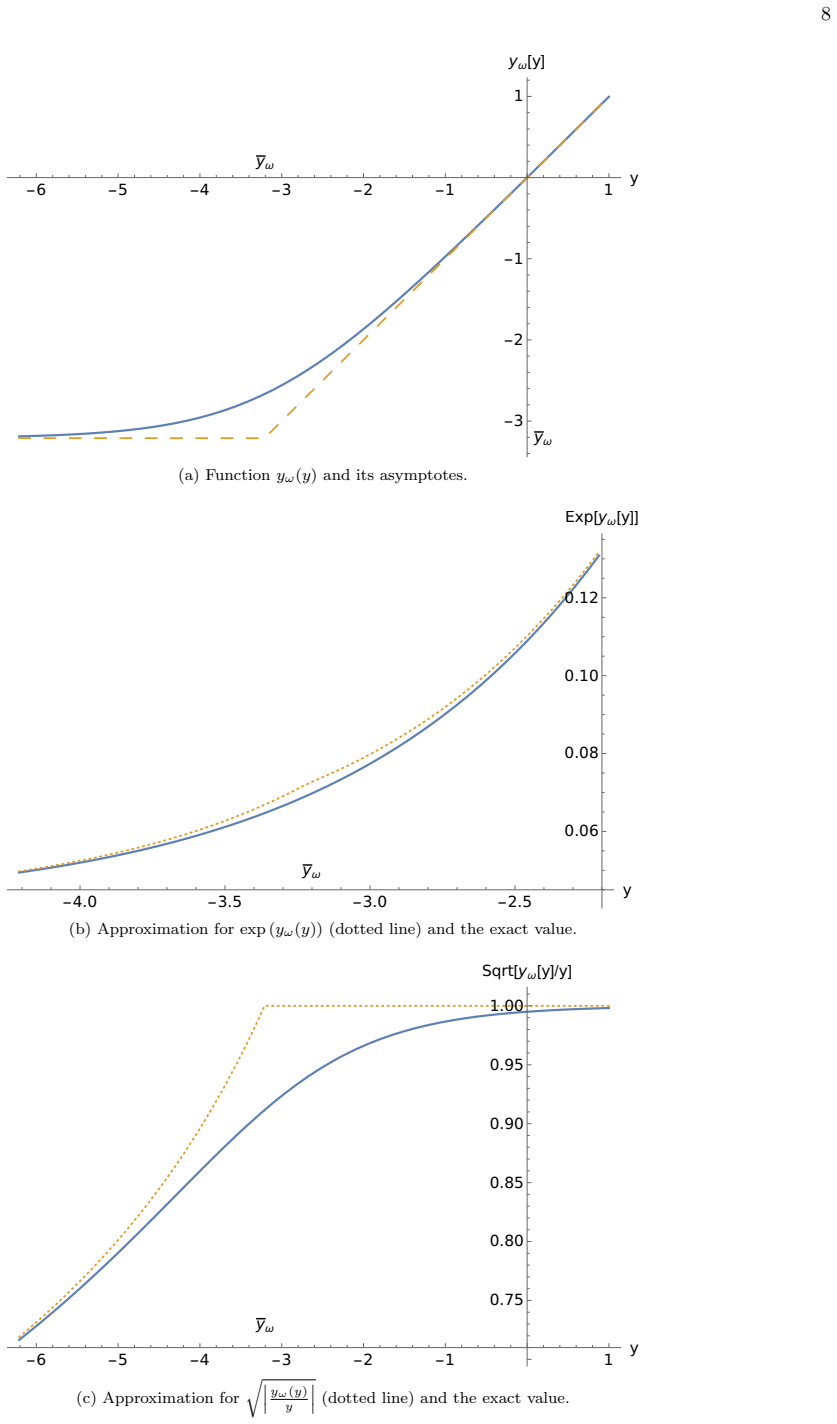
The load-bearing object is the operatorial map from ingoing to outgoing null coordinates, $\hat u(v,\hat v_0,\hat M)=v\hat I-2[\hat M\ln((\hat v_0-v\hat I)/(4M_0))+\ln((\hat v_0-v\hat I)/(4M_0))\hat M]$, built on the commutator $[\hat M,\hat v_0]=i\hbar\hat I$. Its eigenstates, degenerate with multiplicity two, turn the classical Bogoliubov coefficients into operators on the shell's Hilbert space, and their expectation values give an effective c-number coefficient $\beta^{\mathrm{QS}}_{\omega\omega'}(M,\bar\omega)$. The paper evaluates this coefficient through the change of variable $y=\ln((v_0-v)/(4M_0))$, approximating $y_\omega(y)=Ei^{-1}(Ei(y)-\delta_\omega)$ by its asymptotic forms above and below $\bar y_\omega=Ei^{-1}(-\delta_\omega)$; the contribution from $y<\bar y_\omega$, which vanishes in the classical limit, is what produces the non-thermal corrections.
What would settle it
Evaluate the integral (29) for the effective Bogoliubov coefficient numerically without the asymptotic approximations (30)-(33), over the high-frequency region where the paper plots the non-thermal departure; if the excess and the $4M\log(M/(\hbar\omega))$ thermal cutoff disappear once the validity conditions (34)-(35) are violated, then the central claim is an artifact of the approximation. A full wavepacket calculation of the emitted power would supply a definite evaporation time to compare with the naive faster estimate.
Extended reading notes
Core claim
The central claim is that the effective Bogoliubov coefficient $\beta^{\mathrm{QS}}_{\omega\omega'}(M,\bar\omega)$ for a quantum shell departs from the classical-shell coefficient exactly in the region where the function $y_\omega(y)=Ei^{-1}(Ei(y)-\delta_\omega)$ flattens to the constant $\bar y_\omega=Ei^{-1}(-\delta_\omega)$; this region contributes a term that vanishes as $\hbar\to0$ but grows with the ingoing frequency $\omega'$. The paper evaluates the coefficient by splitting the integral at $\bar y_\omega$ and shows that, for wavepackets, thermal radiation is emitted only during a time $\Delta T=4M\log(M/(\hbar\omega_j))$, after which the radiation becomes non-thermal and more intense. The total thermal energy emitted before this cutoff is estimated to be less than 0.1% of the black-hole mass. The paper concludes that a naive estimate of the evaporation time is much shorter than the usual Hawking analysis and that non-thermal radiation may imply there is no information paradox, although a detailed information-retrieval analysis is not given.
Load-bearing premise
The load-bearing premise is that the shell's ADM mass and its asymptotic launch position can be promoted to canonically conjugate operators satisfying $[\hat M,\hat v_0]=i\hbar\hat I$, and that the geometric-optics relation between ingoing and outgoing rays survives as an operator on that Hilbert space; if this is not the correct effective description of a collapsing quantum shell, the non-thermal corrections do not follow.
Editorial extensions
If this is right
- For each frequency $\omega$, thermal Hawking emission lasts about $\Delta T=4M\log(M/(\hbar\omega))$; for a solar-mass black hole this is on the order of milliseconds, far too short to radiate the hole's mass thermally.
- After the thermal phase, a more intense non-thermal radiation takes over, so a naive estimate of the evaporation time is considerably shorter than the classical Hawking prediction.
- The cutoff time diverges as $\hbar\to0$ and the non-thermal contribution vanishes in that limit, so the standard thermal Hawking result is recovered for a classical shell.
- Because the emitted radiation is non-thermal almost from the start, it can carry information about the initial state of the shell, suggesting the information paradox may not arise.
Reading between the lines
- Going beyond the paper, if this mechanism is correct it should also operate for more realistic gravitational collapses, so the endpoint of evaporation may be set by the onset of non-thermal emission rather than by a Planck-mass remnant.
- The frequency-dependent cutoff time is a concrete prediction that a full numerical evaluation of the exact $y_\omega(y)$ integral could test; if the cutoff persists outside the validity conditions (34)-(35), the qualitative conclusion would survive.
- The paper leaves open the question of how information is actually encoded in the non-thermal radiation; a wavepacket-resolved calculation of the full density matrix would show whether the correlations needed to purify the radiation are present.
Signed reviews
Editorial analysis
A structured set of objections, weighed in public.
Referee Report
Summary. This paper is a sequel to the authors' earlier work on Hawking radiation from a collapsing quantum null shell. In the geometric-optics approximation, the shell's ADM mass and launch position are promoted to canonically conjugate operators, and the Bogoliubov coefficients of the emitted scalar field become operators on the shell's Hilbert space. The present paper improves on the previous 'naive limit' by keeping the full ℏ-dependence in the effective c-number Bogoliubov coefficient β_QS (Eq. (10)). The key technical step is a two-branch asymptotic approximation of the function y_ω(y) = Ei^{-1}(Ei(y)-δ_ω) (Eqs. (30)-(33)), with validity conditions (34)-(35). The resulting numerical evaluation of |β_QS|^2 shows a significant departure from the classical Hawking result at large ω', and the paper estimates that thermal emission lasts only ΔT = 4M log(M/ℏω) and that the thermal energy radiated before the departure is less than 0.1% of the black hole mass, implying a much faster evaporation than in the standard Hawking picture.
Significance. The potential significance is high: if the non-thermal corrections are real and as large as claimed, they would alter the standard picture of black hole evaporation and bear directly on the information paradox. The manuscript is strong in its explicit classical limit—Eq. (14) reduces to standard Hawking radiation—and in providing closed-form expressions for the thermal energy bound (Eq. (51)). It also states its approximation validity conditions transparently. However, the quantitative headline ('considerably larger' non-thermality and faster evaporation) is not yet established because the numerical evaluation of the effective Bogoliubov coefficients is partly performed in a regime where the paper's own validity condition (34) fails. The qualitative existence of a non-thermal branch is plausible, but the magnitude and the associated evaporation-time estimate require a reliable evaluation of the exact integral (29).
major comments (3)
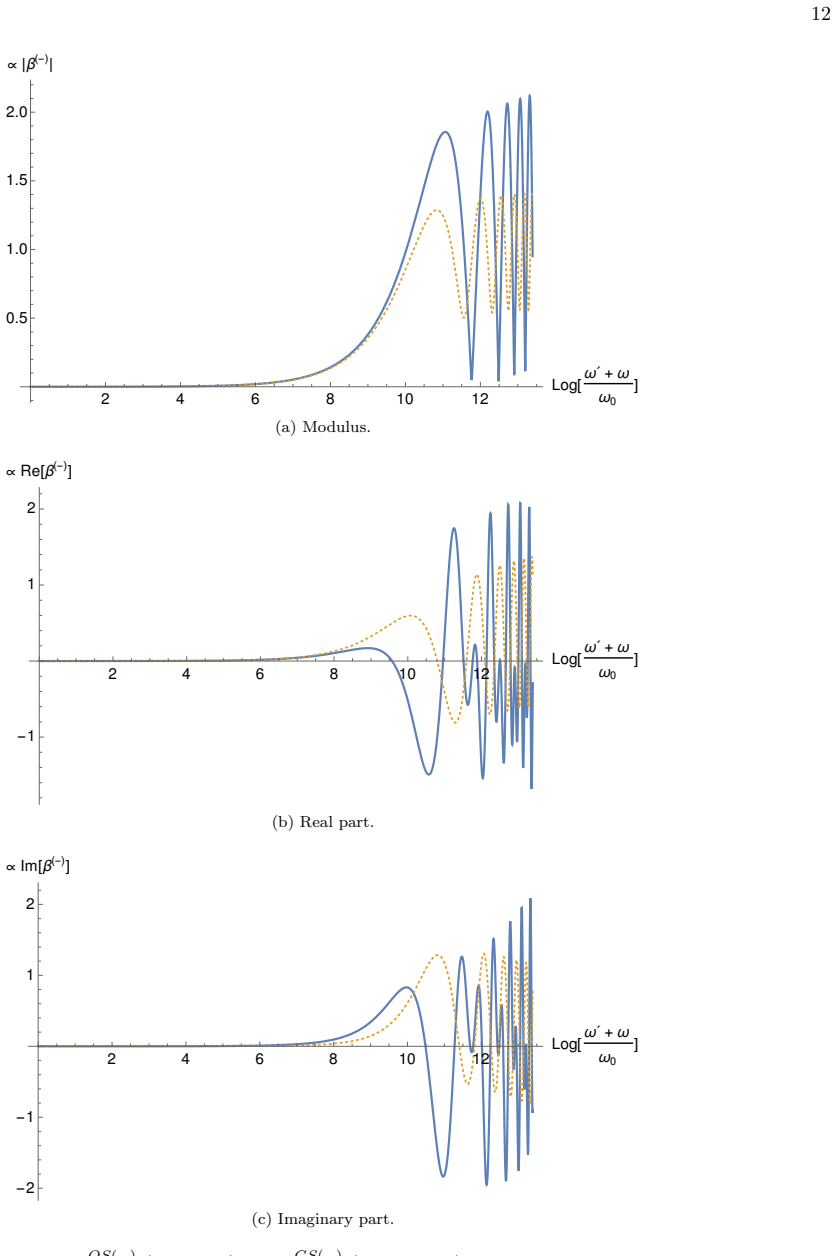
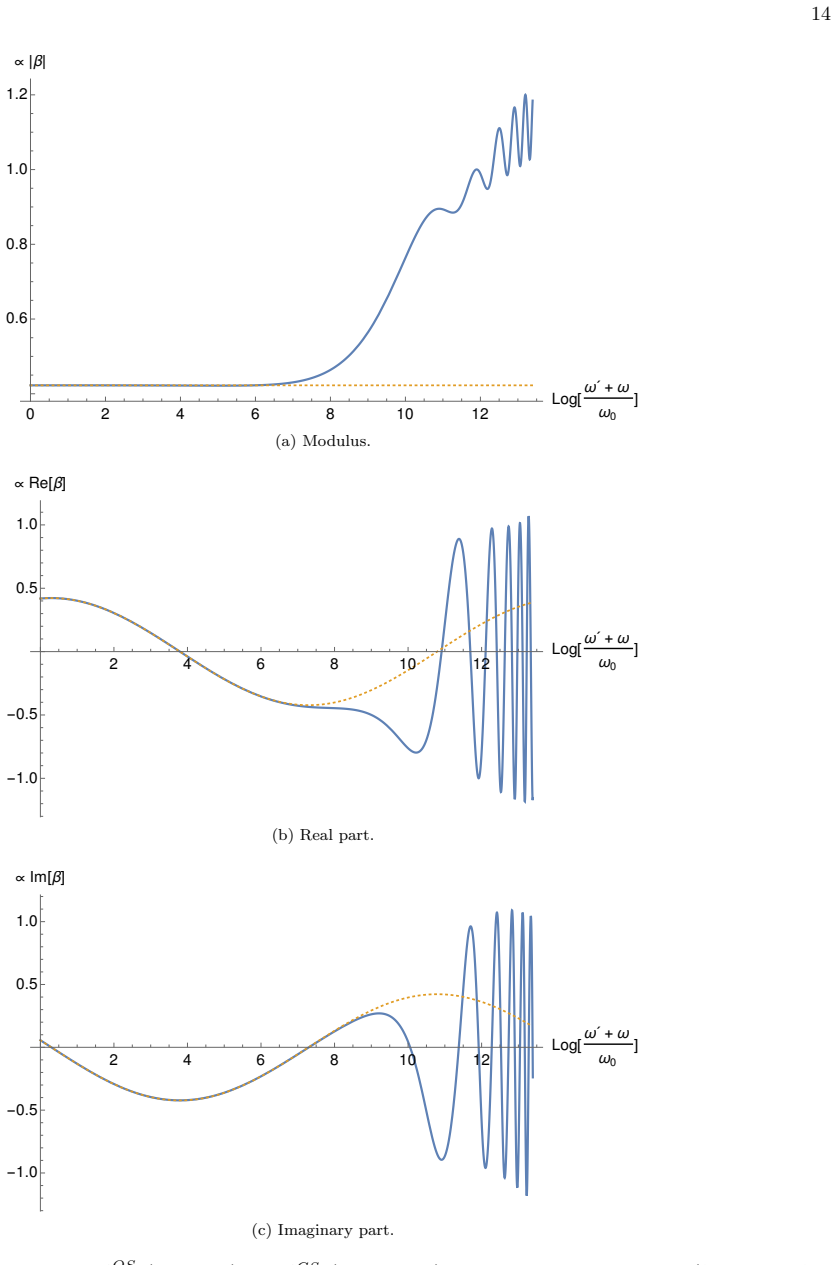
- [III.B.3, Eqs. (30)-(35), Figs. 5-6] The central claim that the amount of non-thermality is considerably larger than previously estimated rests on the numerical evaluation of |β_QS|^2 using the asymptotic forms (30)-(33). The authors themselves state that the oscillatory tail of Fig. (5) is not to be trusted because condition (34) is violated. What is not acknowledged is that a substantial part of the displayed departure at high log((ω'+ω)/ω0) is also outside the strict validity domain; for ω near the peak frequency ω0 and m(ω',ω) of order M, an order-of-magnitude estimate based on the definitions below Eq. (35) gives the left-hand side of (34) of order 4|m| ω |ln|ln(δ_ω)||, which is O(1) rather than <<1 for a solar-mass black hole. Thus the magnitude of |β_QS|^2 in Figs. 3-6, and hence the abstract's quantitative claim, is not established by the analytic approximation alone. I request an evaluation of the exact integral (29) without the asymptotic replacement, with an explicit error budget over the plotted frequency range, or alternatively a restriction of the quantitative claims to the parameter region where (34)-(35) are satisfied.
- [IV, Eqs. (47)-(53)] The thermal-energy bound (less than 0.1% of the mass) and the thermal-emission time ΔT = 4M log(M/ℏω) are derived under the explicit assumption that radiation is thermal for all m(ω',ω) > 0 and stops at m = 0. This assumption is introduced for convenience ('it has the advantage of being frequency independent'), not because the integrand has been shown to match the classical result throughout that region. If the actual |β_QS|^2 departs from |β_CS|^2 before m = 0, the thermal time is shorter and the thermal energy even smaller, so the qualitative conclusion survives, but the numerical values presented as estimates are not derived. The authors should either provide a direct comparison of the integrated number density with the classical Hawking density over the region m > 0, or state clearly that the 0.1% bound and ΔT are conjectures contingent on the assumed location of the departure.
- [II.A, Eq. (3)] All non-thermal corrections follow from promoting the shell's ADM mass and position to conjugate operators, [M-hat, v0-hat] = iℏ, and from promoting the geometric-optics relation u(v) to an operator on that Hilbert space. This is the load-bearing premise of the paper, but it is taken over from Refs. [2,4] without a derivation or a discussion of its domain of validity in the present context. The quantitative predictions also depend on the operator ordering chosen in Eq. (4). The manuscript would be substantially strengthened by a discussion of the expected size of corrections from different quantization choices or from higher-order terms, and by a statement of what physical input selects Eq. (3) over alternatives.
minor comments (5)
- [Introduction] The phrase 'bounds for the total the total thermal energy emitted' in the introduction contains a duplicated phrase and should be corrected.
- [II.C, after Eq. (21)] The sentence defining the wavepacket basis says 'with ε<<ω j', which should read 'ε << ω_j'; note also that the same symbol ε is used for the wavepacket width and for the regulator in Eq. (10), which could confuse the reader.
- [Fig. 2, Sec. III.A] The plots in Fig. 2 use δω = 10^{-2}, which is far larger than the physical δω for stellar-mass black holes; the text notes this is for illustration, but it would be helpful to add a sentence connecting the plot parameters to the regime where condition (34) is actually satisfied.
- [IV, Eq. (45)] The total energy in Eq. (45) is computed with a Planck-frequency cutoff, but no sensitivity analysis of the 0.1% bound to the cutoff is given; since the thermal integrand is exponentially suppressed for large ω, this is likely minor, but it should be stated explicitly.
- [Throughout] The notation oscillates between M0 and \bar M: the text says M0 is set to \bar M in Sec. III, but the figures use M0 = M. The relation between these choices and the mean mass of the shell state should be stated explicitly to avoid ambiguity.
Circularity Check
No significant circularity: the non-thermal corrections follow from an assumed operator algebra and explicit asymptotic approximations, not from fitting or self-referential definitions.
full rationale
The paper's derivation is a self-contained continuation of the authors' prior canonical-quantization framework. The central input, the commutator [M-hat, v0-hat] = i hbar (Eq. 3), is attributed to both the authors' previous work [2] and the external paper by Louko, Whiting and Friedman [4]; it is a physical assumption, not a conclusion that the paper re-imports from itself. The effective Bogoliubov coefficient beta^QS (Eq. 10) is an integral expression derived from the operator formalism, and the classical-shell limit beta^CS (Eq. 14) is obtained by taking hbar -> 0 in the integrand, not by fitting. The central quantitative claims rest on the asymptotic approximations (30)-(33) with stated validity conditions (34)-(35); the paper explicitly flags in Section III.B.3 that the oscillatory high-frequency behavior 'is not to be trusted' because condition (34) is violated there. That is a correctness and error-budget limitation, not a circularity: the approximation is an uncontrolled asymptotic expansion, but it is not equivalent to the result it purports to derive. The choice M0 = Mbar is explicitly conventional and is not a fit to data. No prediction reduces by construction to an input, no fitted parameter is renamed as a prediction, and no load-bearing uniqueness claim is imported solely from the authors' own prior work. The self-flagged violation of the approximation's validity should be addressed by an exact-integral check before the quantitative size of the non-thermal effect is used, but it does not make the derivation circular.
Assumptions & free parameters
free parameters (2)
- M0 (tortoise integration constant) =
M0 = Mbar (mean shell mass)
- Planck frequency cutoff omega_P =
omega_P = M_P / hbar
assumptions (5)
- domain assumption The ADM mass M and position v0 of the shell are a complete set of canonically conjugate Dirac observables, promoted to operators with [M-hat, v0-hat] = i hbar (Eq. 3).
- domain assumption The geometric optics approximation and free scalar field on the collapsing-shell metric are valid for computing Hawking radiation.
- ad hoc to paper Asymptotic approximations (30)-(33) for y_omega(y) = Ei^{-1}(Ei(y) - delta_omega) are valid under conditions (34)-(35).
- domain assumption The shell wavefunction is sharply peaked around Mbar, so integration over M can be ignored in Sec. IV.
- domain assumption Trans-Planckian frequencies contribute no relevant physics and can be cut off at omega_P.
Cite this review
Pith. "Pith review of Quantum fluctuating geometries and the information paradox II." pith.science (2026). https://pith.science/paper/IR2QAW44
@misc{pith2026190804270,
  author       = {Pith},
  title        = {Pith review of: Quantum fluctuating geometries and the information paradox II},
  year         = {2026},
  howpublished = {\url{https://pith.science/paper/IR2QAW44}},
  note         = {Machine review of arXiv:1908.04270}
}
abstract
In a previous paper we discussed corrections to Hawking radiation from a collapsing shell due to quantum fluctuations of the shell and the resulting horizon. For the computation of the quantum corrections we used several approximations. In this paper we take into account effects that were neglected in the previous one. We find important corrections including non-thermal contributions to the radiation at high frequencies and a frequency dependent time scale at which the emission of thermal radiation of frequency $\omega$ cuts off. Such scale tends to infinity in the limit of a classical shell. The fact that one has almost from the outset non-thermal radiation has significant implications for the information paradox. In particular the amount of non-thermality is considerably larger than what we had estimated before. A naive estimate of the evaporation time leads to a much faster evaporation than in the usual Hawking analysis.
Figures


Figures from the paper (3 more)

Reference graph
Works this paper leans on
-
[1]
Mataojo, 11400 Montevideo, Uruguay
Instituto de F´ ısica, Facultad de Ciencias, Igu´ a 4225, esq. Mataojo, 11400 Montevideo, Uruguay
-
[2]
Quantum fluctuating geometries and the information paradox II
Department of Physics and Astronomy, Louisiana State University, Baton Rouge, LA 70803-4001 In a previous paper we discussed corrections to Hawking radiation from a collapsing shell due to quantum fluctuations of the shell and the resulting horizon. For the computation of the quantum corrections we used several approximations. In this paper we take into ac...
work page Pith review arXiv 1976
-
[3]
The integral in (36) can be computed with the change of variable t =y− ¯yω
Study of βQS(+) ωω′ We start by computingβQS(+) ωω′ . The integral in (36) can be computed with the change of variable t =y− ¯yω. Thus, βQS(+) ωω′ (M, ¯ω) = −2M0 exp (−i [ω +ω′] ¯v0) π √ ω′ ω lim ϵ→0 exp ([1 +i4ωm(ω′, ¯ω)] ¯yω) × ∫ +∞ 0 dt exp ( −(ϵ−i4M0 [ω′ +ω])e¯yωet) exp ([1 +i4ωm(ω′, ¯ω)]t), (38) and carrying out the integral in t, βQS(+) ωω′ (M, ¯ω) ...
-
[4]
In this case we do not know how to compute the integral in closed form
Study of βQS(−) ωω′ Let us now concentrate onβQS(−) ωω′ given by (37). In this case we do not know how to compute the integral in closed form. However, unlike βQS(+) ωω′ this contribution is an integral that converges very fast (due to the real exponentials in the integrand). The change of variable t = √ |y| makes it very explicit, βQS(−) ωω′ (M, ¯ω) ∼ −2...
-
[5]
βQS ωω′ vs βCS ωω′ Adding the two contributions previously discussed, we get an expression for the effective Bogoliubov coefficients βQS ωω′ that can be compared with the result (14) for the classical shell. In particular, the modulus ⏐⏐⏐βQS ωω′ ⏐⏐⏐, evaluated numerically, departs from that of the classical shell, ⏐⏐βCS ωω′ ⏐⏐ = √ 4M 2π ω′ ω′ +ω 1 exp(8Mωπ )...
work page 2014
-
[6]
D. G. Boulware, Phys. Rev. D 13, 2169 (1976). doi:10.1103/PhysRevD.13.2169
-
[7]
Quantum fluctuating geometries and the information paradox
R. Eyheralde, M. Campiglia, R. Gambini and J. Pullin, Class. Quant. Grav. 34, no. 23, 235015 (2017) doi:10.1088/1361- 6382/aa8e30 [arXiv:1705.05722 [gr-qc]]
work page Pith review arXiv 2017
-
[8]
S. W. Hawking, Commun. Math. Phys. 43, 199 (1975) Erratum: [Commun. Math. Phys. 46, 206 (1976)]; L. Parker, “Quantum Field Theory in Curved Spacetime: Quantized Fields and Gravity (Cambridge Monographs on Mathemati- cal Physics)”, Cambridge University Press, Cambridge, UK (2009); J. Navarro-Salas, A. Fabbri, “Modeling Black Hole Evaporation”, Imperial Col...
work page 1975
Show all 10 references
-
[9]
Louko, B
J. Louko, B. F. Whiting and J. L. Friedman, Phys. Rev. D 57, 2279 (1998) doi:10.1103/PhysRevD.57.2279 [gr-qc/9708012]
1998 arXiv
-
[10]
Eyheralde, R
R. Eyheralde, R. Gambini and A. Skirzewski, Class. Quant. Grav. 36, 065007 (2019) doi:10.1088/1361-6382/ab0240 [arXiv:1806.07796 [gr-qc]]
2019 arXiv
Reviewed August 14, 2026 · model on record in the stance chip above.
Discussion (0). Continue with ORCID to comment.