REVIEW 3 major objections 5 minor 36 references
Sharp Guarantees for Solving Random Equations with One-Bit Information
T0 review · 3 major / 5 minor · reviewed 2026-08-14 · deepseek-v4-flash
Pith's one-line read Under Gaussian one-bit measurements, every convex-loss estimator's asymptotic correlation is exactly $\sqrt{1/(1+(\alpha/\mu)^2)}$, where $(\mu,\alpha,\lambda)$ solve the three equations (9); the paper also proves a universal upper bound…
desk verdict General convex losses in one-bit recovery: the paper extends the CGMT sharp-analysis program beyond least squares, and the new predictions are probably right, but the main theorem is not fully proved in this manuscript because a key convergence step is deferred. read the letter →
The pith
A machine-rendered reading of the paper's core claim, the machinery that carries it, and where it could break.
The reading
What carries the argument
The load-bearing object is the Moreau envelope of the loss, $M_\ell(x;\lambda)=\min_v \frac1{2\lambda}(x-v)^2+\ell(v)$, which acts as a smoothed surrogate that encodes both the loss and the proximal scale $\lambda$. The proof reduces the original high-dimensional program to a scalar min-max problem by a convex Gaussian min-max comparison argument; the random optimizers of that auxiliary problem are then asserted to converge to the deterministic optimizers of (40). Taking first-order conditions in that limiting problem produces exactly the system (9), whose unknowns $\mu,\alpha,\lambda$ are the limiting signal bias, fluctuation norm, and proximal scale of the estimator. The Moreau envelope is what makes the reduction work: the inner minimization over coordinates in the auxiliary problem evaluates in closed form as a Moreau envelope, and its derivatives supply the expectation identities in (9).
What would settle it
Pick a loss in the paper's class, say logistic loss, fix $\varepsilon=0.1$ and $\delta=4$, solve (9) numerically to get the predicted correlation, then simulate the estimator at $n=1024$ over many trials; a systematic mismatch between the simulated average correlation and the prediction would refute the formula. The same test can be sharpened by computing the minimizers of the auxiliary problem (39) and checking whether they converge to the solution of (40), the exact deferred step the proof relies on.
Extended reading notes
Core claim
On the paper's own terms, the central discovery is that the asymptotic behavior of $\hat x_\ell=\arg\min_x \frac1m\sum_{i=1}^m \ell(y_i a_i^T x)$ is governed exactly by the scalar system (9): under Gaussian measurements and $m/n\to\delta>1$, the absolute correlation converges almost surely to $\sqrt{1/(1+(\alpha/\mu)^2)}$, and $\|\hat x_\ell-\mu x_0/\|x_0\|_2\|_2^2\to\alpha^2$, where $(\mu,\alpha,\lambda)$ is the unique solution of (9). The loss enters the equations only through the Moreau envelope $M_\ell(x;\lambda)=\min_v \frac1{2\lambda}(x-v)^2+\ell(v)$ and its derivatives. A consequence of the same analysis is the universal bound $\sigma_\ell^2 I(\sigma_\ell G+SY)\ge 1/\delta$ on the ratio $\sigma_\ell=\alpha/\mu$, with $G,S$ standard normal and $Y$ the corrupted sign of $S$; inverting it gives a numerical upper bound on correlation that holds for every continuously differentiable convex loss.
Load-bearing premise
The load-bearing step is the deferred claim that the data-dependent minimizers of the simplified auxiliary problem converge to the deterministic solution of the limiting problem; if that convergence fails, the correlation formula does not follow even when the rest of the setup holds.
Editorial extensions
If this is right
- For any convex loss satisfying the theorem's conditions, the limiting correlation is now a computable function of $\delta$ and $\varepsilon$, so LS, LAD, hinge, and logistic estimators can be compared exactly without simulation.
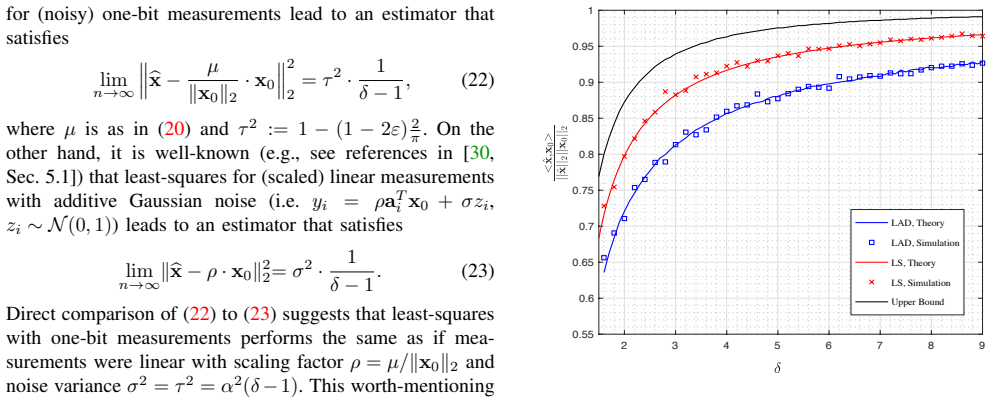
- For least squares the system closes in closed form: $\mu=(1-2\varepsilon)\sqrt{2/\pi}$ and $\alpha^2=(1-(1-2\varepsilon)^2 2/\pi)/(\delta-1)$, recovering the interpretation of one-bit least squares as a noisy linear inverse problem.
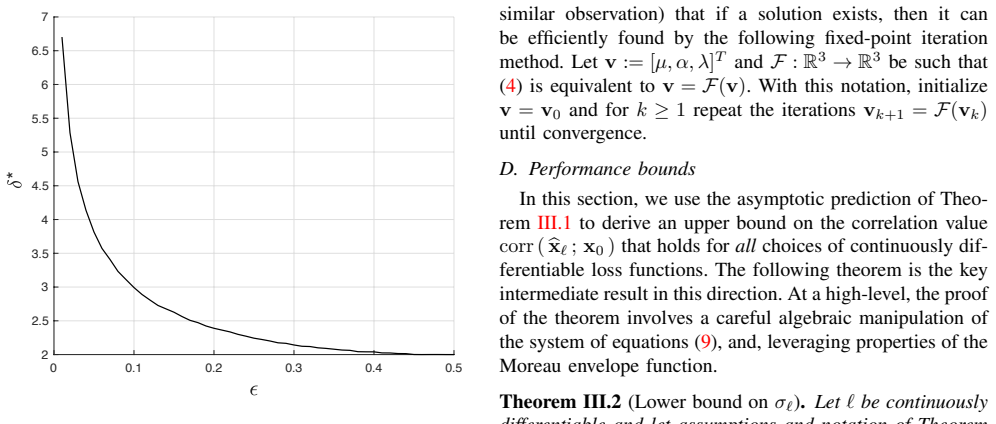
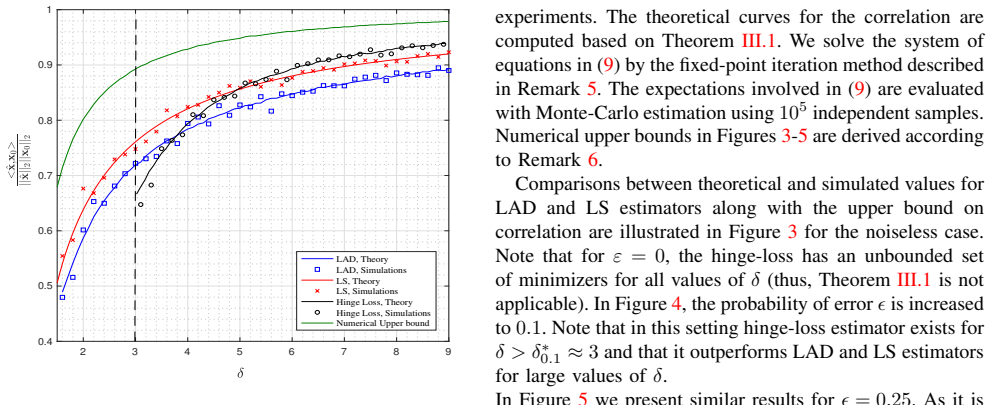
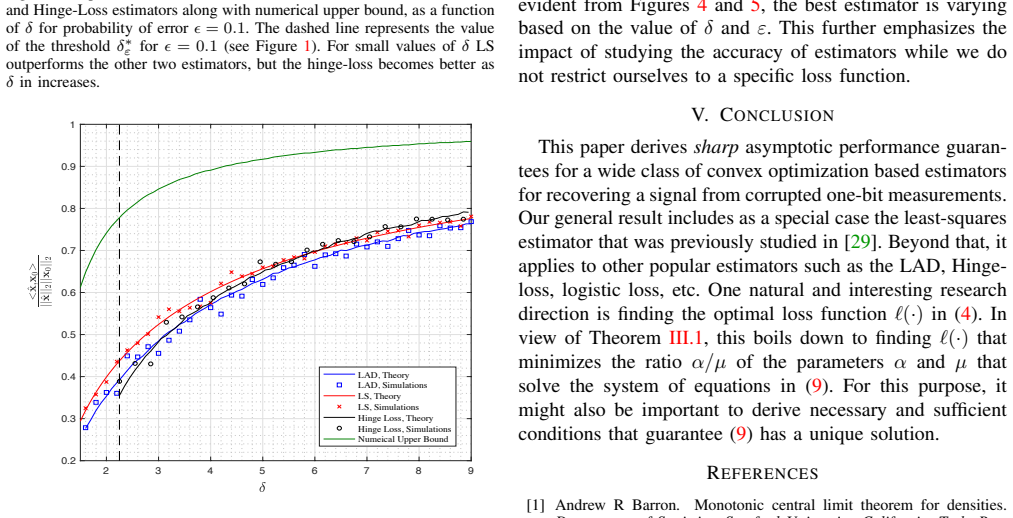
- For hinge and logistic losses, recovery is only well-posed above a threshold $\delta^*_\varepsilon$ that runs from $+\infty$ at $\varepsilon=0$ down to $2$ at $\varepsilon=1/2$; simulations show hinge can outperform LS and LAD at larger $\delta$.
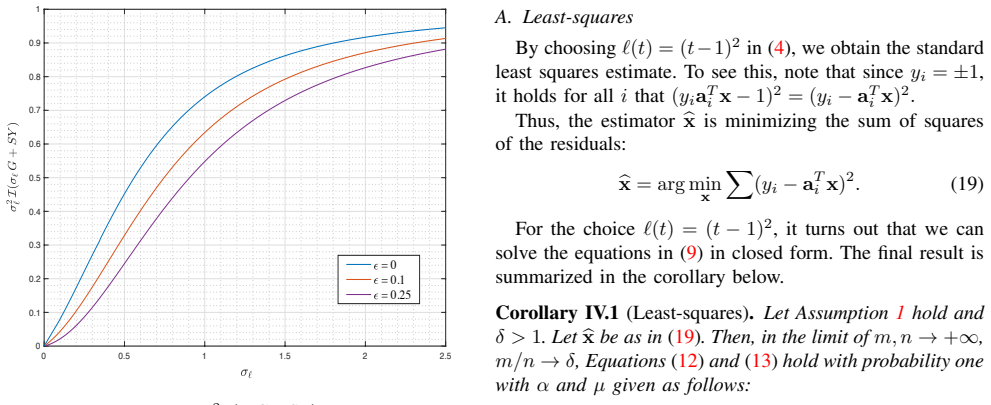
- The universal bound of Theorem III.2 means no continuously differentiable convex loss can exceed the correlation upper bound derived from $\sigma_\ell^2 I(\sigma_\ell G+SY)\ge 1/\delta$.
Reading between the lines
- If correct, the paper reduces the optimal-loss design problem to a scalar program: choose the convex loss whose Moreau envelope minimizes $\alpha/\mu$ in (9). The authors flag this as open; pursuing it could turn the universal bound into an achievability result.
- The universal bound is proved from a Fisher-information inequality, suggesting the optimal estimator may be one that saturates an information-theoretic limit for the binary channel; a natural test is whether a piecewise-linear loss designed from the channel statistics attains the bound.
- The paper's LS result shows one-bit measurements behave like linear measurements with a known scaling and noise variance; if the same equivalence holds for other losses, one could extend these correlation predictions to full distributional statements about the estimator error.
Signed reviews
Editorial analysis
A structured set of objections, weighed in public.
Referee Report
Summary. The paper studies high-dimensional estimation of a signal from one-bit Gaussian measurements with bit flips. For estimators obtained by minimizing a general convex loss function over linear predictors, it claims an exact asymptotic characterization of the correlation with the true signal in the limit m,n -> infinity with m/n -> delta > 1. The characterization is given by a system of three scalar equations (Eq. (9)) involving the Moreau envelope of the loss. The authors specialize the general result to least squares, least absolute deviations, and hinge loss, provide a closed-form result for least squares that matches the earlier result of Thrampoulidis et al. [29], and derive a universal upper bound on correlation over all continuously differentiable convex losses. Numerical simulations for n=128 are presented as corroboration.
Significance. If the main theorem is fully established, the paper would be a valuable contribution: it extends sharp CGMT-based predictions from least-squares nonlinear measurements to general convex losses and gives a principled way to compare estimators such as LAD and hinge loss, where only order-wise guarantees existed. The explicit closed-form least-squares result and the universal lower bound on sigma are concrete, testable achievements. The paper is honest about several deferred technical steps, but the central claim currently rests on one convergence assertion whose proof is not supplied, and the threshold condition for bounded minimizers contains contradictory statements. The overall framework is sound and the result is likely correct, but the manuscript as written does not yet meet the standard for a full journal proof.
major comments (3)
- [Appendix B-C, Eqs. (39)-(40)] The proof of Theorem III.1 hinges on the assertion that the random optimizers alpha_n and mu_n of the auxiliary problem (39) converge to the deterministic optimizers alpha and mu of the limiting problem (40). The text states "Based on that, it can be shown" and defers details to the long version, while Appendix B explicitly lists "uniform convergence in going from (39) to (40)" among omitted technical details. This is a load-bearing step: pointwise convergence in probability of the objective functions does not imply convergence of their argmins without uniform/equicontinuity estimates and compactness control. The stated assumptions of Theorem III.1 (bounded set of minimizers of (4), unique solution of (9)) do not, on their own, provide those estimates, and the step must hold for non-smooth losses such as LAD and hinge loss. The gap must be closed by a proof or the theorem must be restated with this convergence as an explicit hypothesis.
- [Remark 2 / Remark 3, Eq. (15)] The threshold condition for boundedness of the minimizer set is stated inconsistently. Remark 2 says the minimizer set is "unbounded if delta > delta_epsilon", while Remark 3 concludes that for logistic and hinge loss the set is bounded iff delta > delta_epsilon, i.e. unbounded for delta < delta_epsilon. The quotation of [7] around Eq. (15) also has a sign issue: the condition "1/delta <= delta_epsilon" is not equivalent to the stated conclusion "delta < delta_epsilon". Since boundedness of the minimizer set is an explicit hypothesis of Theorem III.1, the correct threshold and its direction must be stated precisely and, if necessary, proved for the present signed-measurement model rather than transferred from the logistic model in [7]. As written, the applicability of Theorem III.1 to hinge and logistic losses is not established.
- [Theorem III.1 and Remark 2] The theorem assumes that the system of equations (9) has a unique solution, but for hinge and logistic losses solvability is left as a conjecture. Consequently, the abstract and introduction claim that the results include hinge-loss and logistic-loss as special cases is stronger than what is proved: for these losses neither the bounded-minimizer condition nor the solvability of (9) is verified. The numerical simulations are suggestive but do not replace a proof. Please either prove the needed conditions for these losses or clearly restate the claims as conditional on them.
minor comments (5)
- [Remark 5] In Remark 5, the text refers to "the system of non-linear equations in (4)" and "(4) is equivalent to v = F(v)"; these should refer to system (9), not to the optimization problem (4).
- [Section IV-C] The sentence "We obtain the hinge-loss estimator in by setting" is missing a word; it should read "in this section" or "in (4)".
- [Remark 7] "In other works" should be "In other words".
- [Figure 5 caption] The caption contains the typo "Numeical" instead of "Numerical".
- [Theorem III.2 proof] "Cauchy-Schwartz" should be "Cauchy-Schwarz".
Circularity Check
No significant circularity: the asymptotic correlation formula is derived from a fixed-point system via CGMT and validated against an independent LS special case and simulations.
full rationale
The paper's central claim, Theorem III.1, is not obtained by fitting or by renaming inputs. The correlation limit (12) is expressed through alpha/mu, where (mu,alpha,lambda) solve the population equations (9), which are first-order conditions of the deterministic auxiliary problem (40) derived from the CGMT reduction. The CGMT is invoked as an external theorem ([30, Thm 6.1], [31]), not as a restatement of the target result. The LS corollary is shown to reduce to the least-squares problem (19) and to match the independent result of [29]; this is an external check, not a load-bearing premise. The only weakness the paper itself discloses is that the passage from the random scalar problem (39) to the deterministic problem (40) is asserted ('it can be shown') with details deferred; that is an omitted technical proof, not a circular step. No parameter is fitted to the simulated correlations, and no equation is defined in terms of the quantity being predicted. Self-citations to [29], [30], and [31] concern prior methodology or the LS special case and do not assume the general result. Hence no circularity is present.
Assumptions & free parameters
assumptions (5)
- domain assumption Measurement vectors have IID standard normal entries (Assumption 1).
- standard math The Convex Gaussian Min-Max Theorem of [30, Theorem 6.1] applies to the primary-auxiliary pair (35)-(36).
- domain assumption Theorem III.1 assumes the set of minimizers of (4) is bounded and Equations (9) have a unique solution (mu,alpha,lambda) with mu != 0.
- ad hoc to paper Random optimizers of (39) converge to deterministic optimizers of (40) as m,n go to infinity.
- domain assumption The feasibility threshold from [7] carries over to the one-bit model.
Cite this review
Pith. "Pith review of Sharp Guarantees for Solving Random Equations with One-Bit Information." pith.science (2026). https://pith.science/paper/MRTV32D6
@misc{pith2026190804433,
  author       = {Pith},
  title        = {Pith review of: Sharp Guarantees for Solving Random Equations with One-Bit Information},
  year         = {2026},
  howpublished = {\url{https://pith.science/paper/MRTV32D6}},
  note         = {Machine review of arXiv:1908.04433}
}
read the original abstract
We study the performance of a wide class of convex optimization-based estimators for recovering a signal from corrupted one-bit measurements in high-dimensions. Our general result predicts sharply the performance of such estimators in the linear asymptotic regime when the measurement vectors have entries IID Gaussian. This includes, as a special case, the previously studied least-squares estimator and various novel results for other popular estimators such as least-absolute deviations, hinge-loss and logistic-loss. Importantly, we exploit the fact that our analysis holds for generic convex loss functions to prove a bound on the best achievable performance across the entire class of estimators. Numerical simulations corroborate our theoretical findings and suggest they are accurate even for relatively small problem dimensions.
Figures
Figures from the paper (2 more)
Reference graph
Works this paper leans on
-
[29]
Lasso with non-linear measurements is equivalent to one with linear mea- surements
Christos Thrampoulidis, Ehsan Abbasi, and Babak Hassibi. Lasso with non-linear measurements is equivalent to one with linear mea- surements. In Advances in Neural Information Processing Systems , pages 3420–3428, 2015
work page 2015
-
[7]
Emmanuel J Cand `es and Pragya Sur. The phase transition for the existence of the maximum likelihood estimate in high-dimensional logistic regression. arXiv preprint arXiv:1804.09753 , 2018
arXiv 2018
-
[1]
Monotonic central limit theorem for densities
Andrew R Barron. Monotonic central limit theorem for densities. Department of Statistics, Stanford University, California, Tech. Rep , 50, 1984
work page 1984
-
[2]
The dynamics of message passing on dense graphs, with applications to compressed sensing
Mohsen Bayati and Andrea Montanari. The dynamics of message passing on dense graphs, with applications to compressed sensing. Information Theory, IEEE Transactions on , 57(2):764–785, 2011
work page 2011
-
[3]
The lasso risk for gaussian matrices
Mohsen Bayati and Andrea Montanari. The lasso risk for gaussian matrices. Information Theory, IEEE Transactions on , 58(4):1997– 2017, 2012
work page 1997
-
[4]
Log-Quadratic Bounds for the Gaussian Q-function
Andrew Mastin and Patrick Jailleth. Log-Quadratic Bounds for the Gaussian Q-function. arXiv preprint arXiv:1304.2488 , 2013
work page Pith review arXiv 2013
-
[5]
Petros T Boufounos and Richard G Baraniuk. 1-bit compressive sensing. In 2008 42nd Annual Conference on Information Sciences and Systems (CISS) , pages 16–21. IEEE, 2008
work page 2008
-
[6]
A generalized linear model with” gaussian” regressor variables
David R Brillinger. A generalized linear model with” gaussian” regressor variables. A Festschrift For Erich L. Lehmann , page 97, 1982
work page 1982
Show all 36 references
-
[8]
The convex geometry of linear inverse problems.Foundations of Computational Mathematics , 12(6):805–849, 2012
Venkat Chandrasekaran, Benjamin Recht, Pablo A Parrilo, and Alan S Willsky. The convex geometry of linear inverse problems.Foundations of Computational Mathematics , 12(6):805–849, 2012
2012
-
[9]
Phase retrieval via polytope optimization: Geometry, phase transitions, and new algorithms
Oussama Dhifallah, Christos Thrampoulidis, and Yue M Lu. Phase retrieval via polytope optimization: Geometry, phase transitions, and new algorithms. arXiv preprint arXiv:1805.09555 , 2018
2018 arXiv
-
[10]
High dimensional robust m- estimation: Asymptotic variance via approximate message passing
David Donoho and Andrea Montanari. High dimensional robust m- estimation: Asymptotic variance via approximate message passing. Probability Theory and Related Fields , 166(3-4):935–969, 2016
2016
-
[11]
Message- passing algorithms for compressed sensing
David L Donoho, Arian Maleki, and Andrea Montanari. Message- passing algorithms for compressed sensing. Proceedings of the National Academy of Sciences , 106(45):18914–18919, 2009
2009
-
[12]
The noise- sensitivity phase transition in compressed sensing
David L Donoho, Arian Maleki, and Andrea Montanari. The noise- sensitivity phase transition in compressed sensing. Information Theory, IEEE Transactions on , 57(10):6920–6941, 2011
2011
-
[13]
On the impact of predictor geometry on the performance on high-dimensional ridge-regularized generalized robust regression estimators
Noureddine El Karoui. On the impact of predictor geometry on the performance on high-dimensional ridge-regularized generalized robust regression estimators. 2015
2015
-
[14]
High-dimensional estimation of structured signals from non-linear observations with general convex loss functions
Martin Genzel. High-dimensional estimation of structured signals from non-linear observations with general convex loss functions. IEEE Transactions on Information Theory , 63(3):1601–1619, 2017
2017
-
[15]
Recovering structured data from super- imposed non-linear measurements
Martin Genzel and Peter Jung. Recovering structured data from super- imposed non-linear measurements. arXiv preprint arXiv:1708.07451 , 2017
2017 arXiv
-
[16]
Structured signal recovery from non-linear and heavy-tailed measurements
Larry Goldstein, Stanislav Minsker, and Xiaohan Wei. Structured signal recovery from non-linear and heavy-tailed measurements. IEEE Transactions on Information Theory , 64(8):5513–5530, 2018
2018
-
[17]
On Milman’s inequality and random subspaces which escape through a mesh in Rn
Yehoram Gordon. On Milman’s inequality and random subspaces which escape through a mesh in Rn. Springer, 1988
1988
-
[18]
Robust 1-bit compressive sensing via binary stable embed- dings of sparse vectors
Laurent Jacques, Jason N Laska, Petros T Boufounos, and Richard G Baraniuk. Robust 1-bit compressive sensing via binary stable embed- dings of sparse vectors. IEEE Transactions on Information Theory , 59(4):2082–2102, 2013
2013
-
[19]
Asymptotic behavior of unregularized and ridge-regularized high-dimensional robust regression estimators: rig- orous results
Noureddine El Karoui. Asymptotic behavior of unregularized and ridge-regularized high-dimensional robust regression estimators: rig- orous results. arXiv preprint arXiv:1311.2445 , 2013
2013 arXiv
-
[20]
The squared-error of generalized lasso: A precise analysis
Samet Oymak, Christos Thrampoulidis, and Babak Hassibi. The squared-error of generalized lasso: A precise analysis. arXiv preprint arXiv:1311.0830, 2013
2013 arXiv
-
[21]
Robust 1-bit compressed sensing and sparse logistic regression: A convex programming approach
Yaniv Plan and Roman Vershynin. Robust 1-bit compressed sensing and sparse logistic regression: A convex programming approach. IEEE Transactions on Information Theory , 59(1):482–494, 2012
2012
-
[22]
One-bit compressed sensing by linear programming
Yaniv Plan and Roman Vershynin. One-bit compressed sensing by linear programming. Communications on Pure and Applied Mathe- matics, 66(8):1275–1297, 2013
2013
-
[23]
The generalized lasso with non-linear observations
Yaniv Plan and Roman Vershynin. The generalized lasso with non-linear observations. IEEE Transactions on information theory , 62(3):1528–1537, 2016
2016
-
[24]
Variational analysis , volume 317
R Tyrrell Rockafellar and Roger J-B Wets. Variational analysis , volume 317. Springer Science & Business Media, 2009
2009
-
[25]
The impact of regularization on high-dimensional logistic regression
Fariborz Salehi, Ehsan Abbasi, and Babak Hassibi. The impact of regularization on high-dimensional logistic regression. arXiv preprint arXiv:1906.03761, 2019
1906 arXiv
-
[26]
Various thresholds for 𝓁1-optimization in compressed sensing
Mihailo Stojnic. Various thresholds for 𝓁1-optimization in compressed sensing. arXiv preprint arXiv:0907.3666 , 2009
2009 arXiv
-
[27]
A framework to characterize performance of lasso algorithms
Mihailo Stojnic. A framework to characterize performance of lasso algorithms. arXiv preprint arXiv:1303.7291 , 2013
2013 arXiv
-
[28]
A modern maximum-likelihood theory for high-dimensional logistic regression
Pragya Sur and Emmanuel J Cand `es. A modern maximum-likelihood theory for high-dimensional logistic regression. Proceedings of the National Academy of Sciences , page 201810420, 2019
2019
-
[30]
Precise error analysis of regularized m-estimators in high dimensions
Christos Thrampoulidis, Ehsan Abbasi, and Babak Hassibi. Precise error analysis of regularized m-estimators in high dimensions. IEEE Transactions on Information Theory , 64(8):5592–5628, 2018
2018
-
[31]
Regu- larized linear regression: A precise analysis of the estimation error
Christos Thrampoulidis, Samet Oymak, and Babak Hassibi. Regu- larized linear regression: A precise analysis of the estimation error. In Proceedings of The 28th Conference on Learning Theory , pages 1683–1709, 2015
2015
-
[32]
The generalized lasso for sub-gaussian measurements with dithered quantization
Christos Thrampoulidis and Ankit Singh Rawat. The generalized lasso for sub-gaussian measurements with dithered quantization. arXiv preprint arXiv:1807.06976, 2018
2018 arXiv
-
[33]
High-Dimensional Estimation of Structured Signals from Non-Linear Observations with General Convex Loss Functions
Martin Genzel. High-Dimensional Estimation of Structured Signals from Non-Linear Observations with General Convex Loss Functions. arXiv preprint arXiv:1602.03436 , 2016
2016 arXiv
-
[34]
Optimal M-estimation in high-dimensional regression
Derek Bean, Peter Bickel, Noureddine El Karoui and Bin Yu. Optimal M-estimation in high-dimensional regression. In Proceedings of the National Academy of Sciences ,110(36):14563–14568, 2013. APPENDIX In this section we provide a proof sketch of Theorem III.1. The main technica...
2013
-
[35]
Gordon’s Min-Max Theorem (GMT): The Gordon’s Gaussian comparison inequality [17] compares the min-max value of two doubly indexed Gaussian processes based on how their autocorrelation functions compare. The inequality is quite general (see [17]), but for our purposes we only n...
-
[36]
Convex Gaussian Min-Max Theorem (CGMT): The proof of Theorem III.1 builds on the CGMT [31]. For ease of reference we summarize here the essential ideas of the framework following the presentation in [30]; please see [30, Section 6] for the formal statement of the theorem and f...
Reviewed August 14, 2026 · model on record in the stance chip above.
Discussion (0). Continue with ORCID to comment.