REVIEW 3 major objections 6 minor 1 cited by
Quantum adiabatic machine learning with zooming
T0 review · 3 major / 6 minor · reviewed 2026-08-14 · deepseek-v4-flash
Pith's one-line read QAML-Z, a zooming variant of quantum-annealing machine learning, matches optimized classical deep neural networks on small Higgs training sets and almost halves the large-set AUROC gap to the DNN.
desk verdict QAML-Z is a genuine algorithmic extension with reproducible benchmarks, but the augmented Hamiltonian omits cross-offset couplings and the quantum advantage disappears against SAE-Z. read the letter →
The pith
A machine-rendered reading of the paper's core claim, the machinery that carries it, and where it could break.
The reading
What carries the argument
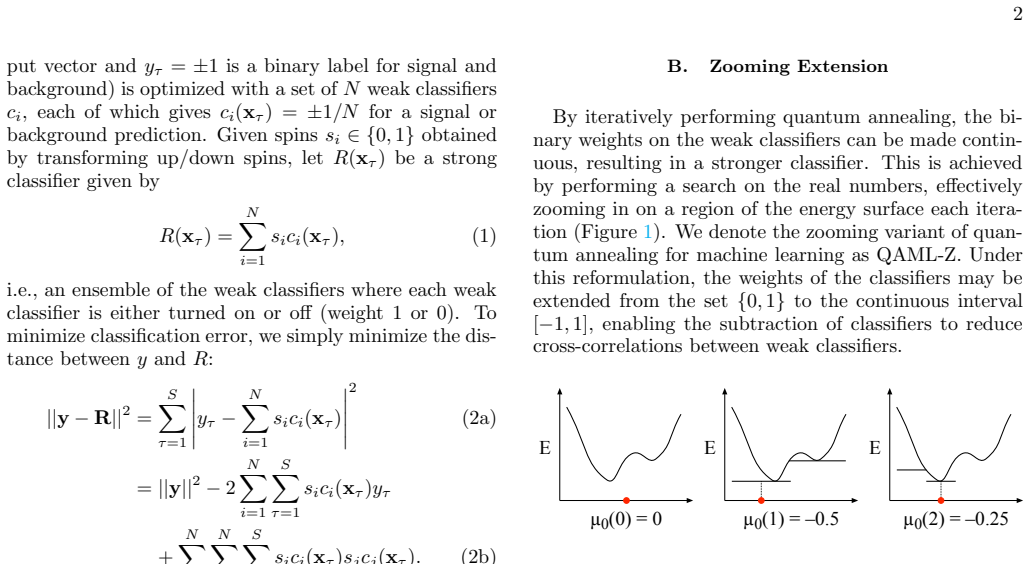
The load-bearing mechanism is the zooming Hamiltonian. Starting from the QAML objective, each weak classifier's contribution is shifted and scaled by the current weight $\mu_i(t)$ and the search breadth $\sigma(t)$, giving $H(t)=\sum_i(-C_i+\sum_j\mu_j(t)C_{ij})\sigma(t)s_i+\sum_{i<j}C_{ij}\sigma^2(t)s_i s_j$, up to constants. This turns one discrete optimization into a sequence of binary searches over the real-valued weight vector, with spin-up/spin-down outcomes moving each weight by an exponentially decaying step. The threshold-augmented classifier set provides the extra weak classifiers that make the continuous ensemble expressive.
What would settle it
Run QAML-Z on the exact, unpruned Ising model for the same Higgs data (in simulation, with all cross-terms and hundreds of logical qubits) and compare AUROC against the 5%-pruned version used on the annealer. If the full-model AUROC no longer matches the deep network at small training-set sizes, or no longer cuts the large-size gap by roughly half, then the claimed improvement is an artifact of the pruning rather than of the zooming algorithm.
Extended reading notes
Core claim
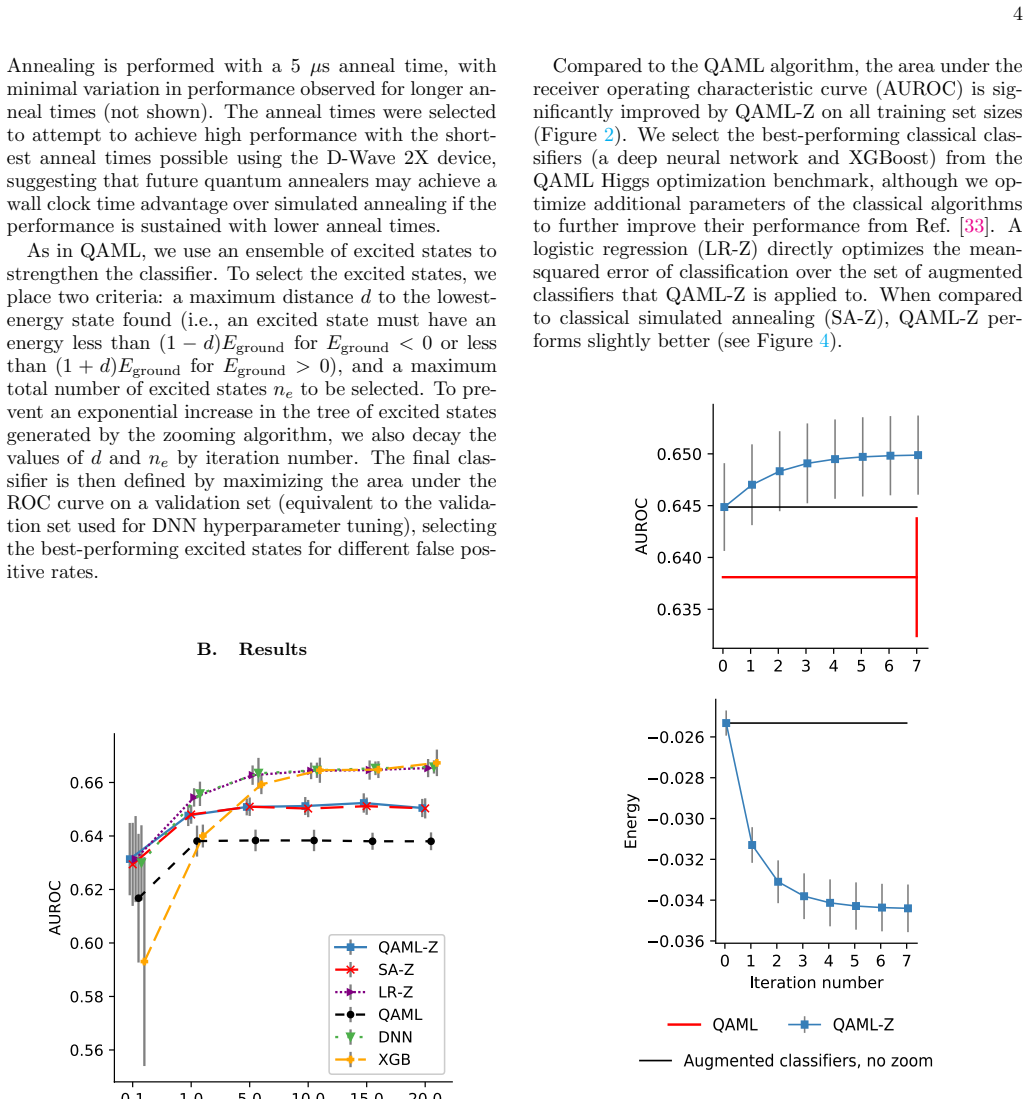
QAML-Z extends the QAML algorithm in two steps: it augments the weak-classifier set by threshold shifts $c_{il}(x_\tau) = \operatorname{sgn}(h_i(x_\tau)+\delta_l)/N$, and it turns each binary weight into a continuous weight by iterating the substitution $s_i c_i(x_\tau) \to \sigma(t)s_i c_i(x_\tau)+\mu_i(t)c_i(x_\tau)$ with shrinking breadth $\sigma(t)=b^t$. Each anneal updates $\mu_i(t+1)=\mu_i(t)+s_i\sigma(t+1)$, so the final classifier is a real-weighted ensemble. On the annealer, the authors report AUROC gains over QAML at every training-set size, parity with the DNN at small sizes, and a 47% reduction of the QAML-DNN gap at the largest size. Because only 33 fully connected logical qubits were available, the implemented Ising Hamiltonian kept only the largest 5% of cross-terms, and the authors also show that simulated annealing with zooming and excited states matches QAML-Z, which locates the algorithm's performance gain in the zooming procedure rather than to quantum dynamics specifically.
Load-bearing premise
The experimental result assumes that pruning the Ising Hamiltonian to the largest 5% of its cross-terms leaves the energy landscape close enough to the full QAML-Z objective that the zooming anneals still find essentially the same good classifiers; if pruning distorts which low-energy configurations are found, the reported AUROC numbers are for a different, truncated problem rather than for the algorithm being proposed.
Editorial extensions
If this is right
- QAML-Z improves AUROC over the original QAML at every tested training-set size on the Higgs benchmark, so the zooming-plus-augmentation recipe is a working upgrade for this problem.
- At training sets of order 1,000 examples, QAML-Z reaches deep-network-level AUROC, indicating that annealer-based classifiers can be competitive in small-data, online-learning settings.
- At the largest training set, the AUROC gap between QAML and the deep network shrinks by 47%, meaning the quantum-classical performance margin is roughly halved.
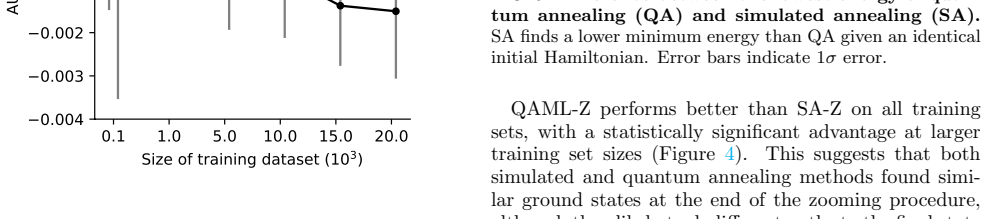
- The Ising energy on the test set decreases monotonically across zooming iterations, which the paper reads as evidence against overfitting during the repeated anneals.
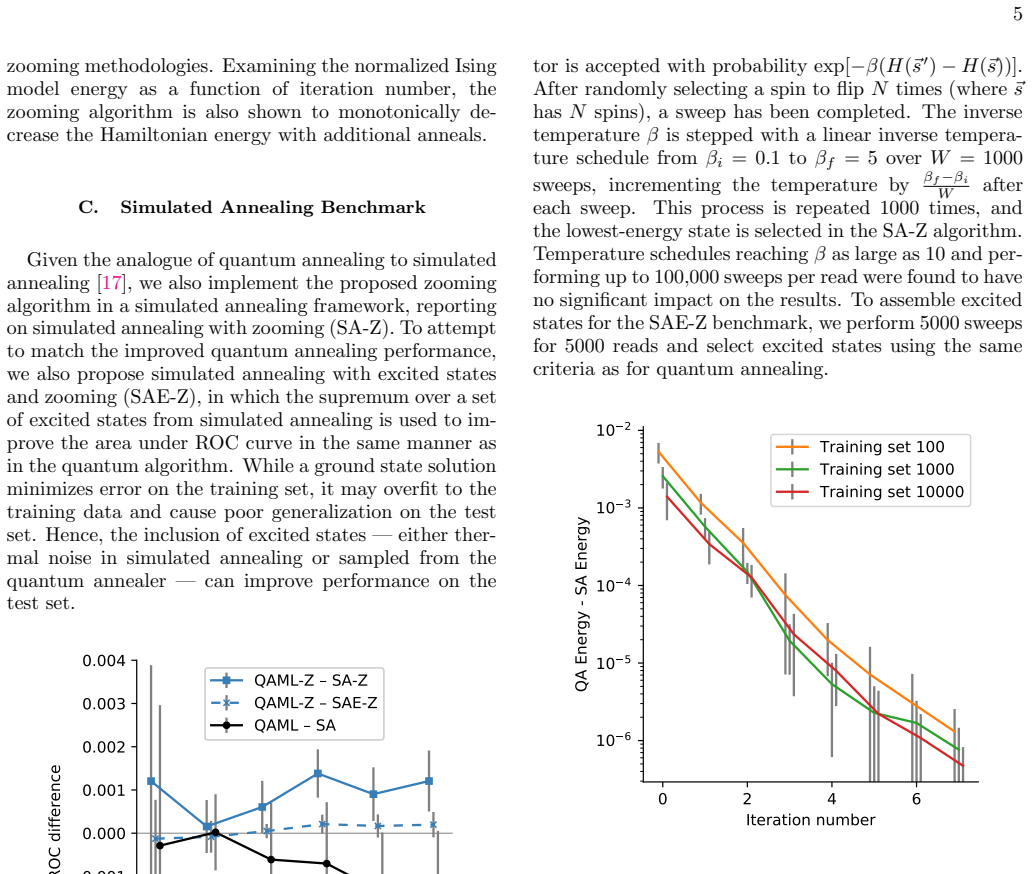
- Because simulated annealing with zooming and excited states matches QAML-Z within one standard deviation, the reported gain does not by itself demonstrate a quantum advantage over classical annealing.
Reading between the lines
- My reading: the 5% cross-term pruning means the experimental numbers characterize a truncated Hamiltonian, so a natural check is to simulate the full QAML-Z objective on the same data and compare AUROC curves before attributing the gain to the algorithm.
- My reading: zooming is a generic way to convert binary Ising optimization into continuous optimization, so the same shrinking-sigma schedule should transfer to other annealer tasks such as feature selection or regularized regression, not just classification.
- My reading: since logistic regression on the augmented classifiers already matches the DNN, much of the power may come from the physics-based kinematic classifiers plus threshold augmentation; an extension would test whether zooming still helps when weak classifiers are generic stumps or random features.
- My reading: the equivalence with SAE-Z implies that any future quantum-speedup or quantum-advantage claim for QAML-Z must be benchmarked against a classical counterpart with excited states, not against plain simulated annealing.
Signed reviews
Editorial analysis
A structured set of objections, weighed in public.
Referee Report
Summary. The paper proposes QAML-Z, an iterative extension of the QAML algorithm in which binary weak-classifier weights are replaced by continuous weights via a zooming search, and the weak-classifier set is augmented by threshold offsets. The algorithm is implemented on a D-Wave 2X quantum annealer and benchmarked on Higgs-boson classification, reporting AUROC values that match a deep neural network at small training-set sizes and reduce the QAML-to-DNN gap by about 47% at large training-set sizes. The authors also provide simulated-annealing and logistic-regression baselines, report error bars, and promise public source code and data.
Significance. If the reported AUROC results are trustworthy, the paper makes a useful contribution by showing that iterative zooming plus classifier augmentation materially improves QAML and brings quantum-annealing-based classification closer to classical benchmarks in a small-data regime. The manuscript has real strengths: it uses an independent simulated benchmark, compares against strong classical baselines whose hyperparameters were optimized, reports error bars, and promises reproducible code and data. It is also honest in reporting that simulated annealing with excited states (SAE-Z) reproduces QAML-Z performance to one standard deviation, which limits any claim of a quantum-specific advantage. The main caveats are that the implemented Hamiltonian deviates from the derived objective, the hardware results use a heavily pruned coupling graph, and the excited-state selection procedure uses validation-set labels in a way that may bias the comparison.
major comments (3)
- [Section II B, Eq. (9)] Equation (9) does not correspond to the squared-error objective for the augmented classifier set. Expanding the objective with the augmented strong classifier R = sum_{i,l} mu_il c_il yields pairwise couplings C_{(i,l),(j,l')} = sum_tau c_il(x_tau)c_jl'(x_tau) for l != l', as well as linear cross terms involving mu_jl' C_{(i,l),(j,l')}. Equation (9) contains only same-offset couplings C_ijl and only for j > i, so the minimization solves a different optimization problem. Because c_il = sgn(h_i + delta_l)/N are highly correlated across offsets, the omitted cross-offset terms are not negligible. The authors should either derive the full Ising mapping for the augmented set or explicitly state and justify the approximation, and the supplied code should be checked against the derivation.
- [Section III A] The D-Wave implementation retains only the largest 5% of Ising couplings, and every reported QAML-Z result on the quantum annealer is therefore obtained from a heavily truncated Hamiltonian. This means the comparison with DNN and XGBoost in Figure 2 is not a clean test of the QAML-Z objective defined in Section II B. The authors should quantify the effect of the pruning, for example by running SA-Z on both the full and the pruned Hamiltonian, or by reporting classical full-Hamiltonian QAML-Z results for a smaller problem size.
- [Section II B and Section III A] The final classifier is not a single fixed ensemble but a per-threshold supremum over excited states selected on a validation set. This validation-set selection procedure is substantially more flexible than the validation-based hyperparameter tuning used for the DNN and XGBoost baselines, so the AUROC comparison in Figure 2 may be biased in favor of QAML-Z. The authors should report the number of excited states used, the selection criteria in detail, and compare with a fixed ensemble rule such as averaging over the selected excited states, to separate the benefit of the zooming algorithm from the benefit of validation-set model selection.
minor comments (6)
- [Section III A] Please state the number N of weak classifiers and the total size of the augmented classifier set; with A = 3, the augmented set contains 7N classifiers, and it is unclear how the problem is embedded into the 33 fully connected logical qubits available on the D-Wave 2X.
- [Section II B] The regularization schedules pf(t), qf(t) and the excited-state thresholds d and ne are described only as being specified in the supplementary code; these schedules should be given in the text or an appendix because they affect the reported results.
- [Section III C, Figure 4] Because SAE-Z achieves statistically equivalent AUROC to QAML-Z, the abstract and conclusion should qualify the role of quantum annealing more carefully; the improvement over QAML appears to be driven substantially by zooming and by excited-state selection rather than by the quantum device.
- [Section II B, Eqs. (7a)-(7b)] The derivation from Eq. (7a) to Eq. (7b) should explicitly show how self-interaction terms and constant terms are handled, and the spin encoding should be stated unambiguously for the zooming iterations.
- [References [61,62]] The promised source code and data should include version or commit identifiers and persistent DOIs so that the reported experiments can be reproduced exactly.
- [Section III B] The numerical AUROC values underlying Figure 2 should be given in a table with confidence intervals, since the small-training-set region appears to have large error bars and the claim of matching DNN performance should be supported by explicit numbers.
Circularity Check
No significant circularity: QAML-Z is validated against external classical benchmarks on an independent test set, and no claimed prediction reduces to a fitted input.
full rationale
The derivation chain is self-contained in the relevant sense. QAML-Z is defined by the substitution s_i c_i -> σ(t) s_i c_i + μ_i(t) c_i, leading to the iterative Hamiltonian H(t) in Eqs. (7) and (9), with μ updated from spin readouts. The headline claim — matching DNN performance at small training-set sizes and reducing the QAML–DNN AUROC gap by about 47% at large sizes — is measured on a test set against classical DNN, XGBoost, and logistic regression baselines; it is not constructed from the target result. Hyperparameters (b=1/2, A=3, δ=0.0075, 8 iterations) are fixed before benchmarking, and the excited-state/validation selection is model selection rather than fitting the test AUROC. The original QAML baseline is cited from prior work by overlapping authors, but it functions as an external benchmark and the improvement is computed from measured AUROC values, so the self-citation is not load-bearing. The possible concern that Eq. (9) omits cross-offset couplings between augmented classifiers is a derivation-correctness issue, not circularity: even if the annealer minimizes a slightly different Hamiltonian, that does not make the reported result equal to the input by definition. No step reduces by construction to its own input.
Assumptions & free parameters
free parameters (7)
- Zoom breadth b =
1/2
- Offset limit A =
3
- Threshold step size delta =
0.0075
- Number of zooming iterations T =
8
- Regularization probabilities pf(t), qf(t) =
Specified in supplementary code
- Excited-state selection thresholds d and ne =
Decayed by iteration in code
- Ising coupling pruning fraction =
5%
assumptions (5)
- standard math Adiabatic theorem: a sufficiently slow evolution keeps the system in the instantaneous ground state.
- domain assumption Samples returned by D-Wave 2X are representative low-energy states of the programmed Ising Hamiltonian.
- domain assumption The simulated Higgs dataset from Mott et al. is a valid and adequate benchmark.
- ad hoc to paper Pruning the Ising Hamiltonian to the largest 5% of couplings preserves the optimization landscape relevant to classification performance.
- domain assumption Selecting excited states and hyperparameters on a validation set transfers to the test set.
Cite this review
Pith. "Pith review of Quantum adiabatic machine learning with zooming." pith.science (2026). https://pith.science/paper/PSQI3HW4
@misc{pith2026190804480,
  author       = {Pith},
  title        = {Pith review of: Quantum adiabatic machine learning with zooming},
  year         = {2026},
  howpublished = {\url{https://pith.science/paper/PSQI3HW4}},
  note         = {Machine review of arXiv:1908.04480}
}
read the original abstract
Recent work has shown that quantum annealing for machine learning, referred to as QAML, can perform comparably to state-of-the-art machine learning methods with a specific application to Higgs boson classification. We propose QAML-Z, a novel algorithm that iteratively zooms in on a region of the energy surface by mapping the problem to a continuous space and sequentially applying quantum annealing to an augmented set of weak classifiers. Results on a programmable quantum annealer show that QAML-Z matches classical deep neural network performance at small training set sizes and reduces the performance margin between QAML and classical deep neural networks by almost 50% at large training set sizes, as measured by area under the ROC curve. The significant improvement of quantum annealing algorithms for machine learning and the use of a discrete quantum algorithm on a continuous optimization problem both opens a new class of problems that can be solved by quantum annealers and suggests the approach in performance of near-term quantum machine learning towards classical benchmarks.
Figures
Figures from the paper (1 more)
Forward citations
Cited by 1 Pith paper
-
Quantum Algorithms for Jet Clustering
Thrust can be computed in O(N^2) time with a Grover-based quantum algorithm under a sequential data-loading model, and in O(N^2 log N) time classically with sorting, but the quantum advantage is only formal for very r...
Reference graph
Works this paper leans on
-
[1]
Computa- tional methods in drug discovery,
Sumudu P Leelananda and Steffen Lindert, “Computa- tional methods in drug discovery,” Beilstein journal of organic chemistry 12, 2694–2718 (2016). 7
work page 2016
-
[2]
Machine learning and its applications to biology,
Adi L Tarca, Vincent J Carey, Xue-wen Chen, Roberto Romero, and Sorin Dr˘ aghici, “Machine learning and its applications to biology,” PLoS computational biology 3, e116 (2007)
work page 2007
-
[3]
William W Hsieh, Machine learning methods in the envi- ronmental sciences: Neural networks and kernels (Cam- bridge university press, 2009)
work page 2009
-
[4]
Machine learning phases of matter,
Juan Carrasquilla and Roger G Melko, “Machine learning phases of matter,” Nature Physics 13, 431 (2017)
work page 2017
-
[5]
Searching for exotic particles in high-energy physics with deep learning,
Pierre Baldi, Peter Sadowski, and Daniel Whiteson, “Searching for exotic particles in high-energy physics with deep learning,” Nature communications 5, 4308 (2014)
work page 2014
-
[6]
Machine learning at the energy and intensity fron- tiers of particle physics,
Alexander Radovic, Mike Williams, David Rousseau, Michael Kagan, Daniele Bonacorsi, Alexander Himmel, Adam Aurisano, Kazuhiro Terao, and Taritree Wongji- rad, “Machine learning at the energy and intensity fron- tiers of particle physics,” Nature 560, 41 (2018)
work page 2018
-
[7]
Jacob Biamonte, Peter Wittek, Nicola Pancotti, Patrick Rebentrost, Nathan Wiebe, and Seth Lloyd, “Quantum machine learning,” Nature 549, 195 (2017)
work page 2017
-
[8]
Quantum support vector machine for big data classifi- cation,
Patrick Rebentrost, Masoud Mohseni, and Seth Lloyd, “Quantum support vector machine for big data classifi- cation,” Physical review letters 113, 130503 (2014)
work page 2014
Show all 66 references
-
[9]
Quantum principal component analysis,
Seth Lloyd, Masoud Mohseni, and Patrick Reben- trost, “Quantum principal component analysis,” Nature Physics 10, 631 (2014)
2014
-
[10]
Quan- tum algorithm for data fitting,
Nathan Wiebe, Daniel Braun, and Seth Lloyd, “Quan- tum algorithm for data fitting,” Physical review letters 109, 050505 (2012)
2012
-
[11]
Prediction by linear regression on a quantum computer,
Maria Schuld, Ilya Sinayskiy, and Francesco Petruc- cione, “Prediction by linear regression on a quantum computer,” Physical Review A 94, 022342 (2016)
2016
-
[12]
Quantum algorithms for topological and geometric anal- ysis of data,
Seth Lloyd, Silvano Garnerone, and Paolo Zanardi, “Quantum algorithms for topological and geometric anal- ysis of data,” Nature communications 7, 10138 (2016)
2016
-
[13]
Quantum gra- dient descent and newton’s method for constrained poly- nomial optimization,
Patrick Rebentrost, Maria Schuld, Leonard Wossnig, Francesco Petruccione, and Seth Lloyd, “Quantum gra- dient descent and newton’s method for constrained poly- nomial optimization,” New Journal of Physics (2019)
2019
-
[14]
Read the fine print,
Scott Aaronson, “Read the fine print,” Nature Physics 11, 291 (2015)
2015
-
[15]
A quantum-inspired classical algorithm for recommendation systems,
Ewin Tang, “A quantum-inspired classical algorithm for recommendation systems,” in Proceedings of the 51st An- nual ACM SIGACT Symposium on Theory of Computing (2019) pp. 217–228
2019
-
[16]
On the robustness of bucket brigade quantum ram,
Srinivasan Arunachalam, Vlad Gheorghiu, Tomas Jochym-O’Connor, Michele Mosca, and Priyaa Varshi- nee Srinivasan, “On the robustness of bucket brigade quantum ram,” New Journal of Physics 17, 123010 (2015)
2015
-
[17]
Quantum annealing in the transverse ising model,
Tadashi Kadowaki and Hidetoshi Nishimori, “Quantum annealing in the transverse ising model,” Physical Review E 58, 5355 (1998)
1998
-
[18]
Test-driving 1000 qubits,
Joshua Job and Daniel Lidar, “Test-driving 1000 qubits,” Quantum Science and Technology 3, 030501 (2018)
2018
-
[19]
Per- spectives of quantum annealing: Methods and implemen- tations,
Philipp Hauke, Helmut G. Katzgraber, Wolfgang Lech- ner, Hidetoshi Nishimori, and William D. Oliver, “Per- spectives of quantum annealing: Methods and implemen- tations,” arXiv:1903.06559 (2019)
2019 arXiv
-
[20]
thesis, University of Southern California (2018)
Joshua Job, The Theory and Practice of Benchmarking Quantum Annealers, Ph.D. thesis, University of Southern California (2018)
2018
-
[21]
Training a binary classifier with the quantum adiabatic algorithm,
Hartmut Neven, Vasil S Denchev, Geordie Rose, and William G Macready, “Training a binary classifier with the quantum adiabatic algorithm,” arXiv preprint arXiv:0811.0416 (2008)
2008 arXiv
-
[22]
Quantum adia- batic machine learning,
Kristen L. Pudenz and Daniel A. Lidar, “Quantum adia- batic machine learning,” Quantum Information Process- ing 12, 2027–2070 (2013)
2013
-
[23]
Bayesian network structure learning using quantum annealing,
B. O’Gorman, R. Babbush, A. Perdomo-Ortiz, A. Aspuru-Guzik, and V. Smelyanskiy, “Bayesian network structure learning using quantum annealing,” The European Physical Journal Special Topics 224, 163–188 (2015)
2015
-
[24]
Quantum boltzmann machine,
Mohammad H. Amin, Evgeny Andriyash, Jason Rolfe, Bohdan Kulchytskyy, and Roger Melko, “Quantum boltzmann machine,” Physical Review X 8, 021050– (2018)
2018
-
[25]
A path towards quantum advantage in train- ing deep generative models with quantum annealers,
Walter Vinci, Lorenzo Buffoni, Hossein Sadeghi, Amir Khoshaman, Evgeny Andriyash, and Mohammad H. Amin, “A path towards quantum advantage in train- ing deep generative models with quantum annealers,” (2019), arXiv:1912.02119 [quant-ph]
2019 arXiv
-
[26]
Experimental investigation of an eight-qubit unit cell in a supercon- ducting optimization processor,
Richard Harris, Mark W Johnson, T Lanting, AJ Berkley, J Johansson, P Bunyk, E Tolkacheva, E Ladizinsky, N Ladizinsky, T Oh, et al. , “Experimental investigation of an eight-qubit unit cell in a supercon- ducting optimization processor,” Physical Review B 82, 024511 (2010)
2010
-
[27]
Quantum annealing with manufactured spins,
Mark W Johnson, Mohammad HS Amin, Suzanne Gildert, Trevor Lanting, Firas Hamze, Neil Dickson, Richard Harris, Andrew J Berkley, Jan Johansson, Paul Bunyk, et al. , “Quantum annealing with manufactured spins,” Nature 473, 194–198 (2011)
2011
-
[28]
Archi- tectural considerations in the design of a superconduct- ing quantum annealing processor,
P. I. Bunyk, E. M. Hoskinson, M. W. Johnson, E. Tolka- cheva, F. Altomare, A. J. Berkley, R. Harris, J. P. Hilton, T. Lanting, A. J. Przybysz, and J. Whittaker, “Archi- tectural considerations in the design of a superconduct- ing quantum annealing processor,” IEEE Transactions...
2014
-
[29]
Quantum annealing applied to de- conflicting optimal trajectories for air traffic manage- ment,
Tobias Stollenwerk, Bryan O’Gorman, Davide Ven- turelli, Salvatore Mandr` a, Olga Rodionova, Hokkwan Ng, Banavar Sridhar, Eleanor Gilbert Rieffel, and Rupak Biswas, “Quantum annealing applied to de- conflicting optimal trajectories for air traffic manage- ment,” IEEE transactions ...
2019
-
[30]
Find- ing low-energy conformations of lattice protein models by quantum annealing,
Alejandro Perdomo-Ortiz, Neil Dickson, Marshall Drew- Brook, Geordie Rose, and Al´ an Aspuru-Guzik, “Find- ing low-energy conformations of lattice protein models by quantum annealing,” Scientific reports 2, 571 (2012)
2012
-
[31]
Quantum annealing versus classical machine learning applied to a simplified computational biology problem,
Richard Y Li, Rosa Di Felice, Remo Rohs, and Daniel A Lidar, “Quantum annealing versus classical machine learning applied to a simplified computational biology problem,” NPJ quantum information 4, 14 (2018)
2018
-
[32]
Unconventional machine learning of genome-wide human cancer data,
Richard Y. Li, Sharvari Gujja, Sweta R. Bajaj, Omar E. Gamel, Nicholas Cilfone, Jeffrey R. Gulcher, Daniel A. Lidar, and Thomas W. Chittenden, “Unconventional machine learning of genome-wide human cancer data,” arXiv:1909.06206 (2019)
2019 arXiv
-
[33]
Solving a higgs optimization problem with quantum annealing for machine learning,
Alex Mott, Joshua Job, Jean-Roch Vlimant, Daniel Li- dar, and Maria Spiropulu, “Solving a higgs optimization problem with quantum annealing for machine learning,” Nature 550, 375 (2017)
2017
-
[34]
Charged particle tracking with quan- 8 tum annealing-inspired optimization,
Alexander Zlokapa, Abhishek Anand, Jean-Roch Vli- mant, Javier M Duarte, Joshua Job, Daniel Lidar, and Maria Spiropulu, “Charged particle tracking with quan- 8 tum annealing-inspired optimization,” arXiv preprint arXiv:1908.04475 (2019)
2019 arXiv
-
[35]
A pattern recognition algorithm for quantum anneal- ers,
Fr´ ed´ eric Bapst, Wahid Bhimji, Paolo Calafiura, Heather Gray, Wim Lavrijsen, Lucy Linder, and Alex Smith, “A pattern recognition algorithm for quantum anneal- ers,” Computing and Software for Big Science 4 (2019), 10.1007/s41781-019-0032-5
2019 doi
-
[36]
On the adiabatic theorem of quantum me- chanics,
Tosio Kato, “On the adiabatic theorem of quantum me- chanics,” Journal of the Physical Society of Japan5, 435– 439 (1950)
1950
-
[37]
Bounds for the adiabatic approximation with appli- cations to quantum computation,
Sabine Jansen, Mary-Beth Ruskai, and Ruedi Seiler, “Bounds for the adiabatic approximation with appli- cations to quantum computation,” J. Math. Phys. 48, 102111 (2007)
2007
-
[38]
Adiabatic approximation with exponential accuracy for many-body systems and quantum computation,
Daniel A. Lidar, Ali T. Rezakhani, and Alioscia Hamma, “Adiabatic approximation with exponential accuracy for many-body systems and quantum computation,” J. Math. Phys. 50, 102106 (2009)
2009
-
[39]
Quantum Computation by Adiabatic Evolution,
Edward Farhi, Jeffrey Goldstone, Sam Gutmann, and Michael Sipser, “Quantum Computation by Adiabatic Evolution,” arXiv:quant-ph/0001106 (2000)
2000 arXiv
-
[40]
Adiabatic quan- tum computation,
Tameem Albash and Daniel A Lidar, “Adiabatic quan- tum computation,” Reviews of Modern Physics 90, 015002 (2018)
2018
-
[41]
Robustness of adiabatic quantum computation,
Andrew M Childs, Edward Farhi, and John Preskill, “Robustness of adiabatic quantum computation,” Phys- ical Review A 65, 012322 (2001)
2001
-
[42]
Decoherence in adiabatic quantum computa- tion,
Mohammad HS Amin, Dmitri V Averin, and James A Nesteroff, “Decoherence in adiabatic quantum computa- tion,” Physical Review A 79, 022107 (2009)
2009
-
[43]
Decoherence in adiabatic quantum computation,
Tameem Albash and Daniel A Lidar, “Decoherence in adiabatic quantum computation,” Physical Review A91, 062320 (2015)
2015
-
[44]
Minor-embedding in adiabatic quantum computation: I. the parameter setting problem,
Vicky Choi, “Minor-embedding in adiabatic quantum computation: I. the parameter setting problem,” Quan- tum Information Processing 7, 193–209 (2008)
2008
-
[45]
Minor-embedding in adiabatic quantum computation: Ii. minor-universal graph design,
Vicky Choi, “Minor-embedding in adiabatic quantum computation: Ii. minor-universal graph design,” Quan- tum Information Processing 10, 343–353 (2011)
2011
-
[46]
Adiabatic quantum programming: minor embed- ding with hard faults,
Christine Klymko, Blair D. Sullivan, and Travis S. Hum- ble, “Adiabatic quantum programming: minor embed- ding with hard faults,” Quant. Inf. Proc. 13, 709–729 (2014)
2014
-
[47]
A prac- tical heuristic for finding graph minors,
Jun Cai, William G. Macready, and Aidan Roy, “A prac- tical heuristic for finding graph minors,” arXiv:1406.2741 (2014)
2014 arXiv
-
[48]
Thermally assisted adiabatic quantum computation,
M. H. S. Amin, Peter J. Love, and C. J. S. Truncik, “Thermally assisted adiabatic quantum computation,” Phys. Rev. Lett. 100, 060503 (2008)
2008
-
[49]
Thermally assisted quantum annealing of a 16-qubit problem,
Neil G Dickson, MW Johnson, MH Amin, R Harris, F Altomare, AJ Berkley, P Bunyk, J Cai, EM Chapple, P Chavez, et al., “Thermally assisted quantum annealing of a 16-qubit problem,” Nature communications 4, 1–6 (2013)
2013
-
[50]
Relaxation ver- sus adiabatic quantum steady-state preparation,
Lorenzo Campos Venuti, Tameem Albash, Milad Mar- vian, Daniel Lidar, and Paolo Zanardi, “Relaxation ver- sus adiabatic quantum steady-state preparation,” Phys. Rev. A 95, 042302– (2017)
2017
-
[51]
Finite temperature quantum annealing solving expo- nentially small gap problem with non-monotonic success probability,
Anurag Mishra, Tameem Albash, and Daniel A. Lidar, “Finite temperature quantum annealing solving expo- nentially small gap problem with non-monotonic success probability,” Nature Communications 9, 2917 (2018)
2018
-
[52]
Defining and detecting quantum speedup,
Troels F. Rønnow, Zhihui Wang, Joshua Job, Sergio Boixo, Sergei V. Isakov, David Wecker, John M. Mar- tinis, Daniel A. Lidar, and Matthias Troyer, “Defining and detecting quantum speedup,” Science 345, 420–424 (2014)
2014
-
[53]
Demonstration of a scaling advantage for a quantum annealer over simu- lated annealing,
Tameem Albash and Daniel A. Lidar, “Demonstration of a scaling advantage for a quantum annealer over simu- lated annealing,” Physical Review X 8, 031016– (2018)
2018
-
[54]
A decep- tive step towards quantum speedup detection,
Salvatore Mandr` a and Helmut G Katzgraber, “A decep- tive step towards quantum speedup detection,” Quantum Sci. Technol. 3, 04LT01 (2018)
2018
-
[55]
Entanglement in a quantum anneal- ing processor,
Trevor Lanting, Anthony J Przybysz, A Yu Smirnov, Federico M Spedalieri, Mohammad H Amin, Andrew J Berkley, Richard Harris, Fabio Altomare, Sergio Boixo, Paul Bunyk, et al., “Entanglement in a quantum anneal- ing processor,” Physical Review X 4, 021041 (2014)
2014
-
[56]
Computational multi- qubit tunnelling in programmable quantum annealers,
Sergio Boixo, Vadim N. Smelyanskiy, Alireza Shabani, Sergei V. Isakov, Mark Dykman, Vasil S. Denchev, Mohammad H. Amin, Anatoly Yu Smirnov, Masoud Mohseni, and Hartmut Neven, “Computational multi- qubit tunnelling in programmable quantum annealers,” Nat Commun 7 (2016)
2016
-
[57]
What is the computational value of finite-range tunneling?
Vasil S. Denchev, Sergio Boixo, Sergei V. Isakov, Nan Ding, Ryan Babbush, Vadim Smelyanskiy, John Marti- nis, and Hartmut Neven, “What is the computational value of finite-range tunneling?” Phys. Rev. X 6, 031015 (2016)
2016
-
[58]
Searching for quantum speedup in quasistatic quantum annealers,
Mohammad H. Amin, “Searching for quantum speedup in quasistatic quantum annealers,” Physical Review A 92, 052323– (2015)
2015
-
[59]
Observation of topological phenomena in a pro- grammable lattice of 1,800 qubits,
Andrew D. King, Juan Carrasquilla, Jack Raymond, Isil Ozfidan, Evgeny Andriyash, Andrew Berkley, Mauricio Reis, Trevor Lanting, Richard Harris, Fabio Altomare, Kelly Boothby, Paul I. Bunyk, Colin Enderud, Alexandre Fr´ echette, Emile Hoskinson, Nicolas Ladizinsky, Travis Oh, Ga...
2018
-
[60]
Phase transitions in a programmable quantum spin glass simu- lator,
R. Harris, Y. Sato, A. J. Berkley, M. Reis, F. Al- tomare, M. H. Amin, K. Boothby, P. Bunyk, C. Deng, C. Enderud, S. Huang, E. Hoskinson, M. W. Johnson, E. Ladizinsky, N. Ladizinsky, T. Lanting, R. Li, T. Med- ina, R. Molavi, R. Neufeld, T. Oh, I. Pavlov, I. Perminov, G. Pouli...
2018
-
[61]
Source code for the QAML-Z algorithm is provided at https://github.com/quantummind/qaml-z/
-
[62]
Kinematics variables of higgs and background data,
Alex Mott, Joshua Job, Jean-Roch Vlimant, Daniel Li- dar, and Maria Spiropulu, “Kinematics variables of higgs and background data,” (2020)
2020
-
[63]
Analog errors in quantum annealing: doom and hope,
Adam Pearson, Anurag Mishra, Itay Hen, and Daniel A. Lidar, “Analog errors in quantum annealing: doom and hope,” npj Quantum Information 5, 107 (2019)
2019
-
[64]
Quantum optimization of fully connected spin glasses,
Davide Venturelli, Salvatore Mandr` a, Sergey Knysh, Bryan O’Gorman, Rupak Biswas, and Vadim Smelyan- skiy, “Quantum optimization of fully connected spin glasses,” Phys. Rev. X 5, 031040 (2015)
2015
-
[65]
Xgboost: A scal- able tree boosting system,
Tianqi Chen and Carlos Guestrin, “Xgboost: A scal- able tree boosting system,” in Proceedings of the 22nd ACM SIGKDD International Conference on Knowledge 9 Discovery and Data Mining , KDD ’16 (Association for Computing Machinery, New York, NY, USA, 2016) pp. 785–794
2016
-
[66]
Opti- mization by simulated annealing,
S. Kirkpatrick, C. D. Gelatt, and M. P. Vecchi, “Opti- mization by simulated annealing,” Science 220, 671–680 (1983)
1983
Reviewed August 14, 2026 · model on record in the stance chip above.
Discussion (0). Continue with ORCID to comment.