REVIEW 3 major objections 6 minor 91 references
First-principles many-body non-additive polarization energies from monomer and dimer calculations only : A case study on water
T0 review · 3 major / 6 minor · reviewed 2026-08-14 · deepseek-v4-flash
Pith's one-line read Many-body polarization energies of water can be predicted from monomer and dimer data alone.
desk verdict Good paper: the monomer+dimer construction passes the trimer tests, but the abstract overstates the hexamer many-body agreement, which relies on error cancellation. read the letter →
The pith
A machine-rendered reading of the paper's core claim, the machinery that carries it, and where it could break.
The reading
What carries the argument
The central object is the regularized second-order induction energy E(2)_IND(Reg), computed with the regularized electrostatic potential of Eq. (3) at eta = 3.0 a.u.; this defines the true second-order polarization energy E(2)_POL that the classical model must reproduce. Fitting the three site-pair damping parameters (beta_OO, beta_OH, beta_HH) to dimer E(2)_POL curves fixes the polarization model's short-range behavior, after which the model solves the self-consistent equations (1)-(2) for induced multipoles using localized ISA-Pol polarizabilities of maximum rank 1, 2, or 3. The same machinery also yields infinite-order polarization and charge-delocalization energies through Eq. (11).
What would settle it
Compute the regularized dimer induction energy E(2)_IND(Reg) for the same water dimer geometries with several values of eta (for instance 2.0, 2.5, 3.0, 3.5, and 4.0 a.u.), refit the three DIFF damping parameters for each eta, and recompute the three-body non-additive energies on the 600-trimer set against CCSD(T) references; if the minimum of the mean-absolute error occurs far from eta = 3.0, or moves by more than about 0.5 kJ/mol between eta = 3.0 and neighboring values, the claim that eta = 3.0 is the correct regularization for water is falsified.
Extended reading notes
Core claim
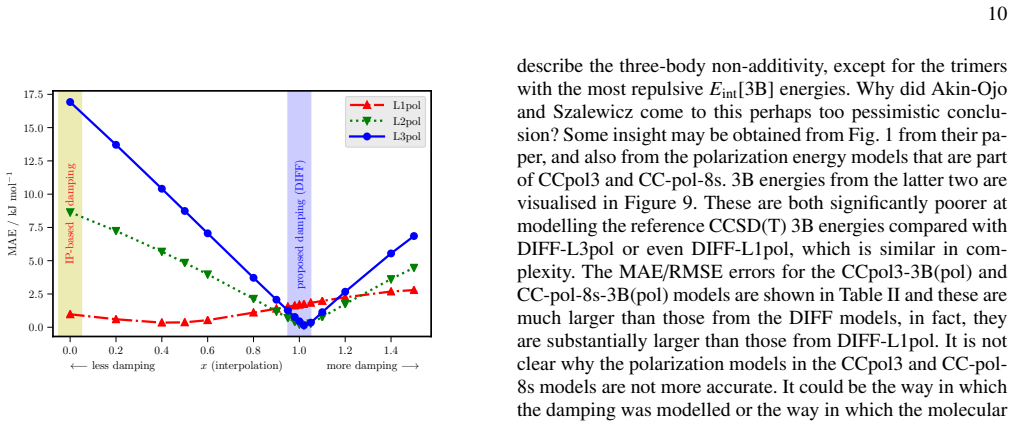
The paper's central claim is that the delicate part of a polarization model—its short-range damping—can be determined from the true second-order polarization energy of dimers, defined through Reg-SAPT(DFT) with the regularization parameter eta = 3.0 a.u. This splits the dimer induction energy into a polarization part, which the damped classical model is meant to reproduce, and an exponentially decaying charge-delocalization part, which it is not. With damping fixed that way, the self-consistent classical polarization model built from ISA-based distributed multipoles and ISA-Pol polarizabilities generates many-body non-additive energies for water clusters that match MP2/CBS and CCSD(T) references, and its best rank-2 and rank-3 versions rival dedicated three-body potentials fitted to 71,000 trimers. The paper also shows that the many-body predictions are extremely sensitive to damping for high-rank polarizability models, and that the Reg-SAPT(DFT) damping is close to optimal.
Load-bearing premise
The entire construction rests on the assumption that the Reg-SAPT(DFT) regularization parameter eta = 3.0 a.u. separates the dimer induction energy into true polarization and charge-delocalization for water; if that partition is wrong, every fitted damping parameter and every predicted many-body energy shifts.
Editorial extensions
If this is right
- Many-body polarization models for other strongly polar molecules could be built directly from monomer properties and dimer energies, removing the need for the thousands of trimer calculations currently used for water.
- For geometries, dipole-only polarizability is not enough: the paper's results imply rank-2 (quadrupolar) polarizabilities are needed to reproduce cluster structures, which should guide force-field development.
- Polarization damping is not a minor detail: with rank-3 polarizabilities, under-damped models overestimate trimer non-additivity by more than 100% and can drive hexamer optimizations into a polarization catastrophe.
- The Reg-SAPT(DFT) damping prescription is close to optimal for water, so the same procedure can be used to set damping parameters without empirical fitting.
- Total cluster energies can be accurate even when the two-body and many-body components are individually offset, because the errors cancel; this means total-energy benchmarks alone do not test a model's many-body physics.
Reading between the lines
- Editorial inference: the systematic error cancellation between two-body and many-body energies observed in water may be specific to water-like hydrogen-bonded networks; testing on a molecule with fewer bonding motifs would reveal whether the cancellation is generic.
- Editorial inference: the paper's suggestion that induced quadrupoles drive the geometry improvement of rank-2 models could be tested directly by computing induced multipole moments in the water hexamers and comparing them between rank-1 and rank-2/3 models.
- Editorial inference: if the regularization parameter eta varies with atomic species as the paper suspects, a transferable protocol would need to derive eta from a measurable quantity such as the charge-delocalization length; the method's generality depends on solving this.
- Editorial inference: applying the same monomer-plus-dimer recipe to a system with heavier atoms, where higher-rank polarizabilities matter more, would be a sharper test than water; the paper notes that water is a sweet spot for dipole-dipole models.
Signed reviews
Editorial analysis
A structured set of objections, weighed in public.
Referee Report
Summary. The paper develops three many-body polarization models for water (DIFF-L1pol, DIFF-L2pol, DIFF-L3pol) from monomer-only distributed multipoles (BS-ISA) and distributed polarizabilities (ISA-Pol), with Tang–Toennies damping parameters fitted to second-order regularized SAPT(DFT) polarization energies of water dimers. No trimer or larger-cluster data are used in the models. The authors test the models on 24 trimers from Liu et al. and 600 trimers from Akin-Ojo and Szalewicz, on the eight water hexamer isomers, and on (H2O)16 and (H2O)24 clusters, comparing three-body non-additivity, total energies, n-body decompositions, and optimized geometries with CCSD(T), MP2/CBS, SAMBA, and several fitted water potentials. They report that DIFF-L3pol gives a mean absolute error of 0.058 kJ/mol on 600 trimer three-body energies, trailing only the explicitly fitted CCpol3 model, and they answer Q1 affirmatively: many-body polarization models can be constructed from monomer properties and dimer energies alone.
Significance. If the main claim holds, this is a conceptually important result: it would mean that the leading many-body non-additivity of water can be predicted without any many-body fitting, using only physically motivated distributed properties and a small number of dimer-based damping parameters. The trimer validation is strong and the comparison against CCpol3, which was fitted to more than 71,000 trimers, is striking. The authors also supply model specifications and Orient input files. However, the abstract overstates the agreement with coupled-cluster for the many-body energies of larger clusters: the hexamer n-body decomposition deviates from CCSD(T)-F12 by several kJ/mol, and the good total energies arise from systematic error cancellation that the paper itself does not explain. The central methodological claim remains plausible, but the manuscript needs revision to separate what is demonstrated for three-body non-additivity from what is only demonstrated for total cluster energies, and to address the unquantified dependence on the regularization parameter eta.
major comments (3)
- [Abstract; §V.C; Figure 14; Supplementary Tables XIX–XXVI] The abstract's claim that the best polarization models "yield many-body energies that agree with those computed with coupled-cluster methods" is not supported for the many-body energy components of the hexamers. For the prism hexamer, DIFF-L3pol gives E[3B] = -40.36 kJ/mol and E[4B] = -4.43 kJ/mol, versus CCSD(T)-F12 values of -36.74 kJ/mol and -2.76 kJ/mol (Supplementary Tables XIX–XXVI), i.e., errors of about -3.6 and -1.7 kJ/mol. The close agreement of the total hexamer energies in Figure 11 arises from cancellation with two-body errors, as the paper itself states in §V.C, and the reason for this cancellation is declared unknown in §VI. This distinction should be made explicit in the abstract and conclusions, which currently overstate what is demonstrated.
- [§IV.A.1; Eq. (5); §VI] The regularization parameter eta = 3.0 a.u. is load-bearing: the fitted damping parameters in Table I are determined from E2_IND(Reg), so any error in the eta-dependent partition of the second-order induction energy propagates into all predicted many-body energies. The paper acknowledges in §IV.A.1 that "there is as yet no rigorous way of determining which value of eta exactly suppresses the charge-delocalization states in all cases," yet no sensitivity study over eta is presented. Since one of the stated questions (Q3) concerns sensitivity of the models to the damping procedure, a scan over eta (for example, 2.0–4.0 a.u.) on the trimer set would quantify this uncertainty, or the authors should explicitly state that the Q1 claim is conditional on the inherited value of eta.
- [§IV.A.2; Table I] The fitted O–O damping parameter was determined using only dimers with interaction energies below 45 kJ/mol, and the H–H damping could not be precisely determined; the text states that no damping model could be found for the more repulsive configurations and that an angular dependence of beta_OO is likely needed. These are acknowledged limitations of the central construction, and they matter because the models are subsequently applied to repulsive trimer geometries, flexible clusters, and, in principle, condensed-phase geometries. The 600-trimer test provides some reassurance, but errors there grow for the most repulsive three-body energies, so the transferability of the damping to repulsive and condensed-phase environments remains a gap that should be discussed more carefully.
minor comments (6)
- [§I] The sentence "then we much describe these complex effects correctly" contains a typo and should read "we must describe."
- [§IV.A.1] The word "denstiy" in the first paragraph of §IV.A.1 should be "density."
- [§V.A] The text contains "timers" in place of "trimers" in two places in the discussion around Figures 6 and 7.
- [§VII] The word "polazization" in the Conclusions should be "polarization."
- [References] Reference [21] appears as an empty entry; the intended reference for the water hexamer benchmark should be supplied.
- [Figure 12] The labels "No conv." would be clearer if the caption explicitly noted that these cases correspond to the polarization catastrophe during geometry relaxation, rather than leaving the reader to infer it.
Circularity Check
No circular derivation: the many-body energies are genuine predictions from monomer/dimer inputs, benchmarked against independent MP2/CCSD(T) trimer and hexamer data; the inherited Reg-SAPT(DFT) regularization parameter is a model-defining choice that is externally tested, not a fitted target.
full rationale
The central claim (Q1) is not circular. The three polarization damping parameters are fitted only to Reg-SAPT(DFT) dimer second-order polarization energies, E(2)_IND(Reg), as described in Section IV A 1 and Section IV A 2, and the resulting models are then evaluated against 24 Liu et al. trimers, 600 Akin-Ojo/Szalewicz CCSD(T) trimers, and CCSD(T)-F12 hexamers. No trimer, tetramer, or hexamer energy enters the construction of the DIFF models, so the trimer MAE of 0.058 kJ/mol for DIFF-L3pol (Table II) and the hexamer comparisons are genuine out-of-sample predictions. The one inherited element is the regularization parameter eta = 3.0 a.u. from prior work by Misquitta [30], which defines the polarization/charge-delocalization split through Eq. (5). This is load-bearing in the construction, but it is not a fitted target and not circular: the paper explicitly acknowledges the limitation, 'there is as yet no rigorous way of determining which value of eta exactly suppresses the charge-delocalization states in all cases,' and then independently tests the resulting damping by interpolating it (Eq. (9), Figs. 7 and 13), finding the DIFF damping close to optimal against external MP2/CCSD(T) references. That makes the inherited parameter externally falsifiable rather than a self-citation that forces the result. The abstract's strongest wording, that the best models' 'many-body energies agree with those computed with coupled-cluster methods,' is overstated relative to the n-body decomposition: SI Tables XIX-XXVI and Figure 14 show DIFF-L3pol hexamer E[3B] and E[4B] values are off by several kJ/mol (e.g., prism E[3B] = -40.36 vs -36.74 kJ/mol, E[4B] = -4.43 vs -2.76 kJ/mol), and the good total energies arise from the error cancellation the paper itself says is not understood ('It is not clear why this error cancellation is so systematic'). That is a correctness and interpretation caveat, not a circularity: the many-body values are still computed from monomer/dimer inputs and compared with independent benchmarks. Overall, no equation or prediction reduces to its own input; the only self-citation concern is the minor, acknowledged regularization parameter, so the circularity score is low.}
Assumptions & free parameters
free parameters (4)
- beta_OO_pol =
1.25 a.u. (L1, L2, L3)
- beta_OH_pol =
1.68 a.u. (L1), 1.57 a.u. (L2), 1.47 a.u. (L3)
- beta_HH_pol =
2.0 a.u. (all models)
- eta (regularization parameter) =
3.0 a.u. (chosen in Ref. 30)
assumptions (4)
- domain assumption Classical polarization model with localized damped multipoles and polarizabilities converges to the true many-body polarization energy.
- domain assumption ISA multipoles and ISA-Pol polarizabilities computed for a fixed monomer geometry are transferable to slightly flexible water monomers in clusters.
- ad hoc to paper The regularization parameter eta=3.0 a.u. in Reg-SAPT(DFT) correctly suppresses charge-delocalization states for water.
- ad hoc to paper The O-O damping fitted only to dimers with interaction energies below 45 kJ/mol remains valid for repulsive and condensed-phase geometries.
Cite this review
Pith. "Pith review of First-principles many-body non-additive polarization energies from monomer and dimer calculations only : A case study on water." pith.science (2026). https://pith.science/paper/PLK2ULTO
@misc{pith2026190804668,
  author       = {Pith},
  title        = {Pith review of: First-principles many-body non-additive polarization energies from monomer and dimer calculations only : A case study on water},
  year         = {2026},
  howpublished = {\url{https://pith.science/paper/PLK2ULTO}},
  note         = {Machine review of arXiv:1908.04668}
}
read the original abstract
The many-body polarization energy is the major source of non-additivity in strongly polar systems such as water. This non-additivity is often considerable and must be included, if only in an average manner, to correctly describe the physical properties of the system. Models for the polarization energy are usually parameterized using experimental data, or theoretical estimates of the many-body effects. Here we show how many-body polarization models can be developed for water complexes using data for the monomer and dimer only using ideas recently developed in the field of intermolecular perturbation theory and state-of-the-art approaches for calculating distributed molecular properties based on the iterated stockholder atoms (ISA) algorithm. We show how these models can be calculated, and validate their accuracy in describing the many-body non-additive energies of a range of water clusters. We further investigate their sensitivity to the details of the polarization damping models used. We show how our very best polarization models yield many-body energies that agree with those computed with coupled-cluster methods, but at a fraction of the computational cost.
Figures


Figures from the paper (17 more)




Reference graph
Works this paper leans on
-
[1]
4444” structure and two of the “boat
(H 2O)16 isomers The (H 2O)16 clusters have been optimized by Yoo and Xantheas [69] and this set includes two bonding variants of the “4444” structure and two of the “boat” structure. The fifth structure, the “anti-boat”, was estimated [69] to have an en- ergy lying between the two boat structures. The best estimates of the energies (total and many-body de...
-
[2]
Ref geom
(H 2O)24 isomers The two (H2O)24 isomers shown in Figure 16 are the largest clusters considered in this study. SAMBA reference energies for these clusters [70] show that the 308 and 316 isomers are nearly isoenergetic, with an Eint[2B-4B] energy difference of less than 1 kJ mol−1, and the 308 isomer the more stable. This small difference arises from a near ...
-
[3]
S. L. Price, M. Leslie, G. W. A. Welch, M. Habgood, L. S. Price, P. G. Karamertzanisc, and G. M. Day, Phys. Chem. Chem. Phys. 12, 8478 (2010)
2010
-
[4]
G. W. A. Welch, P. G. Karamertzanis, A. J. Misquitta, A. J. Stone, and S. L. Price, J. Chem. Theory Comput.4, 522 (2008)
2008
-
[6]
Jankowski and K
P. Jankowski and K. Szalewicz, J. Chem. Phys. 108, 3554 (1998)
1998
-
[7]
A. J. Misquitta, G. W. A. Welch, A. J. Stone, and S. L. Price, Chem. Phys. Lett. 456, 105 (2008)
2008
-
[8]
Bukowski, K
R. Bukowski, K. Szalewicz, G. C. Groenenboom, and A. van der Avoird, Science 315, 1249 (2007)
2007
-
[9]
G. W. M. Vissers, A. Hesselmann, G. Jansen, P. E. S. Wormer, and A. van der Avoird, J. Chem. Phys. 122, 054306 (2005)
work page 2005
Show all 91 references
-
[10]
G. C. Groenenboom, E. M. Mas, R. Bukowski, K. Szalewicz, P. E. S. Wormer, and A. van der Avoird, Phys. Rev. Lett. 84, 4072 (2000)
2000
-
[11]
van der Avoird, R
A. van der Avoird, R. Podeszwa, K. Szalewicz, C. Leforestier, R. van Harrevelt, P. R. Bunker, M. Schnell, G. von Helden, and G. Meijer, Phys. Chem. Chem. Phys. 12, 8219 (2010)
2010
-
[12]
M. J. Van Vleet, A. J. Misquitta, A. J. Stone, and J. R. Schmidt, Journal of Chemical Theory and Computation 12, 3851 (2016), pMID: 27337546, https://doi.org/10.1021/acs.jctc.6b00209
2016 doi
-
[13]
A. J. Misquitta and A. J. Stone, Journal of Chemical The- ory and Computation 12, 4184 (2016), pMID: 27467814, https://doi.org/10.1021/acs.jctc.5b01241
2016 doi
-
[14]
A. J. Stone and A. J. Misquitta, Int. Revs. Phys. Chem. 26, 193 (2007)
2007
-
[15]
Uteva, R
E. Uteva, R. S. Graham, R. D. Wilkinson, and R. J. Wheatley, The Journal of Chemical Physics 147, 161706 (2017)
2017
-
[16]
M. J. Van Vleet, A. J. Misquitta, and J. R. Schmidt, Journal of Chemical Theory and Computation 14, 739 (2018)
2018
-
[17]
M. P. Metz, K. Piszczatowski, and K. Szalewicz, Journal of Chemical Theory and Computation 12, 5895 (2016)
2016
-
[18]
T. G. Cooper, K. E. Hejczyk, W. Jones, and G. M. Day, J. Chem. Theory Comput. 4, 1795 (2008)
2008
-
[19]
Y . Li, H. Li, F. C. Pickard, B. Narayanan, F. Sen, M. K. Y . Chan, S. Sankaranarayanan, B. R. Brooks, and B. Roux, J. Chem. Theory Comput. (2017), 10.1021 /acs.jctc.7b00521
2017
-
[20]
P. L. A. Popelier, Int. J. Quantum Chem. 115, 1005 (2015)
2015
-
[22]
Harder, A
E. Harder, A. D. MacKerell, and B. Roux, J. Am. Chem. Soc. 131, 2760 (2009)
2009
-
[23]
R. P. Misra and D. Blankschtein, J. Phys. Chem. C 121, 28166 (2017)
2017
-
[24]
A. J. Stone, The Theory of Intermolecular Forces, 2nd ed. (Ox- ford University Press, Oxford, 2013)
2013
-
[25]
Babin, C
V . Babin, C. Leforestier, and F. Paesani, Journal of chemical theory and computation 9, 5395 (2013)
2013
-
[26]
Babin, G
V . Babin, G. R. Medders, and F. Paesani, Journal of chemical theory and computation 10, 1599 (2014)
2014
-
[27]
Kumar, F.-F
R. Kumar, F.-F. Wang, G. R. Jenness, and K. D. Jordan, The Journal of chemical physics 132, 014309 (2010)
2010
-
[28]
Millot, J.-C
C. Millot, J.-C. Soetens, M. T. C. M. Costa, M. P. Hodges, and A. J. Stone, J. Phys. Chem. A 102, 754 (1998)
1998
-
[29]
A. J. Misquitta, A. J. Stone, and F. Fazeli, J. Chem. Theory Comput. 10, 5405 (2014)
2014
-
[30]
A. J. Misquitta and A. J. Stone, Theor Chem Acc 137, 153 (2018)
2018
-
[31]
T. C. Lillestolen and R. J. Wheatley, Chem. Commun. 2008, 5909 (2008)
2008
-
[32]
A. J. Misquitta, J. Chem. Theory Comput. 9, 5313 (2013)
2013
-
[33]
A. A. Aina, A. J. Misquitta, and S. L. Price, The Journal of Chemical Physics 147, 161722 (2017)
2017
-
[34]
K. T. Wikfeldt, E. R. Batista, F. D. Vila, and H. Jónsson, Phys. Chem. Chem. Phys. 15, 16542 (2013)
2013
-
[35]
C amCASP: a program for studying intermolecular interactions and for the calculation of molecular properties in distributed form,
A. J. Misquitta and A. J. Stone, “C amCASP: a program for studying intermolecular interactions and for the calculation of molecular properties in distributed form,” University of Cam- bridge (2018), accessed: May 2018
2018
-
[36]
Dalton, a molecu- lar electronic structure program, release 2.0,
T. Helgaker, H. J. A. Jensen, P. Joergensen, J. Olsen, K. Ruud, H. Aagren, A. Auer, K. Bak, V . Bakken, O. Chris- tiansen, S. Coriani, P. Dahle, E. K. Dalskov, T. Enevold- sen, B. Fernandez, C. Haettig, K. Hald, A. Halkier, H. Heiberg, H. Hettema, D. Jonsson, S. Kirpekar, R. K...
2005
-
[37]
SAPT2008: an ab initio program for many- body symmetry-adapted perturbation theory calculations of in- termolecular interaction energies,
R. Bukowski, W. Cencek, P. Jankowski, B. Jeziorski, M. Jeziorska, V . Lotrich, S. Kucharski, A. J. Misquitta, R. Moszynski, K. Patkowski, R. Podeszwa, S. Rybak, K. Sza- lewicz, H. Williams, R. J. Wheatley, P. E. S. Wormer, and P. S. Zuchowski, “SAPT2008: an ab initio program f...
2008
-
[38]
Adamo and V
C. Adamo and V . Barone, J. Chem. Phys. 110, 6158 (1999)
1999
-
[39]
Le orbite ∞s delgi elementi,
E. Fermi and E. Amaldi, “Le orbite ∞s delgi elementi,” in Memorie della Classe di scienze fisiche della Reale Accademia d’Italia, V ol. 6(1) (Reale Accademia d’Italia, 1934) pp. 119– 149
1934
-
[40]
D. J. Tozer and N. C. Handy, J. Chem. Phys.109, 10180 (1998)
1998
-
[41]
S. G. Lias, “Ionization energy evaluation in nist chem- istry webbook, nist standard reference database number 69, eds. w. g. mallard and p. j. linstrom, gaithersburg, 2000 (http://webbook.nist.gov),” Accessed: Oct 2013. 21
2000
-
[42]
H. L. Williams, E. M. Mas, K. Szalewicz, and B. Jeziorski, J. Chem. Phys. 103, 7374 (1995)
1995
-
[43]
Schä ffer and G
R. Schä ffer and G. Jansen, Theoretical Chemistry Accounts: Theory, Computation, and Modeling (Theoretica Chimica Acta) 131, 1 (2012), 10.1007/s00214-012-1235-6
2012 doi
-
[44]
Shoemake, in Graphics Gems III , edited by D
K. Shoemake, in Graphics Gems III , edited by D. Kirk (Aca- demic Press, 1992) pp. 124–132
1992
-
[45]
Jeziorska, B
M. Jeziorska, B. Jeziorski, and J. Cizek, Int. J. Quantum Chem. 32, 149 (1987)
1987
-
[46]
Moszynski, T
R. Moszynski, T. G. A. Heijmen, and B. Jeziorski, Mol. Phys. 88, 741 (1996)
1996
-
[47]
A. J. Misquitta and A. J. Stone, J. Chem. Theory Comput. 4, 7 (2008)
2008
-
[48]
A. J. Misquitta, A. J. Stone, and S. L. Price, J. Chem. Theory Comput. 4, 19 (2008)
2008
-
[49]
Jeziorski, R
B. Jeziorski, R. Moszynski, and K. Szalewicz, Chem. Rev. 94, 1887 (1994)
1994
-
[50]
K. T. Tang and J. P. Toennies, Surf. Sci. Lett. 279, 203 (1992)
1992
-
[51]
Albaugh and T
A. Albaugh and T. Head-Gordon, J. Chem. Theory Comput.13, 5207 (2017)
2017
-
[52]
Lagardère, L.-H
L. Lagardère, L.-H. Jolly, F. Lipparini, F. Aviat, B. Stamm, Z. Jing, M. Harger, H. Torabifard, A. Cisneros, M. Schnieders, N. Gresh, Y . Maday, P. Ren, J. W. Ponder, and J.-P. Piquemal, Chem. Sci. (2017), 10.1039 /C7SC04531J
2017
-
[53]
K. T. Tang and J. P. Toennies, J. Chem. Phys. 80, 3726 (1984)
1984
-
[54]
A. J. Misquitta and A. J. Stone, J. Chem. Phys. 124, 024111 (2006)
2006
-
[55]
A. J. Misquitta, J. Spencer, A. J. Stone, and A. Alavi, Phys. Rev. B 82, 075312 (2010)
2010
-
[56]
R.-F. Liu, J. G. Angyan, and J. F. Dobson, J. Chem. Phys. 134, 114106 (2011)
2011
-
[57]
C. R. Le Sueur and A. J. Stone, Mol. Phys. 83, 293 (1994)
1994
-
[58]
T. C. Lillestolen and R. J. Wheatley, J. Phys. Chem. A 111, 11141 (2007)
2007
-
[59]
Implementation of reg-sapt(dft) in molpro,
A. Hesselmann, “Implementation of reg-sapt(dft) in molpro,” (2019)
2019
-
[60]
R. J. Azar and M. Head-Gordon, J. Chem. Phys. 136, 024103 (2012)
2012
-
[61]
C. Liu, R. Qi, Q. Wang, J.-P. Piquemal, and P. Ren, Journal of chemical theory and computation 13, 2751 (2017)
2017
-
[62]
and recently developed CCpol23+ [61] models. Perhaps more importantly for model building, while these models are all built on extensive sets of water trimers and even larger clus- ters, the DIFF models use only 1-body and 2-body data, in effect reversing a recent trend to large...
2006
-
[63]
Akin-Ojo and K
O. Akin-Ojo and K. Szalewicz, J. Chem. Phys. 138, 024316 (2013)
2013
-
[64]
U. Góra, W. Cencek, R. Podeszwa, A. van der Avoird, and K. Szalewicz, J. Chem. Phys. 140, 194101 (2014)
2014
-
[65]
Cencek, K
W. Cencek, K. Szalewicz, C. Leforestier, R. Van Harrevelt, and A. van der Avoird, Physical Chemistry Chemical Physics 10, 4716 (2008)
2008
-
[66]
G. R. Medders, V . Babin, and F. Paesani, J. Chem. Theory Comput. XXX, XXX (2013)
2013
-
[67]
Y . Wang, X. Huang, B. C. Shepler, B. J. Braams, and J. M. Bowman, J. Chem. Phys. 134, 094509 (2011)
2011
-
[68]
Verstraelen, P
T. Verstraelen, P. Ayers, V . V . Speybroeck, and M. Waroquier, Chem. Phys. Lett. 545, 138 (2012)
2012
-
[69]
D. M. Bates and G. S. Tschumper, The Journal of Physical Chemistry A 113, 3555 (2009)
2009
-
[70]
Pérez, M
C. Pérez, M. T. Muckle, D. P. Zaleski, N. A. Seifert, B. Temelso, G. C. Shields, Z. Kisiel, and B. H. Pate, Science 336, 897 (2012)
2012
-
[71]
G. R. Medders, A. W. Götz, M. A. Morales, P. Bajaj, and F. Pae- sani, J. Chem. Phys. 143, 104102 (2015)
2015
-
[72]
Yoo and S
S. Yoo and S. S. Xantheas, Handbook of Computational Chem- istry , 1139 (2017)
2017
-
[73]
U. Góra, R. Podeszwa, W. Cencek, and K. Szalewicz, The Jour- nal of Chemical Physics 135, 224102 (2011)
2011
-
[74]
A. A. Aina, A. J. Misquitta, M. J. S. Phipps, and S. L. Price, ACS Omega 4, 8614 (2019)
2019
-
[75]
J. F. Ouyang and R. P. A. Bettens, CHIMIA 69, 104 (2015)
2015
-
[76]
Orient: a program for studying interactions be- tween molecules, version 5.0,
A. J. Stone, A. Dullweber, O. Engkvist, E. Fraschini, M. P. Hodges, A. W. Meredith, D. R. Nutt, P. L. A. Popelier, and D. J. Wales, “Orient: a program for studying interactions be- tween molecules, version 5.0,” University of Cambridge (2019), accessed: Aug 2019
2019
-
[77]
Salanne, B
M. Salanne, B. Rotenberg, S. Jahn, R. Vuilleumier, C. Simon, and P. A. Madden, Theor Chem Acc 131, 1143 (2012)
2012
-
[78]
First-principles many-body non-additive polarization energies from monomer and dimer calculations only : A case study on water
S. Iuchi, S. Izvekov, and G. A. V oth, J. Chem. Phys. 126, 124505 (2007). Supplementary information for: “First-principles many-body non-additive polarization energies from monomer and dimer calculations only : A case study on water” Rory A. J. Gilmore, Martin T. Dove, and Als...
2007 arXiv
-
[79]
J.; Stone, A
Misquitta, A. J.; Stone, A. J. Journal of Chemical Theory and Computation 2016, 12, 4184–4208, PMID: 27467814
2016
-
[80]
J.; Misquitta, A
Van Vleet, M. J.; Misquitta, A. J.; Stone, A. J.; Schmidt, J. R. J. Chem. Theory Comput. 2016, 12, 3851–3870
2016
-
[81]
J.; Misquitta, A
Van Vleet, M. J.; Misquitta, A. J.; Schmidt, J. R. J. Chem. Theory Comput. 2018, 14, 739–758
2018
-
[82]
Stone, A. J. The Theory of Intermolecular F orces, 2nd ed.; Oxford University Press, Oxford, 2013
2013
-
[83]
T.; Toennies, J
Tang, K. T.; Toennies, J. P.Surf. Sci. Lett. 1992, 279, 203–206
1992
-
[84]
Misquitta, A. J. J. Chem. Theory Comput. 2013, 9, 5313–5326
2013
-
[85]
J.; Stone, A
Misquitta, A. J.; Stone, A. J. J. Chem. Theory Comput. 2008, 4, 7–18
2008
-
[86]
J.; Dullweber, A.; Engkvist, O.; Fraschini, E.; Hodges, M
Stone, A. J.; Dullweber, A.; Engkvist, O.; Fraschini, E.; Hodges, M. P.; Meredith, A. W.; Nutt, D. R.; Popelier, P. L. A.; Wales, D. J. ORIENT: a program for studying interactions between molecules, version 5.0, University of Cambridge, 2019.http://www-stone.ch. cam.ac.uk/prog...
2019
-
[87]
M.; Bukowski, R.; Szalewicz, K.; Groenenboom, G
Mas, E. M.; Bukowski, R.; Szalewicz, K.; Groenenboom, G. C.; Wormer, P. E. S.; van der Avoird, A. J. Chem. Phys. 2000, 113, 6687– 6701
2000
-
[88]
Journal of chemical theory and computation 2017, 13, 2751–2761
Liu, C.; Qi, R.; Wang, Q.; Piquemal, J.-P.; Ren, P. Journal of chemical theory and computation 2017, 13, 2751–2761
2017
-
[89]
Akin-Ojo, O.; Szalewicz, K. J. Chem. Phys. 2013, 138, 024316
2013
-
[90]
M.; Tschumper, G
Bates, D. M.; Tschumper, G. S. The Journal of Physical Chemistry A 2009, 113, 3555–3559
2009
-
[91]
Yoo, S.; Xantheas, S. S. Handbook of Computational Chemistry 2017, 1139–1173
2017
-
[92]
Góra, U.; Cencek, W.; Podeszwa, R.; van der Avoird, A.; Szalewicz, K. J. Chem. Phys. 2014, 140, 194101
2014
-
[93]
R.; Götz, A
Medders, G. R.; Götz, A. W.; Morales, M. A.; Bajaj, P.; Paesani, F. J. Chem. Phys. 2015, 143, 104102
2015
Reviewed August 14, 2026 · model on record in the stance chip above.
Discussion (0). Continue with ORCID to comment.