REVIEW 3 major objections 6 minor 43 references
Deep material network with cohesive layers: Multi-stage training and interfacial failure analysis
T0 review · 3 major / 6 minor · reviewed 2026-08-14 · deepseek-v4-flash
Pith's one-line read A deep material network trained only on linear-elastic stiffness data can extrapolate to irreversible softening interfacial failure, reproducing path-dependent debonding responses at over 6000 times lower CPU cost.
desk verdict A genuine DMN extension with clean analytics and honest validation, but the Nc=4 orientation-coverage heuristic and missing code/data keep it from being a home run. read the letter →
The pith
A machine-rendered reading of the paper's core claim, the machinery that carries it, and where it could break.
The reading
What carries the argument
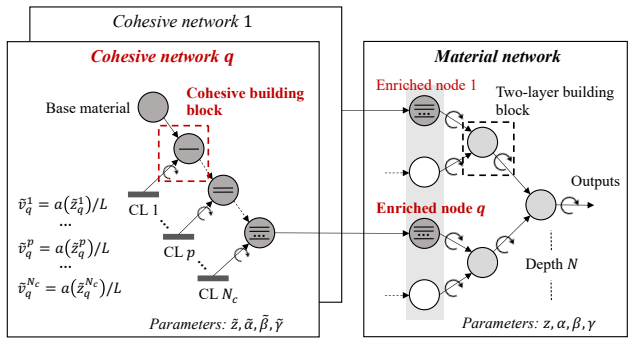
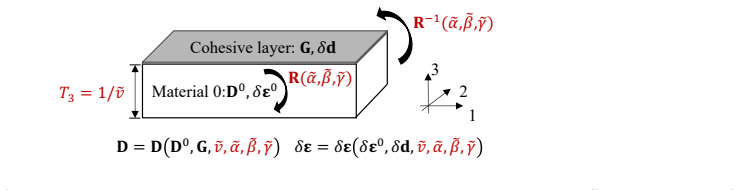
The load-bearing object is the cohesive building block: a planar cohesive layer with zero thickness embedded in a bulk material block, carrying a learned orientation $(\alpha,\beta,\gamma)$ and a ReLU-activated reciprocal length parameter $\tilde{v}=\max(\tilde{z},0)/L$. Physically, $\tilde{v}$ is the inverse effective thickness of the block normal to the layer, so it converts separation displacements into strain; when $\tilde{v}=0$ the layer is inert and the block is perfectly bonded. Because the layer contributes additively to the compliance matrix and linearly to the residual strain, the entire network stays differentiable, enabling gradient-based training, and layers sharing a normal direction can be merged to compress the model. The two-stage training strategy is the second carrier of the argument: stage I fits the material network to elastic two-phase data; stage II keeps those weights frozen and fits only the cohesive orientations and lengths to elastic DNS with interfacial stiffness, so the extrapolation to failure is learned without any nonlinear data.
What would settle it
Run the trained $N=9$, $N_c=4$ network on a biaxial path whose dominant interface normals lie about 30 degrees from any learned cohesive-layer normal and compare against DNS: if the elastic part still matches but the softening slope and failure strain are systematically off, the small-plane geometric proxy is the culprit. A complementary check is to retrain on an RVE with a deliberately bimodal interface orientation distribution and see whether stage-II test error exceeds the 2.45% maximum reported here.
Extended reading notes
Core claim
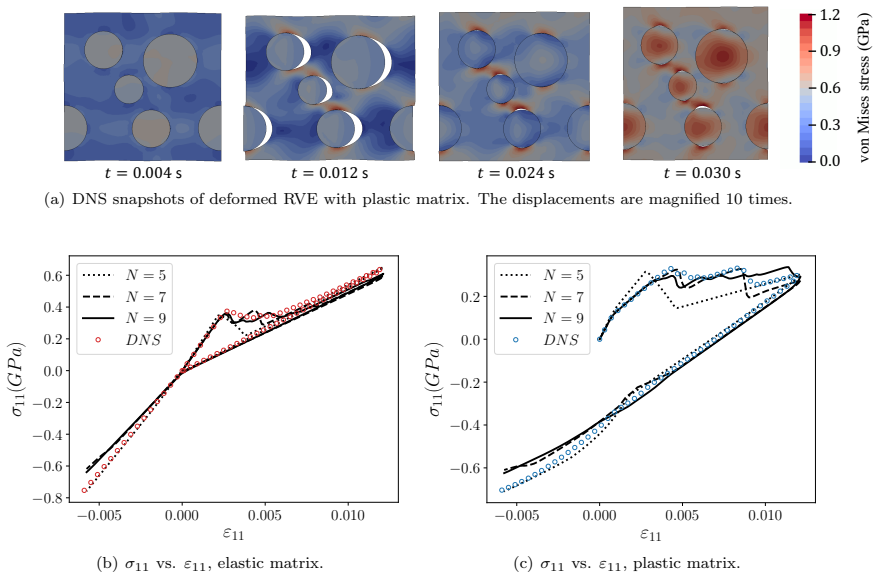
The central claim is that enriching a deep material network with cohesive networks—stacks of planar, zero-thickness cohesive layers with learned orientations and reciprocal-length activations, attached to the active fiber-phase nodes at the bottom layer—lets a network trained only on linear-elastic DNS stiffness tensors predict irreversible softening, mixed-mode debonding. The cohesive building block has an exact analytical form, $D = D_0 + \tilde{v} R \tilde{G} R^{-1}$ for compliance and an analogous linear add-on for residual strain, so gradients flow through the network by backpropagation. Training proceeds in two stages: stage I learns the phase topology from perfectly bonded linear-elastic data; stage II freezes those parameters and fits only the cohesive-layer parameters to linear-elastic data with interfacial stiffness. The resulting network with depth $N=9$ and $N_c=4$ cohesive layers per node matches DNS for transverse tension and compression, transverse shear, and longitudinal shear, with both elastic and elastoplastic matrices, captures interface opening and closure, and estimates local stress and traction distributions, all at more than 6000 times lower CPU time.
Load-bearing premise
The load-bearing premise, stated heuristically in Section 5.3, is that a few flat, learned interfaces (four per node) can stand in for the full orientation distribution of real interfaces, and that this geometric stand-in fitted from linear-elastic data remains faithful when those interfaces soften, fail, and close irreversibly.
Editorial extensions
If this is right
- Only linear-elastic DNS of the RVE is needed offline; the same trained network can then be run under arbitrary loading paths, including loading, unloading, interface closure, and re-debonding.
- Local micromechanical fields—phase stress distributions and interface traction distributions—are available from the reduced model, not just the macroscopic stress–strain response.
- The architecture transfers across microstructures: the particle-reinforced composite in Appendix A uses the same training stages, the same $N_c=4$ default, and shows similar agreement with DNS.
- The reciprocal-length parameter gives a built-in size-effect rule: rescaling the RVE geometry by a factor just rescales all $\tilde{v}$ by the inverse factor without retraining, so the same network covers a family of microstructure sizes.
- Speedups of this magnitude make concurrent multiscale simulation with interfacial failure practical: the online cost moves from hours per RVE on many cores to tens of seconds on one core.
Reading between the lines
- A testable extension the paper does not run: hold the trained network fixed and vary the cohesive-law parameters ($\sigma_c$, $G_c$, $\beta$) online; if accuracy degrades sharply, the 'extrapolation to unknown material space' is narrower than the elastic-to-softening demonstration suggests.
- The geometric-proxy assumption implies a scaling law: adding a second family of interfaces with a distinctly different preferential orientation to the RVE should require more than $N_c=4$ cohesive layers; failure to recover accuracy would separate morphological coverage from numerical redundancy.
- Nothing in the building-block derivation requires the cohesive compliance to be isotropic or linear, so the same two-stage scheme could be probed for frictional sliding, rate-dependent interfaces, or coupled normal-shear softening.
- Because cohesive networks are attached only to one phase's active nodes, the method's efficiency is tied to phase contrast and volume fraction; microstructures in which both phases carry comparable interface area would need a modified enrichment and training scheme.
Signed reviews
Editorial analysis
A structured set of objections, weighed in public.
Referee Report
Summary. This paper enriches the deep material network (DMN) with cohesive layers to capture interfacial debonding in heterogeneous materials. The cohesive building block is derived analytically under small strain, introducing a reciprocal length parameter and orientation angles as interpretable fitting parameters. A two-stage training strategy fits the material network and the cohesive networks separately using only linear-elastic DNS stiffness tensors. Online, the network is equipped with an irreversible mixed-mode cohesive law (Camacho-Ortiz) and tested on a unidirectional fiber-reinforced composite under transverse tension/compression, transverse shear, and longitudinal shear, with both elastic and elastoplastic matrices, plus a particle-reinforced example in Appendix A. The reported results show that N=7 and N=9 networks reproduce DNS stress-strain curves well, with more than 6000x CPU speedup for N=9, Nc=4.
Significance. If the extrapolation claim holds, the paper makes a useful contribution: it extends the physically interpretable DMN framework to interfacial failure while keeping offline training linear elastic, and the analytical cohesive building block (Eqs. 2.20-2.28) is a clean derivation. The multi-stage training (Section 3) is well motivated, and the paper reports training/test errors below 1% for N=9. The online validation covers multiple load paths, both elastic and plastic matrices, and includes local field distributions (Section 5.4). The strength of the paper is the coherent analytical formulation and the demonstrated speedup; the main open issue is the quantitative basis for the extrapolation claim and the heuristic choice of Nc.
major comments (3)
- [§5.3, Figs. 9–11] The paper’s central extrapolation claim—that a network trained only on linear-elastic stiffness tensors reproduces irreversible softening interfacial failure—is supported only by visual comparison of stress-strain curves. No quantitative online error metric is reported for the four load paths (transverse tension/compression, transverse shear, longitudinal shear) or for the elastic and plastic matrix cases. The abstract’s word 'accurate' is therefore not backed by numbers. Please report quantitative errors (e.g., relative L2 error on the stress-strain curves, peak-stress error, or dissipated energy error) and, if possible, an accumulated error over the loading-unloading path.
- [§5.3, Eqs. (2.29), (3.4), (4.5)–(4.8)] The choice Nc=4 is justified only by the heuristic in §5.3 that three orthogonal planes can cover a 3D block and that Nc=4 'tends to be sufficient,' and the paper explicitly defers a coherent investigation to future work. This is load-bearing for the extrapolation claim: stage II fits only six linear-elastic stiffness tensors per sample (Eq. 3.4), and Eq. (2.29) shows the cohesive-layer contribution is a sum of rank-updated compliance terms, so multiple orientation sets can match the elastic training data while predicting different normal-vs-shear failure under the Camacho-Ortiz law. Since the online model has no mechanism to add or reorient cohesive layers as damage evolves, all failure directions are fixed by elastic pre-training. Please provide a sensitivity study of online predictions to Nc and to random initializations of the cohesive-network parameters, or revise the extrapolation claim to be explicitly load-path-specific.
- [§3.2, Eq. (3.14); Table 2] The offline training samples log10(Kc_nn*L) in [-3,3], so the largest interface stiffness seen in training is Kc*L = 10^3 GPa, whereas the online interface in Table 2 has K*L = 25000 GPa, a factor of 25 outside the training range. The paper does not comment on this extrapolation gap; either include stiffer interfaces in the training distribution or provide evidence that the elastic-fit and online predictions are insensitive to this mismatch.
minor comments (6)
- [§5.2 and Fig. 8] The text around Figure 8 states the average fiber diameter is 25 mm and the hyper-parameter L is 25 mm, both inconsistent with Eq. (5.1) (L = 2.5 mm) and the earlier statement of average diameter 2.5 mm; please correct the unit/value typo.
- [§4, Eqs. (4.1)–(4.2)] dS is used both as the scalar magnitude (Eq. 4.1) and as the tangential vector (Eq. 4.2); please introduce separate symbols, e.g., d_S and |d_S|.
- [Appendix D, Eqs. (D.3) and (D.6)] The component Kss is listed twice; the second entry appears to be Ktt. Please fix the labels.
- [§5.4, Figs. 12–13] The local field distributions are compared only qualitatively; adding a quantitative distance (e.g., Wasserstein distance or relative histogram error) would strengthen the claim of 'good estimation.'
- [§5.3, speedup statement] The speedup 'more than 6000 times' compares 5.6 h on 10 CPUs (DNS) with 33.3 s on 1 CPU (DMN); please state the normalization (CPU-hours) to make the comparison unambiguous.
- [General] No data or code availability statement is provided; releasing the Python implementation or the training/validation data would improve reproducibility.
Circularity Check
No significant circularity: nonlinear failure responses are validated against DNS and are not used in any training stage.
full rationale
The paper's central predictive claim is that a DMN whose parameters are fitted only to linear-elastic DNS stiffness tensors (training stages I and II, Eqs. 3.2-3.4) can extrapolate to irreversible mixed-mode cohesive failure (Secs. 4-5). The stage-II cost function (Eq. 3.4) contains only the linear-elastic overall stiffness tensors; the Camacho-Ortiz parameters (K, σc, Gc, β) in Table 2 are prescribed problem data rather than learned parameters, and the nonlinear DNS results in Figs. 9-11 are used for validation only. The online stress-strain curves are therefore not equal by construction to any fitted quantity. The cohesive building block (Eqs. 2.27-2.28) is an analytic homogenization of a planar interface in series with bulk material, and the same form is applied incrementally to the tangent compliance of the softening law; this is a stated modeling assumption, not a tautology. The paper's own caveat in Sec. 5.3 that Nc=4 "tends to be sufficient" and "will be investigated more coherently in the future" is a genuine limitation about whether elastic-only training fixes the needed failure orientations, but it concerns extrapolation robustness and correctness risk, not circularity. The reliance on the author's prior DMN framework [40,41] is self-citation, but it is background architecture; the new cohesive-layer enrichment, its training, and the nonlinear validation are carried out here against independent DNS, so the central claim does not reduce to a self-citation chain.
Assumptions & free parameters
free parameters (6)
- z_j (material network node activations) =
learned, values not reported
- alpha, beta, gamma (material network rotation angles) =
learned, values not reported
- tilde z_p_q (cohesive layer activations) =
learned, values not reported
- tilde alpha, tilde beta, tilde gamma (cohesive layer orientations) =
learned, values not reported
- characteristic length L =
2.5 mm (UD RVE), 5.0 mm (particle RVE)
- network depth N and cohesive layer count Nc =
N=9, Nc=4 chosen for final results
assumptions (6)
- domain assumption The 3D RVE can be represented by a binary tree of two-layer blocks with unknown phase fractions and orientations (Section 2, Eqs 2.1 to 2.2).
- domain assumption Training on linear-elastic DNS stiffness tensors is sufficient to learn a network that extrapolates to nonlinear path-dependent cohesive failure (Section 3 opening).
- domain assumption A zero-thickness cohesive layer contributes a compliance term proportional to the reciprocal length parameter, added linearly to the bulk compliance (Eqs 2.23 to 2.27).
- ad hoc to paper Nc=4 cohesive layers per enriched node suffice to represent interface orientation effects (Section 5.3).
- domain assumption The Camacho-Ortiz bilinear irreversible cohesive law with viscous regularization is the correct online constitutive model (Section 4).
- standard math Small-strain kinematics and Mandel vector notation apply (Section 2.3).
Cite this review
Pith. "Pith review of Deep material network with cohesive layers: Multi-stage training and interfacial failure analysis." pith.science (2026). https://pith.science/paper/TJM6HZNS
@misc{pith2026190804858,
  author       = {Pith},
  title        = {Pith review of: Deep material network with cohesive layers: Multi-stage training and interfacial failure analysis},
  year         = {2026},
  howpublished = {\url{https://pith.science/paper/TJM6HZNS}},
  note         = {Machine review of arXiv:1908.04858}
}
read the original abstract
A fundamental issue in multiscale materials modeling and design is the consideration of traction-separation behavior at the interface. By enriching the deep material network (DMN) with cohesive layers, the paper presents a novel data-driven material model which enables accurate and efficient prediction of multiscale responses for heterogeneous materials with interfacial effect. In the newly invoked cohesive building block, the fitting parameters have physical meanings related to the length scale and orientation of the cohesive layer. It is shown that the enriched material network can be effectively optimized via a multi-stage training strategy, with training data generated only from linear elastic direct numerical simulation (DNS). The extrapolation capability of the method to unknown material and loading spaces is demonstrated through the debonding analysis of a unidirectional fiber-reinforced composite, where the interface behavior is governed by an irreversible softening mixed-mode cohesive law. Its predictive accuracy is validated against the nonlinear path-dependent DNS results, and the reduction in computational time is particularly significant.
Figures

Figures from the paper (10 more)




Reference graph
Works this paper leans on
- [1]
-
[2]
S. Cantournet, R. Desmorat, J. Besson, Mullins effect and cyclic stress softening of filled elastomers by internal sliding and friction thermodynamics model, International Journal of Solids and Structures 46 (11-12) (2009) 2255–2264
work page 2009
-
[3]
F. J. Vernerey, C. McVeigh, W. K. Liu, B. Moran, D. Tewari, D. M. Parks, G. B. Olson, The 3-d computational modeling of shear-dominated ductile failure in steel, Jom 58 (12) (2006) 45–51
work page 2006
-
[4]
C. McVeigh, F. Vernerey, W. K. Liu, B. Moran, G. Olson, An interactive micro-void shear localization mechanism in high strength steels, Journal of the Mechanics and Physics of Solids 55 (2) (2007) 225–244
work page 2007
- [5]
-
[6]
H. D. Espinosa, P. D. Zavattieri, A grain level model for the study of failure initiation and evolution in polycrystalline brittle materials. part i: Theory and numerical implementation, Mechanics of Materials 35 (3-6) (2003) 333–364
work page 2003
-
[7]
A. Needleman, A continuum model for void nucleation by inclusion debonding, Journal of applied mechanics 54 (3) (1987) 525–531
work page 1987
-
[8]
H. Duan, J.-x. Wang, Z. Huang, B. L. Karihaloo, Size-dependent effective elastic constants of solids containing nano- inhomogeneities with interface stress, Journal of the Mechanics and Physics of Solids 53 (7) (2005) 1574–1596
work page 2005
Show all 43 references
-
[9]
J. D. Eshelby, The determination of the elastic field of an ellipsoidal inclusion, and related problems, Proc. R. Soc. Lond. A 241 (1226) (1957) 376–396
1957
-
[10]
T. Mori, K. Tanaka, Average stress in matrix and average elastic energy of materials with misfitting inclusions, Acta metallurgica 21 (5) (1973) 571–574
1973
-
[11]
Hill, A self-consistent mechanics of composite materials, Journal of the Mechanics and Physics of Solids 13 (4) (1965) 213–222
R. Hill, A self-consistent mechanics of composite materials, Journal of the Mechanics and Physics of Solids 13 (4) (1965) 213–222
1965
-
[12]
Qu, The effect of slightly weakened interfaces on the overall elastic properties of composite materials, Mechanics of Materials 14 (4) (1993) 269–281
J. Qu, The effect of slightly weakened interfaces on the overall elastic properties of composite materials, Mechanics of Materials 14 (4) (1993) 269–281
1993
-
[13]
H. Tan, Y. Huang, C. Liu, P. H. Geubelle, The mori–tanaka method for composite materials with nonlinear interface debonding, International Journal of Plasticity 21 (10) (2005) 1890–1918
2005
-
[14]
M. G. Geers, V. G. Kouznetsova, W. Brekelmans, Multi-scale computational homogenization: Trends and challenges, Journal of computational and applied mathematics 234 (7) (2010) 2175–2182
2010
-
[15]
K. Park, G. H. Paulino, Cohesive zone models: a critical review of traction-separation relationships across fracture surfaces, Applied Mechanics Reviews 64 (6) (2011) 060802
2011
-
[16]
G. T. Camacho, M. Ortiz, Computational modelling of impact damage in brittle materials, International Journal of solids and structures 33 (20-22) (1996) 2899–2938
1996
-
[17]
Ortiz, A
M. Ortiz, A. Pandolfi, Finite-deformation irreversible cohesive elements for three-dimensional crack-propagation analysis, International journal for numerical methods in engineering 44 (9) (1999) 1267–1282
1999
-
[18]
Hettich, E
T. Hettich, E. Ramm, Interface material failure modeled by the extended finite-element method and level sets, Computer Methods in Applied Mechanics and Engineering 195 (37-40) (2006) 4753–4767
2006
-
[19]
Belytschko, R
T. Belytschko, R. Gracie, G. Ventura, A review of extended/generalized finite element methods for material modeling, Modelling and Simulation in Materials Science and Engineering 17 (4) (2009) 043001
2009
-
[20]
X. Deng, A. Korobenko, J. Yan, Y. Bazilevs, Isogeometric analysis of continuum damage in rotation-free composite shells, Computer Methods in Applied Mechanics and Engineering 284 (2015) 349–372
2015
-
[21]
Bazilevs, M
Y. Bazilevs, M. Pigazzini, A. Ellison, H. Kim, A new multi-layer approach for progressive damage simulation in composite laminates based on isogeometric analysis and kirchhoff–love shells. part i: basic theory and modeling of delamination and transverse shear, Computational Mec...
2018
-
[22]
J. Zhao, O. Y. Kontsevoi, W. Xiong, J. Smith, Simulation-aided constitutive law development–assessment of low triaxiality void nucleation models via extended finite element method, Journal of the Mechanics and Physics of Solids 102 (2017) 30–45
2017
-
[23]
Z. Liu, M. Fleming, W. K. Liu, Microstructural material database for self-consistent clustering analysis of elastoplastic strain softening materials, Computer Methods in Applied Mechanics and Engineering 330 (2018) 547–577
2018
-
[24]
Z. Liu, C. Wu, M. Koishi, Transfer learning of deep material network for seamless structure–property predictions, Com- putational Mechanics 64 (2) (2019) 451–465
2019
-
[25]
Ghosh, Y
S. Ghosh, Y. Ling, B. Majumdar, R. Kim, Interfacial debonding analysis in multiple fiber reinforced composites, Mechanics of Materials 32 (10) (2000) 561–591
2000
-
[26]
Ghosh, J
S. Ghosh, J. Bai, P. Raghavan, Concurrent multi-level model for damage evolution in microstructurally debonding com- posites, Mechanics of Materials 39 (3) (2007) 241–266
2007
-
[27]
Oskay, J
C. Oskay, J. Fish, Eigendeformation-based reduced order homogenization for failure analysis of heterogeneous materials, Computer Methods in Applied Mechanics and Engineering 196 (7) (2007) 1216 – 1243
2007
-
[28]
Z. Yuan, J. Fish, Multiple scale eigendeformation-based reduced order homogenization, Computer Methods in Applied Mechanics and Engineering 198 (21-26) (2009) 2016–2038
2009
-
[29]
Zhang, C
X. Zhang, C. Oskay, Eigenstrain based reduced order homogenization for polycrystalline materials, Computer Methods in Applied Mechanics and Engineering 297 (2015) 408–436
2015
-
[30]
Z. Liu, M. Bessa, W. K. Liu, Self-consistent clustering analysis: An efficient multi-scale scheme for inelastic heterogeneous materials, Computer Methods in Applied Mechanics and Engineering 306 (2016) 319–341. 25
2016
-
[31]
Z. Liu, O. L. Kafka, C. Yu, W. K. Liu, Data-driven self-consistent clustering analysis of heterogeneous materials with crystal plasticity, in: Advances in Computational Plasticity, Springer, 2018, pp. 221–242
2018
-
[32]
Shakoor, J
M. Shakoor, J. Gao, Z. Liu, W. K. Liu, A data-driven multiscale theory for modeling damage and fracture of composite materials, in: International Workshop on Meshfree Methods for Partial Differential Equations, Springer, 2017, pp. 135–148
2017
-
[33]
H. Li, O. L. Kafka, J. Gao, C. Yu, Y. Nie, L. Zhang, M. Tajdari, S. Tang, X. Guo, G. Li, et al., Clustering discretization methods for generation of material performance databases in machine learning and design optimization, Computational Mechanics 64 (2) (2019) 281–305
2019
-
[34]
Oliver, M
J. Oliver, M. Caicedo, A. Huespe, J. Hern´ andez, E. Roubin, Reduced order modeling strategies for computational multiscale fracture, Computer Methods in Applied Mechanics and Engineering 313 (2017) 560–595
2017
-
[35]
Ghaboussi, J
J. Ghaboussi, J. Garrett Jr, X. Wu, Knowledge-based modeling of material behavior with neural networks, Journal of engineering mechanics 117 (1) (1991) 132–153
1991
-
[36]
B. Le, J. Yvonnet, Q.-C. He, Computational homogenization of nonlinear elastic materials using neural networks, Inter- national Journal for Numerical Methods in Engineering 104 (12) (2015) 1061–1084
2015
-
[37]
Bessa, R
M. Bessa, R. Bostanabad, Z. Liu, A. Hu, D. Apley, C. Brinson, W. Chen, W. Liu, A framework for data-driven analysis of materials under uncertainty: Countering the curse of dimensionality, Computer Methods in Applied Mechanics and Engineering 320 (2017) 633–667
2017
-
[38]
K. Wang, W. Sun, A multiscale multi-permeability poroplasticity model linked by recursive homogenizations and deep learning, Computer Methods in Applied Mechanics and Engineering 334 (2018) 337–380
2018
-
[39]
K. Wang, W. Sun, Meta-modeling game for deriving theory-consistent, microstructure-based traction–separation laws via deep reinforcement learning, Computer Methods in Applied Mechanics and Engineering 346 (2019) 216–241
2019
-
[40]
Z. Liu, C. T. Wu, M. Koishi, A deep material network for multiscale topology learning and accelerated nonlinear modeling of heterogeneous materials, Computer Methods in Applied Mechanics and Engineering 345 (2019) 1138–1168
2019
-
[41]
Z. Liu, C. Wu, Exploring the 3d architectures of deep material network in data-driven multiscale mechanics, Journal of the Mechanics and Physics of Solids 127 (2019) 20 – 46
2019
-
[42]
Banerjee, K
R. Banerjee, K. Sagiyama, G. Teichert, K. Garikipati, A graph theoretic framework for representation, exploration and analysis on computed states of physical systems, Computer Methods in Applied Mechanics and Engineering 351 (2019) 501–530
2019
-
[43]
Y. Gao, A. Bower, A simple technique for avoiding convergence problems in finite element simulations of crack nucleation and growth on cohesive interfaces, Modelling and Simulation in Materials Science and Engineering 12 (3) (2004) 453. 26
2004
Reviewed August 14, 2026 · model on record in the stance chip above.
Discussion (0). Continue with ORCID to comment.