REVIEW 3 major objections 4 minor 1 cited by
A curious behavior of three-dimensional lattice Dirac operators coupled to monopole background
T0 review · 3 major / 4 minor · reviewed 2026-08-14 · deepseek-v4-flash
Pith's one-line read Only the overlap Dirac operator preserves the parity-doubled spectrum in a singular monopole background.
desk verdict A careful spectral comparison showing naive and Wilson fermions break parity-doubling in a monopole background while overlap preserves it exactly, though the 'properly regulated' conclusion is stronger than the evidence supports. read the letter →
The pith
A machine-rendered reading of the paper's core claim, the machinery that carries it, and where it could break.
The reading
What carries the argument
The argument is carried by three operators and one symmetry. The background is a non-compact flux $B_{12}(n)=2\pi Q$ on a single plaquette in the $z$-direction for $1\le n_3\le s$, minimized by the non-compact Wilson action to give link fields $\theta_\mu(n)$; the symmetry is parity combined with a translation $t=(-1,-1,s+1-L)$, written as $\bar P = P\tau_t$, which satisfies $T_\mu^\dagger = \bar P T_\mu \bar P^\dagger$ (Eq. (17)). Against this background, the paper studies $D_{\rm naive}^\dagger D_{\rm naive}$ for the naive operator, $X^\dagger X$ for Wilson with $X = B - m_w + D_{\rm naive}$, and $D_o^\dagger D_o = (2+V+V^\dagger)/4$ with $V = X(X^\dagger X)^{-1/2}$ for the overlap operator. Since $\bar P^\dagger V \bar P = V^\dagger$, the eigenvalues of $V$ come in conjugate pairs and the overlap spectrum is automatically doubly degenerate; no analogous statement holds for $X$, which is why Wilson breaks parity doubling.
What would settle it
Recompute the two lowest eigenvalues of the massless Wilson-Dirac operator for the same monopole-anti-monopole pair using the alternative link-integrated background construction the paper set aside, taking $L\to\infty$ at fixed $s/L$. If the two eigenvalues become degenerate in that discretization, the reported breaking of parity doubling is an artifact of the specific lattice realization rather than a property of the singular field itself.
Extended reading notes
Core claim
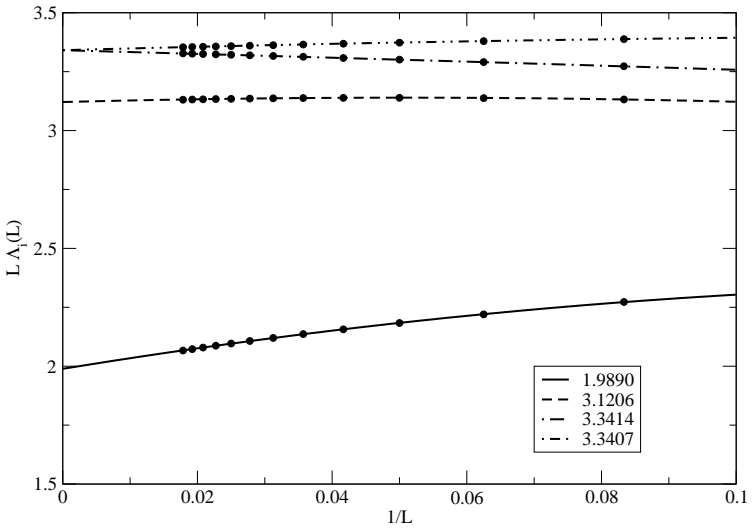
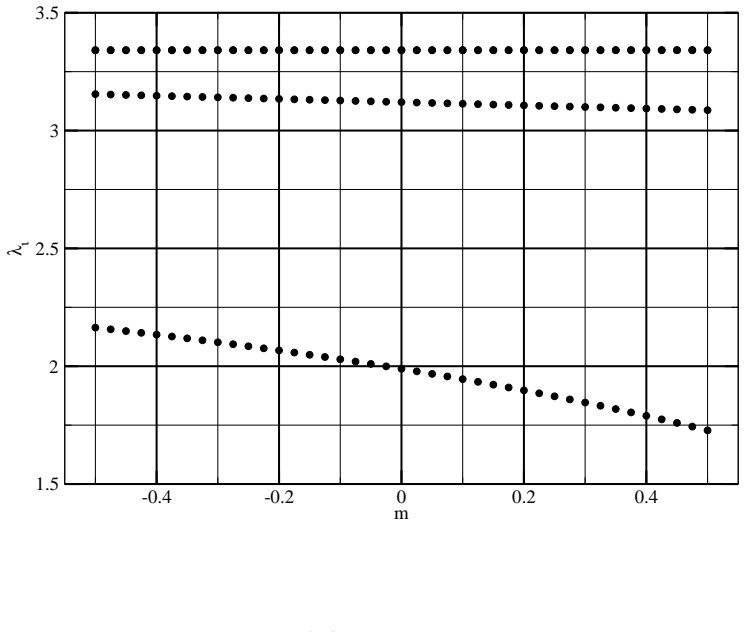
The central discovery is that three standard lattice Dirac operators respond differently to the same singular background. For the parity-translation invariant monopole pair defined by the flux in Eq. (5), the continuum-like expectation is a twofold degeneracy of every eigenvalue of $D^\dagger D$. The naive-Dirac operator satisfies the parity relation and therefore shows parity doubling, but it breaks the degeneracy among fermion-doubler modes for the $Q$ lowest eigenvalues in the continuum limit. The Wilson-Dirac operator removes the doublers, but the two lowest eigenvalues of $X^\dagger X$ approach different limits as $L\to\infty$, so the expected parity doubling is not recovered for $Q=1$; the third and fourth eigenvalues do pair up. The overlap-Dirac operator, built from $V = X(X^\dagger X)^{-1/2}$, satisfies $\bar P^\dagger V \bar P = V^\dagger$, which forces a double degeneracy in $D_o^\dagger D_o$ for every mode; numerically this degeneracy is seen already at finite $L$, with no doublers, and the low-lying spectrum is essentially independent of the Wilson kernel mass for $m_w > 0.3$. The paper therefore singles out the overlap operator as the only properly regulated continuum Dirac operator in this singular background, at the price of an algorithmic difficulty: the Wilson kernel $X$ develops an exponentially small eigenvalue for $m_w > 0$.
Load-bearing premise
The whole comparison rests on the assumption that the paper's lattice version of the monopole-anti-monopole background is the right stand-in for the continuum field, so the expected twofold degeneracy is the correct thing to look for.
Editorial extensions
If this is right
- Massless Wilson-Dirac fermions do not recover the expected twofold degeneracy in the continuum limit for $Q=1$; the splitting between the two lowest eigenvalues grows with charge, with two anomalous eigenvalues at $Q=2$.
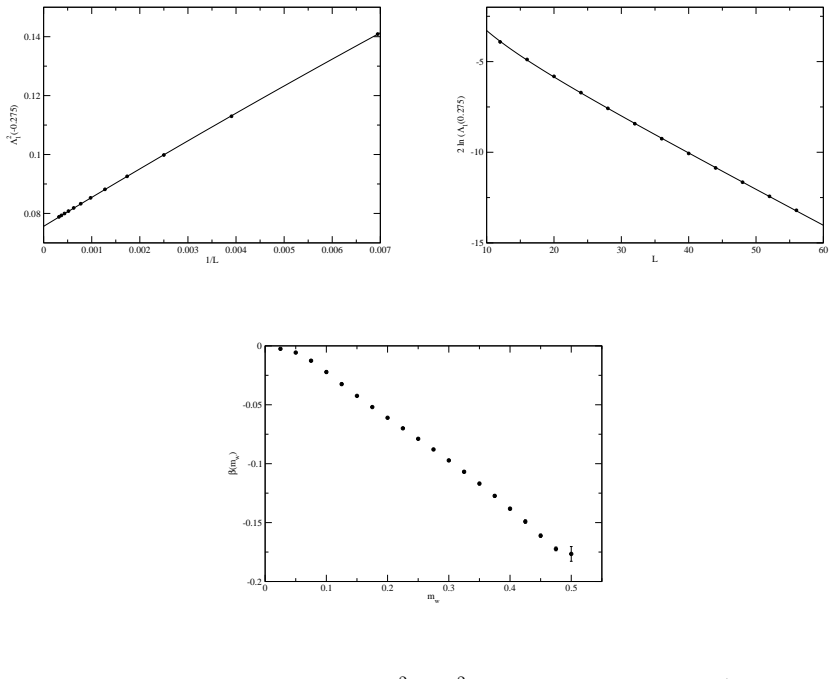
- The anomalously small eigenvalue of the Wilson kernel $X$ for $m_w>0$ decays exponentially with $L$, making overlap computations progressively more expensive as the lattice grows.
- For the overlap operator, the low-lying spectrum is essentially independent of the Wilson kernel mass once $m_w>0.3$, the behavior expected from a proper regulator.
- Naive and massless Wilson spectra agree in the continuum limit at $Q=1$, so the lowest-eigenvalue splitting is a property of the singular background rather than of the Wilson term alone.
Reading between the lines
- The paper's conclusion is tied to the particular discretization in Eq. (5); an equally natural link-integrated construction of the same continuum field was set aside, and rerunning the eigenvalue analysis there would show whether the Wilson splitting is a discretization artifact.
- The $Q=2$ results hint at a counting rule: each unit of monopole charge contributes one anomalously small eigenvalue to $X^\dagger X$ for $m_w>0$, which would make the cost of overlap simulations in compact QED scale with the total monopole number.
- The parity-doubling diagnostic used here is cheap and could be applied to any new lattice fermion formulation before it is used in dynamical simulations.
Signed reviews
Editorial analysis
A structured set of objections, weighed in public.
Referee Report
Summary. The paper studies the low-lying eigenvalues of three lattice Dirac operators (naive, Wilson, and overlap) coupled to a fixed compact U(1) background on an L^3 torus representing a monopole-antimonopole pair of charge ±Q separated by a distance s = L/4. Because the background is invariant under the combined parity-translation operator \bar P = P τ_t defined in Eq. (17), the continuum Dirac operator is expected to have doubly degenerate eigenvalues, and the paper uses this parity-doubling as a diagnostic. The numerical results show that the naive-Dirac operator has an eight- or four-fold degeneracy rather than the expected sixteen-fold degeneracy for the Q lowest eigenvalues, that the Wilson-Dirac operator lifts the doublers but splits the lowest two-fold degenerate level, and that the overlap-Dirac operator has exactly doubly degenerate eigenvalues by virtue of Eqs. (35)-(37). The paper concludes that the overlap operator is the only properly regulated continuum Dirac operator in this singular background, and it further reports an exponentially small lowest eigenvalue of the Wilson-Dirac kernel for m_w > 0 that makes overlap simulations numerically difficult, with the effect growing with Q.
Significance. The paper is a careful numerical study of a specific singular background and contains several useful observations. The construction of a parity-invariant monopole-antimonopole background, the clean algebraic derivation of the overlap degeneracy, and the explicit demonstration of the Wilson-kernel eigenvalue collapse are strengths. The comparison among naive, Wilson, and overlap operators is internally consistent, and the reported exponential small eigenvalue is a practical caution for numerical work in compact QED. However, the headline claim that the overlap operator 'singles out as a properly regulated continuum Dirac operator' is not established by the data, because the overlap degeneracy is exact by construction and no independent continuum spectrum is computed. The paper is therefore significant as a numerical observation, but its interpretive conclusion needs additional support.
major comments (3)
- [Section V, Eqs. (35)-(37)] The two-fold degeneracy of D_o†D_o is an algebraic consequence of \bar P† V \bar P = V† and the unitarity of V, as the paper itself states. Figures 7 and 8 therefore confirm that the numerical implementation respects this identity, but they do not test whether the limiting overlap eigenvalues λ_i^o coincide with the spectrum of the continuum Dirac operator in the same background. The conclusion in the abstract that the overlap operator 'singles out as a properly regulated continuum Dirac operator' requires an independent benchmark, such as a calculation of the parity-doubled spectrum of the continuum Dirac operator in a singular monopole-antimonopole background, or agreement with a known continuum value. Without such a benchmark, the comparison among lattice operators is internal to the lattice regulators and does not validate the 'properly regulated continuum' claim.
- [Section IIC, Eq. (19), and Eq. (27)] The background does not have a standard continuum limit: Eq. (19) gives p(L) ≈ 3.271/L^2, so the total gauge action grows linearly with L and the link variables θμ(n) do not scale as 1/L. The extrapolation Λ_i L = λ_i + α_i/L + β_i/L^2 in Eq. (27) is an ansatz whose validity is not demonstrated for the L values used, and its use is especially delicate given the exponential behavior of the Wilson kernel reported in Sec. IVB. The claim that the overlap operator is properly regulated in the L→∞ limit at fixed s/L would be substantially strengthened if the extrapolated λ_i were compared with a separately defined continuum spectrum for the same singular background; as it stands, the continuum-limit interpretation rests entirely on the scaling ansatz.
- [Section II, Eq. (5)] The background is constructed by minimizing the non-compact action in the presence of a non-compact flux on a line of plaquettes, and the paper explicitly says this is a 'minor change' from the link-integrated construction in Eq. (4) used in Ref. [19]. The central observations in Secs. III and IV—the degeneracy breaking for naive and Wilson fermions and the exponential small Wilson eigenvalue—are not tested under that alternative discretization or under other positions or orientations of the flux line. Because the paper draws general conclusions about lattice Dirac operators coupled to singular monopole backgrounds, a robustness check with respect to the background discretization is needed; otherwise the reported phenomena could be specific to the particular plaquette-flux construction in Eq. (5).
minor comments (4)
- [Section IV] In the first paragraph of Section IV, 'Fo our particular background' should be 'For our particular background'.
- [Figure 6] In the top-right panel, the vertical axis label and the text describing the plot should be made consistent: the text says log(Λ_1^2) is plotted against L, while the axis label reads '2 ln(Λ_1(0.275))'; please also state the fit range used for the exponential fit.
- [Figure 9] For the Q=2 case, the right panel shows LΛ_i(L) but no fit to Eq. (27) and no extrapolated λ_i values are quoted; adding them would allow the reader to compare the Q=2 splitting with the Q=1 results in Figure 3.
- [Section IID] Equation (21) is stated for a parity-invariant field up to a gauge transformation; the paper should state explicitly how this gauge equivalence is handled in the eigenvalue argument, since the lattice implementation uses the combined operation \bar P = P τ_t rather than a pure parity transformation.
Circularity Check
No significant circularity: the parity-doubling benchmark is derived from the continuum operator, and the overlap degeneracy is an explicitly proved symmetry consequence rather than a fitted or renamed input.
full rationale
The paper's central comparison is not circular. The reference diagnostic, two-fold degeneracy of (D_cont)^† D_cont, is derived in Sec. II.D from the continuum anti-commutation relation (Eq. (21)), not from any fitted lattice quantity. The overlap-Dirac degeneracy is then shown in Sec. V to follow algebraically from Eq. (35), [P̄^† V P̄] = V^†, which is a direct consequence of the parity symmetry of the background (Eq. (17)) and the definition V = X (X^† X)^{-1/2}. The paper states this derivation explicitly, so it is a proved theorem, not a concealed circular step. The genuinely empirical content lies in the naive- and Wilson-Dirac results: the breaking of the doubler degeneracy in the Q lowest eigenvalues for naive fermions and the breaking of parity-doubling for Wilson fermions are extracted from data via the extrapolation Eq. (27) and are not equivalent to the inputs that define the operators. The only fitted parameters are the extrapolation coefficients, which describe the spectra rather than serve as the predicted quantity. The citation to Ref. [19] is for the background construction and is not load-bearing; the present paper defines its own background in Sec. II.A with an explicitly stated modification. The absence of an independent continuum spectrum for the singular background is a limitation on interpretation, but it is not a circularity: the paper does not define 'properly regulated' as equivalent to the overlap construction, and the comparative failure of naive and Wilson fermions is an independent numerical observation.
Assumptions & free parameters
free parameters (2)
- Q =
1
- f = s/L =
1/4
assumptions (4)
- domain assumption The continuum Dirac operator in a parity-invariant background satisfies P D_cont P = -D_cont, so (D_cont)†D_cont has a two-fold degenerate spectrum.
- domain assumption The lattice monopole-anti-monopole background of Eq. (5), with links obtained by minimizing the non-compact action (Eq. 7), is parity-invariant under \bar P = Pτ_t with t=(-1,-1,s+1-L) (Eq. 17).
- ad hoc to paper The L→∞ limit at fixed f=s/L is a valid continuum limit for the fermion spectrum even though the background gauge field fails the usual scaling (action per lattice site p(L) ~ 1/L^2 instead of 1/L^4, Eq. 19).
- ad hoc to paper Each eigenvalue extrapolates as Λ_i L = λ_i + α_i/L + β_i/L^2 (Eq. 27) for the L values used.
Cite this review
Pith. "Pith review of A curious behavior of three-dimensional lattice Dirac operators coupled to monopole background." pith.science (2026). https://pith.science/paper/MGJYTBJI
@misc{pith2026190805284,
  author       = {Pith},
  title        = {Pith review of: A curious behavior of three-dimensional lattice Dirac operators coupled to monopole background},
  year         = {2026},
  howpublished = {\url{https://pith.science/paper/MGJYTBJI}},
  note         = {Machine review of arXiv:1908.05284}
}
abstract
We investigate numerically the effect of regulating fermions in the presence of singular background fields in three dimensions. For this, we couple free lattice fermions to a background compact U(1) gauge field consisting of a monopole-anti-monopole pair of magnetic charge $\pm Q$ separated by a distance $s$ in a periodic $L^3$ lattice, and study the low-lying eigenvalues of different lattice Dirac operators under a continuum limit defined by taking $L\to\infty$ at fixed $s/L$. As the background gauge field is parity even, we look for a two-fold degeneracy of the Dirac spectrum that is expected of a continuum-like Dirac operator. The naive-Dirac operator exhibits such a parity-doubling, but breaks the degeneracy of the fermion-doubler modes for the $Q$ lowest eigenvalues in the continuum limit. The Wilson-Dirac operator lifts the fermion-doublers but breaks the parity-doubling in the $Q$ lowest modes even in the continuum limit. The overlap-Dirac operator shows parity-doubling of all the modes even at finite $L$ that is devoid of fermion-doubling, and singles out as a properly regulated continuum Dirac operator in the presence of singular gauge field configurations albeit with a peculiar algorithmic issue.
Figures


Figures from the paper (6 more)



Forward citations
Cited by 1 Pith paper
-
Numerical determination of monopole scaling dimension in parity-invariant three-dimensional non-compact QED
Monte Carlo measurement gives monopole scaling dimension Delta(12)=3.24(24), consistent with large-N theory, and positive finite-N corrections for N=2,4 that disagree in sign with the leading 1/N expansion.
Reference graph
Works this paper leans on
-
[19]
Domain Wall Fermions for Planar Physics
S. Hands, JHEP 09, 047 (2015), 1507.07717
work page Pith review arXiv 2015
-
[1]
as a function of L where we observe a good description of the large L data by a simple exp (−β(0.275)L) shown by the line. On the other hand, the higher eigenvalues are gapped at finite mw > 0 for L→∞ as we would naively expect. If we examine the dependence of the β(mw) as a function of mw, we find β(0) is consistent with zero and increases with mw as shown...
- [2]
- [3]
-
[4]
We will work with L that are multiples of 4 fromL = 12 toL = 56. At the end we will study Wilson-Dirac fermions with Q = 2 in order to make some conclusions about the study of compact QED using Wilson-Dirac and overlap-Dirac fermions. 8 0 0.05 0.1 1/L 2 2.5 3 L Λ i (L) 1.9620 3.1088 3.3405 3.3416 0 0.05 0.1 1/L 1.5 2 2.5 3 L Λ i (L) 1.318 2.3738 2.9807 3....
- [5]
-
[6]
Flavor and topological current correlators in parity-invariant three-dimensional QED
N. Karthik and R. Narayanan, Phys. Rev. D96, 054509 (2017), 1705.11143
work page Pith review arXiv 2017
- [7]
Show all 26 references
-
[8]
J. B. Kogut and L. Susskind, Phys. Rev. D11, 395 (1975). 20
1975
-
[9]
Gattringer and C
C. Gattringer and C. B. Lang, Lect. Notes Phys. 788, 1 (2010)
2010
-
[10]
Creutz, PoS CONFINEMENT8, 016 (2008), 0810.4526
M. Creutz, PoS CONFINEMENT8, 016 (2008), 0810.4526
2008 arXiv
- [11]
- [12]
-
[13]
Creutz, PoS LATTICE2007, 007 (2007), 0708.1295
M. Creutz, PoS LATTICE2007, 007 (2007), 0708.1295
2007 arXiv
- [14]
-
[15]
Redlich, Phys.Rev
A. Redlich, Phys.Rev. D29, 2366 (1984)
1984
-
[16]
Niemi and G
A. Niemi and G. Semenoff, Phys.Rev.Lett. 51, 2077 (1983)
1983
-
[17]
Coste and M
A. Coste and M. Luscher, Nucl.Phys. B323, 631 (1989)
1989
- [18]
- [20]
- [21]
-
[22]
Ya. M. Shnir, Magnetic monopoles (2005), URL http://www.springer.com/book/ 3-540-25277-0
2005
-
[23]
Kalkreuter and H
T. Kalkreuter and H. Simma, Comput. Phys. Commun. 93, 33 (1996), hep-lat/9507023
1996 arXiv
-
[24]
van den Eshof, A
J. van den Eshof, A. Frommer, T. Lippert, K. Schilling, and H. A. van der Vorst, Comput. Phys. Commun. 146, 203 (2002), hep-lat/0202025
2002 arXiv
-
[25]
Chiu, T.-H
T.-W. Chiu, T.-H. Hsieh, C.-H. Huang, and T.-R. Huang, Phys. Rev. D66, 114502 (2002), hep- lat/0206007
2002
-
[26]
R. G. Edwards, U. M. Heller, and R. Narayanan, Phys.Rev.D59, 094510 (1999), hep-lat/9811030. 21
1999 arXiv
Reviewed August 14, 2026 · model on record in the stance chip above.
Discussion (0). Continue with ORCID to comment.