REVIEW 3 major objections 5 minor 59 references
Thermodynamics of Cyclic Quantum Amplifiers
T0 review · 3 major / 5 minor · reviewed 2026-08-14 · deepseek-v4-flash
Pith's one-line read A cyclic quantum amplifier can amplify a periodic signal only if a medium-specific coefficient built from jump rates is positive, and qubits and harmonic oscillators fail this test.
desk verdict A solid, genuinely new necessary condition for cyclic quantum amplifiers under Lindblad dynamics, with a real but addressable gap about abrupt temperature switches in the example protocol. read the letter →
The pith
A machine-rendered reading of the paper's core claim, the machinery that carries it, and where it could break.
The reading
What carries the argument
The load-bearing object is the set of coefficients $\Phi_n$ defined by Eq. (10), computed from the ordered squared jump weights $\ell_m^2$ of the Lindblad dissipator together with the ordering function $\pi_k$. The derivation splits the ergotropy production into a manifestly non-positive part and a state-dependent part, then uses the rearrangement inequality to maximize the state-dependent part independently of $\rho_t$. The resulting maximum, $\Phi_{\max}$, is a protocol-independent selector: if it is zero or negative, no periodic temperature protocol can make the reservoir create ergotropy, and hence no coherent output is possible.
What would settle it
Take a two-level quantum ladder and numerically search over all periodic temperature protocols and resonant driving for the maximum cycle-averaged coherent work; the criterion predicts the maximum is zero, so any positive value found would refute the result.
Extended reading notes
Core claim
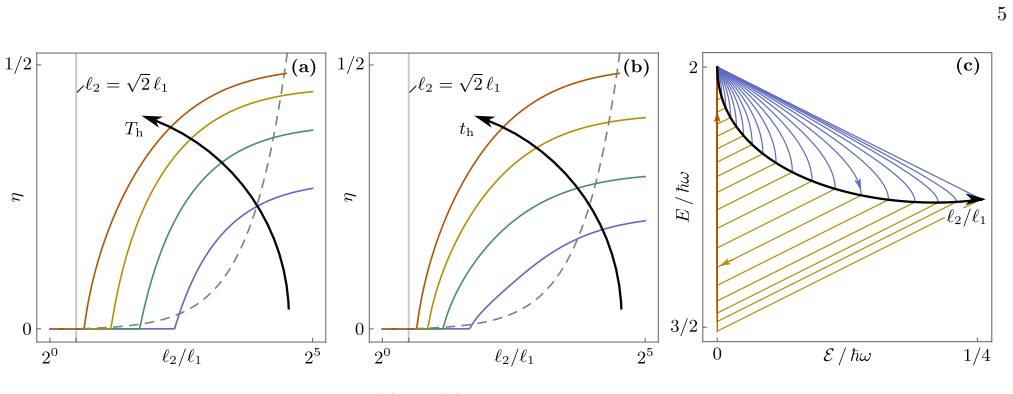
The paper proves that, for any quantum ladder with equally spaced energy levels governed by the Lindblad master equation, the reservoir-induced ergotropy production is bounded by $J_t \le \hbar\omega\gamma \sum_{n=1}^N (r_n^t - r_{n+1}^t) \Phi_n$, where $\Phi_n$ is built only from the jump weights $\ell_m$ of the dissipator. Since the ordered probabilities satisfy $r_n^t \ge r_{n+1}^t$, the bound can be positive only when $\Phi_{\max} \equiv \max_n \Phi_n > 0$. Because the cycle-averaged work equals the cycle-averaged ergotropy production, $\Phi_{\max} \le 0$ makes coherent work extraction impossible for every control protocol and temperature profile. For qubits and harmonic oscillators the calculation gives $\Phi_{\max}=0$; for three-level ladders the criterion is tight in the limit of an infinitely hot and long input stroke, and the efficiency in that limit is $1/2$.
Load-bearing premise
The whole argument assumes the working medium stays in a Markovian, weakly coupled regime even during an abrupt jump in the bath temperature, and that sudden cold stroke is the point where this assumption is most likely to fail.
Editorial extensions
If this is right
- Qubits and quantum harmonic oscillators are excluded as working substances: for both, $\Phi_{\max}=0$, so no periodic temperature protocol can yield positive cycle-averaged coherent work.
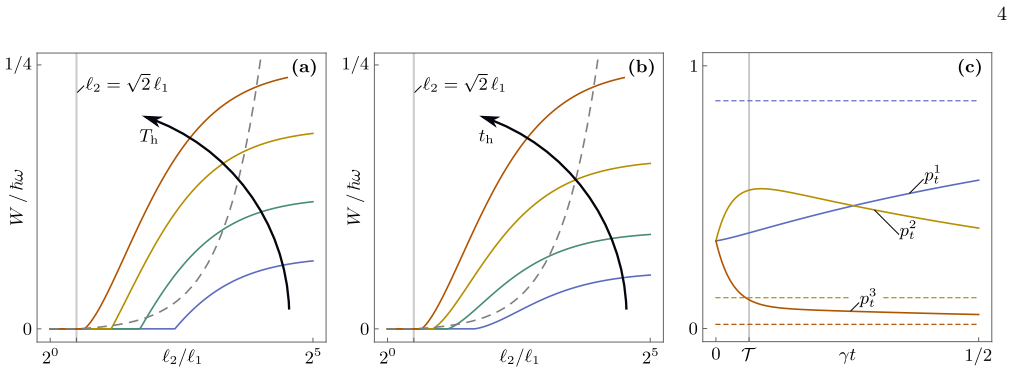
- Three-level quantum ladders satisfy the criterion when $\ell_2 \le \ell_1$ or $\ell_2 \ge \sqrt{2}\,\ell_1$, and in the minimal three-level protocol the criterion is tight.
- The three-level amplifier reaches at most $\eta=1/2$ in the ideal limit, below the Carnot bound for the temperatures considered, because the equidistant spacing costs an equal amount of internal energy during the ergotropy-creating stroke; ladders with more levels can exceed this value.
- For algebraically scaling jump weights $\ell_n=n^\alpha$, the criterion gives $\Phi_{\max}=0$ for $0\le\alpha\le1/2$ regardless of the number of levels, so the squared weights must either decrease with $n$ or grow at least linearly.
- The criterion is only necessary, not sufficient: even a medium with $\Phi_{\max}>0$ needs a suitable driving protocol, so any sufficient condition for power generation must depend on the protocol.
Reading between the lines
- Because $\Phi_{\max}$ depends only on the jump weights, one could exhaustively scan finite ladders to find maximally amplifying level structures; the paper does not carry out such a search.
- The same bounding technique could be applied to composite systems made of several non-interacting ladders or to non-equilibrium reservoirs, although the paper only sketches these possibilities.
- The criterion suggests a design rule for experimental realizations: use a medium with a metastable level and strongly separated relaxation time scales rather than spectral energy filters; the three-level case study supports this reading.
- An open question the paper leaves is whether the $\Phi_{\max}=0$ result for weights $n^\alpha$ with $0\le\alpha\le1/2$ persists for nonlinear dependences of the weights on the level index.
Signed reviews
Editorial analysis
A structured set of objections, weighed in public.
Referee Report
Summary. The paper proposes a model of a cyclic quantum heat engine whose working medium is a quantum ladder with equally spaced levels, coupled to a single reservoir whose temperature is varied periodically. The central result is a necessary condition, Φmax > 0 in Eq. (11), for the possibility of positive reservoir-induced ergotropy production and hence of coherent work extraction. The condition is derived from a time-dependent Lindblad master equation through a rearrangement-inequality bound on the ergotropy production, and it is independent of the driving protocol, the temperature profile, and the instantaneous state. The authors show that qubits and harmonic oscillators have Φmax = 0 and are therefore excluded, while a three-level ladder can satisfy the criterion for certain jump weights. A three-level protocol is analyzed numerically and an efficiency bound η ≤ 1/2 is asserted, together with a numerical extension to algebraically scaling jump weights.
Significance. If the central bound is valid, the paper provides a genuinely parameter-free, protocol-independent necessary condition for coherent power generation in a broad class of cyclic quantum machines. The derivation via the rearrangement inequality is transparent, and the exclusion of qubits and harmonic oscillators is a crisp, falsifiable prediction that does not rely on fitting any free parameter. The paper also gives credit to earlier ergotropy-based frameworks and is careful to note that the criterion is only necessary, not sufficient. The main value is as a classification tool for working media, and the numerical three-level example demonstrates the intended phenomenology. However, the physical applicability of the central criterion inherits the validity assumptions of the Lindblad equation during the very fast temperature strokes used in the protocol, and the efficiency bound is not actually proved. These points need to be resolved before the claims can be taken as fully established.
major comments (3)
- [§II.B and §IV.A] The derivation of Eq. (9) presupposes the time-dependent Lindblad master equation (7) at every instant of the cycle, but the three-level protocol implements stroke 2 by abruptly reducing T_t. The hypotheses stated for Eq. (7) in §II.B, namely weak coupling and driving slow compared with bath relaxation, are not satisfied during such a temperature quench. Since the exclusion claim (11) is the central physical conclusion, a positive J_t arising from transient non-Markovian or initial-slip corrections during the quench would invalidate the conclusion. The authors should either justify the instantaneous Lindblad form for their quench from a microscopic model, replace the abrupt switch by a controlled finite-ramp protocol and show the limit is benign, or quantitatively bound the corrections to the bound (9).
- [§IV.B, Eqs. (23)–(24)] The efficiency bound η ≤ 1/2 is asserted with only the statement that 'it suffices to verify that either J_t ≤ 0 or J_t + tr[ρ˙_t H_t] ≤ 0 holds for any diagonal state,' but no verification is provided. This bound is a load-bearing part of the performance analysis, as the paper presents it as a specific three-level upper bound below Carnot. Please supply the missing proof, or explicitly label the bound as a conjecture supported by numerics.
- [§IV.A and Abstract] The claim that the working criterion is 'tight' for the three-level amplifier is not formulated precisely. The numerical results in Fig. 2 and the limiting argument Th, th → ∞ show that the threshold for positive work approaches the criterion boundary, but this does not constitute a proof that whenever Eq. (18) holds there exists a protocol with W > 0, nor does it clarify in what sense the criterion is sharp for finite-time cycles. Please state the exact tightness statement and either prove it or describe it as numerical evidence.
minor comments (5)
- [§IV.B, Eq. (24)] As printed, Δ2E ≤ −Δ2E is tautologically equivalent to Δ2E ≤ 0; please rewrite the display to show the intended relation between the ergotropy change and the internal-energy loss during stroke 2.
- [§V, Eq. (25)] The statement that Φ_α^max = 0 for 0 ≤ α ≤ 1/2 'irrespective of N' appears to be inferred from Fig. 4 for finitely many values of N. If this is meant as a theorem, a proof should be given; otherwise the claim should be qualified as numerical evidence.
- [§III.B, Eq. (16)] In Eq. (16), π_n is applied to two different sets in the same expression; a short reminder of which set each π_n acts on would improve readability.
- [§IV.A] The phrase 'the bound (18) becomes tight' is confusing because Eq. (18) is a condition on the jump weights, not a bound; please rephrase in terms of the criterion becoming sharp.
- [Fig. 2c] The relaxation time T plotted on the horizontal axis shares its symbol with the temperature T_t used throughout the paper; renaming one of them would avoid confusion.
Circularity Check
No significant circularity: the no-work criterion is derived from the stated Lindblad dynamics and mathematical bounds, not from its conclusion.
full rationale
The paper's central claim is the necessary condition Phi_max > 0 for cyclic quantum amplifiers. This is derived self-contained from the Lindblad master equation (7): the ergotropy balance (3)-(6) follows from the definitions of ergotropy and cyclic states, and the upper bound (9) is obtained through explicitly shown manipulations—decomposition into I1 and I2, the sign of I1, the rearrangement inequality bound (16), and summation by parts (17). No parameter is fitted to force the criterion; Phi_n depends only on the fixed jump weights and level structure, and the qubit and harmonic-oscillator values (12)-(13) are direct evaluations. The three-level example solves the same master equation numerically and is a demonstration, not an input-equivalent prediction. There are self-citations (e.g., Refs. [35], [48], [49], [51]) that supply framework or context, but the load-bearing derivation does not reduce to these citations; the bound is proven in the paper. The main caveat—validity of the time-dependent Lindblad equation during the abrupt temperature drop in stroke 2—is a physical applicability concern, not a circularity: even if the Markovian assumption fails there, the criterion would be an artifact of the model rather than a derivation that presupposes its own conclusion. The short derivation of the efficiency bound (24) is sketched rather than fully displayed, but this omission does not feed the criterion back into its inputs. Overall, no circular step exhibits Eq. X = Eq. Y by construction or a fitted input renamed as a prediction.
Assumptions & free parameters
free parameters (3)
- γ (global relaxation rate) =
1 (in units of inverse time)
- ℓ1 (jump weight of first transition) =
1
- kBTc/ℏω (cold temperature in units of level spacing) =
1/2
assumptions (5)
- domain assumption Lindblad master equation with time-dependent temperature (Eq. 7)
- domain assumption Energy levels are equally spaced, En = nℏω
- standard math Bose-Einstein factors νt enforce local detailed balance
- standard math Rearrangement inequality
- standard math Hellmann-Feynman theorem for the derivative of residual energy
Cite this review
Pith. "Pith review of Thermodynamics of Cyclic Quantum Amplifiers." pith.science (2026). https://pith.science/paper/2AD6UVJZ
@misc{pith2026190805496,
  author       = {Pith},
  title        = {Pith review of: Thermodynamics of Cyclic Quantum Amplifiers},
  year         = {2026},
  howpublished = {\url{https://pith.science/paper/2AD6UVJZ}},
  note         = {Machine review of arXiv:1908.05496}
}
read the original abstract
We develop a generic model for a cyclic quantum heat engine that makes it possible to coherently amplify a periodically modulated input signal without the need to couple the working medium to multiple reservoirs at the same time. Instead, we suggest an operation principle that is based on the spontaneous creation of population inversion in incomplete relaxation processes induced by periodic temperature variations. Focusing on Lindblad dynamics and systems with equally spaced energy levels, e.g. qubits or quantum harmonic oscillators, we derive a general working criterion for such cyclic quantum amplifiers. This criterion defines a class of candidates for suitable working media and applies to arbitrary control protocols. For the minimal case of a cyclic three-level amplifier, we show that our criterion is tight and explore the conditions for optimal performance.
Figures

Figures from the paper (1 more)

Reference graph
Works this paper leans on
-
[1]
E. Geva and R. Kosloff, Three-level quantum amplifier as a heat engine: A study in finite-time thermodynamics, Phys. Rev. E 49, 3903 (1994)
work page 1994
-
[2]
E. Boukobza and D. J. Tannor, Thermodynamic analysis of quantum light amplification, Phys. Rev. A 74, 063822 (2006)
work page 2006
-
[3]
A. A. Clerk, M. H. Devoret, S. M. Girvin, F. Marquardt, and R. J. Schoelkopf, Introduction to quantum noise, measurement, and amplification, Rev. Mod. Phys. 82, 1155 (2010)
2010
-
[4]
H. E. D. Scovil and E. O. Schulz-DuBois, Three-Level Masers as Heat Engines, Phys. Rev. Lett. 2, 262 (1959)
work page 1959
-
[5]
E. Geva and R. Kosloff, The quantum heat engine and heat pump: An irreversible thermodynamic analysis of the three-level amplifier, J. Chem. Phys. 104, 7681 (1996)
work page 1996
-
[6]
E. Boukobza and D. J. Tannor, Three-Level Systems as Amplifiers and Attenuators: A Thermodynamic Analy- sis, Phys. Rev. Lett. 98, 240601 (2007)
work page 2007
-
[7]
K. Sandner and H. Ritsch, Temperature Gradient Driven Lasing and Stimulated Cooling, Phys. Rev. Lett. 109, 193601 (2012)
work page 2012
-
[8]
Uzdin, A
R. Uzdin, A. Levy, and R. Kosloff, Equivalence of Quan- tum Heat Machines, and Quantum-Thermodynamic Sig- natures, Phys. Rev. X 5, 031044 (2015)
2015
Show all 59 references
-
[9]
Uzdin, Coherence-Induced Reversibility and Collec- tive Operation of Quantum Heat Machines via Coherence Recycling, Phys
R. Uzdin, Coherence-Induced Reversibility and Collec- tive Operation of Quantum Heat Machines via Coherence Recycling, Phys. Rev. Appl. 6, 024004 (2016)
2016
-
[10]
S.-W. Li, M. B. Kim, G. S. Agarwal, and M. O. Scully, Quantum statistics of a single-atom Scovil– Schulz-DuBois heat engine, Phys. Rev. A 96, 063806 (2017)
2017
-
[11]
M. O. Scully, Quantum Photocell: Using Quantum Co- herence to Reduce Radiative Recombination and Increase Efficiency, Phys. Rev. Lett. 104, 207701 (2010)
2010
-
[12]
K. E. Dorfman, D. V. Voronine, S. Mukamel, and M. O. Scully, Photosynthetic reaction center as a quantum heat engine, PNAS 110, 2746 (2013). 7
2013
-
[13]
D. Xu, C. Wang, Y. Zhao, and J. Cao, Polaron effects on the performance of light-harvesting systems: A quantum heat engine perspective, New J. Phys. 18, 023003 (2016)
2016
-
[14]
Su, C.-P
S.-H. Su, C.-P. Sun, S.-W. Li, and J.-C. Chen, Photo- electric converters with quantum coherence, Phys. Rev. E 93, 052103 (2016)
2016
-
[15]
Kosloff, E
R. Kosloff, E. Geva, and J. M. Gordon, Quantum refrig- erators in quest of the absolute zero, Journal of Applied Physics 87, 8093 (2000)
2000
-
[16]
J. P. Palao, R. Kosloff, and J. M. Gordon, Quantum thermodynamic cooling cycle, Phys. Rev. E 64, 056130 (2001)
2001
-
[17]
Linden, S
N. Linden, S. Popescu, and P. Skrzypczyk, How Small Can Thermal Machines Be? The Smallest Possible Re- frigerator, Phys. Rev. Lett. 105, 130401 (2010)
2010
-
[18]
Cleuren, B
B. Cleuren, B. Rutten, and C. Van den Broeck, Cooling by Heating: Refrigeration Powered by Photons, Phys. Rev. Lett. 108, 120603 (2012)
2012
-
[19]
M. O. Scully, Quantum Afterburner: Improving the Ef- ficiency of an Ideal Heat Engine, Phys. Rev. Lett. 88, 050602 (2002)
2002
-
[20]
M. O. Scully, M. S. Zubairy, G. S. Agarwal, and H. Walther, Extracting work from a single heat bath via vanishing quantum coherence, Science 299, 862 (2003)
2003
-
[21]
M. O. Scully, K. R. Chapin, K. E. Dorfman, M. B. Kim, and A. Svidzinsky, Quantum heat engine power can be increased by noise-induced coherence, PNAS 108, 15097 (2011)
2011
-
[22]
Harbola, S
U. Harbola, S. Rahav, and S. Mukamel, Quantum heat engines: A thermodynamic analysis of power and effi- ciency, EPL 99, 50005 (2012)
2012
-
[23]
K. E. Dorfman, D. Xu, and J. Cao, Efficiency at maxi- mum power of a laser quantum heat engine enhanced by noise-induced coherence, Phys. Rev. E97, 042120 (2018)
2018
-
[24]
S. E. Harris, Electromagnetically induced transparency and quantum heat engines, Phys. Rev. A 94, 053859 (2016)
2016
-
[25]
V. A. Gerasimov, V. V. Gerasimov, and A. V. Pavlinskiy, Two Level Metal Vapor Lasers with Thermal Creation of Population Inversion, Phys. Rev. Lett.96, 123902 (2006)
2006
-
[26]
Ghosh, C
A. Ghosh, C. L. Latune, L. Davidovich, and G. Kur- izki, Catalysis of heat-to-work conversion in quantum machines, PNAS 114, 12156 (2017)
2017
-
[27]
Ghosh, D
A. Ghosh, D. Gelbwaser-Klimovsky, W. Niedenzu, A. I. Lvovsky, I. Mazets, M. O. Scully, and G. Kurizki, Two- level masers as heat-to-work converters, PNAS115, 9941 (2018)
2018
-
[28]
Y. Zou, Y. Jiang, Y. Mei, X. Guo, and S. Du, Quantum Heat Engine Using Electromagnetically Induced Trans- parency, Phys. Rev. Lett. 119, 050602 (2017)
2017
-
[29]
Klatzow, J
J. Klatzow, J. N. Becker, P. M. Ledingham, C. Weinzetl, K. T. Kaczmarek, D. J. Saunders, J. Nunn, I. A. Walms- ley, R. Uzdin, and E. Poem, Experimental Demonstration of Quantum Effects in the Operation of Microscopic Heat Engines, Phys. Rev. Lett. 122, 110601 (2019)
2019
-
[30]
Kosloff and A
R. Kosloff and A. Levy, Quantum Heat Engines and Refrigerators: Continuous Devices, Annu. Rev. Phys. Chem. 65, 365 (2014)
2014
-
[31]
T. E. Humphrey and H. Linke, Quantum, cyclic, and particle-exchange heat engines, Physica E Frontiers of Quantum, 29, 390 (2005)
2005
-
[32]
H. T. Quan, P. Zhang, and C. P. Sun, Quantum heat engine with multilevel quantum systems, Phys. Rev. E 72, 056110 (2005)
2005
-
[33]
H. T. Quan, Y. X. Liu, C. P. Sun, and F. Nori, Quantum thermodynamic cycles and quantum heat engines, Phys. Rev. E 76, 031105 (2007)
2007
-
[34]
Vinjanampathy and J
S. Vinjanampathy and J. Anders, Quantum thermody- namics, Contemp. Phys. 57, 545 (2016)
2016
-
[35]
Brandner, M
K. Brandner, M. Bauer, and U. Seifert, Universal Coherence-Induced Power Losses of Quantum Heat En- gines in Linear Response, Phys. Rev. Lett. 119, 170602 (2017)
2017
-
[36]
A. E. Allahverdyan, R. Balian, and T. M. Nieuwenhuizen, Maximal work extraction from finite quantum systems, EPL 67, 565 (2004)
2004
-
[37]
Perarnau-Llobet, K
M. Perarnau-Llobet, K. V. Hovhannisyan, M. Huber, P. Skrzypczyk, N. Brunner, and A. Ac´ ın, Extractable Work from Correlations, Phys. Rev. X 5, 041011 (2015)
2015
-
[38]
Uzdin and S
R. Uzdin and S. Rahav, Global Passivity in Microscopic Thermodynamics, Phys. Rev. X 8, 021064 (2018)
2018
-
[39]
Ghosh, V
A. Ghosh, V. Mukherjee, W. Niedenzu, and G. Kurizki, Are quantum thermodynamic machines better than their classical counterparts?, Eur. Phys. J. Spec. Top. 227, 2043 (2019)
2019
-
[40]
Alicki, The quantum open system as a model of the heat engine, J
R. Alicki, The quantum open system as a model of the heat engine, J. Phys. A 12, L103 (1979)
1979
-
[41]
The second equality holds due to ∂t⟨rn t|rn t⟩ = 0
The Hellmann-Feynman theorem states that the deriva- tive of an eigenvalue rn t of any parameter-dependent op- erator ρt is given by ˙rn t =∂t⟨rn t|ρt|rn t⟩ =⟨rn t| ˙ρt|rn t⟩. The second equality holds due to ∂t⟨rn t|rn t⟩ = 0
-
[42]
˚Aberg, Catalytic Coherence, Phys
J. ˚Aberg, Catalytic Coherence, Phys. Rev. Lett. 113, 150402 (2014)
2014
-
[43]
M. O. Scully and M. S. Zubairy, Quantum Optics (Cam- bridge University Press, 1997)
1997
-
[44]
Breuer and F
H.-P. Breuer and F. Petruccione, The Theory of Open Quantum Systems (Oxford University Press, 2002)
2002
-
[45]
Kosloff, Quantum Thermodynamics: A Dynamical Viewpoint, Entropy 15, 2100 (2013)
R. Kosloff, Quantum Thermodynamics: A Dynamical Viewpoint, Entropy 15, 2100 (2013)
2013
-
[46]
J. P. Pekola, Towards quantum thermodynamics in elec- tronic circuits, Nat. Phys. 11, 118 (2015)
2015
-
[47]
Albash, S
T. Albash, S. Boixo, D. A. Lidar, and P. Zanardi, Quan- tum adiabatic Markovian master equations, New J. Phys. 14, 123016 (2012)
2012
-
[48]
Brandner and U
K. Brandner and U. Seifert, Periodic thermodynamics of open quantum systems, Phys. Rev. E 93, 062134 (2016)
2016
-
[49]
Brandner and K
K. Brandner and K. Saito, Thermodynamic Geometry of Microscopic Heat Engines, Phys. Rev. Lett. 124, 040602 (2020)
2020
-
[50]
G. H. Hardy, J. E. Littlewood, and G. P´ olya,Inequalities (Cambridge University Press, 1952)
1952
-
[51]
Menczel and K
P. Menczel and K. Brandner, Limit cycles in periodically driven open quantum systems, J. Phys. A 52, 43LT01 (2019)
2019
-
[52]
We repeated the analysis with varying values ofT and numerically determined the period length that maximizes the extracted work in the cyclic state
In this procedure, the relaxation time T is kept fixed, because its optimal value for the cyclic state is not known a priori . We repeated the analysis with varying values ofT and numerically determined the period length that maximizes the extracted work in the cyclic state
-
[53]
Roßnagel, O
J. Roßnagel, O. Abah, F. Schmidt-Kaler, K. Singer, and E. Lutz, Nanoscale Heat Engine Beyond the Carnot Limit, Phys. Rev. Lett. 112, 030602 (2014)
2014
-
[54]
Manzano, F
G. Manzano, F. Galve, R. Zambrini, and J. M. R. Par- rondo, Entropy production and thermodynamic power of the squeezed thermal reservoir, Phys. Rev. E 93, 052120 (2016)
2016
-
[55]
Klaers, S
J. Klaers, S. Faelt, A. Imamoglu, and E. Togan, Squeezed Thermal Reservoirs as a Resource for a Nanomechanical 8 Engine beyond the Carnot Limit, Phys. Rev. X7, 031044 (2017)
2017
-
[56]
Niedenzu, V
W. Niedenzu, V. Mukherjee, A. Ghosh, A. G. Kofman, and G. Kurizki, Quantum engine efficiency bound beyond the second law of thermodynamics, Nat Commun 9, 1 (2018)
2018
-
[57]
Breuer and F
H.-P. Breuer and F. Petruccione, Dissipative quantum systems in strong laser fields: Stochastic wave-function method and Floquet theory, Phys. Rev. A 55, 3101 (1997)
1997
-
[58]
Alicki, D
R. Alicki, D. A. Lidar, and P. Zanardi, Internal consis- tency of fault-tolerant quantum error correction in light of rigorous derivations of the quantum Markovian limit, Phys. Rev. A 73, 052311 (2006)
2006
-
[59]
Millen and A
J. Millen and A. Xuereb, Perspective on quantum ther- modynamics, New J. Phys. 18, 011002 (2016)
2016
Reviewed August 14, 2026 · model on record in the stance chip above.
Discussion (0). Continue with ORCID to comment.