REVIEW 3 major objections 4 minor 27 references
Heat rectification via a superconducting artificial atom
T0 review · 3 major / 4 minor · reviewed 2026-08-14 · deepseek-v4-flash
Pith's one-line read A superconducting transmon qubit between two unequal resonators rectifies photon heat flow by up to 10 percent.
desk verdict First experimental spin-boson heat rectifier with a transmon; the qualitative effect is visible, but the 10% rectification number rests on an undefined background subtraction and missing error bars. read the letter →
The pith
A machine-rendered reading of the paper's core claim, the machinery that carries it, and where it could break.
The reading
What carries the argument
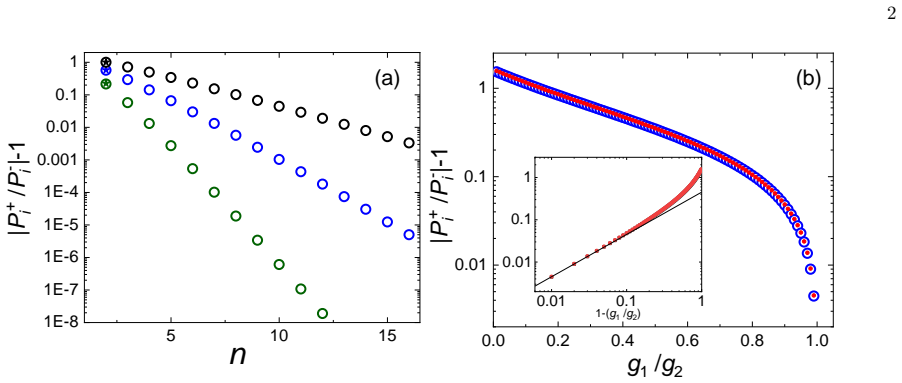
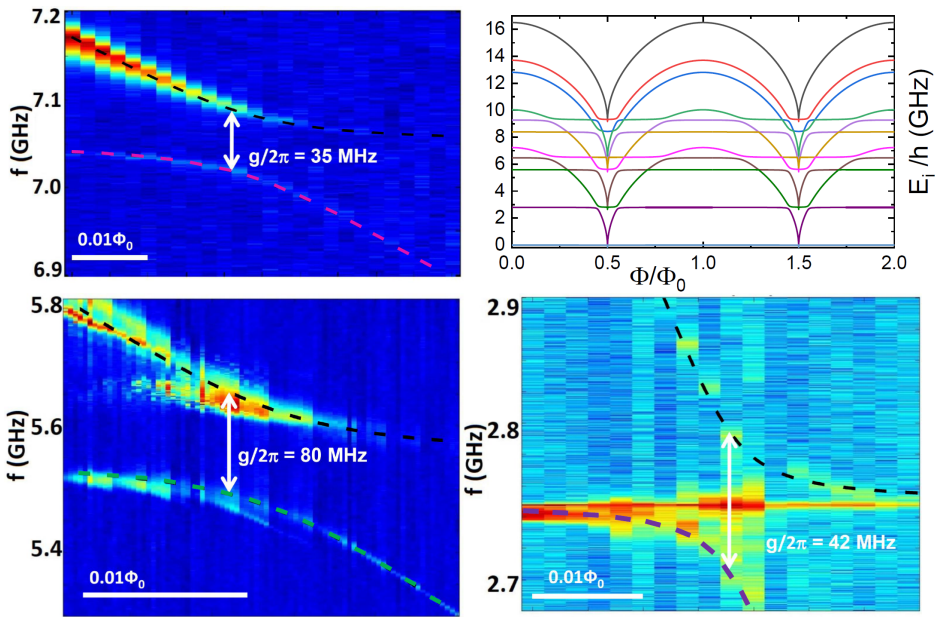
The central object is a transmon—a superconducting artificial atom whose lowest two levels form the qubit—placed between two coplanar-waveguide resonators at 2.8 GHz and 6.7 GHz, each shunted by a copper thin-film resistor that acts as a mesoscopic thermal bath. The load-bearing quantity is the flux-tunable Josephson energy $E_J(\Phi)\simeq E_{J0}|\cos(\pi\Phi/\Phi_0)|$, which sets the qubit transition frequencies $\omega_{n,n+1}(\Phi)=\omega_p(\Phi)-(n+1)E_C/\hbar$ and therefore the spectral overlaps that determine the effective couplings $g_1$ and $g_2$ to the two baths. Tuning the flux moves the qubit frequency through the joint resonator-qubit-resonator spectrum, opening and closing photon transfer channels; the rectification formula $R-1 = e^{-\beta\hbar\omega_{01}}\delta$ encodes the requirement that anharmonicity ($\omega_{01}$) and coupling asymmetry ($\delta$) both be nonzero.
What would settle it
With both baths at the same base temperature, apply a magnetic flux sweep and measure the power transmitted in each direction; if the flux-dependent part of $R$ does not vanish at zero temperature bias, the $R_{\min}$ subtraction has removed a real effect or introduced an artifact. The more direct test is to heat the left bath and measure the right, then heat the right by the same electrical power and measure the left, for each flux value, and to repeat this after physically swapping which resonator is on the left; an intrinsic rectifier must give the same $R$ when the two baths are exchanged.
Extended reading notes
Core claim
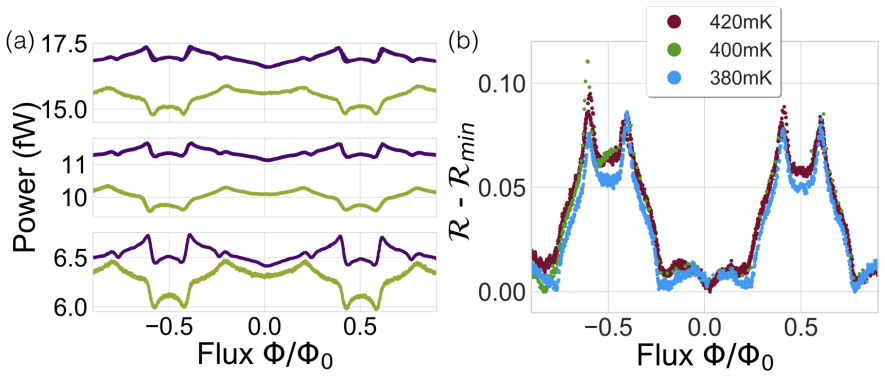
The paper claims that a flux-tunable transmon qubit coupled to two strongly unequal resonators is a heat rectifier: when the left bath is hot and the right cold, the transmitted photon power differs from the case with the same two temperatures reversed. The measured rectification ratio $R=|P_i^+|/|P_i^-|$ departs from 1 and is flux-tunable, with $R-1$ up to about 0.1 (10 percent rectification). The mechanism is the combination of the transmon's anharmonic level spacing—which makes the compound nonlinear—with unequal qubit-bath couplings $g_1 \neq g_2$, which break left-right symmetry; the paper's two-level model gives $R = (g_1 + g_2 \coth(\beta\hbar\omega_{01}/2))/(g_1 \coth(\beta\hbar\omega_{01}/2) + g_2)$, reducing to $R \approx 1 + e^{-\beta\hbar\omega_{01}}\delta$ for small asymmetry $\delta = 1 - g_1/g_2$. The authors also show in the supplementary treatment that a harmonic oscillator or a single-level quantum dot would not rectify, so the effect requires bosonic statistics plus nonlinearity.
Load-bearing premise
The load-bearing premise is that the forward and reverse measurements differ only in which bath is heated, so that any flux-dependent asymmetry in the transmitted power is due to the qubit-resonator structure; if the two resistive baths respond to heating with different efficiencies, or if the subtracted non-tunable contribution $R_{\min}$ itself depends on flux, part of the observed rectification could be a measurement artifact.
Editorial extensions
If this is right
- If the central claim is right, heat can be rectified with standard superconducting circuit elements and controlled remotely by a magnetic field, without any mechanical asymmetry or material junction in the heat path.
- The rectification ratio can be tuned continuously from about 1 to 1.1 by flux, so the same device can act as a heat valve whose directionality is adjustable.
- Because the effect depends on anharmonicity, the demonstration implies that only nonlinear, boson-like quantum systems rectify photon heat flow; harmonic oscillators and single-level fermionic dots do not.
- The device is compatible with existing superconducting qubit and Josephson logic circuits, so it could be used to direct heat away from a qubit during initialization or to explore coherent caloritronics.
- The small temperature-gradient dependence of $R$ means the rectification is robust over the tested heating powers (source temperatures 380-420 mK), rather than being a threshold effect.
Reading between the lines
- As an extension beyond the paper: replacing the transmon with a harmonic oscillator at the same frequencies should make the flux-dependent rectification vanish; this is a direct control experiment implied by the supplementary model but not performed here.
- As an editorial inference: the 10 percent figure is set by the low quality factor (about 10) of the metal-terminated resonators; raising the Q of the baths should increase $R$, and the paper notes the tradeoff that transmitted power would drop, but does not quantify the maximum possible ratio.
- As an editorial inference: measuring $R$ versus flux with fine resolution around half-integer $\Phi/\Phi_0$ should show sharp peaks tied to avoided crossings; the paper associates these with level repulsion but does not trace individual peaks to specific crossings experimentally.
- As an editorial inference: extending the same two-terminal structure to three or more resonators could turn the diode into a heat circulator or heat transistor, a direction the paper mentions only as 'coherent caloritronics' and does not develop.
Signed reviews
Editorial analysis
A structured set of objections, weighed in public.
Referee Report
Summary. The manuscript reports an experimental study of heat transport through a superconducting transmon qubit coupled to two strongly asymmetric microwave resonators that are terminated by mesoscopic normal-metal heat baths. The authors define one transport direction as forward and the opposite as reverse, heat one bath while the other is held at 150 mK, and measure the power arriving at the cold bath as a function of magnetic flux. They observe that the flux dependence of the transmitted power differs between the two directions, extract a rectification ratio from the traces, and report wireless flux-tunable thermal rectification up to 10%. A two-level spin-boson model, following Segal and Nitzan, is used to derive an analytic rectification formula, and the supplementary material extends the discussion to multilevel systems, showing that harmonic oscillators and single-level fermionic dots do not rectify. The paper claims this is the first experimental realization of a spin-boson quantum heat rectifier in a circuit-QED architecture.
Significance. If the results are correct, this is a significant experimental milestone: it would be the first demonstration that a superconducting artificial atom with anharmonic energy levels, coupled asymmetrically to two photon baths, rectifies photon-mediated heat flow in a flux-tunable manner. The work connects a long-standing theoretical proposal (Segal and Nitzan) to a cQED platform, and the device is compatible with existing superconducting circuit technology, making it a plausible building block for quantum thermodynamics experiments. Strengths of the paper include the derivation of the rectification formula from a stated microscopic model rather than by fitting to the rectification data, the use of independent spectroscopy to constrain the energy-level parameters, and the fact that the qualitative direction-dependent flux response is visible already in the raw power traces before any subtraction. The main weaknesses are in the analysis supporting the quantitative 10% claim: the baseline subtraction Rmin is not defined, no error bars are reported, and the theoretical formula is derived for a zero-temperature cold bath while the experiment uses a 150 mK cold bath.
major comments (3)
- [Main text, page 4 and Fig. 2] Rmin, the quantity subtracted to obtain the flux-tunable rectification, is never defined operationally. The text states only that it is a 'non-tunable contribution' and that its likely origin is an estimated +/-5 mK temperature-bias uncertainty, which can shift non-flux-dependent heat transport by up to 5 fW. This is not a measurement or a fit. If Rmin were instead taken as the minimum of the raw ratio over flux, the reported peaks would be the range of a noisy trace, and any flux-dependent offset (for example, asymmetric bath thermal resistances, heater calibration differences, or thermometer crosstalk) would be misattributed to rectification. Please specify how Rmin was determined, report its value and uncertainty, and show the raw forward and reverse traces, the unsubtracted ratio, and the subtracted ratio so that the reader can assess the procedure.
- [Fig. 2] No error bars or uncertainty intervals are provided on the power traces or on the rectification ratio, so the statement 'rectification up to 10%' has no statistical support. The peaks in R should be compared with the noise level and with the systematic uncertainty propagated from the temperature determination. Without this, the 10% value cannot be distinguished from a fluctuation or a baseline artifact.
- [Eq. (2) and Supplementary Sec. I] The theoretical rectification formula in Eq. (2) and its simplified form in Eq. (3) are derived under the assumption that one bath is at zero temperature, whereas the experiment operates with a cold bath at 150 mK and hot baths at 380-420 mK. This affects the Bose-Einstein factors in the transition rates and can modify the predicted rectification ratio quantitatively. To support a quantitative comparison with the measured R, the authors should provide the finite-temperature generalization of Eq. (2) or an estimate of the size of the correction at 150 mK.
minor comments (4)
- [Supplementary material, Eq. (1)] The displayed equation contains unrendered square symbols in the denominators (e.g., 'e□β1ℏωq'), making the transition-rate formulas unreadable as supplied. Please fix the LaTeX rendering.
- [Methods] There are several typos: 'alumimina' should be 'alumina', 'susbsequently' should be 'subsequently', and 'seperation' should be 'separation'.
- [Fig. 2 and page 4] The figure caption lists source temperatures of 380, 400, and 420 mK with corresponding powers of 600, 750, and 1000 fW, but it is not stated whether these powers are measured or inferred from the electron-phonon model. Clarify the relationship between temperature and power and whether the two baths have identical thermal resistance.
- [Page 4, paragraph on power independence] The claim that 'rectification appears to be almost independent of applied power' is based on only three temperature points and the approximate formula R(T)/R(T+ΔT) ≈ 1 - (ΔT/T)δβℏω01 exp(-βℏω01). Please state the values of δ, βℏω01, and ΔT used in this estimate, and indicate whether the three measured traces are consistent within the scatter of the data.
Circularity Check
No circularity in the central derivation; the rectification formula follows from an explicit two-level rate model, and the experiment is an independent measurement, despite an under-specified Rmin baseline subtraction.
full rationale
The central derivation is self-contained and not circular. Equation (2), R = |P_i^+|/|P_i^-| = (g1 + g2 coth(beta hbar omega01/2))/(g1 coth(beta hbar omega01/2) + g2), is presented as a result of a two-level approximation, and the supplementary material derives the same expression from explicit golden-rule transition rates (Supplementary Eqs. (1)-(5)). No parameter of that formula is fitted to the rectification data shown in Fig. 2; the couplings g1 and g2 are properties of the device, and the flux dependence of the transmon frequency is independently set by EJ(Phi) = EJ0 |cos(pi Phi/Phi0)|. The experimental claim of direction-dependent heat flow is a measurement under reversed temperature biases, not a consequence of the theoretical model. The only under-specified step is the statement that 'The flux-tunable rectification is isolated by a subtraction of the non-tunable contribution Rmin' and the estimate of +/-5 mK bias uncertainty; because the paper does not define how Rmin is obtained, one cannot exhibit a reduction of the reported 10% to a fitted parameter or self-citation. This is a systematic-uncertainty concern, not a demonstrated circularity. Citations to prior work by the same group (e.g., Refs. [24] and [26]) are for established background or independent characterization and are not load-bearing; the rectification formula is re-derived in the supplement rather than imported.
Assumptions & free parameters
free parameters (2)
- R_min (non-tunable rectification contribution) =
not stated
- EJ/h and EC/h in the energy-level model =
EJ/h = 45 GHz, EC/h = 0.15 GHz
assumptions (4)
- domain assumption The thermal baths are bosonic reservoirs with transition rates proportional to the coupling g_i and Bose-Einstein factors, as in Eqs. (S1).
- domain assumption The transmon is treated as a two-level system in the rectification formula Eq. (2).
- domain assumption One bath is at zero temperature in the derivation of Eq. (2).
- domain assumption The measured power is carried only by photons through the resonator-qubit-resonator structure, with negligible quasiparticle or phonon leakage.
Cite this review
Pith. "Pith review of Heat rectification via a superconducting artificial atom." pith.science (2026). https://pith.science/paper/HY4OAOJQ
@misc{pith2026190805574,
  author       = {Pith},
  title        = {Pith review of: Heat rectification via a superconducting artificial atom},
  year         = {2026},
  howpublished = {\url{https://pith.science/paper/HY4OAOJQ}},
  note         = {Machine review of arXiv:1908.05574}
}
read the original abstract
In miniaturising electrical devices down to nanoscales, heat transfer has turned into a serious obstacle but also potential resource for future developments, both for conventional and quantum computing architectures. Controlling heat transport in superconducting circuits has thus received increasing attention in engineering microwave environments for circuit quantum electrodynamics (cQED) and circuit quantum thermodynamics experiments (cQTD). While theoretical proposals for cQTD devices are numerous, the experimental situation is much less advanced. There exist only relatively few experimental realisations, mostly due to the difficulties in developing the hybrid devices and in interfacing these often technologically contrasting components. Here we show a realisation of a quantum heat rectifier, a thermal equivalent to the electronic diode, utilising a superconducting transmon qubit coupled to two strongly unequal resonators terminated by mesoscopic heat baths. Our work is the experimental realisation of the spin-boson rectifier proposed by Segal and Nitzan.
Figures


Figures from the paper (4 more)


Reference graph
Works this paper leans on
-
[1]
Erdman, P.A., et al. Maximum Power and Corresponding Efficiency for Two-Level Quantum Heat Engines and Refrigerators. arXiv preprint arXiv:1812.05089. (2018)
work page Pith review arXiv 2018
-
[2]
Menczel, P. et al. Two-Stroke Optimization Scheme for Mesoscopic Refrigerators. Phys. Rev. B 99, 224306 (2019)
work page 2019
-
[3]
Karimi, B. & Pekola, J. P. Otto refrigerator based on a superconducting qubit: Classical and quantum performance. Phys. Rev. B 94, 184503 (2016). 8
work page 2016
-
[4]
Wallraff, A. et al. Strong coupling of a single photon to a superconducting qubit using circuit quantum electrodynamics. Nature 431, 162–167 (2004)
2004
-
[5]
Partanen, M. et al. Flux-tunable heat sink for quantum electric circuits. Scientific reports 8.1 6325 (2018)
work page 2018
-
[6]
Tan, K. Y. et al. Quantum-circuit refrigerator. Nat. Comm. 8, 15189 (2017)
work page 2017
-
[7]
Pekola, J. P. Towards Quantum Thermodynamics in electronic circuits. Nat. Phys. 11, 118 (2015)
work page 2015
-
[8]
Vinjanampathy, S. & Anders, J. Quantum thermodynamics. Contemp. Phys. 57, 545 (2016)
work page 2016
Show all 27 references
-
[9]
Mart´ ınez-P´ erez, M. J. & Giazotto, F. The Josephson heat interferometer, Nature 492, 401 (2012)
2012
-
[10]
Phase-coherent heat circulator based on multi- terminal Josephson junctions
Hwang, S.Y., Giazotto, F., & Sothmann, B. Phase-coherent heat circulator based on multi- terminal Josephson junctions. Physical Review Applied, 10(4), 044062. (2018)
2018
-
[11]
Ordonez-Miranda, J. et al. Photonic thermal diode based on superconductors, J. Appl. Phs. 122, 093105 (2017)
2017
-
[12]
Thermal rectification in classical and quantum systems: Searching for efficient thermal diodes
Pereira, E. Thermal rectification in classical and quantum systems: Searching for efficient thermal diodes. EPS 126, 1 (2019)
2019
-
[13]
& Xuereb, A
Barzanjeh, S., Aquilina, M. & Xuereb, A. Manipulating the Flow of Thermal Noise in Quan- tum Devices, Phys. Rev. Lett. 120, 060601 (2018)
2018
-
[14]
Negative differential thermal resistance and thermal transistor, Appl
Li, B. Negative differential thermal resistance and thermal transistor, Appl. Phys. Lett. 88, 143501 (2006)
2006
-
[15]
& Levy, A
Kosloff, R. & Levy, A. Quantum heat engines and refrigerators: continuous devices. Annual Rev. Phys. Chem. 65, 365 (2014)
2014
-
[16]
Chang, C.W. et al. Solid-state Thermal Rectifier, Science 314, 1121 (2006)
2006
-
[17]
Rectification of electronic heat current by a hybrid thermal diode, Nature Nanotechnology 10 303–307 (2015)
Mart´ ınez-P´ erez, M.J., Fornieri, A., & Giazotto, F. Rectification of electronic heat current by a hybrid thermal diode, Nature Nanotechnology 10 303–307 (2015)
2015
-
[18]
Ronzani, A. et al. Tunable photonic heat transport in a quantum heat valve, Nature Physics 14, 991-995 (2018)
2018
-
[19]
Roßnagel, J. et al. single atom heat engine. Science 352, 325 (2016)
2016
-
[20]
et al Quantum dot as thermal rectifier, New J
Scheibner, R. et al Quantum dot as thermal rectifier, New J. Phys. 10 083016 (2008)
2008
-
[21]
& Nitzan, A
Segal, D. & Nitzan, A. Spin-Boson Thermal Rectifier, Phys. Rev. Lett. 94, 034301 (2005) 9
2005
-
[22]
Motz, T. et al. Rectification of heat currents across nonlinear quantum chains: a versatile approach beyond weak thermal contact, New Journal of Physics 20, (2018)
2018
-
[23]
R., Schoelkopf, R
Schmidt, D. R., Schoelkopf, R. J. & Cleland, A. N. Photon-mediated thermal relaxation of electrons in nanostructures. Phys. Rev. Lett. 93, 045901 (2004)
2004
-
[24]
& Guichard, W
Meschke, M. & Guichard, W. & Pekola, J. P. Single-mode heat conduction by photons. Nature 444, 187 (2006)
2006
-
[25]
Koch, J. et al. Charge-insensitive qubit design derived from the Cooper pair box. Phys. Rev. A 76, 042319 (2007)
2007
-
[26]
Chang, Y.-C. et al. Utilization of the Superconducting Transition for Characterizing Low- Quality-Factor Superconducting Resonators, Appl. Phys. Lett. 115, 022601 (2019)
2019
-
[27]
Giazotto, F. et al. Opportunities for mesoscopics in thermometry and refrigeration: Physics and applications. Rev. Mod. Phys 78(1) 217 (2006). 10 Supplementary material (Dated: August 15, 2019) I. RECTIFICA TION IN A TWO-LEVEL SYSTEM A. Qubit Consider a qubit coupled to two ba...
2006
Reviewed August 14, 2026 · model on record in the stance chip above.
Discussion (0). Continue with ORCID to comment.