REVIEW 2 major objections 4 minor 65 references
Topotaxis of active Brownian particles
T0 review · 2 major / 4 minor · reviewed 2026-08-14 · deepseek-v4-flash
Pith's one-line read Persistent motion alone is sufficient to drive topotaxis: an obstacle-density gradient acts as a persistence gradient that pushes active Brownian particles toward lower density.
desk verdict Solid simulation result; the persistence-modulation mechanism is plausible but not quantitatively closed. read the letter →
The pith
A machine-rendered reading of the paper's core claim, the machinery that carries it, and where it could break.
The reading
What carries the argument
The central object is the effective persistent random walk (PRW) description of an active Brownian particle in a regular obstacle lattice. The velocity autocorrelation function remains exponential, $\langle \mathbf{v}(t+\Delta t)\cdot\mathbf{v}(t)\rangle = v_{\mathrm{eff}}^2 e^{-\Delta t/\tau_{\mathrm{eff}}}$, and from the mean-squared displacement at long times one extracts the effective diffusion coefficient $D_{\mathrm{eff}}$; the relations $D_{\mathrm{eff}}=v_{\mathrm{eff}}^2\tau_{\mathrm{eff}}/2$ and $\ell_{\mathrm{eff}}=v_{\mathrm{eff}}\tau_{\mathrm{eff}}$ connect the renormalized transport coefficients. These coefficients are monotone functions of lattice spacing, turning a density gradient into a persistence gradient. The durotactic drift law for persistent random walkers—drift toward larger persistence—then carries the argument; the paper adds a Fokker–Planck calculation showing that obstacle collisions increase effective rotational diffusion at short times.
What would settle it
Run the gradient-lattice simulation, measure the local effective persistence length profile $\ell_{\mathrm{eff}}(x)$, predict $v_{\mathrm{top}}$ from the persistence-gradient drift law, and compare with the directly measured drift; disagreement at steep gradients or small spacings would show the local mechanism is incomplete.
Extended reading notes
Core claim
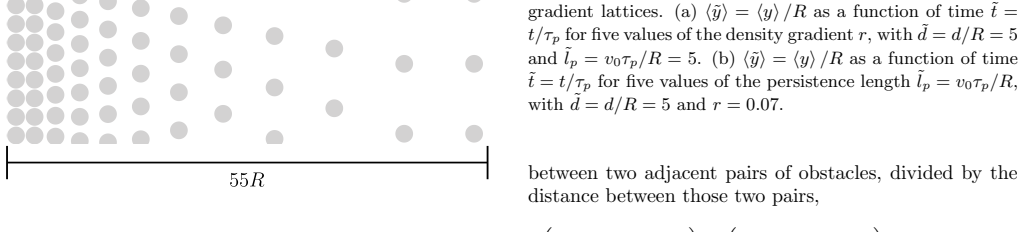
In a lattice of obstacles with a linear gradient in lattice spacing, the average particle position $\langle x\rangle$ grows linearly in time, defining a topotactic velocity $v_{\mathrm{top}}$ that is proportional to the gradient parameter $r$ and increases with the free persistence length $\ell_p$ faster than linearly. The paper's central discovery is the mechanism: uniform obstacle lattices leave the velocity autocorrelation function exponential, so ABPs remain persistent random walkers with effective velocity $v_{\mathrm{eff}}$ and effective reorientation time $\tau_{\mathrm{eff}}$, both smaller than their free-space values and both increasing with lattice spacing. Hence the effective persistence length $\ell_{\mathrm{eff}} = v_{\mathrm{eff}}\tau_{\mathrm{eff}}$ is a decreasing function of obstacle density, and the density gradient becomes a persistence gradient. Applying the durotaxis result that persistent random walkers drift toward higher persistence, the authors conclude that the particles move to lower obstacle density purely because persistence is spatially modulated. A short-time Fokker–Planck expansion identifies the effective increase in rotational diffusion caused by obstacle encounters, while the long-time analysis shows why the effective diffusion coefficient is reduced.
Load-bearing premise
The argument assumes that the typical distance a particle keeps moving in one direction, measured in a uniform obstacle array, still describes its motion at each point in a density gradient, so the known drift toward longer persistence can be applied point by point.
Editorial extensions
If this is right
- Topotaxis is generic: any self-propelled particle whose orientation persists over a finite time and that moves through a spatially varying obstacle distribution will drift toward the less crowded side, with no need for gradient sensing or biochemical signaling.
- The topotactic velocity increases with both the steepness of the obstacle-density gradient and the free persistence length, and because $\ell_{\mathrm{eff}}$ depends more strongly on density for large $\ell_p$, the speed grows superlinearly with persistence.
- Inside obstacle lattices, active Brownian motion remains a persistent random walk at long times, so large-scale transport can be summarized by the two renormalized numbers $v_{\mathrm{eff}}$ and $\tau_{\mathrm{eff}}$.
- The phenomenon is better classified as kinesis than taxis, since the topographical cue acts by changing local motility rather than by imposing a directional bias on individual steps.
- When compared with experiments on amoeboid cells, the toy model reproduces the direction of topotaxis but underestimates its efficiency (about 1% of the intrinsic speed versus about 5% in cells), indicating that cell-specific mechanisms add to this generic persistence effect.
Reading between the lines
- The paper links the mechanism to the measured $\ell_{\mathrm{eff}}(d)$ only qualitatively; a direct test would be to compute the drift velocity predicted by combining $\ell_{\mathrm{eff}}(d)$ with the persistence-gradient drift law and compare it with the simulated $v_{\mathrm{top}}$, especially for steep gradients where local equilibrium may fail.
- Because the argument only uses persistence, the same topotactic drift should appear in run-and-tumble or Lévy-walk models with the same persistence length, a prediction that could be tested in the same lattice geometry.
- In the deterministic limit of infinite persistence, the mechanism must break down, since reorientation is what lets obstacles randomize directions; this suggests the drift should be non-monotonic in persistence length when $\ell_p$ greatly exceeds the lattice size.
- The cell experiments' fivefold higher efficiency hint that cells may combine this passive persistence effect with active responses; measuring the persistence length of cells on uniform pillar arrays with varying spacing would separate the generic physical contribution from cell-specific sensing.
Signed reviews
Editorial analysis
A structured set of objections, weighed in public.
Referee Report
Summary. The manuscript introduces a minimal model of topotaxis: active Brownian particles (ABPs) moving in a two-dimensional square lattice of circular obstacles whose spacing decreases with increasing x, so that obstacle density is higher on the left and lower on the right. Simulations with 10^6 particles show a mean drift in the +x direction, with a topotactic velocity that increases with the density gradient r and with the persistence length lp. In uniform lattices, the authors measure the mean-squared displacement and velocity autocorrelation function, showing that ABPs remain well described by an effective persistent random walk with reduced effective velocity, persistence time, and persistence length when the obstacle spacing is small. They then argue that this local reduction of persistence in dense regions, combined with the known drift of persistent random walkers toward higher persistence (durotaxis literature), explains the observed topotaxis. A Fokker-Planck moment calculation rationalizes the reduced persistence time and velocity in a uniform lattice, but the calculation involves a smoothing assumption for the discontinuous obstacle force.
Significance. If the mechanism claim were fully established, the paper would provide a generic, cell-type-independent physical mechanism for topotaxis, with implications for active colloids and amoeboid cell migration. The strengths of the paper include the high-statistics simulations (10^6 particles) with explicit error bars, the careful extraction of effective persistent-random-walk parameters and their cross-validation between MSD and VACF (Fig. 4), the symmetry check in the y-direction (Appendix C), and the honest discussion of quantitative discrepancies with the cellular experiments of Ref. [15]. The main weakness is that the central mechanistic claim is not quantitatively closed: the predicted topotactic velocity from the measured persistence-length modulation is never computed and compared with simulation.
major comments (2)
- [Sec. III B (Figs. 2 and 4d)] The central claim that topotaxis is caused by a persistence gradient is asserted rather than demonstrated. The authors measure l_eff(d) in uniform lattices (Fig. 4d) and combine this with the persistence-gradient drift law of Refs. [35,50,51] to conclude that ABPs in the gradient lattice drift toward lower obstacle density. However, no expression for the predicted topotactic velocity is derived from l_eff(d) and the local spacing d(x) of the gradient lattice, and no comparison with the simulated v_top in Figs. 2b,d is made. Such a closure is necessary to rule out that the drift is partially or entirely due to geometric rectification by the asymmetric lattice deformation. I request a quantitative test: either compute v_top from the drift law using the measured l_eff(d) and compare it with Fig. 2b,d, or perform a control simulation in which the persistence-gradient contribution is eliminated (e.g., by position-dependent rotational diffusion tuned to keep l_eff constant) while retaining the geometric density gradient.
- [Sec. III B] The paper assumes a local-closure relation: ABPs in the gradient lattice at position x are taken to behave as in a uniform lattice with spacing d(x), with a pointwise persistence l_eff(d(x)). This is nontrivial because the persistence length can be comparable to the lattice spacing and because the spacing varies continuously across the gradient region; moreover, the drift law of Refs. [35,50,51] was derived for free-space persistent random walkers with a prescribed persistence gradient, not for ABPs in an obstacle lattice, and it assumes a constant speed, whereas here both v_eff and tau_eff vary with d. The validity of this local closure should be tested directly, for example by measuring the local effective persistence length in the gradient lattice, before it is used to explain the origin of topotaxis.
minor comments (4)
- [Sec. III C, Eqs. (13)-(15)] The Taylor expansion of the discontinuous hard-wall force (Eq. (4)) is not a controlled approximation; the statement 'one can imagine to smoothen the force ... without altering the qualitative picture' is a heuristic assumption, and the force in Eq. (4) depends on the orientation p, so F(r) is not a function of r alone. Either regularize the obstacle interaction explicitly or label this derivation as heuristic.
- [Appendix B, Eq. (B3)] The text calls the obstacle spacing a 'linear gradient' and states that the exponential spacing in n 'leads to a linear gradient' in x; this is only true for small r. For the finite values used (e.g., r=0.15 in Fig. 5), d(x) is exponential in x; please clarify or redefine the lattice to make d(x) exactly linear.
- [Sec. III A, definition of v_top] The topotactic velocity is defined as <Delta x>/Delta t averaged over t in [0,30 tau_p]; since the gradient region has finite width and is flanked by uniform lattices, this is a transient average. Please state explicitly whether particles leave the gradient region by t=30 tau_p and whether the drift is stationary over the averaging interval.
- [Throughout] There are several typos: 'cell-type-indenpendent' in Sec. I, 'the the persistence time' in Sec. II, 'a exponential fit' in the caption of Fig. 3, and 'alterning' in Sec. III C.
Circularity Check
No significant circularity: the topotaxis simulation is independent of the cited persistence-gradient drift and of the measured effective persistence lengths.
full rationale
The paper's central result, topotactic drift in a gradient obstacle lattice, is obtained by direct numerical simulation of the active Brownian particle equations (Eqs. 1 and 4) in Sec. III A, with no parameter fitted to the topotaxis data. The explanatory argument in Sec. III B is qualitative: the authors measure an effective persistence length leff(d) in uniform lattices, observe that it increases with lattice spacing, and then invoke independent external results (Refs. [35,50,51]) that persistent random walkers drift toward regions of larger persistence. This is a mechanistic interpretation, not a prediction derived from the measured leff(d), and it is not a fit in disguise: the topotactic velocity vtop is never computed from leff(d) and compared with simulation, so the explanation is not forced by construction. Sec. III C derives only the sign of the effective rotational diffusion enhancement and does not smuggle in the drift law; the drift law is explicitly imported from external literature, which is legitimate support rather than circularity. The co-author experimental paper (Ref. [15]) is used only as motivation and for an order-of-magnitude discussion in Sec. IV, not as evidence for the simulation claim. The absence of a quantitative closure test between leff(d) and vtop is a completeness or correctness concern, not a circularity, and no self-referential reduction of the paper's equations to their inputs can be exhibited.
Assumptions & free parameters
assumptions (5)
- domain assumption Active Brownian particles with a frictionless hard-wall interaction are a sufficient toy model for persistent amoeboid cell motility in obstacle arrays.
- domain assumption The wall force Eq. (4) cancels the normal component of the particle velocity without changing its orientation p.
- domain assumption ABPs in regular square lattices retain an exponential velocity autocorrelation, i.e., they behave as persistent random walkers with effective parameters v_eff and tau_eff (Eq. 6).
- domain assumption The drift of persistent random walkers toward regions of higher persistence, established for durotaxis in Refs. [35,50,51], applies locally to ABPs in a gradient obstacle lattice.
- ad hoc to paper The discontinuous obstacle force can be Taylor-expanded after an unspecified smoothing without altering the qualitative short-time dynamics.
Cite this review
Pith. "Pith review of Topotaxis of active Brownian particles." pith.science (2026). https://pith.science/paper/J4WVCQ3Y
@misc{pith2026190806078,
  author       = {Pith},
  title        = {Pith review of: Topotaxis of active Brownian particles},
  year         = {2026},
  howpublished = {\url{https://pith.science/paper/J4WVCQ3Y}},
  note         = {Machine review of arXiv:1908.06078}
}
read the original abstract
Recent experimental studies have demonstrated that cellular motion can be directed by topographical gradients, such as those resulting from spatial variations in the features of a micropatterned substrate. This phenomenon, known as topotaxis, is especially prominent among cells persistently crawling within a spatially varying distribution of cell-sized obstacles. In this article we introduce a toy model of topotaxis based on active Brownian particles constrained to move in a lattice of obstacles, with space-dependent lattice spacing. Using numerical simulations and analytical arguments, we demonstrate that topographical gradients introduce a spatial modulation of the particles' persistence, leading to directed motion toward regions of higher persistence. Our results demonstrate that persistent motion alone is sufficient to drive topotaxis and could serve as a starting point for more detailed studies on self-propelled particles and cells.
Figures


Figures from the paper (2 more)

Reference graph
Works this paper leans on
-
[15]
Chemo- taxis and topotaxis add vectorially for amoeboid cell mi- gration,
J. A. Wondergem, M. Mytiliniou, F. C. H. de Wit, T. G. A. Reuvers, D. Holcman, and D. Heinrich, “Chemo- taxis and topotaxis add vectorially for amoeboid cell mi- gration,” bioRxiv, 2019
work page 2019
-
[1]
Chemotaxis: signalling the way forward,
P. J. M. Van Haastert and P. N. Devreotes, “Chemotaxis: signalling the way forward,” Nature Reviews Molecular Cell Biology, vol. 5, p. 626, 2004
work page 2004
-
[2]
K. F. Swaney, C.-H. Huang, and P. N. Devreotes, “Eu- karyotic chemotaxis: A network of signaling pathways controls motility, directional sensing, and polarity,” An- nual Review of Biophysics , vol. 39, no. 1, pp. 265–289, 2010
work page 2010
-
[3]
Laminin and fi- bronectin promote the haptotactic migration of b16 mouse melanoma cells in vitro.,
J. B. McCarthy and L. T. Furcht, “Laminin and fi- bronectin promote the haptotactic migration of b16 mouse melanoma cells in vitro.,” The Journal of Cell Biology, vol. 98, no. 4, pp. 1474–1480, 1984
work page 1984
-
[4]
Cell movement is guided by the rigidity of the substrate.,
C. M. Lo, H. B. Wang, M. Dembo, and Y. L. Wang, “Cell movement is guided by the rigidity of the substrate.,” Biophysical journal, vol. 79, no. 1, pp. 144–152, 2000
work page 2000
-
[5]
Physical influences of the ex- tracellular environment on cell migration,
G. Charras and E. Sahai, “Physical influences of the ex- tracellular environment on cell migration,” Nature Re- views Molecular Cell Biology , vol. 15, p. 813, 2014
work page 2014
-
[6]
Contact-controlled amoeboid motility induces dynamic cell trapping in 3d-microstructured surfaces,
D. Arcizet, S. Capito, M. Gorelashvili, C. Leonhardt, M. Vollmer, S. Youssef, S. Rappl, and D. Heinrich, “Contact-controlled amoeboid motility induces dynamic cell trapping in 3d-microstructured surfaces,” Soft Mat- ter, vol. 8, pp. 1473–1481, 2012
work page 2012
-
[7]
Can- cer cell motility: lessons from migration in confined spaces,
C. D. Paul, P. Mistriotis, and K. Konstantopoulos, “Can- cer cell motility: lessons from migration in confined spaces,” Nature Reviews Cancer, vol. 17, p. 131, 2016
work page 2016
Show all 65 references
-
[8]
Gaussian curvature directs stress fiber orientation and cell migration,
N. D. Bade, T. Xu, R. D. Kamien, R. K. Assoian, and K. J. Stebe, “Gaussian curvature directs stress fiber orientation and cell migration,” Biophysical Jour- nal, vol. 114, no. 6, pp. 1467 – 1476, 2018
2018
-
[9]
Curvotaxis directs cell migration through cell-scale curvature landscapes,
L. Pieuchot, J. Marteau, A. Guignandon, T. Dos San- tos, I. Brigaud, P.-F. Chauvy, T. Cloatre, A. Ponche, T. Petithory, P. Rougerie, M. Vassaux, J.-L. Milan, N. Tusamda Wakhloo, A. Spangenberg, M. Bigerelle, and K. Anselme, “Curvotaxis directs cell migration through cell-scale...
2018
-
[10]
Ratchetaxis: Long-range directed cell mi- gration by local cues,
D. Caballero, J. Comelles, M. Piel, R. Voituriez, and D. Riveline, “Ratchetaxis: Long-range directed cell mi- gration by local cues,” Trends in Cell Biology , vol. 25, no. 12, pp. 815 – 827, 2015
2015
-
[11]
Cell migration according to shape of graphene oxide micropatterns,
S. E. Kim, M. S. Kim, Y. C. Shin, S. U. Eom, J. H. Lee, D.-M. Shin, S. W. Hong, B. Kim, J.-C. Park, B. S. Shin, D. Lim, and D.-W. Han, “Cell migration according to shape of graphene oxide micropatterns,” Micromachines, vol. 7, no. 10, 2016
2016
-
[12]
Chapter 7 - directing cell migration on flat substrates and in confinement with microfabrication and microflu- idics,
E. L. Maout, S. L. Vecchio, A. Bhat, and D. Riveline, “Chapter 7 - directing cell migration on flat substrates and in confinement with microfabrication and microflu- idics,” in Microfluidics in Cell Biology Part B: Microflu- idics in Single Cells (M. Piel, D. Fletcher, and J. Doh, ...
2018
-
[13]
Cellular behavior con- trolled by bio-inspired and geometry-tunable nanohairs,
C. Heo, C. Jeong, H. S. Im, J. U. Kim, J. Woo, J. Y. Lee, B. Park, M. Suh, and T.-i. Kim, “Cellular behavior con- trolled by bio-inspired and geometry-tunable nanohairs,” Nanoscale, vol. 9, pp. 17743–17751, 2017
2017
-
[14]
Topotaxis: A new mechanism of directed cell migration in topographic ecm gradients,
J. Park, D.-H. Kim, and A. Levchenko, “Topotaxis: A new mechanism of directed cell migration in topographic ecm gradients,” Biophysical Journal , vol. 114, no. 6, pp. 1257 – 1263, 2018
2018
-
[16]
Catalytic janus col- loids: Controlling trajectories of chemical microswim- mers,
S. J. Ebbens and D. A. Gregory, “Catalytic janus col- loids: Controlling trajectories of chemical microswim- mers,” Accounts of Chemical Research , vol. 51, no. 9, pp. 1931–1939, 2018
1931
-
[17]
Cell motility as persistent random motion: Theories from experiments,
D. Selmeczi, S. Mosler, P. H. Hagedorn, N. B. Larsen, and H. Flyvbjerg, “Cell motility as persistent random motion: Theories from experiments,” Biophysical Journal, vol. 89, no. 2, pp. 912 – 931, 2005
2005
-
[18]
For details on the numerical implementation of Eqs
as well as various types of cells [48, 49]. For details on the numerical implementation of Eqs. (1) and (4), see Appendix A. In the following Sections, we measure times in units of the the persistence time, i.e., ˜t = t/τp, and lengths in units of the effective obstacle radius,...
-
[19]
Dynamics of self-propelled particles under strong confinement,
Y. Fily, A. Baskaran, and M. F. Hagan, “Dynamics of self-propelled particles under strong confinement,” Soft Matter, vol. 10, pp. 5609–5617, 2014
2014
-
[20]
Microswimmers in patterned environ- ments,
G. Volpe, I. Buttinoni, D. Vogt, H.-J. K¨ ummerer, and C. Bechinger, “Microswimmers in patterned environ- ments,” Soft Matter, vol. 7, pp. 8810–8815, 2011
2011
-
[21]
Active brownian particles and run-and-tumble particles separate inside a maze,
M. Khatami, K. Wolff, O. Pohl, M. R. Ejtehadi, and H. Stark, “Active brownian particles and run-and-tumble particles separate inside a maze,” Scientific Reports , vol. 6, p. 37670, 2016
2016
-
[22]
Dynamics and density distribution of strongly confined noninter- acting nonaligning self-propelled particles in a nonconvex boundary,
Y. Fily, A. Baskaran, and M. F. Hagan, “Dynamics and density distribution of strongly confined noninter- acting nonaligning self-propelled particles in a nonconvex boundary,” Physical Review E, vol. 91, p. 012125, 2015
2015
-
[23]
Geometrically biased random walks in bacteria-driven micro-shuttles,
L. Angelani and R. D. Leonardo, “Geometrically biased random walks in bacteria-driven micro-shuttles,” New Journal of Physics , vol. 12, no. 11, p. 113017, 2010
2010
-
[24]
A wall of funnels concentrates swimming bacteria,
P. Galajda, J. Keymer, P. Chaikin, and R. Austin, “A wall of funnels concentrates swimming bacteria,”Journal of Bacteriology, vol. 189, no. 23, pp. 8704–8707, 2007
2007
-
[25]
Self- starting micromotors in a bacterial bath,
L. Angelani, R. Di Leonardo, and G. Ruocco, “Self- starting micromotors in a bacterial bath,” Physical Re- view Letters, vol. 102, p. 048104, 2009
2009
-
[26]
Curvature- induced activation of a passive tracer in an active bath,
S. A. Mallory, C. Valeriani, and A. Cacciuto, “Curvature- induced activation of a passive tracer in an active bath,” Physical Review E, vol. 90, p. 032309, 2014
2014
-
[27]
Active mat- ter transport and jamming on disordered landscapes,
C. Reichhardt and C. J. Olson Reichhardt, “Active mat- ter transport and jamming on disordered landscapes,” Physical Review E, vol. 90, p. 012701, 2014
2014
-
[28]
kinesis” than as a “taxis
and a model of persistently moving cells in a tissue of stationary cells [52]. This effect increases with the free space persistence length, as the motion of less persistent particles is randomized before they can reach an obsta- cle. Furthermore, the difference between data wit...
2017
-
[29]
The topography of the environ- ment alters the optimal search strategy for active parti- cles,
G. Volpe and G. Volpe, “The topography of the environ- ment alters the optimal search strategy for active parti- cles,” Proceedings of the National Academy of Sciences , vol. 114, no. 43, pp. 11350–11355, 2017
2017
-
[30]
Active brownian par- ticles moving in a random lorentz gas,
M. Zeitz, K. Wolff, and H. Stark, “Active brownian par- ticles moving in a random lorentz gas,” The European Physical Journal E , vol. 40, no. 2, p. 23, 2017
2017
-
[31]
Diffusion, subdiffusion, and localization of active colloids in random post lattices,
A. Morin, D. Lopes Cardozo, V. Chikkadi, and D. Bar- tolo, “Diffusion, subdiffusion, and localization of active colloids in random post lattices,” Physical Review E , vol. 96, p. 042611, 2017
2017
-
[32]
Ideal circle microswim- mers in crowded media,
O. Chepizhko and T. Franosch, “Ideal circle microswim- mers in crowded media,” Soft matter , vol. 15, no. 3, pp. 452–461, 2019
2019
-
[33]
Active particles in complex and crowded environments,
C. Bechinger, R. Di Leonardo, H. L¨ owen, C. Reichhardt, G. Volpe, and G. Volpe, “Active particles in complex and crowded environments,” Reviews of Modern Physics, vol. 88, p. 045006, 2016
2016
-
[34]
Emergent behavior in active col- loids,
A. Z¨ ottl and H. Stark, “Emergent behavior in active col- loids,” Journal of Physics: Condensed Matter , vol. 28, 10 no. 25, p. 253001, 2016
2016
-
[35]
Chemotaxis of active janus nanoparticles,
M. N. Popescu, W. E. Uspal, C. Bechinger, and P. Fis- cher, “Chemotaxis of active janus nanoparticles,” Nano Letters, vol. 18, no. 9, pp. 5345–5349, 2018
2018
-
[36]
Pairing, waltzing and scattering of chemotactic active colloids,
S. Saha, S. Ramaswamy, and R. Golestanian, “Pairing, waltzing and scattering of chemotactic active colloids,” New Journal of Physics , vol. 21, no. 6, p. 063006, 2019
2019
-
[37]
Persistence-driven durotaxis: Generic, directed motility in rigidity gradients,
E. A. Novikova, M. Raab, D. E. Discher, and C. Storm, “Persistence-driven durotaxis: Generic, directed motility in rigidity gradients,” Physical Review Letters, vol. 118, p. 078103, 2017
2017
-
[38]
Diffusing wave paradox of phototactic particles in traveling light pulses,
C. Lozano and C. Bechinger, “Diffusing wave paradox of phototactic particles in traveling light pulses,” Nature Communications, vol. 10, no. 1, p. 2495, 2019
2019
-
[39]
Guiding microscale swimmers using teardrop- shaped posts,
M. S. Davies Wykes, X. Zhong, J. Tong, T. Adachi, Y. Liu, L. Ristroph, M. D. Ward, M. J. Shelley, and J. Zhang, “Guiding microscale swimmers using teardrop- shaped posts,” Soft Matter, vol. 13, pp. 4681–4688, 2017
2017
-
[40]
Directed migration of mi- croscale swimmers by an array of shaped obstacles: Mod- eling and shape optimization,
J. Tong and M. Shelley, “Directed migration of mi- croscale swimmers by an array of shaped obstacles: Mod- eling and shape optimization,” SIAM Journal on Applied Mathematics, vol. 78, no. 5, pp. 2370–2392, 2018
2018
-
[41]
Ac- tive ratchets,
L. Angelani, A. Costanzo, and R. D. Leonardo, “Ac- tive ratchets,” EPL (Europhysics Letters), vol. 96, no. 6, p. 68002, 2011
2011
-
[42]
Rectification and diffusion of self-propelled particles in a two-dimensional corrugated channel,
B.-q. Ai, Q.-y. Chen, Y.-f. He, F.-g. Li, and W.-r. Zhong, “Rectification and diffusion of self-propelled particles in a two-dimensional corrugated channel,” Physical Review E, vol. 88, p. 062129, 2013
2013
-
[43]
Transport of active ellipsoidal particles in ratchet potentials,
B.-Q. Ai and J.-C. Wu, “Transport of active ellipsoidal particles in ratchet potentials,” The Journal of Chemical Physics, vol. 140, no. 9, p. 094103, 2014
2014
-
[44]
Self-propelled janus particles in a ratchet: Numer- ical simulations,
P. K. Ghosh, V. R. Misko, F. Marchesoni, and F. Nori, “Self-propelled janus particles in a ratchet: Numer- ical simulations,” Physical Review Letters , vol. 110, p. 268301, 2013
2013
-
[45]
Active brownian motion in a narrow channel,
X. Ao, P. Ghosh, Y. Li, G. Schmid, P. H¨ anggi, and F. Marchesoni, “Active brownian motion in a narrow channel,” The European Physical Journal Special Topics, vol. 223, no. 14, pp. 3227–3242, 2014
2014
-
[46]
Ratcheting of brownian swimmers in periodically corrugated channels: A reduced fokker-planck approach,
E. Yariv and O. Schnitzer, “Ratcheting of brownian swimmers in periodically corrugated channels: A reduced fokker-planck approach,” Physical Review E , vol. 90, p. 032115, 2014
2014
-
[47]
Directed flow of micromotors through align- ment interactions with micropatterned ratchets,
J. Katuri, D. Caballero, R. Voituriez, J. Samitier, and S. Sanchez, “Directed flow of micromotors through align- ment interactions with micropatterned ratchets,” ACS Nano, vol. 12, no. 7, pp. 7282–7291, 2018
2018
-
[48]
Functional analysis of spontaneous cell movement under different physiological conditions,
H. Takagi, M. J. Sato, T. Yanagida, and M. Ueda, “Functional analysis of spontaneous cell movement under different physiological conditions,” PLOS ONE , vol. 3, no. 7, pp. 1–7, 2008
2008
-
[49]
‘dicty dynamics’: Dictyostelium motility as persistent random motion,
L. Li, E. C. Cox, and H. Flyvbjerg, “‘dicty dynamics’: Dictyostelium motility as persistent random motion,” Physical Biology, vol. 8, no. 4, p. 046006, 2011
2011
-
[50]
Human spermatozoa migration in microchan- nels reveals boundary-following navigation,
P. Denissenko, V. Kantsler, D. J. Smith, and J. Kirkman- Brown, “Human spermatozoa migration in microchan- nels reveals boundary-following navigation,” Proceedings of the National Academy of Sciences , vol. 109, no. 21, pp. 8007–8010, 2012
2012
-
[51]
Ciliary contact interactions dominate surface scatter- ing of swimming eukaryotes,
V. Kantsler, J. Dunkel, M. Polin, and R. E. Goldstein, “Ciliary contact interactions dominate surface scatter- ing of swimming eukaryotes,”Proceedings of the National Academy of Sciences , vol. 110, no. 4, pp. 1187–1192, 2013
2013
-
[52]
Phenomenolog- ical modeling of durotaxis,
G. Yu, J. Feng, H. Man, and H. Levine, “Phenomenolog- ical modeling of durotaxis,” Physical Review E , vol. 96, p. 010402, 2017
2017
-
[53]
Random walker models for durotaxis,
C. R. Doering, X. Mao, and L. M. Sander, “Random walker models for durotaxis,” Physical Biology, vol. 15, no. 6, p. 066009, 2018
2018
-
[54]
Crawling and gliding: A computational model for shape-driven cell mi- gration,
I. Niculescu, J. Textor, and R. J. de Boer, “Crawling and gliding: A computational model for shape-driven cell mi- gration,” PLOS Computational Biology , vol. 11, no. 10, pp. 1–22, 2015
2015
-
[55]
Chemotaxis in escherichia coli analysed by three-dimensional tracking,
H. C. Berg and D. A. Brown, “Chemotaxis in escherichia coli analysed by three-dimensional tracking,” Nature, vol. 239, no. 5374, pp. 500–504, 1972
1972
-
[56]
Influence of swimming strat- egy on microorganism separation by asymmetric obsta- cles,
I. Berdakin, Y. Jeyaram, V. V. Moshchalkov, L. Venken, S. Dierckx, S. J. Vanderleyden, A. V. Silhanek, C. A. Condat, and V. I. Marconi, “Influence of swimming strat- egy on microorganism separation by asymmetric obsta- cles,” Physical Review E, vol. 87, p. 052702, 2013
2013
-
[57]
Sorting of chiral microswim- mers,
M. Mijalkov and G. Volpe, “Sorting of chiral microswim- mers,” Soft Matter, vol. 9, no. 28, pp. 6376–6381, 2013
2013
-
[58]
Optimized diffusion of run-and-tumble particles in crowded environments,
T. Bertrand, Y. Zhao, O. B´ enichou, J. Tailleur, and R. Voituriez, “Optimized diffusion of run-and-tumble particles in crowded environments,” Physical Review Let- ters, vol. 120, p. 198103, 2018
2018
-
[59]
Diffusion, subdiffusion, and trapping of active particles in heterogeneous media,
O. Chepizhko and F. Peruani, “Diffusion, subdiffusion, and trapping of active particles in heterogeneous media,” Physical Review Letters, vol. 111, p. 160604, 2013
2013
-
[60]
Hydrodynamic capture of microswimmers into sphere-bound orbits,
D. Takagi, J. Palacci, A. B. Braunschweig, M. J. Shelley, and J. Zhang, “Hydrodynamic capture of microswimmers into sphere-bound orbits,” Soft Matter, vol. 10, pp. 1784– 1789, 2014
2014
-
[61]
Diffusion of ac- tive particles in a complex environment: Role of surface scattering,
T. Jakuszeit, O. A. Croze, and S. Bell, “Diffusion of ac- tive particles in a complex environment: Role of surface scattering,” Physical Review E, vol. 99, p. 012610, 2019
2019
-
[62]
Progress and perspectives in signal transduction, actin dynamics, and movement at the cell and tissue level: lessons from dictyostelium,
T. Bretschneider, H. G. Othmer, and C. J. Weijer, “Progress and perspectives in signal transduction, actin dynamics, and movement at the cell and tissue level: lessons from dictyostelium,” Interface Focus, vol. 6, no. 5, p. 20160047, 2016
2016
-
[63]
Illuminating the metastatic process,
E. Sahai, “Illuminating the metastatic process,” Nature Reviews Cancer, vol. 7, p. 737, 2007
2007
-
[64]
Amoeboid leukocyte crawling through extracellular matrix: lessons from the dictyostelium paradigm of cell movement,
P. Friedl, S. Borgmann, and E.-B. Br¨ ocker, “Amoeboid leukocyte crawling through extracellular matrix: lessons from the dictyostelium paradigm of cell movement,” Journal of leukocyte biology , vol. 70, no. 4, pp. 491–509, 2001
2001
-
[65]
How cells integrate complex stimuli: The ef- fect of feedback from phosphoinositides and cell shape on cell polarization and motility,
A. F. M. Mar´ ee, V. A. Grieneisen, and L. Edelstein- Keshet, “How cells integrate complex stimuli: The ef- fect of feedback from phosphoinositides and cell shape on cell polarization and motility,” PLOS Computational Biology, vol. 8, no. 3, pp. 1–20, 2012
2012
Reviewed August 14, 2026 · model on record in the stance chip above.
Discussion (0). Continue with ORCID to comment.