REVIEW 4 major objections 4 minor 36 references
Modeling spontaneous charge transfer at metal/organic hybrid heterostructures
T0 review · 4 major / 4 minor · reviewed 2026-08-14 · deepseek-v4-flash
Pith's one-line read The amount of charge that spontaneously transfers across a buried metal/P3HT interface can be read from the interface's non-resonant optical response.
desk verdict A useful qualitative link between regio-randomness, interfacial charge transfer, and non-resonant HD-VSFG, but the six-point calibration does not support the abstract's stronger 'can be determined' claim. read the letter →
The pith
A machine-rendered reading of the paper's core claim, the machinery that carries it, and where it could break.
The reading
What carries the argument
The central object is the non-resonant HD-VSFG signal of the metal/P3HT interface under SSP polarization—the featureless background of the heterodyne vibrational sum-frequency spectrum that is not tied to a particular molecular vibration. Under SSP polarization the bare metal substrates give no such signal because lateral screening suppresses it, so its appearance at the metal/P3HT interface is attributed to the modified interfacial electronic structure. The paper shows a linear relation between the integrated non-resonant intensity and the DFT-computed interfacial charge density, and proposes two physical origins: hybridization with the polymer reduces lateral screening of the metal electrons, and the charge-transfer-induced interfacial electric field produces a $\chi^{(3)}$ contribution to the second-order signal. The regio-regular and regio-random P3HT conformations, with their different side-chain orientations and interlayer-state localization, are the control variable that tunes the charge transfer and hence the signal.
What would settle it
If two metal/P3HT junctions with identical non-resonant HD-VSFG intensities are found by independent electrical or photoemission measurements to have substantially different interfacial charge densities—or if an interface whose net charge transfer is changed by an external bias shows no change in non-resonant intensity—the claimed linear correlation would fail.
Extended reading notes
Core claim
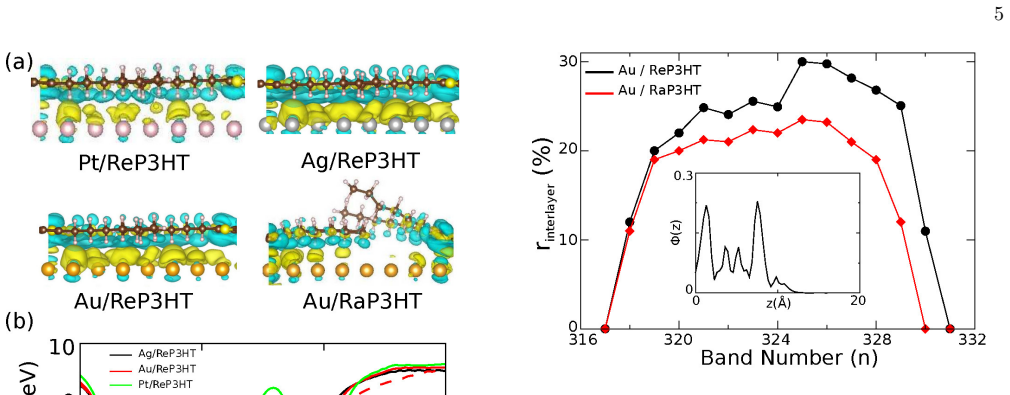
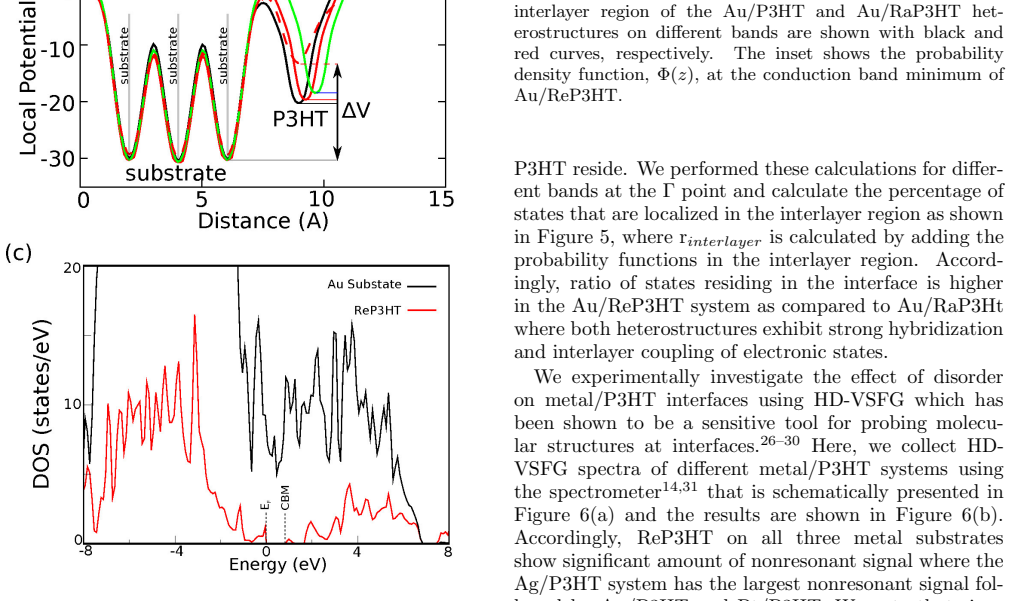
On the authors' own terms, the discovery is that the non-resonant HD-VSFG response of a metal/P3HT junction is a quantitative indicator of spontaneous interfacial charge transfer. Density functional theory predicts that regio-regular P3HT transfers more charge to Ag, Au and Pt substrates than regio-random P3HT, with calculated interfacial charge densities ordered Ag > Au > Pt; HD-VSFG measurements under SSP polarization show the integrated non-resonant signal following the same ordering, varying linearly with the calculated charge density. Regio-randomness rotates the alkyl side chains away from the substrate, reducing contact area, hybridization, interlayer-state localization and charge transfer, and raises the interface work function. The authors conclude that the non-resonant response of these heterojunctions can be used to determine the level of spontaneous charge transfer at the interface.
Load-bearing premise
The claim rests on the assumption that the non-resonant signal at the metal/polymer interface is generated specifically by the charge that actually moves between the two materials, and not by other interfacial changes that happen to accompany charge transfer.
Editorial extensions
If this is right
- Buried interfacial charge transfer at metal/organic contacts can be read optically from the non-resonant HD-VSFG intensity, including at thick polymer films that photoelectron spectroscopy cannot penetrate.
- The linear correlation between non-resonant signal and computed charge density gives a calibration path: on a given metal, measured SFG intensity can be converted into interfacial charge density.
- Regio-randomness becomes a design lever for tailoring interfacial charge transfer, hybridization, and work function in hybrid photovoltaic and molecular-electronics junctions.
- Depositing a polymer film that transfers more charge lowers the interface work function, allowing work-function engineering of metal electrodes by conformer choice.
- HD-VSFG works under ambient conditions, so the same measurement could monitor charge transfer at working device interfaces rather than only in vacuum or on model surfaces.
Reading between the lines
- Beyond the paper: if the $\chi^{(3)}$ mechanism dominates, the non-resonant signal actually reports the interfacial electric field, which equals the transferred charge only for a fixed film geometry; varying the P3HT film thickness would separate field strength from net charge.
- Beyond the paper: the same correlation should transfer to other conjugated polymers and coinage metals, with the slope of the linear relation set by the substrate's electronic structure; testing one additional polymer would show whether the calibration is universal or material-specific.
- Beyond the paper: polarization- and angle-resolved HD-VSFG could discriminate the two proposed origins, since screening-mediated and field-mediated non-resonant signals have different symmetry and delay responses.
- Beyond the paper: an in-operando variant with an external bias across the junction would test whether dynamic charge transfer follows the same linear relation, extending the static correlation to working devices.
Signed reviews
Editorial analysis
A structured set of objections, weighed in public.
Referee Report
Summary. The paper combines DFT calculations and heterodyne vibrational sum frequency generation (HD-VSFG) measurements on metal/P3HT interfaces to argue that the non-resonant HD-VSFG signal under SSP polarization can serve as a quantitative probe of spontaneous interfacial charge transfer. The DFT part compares regioregular and regiorandom P3HT on Ag, Au, and Pt surfaces, reporting binding energies, charge-density differences, work functions, density of states, and wavefunction localization. The experimental part presents HD-VSFG spectra showing larger non-resonant signals for regioregular than for regiorandom P3HT, with an apparent linear correlation between integrated non-resonant intensity and DFT-computed interfacial charge density (inset of Fig. 6(b)). The central claim is stated in the abstract and conclusion: by measuring the non-resonant response of metal/P3HT heterojunctions, the level of spontaneous charge transfer at the interface can be determined.
Significance. If the central claim holds, the paper would establish a valuable optical probe of buried metal/organic interfaces, complementing photoelectron spectroscopy, which is limited by penetration depth. The combination of first-principles calculations and interface-specific spectroscopy is appropriate, and the internal consistency of the DFT trends across three metals and two polymer regularities is a genuine strength. The authors are also candid about the unresolved mechanism. However, the quantitative claim rests on a six-point correlation without reported uncertainty, and the two proposed mechanisms for the non-resonant signal are not experimentally or theoretically distinguished. The result is therefore promising but not yet at the level of a demonstrated quantitative proxy.
major comments (4)
- [Figure 6(b), inset] The central correlation is based on only six points, and no error bars, fit statistics, or uncertainties are reported for either the integrated non-resonant intensities or the DFT charge densities. Since the abstract and conclusion claim that the level of charge transfer 'can be determined' from the non-resonant response, the calibration must be shown to generalize. Please provide the fit parameters and residuals, quantify both experimental and computational uncertainties, and ideally include an out-of-sample or cross-validated test rather than only the in-sample correlation.
- [Experimental results, paragraph on HD-VSFG] The manuscript lists two candidate origins for the non-resonant signal: reduced lateral screening due to hybridization, and a charge-transfer-induced electric field giving a chi^(3) contribution, and then states that 'Further investigation will be necessary to completely explain the mechanism.' These mechanisms have different dependencies on microscopic quantities: the screening channel depends on orbital overlap and local dielectric response, whereas the chi^(3) channel depends on the interfacial electric field and net charge. Because changing the metal and the regio-regularity simultaneously changes hybridization, screening, and charge transfer, the monotonic trend in Fig. 6(b) does not establish that the signal specifically tracks net transferred charge. A control experiment that varies charge transfer while keeping hybridization nearly fixed, or a calculation of the nonlinear response from the computed interfacial electronic structure, is needed to support the specificity of the proposed proxy.
- [DFT models, paragraph beginning 'We next place the Re- and RaP3HT layers'] The regiorandom DFT model uses a single representative structure, chosen as the conformation with the highest band gap, while the experimental regiorandom film is an ensemble of conformations. This representational mismatch can bias the computed charge densities that enter the calibration curve. The paper should quantify the sensitivity of the interfacial charge density to conformer choice and, if feasible, use an ensemble average over multiple regiorandom configurations before using these values for a quantitative calibration.
- [Methods, experimental substrate preparation] The experimental metal substrates are polycrystalline sputtered films with a titanium adhesion layer, whereas the DFT calculations model clean three-layer crystalline metal slabs with a single P3HT layer. Roughness, grain boundaries, possible titanium exposure, and ambient contamination are present in the experiment but absent in the calculation. If these factors alter the relationship between the measured non-resonant intensity and the computed net charge, the calibration is sample-specific. The authors should discuss this mismatch and, where possible, test its effect, for example by comparing sputtered and single-crystal substrates for at least one metal/polymer combination.
minor comments (4)
- [Throughout] There are several typographical errors, including 'distacne' in the Figure 2 caption, 'recpect' in the band-structure discussion, 'electon' in the effective-mass sentence, 'althoguh' in the binding-energy paragraph, and 'valance' for 'valence'.
- [Band-structure discussion] The effective-mass expression 'h-bar/m* = 1/(d^2E/dk^2)' appears dimensionally inconsistent; the standard relation is 1/m* = (1/h-bar^2) d^2E/dk^2. Please correct the formula and its surrounding text.
- [Figure 4(b) and accompanying text] The notation Delta V_{Ag-ReP3HT} < Delta V_{Au-ReP3HT} < Delta V_{Pt-ReP3HT} is used without an explicit definition of the potential difference being plotted; please define it clearly.
- [Band-gap comparison] The comparison between the experimental statement that the P3HT band gap decreases from 2.1 eV to 1.5 eV and the DFT statement that the GGA gap decreases by 0.4 eV is not direct because GGA and optical gaps differ; please clarify which quantities are being compared and whether the shift is the relevant observable.
Circularity Check
There is no circularity: DFT charge densities and HD-VSFG intensities are independent data streams, and the reported correlation is an empirical calibration rather than a construction or a fitted parameter disguised as a prediction.
full rationale
The paper's chain is: DFT computes interfacial charge redistribution via Delta-rho and reports per-area surface charge densities (0.061, 0.056, and 0.038 C/m^2 for Ag/ReP3HT, Au/ReP3HT, and Pt/ReP3HT, with lower values for the regiorandom systems); HD-VSFG measures nonresonant intensities under SSP polarization; the inset of Fig. 6(b) shows a linear trend between these two independent quantities; and the abstract concludes that the nonresonant response can determine the level of spontaneous charge transfer. There is no equation in which one quantity is defined in terms of the other, and no fitted parameter is later relabeled as a prediction. The linear correlation is an in-sample empirical calibration, not a derived equality forced by construction. The self-citations (refs. 14 and 31) supply a band-gap comparison and spectrometer details, but the central DFT-versus-experiment comparison is not carried by those citations. The paper's own caveat that 'further investigation will be necessary to completely explain the mechanism' flags an unresolved mechanistic ambiguity, not a circular step: the nonresonant signal could in principle track hybridization or screening effects correlated with charge transfer, which is a concern about specificity and validity, but the quoted 'agreement' and 'linear correlation' are empirical comparisons rather than entailments. The modeling choice 'For RaP3HT, we use the structure with highest band gap' constrains the sample but does not define the measured intensity through the calculated charge density. Therefore no circular step can be exhibited, and the derivation is self-contained relative to its inputs.
Assumptions & free parameters
free parameters (1)
- Linear calibration between integrated non-resonant SFG intensity and computed interfacial charge density =
not reported
assumptions (4)
- domain assumption PBE-GGA with Grimme vdW corrections provides accurate interfacial geometries, binding energies, and charge transfer for metal/P3HT systems, despite known band-gap underestimation.
- domain assumption A model consisting of one P3HT monolayer on a three-layer metal slab with 10 Angstrom vacuum captures the semi-infinite metal/organic interface.
- domain assumption The non-resonant HD-VSFG signal under SSP polarization from metal/P3HT samples originates from interfacial charge transfer effects and not from other optical artifacts.
- domain assumption The single modeled regio-random P3HT conformation (the one with the highest band gap) is representative of the commercial regio-random P3HT used in the experiments.
Cite this review
Pith. "Pith review of Modeling spontaneous charge transfer at metal/organic hybrid heterostructures." pith.science (2026). https://pith.science/paper/Q5L3YFHR
@misc{pith2026190806269,
  author       = {Pith},
  title        = {Pith review of: Modeling spontaneous charge transfer at metal/organic hybrid heterostructures},
  year         = {2026},
  howpublished = {\url{https://pith.science/paper/Q5L3YFHR}},
  note         = {Machine review of arXiv:1908.06269}
}
read the original abstract
Hybrid materials are crucial in photovoltaics where the overall efficiency of the heterostructure is closely related to the level of charge transfer at the interface. Here, using various metal / poly(3-hexylthiophene)(P3HT) heterostructure models, we reveal that the level of spontaneous charge transfer and electronic coupling at these interfaces depend on the conformational regularity of the organic polymer deposited on the metal substrate. Using ab-initio quantum chemical calculations based on density functional theory (DFT) and heterodyne vibrational sum frequency generation (HD-VSFG) measurements, we show that inducing regio-randomness into the organic polymer modifies the intensity of interfacial electronic states, level of hybridization, density of interfacial charge transfer and the electronic wave function of the material. We present the HD-VSFG responses of the metal/P3HT heterojunctions containing both regio-regular and regio-random P3HT structures and show that the amount of non-resonant signal is closely related to the level of the spontaneous charge transfer at the interface. Thus, by measuring the non-resonant response of the metal/P3HT heterojunctions, the level of spontaneous charge transfer at the interface can be determined.
Figures


Figures from the paper (3 more)

Reference graph
Works this paper leans on
-
[1]
Integration of bulk materials with two-dimensional materials for physical coupling and applications
Bae, S.-H.; Kum, H.; Kong, W.; Kim, Y.; Choi, C.; Lee, B.; Lin, P.; Park, Y.; Kim, J. Integration of bulk materials with two-dimensional materials for physical coupling and applications. Nat. Mater. 2019, 18, 550
work page 2019
-
[2]
Huynh, W. U.; Dittmer, J. J.; Alivisatos, A. P. Hybrid nanorod-polymer solar cells. Science 2002, 295, 2425--2427
work page 2002
-
[3]
Yin, Y.; Alivisatos, A. P. Colloidal nanocrystal synthesis and the organic--inorganic interface. Nature 2004, 437, 664
work page 2004
-
[4]
Coakley, K. M.; McGehee, M. D. Conjugated polymer photovoltaic cells. Chem. Mater. 2004, 16, 4533--4542
work page 2004
-
[5]
Chang, J. A.; Rhee, J. H.; Im, S. H.; Lee, Y. H.; Kim, H.-j.; Seok, S. I.; Nazeeruddin, M. K.; Gratzel, M. High-performance nanostructured inorganic- organic heterojunction solar cells. Nano Lett. 2010, 10, 2609--2612
work page 2010
-
[6]
Braun, S.; Salaneck, W. R.; Fahlman, M. Energy-level alignment at organic/metal and organic/organic interfaces. Adv. Mater. 2009, 21, 1450--1472
work page 2009
-
[7]
Modeling of Nanoscale morphology of regioregular poly (3-hexylthiophene) on a ZnO (1010) surface
Dag, S.; Wang, L.-W. Modeling of Nanoscale morphology of regioregular poly (3-hexylthiophene) on a ZnO (1010) surface. Nano Lett. 2008, 8, 4185--4190
work page 2008
-
[8]
Packing structure of poly (3-hexylthiophene) crystal: ab initio and molecular dynamics studies
Dag, S.; Wang, L.-W. Packing structure of poly (3-hexylthiophene) crystal: ab initio and molecular dynamics studies. J. Phys. Chem. C 2010, 114, 5997--6000
work page 2010
Show all 36 references
-
[9]
T.; Hirsch, L.; Wantz, G
Dang, M. T.; Hirsch, L.; Wantz, G. P3HT: PCBM, best seller in polymer photovoltaic research. Adv. Mater. 2011, 23, 3597--3602
2011
-
[10]
S.; Wadsworth, A.; Baran, D.; Yousaf, S
Holliday, S.; Ashraf, R. S.; Wadsworth, A.; Baran, D.; Yousaf, S. A.; Nielsen, C. B.; Tan, C.-H.; Dimitrov, S. D.; Shang, Z.; et. al., High-efficiency and air-stable P3HT-based polymer solar cells with a new non-fullerene acceptor. Nat. Commun. 2016, 7, 11585
2016
-
[11]
J.; Zhang, H.-M.; Narasimhan, M.; Demaray, R
Wang, G.; Moses, D.; Heeger, A. J.; Zhang, H.-M.; Narasimhan, M.; Demaray, R. Poly (3-hexylthiophene) field-effect transistors with high dielectric constant gate insulator. J. Appl. Phys. 2004, 95, 316--322
2004
-
[12]
M.; Bechgaard, K.; Langeveld-Voss, B.; Spiering, A.; Janssen, R
Sirringhaus, H.; Brown, P.; Friend, R.; Nielsen, M. M.; Bechgaard, K.; Langeveld-Voss, B.; Spiering, A.; Janssen, R. A.; Meijer, E.; Herwig, P.; Leeuw, D. M. Two-dimensional charge transport in self-organized, high-mobility conjugated polymers. Nature 1999, 401, 685
1999
-
[13]
C.; O'Brien, D
Anglin, T. C.; O'Brien, D. B.; Massari, A. M. Monitoring the charge accumulation process in polymeric field-effect transistors via in situ sum frequency generation. J. Phys. Chem. C 2010, 114, 17629--17637
2010
-
[14]
H.; Paesani, F.; Xiong, W
Xiang, B.; Li, Y.; Pham, C. H.; Paesani, F.; Xiong, W. Ultrafast direct electron transfer at organic semiconductor and metal interfaces. Sci. Adv. 2017, 3, e1701508
2017
-
[15]
The probing depth in photoemission and Auger-electron spectroscopy
Lindau, I.; Spicer, W. The probing depth in photoemission and Auger-electron spectroscopy. J. Electron. Spectrosc. Relat. Phenom 1974, 3, 409--413
1974
-
[16]
M.; Bechgaard, K.; Langeveld-Voss, B.; Spiering, A.; Janssen, R.; Meijer, E
Sirringhaus, H.; Brown, P.; Friend, R.; Nielsen, M. M.; Bechgaard, K.; Langeveld-Voss, B.; Spiering, A.; Janssen, R.; Meijer, E. Microstructure--mobility correlation in self-organised, conjugated polymer field-effect transistors. Synth. Met. 2000, 111, 129--132
2000
-
[17]
Density functional theory study of finite carbon chains
Fan, X.; Liu, L.; Lin, J.; Shen, Z.; Kuo, J.-L. Density functional theory study of finite carbon chains. ACS Nano 2009, 3, 3788--3794
2009
-
[18]
Long-range interactions in carbon atomic chains
Cahangirov, S.; Topsakal, M.; Ciraci, S. Long-range interactions in carbon atomic chains. Phys. Rev. B 2010, 82, 195444
2010
-
[19]
O.; Ciraci, S
\"O z c elik, V. O.; Ciraci, S. Self-assembly mechanisms of short atomic chains on single-layer graphene and boron nitride. Phys. Rev. B 2012, 86, 155421
2012
-
[20]
Orientation of regioregular poly (3-hexylthiophene) by directional solidification: a simple method to reveal the semicrystalline structure of a conjugated polymer
Brinkmann, M.; Wittmann, J.-C. Orientation of regioregular poly (3-hexylthiophene) by directional solidification: a simple method to reveal the semicrystalline structure of a conjugated polymer. Adv. Mater. 2006, 18, 860--863
2006
-
[21]
Y.; Freeman, A
Li, L.-H.; Kontsevoi, O. Y.; Freeman, A. J. Atomic-scale understanding of the interaction of poly (3-hexylthiophene) with the NiO (100) surface: A first-principles study. J. Phys. Chem. C 2014, 118, 20298--20305
2014
-
[22]
H.; Benitez, G.; Rubert, A
Pensa, E.; Cortes, E.; Corthey, G.; Carro, P.; Vericat, C.; Fonticelli, M. H.; Benitez, G.; Rubert, A. A.; Salvarezza, R. C. The chemistry of the sulfur--gold interface: in search of a unified model. Accounts Chem. Res. 2012, 45, 1183--1192
2012
-
[23]
M.; Srivastava, N.; Gao, Q.; Widom, M.; Diaconescu, B.; Ohta, T.; Kellogg, G.; Robinson, J.; Vlassiouk, I
Feenstra, R. M.; Srivastava, N.; Gao, Q.; Widom, M.; Diaconescu, B.; Ohta, T.; Kellogg, G.; Robinson, J.; Vlassiouk, I. Low-energy electron reflectivity from graphene. Phys. Rev. B 2013, 87, 041406
2013
-
[24]
O.; Fathi, M.; Azadani, J
\"O z c elik, V. O.; Fathi, M.; Azadani, J. G.; Low, T. Tin monochalcogenide heterostructures as mechanically rigid infrared band gap semiconductors. Phys. Rev. Mater. 2018, 2, 051003
2018
-
[25]
O.; Grassi, R.; Low, T
Chaves, A.; Azadani, J.; \"O z c elik, V. O.; Grassi, R.; Low, T. Electrical control of excitons in van der Waals heterostructures with type-II band alignment. Phys. Rev. B 2018, 98, 121302
2018
-
[26]
Mapping molecular orientation and conformation at interfaces by surface nonlinear optics
Zhuang, X.; Miranda, P.; Kim, D.; Shen, Y. Mapping molecular orientation and conformation at interfaces by surface nonlinear optics. Phys. Rev. B 1999, 59, 12632
1999
-
[27]
K.; Beaman, D
Hore, D. K.; Beaman, D. K.; Parks, D. H.; Richmond, G. L. Whole-molecule approach for determining orientation at isotropic surfaces by nonlinear vibrational spectroscopy. J. Phys. Chem. B 2005, 109, 16846--16851
2005
-
[28]
B.; Massari, A
O'Brien, D. B.; Massari, A. M. Experimental evidence for an optical interference model for vibrational sum frequency generation on multilayer organic thin film systems. Consideration for higher order terms. J. Chem. Phys. 2015, 142, 024704
2015
-
[29]
Quantitative sum-frequency generation vibrational spectroscopy of molecular surfaces and interfaces: lineshape, polarization, and orientation
Wang, H.-F.; Velarde, L.; Gan, W.; Fu, L. Quantitative sum-frequency generation vibrational spectroscopy of molecular surfaces and interfaces: lineshape, polarization, and orientation. Annu. Rev. Phys. Chem. 2015, 66, 189--216
2015
-
[30]
Probing electronic structures of organic semiconductors at buried interfaces by electronic sum frequency generation spectroscopy
Li, Y.; Wang, J.; Xiong, W. Probing electronic structures of organic semiconductors at buried interfaces by electronic sum frequency generation spectroscopy. J. Phys. Chem. C 2015, 119, 28083--28089
2015
-
[31]
Heterodyne transient vibrational SFG to reveal molecular responses to interfacial charge transfer
Li, Y.; Xiang, B.; Xiong, W. Heterodyne transient vibrational SFG to reveal molecular responses to interfacial charge transfer. J. Chem. Phys. 2019, 150, 114706
2019
-
[32]
E.; Wang, H.-f.; Geiger, F
Ohno, P. E.; Wang, H.-f.; Geiger, F. M. Second-order spectral lineshapes from charged interfaces. Nat. Commun. 2017, 8, 1032
2017
-
[33]
Semiempirical GGA -type density functional constructed with a long-range dispersion correction
Grimme, S. Semiempirical GGA -type density functional constructed with a long-range dispersion correction. J. Comput. Chem. 2006, 27, 1787--1799
2006
-
[34]
Bl\"ochl, P. E. Projector augmented-wave method. Phys. Rev. B 1994, 50, 17953--17979
1994
-
[35]
P.; Burke, K.; Ernzerhof, M
Perdew, J. P.; Burke, K.; Ernzerhof, M. Generalized gradient approximation made simple. Phys. Rev. Lett. 1996, 77, 3865--3868
1996
-
[36]
Hz^Tڲ (<>'>_[I3 sߜ<[ zwv @ 'Ud rmg/KH S >G( :/Z30* i>O#u dѺf@ mvyoeu K>fR b 0 ex G > 0Vًg :o` 2@0qNnż ̨ݰdY
Kresse, G.; Furthm\"uller, J. Efficient iterative schemes for ab initio total-energy calculations using a plane-wave basis set. Phys. Rev. B 1996, 54, 11169--11186 mcitethebibliography arxiv.tex0000664000000000000000000007542013525742616011454 0ustar rootroot [aps,english,prb,...
1996
Reviewed August 14, 2026 · model on record in the stance chip above.
Discussion (0). Continue with ORCID to comment.