REVIEW 4 major objections 5 minor 56 references
U-CAM: Visual Explanation using Uncertainty based Class Activation Maps
T0 review · 4 major / 5 minor · reviewed 2026-08-14 · deepseek-v4-flash
Pith's one-line read Adding uncertainty-loss gradients to the classifier gradient produces visual attention maps that align with human gaze and improves visual question answering accuracy.
desk verdict The paper has a plausible new recipe and a clean external benchmark, but the missing noise control leaves the central mechanism claim unproven. read the letter →
The pith
A machine-rendered reading of the paper's core claim, the machinery that carries it, and where it could break.
The reading
What carries the argument
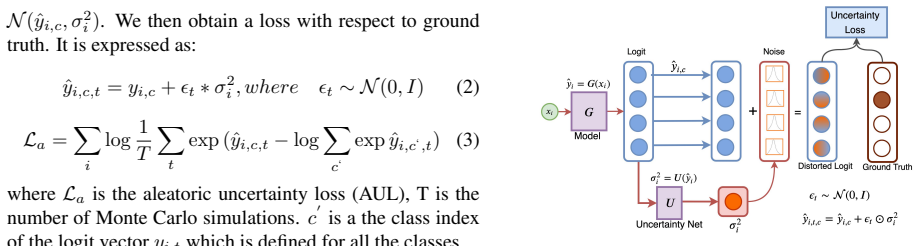
The mechanism is the Gradient-based Certainty Attention (GCA) mask. The uncertainty gradient $\partial L_u/\partial f_i$ is multiplied pointwise with the classification gradient $\partial L_y/\partial f_i$, negated with hyperparameter $\lambda$, then passed through an asymmetric ReLU that keeps positive activations and scales negative ones by a large negative $\gamma$. After normalizing to a probability distribution, this certainty mask is added back to the original gradient $\partial L_y/\partial f_i$ to form the effective gradient used to update the attention network. The uncertainty losses themselves come from a Gaussian-perturbed logit reparameterization: aleatoric loss uses a per-input variance, and predictive loss adds the entropy of Monte Carlo sampled probabilities.
What would settle it
Train the same VQA model with the same uncertainty-loss hyperparameters but replace the elementwise product and sign flip in Equation 6 with a randomly signed copy of the uncertainty gradient. If rank correlation with human attention on VQA-HAT does not drop materially, the product and sign asymmetry are not the operative cause of the reported gains.
Extended reading notes
Core claim
The central claim is that if you compute the gradient of an aleatoric or predictive uncertainty loss with respect to the attended image feature and combine it with the standard cross-entropy gradient through an elementwise product, a sign flip, an asymmetric ReLU, and a residual connection, the resulting 'certainty map' improves both the attention masks and the predictive accuracy of a VQA model. On VQA-v1 test-dev, the Predictive-GCA variant raises the MCB baseline accuracy from 63.8% to 66.5%, and on the VQA-HAT benchmark it raises rank correlation with human attention from 0.279 to 0.334.
Load-bearing premise
The modified gradient in Equation 9, which uses the elementwise product and sign flip of uncertainty gradients with hyperparameters lambda and gamma, is taken to be a valid optimization signal, even though it is not derived from any single loss function.
Editorial extensions
If this is right
- On VQA-v1 test-dev, P-GCA improves the MCB baseline by 2.7 points overall, with the largest gain on yes/no questions (82.2% to 84.7%).
- On VQA-HAT, rank correlation of the produced attention maps with human attention rises from 0.279 (baseline) to 0.334 (P-GCA), while the Earth Mover's Distance decreases from 0.3931 to 0.3721.
- The recipe transfers to other VQA models: P-GCA grafted on to the Counter model reaches 69.2% on VQA-v2 test-dev, approaching the then state of the art BAN model.
- Uncertainty estimates correlate with misclassification: correctly predicted samples are typically more certain, and the margin between top-2 softmax scores grows for similar answer classes.
- The method can be viewed as a plug-in that improves any VQA architecture outfitted with the uncertainty-estimation branches.
Reading between the lines
- The asymmetric ReLU with a large negative multiplier for negative activations is an ad hoc detail; if it is the actual engine of the accuracy gain, a simpler sign-aware regularizer might reproduce the effect without the full gradient surgery.
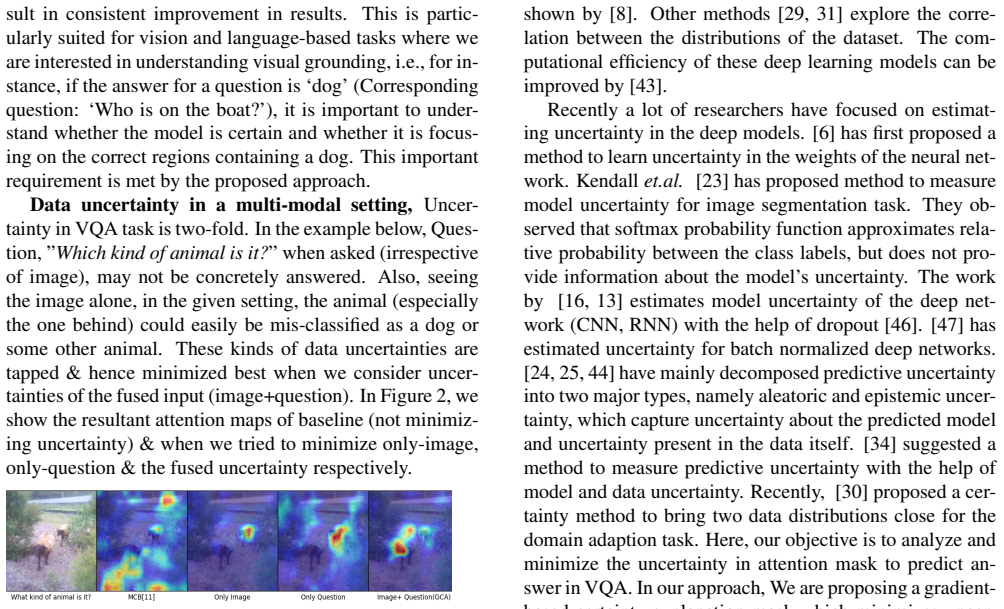
- A natural stress test is to perturb images or add distractors and see whether the P-GCA attention maps remain grounded on the correct object; success would separate true grounding gains from generic gaze mimicking.
- The uncertainty-correlation claim suggests a testable extension: P-GCA attention maps might be more robust to domain shift than standard Grad-CAM maps, because the certainty signal is trained rather than inferred post hoc.
- The comparison to human attention is correlational; an evaluation on a downstream task requiring precise localization, such as providing the bounding box of the answered object, would test whether the improved rank correlation translates to better spatial grounding.
Signed reviews
Editorial analysis
A structured set of objections, weighed in public.
Referee Report
Summary. The paper proposes U-CAM, a method for visual question answering (VQA) that combines gradients of the standard classification loss with gradients of aleatoric and predictive uncertainty losses with respect to the attended feature representation. The resulting 'certainty gradients' (Eqs. 6-9) are used both as visual explanation masks and as a modified training signal. Experiments on VQA-v1 and VQA-v2, evaluated against human attention in VQA-HAT and VQA-X, show a monotone improvement in rank correlation from the baseline (0.2790) to P-GCA (0.3341) in Table 3, and accuracy gains from 63.8 to 66.5 for P-GCA in Table 1. The paper claims this is a general recipe for obtaining improved certainty estimates and explanations for deep learning models.
Significance. If the results hold, the contribution is practically valuable: a simple, model-agnostic addition that improves both VQA accuracy and agreement with human attention, without training on human attention data. The use of an external human-attention benchmark that is not part of the training objective rules out direct circularity for the correlation claims, and the ablation series from VE through P-GCA is a useful empirical mapping. The method is applicable to at least two existing attention architectures (MCB and SAN). However, the significance is currently limited by unresolved specification issues, missing control experiments, and the absence of error bars, which prevent a reliable assessment of the claimed uncertainty-based mechanism.
major comments (4)
- [Section 4.1.3, Eq. (6); Tables 1 and 3] The central claim that the uncertainty-specific content of the modified gradient drives the gains is not tested. Every proposed variant (VE, UDL, AUL, PUL, A-GCA, P-GCA) uses the same elementwise product, sign flip, ReLU, and normalization surgery, so the monotone improvements in Tables 1 and 3 could in principle come from the surgery itself rather than from the uncertainty estimates. A control experiment that replaces ∂Lu/∂fi in Eq. (6) with a gradient of unrelated semantics but matched shape and scale (e.g., gradient of a random auxiliary loss, or structured noise) is missing. If such a control reproduces the RC of 0.3341 and accuracy of 66.5, the paper's 'recipe' claim is unsupported.
- [Section 4.2, Algorithm 1, Eqs. (8)-(9)] There are two load-bearing specification gaps in the training procedure. First, Eq. (8) normalizes ∇''y by its spatial sum, whereas Algorithm 1 line 25 applies a softmax; these are different operations and the paper does not say which one was used in the reported experiments. Second, the cost function in Section 4.2 is C = Ly + ηLu, but Algorithm 1 line 27 updates θf with ∇y = ∂Ly/∂fi + ∇'''u and never adds η∂Lu/∂fi. As written, the update is not a gradient step on C, so the objective actually being optimized is unclear; this directly affects the claim that uncertainty is minimized and that the heatmaps reflect certainty.
- [Section 5.2, Figure 5] The abstract and Section 5.2 claim that the uncertainty estimates show 'strong correlation with misclassification' and that the method improves certainty estimates, but no quantitative correlation coefficient or statistical test is reported; Figure 5(a,b) are qualitative plots. Since this is one of the two main claimed benefits, a number (such as Spearman or Pearson correlation between uncertainty and error, with confidence intervals) should be provided.
- [Tables 1-5 and Section 5.5] No error bars, standard deviations, or multiple-seed results are reported for any table, and the values of the free hyperparameters λ (Eq. 6), γ (Eq. 7), η (Section 4.2), α (Eq. 11), σ0 (Eq. 10), and T (Eqs. 2 and 5) are never given, despite being 'fine-tuned using the validation set.' The reported differences are small (e.g., Table 3: PUL 0.3012 vs PUL+UDL 0.3243; Table 1: AUL 64.7 vs PUL 64.9), so the monotone ablation pattern could be within run-to-run variation. Means over at least three seeds and a listing of all hyperparameter values are necessary for the claims to be reproducible.
minor comments (5)
- [Eq. (13)] Equation (13) writes the solution as arg max of the cost function, but the text describes training by minimizing a loss; this should be arg min.
- [Section 1, paragraph after contributions] The sentence 'Data uncertainty in a multi-modal setting, Uncer- tainty in VQA task is two-fold.' is a broken fragment and should be rewritten.
- [Table 2 and surrounding text] The caption of Table 2 says 'VQA-X' and the text says 'This human explanation mask only available for VQA-v2 dataset.' Please clarify the relationship between VQA-X and VQA-v2, and state which dataset each row of Table 2 is evaluated on.
- [Figure 6] For each column in Figure 6, state explicitly whether the displayed map is the raw attention weight, the gradient mask ∂Ly/∂fi, or the modified certainty gradient, so the qualitative comparison is interpretable.
- [Algorithm 1, line 14 and Eq. (10)] Algorithm 1 line 14 references 'expI' and Eq. (10), but Eq. (10) defines exp(σ0^2); align the notation between the algorithm and the equation.
Circularity Check
No significant circularity: the human-attention benchmark is external and the key uncertainty losses are imported from prior work, so the reported gains are not forced by construction.
full rationale
The central claim is an empirical recipe: replacing the classification gradient used for training and explanation with the modified gradient of Eqs. 6-9 improves VQA-HAT rank correlation, VQA-X EMD, and VQA accuracy. There is no formal derivation chain whose predicted quantity is re-inserted as an input. The uncertainty losses (Eqs. 1-5, 10-12) are taken from Kendall/Gal and Dorman, not rederived from this paper's fitted values, and the human attention maps (VQA-HAT, VQA-X) are never used to train the model or, on the evidence in the paper, to tune the main gradient-surgery hyperparameters, so the reported RC/EMD improvements are externally falsifiable rather than constructed. The self-citations (DVQA [37]; certainty for domain adaptation [29-31]) appear as related work or comparison baselines and do not carry the load-bearing argument. The manuscript does have internal consistency defects -- Eq. 9 writes an in-place overwrite as an equality, Algorithm 1 uses softmax where Eq. 8 specifies sum-normalization, Algorithm 1's update omits the eta*partial Lu/partial fi term from the stated cost, and Eq. 13 says arg max where minimization is meant -- and reference [9] is mis-cited for Grad-CAM, but these are rigor/reproducibility issues, not circularity. No step reduces by construction to its own input.
Assumptions & free parameters
free parameters (6)
- lambda (Equation 6) =
not reported
- gamma (Equation 7) =
large negative number
- eta (cost function, Section 4.2) =
fine-tuned on validation set
- alpha (Equation 11) =
not reported
- sigma0 (Equation 10) =
constant
- T (Equations 2 and 5) =
25 for plots in Section 5.3
assumptions (4)
- domain assumption Predictive uncertainty decomposes as entropy plus expected aleatoric variance (Equation 5).
- ad hoc to paper The gradient product and sign flip in Equation 6 produce certainty directions that improve attention.
- ad hoc to paper ReLU plus gamma weighting in Equation 7 emphasizes positive attention regions and suppresses negatives.
- domain assumption Replacing the true gradient with the modified gradient in Equation 9 converges to a model with better attention.
Cite this review
Pith. "Pith review of U-CAM: Visual Explanation using Uncertainty based Class Activation Maps." pith.science (2026). https://pith.science/paper/6RVHDFUF
@misc{pith2026190806306,
  author       = {Pith},
  title        = {Pith review of: U-CAM: Visual Explanation using Uncertainty based Class Activation Maps},
  year         = {2026},
  howpublished = {\url{https://pith.science/paper/6RVHDFUF}},
  note         = {Machine review of arXiv:1908.06306}
}
read the original abstract
Understanding and explaining deep learning models is an imperative task. Towards this, we propose a method that obtains gradient-based certainty estimates that also provide visual attention maps. Particularly, we solve for visual question answering task. We incorporate modern probabilistic deep learning methods that we further improve by using the gradients for these estimates. These have two-fold benefits: a) improvement in obtaining the certainty estimates that correlate better with misclassified samples and b) improved attention maps that provide state-of-the-art results in terms of correlation with human attention regions. The improved attention maps result in consistent improvement for various methods for visual question answering. Therefore, the proposed technique can be thought of as a recipe for obtaining improved certainty estimates and explanation for deep learning models. We provide detailed empirical analysis for the visual question answering task on all standard benchmarks and comparison with state of the art methods.
Figures

Figures from the paper (3 more)


Reference graph
Works this paper leans on
-
[1]
Bottom-up and top-down attention for image captioning and visual question answering
Peter Anderson, Xiaodong He, Chris Buehler, Damien Teney, Mark Johnson, Stephen Gould, and Lei Zhang. Bottom-up and top-down attention for image captioning and visual question answering. In Proceedings of the IEEE Con- ference on Computer Vision and Pattern Recognition, pages 6077–6086, 2018
work page 2018
-
[2]
Lawrence Zitnick, and Devi Parikh
Stanislaw Antol, Aishwarya Agrawal, Jiasen Lu, Margaret Mitchell, Dhruv Batra, C. Lawrence Zitnick, and Devi Parikh. VQA: Visual Question Answering. In International Conference on Computer Vision (ICCV), 2015
2015
-
[3]
Martin Arjovsky, Soumith Chintala, and L ´eon Bottou. Wasserstein gan. stat, 1050:26, 2017
work page 2017
-
[4]
Deep at- tention neural tensor network for visual question answering
Yalong Bai, Jianlong Fu, Tiejun Zhao, and Tao Mei. Deep at- tention neural tensor network for visual question answering. In Proceedings of the European Conference on Computer Vi- sion (ECCV), pages 20–35, 2018
work page 2018
-
[5]
K Barnard, P Duygulu, and D Forsyth. N. de freitas, d. Blei, and MI Jordan, ” Matching Words and Pictures”, submitted to JMLR, 2003
work page 2003
-
[6]
Weight uncertainty in neural network
Charles Blundell, Julien Cornebise, Koray Kavukcuoglu, and Daan Wierstra. Weight uncertainty in neural network. In International Conference on Machine Learning , pages 1613–1622, 2015
work page 2015
-
[7]
Mind’s eye: A recur- rent visual representation for image caption generation
Xinlei Chen and C Lawrence Zitnick. Mind’s eye: A recur- rent visual representation for image caption generation. In Proceedings of the IEEE conference on computer vision and pattern recognition, pages 2422–2431, 2015
work page 2015
-
[8]
Lawrence Zitnick, Devi Parikh, and Dhruv Batra
Abhishek Das, Harsh Agrawal, C. Lawrence Zitnick, Devi Parikh, and Dhruv Batra. Human Attention in Visual Ques- tion Answering: Do Humans and Deep Networks Look at the Same Regions? In Conference on Empirical Methods in Natural Language Processing (EMNLP), 2016
work page 2016
Show all 56 references
-
[9]
Moura, Stefan Lee, and Dhruv Batra
Abhishek Das, Satwik Kottur, Jos ´e M.F. Moura, Stefan Lee, and Dhruv Batra. Learning cooperative visual dialog agents with deep reinforcement learning. In IEEE International Conference on Computer Vision (ICCV), 2017
2017
-
[10]
Bayesian neural network blogpost
Kyle Dorman. Bayesian neural network blogpost. https://github.com/kyle-dorman/bayesian-neural-network- blogpost. Accessed: 2018-07-015
2018
-
[11]
From captions to visual concepts and back
Hao Fang, Saurabh Gupta, Forrest Iandola, Rupesh Srivas- tava, Li Deng, Piotr Doll ´ar, Jianfeng Gao, Xiaodong He, Margaret Mitchell, John Platt, et al. From captions to visual concepts and back. In Proceedings of the IEEE conference on computer vision and pattern recognition, 2015
2015
-
[12]
Every picture tells a story: Generating sentences from images
Ali Farhadi, Mohsen Hejrati, Mohammad Amin Sadeghi, Pe- ter Young, Cyrus Rashtchian, Julia Hockenmaier, and David Forsyth. Every picture tells a story: Generating sentences from images. In European conference on computer vision , pages 15–29. Springer, 2010
2010
-
[13]
Bayesian recurrent neural networks
Meire Fortunato, Charles Blundell, and Oriol Vinyals. Bayesian recurrent neural networks. arXiv preprint arXiv:1704.02798, 2017
2017 arXiv
-
[14]
Multimodal com- pact bilinear pooling for visual question answering and vi- sual grounding
Akira Fukui, Dong Huk Park, Daylen Yang, Anna Rohrbach, Trevor Darrell, and Marcus Rohrbach. Multimodal com- pact bilinear pooling for visual question answering and vi- sual grounding. arXiv preprint arXiv:1606.01847, 2016
2016 arXiv
-
[15]
Uncertainty in Deep Learning
Yarin Gal. Uncertainty in Deep Learning. PhD thesis, Uni- versity of Cambridge, 2016
2016
-
[16]
Dropout as a bayesian approximation: Representing model uncertainty in deep learning
Yarin Gal and Zoubin Ghahramani. Dropout as a bayesian approximation: Representing model uncertainty in deep learning. In International Conference on Machine Learning (ICML), pages 1050–1059, 2016
2016
-
[17]
A theoretically grounded application of dropout in recurrent neural networks
Yarin Gal and Zoubin Ghahramani. A theoretically grounded application of dropout in recurrent neural networks. In Advances in neural information processing systems , pages 1019–1027, 2016
2016
-
[18]
Making the v in vqa matter: Elevating the role of image understanding in visual question answer- ing
Yash Goyal, Tejas Khot, Douglas Summers-Stay, Dhruv Ba- tra, and Devi Parikh. Making the v in vqa matter: Elevating the role of image understanding in visual question answer- ing. In Proceedings of the IEEE Conference on Computer Vision and Pattern Recognition, pages 1–9, 2017
2017
-
[19]
Multimodal explanations: Justifying decisions and pointing to the evidence
Dong Huk Park, Lisa Anne Hendricks, Zeynep Akata, Anna Rohrbach, Bernt Schiele, Trevor Darrell, and Marcus Rohrbach. Multimodal explanations: Justifying decisions and pointing to the evidence. In Proceedings of the IEEE Conference on Computer Vision and Pattern Recognition , p...
2018
-
[20]
Densecap: Fully convolutional localization networks for dense caption- ing
Justin Johnson, Andrej Karpathy, and Li Fei-Fei. Densecap: Fully convolutional localization networks for dense caption- ing. In Proceedings of the IEEE Conference on Computer Vision and Pattern Recognition, pages 4565–4574, 2016
2016
-
[21]
Learning to predict where humans look
Tilke Judd, Krista Ehinger, Fr ´edo Durand, and Antonio Tor- ralba. Learning to predict where humans look. In Computer Vision, 2009 IEEE 12th international conference on , pages 2106–2113. IEEE, 2009
2009
-
[22]
Deep visual-semantic align- ments for generating image descriptions
Andrej Karpathy and Li Fei-Fei. Deep visual-semantic align- ments for generating image descriptions. In Proceedings of the IEEE conference on computer vision and pattern recog- nition, pages 3128–3137, 2015
2015
-
[23]
Bayesian segnet: Model uncertainty in deep convolu- tional encoder-decoder architectures for scene understand- ing
Alex Kendall, Vijay Badrinarayanan, and Roberto Cipolla. Bayesian segnet: Model uncertainty in deep convolu- tional encoder-decoder architectures for scene understand- ing. arXiv preprint arXiv:1511.02680, 2015
2015 arXiv
-
[24]
What uncertainties do we need in bayesian deep learning for computer vision? In Advances in neural information processing systems, pages 5574–5584, 2017
Alex Kendall and Yarin Gal. What uncertainties do we need in bayesian deep learning for computer vision? In Advances in neural information processing systems, pages 5574–5584, 2017
2017
-
[25]
Multi-task learning using uncertainty to weigh losses for scene geome- try and semantics
Alex Kendall, Yarin Gal, and Roberto Cipolla. Multi-task learning using uncertainty to weigh losses for scene geome- try and semantics. 2018
2018
-
[26]
Bilin- ear attention networks
Jin-Hwa Kim, Jaehyun Jun, and Byoung-Tak Zhang. Bilin- ear attention networks. In Advances in Neural Information Processing Systems, pages 1571–1581, 2018
2018
-
[27]
Hadamard Product for Low-rank Bilinear Pooling
Jin-Hwa Kim, Kyoung Woon On, Woosang Lim, Jeonghee Kim, Jung-Woo Ha, and Byoung-Tak Zhang. Hadamard Product for Low-rank Bilinear Pooling. In The 5th Inter- national Conference on Learning Representations, 2017
2017
-
[28]
Baby talk: Understanding and generating image descriptions
Girish Kulkarni, Visruth Premraj, Sagnik Dhar, Siming Li, Yejin Choi, Alexander C Berg, and Tamara L Berg. Baby talk: Understanding and generating image descriptions. In Proceedings of the 24th CVPR. Citeseer, 2011
2011
-
[29]
Curriculum based 9 dropout discriminator for domain adaptation
Vinod Kumar Kurmi, Vipul Bajaj, Venkatesh K Subra- manian, and Vinay P Namboodiri. Curriculum based 9 dropout discriminator for domain adaptation. arXiv preprint arXiv:1907.10628, 2019
1907 arXiv
-
[30]
Attending to discriminative certainty for domain adapta- tion
Vinod Kumar Kurmi, Shanu Kumar, and Vinay P Nambood- iri. Attending to discriminative certainty for domain adapta- tion. In Proceedings of the IEEE Conference on Computer Vision and Pattern Recognition, pages 491–500, 2019
2019
-
[31]
Looking back at labels: A class based domain adaptation technique
Vinod Kumar Kurmi and Vinay P Namboodiri. Looking back at labels: A class based domain adaptation technique. arXiv preprint arXiv:1904.01341, 2019
1904 arXiv
-
[32]
Visual question answering with ques- tion representation update (qru)
Ruiyu Li and Jiaya Jia. Visual question answering with ques- tion representation update (qru). In Advances in Neural In- formation Processing Systems, pages 4655–4663, 2016
2016
-
[33]
Hierarchical question-image co-attention for visual question answering
Jiasen Lu, Jianwei Yang, Dhruv Batra, and Devi Parikh. Hierarchical question-image co-attention for visual question answering. In Advances In Neural Information Processing Systems, pages 289–297, 2016
2016
-
[34]
Predictive uncertainty es- timation via prior networks
Andrey Malinin and Mark Gales. Predictive uncertainty es- timation via prior networks. In Advances in Neural Informa- tion Processing Systems, pages 7047–7058, 2018
2018
-
[35]
A multi-world ap- proach to question answering about real-world scenes based on uncertain input
Mateusz Malinowski and Mario Fritz. A multi-world ap- proach to question answering about real-world scenes based on uncertain input. In Advances in Neural Information Pro- cessing Systems (NIPS), 2014
2014
-
[36]
Im- age question answering using convolutional neural network with dynamic parameter prediction
Hyeonwoo Noh, Paul Hongsuck Seo, and Bohyung Han. Im- age question answering using convolutional neural network with dynamic parameter prediction. In Proceedings of the IEEE Conference on Computer Vision and Pattern Recogni- tion, pages 30–38, 2016
2016
-
[37]
Namboodiri
Badri Patro and Vinay P. Namboodiri. Differential atten- tion for visual question answering. In The IEEE Conference on Computer Vision and Pattern Recognition (CVPR) , June 2018
2018
-
[38]
Multimodal differential net- work for visual question generation
Badri Narayana Patro, Sandeep Kumar, Vinod Kumar Kurmi, and Vinay Namboodiri. Multimodal differential net- work for visual question generation. In Proceedings of the 2018 Conference on Empirical Methods in Natural Lan- guage Processing, pages 4002–4012. Association for Com- pu...
2018
-
[39]
Learning semantic sentence embeddings using sequential pair-wise discriminator
Badri Narayana Patro, Vinod Kumar Kurmi, Sandeep Ku- mar, and Vinay Namboodiri. Learning semantic sentence embeddings using sequential pair-wise discriminator. InPro- ceedings of the 27th International Conference on Computa- tional Linguistics, pages 2715–2729, 2018
2018
-
[40]
Explor- ing models and data for image question answering
Mengye Ren, Ryan Kiros, and Richard Zemel. Explor- ing models and data for image question answering. In Ad- vances in Neural Information Processing Systems (NIPS) , pages 2953–2961, 2015
2015
-
[41]
Grad-cam: Visual explanations from deep networks via gradient-based localization
Ramprasaath R Selvaraju, Michael Cogswell, Abhishek Das, Ramakrishna Vedantam, Devi Parikh, and Dhruv Batra. Grad-cam: Visual explanations from deep networks via gradient-based localization. In Proceedings of the IEEE In- ternational Conference on Computer Vision (ICCV), 2017
2017
-
[42]
Where to look: Focus regions for visual question answering
Kevin J Shih, Saurabh Singh, and Derek Hoiem. Where to look: Focus regions for visual question answering. In Pro- ceedings of the IEEE Conference on Computer Vision and Pattern Recognition, pages 4613–4621, 2016
2016
-
[43]
Namboodiri
Pravendra Singh, Vinay Kumar Verma, Piyush Rai, and Vinay P. Namboodiri. Hetconv: Heterogeneous kernel- based convolutions for deep cnns. In The IEEE Conference on Computer Vision and Pattern Recognition (CVPR) , June 2019
2019
-
[44]
Understanding measures of un- certainty for adversarial example detection
Lewis Smith and Yarin Gal. Understanding measures of un- certainty for adversarial example detection. arXiv preprint arXiv:1803.08533, 2018
2018 arXiv
-
[45]
Grounded compositional se- mantics for finding and describing images with sentences
Richard Socher, Andrej Karpathy, Quoc V Le, Christopher D Manning, and Andrew Y Ng. Grounded compositional se- mantics for finding and describing images with sentences. Transactions of the Association of Computational Linguis- tics, 2(1):207–218, 2014
2014
-
[46]
Dropout: a simple way to prevent neural networks from overfitting
Nitish Srivastava, Geoffrey Hinton, Alex Krizhevsky, Ilya Sutskever, and Ruslan Salakhutdinov. Dropout: a simple way to prevent neural networks from overfitting. The Journal of Machine Learning Research, 15(1):1929–1958, 2014
1929
-
[47]
Bayesian uncertainty estimation for batch normalized deep networks
Mattias Teye, Hossein Azizpour, and Kevin Smith. Bayesian uncertainty estimation for batch normalized deep networks. arXiv preprint arXiv:1802.06455, 2018
2018 arXiv
-
[48]
Show and tell: A neural image caption gen- erator
Oriol Vinyals, Alexander Toshev, Samy Bengio, and Du- mitru Erhan. Show and tell: A neural image caption gen- erator. In Proceedings of the IEEE Conference on Computer Vision and Pattern Recognition, pages 3156–3164, 2015
2015
-
[49]
Dy- namic memory networks for visual and textual question an- swering
Caiming Xiong, Stephen Merity, and Richard Socher. Dy- namic memory networks for visual and textual question an- swering. In Proceedings of International Conference on Ma- chine Learning (ICML), 2016
2016
-
[50]
Ask, attend and answer: Ex- ploring question-guided spatial attention for visual question answering
Huijuan Xu and Kate Saenko. Ask, attend and answer: Ex- ploring question-guided spatial attention for visual question answering. In European Conference on Computer Vision , pages 451–466. Springer, 2016
2016
-
[51]
Show, attend and tell: Neural image caption gen- eration with visual attention
Kelvin Xu, Jimmy Ba, Ryan Kiros, Kyunghyun Cho, Aaron Courville, Ruslan Salakhudinov, Rich Zemel, and Yoshua Bengio. Show, attend and tell: Neural image caption gen- eration with visual attention. In International Conference on Machine Learning, pages 2048–2057, 2015
2015
-
[52]
Attribute2image: Conditional image generation from visual attributes
Xinchen Yan, Jimei Yang, Kihyuk Sohn, and Honglak Lee. Attribute2image: Conditional image generation from visual attributes. In European Conference on Computer Vision , pages 776–791. Springer, 2016
2016
-
[53]
Stacked attention networks for image question answering
Zichao Yang, Xiaodong He, Jianfeng Gao, Li Deng, and Alex Smola. Stacked attention networks for image question answering. In Proceedings of the IEEE Conference on Com- puter Vision and Pattern Recognition, pages 21–29, 2016
2016
-
[54]
Learning to count objects in natural images for visual ques- tion answering
Yan Zhang, Jonathon Hare, and Adam Pr ¨ugel-Bennett. Learning to count objects in natural images for visual ques- tion answering. 2018
2018
-
[55]
Visual7w: Grounded question answering in images
Yuke Zhu, Oliver Groth, Michael Bernstein, and Li Fei-Fei. Visual7w: Grounded question answering in images. In Pro- ceedings of the IEEE Conference on Computer Vision and Pattern Recognition, pages 4995–5004, 2016
2016
-
[56]
supplementary This is the supplementary material for the paper ‘ U- CAM: Visual Explanation using Uncertainty based Class Activation Maps’. 10 A. Questions for Figure 5(c, d) Table 6 and 7 have the questions corresponding to ID’s present in the Figure 5 of the main paper. Ques...
Reviewed August 14, 2026 · model on record in the stance chip above.
Discussion (0). Continue with ORCID to comment.