REVIEW 3 major objections 5 minor 33 references
RefNet: A Reference-aware Network for Background Based Conversation
T0 review · 3 major / 5 minor · reviewed 2026-08-14 · deepseek-v4-flash
Pith's one-line read RefNet's reference decoder cites whole semantic units from background text, making grounded chatbot responses more informative and natural.
desk verdict A genuinely hybrid decoder for BBC, honestly ablated, but the 'state-of-the-art' claim rests on an unmatched comparison with AKGCM. read the letter →
The pith
A machine-rendered reading of the paper's core claim, the machinery that carries it, and where it could break.
The reading
What carries the argument
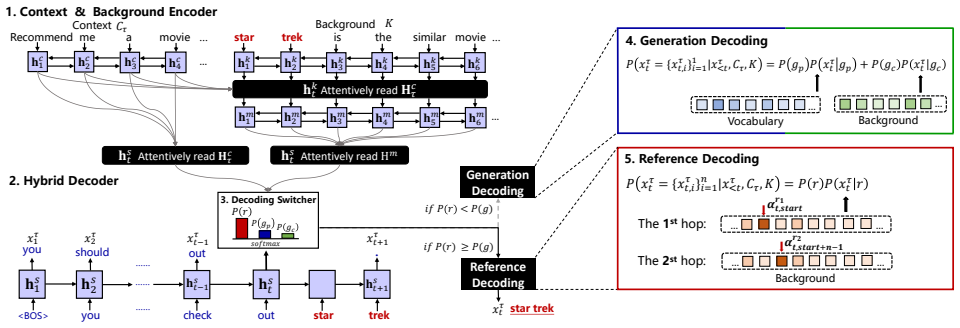
The central mechanism is the reference decoder, a two-hop pointer network that selects a semantic unit (a span carrying complete semantic meaning) directly from the context-aware background representation. At each step the decoding switcher computes probabilities for reference decoding, vocabulary prediction, and background copying; if reference decoding wins, the start pointer and end pointer emit a whole span, and the decoder state is updated once per token in that span. This is what gives the model a global perspective on the span rather than committing token by token. The matching layer that makes background tokens context-aware, and the switcher loss that supervises the reference-versus-generation choice, are supporting machinery that the ablations show are needed for the full gain.
What would settle it
Take the Holl-E test set and count how often RefNet's selected span has a start index after its end index, a length of one, or no overlap with the annotated gold span; if these degenerate spans are common even in responses that score well on human metrics, then span selection is not actually doing the work the paper attributes to it.
Extended reading notes
Core claim
On the paper's own terms, RefNet establishes that a hybrid decoder with a reference mode can solve the two failure modes of background-based conversation: missing the right background information and breaking complete semantic units. The reference decoder uses a two-hop pointer to mark the start and end of a span in the background, scoring a span as the product of the start and end probabilities, and the decoding switcher learns when to cite a span versus generate a token. On the mixed-short background version of Holl-E, RefNet outperforms the strongest generation baseline CaKe by roughly 2 to 4 percent on automatic metrics and receives higher human ratings on all four quality aspects. The paper also shows that forcing only reference decoding or only generation decoding performs worse than their combination, supporting the claim that the two modes are complementary.
Load-bearing premise
The load-bearing premise is that the start and end probabilities of a background span can be predicted independently and multiplied together; if this fails, the model cites trivial fragments such as 'i' and 'it', and the claimed gains in appropriateness and humanness would shrink.
Editorial extensions
If this is right
- If the reported gains hold, BBC systems can produce responses that cite complete background facts without breaking them across commas or filler words.
- The complementarity result implies that purely generative and purely extractive decoders are not enough; a learned switch between them is a viable design for grounded dialogue.
- The need for boundary annotations means the approach transfers directly only to datasets annotated with the background spans used in each response.
- Forcing reference decoding alone still beats or matches some baselines, which suggests span citation itself carries much of the informativeness benefit.
Reading between the lines
- Beyond the paper, the two-hop pointer's independence assumption could be tested by adding a start-before-end constraint and a minimum span length; if that lifts F1 further, the current decoding under-uses available structure.
- The reference decoder could be repurposed as a weakly supervised span selector for datasets without boundary annotations, using the switcher's reference probability as a soft label.
- A neighbouring question is whether the same hybrid decoder helps in document-grounded question answering or summarization, where the tension between fluent generation and faithful extraction also appears.
Signed reviews
Editorial analysis
A structured set of objections, weighed in public.
Referee Report
Summary. The paper proposes RefNet, a neural architecture for Background Based Conversation (BBC) on the Holl-E dataset. RefNet combines a background encoder, a context encoder, a decoding switcher, and a hybrid decoder: at each step the switcher chooses between reference decoding, which directly selects a contiguous semantic unit from the background via two-hop pointer networks, and generation decoding, which either predicts a token from the vocabulary or copies a background token. The model is trained end-to-end with a sum of generation, reference, and switcher losses using span-boundary annotations. Experiments compare RefNet with extraction-based baselines (BiDAF, R-Net, QANet) and generation-based baselines (S2S, HRED, S2SA, GTTP, CaKe, AKGCM) on automatic metrics and with CaKe and QANet in a Mechanical Turk human evaluation. The central claim is that RefNet significantly outperforms state-of-the-art methods on both automatic and human evaluations by referring to complete semantic units while preserving fluency.
Significance. If the claims are upheld, the paper makes a useful architectural contribution to knowledge-grounded conversation: it explicitly addresses the known failure of token-by-token generation to preserve complete semantic units, and the ablation study (Table 3, Table 5) provides evidence that the reference decoder and switcher loss each contribute. The code is released, which aids reproducibility. However, the strength of the headline claim is currently not matched by the evidence: the strongest published baseline, AKGCM, is evaluated under different conditions and is absent from the human study, and no uncertainty estimates are reported for any automatic or human metric. The core idea is defensible, but the comparison and reporting need revision before the stated conclusions can be accepted.
major comments (3)
- [Table 1 / §5.1] The claim that RefNet 'significantly outperforms state-of-the-art methods' is not supported against the strongest generation-based baseline. AKGCM attains BLEU-SR 30.84 while RefNet attains 30.33, and the table note states that AKGCM uses pretrained GloVe and BERT whereas all other models, including RefNet, use randomly initialized embeddings with the same vocabulary. Because AKGCM's results are taken from the original paper rather than re-run under matched conditions, the comparison is confounded by pretraining and by any implementation differences. Furthermore, AKGCM is not included in the human evaluation of Table 2, even though it is the baseline most relevant to the 'human-like responses' claim. The authors should either re-implement AKGCM under matched conditions, include it in the human study, or restrict the abstract/conclusion claim to 'outperforms the baselines we could match.'
- [§4.4 / §5.1] No error bars, confidence intervals, or variance estimates are reported for any automatic metric. The significance markers in Table 1, Table 3, and Table 5 refer to t-tests, but the reader cannot assess the stability of the reported BLEU/ROUGE differences or the validity of the t-test without knowing the number of samples per system and the per-sample score distribution. The human evaluation in Table 2 is likewise reported only as raw counts of MTurk judgments with no inter-annotator agreement or significance test. To support the word 'significantly,' the authors should report confidence intervals or bootstrap estimates for the automatic metrics and a statistical test for the human evaluation.
- [§3.2, Eq. (6)] The reference decoder models the probability of a span as the product of independently predicted start and end probabilities, P(x_t|r) = α_start * α_end, with no constraint that the end position follows the start position or that the resulting span is a meaningful unit. The case study in §6.3 acknowledges that RefNet 'occasionally selects short or meaningless semantic units, such as i and it,' which is a direct symptom of this assumption. Because span selection is the central mechanism of the paper, the authors should quantify how often such invalid or trivial spans occur and either add a monotonicity/span-length constraint to Eq. (6) or report the impact of this failure mode on the automatic and human metrics.
minor comments (5)
- [§2.1] The sentence 'response informativeness is still a urgently need to be addressed challenge' contains a grammatical error; it should be rephrased.
- [Contributions (p. 2)] 'We propose a novel architecture, RefNet, for BBCs by combing the advantages...' should read 'combining.'
- [Fig. 2] The label 'The 2st hop:' should be 'The 2nd hop'.
- [Eq. (16)] The logarithm in the reference loss has unbalanced parentheses: log[P(x_t|x_<t,C,K)))] has an extra closing parenthesis. This is likely a typographical issue but should be corrected.
- [§4.3, footnote 2] The footnote says 'for fair comparison... we do not use pre-trained GloVe such that all models randomly initialize the word embedding with the same vocabulary size,' but the table note later states that AKGCM does use pretrained GloVe and BERT. The text should explicitly acknowledge that AKGCM is the exception to this fair-comparison setup.
Circularity Check
No significant circularity: RefNet's architecture, training losses, and evaluation are externally grounded; the minor overlap with the CaKe baseline is not load-bearing.
full rationale
The paper's derivation chain is self-contained and empirically grounded. RefNet's reference decoder (Eqs. 4-8) predicts span boundaries with two-hop pointers trained against explicit boundary annotations in the Holl-E dataset, and the generation decoder (Eqs. 9-10) is trained with standard cross-entropy losses (Eqs. 15-18). No parameter is fitted to the test set and then renamed a prediction; the reported automatic metrics (BLEU, ROUGE, F1) and human evaluations are computed on held-out test samples. The comparison with CaKe, a baseline from prior work by two co-authors, is not a load-bearing self-citation: CaKe is re-run under the same embedding, hidden size, vocabulary, and training settings as RefNet, and RefNet is also compared against multiple external baselines (S2S, HRED, S2SA, GTTP, BiDAF, R-Net, QANet, AKGCM). The only potentially unfair comparison, AKGCM, whose results are taken from its original paper with pretrained GloVe and BERT, is a correctness/experimental-design concern rather than a circularity concern, and it does not cause the central claim to reduce to the paper's own inputs. The paper even acknowledges failure cases in Section 6.3, showing the evaluation is not engineered to confirm the hypothesis. Thus no circular step can be exhibited from the paper's own equations or citations.
Assumptions & free parameters
free parameters (6)
- word embedding size =
128
- GRU hidden state size =
256
- context length =
65
- learning rate =
0.001
- batch size =
32
- training epochs =
30
assumptions (4)
- domain assumption The Holl-E dataset provides valid semantic unit boundary annotations for training and evaluation.
- domain assumption The automatic and human evaluation metrics accurately reflect response quality.
- ad hoc to paper The start and end span probabilities in Eq. 6 are independent.
- domain assumption The t-test is valid for the reported metric distributions.
Cite this review
Pith. "Pith review of RefNet: A Reference-aware Network for Background Based Conversation." pith.science (2026). https://pith.science/paper/FSCR3ACS
@misc{pith2026190806449,
  author       = {Pith},
  title        = {Pith review of: RefNet: A Reference-aware Network for Background Based Conversation},
  year         = {2026},
  howpublished = {\url{https://pith.science/paper/FSCR3ACS}},
  note         = {Machine review of arXiv:1908.06449}
}
read the original abstract
Existing conversational systems tend to generate generic responses. Recently, Background Based Conversations (BBCs) have been introduced to address this issue. Here, the generated responses are grounded in some background information. The proposed methods for BBCs are able to generate more informative responses, they either cannot generate natural responses or have difficulty in locating the right background information. In this paper, we propose a Reference-aware Network (RefNet) to address the two issues. Unlike existing methods that generate responses token by token, RefNet incorporates a novel reference decoder that provides an alternative way to learn to directly cite a semantic unit (e.g., a span containing complete semantic information) from the background. Experimental results show that RefNet significantly outperforms state-of-the-art methods in terms of both automatic and human evaluations, indicating that RefNet can generate more appropriate and human-like responses.
Figures

Reference graph
Works this paper leans on
-
[1]
write newline
" write newline "" before.all 'output.state := FUNCTION fin.entry add.period write newline FUNCTION new.block output.state before.all = 'skip after.block 'output.state := if FUNCTION new.sentence output.state after.block = 'skip output.state before.all = 'skip after.sentence 'output.state := if if FUNCTION not #0 #1 if FUNCTION and 'skip pop #0 if FUNCTIO...
-
[2]
Bahdanau, D.; Cho, K.; and Bengio, Y. 2015. Neural machine translation by jointly learning to align and translate. In ICLR
2015
-
[3]
Cho, K.; van Merrienboer, B.; Gulcehre, C.; Bahdanau, D.; Bougares, F.; Schwenk, H.; and Bengio, Y. 2014. Learning phrase representations using rnn encoder--decoder for statistical machine translation. In EMNLP , 1724--1734
work page 2014
-
[4]
Dinan, E.; Roller, S.; Shuster, K.; Fan, A.; Auli, M.; and Weston, J. 2019. Wizard of wikipedia: Knowledge-powered conversational agents. In ICLR
2019
-
[5]
Gao, J.; Galley, M.; Li, L.; et al. 2019. Neural approaches to conversational ai. Foundations and Trends in Information Retrieval 13(2-3):127--298
work page 2019
-
[6]
Ghazvininejad, M.; Brockett, C.; Chang, M.-W.; Dolan, B.; Gao, J.; Yih, W.-t.; and Galley, M. 2018. A knowledge-grounded neural conversation model. In AAAI , 5110--5117
2018
-
[7]
Huang, M.; Zhu, X.; and Gao, J. 2019. Challenges in building intelligent open-domain dialog systems. arXiv preprint arXiv:1905.05709
arXiv 2019
-
[8]
Jiang, S.; Ren, P.; Monz, C.; and de Rijke, M. 2019. Improving neural response diversity with frequency-aware cross-entropy loss. In The Web Conference 2019
work page 2019
Show all 33 references
-
[9]
Lei, W.; Jin, X.; Kan, M.-Y.; Ren, Z.; He, X.; and Yin, D. 2018. Sequicity: Simplifying task-oriented dialogue systems with single sequence-to-sequence architectures. In ACL , 1437--1447
2018
-
[10]
Li, J.; Galley, M.; Brockett, C.; Gao, J.; and Dolan, B. 2016. A diversity-promoting objective function for neural conversation models. In NAACL , 110--119
2016
-
[11]
Li, Z.; Niu, C.; Meng, F.; Feng, Y.; Li, Q.; and Zhou, J. 2019. Incremental transformer with deliberation decoder for document grounded conversations. In ACL , 12--21
2019
-
[12]
Lian, R.; Xie, M.; Wang, F.; Peng, J.; and Wu, H. 2019. Learning to select knowledge for response generation in dialog systems. In IJCAI
2019
-
[13]
Liu, S.; Chen, H.; Ren, Z.; Feng, Y.; Liu, Q.; and Yin, D. 2018. Knowledge diffusion for neural dialogue generation. In ACL , 1489--1498
2018
-
[14]
Liu, Z.; Niu, Z.-Y.; Wu, H.; and Wang, H. 2019. Knowledge aware conversation generation with reasoning on augmented graph. In EMNLP , 1782--1792
2019
-
[15]
Moghe, N.; Arora, S.; Banerjee, S.; and Khapra, M. M. 2018. Towards exploiting background knowledge for building conversation systems. In EMNLP , 2322--2332
2018
-
[16]
Parthasarathi, P., and Pineau, J. 2018. Extending neural generative conversational model using external knowledge sources. In EMNLP , 690--695
2018
-
[17]
Pennington, J.; Socher, R.; and Manning, C. 2014. Glove: Global vectors for word representation. In EMNLP , 1532--1543
2014
-
[18]
Qin, L.; Galley, M.; Brockett, C.; and Liu, X. 2019. Conversing by reading: Contentful neural conversation with on-demand machine reading. In ACL , 5427--5436
2019
-
[19]
Rajpurkar, P.; Zhang, J.; Lopyrev, K.; and Liang, P. 2016. Squad: 100,000+ questions for machine comprehension of text. In EMNLP , 2383--2392
2016
-
[20]
Schuster, M., and Paliwal, K. K. 1997. Bidirectional recurrent neural networks. IEEE Transactions on Signal Processing 45(11):2673--2681
1997
-
[21]
J.; and Manning, C
See, A.; Liu, P. J.; and Manning, C. D. 2017. Get to the point: Summarization with pointer-generator networks. In ACL , 1073--1083
2017
-
[22]
Seo, M.; Kembhavi, A.; Farhadi, A.; and Hajishirzi, H. 2016. Bidirectional attention flow for machine comprehension. In ICLR
2016
-
[23]
V.; Sordoni, A.; Bengio, Y.; Courville, A
Serban, I. V.; Sordoni, A.; Bengio, Y.; Courville, A. C.; and Pineau, J. 2016. Building end-to-end dialogue systems using generative hierarchical neural network models. In AAAI , 3776--3784
2016
-
[24]
Sutskever, I.; Vinyals, O.; and Le, Q. V. 2014. Sequence to sequence learning with neural networks. In NeurIPS , 3104--3112
2014
-
[25]
Vinyals, O.; Fortunato, M.; and Jaitly, N. 2015. Pointer networks. In NeurIPS , 2692--2700
2015
-
[26]
Wang, S., and Jiang, J. 2017. Machine comprehension using match-lstm and answer pointer. In ICLR
2017
-
[27]
Wang, W.; Yang, N.; Wei, F.; Chang, B.; and Zhou, M. 2017. Gated self-matching networks for reading comprehension and question answering. In ACL , 189--198
2017
-
[28]
Xing, C.; Wu, W.; Wu, Y.; Liu, J.; Huang, Y.; Zhou, M.; and Ma, W.-Y. 2017. Topic aware neural response generation. In AAAI , 3351--3357
2017
-
[29]
Xiong, C.; Zhong, V.; and Socher, R. 2017. Dynamic coattention networks for question answering. In ICLR
2017
-
[30]
W.; Dohan, D.; Luong, M.-T.; Zhao, R.; Chen, K.; Norouzi, M.; and Le, Q
Yu, A. W.; Dohan, D.; Luong, M.-T.; Zhao, R.; Chen, K.; Norouzi, M.; and Le, Q. V. 2018. Qanet: Combining local convolution with global self-attention for reading comprehension. In ICLR
2018
-
[31]
Zhang, Y.; Ren, P.; and de Rijke, M. 2019. Improving background based conversation with context-aware knowledge pre-selection. In SCAI
2019
-
[32]
Zhou, H.; Young, T.; Huang, M.; Zhao, H.; Xu, J.; and Zhu, X. 2018. Commonsense knowledge aware conversation generation with graph attention. In IJCAI , 4623--4629
2018
-
[33]
Zhou, K.; Prabhumoye, S.; and Black, A. W. 2018. A dataset for document grounded conversations. In EMNLP , 708--713
2018
Reviewed August 14, 2026 · model on record in the stance chip above.
Discussion (0). Continue with ORCID to comment.