REVIEW 3 major objections 5 minor 47 references
Accelerated relaxation in disordered solids under cyclic loading with alternating shear orientation
T0 review · 3 major / 5 minor · reviewed 2026-08-14 · deepseek-v4-flash
Pith's one-line read Cyclic shear with an alternating shear plane—especially cycling through all three spatial directions—drives a model metallic glass to lower potential energies than single-plane cycling at the same sub-yield strain amplitude, approaching…
desk verdict The multi-axis mechanical annealing result is new and plausible, but single-sample statistics leave the protocol ordering provisional. read the letter →
The pith
A machine-rendered reading of the paper's core claim, the machinery that carries it, and where it could break.
The reading
What carries the argument
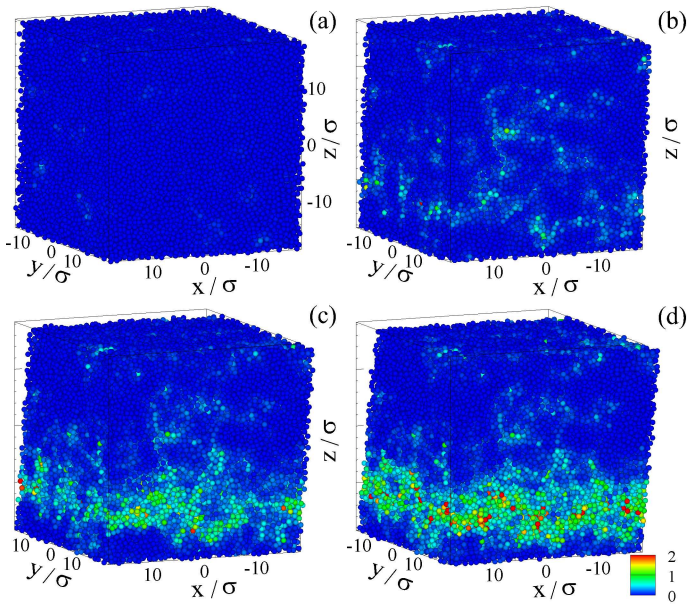
The object doing the work is the deformation protocol itself: periodic shear $\gamma(t) = \gamma_0\sin(2\pi t/T)$ with period $T=5000\tau$, applied along one plane, alternating between two planes, or alternating among three mutually perpendicular planes. The quantity that carries the comparison is the potential energy at the end of each shear cycle, tracked over 1400 cycles, with the slowly cooled glass as the reference energy. Under cyclic strain the energy landscape is effectively tilted, so groups of atoms can undergo irreversible rearrangements into lower minima; changing the shear plane appears to open additional rearrangement pathways. The nonaffine displacement measure $D^2$ (squared deviation of atomic trajectories from the best affine fit) is used to show where these rearrangements localize, including the shear band that forms during subsequent monotonic loading.
What would settle it
Repeat the three protocols (xz; xz+yz; xz+yz+xy) for at least five independently quenched samples at $\gamma_0 = 0.01$, $0.03$, and $0.06$, and compare the end-of-cycle potential energies as an ensemble. If the single-plane sample is sometimes as deep as the three-plane sample, or if the ordering does not hold within the spread, the claim that each added orientation lowers the energy is not supported. A complementary check: run the same protocols under athermal quasistatic shear and see whether the limit-cycle energy still decreases with added orientations.
Extended reading notes
Core claim
The central claim is that, within the elastic range ($\gamma_0 \le 0.065$), each additional alternation of the shear orientation in the deformation protocol relocates the glass to deeper energy minima. The ordering holds for every amplitude tested: single-plane shear along xz gives the highest energy, alternating xz/yz goes lower, and alternating among xz, yz, and xy goes lower still. At $\gamma_0 = 0.06$, the last protocol reaches $U\approx -8.29\,\varepsilon$, within about $0.02\,\varepsilon$ of the slowly cooled glass, and the energy curves nearly coincide at $\gamma_0 = 0.06$ and $0.065$ for the multi-plane protocols, suggesting a slightly lower critical amplitude there. After cycling, steady-shear tests show a pronounced yielding peak, and the shear modulus is larger along planes that were not used during cyclic loading. The paper concludes that cyclic loading in the elastic regime increases strength and produces shear-modulus anisotropy, with more orientations giving stronger relaxation.
Load-bearing premise
The ordering of energies across protocols is read from a single simulated sample per protocol; if sample-to-sample fluctuations exceed the roughly 0.01-0.02 energy-unit differences between protocols, the central claim about protocol efficiency collapses.
Editorial extensions
If this is right
- For a given sub-yield strain amplitude, adding shear orientations monotonically lowers the attainable potential energy; three-axis cycling is therefore a faster mechanical annealing route than single-plane cycling.
- Cyclic loading raises the yield stress of the relaxed glass, and the yield peak grows with both strain amplitude and the number of shear orientations in the protocol.
- Cyclic loading creates mechanical anisotropy: the shear modulus is larger along planes that were not deformed during cycling, which should be measurable in experiments on trained metallic glasses.
- Deeper relaxation correlates with more pronounced strain localization: after multi-plane cycling, subsequent monotonic shear produces a clear shear band soon after the yielding peak.
- At the higher sub-yield amplitudes, the two- and three-plane protocols nearly saturate in energy between $\gamma_0 = 0.06$ and $0.065$, implying a slightly lower protocol-dependent critical strain amplitude.
Reading between the lines
- The same ordering might hold in athermal quasistatic cycling, where a fully reversible limit cycle bounds the attainable energy; alternating the shear direction could lower that bound. This is a direct, testable extension of the paper's mechanism.
- Because the energy differences between protocols are only about $0.01$-$0.02\,\varepsilon$ per atom, the protocol ranking should be rechecked with several independently prepared samples; the paper itself notes only one sample was simulated per protocol.
- A practical optimization question follows: how often the shear plane should be switched (every cycle vs every 10 cycles) and whether non-perpendicular plane sets work as well. The paper only tests every-cycle and every-10-cycle switching at $\gamma_0=0.06$.
- If multi-axis mechanical annealing works in bulk metallic glasses, it could complement thermal cycling treatments for tuning ductility and strength.
Signed reviews
Editorial analysis
A structured set of objections, weighed in public.
Referee Report
Summary. This paper uses molecular dynamics simulations of a Kob-Andersen binary Lennard-Jones glass (60,000 atoms) to compare cyclic shear deformation protocols: single-plane shear (xz), alternating two-plane shear (xz, yz), and alternating three-plane shear (xz, yz, xy). For strain amplitudes in the claimed elastic range (γ0 ≤ 0.065), the potential energy decreases with increasing amplitude within each protocol. The central claim is that, for a fixed amplitude, each additional alternation of the shear orientation produces a lower final potential energy, with the three-plane protocol approaching the energy of a slowly cooled glass. The paper further reports, after 1400 cycles, an increase in yield stress and orientation-dependent shear moduli, along with qualitative observations of shear localization from nonaffine displacement fields in subsequent steady shear.
Significance. If the central ordering result holds, the paper identifies a simple and potentially useful protocol for mechanical annealing of glasses: multi-axis cyclic loading at sub-yield amplitudes drives the system to deeper energy minima than single-plane cycling alone. The study uses a standard, well-characterized model and a direct simulation approach with no fitted parameters; the γ0 = 0 baseline is stable, and the energy series are internally consistent. The main significance is therefore as a candidate protocol comparison. However, the strength of the claim is currently limited by the single-trajectory statistics, since the reported inter-protocol energy differences (≈0.01–0.02 ε per atom) are of the same order as typical sample-to-sample fluctuations in such systems.
major comments (3)
- [Section II; Figs. 1–3] The central claim that each additional shear orientation brings the glass to lower energy states rests on a single molecular dynamics trajectory per protocol, as the paper explicitly states in Section II: 'the simulations of periodic shear deformation were performed only for one sample.' At γ0 = 0.06 the inter-protocol differences in Fig. 3 are roughly 0.01–0.02 ε per atom (U ≈ −8.26, −8.275, −8.29 for xz, xz–yz, and xz–yz–xy, respectively), while at γ0 = 0.01 and 0.03 the separation is comparable to the cycle-to-cycle fluctuations visible in Fig. 1. Without independent initial configurations or error bars, the ordering in Fig. 3 cannot be distinguished from sample-to-sample fluctuations, so the headline conclusion is not statistically established. The authors should run replicate samples per protocol (at least at the smaller amplitudes where the separation is marginal) and report averages with error bars, or alternatively restrict the claim to the single sample studied.
- [Section III; Fig. 5] The mechanical-property trends — that the yield peak increases when an additional shear orientation is introduced and that the shear modulus is larger along directions not used during cyclic loading — are also drawn from one sample per protocol. The data in Fig. 5 are visibly scattered (e.g., the shear-modulus values for a given protocol vary by several units across directions and amplitudes), so without replicate samples these trends, like the energy ordering, are not statistically supported. This is a secondary but still load-bearing part of the abstract's claim of increased strength and modulus anisotropy.
- [Section III, comparison with slowly cooled reference] The statement that the three-plane protocol attains U ≈ −8.29 ε, 'approaching' the slowly cooled value of U ≈ −8.31 ε, is made without an uncertainty estimate. Given the single-sample limitation, the residual gap of 0.02 ε per atom may be statistically meaningful or may be within fluctuations; the paper should either provide error bars or soften this comparison.
minor comments (5)
- [Section II] The cooling rate is rendered as '10 −2ε/kBτ' with an awkward spacing; please format as 10^{-2} ε/(kB τ) for clarity.
- [Section III (not shown result)] The mention of test simulations at γ0 = 0.07 that show flow localization within the first 300 cycles is not shown; consider reporting at least the final energy levels or the time of localization in a supplementary figure, since this is directly relevant to the claim that the studied amplitudes are in the elastic range.
- [Fig. 2 caption] The legend entry '10 xz, 10 yz' would benefit from an explicit statement that this denotes 10 consecutive cycles along xz followed by 10 consecutive cycles along yz; the caption currently describes it in the text but not in the legend itself.
- [References] Reference [40] is cited as an arXiv preprint (Das, Parmar, and Sastry, 'Annealing glasses by cyclic shear deformation'); if a peer-reviewed version has appeared, please cite the published version instead.
- [Throughout] The title word 'Accelerated' implies a rate comparison, but the paper reports final energies after a fixed number of cycles rather than relaxation rates. Consider clarifying in the introduction whether 'accelerated' refers to reaching lower energies after the same number of cycles or to a faster relaxation rate.
Circularity Check
No circularity: the protocol-energy ordering is a direct molecular dynamics observation with no fitted parameters, and the self-citations are contextual rather than load-bearing.
full rationale
The paper's central claim, that each additional alternation of the shear orientation during cyclic loading brings the glass to lower potential energy states, is an empirical observation extracted from simulated trajectories. The potential energy is computed directly from the Lennard-Jones interactions (Eq. 1) and atomic coordinates; no adjustable parameter or fitted constant is introduced to produce the ordering among protocols. The comparison is made by running distinct deformation protocols on an identically prepared sample and reading the resulting energy series (Figs. 1-3), so the ordering is not implied by any input definition or equation. The reference value for the slowly cooled glass (U ≈ -8.31 epsilon) is an independent simulation result, not a fitted target. The paper's many self-citations are used to motivate the phenomenology of cyclic shear (limit cycles, yielding transitions, nonaffine displacements) but none of these citations supplies the specific energy ordering that is claimed; the ordering stands on the present simulation data. The explicitly acknowledged limitation that only one sample was simulated (Sec. II: 'Due to computational limitations, the simulations of periodic shear deformation were performed only for one sample') is a statistical robustness concern, not circularity: a single-trajectory observation can be unrepresentative, but it is not equivalent to the paper's input by construction. No equation in the paper reduces a predicted quantity to a fitted input, and no load-bearing assertion is justified solely by a self-citation. Therefore the derivation chain is self-contained and no circularity is present.
Assumptions & free parameters
assumptions (4)
- domain assumption The Kob-Andersen binary Lennard-Jones mixture (80:20, parameters in Eq. (1)) is an adequate model of metallic glass behavior.
- domain assumption A single simulation trajectory per protocol is representative of the ensemble behavior.
- domain assumption Rapid cooling at 10^-2 epsilon/(kB tau) produces a poorly annealed glass whose relaxation is negligible at gamma0=0 over 1400T.
- standard math Finite-temperature MD with the Nose-Hoover thermostat faithfully samples the potential energy landscape at T=0.01.
Cite this review
Pith. "Pith review of Accelerated relaxation in disordered solids under cyclic loading with alternating shear orientation." pith.science (2026). https://pith.science/paper/BADFS325
@misc{pith2026190806523,
  author       = {Pith},
  title        = {Pith review of: Accelerated relaxation in disordered solids under cyclic loading with alternating shear orientation},
  year         = {2026},
  howpublished = {\url{https://pith.science/paper/BADFS325}},
  note         = {Machine review of arXiv:1908.06523}
}
read the original abstract
The effect of alternating shear orientation during cyclic loading on the relaxation dynamics in disordered solids is examined using molecular dynamics simulations. The model glass was initially prepared by rapid cooling from the liquid state and then subjected to cyclic shear along a single plane or periodically alternated in two or three dimensions. We showed that with increasing strain amplitude in the elastic range, the system is relocated to deeper energy minima. Remarkably, it was found that each additional alternation of the shear orientation in the deformation protocol brings the glass to lower energy states. The results of mechanical tests after more than a thousand shear cycles indicate that cyclic loading leads to the increase in strength and shear-modulus anisotropy.
Figures


Figures from the paper (6 more)




Reference graph
Works this paper leans on
-
[40]
P. Das, A. D. S. Parmar, and S. Sastry, Annealing glasses by cyclic shear deformation, arXiv:1805.12476 (2018)
work page Pith review arXiv 2018
-
[1]
B. Ruta, E. Pineda, and Z. Evenson, Relaxation processes and physical aging in metallic glasses, J. Phys. Condens. Matter 29, 503002 (2017)
work page 2017
-
[2]
Spaepen, A microscopic mechanism for steady state inhomogeneous flow in metallic glasses, Acta Metall
F. Spaepen, A microscopic mechanism for steady state inhomogeneous flow in metallic glasses, Acta Metall. 25, 407 (1977)
work page 1977
-
[3]
A. S. Argon, Plastic deformation in metallic glasses, Acta Metall. 27, 47 (1979)
work page 1979
-
[4]
Y. Sun, A. Concustell, and A. L. Greer, Thermomechanical processing of metallic glasses: Extending the range of the glassy state, Nat. Rev. Mater. 1, 16039 (2016)
work page 2016
-
[5]
K.-W. Park, C.-M. Lee, M. Wakeda, Y. Shibutani, M. L. Falk, and J.-C. Lee, Elastostatically induced structural disordering in amorphous alloys, Acta Materialia 56, 5440 (2008)
work page 2008
- [6]
-
[7]
Y. Tong, W. Dmowski, Y. Yokoyama, G. Wang, P. K. Liaw, and T. Egami, Recovering compressive plasticity of bulk metallic glasses by high-temperature creep, Scripta Materialia 69 570 (2013)
work page 2013
Show all 47 references
-
[8]
J. Gu, M. Song, S. Ni, X. Liao, and S. Guo, Improving the plasticity of bulk metallic glasses via pre-compression below the yield stress, Mater. Sci. Eng., A 602, 68 (2014)
2014
-
[9]
A. L. Greer, and Y. H. Sun, Stored energy in metallic glasses due to strains within the elastic limit, Philos. Mag. 96, 1643 (2016)
2016
-
[10]
J. Pan, Y. X. Wang, Q. Guo, D. Zhang, A. L. Greer, and Y. Li, Extreme rejuvenation and softening in a bulk metallic glass, Nat. Commun. 9, 560 (2018)
2018
-
[11]
N. V. Priezjev, Aging and rejuvenation during elastostatic loading of amorphous alloys: A molecular dynamics simulation study, Comput. Mater. Sci. 168, 125 (2019). 10
2019
-
[12]
Saida, R
J. Saida, R. Yamada, and M. Wakeda, Recovery of less relaxed state in Zr-Al-Ni-Cu bulk metallic glass annealed above glass transition temperature, Appl. Phys. Lett. 103, 221910 (2013)
2013
-
[13]
Wakeda, J
M. Wakeda, J. Saida, J. Li, and S. Ogata, Controlled rejuvenation of amorphous metals with thermal processing, Sci. Rep. 5, 10545 (2015)
2015
-
[14]
Kuchemann, P
S. Kuchemann, P. M. Derlet, C. Liu, D. Rosenthal, G. Sparks, W. S. Larson, and R. Maass, Energy Storage in Metallic Glasses via Flash Annealing, Adv. Funct. Mater. 28, 1805385 (2018)
2018
-
[15]
M. Wang, H. Liu, J. Mo, Y. Zhang, Z. Chen, C. Yin, and W. Yang, Thermal-pressure effects on energy state of metallic glass Cu 50Zr50, Comput. Mater. Sci. 155, 493 (2018)
2018
-
[16]
N. V. Priezjev, Atomistic modeling of heat treatment processes for tuning the mechanical properties of disordered solids, J. Non-Cryst. Solids 518, 128 (2019)
2019
-
[17]
S. V. Ketov, Y. H. Sun, S. Nachum, Z. Lu, A. Checchi, A. R. Beraldin, H. Y. Bai, W. H. Wang, D. V. Louzguine-Luzgin, M. A. Carpenter, and A. L. Greer, Rejuvenation of metallic glasses by non-affine thermal strain, Nature 524, 200 (2015)
2015
-
[18]
F. Bu, J. Wang, L. Li, H. Kou, X. Xue, J. Li, The effect of thermal cycling treatments on the thermal stability and mechanical properties of a Ti-based bulk metallic glass composite, Metals 6, 274 (2016)
2016
-
[19]
M.-C. Ri, S. Sohrabi, D.-W. Ding, B.-S. Dong, S.-X. Zhou, and W.-H. Wang, Serrated mag- netic properties in metallic glass by thermal cycle, Chin. Phys. B 26, 066101 (2017)
2017
-
[20]
W.-H. Liu, B. A. Sun, H. Gleiter, S. Lan, Y. Tong, X.-L. Wang, H. Hahn, Y. Yang, J.-J. Kai, and C. T. Liu, Nanoscale Structural Evolution and Anomalous Mechanical Response of Nanoglasses by Cryogenic Thermal Cycling, Nano Lett. 18, 4188 (2018)
2018
-
[21]
N. V. Priezjev, The effect of cryogenic thermal cycling on aging, rejuvenation, and mechanical properties of metallic glasses, J. Non-Cryst. Solids 503, 131 (2019)
2019
-
[22]
Liu and N
Q.-L. Liu and N. V. Priezjev, The influence of complex thermal treatment on mechanical properties of amorphous materials, Comput. Mater. Sci. 161, 93 (2019)
2019
-
[23]
N. V. Priezjev, Potential energy states and mechanical properties of thermally cycled binary glasses, J. Mater. Res. 34, 2664 (2019)
2019
-
[24]
B. S. Li, S. Xie, and J. J. Kruzic, Toughness enhancement and heterogeneous softening of a cryogenically cycled Zr-Cu-Ni-Al-Nb bulk metallic glass, Acta Materialia 176, 278 (2019). 11
2019
-
[25]
N. V. Priezjev, Heterogeneous relaxation dynamics in amorphous materials under cyclic load- ing, Phys. Rev. E 87, 052302 (2013)
2013
-
[26]
Fiocco, G
D. Fiocco, G. Foffi, and S. Sastry, Oscillatory athermal quasistatic deformation of a model glass, Phys. Rev. E 88, 020301(R) (2013)
2013
-
[27]
Regev, T
I. Regev, T. Lookman, and C. Reichhardt, Onset of irreversibility and chaos in amorphous solids under periodic shear, Phys. Rev. E 88, 062401 (2013)
2013
-
[28]
N. V. Priezjev, Dynamical heterogeneity in periodically deformed polymer glasses, Phys. Rev. E 89, 012601 (2014)
2014
-
[29]
Regev, J
I. Regev, J. Weber, C. Reichhardt, K. A. Dahmen, and T. Lookman, Reversibility and criti- cality in amorphous solids, Nat. Commun. 6, 8805 (2015)
2015
-
[30]
N. V. Priezjev, Reversible plastic events during oscillatory deformation of amorphous solids, Phys. Rev. E 93, 013001 (2016)
2016
-
[31]
Kawasaki and L
T. Kawasaki and L. Berthier, Macroscopic yielding in jammed solids is accompanied by a non-equilibrium first-order transition in particle trajectories, Phys. Rev. E 94, 022615 (2016)
2016
-
[32]
N. V. Priezjev, Nonaffine rearrangements of atoms in deformed and quiescent binary glasses, Phys. Rev. E 94, 023004 (2016)
2016
-
[33]
Leishangthem, A
P. Leishangthem, A. D. S. Parmar, and S. Sastry, The yielding transition in amorphous solids under oscillatory shear deformation, Nat. Commun. 8, 14653 (2017)
2017
-
[34]
N. V. Priezjev, Collective nonaffine displacements in amorphous materials during large- amplitude oscillatory shear, Phys. Rev. E 95, 023002 (2017)
2017
-
[35]
M. Fan, M. Wang, K. Zhang, Y. Liu, J. Schroers, M. D. Shattuck, and C. S. O’Hern, The effects of cooling rate on particle rearrangement statistics: Rapidly cooled glasses are more ductile and less reversible, Phys. Rev. E 95, 022611 (2017)
2017
-
[36]
Dagois-Bohy, E
S. Dagois-Bohy, E. Somfai, B. P. Tighe, and M. van Hecke, Softening and yielding of soft glassy materials, Soft Matter 13, 9036 (2017)
2017
-
[37]
N. V. Priezjev, Molecular dynamics simulations of the mechanical annealing process in metallic glasses: Effects of strain amplitude and temperature, J. Non-Cryst. Solids 479, 42 (2018)
2018
-
[38]
N. V. Priezjev, The yielding transition in periodically sheared binary glasses at finite temper- ature, Comput. Mater. Sci. 150, 162 (2018)
2018
-
[39]
N. V. Priezjev, Slow relaxation dynamics in binary glasses during stress-controlled, tension- compression cyclic loading, Comput. Mater. Sci. 153, 235 (2018). 12
2018
-
[41]
N. V. Priezjev and M. A. Makeev, The influence of periodic shear on structural relaxation and pore redistribution in binary glasses, J. Non-Cryst. Solids 506, 14 (2019)
2019
-
[42]
N. V. Priezjev and M. A. Makeev, Structural transformations during periodic deformation of low-porosity amorphous materials, Modelling Simul. Mater. Sci. Eng. 27, 025004 (2019)
2019
-
[43]
Kob and H
W. Kob and H. C. Andersen, Testing mode-coupling theory for a supercooled binary Lennard- Jones mixture: The van Hove correlation function, Phys. Rev. E 51, 4626 (1995)
1995
-
[44]
S. J. Plimpton, Fast parallel algorithms for short-range molecular dynamics, J. Comp. Phys. 117, 1 (1995)
1995
-
[45]
M. P. Allen and D. J. Tildesley, Computer Simulation of Liquids (Clarendon, Oxford, 1987)
1987
-
[46]
D. J. Lacks and M. J. Osborne, Energy landscape picture of overaging and rejuvenation in a sheared glass, Phys. Rev. Lett. 93, 255501 (2004)
2004
-
[47]
M. L. Falk and J. S. Langer, Dynamics of viscoplastic deformation in amorphous solids, Phys. Rev. E 57, 7192 (1998). 13 Figures 14 0 400 800 1200 t / T -8.28 -8.27 -8.26 -8.25 -8.24 -8.23U/ ε 0.01 0.03 0.06 FIG. 1: (Color online) The potential energy series during 1400 shear c...
1998
Reviewed August 14, 2026 · model on record in the stance chip above.
Discussion (0). Continue with ORCID to comment.