REVIEW 2 major objections 4 minor 6 references
On a simple derivation of the very low damping escape rate for classical spins by modifying the method of Kramers
T0 review · 2 major / 4 minor · reviewed 2026-08-14 · deepseek-v4-flash
Pith's one-line read Kramers' 1940 method now derives spin escape rates with spin torque
desk verdict A clean, self-contained rederivation of a known spin escape-rate formula; no new physics, but a genuinely useful methodological simplification that deserves a serious referee. read the letter →
The pith
A machine-rendered reading of the paper's core claim, the machinery that carries it, and where it could break.
The reading
What carries the argument
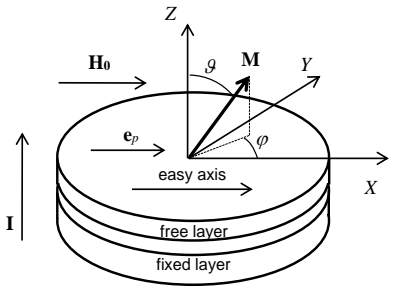
The machinery is the change of variables from the polar and azimuthal angles $(\vartheta,\varphi)$ to the slow dimensionless energy $E=vV/kT$ and the fast precessional phase $\phi$ that runs uniformly along a closed Stoner-Wohlfarth orbit at frequency $f_E$, with the dimensionless magnetic action $S_E$ as the conjugate variable. Averaging the perturbed Fokker-Planck equation over $\phi$ removes the fast phase: the Liouville term averages to zero by periodicity, and the dissipative and STT terms reduce to an energy-space diffusion operator once phase averages factorize. This is what closes the two-dimensional surface distribution into a one-dimensional energy diffusion equation, Eq. (26).
What would settle it
Numerically solve Brown's Fokker-Planck equation for a biaxial macrospin with spin-transfer torque at small damping, transform the solution to energy and phase variables, and compare the first-passage-time distribution predicted by the phase-averaged Eq. (26) with the full two-dimensional result; if the difference grows faster than linearly in $\alpha$, the factorization assumption fails.
Extended reading notes
Core claim
The central claim is that in the very low damping limit, phase-averaging Brown's Fokker-Planck equation over the fast precessional phase on closed constant-energy (Stoner-Wohlfarth) orbits collapses the two-dimensional orientation dynamics into a one-dimensional Fokker-Planck equation for the energy distribution $W(E,t)$, Eq. (26). The averaged Liouville term vanishes by periodicity in $\phi$, while dissipation and spin-transfer torque enter as energy drift and diffusion built from the orbit-averaged magnetic action $S_E$ and the STT work $V_E$; the quasi-stationary solution then yields the high-barrier VLD escape rate (30)-(31), with effective barrier $\Delta E = E_C - E_A - \alpha^{-1}\int_{E_A}^{E_C} V_E\,dE$. The paper states that this reproduces the energy-controlled diffusion equation previously reached by vector manipulation and by Stratonovich-type energy-phase calculations, and it is presented as the direct spin analog of Kramers' particle calculation.
Load-bearing premise
The load-bearing premise is that the perturbation in the spin-orientation distribution is only as large as the damping coefficient (order $\alpha$), so that phase averages in Eq. (24) can be factorized; if the distribution retains zeroth-order phase structure, the one-dimensional energy equation does not close.
Editorial extensions
If this is right
- Spin-transfer torque enters the energy diffusion equation purely as an energy drift $V_E$, so the high-barrier escape rate keeps an Arrhenius form with an STT-shifted barrier.
- The derivation removes the need for vector manipulation or multiplicative-noise energy-phase transformations when computing the VLD rate for classical spins.
- Because the reduction holds for non-separable spin Hamiltonians, the same energy equation applies to general anisotropy-Zeeman potentials with two angular degrees of freedom.
- The quasi-stationary solution yields a two-well relaxation time $\tau = 2\tau_{VLD}^A \tau_{VLD}^B/(\tau_{VLD}^A+\tau_{VLD}^B)$, so magnetization reversal times follow once each well's VLD escape time is known.
Reading between the lines
- This suggests the same phase-averaging route may extend to other two-variable stochastic systems with a fast conserved angle, such as underdamped Josephson junctions, where a Kramers-type energy diffusion equation could be derived without solving the full phase dynamics.
- A direct numerical test of whether the full two-dimensional distribution in $(E,\phi)$ stays nearly phase-independent at small damping would settle the validity of the factorization step and could indicate how high in $\alpha$ the VLD formula remains usable.
- If the factorization assumption holds, the Kramers turnover problem for spins becomes effectively one-dimensional in energy, so interpolation schemes designed for particles could be adapted to spins with STT without re-deriving the two-dimensional dynamics.
Signed reviews
Editorial analysis
A structured set of objections, weighed in public.
Referee Report
Summary. The manuscript presents a derivation of the very-low-damping (VLD) energy-controlled diffusion equation for a classical macrospin with spin-transfer torque, starting from Brown's Fokker-Planck equation on the unit sphere. The authors adapt Kramers' perturbative phase-averaging method to the two angular variables (θ,φ), transform to energy E and phase φ, drop the averaged Liouville term by periodicity, and close the averaged Fokker-Planck equation into a one-dimensional diffusion equation in E. From the quasi-stationary solution of this equation they obtain the VLD escape rate in the high-barrier limit. The authors stress the simplicity of the method relative to prior vector-manipulation or Stratonovich-type derivations, and they compare their Eq. (26) with results of Apalkov-Visscher and Dunn et al.
Significance. The result, if correct, is a useful and pedagogically cleaner route to known VLD escape-rate formulas for magnetic nanoparticles in the presence of STT. The derivation is self-contained from Brown's Fokker-Planck equation, introduces no free parameters, and is cross-checked against two independent earlier derivations, which is a notable strength. The paper also makes a specific, falsifiable prediction: the energy-controlled diffusion equation (26) and the rate formula (30)-(31) follow from the underlying Fokker-Planck equation to first order in α and J. The main caveat is that the closure of the phase-averaged equation rests on an ordering assumption that is stated but not proved.
major comments (2)
- [Section 3, after Eq. (24)] The step from Eq. (24) to Eqs. (25)-(26) replaces phase averages of products, such as overline{f_E (∂P/∂E) W}, by products of phase averages. The paper justifies this by stating that perturbations in W are 'implicitly of order α'. This is the load-bearing step of the derivation, because it closes the two-variable Fokker-Planck equation into the one-dimensional energy diffusion equation from which the escape rate (30)-(31) is obtained. The ordering is asserted rather than demonstrated: an explicit expansion W(E,φ,t)=bar W(E,t)+δW(E,φ,t) with a bound on δW (and hence on the neglected correlations overline{f_E (∂P/∂E) δW} and overline{f_E δW}) is needed. Without such an estimate, one cannot rule out an O(1) or O(√α) phase-dependent component driven by the phase-dependent dissipative/STT terms, which would change Eq. (26) at leading order. Please add the missing asymptotic argument.
- [Appendix A] The change of variables for St(W) is only sketched. In particular, the treatment of St(W)_φ states that terms containing ∂_φ can be dropped after phase averaging because averaged functions do not depend on φ. However, overline{A(E,φ) ∂_φ W} = -overline{(∂_φ A) W} by integration by parts, which need not vanish for periodic A and W. The vanishing, or at least the smallness at the retained order, of all phase-derivative contributions to Eq. (24) is not demonstrated. A complete calculation of the φ-part of the transformed operator, or a precise reference for the result, is required for the 'simple derivation' to be verifiable.
minor comments (4)
- [Abstract and reference [1]] The page number of Kramers' paper is given as 384 in the abstract and as 284 in the reference list; the correct page is 284.
- [Section 3, Eq. (20)] The same overbar notation denotes the phase average in Eq. (20) and the angle-averaged energy distribution bar W(E,t) in Eq. (25); please use distinct notation or state the definition explicitly.
- [Section 3, Eq. (23)] The vanishing of the averaged Liouville term uses periodicity of W in φ; the argument should also state that f_E is single-valued along the closed orbit so that overline{∂_φ(f_E W)}=0 follows from periodicity of both f_E and W.
- [Section 2, after Eq. (13)] After Eq. (13), the paper states that terms of order α^2, αJ, and J^2 are neglected; please carry this order-of-accuracy statement through to the final equations (25)-(26) and (30)-(31), for instance by writing 'to first order in α and J' next to Eq. (26).
Circularity Check
No significant circularity: the energy-controlled diffusion equation is derived from Brown's Fokker-Planck equation via explicit variable transformation, and the final rate is checked against external benchmarks.
full rationale
The paper's central derivation transforms Brown's Fokker-Planck equation (11) into energy and phase variables, computes the Jacobian (19), and averages over the fast phase. The Liouville term vanishes by periodicity (23), and the dissipative/STT term is transformed explicitly in Appendix A, leading to Eq. (24) and then Eq. (26). The factorization of phase averages in Eq. (24) is justified by an explicit O(alpha) hypothesis about perturbations in W; this is a stated ordering assumption rather than a redefinition or a fitted parameter renamed as a prediction, so it does not constitute circularity. The quasi-stationary solution of the resulting one-dimensional diffusion equation is cited from the authors' own book (Ref. [12]), but that solution is a standard mathematical result for the 1D energy diffusion equation, and the derived equation itself is validated against independent benchmarks by Apalkov and Visscher and by Dunn et al. as stated in the Conclusions. No load-bearing step reduces to a self-citation or to the target result by construction, and no fitted input is presented as a prediction. The derivation is therefore self-contained for the purposes of circularity analysis; the O(alpha) factorization assumption may be a correctness risk, but it is not circular.
Assumptions & free parameters
assumptions (5)
- domain assumption Brown's Fokker-Planck equation (Eq. 11) with STT correctly governs the surface density of magnetization orientations.
- domain assumption Terms of order alpha^2, J^2 and alpha J are negligible for very low damping and small spin current.
- domain assumption Undamped spin motion traces closed Stoner-Wohlfarth orbits of constant dimensionless energy E, with precession frequency f_E.
- domain assumption The distribution W is nearly uniform in the fast phase phi, so averages factorize to first order in alpha.
- domain assumption The spin-transfer torque potential can be approximated by the linear form Phi = (v/kT) J (u dot e_p).
Cite this review
Pith. "Pith review of On a simple derivation of the very low damping escape rate for classical spins by modifying the method of Kramers." pith.science (2026). https://pith.science/paper/PDCYCYH3
@misc{pith2026190806747,
  author       = {Pith},
  title        = {Pith review of: On a simple derivation of the very low damping escape rate for classical spins by modifying the method of Kramers},
  year         = {2026},
  howpublished = {\url{https://pith.science/paper/PDCYCYH3}},
  note         = {Machine review of arXiv:1908.06747}
}
abstract
The original perturbative Kramers' method (starting from the phase space coordinates) (Kramers, 1940) of determining the energy-controlled-diffusion equation for Newtonian particles with separable and additive Hamiltonians is generalized to yield the energy-controlled diffusion equation and thus the very low damping (VLD) escape rate including spin-transfer torque for classical giant magnetic spins with two degrees of freedom. These have dynamics governed by the magnetic Langevin and Fokker-Planck equations and thus are generally based on non-separable and non-additive Hamiltonians. The derivation of the VLD escape rate directly from the (magnetic) Fokker-Planck equation for the surface distribution of magnetization orientations in the configuration space of the polar and azimuthal angles $(\vartheta, \varphi)$ is much simpler than those previously used.
Figures
Reference graph
Works this paper leans on
-
[1]
Introduction The rate of escape of particles over potential barriers due to the shuttling action of the Brownian motion arising from their heat bath constitutes one of the famous problems of physics and chemistry. This was effectively solved by Kramers in 1940 [1] for assemblies of Newtonian particles moving in a one dimensional extension q , acted upon b...
work page 1940
-
[2]
Brown’s Fokker-Planck Equation including STT 5 To write down the relevant magnetic Fokker -Planck equation in terms of ( , ) , commonly known as Brown’s Fokker -Planck equation [11], we first consider the magnetic Langevin equation which may be briefly described as follows. The magnetization M of a ferromagnetic nanoparticle of volume v precesses (witho...
-
[3]
Energy-controlled-diffusion equation with STT By analogy with Kramers’ derivation of the energy -controlled diffusion equation for point particles in the VLD limit [1], one may parameterize the instantaneo us magnetization direction of a macrospin by the slow dimensionless energy variable E and the fast precessional variable running uniformly along a cl...
-
[4]
Escape from a potential well The mean first passage time VLD (i.e., the time to reach the separatrix for the first time from a minimum within a potential well provided that all spins there are absorbed, which is the boundary condition that W vanishes at the critical or separatrix energy) is then, by the quasi - stationary solution of Eq. (26) as given in...
-
[5]
presented a complete solution of the Kramers turnover problem and have shown that the 3 Mel’nikov and Meshkov turnover formula can be obtained without ad hoc interpolation between the VLD and VHD regimes. Versions of the Kramers escape rate th eory are still being employed in innovative scientific research. For example, this theory as applied to Josephson...
-
[6]
Conclusions Equation (26)-(28) agree in all respects with the energy -controlled-diffusion equation derived by Apalkov and Visscher [14] via appropriate manipulation of the magnetization vector, and with that derived by Dunn et a l. [24] by transforming Brown’s Fokker -Planck equation to energy E and phase variables using essentially the method of Strat...
work page 1940
Reviewed August 14, 2026 · model on record in the stance chip above.
Discussion (0). Continue with ORCID to comment.