REVIEW 2 major objections 6 minor 23 references
Finite spectral triples for the fuzzy torus
T0 review · 2 major / 6 minor · reviewed 2026-08-14 · deepseek-v4-flash
Pith's one-line read Fuzzy-torus Dirac operators have spectra obtained from the flat torus by replacing each integer with its quantum integer.
desk verdict The paper contributes a real construction—finite spectral triples for the fuzzy torus with exact Dirac spectra and all four spin structures—but its central D^2 identities are asserted rather than proved, and that is the one thing to demand before accepting. read the letter →
The pith
A machine-rendered reading of the paper's core claim, the machinery that carries it, and where it could break.
The reading
What carries the argument
The central object is the finite real spectral triple of Definition 11: Hilbert space $H=\mathbb{C}^4\otimes h$, algebra $A=\langle U,V\rangle$ acting on the left, real structure $J=j\otimes J$, chirality $\Gamma=\gamma\otimes1$, and Dirac operator $D_{X,Y}=E_X+E_Y$ written as a sum of commutators $[X\pm X^*,\cdot]$ and anticommutators $\{X\pm X^*,\cdot\}$ with coefficients involving $Q^{1/4}$. The identity that carries the argument is the cross-term cancellation $E_X E_Y+E_Y E_X=0$, which makes $D^2=E_X^2+E_Y^2$ and reduces the eigenvalue problem to the quantum-integer algebra of the normalised monomials $E(m,n)=q^{-mn/2}U^mV^n$. Quantum integers $[n]_q=(q^{n/2}-q^{-n/2})/(q^{1/2}-q^{-1/2})$ turn the spectral computation into the trigonometric identities that produce the deformed spectrum, and the fourfold cover $U=C^2$, $V=S^2$ supplies the character decomposition that separates the four spin structures.
What would settle it
Diagonalise $D_{X,Y}$ of Definition 11 for a small concrete case, for example $N=4$, $X=C^2$, $Y=S^2$, and compare the eigenvalues with the claimed formula $\pm\sqrt{[k+1/2]_Q^2+[l+1/2]_Q^2}$; any mismatch would falsify the spectral theorem. Separately, solving the coefficient equations imposed by $E_X E_Y+E_Y E_X=0$ would show whether the coefficients in Definition 11 are genuinely unique.
Extended reading notes
Core claim
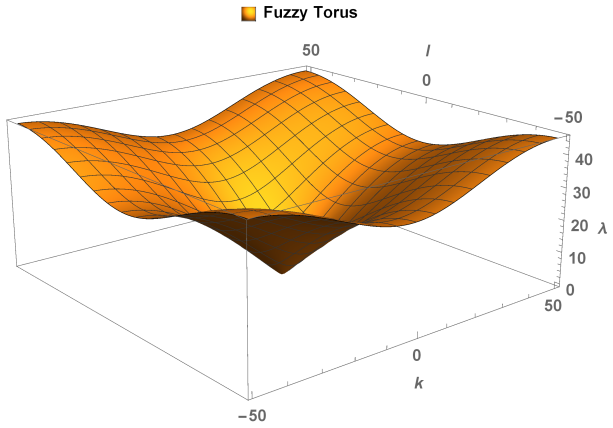
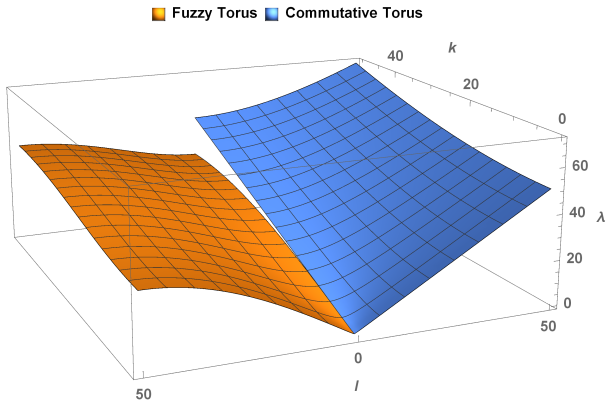
The paper's central claim is that a fuzzy torus—a finite noncommutative torus with a real structure making its Hilbert space a bimodule—admits a Dirac operator that makes it a finite real spectral triple of KO-dimension 4. The operator, given in Definition 11, is built from algebra elements $X$ and $Y$ by replacing derivatives with commutators and functions with anticommutators, with coefficients chosen so that its $X$-part and $Y$-part anticommute. Its spectrum is computed exactly: for the square fuzzy torus $X=C$, $Y=S$, the square of the Dirac operator has eigenvalues $[k+1/2]_q^2+[l+1/2]_q^2$, so the Dirac eigenvalues are the two square roots of these numbers; for the general integral metric $X=E(a,b)$, $Y=E(c,d)$, the squared eigenvalues are $([al-bk]_q^2+[dk-cl]_q^2)/[ad-bc]_q^2$. As $q\to1$ these spectra reduce to the eigenvalues of the commutative flat-torus Dirac operator with the corresponding metric. The four spin structures are realized by taking $U=C^2$, $V=S^2$, a noncommutative fourfold cover whose four character subspaces are the noncommutative analogue of the four sectors of the spinor bundle on the torus.
Load-bearing premise
The construction rests on the claim that the numerical coefficients in the Dirac operator are uniquely fixed by requiring the X-part and Y-part of the operator to anticommute; if other coefficient choices also satisfy the spectral-triple axioms, the quantum-integer spectrum would reflect a choice rather than the geometry of the fuzzy torus.
Editorial extensions
If this is right
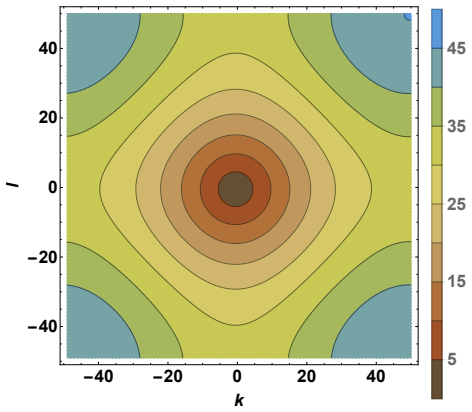
- For the square fuzzy torus, the Dirac spectrum is exactly $\pm\sqrt{[k+1/2]_q^2+[l+1/2]_q^2}$, with multiplicity two for each eigenvalue; this is the direct $q$-analogue of the commutative square-torus spectrum.
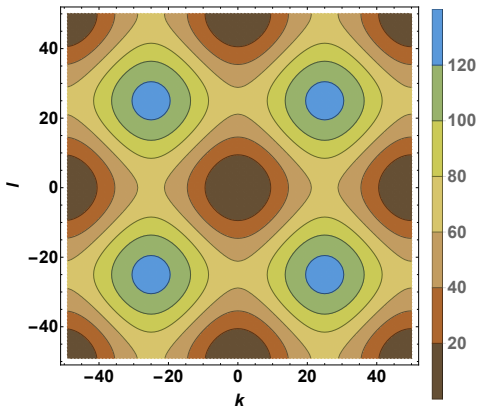
- For an integral metric with $X=E(a,b)$, $Y=E(c,d)$, the squared Dirac operator has eigenvalues $([al-bk]_q^2+[dk-cl]_q^2)/[ad-bc]_q^2$, so the full spectral geometry of the fuzzy torus can be read off from its spectrum.
- In the $q\to1$ limit with fixed labels, the fuzzy-torus spectrum reduces to the commutative flat-torus Dirac spectrum, so at low energies the fuzzy and commutative tori are spectrally indistinguishable.
- The four character subspaces of $U=C^2$, $V=S^2$ realize all four spin structures of the torus; the canonical spin structure is $\sigma_c=([a]_2+[c]_2,[b]_2+[d]_2)$.
- The Dirac operator is equivariant under the finite translation group $\mathbb{Z}_N\times\mathbb{Z}_N$, the noncommutative analogue of the $\mathrm{Spin}(2)\times\mathrm{Spin}(2)$ equivariance of the rotating-frame Dirac operator.
Reading between the lines
- The paper leaves implicit that the three non-canonical spin structures are the half-shifted sectors already visible in the scalar Laplacian examples, and that the fourfold cover unifies them; the same character decomposition should work for any finite abelian group action on a fuzzy torus.
- The large multiplicities in the contour plots lie on the lines $(l+1/2)\pm(k+1/2)=\pm(N/2+2jN)$; a testable extension is to check whether these degeneracies survive modular transformations, which would probe the modular covariance of the spectral triple.
- The paper's symplectic-reduction analogy suggests a general recipe: impose a discrete momentum constraint on a larger matrix algebra and take the invariant subspace, producing fuzzy spaces with prescribed spin structures; the fourfold cover is the first instance of that recipe.
- One could test the universality of the quantum-integer spectrum by constructing $D_{X,Y}$ for $X,Y$ that are not normalised monomials; if the same replacement of integers by quantum integers appears, the phenomenon belongs to the fuzzy torus itself rather than to a particular choice of frame.
Editorial analysis
A structured set of objections, weighed in public.
Referee Report
Summary. The paper constructs finite real spectral triples for fuzzy tori, i.e., finite-dimensional non-commutative analogues of flat tori with integral metric. For a fuzzy torus with elements X,Y satisfying XY=QYX, the authors define a Dirac operator D_{X,Y} (Definition 11) built from commutators and anticommutators with X and Y, with numerical coefficients normalized by powers of Q^{1/4}. The main results are exact spectrum computations: for the square fuzzy torus (X=C, Y=S) the eigenvalues are ±√([k+1/2]_q²+[l+1/2]_q²), and for a general integral metric (X=e(a,b), Y=e(c,d)) they are ±√(([al−bk]_q²+[dk−cl]_q²)/[ad−bc]_q²); these reduce to the commutative torus Dirac spectra as q→1. The paper also constructs all four spin structures through a non-commutative four-fold covering (U=C², V=S²), identifying the sectors' spectra with the four commutative spin structures, and develops the scalar fuzzy Laplacian, the line-bundle interpretation of bimodule sectors, and a rotating-frame formulation of the commutative Dirac operator that motivates the ansatz.
Significance. If fully proved, the result is a valuable contribution: it gives explicit finite real spectral triples for the fuzzy torus with exact, parameter-free spectrum formulas, extends the known Laplace spectrum [7] to the Dirac case, and exhibits the quantum-integer replacement rule as a clean structural feature. The explicit eigenvector formulas for the square torus (Section 6.1) and the general integral case (Section 6.2) make the spectral claims concretely checkable, and the non-commutative covering construction connecting the four sectors to the four spin structures is conceptually elegant. The commutative background in Sections 2 and 5 is thorough and makes the geometric motivation transparent. The main reservation is that the derivation of the central identities (168)–(169) is not supplied; otherwise the manuscript is carefully written, and the internal consistency of the square-torus computation supports the correctness of the formulas.
major comments (2)
- [Section 6, Eqs. (168)–(169)] The paper's headline spectra — (172), (185), (189), (190), and (196) — all follow from the formula for D²_{X,Y} in (168) together with the cross-term cancellation E_X E_Y + E_Y E_X = 0 in (169). These are the load-bearing identities of the paper, yet neither is proved: (168) is introduced with 'A lengthy calculation shows' and (169) with the assertion that it 'does actually fix the numerical coefficients uniquely,' without showing the expansion or the uniqueness argument. Because (169) is claimed for every pair X,Y with XY=QYX, including the non-square examples of Section 6.2, and because a sign or normalization error in the Q^{1/4}-dependent coefficients would change the spectrum and hence the spin-structure identification of Section 6.3, this omission leaves the central claim unverified. I request that the authors include the calculation (at least for the monomial case X=e(a,b), Y=e(c,d) with arbitrary integers a,b,c,d), e.g., in an appendix, as a computer-algebra verification, or with a precise pointer to the derivation in [14], and that the uniqueness claim be stated and proved as a lemma.
- [Section 6, Definition 11] The assertion that Definition 11 defines a real spectral triple is supported only by 'It is a straightforward calculation to check'; the verification is not shown. In particular, the first-order condition (164), the J² = −1 and JΓJ⁻¹Γ = +1 relations appropriate to KO-dimension 4, and the conditions DΓ+ΓD=0 and DJ=JD should be checked explicitly. Since the abstract's central claim is that finite real spectral triples are constructed, the axioms are part of the claim, and at least one representative check (e.g., the first-order condition, which the text says follows from the structure of D as a sum of left- and right-acting terms) should be spelled out.
minor comments (6)
- [Eq. (168)] The displayed formula for D²_{X,Y} has unmatched brackets; it should be (1⊗[X,[X∗,·]] + 1⊗[Y,[Y∗,·]]) with the inner commutator brackets closed before the plus sign.
- [Eq. (196)] The eigenvalue [l/2]_q² + [k/2]_q² is ambiguous: with the conventions of (185) and (62) it should be [l/2]_{q⁴}² + [k/2]_{q⁴}² (with Q = q⁴), whereas [l/2]_q for the original parameter q denotes a different rational quantum integer; the subscript should be fixed.
- [References] Reference [21] (Rieffel) does not appear to be cited in the text.
- [Introduction] The statement that 'the spectrum of the fuzzy Dirac operator is exactly the set of square roots of the spectrum of the corresponding fuzzy Laplacian' is only literally true on each sector via the unitary equivalence (188) or with the line-bundle Laplacian of Section 4.2; the wording should be qualified.
- [Example 9, Eq. (86)] The passage from sin²(2πk/N)+sin²(2πl/N) to sin²(2πk/N)+cos²(2πk/N) omits the relation between k and l that is being used; one sentence of explanation would help.
- [Section 6.2, Eq. (179)] The equivariance D_{X,Y}Π(j,n)=Π(j,n)D_{X,Y} is asserted without proof; given that the action and the associated unitary W are defined with different gamma-matrix combinations, a brief verification (or a reference to the calculation used for (184)) should be included.
Circularity Check
No circularity: the fuzzy-torus spectra are computed from the explicit Definition 11 Dirac operator; the commutative spectrum is only a benchmark.
full rationale
The claimed derivation chain is not circular. The central object, the fuzzy-torus Dirac operator D_{X,Y}, is defined explicitly in Definition 11 from the fuzzy-torus data (U,V,h,J,X,Y,Q^{1/4}); it is not defined in terms of the spectra that are later derived. The exact spectra in (172), (185), (189) and (196) are obtained by direct calculation of D^2 on the basis e(k,l), using the commutator/anticommutator formulas (39)-(40); no eigenvalue formula is inserted as an input. The commutative torus spectrum (142)/(152) is used only as a q->1 benchmark to identify which spin structure the fuzzy construction matches, not to fix any coefficient. The dependence on reference [4] is a citation for the general finite-spectral-triple formalism and the systematic form (166), but the specific K_i, K_ijk and the resulting spectrum are explicit in this paper and do not reduce to that reference. The manuscript's own admission that (168) is a 'lengthy calculation' and the unproved uniqueness claim for (169) are gaps in proof presentation, but they are not circularity: the identities are asserted consequences of Definition 11, not equivalent to the claimed results by construction. No fitted parameter is renamed as a prediction, no uniqueness theorem from the authors' prior work is invoked to rule out alternatives, and the q-deformed spectrum is a new computed result rather than a relabelling of a known one. Score 0.
Assumptions & free parameters
free parameters (4)
- N =
positive integer (e.g., 100 in plots)
- q =
e^{2π i K/N}, gcd(K,N)=1
- a,b,c,d =
integers, with Hermite normal form a>0, 0≤c<d
- Q^{1/4} =
choice of fourth root
assumptions (4)
- standard math Classification of finite irreducible noncommutative tori (Weyl-Mackey, Lemma 2): every irreducible finite torus is unitarily equivalent to clock and shift matrices.
- standard math Standard spin-structure formalism on the torus, including H¹(T²;Z₂)≅Z₂×Z₂ and the pull-back formula σ′=[A^T]₂σ (equation (100)).
- domain assumption Heuristic commutative-limit replacement: scaled commutators become vector fields and anticommutators become twice the corresponding function, equations (75) and (170).
- domain assumption The fourfold cover U=C², V=S² with G=Z₂×Z₂ characters provides the noncommutative analogue of the four spin structures via the sectors h_χ.
invented entities (1)
-
Finite real spectral triple (A,H,Γ,J,D_{X,Y}) for the fuzzy torus
Cite this review
Pith. "Pith review of Finite spectral triples for the fuzzy torus." pith.science (2026). https://pith.science/paper/GGU63URQ
@misc{pith2026190806796,
  author       = {Pith},
  title        = {Pith review of: Finite spectral triples for the fuzzy torus},
  year         = {2026},
  howpublished = {\url{https://pith.science/paper/GGU63URQ}},
  note         = {Machine review of arXiv:1908.06796}
}
read the original abstract
Finite real spectral triples are defined to characterise the non-commutative geometry of a fuzzy torus. The geometries are the non-commutative analogues of flat tori with moduli determined by integer parameters. Each of these geometries has four different Dirac operators, corresponding to the four unique spin structures on a torus. The spectrum of the Dirac operator is calculated. It is given by replacing integers with their quantum integer analogues in the spectrum of the corresponding commutative torus.
Figures


Figures from the paper (5 more)


Reference graph
Works this paper leans on
-
[7]
Generalized Fuzzy Torus and its Modular Properties
P. Schreivogl and H. Steinacker, “Generalized Fuzzy Torus and its Mod- ular Properties,” SIGMA 9 (2013) 060 doi:10.3842/SIGMA.2013.060 [arXiv:1305.7479 [hep-th]]
work page Pith review arXiv 2013
-
[14]
Aspects of the noncommutative torus
J. Gaunt, “Aspects of the noncommutative torus”. PhD thesis, Univer- sity of Nottingham. (2019) http://eprints.nottingham.ac.uk/56288/
work page 2019
-
[1]
Noncommutative geometry and reality,
A. Connes, “Noncommutative geometry and reality,” J. Math. Phys. 36 (1995) 6194. doi:10.1063/1.531241
doi:10.1063/1.531241 1995
-
[2]
A. Connes, “Noncommutative geometry,” Academic Press, Inc., San Diego, CA, 1994, xiv+661, 0-12-185860-X
work page 1994
-
[3]
Gravity coupled with matter and foundation of non- commutative geometry,
A. Connes, “Gravity coupled with matter and foundation of non- commutative geometry,” Commun. Math. Phys. 182 (1996) 155 doi:10.1007/BF02506388 [hep-th/9603053]
arXiv 1996
-
[4]
Matrix geometries and fuzzy spaces as finite spectral triples,
J. W. Barrett, “Matrix geometries and fuzzy spaces as finite spectral triples,” J. Math. Phys. 56 (2015) no.8, 082301 doi:10.1063/1.4927224 [arXiv:1502.05383 [math-ph]]
arXiv 2015
-
[5]
Dependence on the spin structure of the Dirac spectrum
C. B¨ ar, “Dependence of Dirac Spectrum on the Spin Structure,” In: Global analysis and harmonic analysis (Marseille-Luminy, 1999), S´ eminaires and Congr´ es,4, J.P. Bourguignon, T. Branson, O. Hijazi, (eds.), Soc. Math. France, Paris (2000) pp. 17-33. [arXiv:math/0007131]
work page Pith review arXiv 2000
-
[6]
From Large N Matrices to the Noncommutative Torus
G. Landi, F. Lizzi and R. J. Szabo, “From large N matrices to the noncommutative torus,” Commun. Math. Phys. 217 (2001) 181 doi:10.1007/s002200000356 [hep-th/9912130]
work page Pith review arXiv 2001
Show all 23 references
-
[8]
Noncommutative gauge theories on fuzzy sphere and fuzzy torus from matrix model,
Y. Kimura, “Noncommutative gauge theories on fuzzy sphere and fuzzy torus from matrix model,” Prog. Theor. Phys. 106 (2001) 445 doi:10.1143/PTP.106.445 [hep-th/0103192]
2001 arXiv
-
[9]
Classification of C∗-algebras admitting ergodic actions of the two-dimensional torus
R. Høegh-Krohn, T. Skjelbred, “Classification of C∗-algebras admitting ergodic actions of the two-dimensional torus”, Journal f¨ ur die Reine und Angewandte Mathematik. [Crelle’s Journal], 328, (1981), 1–8, DOI 10.1515/crll.1981.328.1
1981 doi
-
[10]
On Spin Structures and Dirac Opera- tors on the Noncommutative Torus,
M. Paschke and A. Sitarz, “On Spin Structures and Dirac Opera- tors on the Noncommutative Torus,” Lett. Math. Phys. 77 (2006) 317 doi:10.1007/s11005-006-0094-2 [math/0605191 [math.QA]]. 52
2006 arXiv
-
[11]
Classification of spin structures on the non- commutative n-torus,
J. J. Venselaar, “Classification of spin structures on the non- commutative n-torus,” J. Noncommut. Geom. 7 (2013) no.3, 787 doi:10.4171/JNCG/135 [arXiv:1003.5156 [math.OA]]
2013 arXiv
-
[12]
Spin geometry of the ra- tional noncommutative torus,
A. Carotenuto and L. Dabrowski, “Spin geometry of the ra- tional noncommutative torus,” J. Geom. Phys. 144 (2019) 28 doi:10.1016/j.geomphys.2019.05.008 [arXiv:1804.06803 [math.QA]]
2019 arXiv
-
[13]
Non-commutative spectral triples for space-time
J. W. Barrett “Non-commutative spectral triples for space-time.” In: Mathematisches Forschungsinstitut Oberwolfach Report No. 32/2018 Non-commutative Geometry, Index Theory and Mathematical Physics, 8–14 July 2018 eds. A. Connes, R. Nest, T. Schick and G. Yu. 43–45 DOI: 10.417...
2018 doi
-
[15]
The theory of groups and quantum mechanics,
H. Weyl, “The theory of groups and quantum mechanics,” Translated from the second (revised) German edition by H. P. Roberton; Reprint of the 1931 English translation, Dover Publications, Inc., New York, (1950)
1950
-
[16]
Some remarks on symplectic automor- phisms,
G.W. Mackey, “Some remarks on symplectic automor- phisms,” Proc. Amer. Math. Soc. 16 (1965), 393-397 DOI: https://doi.org/10.1090/S0002-9939-1965-0177064-5
1965 doi
-
[17]
Holonomy and path structures in general relativ- ity and Yang-Mills theory,
J. W. Barrett, “Holonomy and path structures in general relativ- ity and Yang-Mills theory,” Int. J. Theor. Phys. 30 (1991) 1171. doi:10.1007/BF00671007
1991 doi
-
[18]
Algebraic topology,
A. Hatcher, “Algebraic topology,” Cambridge University Press, Cam- bridge, 2002
2002
-
[19]
The topology of 4-manifolds,
R.C. Kirby, “The topology of 4-manifolds,” Lecture Notes in Mathemat- ics, 1374, Springer-Verlag, Berlin, (1989)
1989
-
[20]
Elements of Non- commutative Geometry,
J. M. Gracia-Bond´ ıa, J. C. Varilly, H. Figueroa, “Elements of Non- commutative Geometry,” Birkh¨ auser Basel, 2001, XVIII, 686, doi: 10.1007/978-1-4612-0005-5
2001 doi
-
[21]
Noncommutative tori: a case study of noncommutative dif- ferential manifolds,
M. Rieffel, “Noncommutative tori: a case study of noncommutative dif- ferential manifolds,” in Geometric and topological invariants of elliptic operators Contemp. Math. 105, American Mathematical Society, 1990, pp. 191-211. 53
1990
-
[22]
Spin Geometry,
H. B. Lawson and M. Michelsohn, “Spin Geometry,” (PMS-38), Volume 38, Princeton University Press, 1990, 440p, ISBN9780691085425
1990
-
[23]
Reduction of symplectic manifolds with sym- metry
J. Marsden, A. Weinstein, “Reduction of symplectic manifolds with sym- metry”, Reports on Mathematical Physics, 5, no 1, (1974), 121–130, DOI 10.1016/0034-4877(74)90021-4, 54
1974 doi
Reviewed August 14, 2026 · model on record in the stance chip above.
Discussion (0). Continue with ORCID to comment.