REVIEW 3 major objections 4 minor 37 references
Customizing Student Networks From Heterogeneous Teachers via Adaptive Knowledge Amalgamation
T0 review · 3 major / 4 minor · reviewed 2026-08-14 · deepseek-v4-flash
Pith's one-line read A compact student network trained from heterogeneous pre-trained teachers, without labels, can beat each teacher on its own specialty.
desk verdict A clear, modular extension of knowledge amalgamation with a two-stage pipeline and per-sample entropy selection; the central claim is plausible but hinges on an unvalidated reliability proxy that should be tested before the 'better than teachers' claim is trusted. read the letter →
The pith
A machine-rendered reading of the paper's core claim, the machinery that carries it, and where it could break.
The reading
What carries the argument
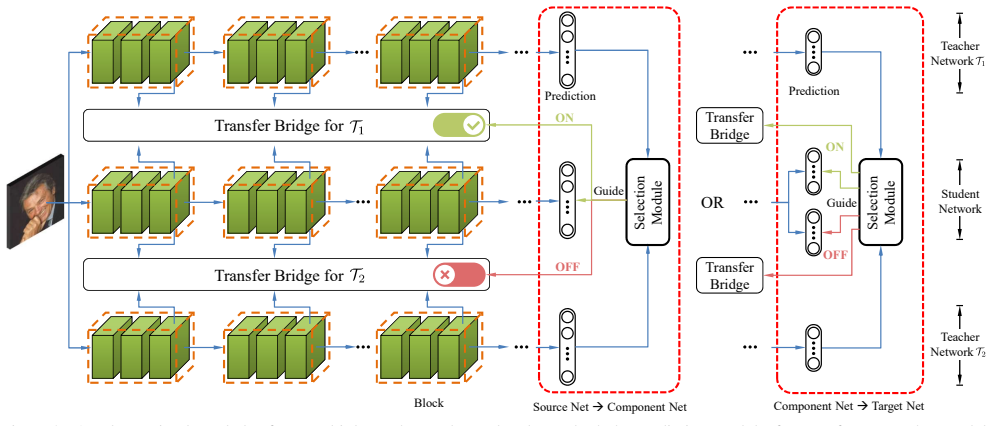
The central mechanism is a transfer bridge paired with an entropy-based teacher selector. The transfer bridge inserts a one-by-one convolutional feature-alignment module between corresponding blocks of teacher and student; a squared difference on the aligned features plus a weight-normalization regularizer makes the student imitate intermediate representations without collapsing to zero. The selective-learning rule chooses, for each unlabeled sample, the teacher whose softmax entropy is smallest, and the student's total loss combines the aligned-feature losses from that teacher with a logit-matching loss. The dual-stage composition, source to component and then component to target, is what carries the customization claim, since it lets each task be learned first from the teachers that cover it and only then combined.
What would settle it
On a held-out labelled subset, compare the lowest-entropy teacher's prediction with the labels and with the other teachers' predictions; if the lowest-entropy teacher is not the most accurate teacher on many samples, retrain the student using an oracle that picks the actually-correct teacher and check whether accuracy rises, which would show the entropy proxy, not the amalgamation pipeline, is the limiting step.
Extended reading notes
Core claim
The central claim is that adaptive knowledge amalgamation can produce a compact multi-task student that is at least as accurate as each source teacher on its own task, and usually more accurate, even though no ground-truth labels are seen. The mechanism is a two-stage pipeline: source networks covering the same task are first amalgamated into single-task component networks, and those components are then amalgamated into the user-specified target network. At each stage the student is guided sample-wise by the teacher with the least entropy in its prediction, and it learns both the teacher's score vector and its block-wise feature maps after alignment through a one-by-one convolutional transfer bridge. Results on face attributes and four fine-grained recognition datasets show the component net beating its source nets and the target net beating or matching its component nets, with resource use far below the sum of teachers.
Load-bearing premise
The method assumes that on every sample the teacher with the lowest prediction entropy is the one the student should imitate, so a confidently wrong teacher will pass its error straight into the student.
Editorial extensions
If this is right
- A user can specify any subset of tasks covered by the teacher pool and obtain a single network for exactly those tasks, with no manual annotation effort.
- The resulting target network is more resource-efficient than the sum of teachers, because the experiments report parameter counts and FLOPs far below the total of all source networks.
- Component networks are reusable modular units, so the same first-stage outputs can be recombined to serve different user requests.
- Increasing the number of teachers for a task tends to improve the student, consistent with the idea that the student absorbs complementary knowledge and dilutes individual teacher errors.
- Both the transfer bridge and the teacher-selection rule contribute to the gain, since removing either one lowers accuracy in the ablation study.
Reading between the lines
- Beyond the paper, the entropy selector could be swapped for a calibrated confidence score; if low-entropy teachers are systematically overconfident on some classes, a calibration step would change which teacher is imitated on those samples and could push accuracy higher.
- Because the transfer bridge only needs feature maps of comparable shape, the same dual-stage recipe is a natural candidate for amalgamating teachers with different architectures, a direction the paper lists as future work.
- A labelled-holdout audit could separate the contribution of the two-stage pipeline from the contribution of the sample-wise selector: compare entropy selection against an oracle selector that always picks the actually correct teacher.
- The component-based construction points to a combinatorial customization property: the first stage is paid once per task, and any later user-defined combination of tasks costs only one additional second-stage amalgamation.
Signed reviews
Editorial analysis
A structured set of objections, weighed in public.
Referee Report
Summary. The paper proposes a dual-stage knowledge amalgamation method to train a student network from heterogeneous pre-trained teachers without human annotations. In the first stage, source networks sharing a task are amalgamated into compact component networks; in the second stage, these component networks are amalgamated into a user-specified target network. For each unlabeled sample, a selective learning scheme picks the teacher with the lowest prediction entropy as the supervision source, and a transfer bridge aligns feature maps between teacher and student. Experiments on CelebA and four fine-grained datasets report that the student achieves comparable or better accuracy than the teachers on their respective tasks while being more resource-efficient.
Significance. If the central claims hold, this is a useful contribution to knowledge distillation and model customization. The problem formulation is clear, the dual-stage idea yields modular component nets as byproducts, and the method is evaluated on multiple datasets with consistent directional improvements. The paper is generally well written and the algorithm is reproducible in principle. However, the empirical evidence for the claimed adaptive advantage is weakened by an unvalidated selection rule and by the absence of statistical confidence in the reported accuracies. The novelty is incremental relative to prior knowledge amalgamation work, but the modular customization perspective is interesting and worth pursuing.
major comments (3)
- [§3.3, Eqs. (5)-(6)] The selective learning scheme assumes that the teacher with minimal prediction entropy is the most reliable supervisor for each sample. This assumption is load-bearing for the claimed adaptive advantage, but it is never validated. The paper reports no oracle comparison (e.g., how often the selected teacher is actually the most accurate), no calibration analysis, and no statistics on selection frequency across teachers. The ablation in Table 8 (wo/TS) shows that removing the selection rule costs only 0.2-0.4 percentage points, so even a modest rate of confidently-wrong selections could erase the advantage. The authors should either validate the proxy (e.g., measure oracle accuracy on a labeled subset, compare with random selection) or clearly restrict the claim to the entropy-based rule as a heuristic.
- [§4.2, Tables 3, 5, 7, 8, 9] All reported accuracies are from single runs with no standard deviations or repeats. The improvements over the teachers are often between 0.5 and 3.0 percentage points, which is within the typical run-to-run variability of ResNet-18 training. Without error bars or multiple seeds, the statement that the student 'consistently outperforms' the teachers is not statistically supported. Please report mean and standard deviation over at least three runs, or apply a significance test.
- [§4.2] The experiments do not include quantitative comparisons with prior knowledge amalgamation methods that also operate without human labels, such as [28], [33], and [34]. Because the problem setting is closely related, the reader cannot assess whether the dual-stage strategy adds value over these existing approaches. Adding at least one common benchmark comparison would strengthen the claims.
minor comments (4)
- [§3.1] There is a typo 'For In what follows'; it should read 'In what follows'.
- [§4.1.2] The channel widths of component and target nets are not specified; the text says the target net has 'more channels' than the component net, but the exact numbers are needed for reproducibility.
- [§3.4, Eq. (7)] The per-teacher scale parameter λt is a free parameter; the paper does not discuss its initialization, its optimization, or its sensitivity. A brief analysis or ablation would be useful.
- [§4.2.5, Table 9] The one-shot amalgamation baseline is described only in one sentence; more details on the student architecture and training procedure are needed to ensure a fair comparison.
Circularity Check
No circularity: student accuracy is measured against external ground-truth labels, and the entropy-based teacher selection is an unvalidated proxy, not a derivation loop.
full rationale
The paper's derivation chain is not circular. The target quantity — the student's accuracy on each task — is evaluated on held-out test sets with ground-truth labels (e.g., CelebA test split, fine-grained dataset test partitions), not on the teachers' own outputs. Equation 8 trains the student to imitate the selected teacher's logits and features, but the reported performance is measured independently of those training signals. The selective-learning rule in Eqs. 5–6 assumes that the lowest-entropy teacher is the most reliable supervisor; this is an empirical assumption about teacher reliability, and the paper does not calibrate it against an oracle. That is a correctness risk, not circularity: the assumption does not define the student's accuracy in terms of the fitted selection rule, nor does it rename a fitted parameter as a prediction. The self-citations to prior knowledge-amalgamation papers (e.g., [28], [23], [33], [34]) are contextual and provide background or implementation details; the dual-stage selective amalgamation scheme is not justified by invoking a self-cited uniqueness theorem or by importing an unverified ansatz. Therefore no specific circular step can be exhibited, and the appropriate finding is no significant circularity.
Assumptions & free parameters
free parameters (2)
- per-teacher soft-target scale lambda_t =
not reported
- student and component channel widths =
not reported
assumptions (4)
- domain assumption Prediction entropy is a valid per-sample proxy for teacher reliability (Sec. 3.3, Eqs. 5 and 6).
- domain assumption A 1x1 convolution can align teacher and student feature maps block-wise without discarding task-relevant information (Sec. 3.2, Eqs. 1 to 4).
- domain assumption Teachers are all well-trained and share the ResNet-18 block structure (Sec. 4.1.2).
- domain assumption Inputs are unlabeled but drawn from the same distribution as teacher training data (Sec. 4.1.1).
Cite this review
Pith. "Pith review of Customizing Student Networks From Heterogeneous Teachers via Adaptive Knowledge Amalgamation." pith.science (2026). https://pith.science/paper/OJOLGIXC
@misc{pith2026190807121,
  author       = {Pith},
  title        = {Pith review of: Customizing Student Networks From Heterogeneous Teachers via Adaptive Knowledge Amalgamation},
  year         = {2026},
  howpublished = {\url{https://pith.science/paper/OJOLGIXC}},
  note         = {Machine review of arXiv:1908.07121}
}
read the original abstract
A massive number of well-trained deep networks have been released by developers online. These networks may focus on different tasks and in many cases are optimized for different datasets. In this paper, we study how to exploit such heterogeneous pre-trained networks, known as teachers, so as to train a customized student network that tackles a set of selective tasks defined by the user. We assume no human annotations are available, and each teacher may be either single- or multi-task. To this end, we introduce a dual-step strategy that first extracts the task-specific knowledge from the heterogeneous teachers sharing the same sub-task, and then amalgamates the extracted knowledge to build the student network. To facilitate the training, we employ a selective learning scheme where, for each unlabelled sample, the student learns adaptively from only the teacher with the least prediction ambiguity. We evaluate the proposed approach on several datasets and experimental results demonstrate that the student, learned by such adaptive knowledge amalgamation, achieves performances even better than those of the teachers.
Figures


Figures from the paper (1 more)

Reference graph
Works this paper leans on
-
[28]
Amalgamating knowledge towards comprehensive classification
Chengchao Shen, Xinchao Wang, Jie Song, Li Sun, and Min- gli Song. Amalgamating knowledge towards comprehensive classification. In AAAI Conference on Artificial Intelligence (AAAI), pages 3068–3075, 2019
work page 2019
-
[33]
Jingwen Ye, Yixin Ji, Xinchao Wang, Kairi Ou, Dapeng Tao, and Mingli Song. Student becoming the master: Knowledge amalgamation for joint scene parsing, depth estimation, and more. In The IEEE Conference on Computer Vision and Pat- tern Recognition (CVPR), 2019
work page 2019
-
[34]
Amalgamating filtered knowledge: Learning task- customized student from multi-task teachers
Jingwen Ye, Xinchao Wang, Yixin Ji, Kairi Ou, and Min- gli Song. Amalgamating filtered knowledge: Learning task- customized student from multi-task teachers. In Interna- tional Joint Conference on Artificial Intelligence (IJCAI) , 2019
work page 2019
-
[1]
Segnet: A deep convolutional encoder-decoder architecture for image segmentation
Vijay Badrinarayanan, Alex Kendall, and Roberto Cipolla. Segnet: A deep convolutional encoder-decoder architecture for image segmentation. IEEE Transactions on Pattern Anal- ysis and Machine Intelligence (TPAMI), 39(12):2481–2495, 2017
work page 2017
-
[2]
Liang-Chieh Chen, George Papandreou, Iasonas Kokkinos, Kevin Murphy, and Alan L Yuille. Deeplab: Semantic image segmentation with deep convolutional nets, atrous convolu- tion, and fully connected crfs. IEEE Transactions on Pattern Analysis and Machine Intelligence (TPAMI), 40(4):834–848, 2018
work page 2018
-
[3]
Large scale fine-grained categorization and domain-specific transfer learning
Yin Cui, Yang Song, Chen Sun, Andrew Howard, and Serge Belongie. Large scale fine-grained categorization and domain-specific transfer learning. In The IEEE Conference on Computer Vision and Pattern Recognition (CVPR), pages 4109–4118, 2018
work page 2018
-
[4]
Graph adaptive knowledge transfer for unsupervised domain adaptation
Zhengming Ding, Sheng Li, Ming Shao, and Yun Fu. Graph adaptive knowledge transfer for unsupervised domain adaptation. In European Conference on Computer Vision (ECCV), pages 37–52, 2018
work page 2018
-
[5]
Punda: Probabilistic unsupervised domain adaptation for knowledge transfer across visual categories
Behnam Gholami, Ognjen Rudovic, and Vladimir Pavlovic. Punda: Probabilistic unsupervised domain adaptation for knowledge transfer across visual categories. In The IEEE International Conference on Computer Vision (ICCV), pages 3601–3610, 2017
work page 2017
Show all 37 references
-
[6]
Deep residual learning for image recognition
Kaiming He, Xiangyu Zhang, Shaoqing Ren, and Jian Sun. Deep residual learning for image recognition. In The IEEE Conference on Computer Vision and Pattern Recognition (CVPR), pages 770–778, 2016
2016
-
[7]
Multi-task zip- ping via layer-wise neuron sharing
Xiaoxi He, Zimu Zhou, and Lothar Thiele. Multi-task zip- ping via layer-wise neuron sharing. In Advances in Neural Information Processing Systems (NIPS) , pages 6019–6029, 2018
2018
-
[8]
Distilling the knowledge in a neural network
Geoffrey Hinton, Oriol Vinyals, and Jeff Dean. Distilling the knowledge in a neural network. In Advances in Neural Information Processing Systems (NIPS), 2015
2015
-
[9]
Learning transferrable knowledge for semantic seg- mentation with deep convolutional neural network
Seunghoon Hong, Junhyuk Oh, Honglak Lee, and Bohyung Han. Learning transferrable knowledge for semantic seg- mentation with deep convolutional neural network. In The IEEE Conference on Computer Vision and Pattern Recogni- tion (CVPR), pages 3204–3212, 2016
2016
-
[10]
Deep transfer met- ric learning
Junlin Hu, Jiwen Lu, and Yap-Peng Tan. Deep transfer met- ric learning. In The IEEE Conference on Computer Vision and Pattern Recognition (CVPR), pages 325–333, 2015
2015
-
[11]
Densely connected convolutional networks
Gao Huang, Zhuang Liu, Kilian Q Weinberger, and Laurens van der Maaten. Densely connected convolutional networks. In The IEEE Conference on Computer Vision and Pattern Recognition (CVPR), 2017
2017
-
[12]
Domain transfer through deep activation matching
Haoshuo Huang, Qixing Huang, and Philipp Kr ¨ahenb¨uhl. Domain transfer through deep activation matching. In Euro- pean Conference on Computer Vision (ECCV) , pages 611– 626, 2018
2018
-
[13]
Like what you like: Knowl- edge distill via neuron selectivity transfer
Zehao Huang and Naiyan Wang. Like what you like: Knowl- edge distill via neuron selectivity transfer. arXiv preprint arXiv:1707.01219, 2017
2017 arXiv
-
[14]
Knowledge flow: Improve upon your teachers
Alexander Schwing Iou-Jen Liu, Jian Peng. Knowledge flow: Improve upon your teachers. In International Con- ference on Learning Representations (ICLR), 2019
2019
-
[15]
Novel dataset for fine-grained image categorization
Aditya Khosla, Nityananda Jayadevaprakash, Bangpeng Yao, and Li Fei-Fei. Novel dataset for fine-grained image categorization. In Workshop on Computer Vision and Pat- tern Recognition (CVPR), 2011
2011
-
[16]
3d object representations for fine-grained categorization
Jonathan Krause, Michael Stark, Jia Deng, and Li Fei-Fei. 3d object representations for fine-grained categorization. In International IEEE Workshop on 3D Representation and Recognition (3dRR), 2013
2013
-
[17]
Imagenet classification with deep convolutional neural net- works
Alex Krizhevsky, Ilya Sutskever, and Geoffrey E Hinton. Imagenet classification with deep convolutional neural net- works. In Advances in Neural Information Processing Sys- tems (NIPS), pages 1097–1105, 2012
2012
-
[18]
Few sample knowledge distillation for efficient network compression
Tianhong Li, Jianguo Li, Zhuang Liu, and Changshui Zhang. Few sample knowledge distillation for efficient network compression. arXiv preprint arXiv:1812.01839, 2018
2018 arXiv
-
[19]
Ssd: Single shot multibox detector
Wei Liu, Dragomir Anguelov, Dumitru Erhan, Christian Szegedy, Scott Reed, Cheng-Yang Fu, and Alexander C Berg. Ssd: Single shot multibox detector. In European Con- ference on Computer Vision (ECCV), pages 21–37. Springer, 2016
2016
-
[20]
Deep learning face attributes in the wild
Ziwei Liu, Ping Luo, Xiaogang Wang, and Xiaoou Tang. Deep learning face attributes in the wild. In The IEEE In- ternational Conference on Computer Vision (ICCV), 2015
2015
-
[21]
Fully convolutional networks for semantic segmentation
Jonathan Long, Evan Shelhamer, and Trevor Darrell. Fully convolutional networks for semantic segmentation. In The IEEE Conference on Computer Vision and Pattern Recogni- tion (CVPR), pages 3431–3440, 2015
2015
-
[22]
Transfer feature learning with joint dis- tribution adaptation
Mingsheng Long, Jianmin Wang, Guiguang Ding, Jiaguang Sun, and S Yu Philip. Transfer feature learning with joint dis- tribution adaptation. In The IEEE International Conference on Computer Vision (ICCV), pages 2200–2207, 2013
2013
-
[23]
Knowledge amalgamation from het- erogeneous networks by common feature learning
Sihui Luo, Xinchao Wang, Gongfan Fang, Yao Hu, Dapeng Tao, and Mingli Song. Knowledge amalgamation from het- erogeneous networks by common feature learning. In Inter- national Joint Conference on Artificial Intelligence (IJCAI), 2019
2019
-
[24]
A survey on transfer learning
Sinno Jialin Pan, Qiang Yang, et al. A survey on transfer learning. IEEE Transactions on Knowledge and Data Engi- neering (TKDE), 22(10):1345–1359, 2010
2010
-
[25]
Faster r-cnn: Towards real-time object detection with region proposal networks
Shaoqing Ren, Kaiming He, Ross Girshick, and Jian Sun. Faster r-cnn: Towards real-time object detection with region proposal networks. In Advances in Neural Information Pro- cessing Systems (NIPS), pages 91–99, 2015
2015
-
[26]
Fit- nets: Hints for thin deep nets
Adriana Romero, Nicolas Ballas, Samira Ebrahimi Kahou, Antoine Chassang, Carlo Gatta, and Yoshua Bengio. Fit- nets: Hints for thin deep nets. In International Conference on Learning Representations (ICLR), 2014
2014
-
[27]
E. Rahtu M. Blaschko A. Vedaldi S. Maji, J. Kannala. Fine-grained visual classification of aircraft. arXiv preprint arXiv:1306.5151, 2013
2013 arXiv
-
[29]
Very deep convo- lutional networks for large-scale image recognition
Karen Simonyan and Andrew Zisserman. Very deep convo- lutional networks for large-scale image recognition. arXiv preprint arXiv:1409.1556, 2014
2014 arXiv
-
[30]
Going deeper with convolutions
Christian Szegedy, Wei Liu, Yangqing Jia, Pierre Sermanet, Scott Reed, Dragomir Anguelov, Dumitru Erhan, Vincent Vanhoucke, and Andrew Rabinovich. Going deeper with convolutions. In The IEEE Conference on Computer Vision and Pattern Recognition (CVPR), pages 1–9, 2015
2015
-
[31]
C. Wah, S. Branson, P. Welinder, P. Perona, and S. Belongie. The Caltech-UCSD Birds-200-2011 Dataset. Technical Re- port CNS-TR-2011-001, California Institute of Technology, 2011
2011
-
[32]
Accel- erating convolutional neural networks with dominant convo- lutional kernel and knowledge pre-regression
Zhenyang Wang, Zhidong Deng, and Shiyao Wang. Accel- erating convolutional neural networks with dominant convo- lutional kernel and knowledge pre-regression. In European Conference on Computer Vision (ECCV) , pages 533–548, 2016
2016
-
[35]
Learning from multiple teacher networks
Shan You, Chang Xu, Chao Xu, and Dacheng Tao. Learning from multiple teacher networks. In The ACM SIGKDD In- ternational Conference on Knowledge Discovery and Data Mining (KDD), pages 1285–1294, 2017
2017
-
[36]
Paying more at- tention to attention: Improving the performance of convolu- tional neural networks via attention transfer
Sergey Zagoruyko and Nikos Komodakis. Paying more at- tention to attention: Improving the performance of convolu- tional neural networks via attention transfer. InInternational Conference on Learning Representations (ICLR), 2017
2017
-
[37]
Single-shot refinement neural network for ob- ject detection
Shifeng Zhang, Longyin Wen, Xiao Bian, Zhen Lei, and Stan Z Li. Single-shot refinement neural network for ob- ject detection. In The IEEE Conference on Computer Vision and Pattern Recognition (CVPR), pages 4203–4212, 2018
2018
Reviewed August 14, 2026 · model on record in the stance chip above.
Discussion (0). Continue with ORCID to comment.