REVIEW 4 major objections 4 minor 2 cited by
Gravitational memory in the bulk
T0 review · 4 major / 4 minor · reviewed 2026-08-14 · deepseek-v4-flash
Pith's one-line read The geodesic deviation between pairs of infalling null geodesics, compared before and after a burst, detects gravitational memory at every radius; in Newman-Unti gauge the change is the action of a BMS supertranslation.
desk verdict A short, clean note: null geodesics as bulk memory detectors, with an honest null-infinity check and a neat BMS observation, but the bulk observable is less well-defined than claimed. read the letter →
The pith
A machine-rendered reading of the paper's core claim, the machinery that carries it, and where it could break.
The reading
What carries the argument
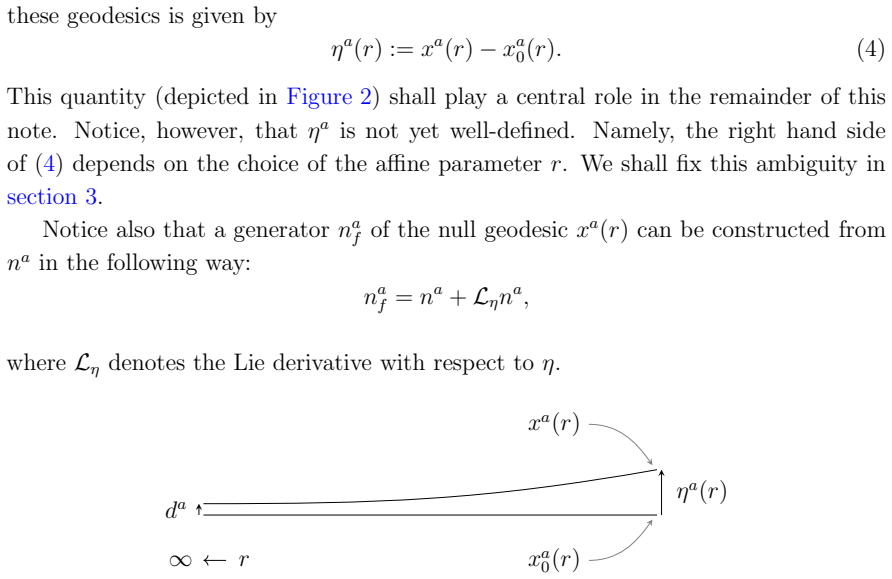
The load-bearing object is the geodesic deviation vector $\eta^a(r) := x^a(r) - x_0^a(r)$, built from the first-order solution $p_a = n_a - \partial_a f$, $x^a = \int g^{ab}p_b + z^a$ of the geodesic equations. Here $n^a = -\partial^a v$ generates the null hypersurfaces $\Sigma_v$, $f$ is a small function, and $z^a$ fixes the ingoing location of the deformed ray. In Newman-Unti coordinates — a gauge adapted to a foliation by null hypersurfaces, with metric (5) — the deformed ray is null and affinely parametrised by $r$, so comparing $\eta^a$ at two values of $v$ (keeping $f,z^a$ independent of $v$) isolates the permanent part of the deviation. The same deviation vector, with $f = T(x^A)+\tfrac12 v\,D_A Y^A$ and the associated $z^a$, reproduces the BMS generators — the asymptotic symmetries of null infinity, whose supertranslations are the angle-dependent translations — which identifies the supertranslation part of the memory.
What would settle it
Construct two different $v$-independent choices of $(f,z^a)$ in Newman-Unti coordinates that agree on the same past-null-infinity boundary data for a nonlinear dynamical spacetime; if they give different $\Delta\eta^a$ at finite radius, the proposed bulk memory is gauge-dependent and the central claim fails. A simpler check is to find a spacetime where no Newman-Unti chart covers the radiation region, in which case the method has no bulk meaning there.
Extended reading notes
Core claim
The central discovery is that the geodesic deviation vector $\eta^a(r)=x^a(r)-x_0^a(r)$ between an ingoing null geodesic generated by $n^a$ and a neighbouring null geodesic generated by the deformation $n^a_f = n^a + \mathcal{L}_\eta n^a$ is a bulk detector of gravitational memory. Provided the coordinates are Newman-Unti and the deformation data $(f,z^a)$ are chosen independent of $v$, the change $\Delta\eta^a = \eta^a|_{v'} - \eta^a|_v$ is well defined at every $r$ and is nonzero only when the two light-ray pairs lie on opposite sides of the radiation burst. At large radius it reduces to the known displacement-memory formula $\Delta x^A = -\frac{(\delta x_0)^B}{2r}\Delta C^A{}_B$; for a shell on Schwarzschild it gives $\Delta\eta^A = -\frac{1}{2r^2}\Delta C^A{}_B\,\partial^B f$. Finally, BMS supertranslation generators in Newman-Unti gauge are exactly such deviation vectors, so the bulk memory is the action of a supertranslation, extending the earlier null-infinity connection to the bulk.
Load-bearing premise
The whole construction stands on the assumption that Newman-Unti coordinates extend into the bulk and that the two light-ray pairs at different times can be identified as 'the same' pair via $v$-independent choices of $f$ and $z^a$; if that identification is not unique, the bulk memory $\Delta\eta^a$ is not well-defined.
Editorial extensions
If this is right
- Bulk observers can detect memory using pairs of infalling light rays instead of timelike test particles, avoiding the inward drift of timelike geodesics near a black hole.
- The method works at every affine radius $r$, so gravitational memory is a bulk observable, not only an asymptotic one.
- At large $r$ the new quantity $\Delta\eta^A$ reproduces the known displacement memory, giving a consistency check against the standard null-infinity result.
- In Newman-Unti gauge, BMS supertranslations acquire a concrete bulk action: they are geodesic deviation vectors, so the memory effect is their physical manifestation.
- BMS generators in Bondi gauge are generally not geodesic deviations, so this memory interpretation is tied to Newman-Unti gauge.
Reading between the lines
- If the $v$-independence condition can be relaxed or reformulated covariantly, the same null-ray deviation might define memory in spacetimes without global Newman-Unti charts, such as numerical binary-black-hole mergers.
- Because light-ray pairs are natural observables, the construction suggests a practical route to finite-radius memory measurements in gravitational-wave detectors or pulsar-timing data.
- A testable extension would be to compute $\Delta\eta^a$ in a nonlinear numerical spacetime to see whether the $v$-independent pairing selects a unique supertranslation frame; the paper does not demonstrate uniqueness in general.
- If Newman-Unti gauge exists in higher dimensions, the same deviation-vector argument could give a bulk memory interpretation for higher-dimensional BMS supertranslations.
Signed reviews
Editorial analysis
A structured set of objections, weighed in public.
Referee Report
Summary. The paper proposes a bulk formulation of gravitational memory based on the geodesic deviation between an ingoing null geodesic generator n^a and a neighboring null geodesic obtained by deforming n^a with a function f. After imposing Newman-Unti coordinates and requiring f and the initial location z^a to be v-independent, the author defines the bulk memory as the change Δη^a = η^a|_{v'} - η^a|_v. The paper shows that at null infinity this quantity reproduces Christodoulou's timelike-geodesic memory formula, illustrates the construction for a linearized null shell on Schwarzschild, and observes that BMS generators in Newman-Unti gauge are themselves geodesic deviation vectors, thereby extending the Strominger-Zhiboedov supertranslation-memory connection to the bulk.
Significance. If the construction is made fully rigorous, the paper would provide a conceptually new way to detect gravitational memory away from null infinity using light rays rather than timelike test particles, and would give a bulk interpretation of BMS supertranslations. The null-infinity check in Eq. (10) against Eq. (7) is a valuable consistency test, and the explicit linearized shell computation in Section 3.2 makes the proposal concrete. The paper is short and the main claims rest on a small number of technical steps; those steps are asserted rather than derived, and the bulk observable as defined is not shown to be gauge-invariant. The significance is therefore conditional on filling these gaps.
major comments (4)
- [Section 3, Eq. (6) and conditions (i)-(ii)] The definition of Δη^a is not shown to be well-defined. Condition (ii) only requires f and z^a to be independent of v, but for any v-independent function δT(x^A), the replacement f → f + δT gives another admissible deformation. Since Eq. (14) gives Δη^A = − (1/(2r^2)) ΔC^A{}_B ∂^B f, this replacement changes the bulk memory by − (1/(2r^2)) ΔC^A{}_B ∂^B δT and also changes the initial separation d^A in Eq. (9). Unless an additional normalization rule for f or d^A is imposed, the numerical value of Δη^a is gauge-dependent rather than a well-defined bulk observable.
- [Section 2, Eq. (3) and Section 3.1, Eq. (8)] The key technical formulas are asserted without derivation. The text says 'One may then verify' for the linearized solution (3) and 'This follows from integrating' for the asymptotic expansion (8), but no computation or precise hypotheses are supplied. Because Eq. (8) is the basis for the claimed match with Christodoulou's result in Eq. (10) and also underlies the bulk formulas (13)-(14), these steps need to be shown explicitly or supported by a complete reference. As written, the agreement with Eq. (7) is formal and cannot be checked by the reader.
- [Section 4, paragraph 2] The claim that BMS generators have a unique extension into the bulk once Newman-Unti gauge is fixed is stated without proof. The subsequent identification of the BMS generators with the geodesic deviation vector, using the specific expressions in Eq. (15), is also not verified against the known form of BMS vector fields in Newman-Unti coordinates. This uniqueness and identification are essential for the claimed generalization of the Strominger-Zhiboedov connection to the bulk; please provide the explicit computation or a precise reference.
- [Sections 3.2 and Abstract] The bulk applicability is demonstrated only for a first-order null shell on a Schwarzschild background, and the computation assumes that the required Newman-Unti coordinates and v-independent choices of f and z^a exist. The paper does not show that conditions (i) and (ii) can be satisfied, let alone uniquely, for a general dynamical spacetime. Since the abstract states that the method is applicable in the bulk of a spacetime, the general claim overstates what has been established; at minimum the intended scope (e.g., linearized perturbations of stationary black holes) should be stated and the existence assumptions made explicit.
minor comments (4)
- [Section 1] There is a typo in the Introduction: 'Christoudoulou' should be 'Christodoulou'.
- [Eq. (3)] The integral in Eq. (3) is written with an upper limit r but no lower limit; since z^a is meant to encode the initial location, please specify the lower limit of integration or define z^a to include the integration constant.
- [Eqs. (10) and (14)] The index position on the mixed quantity ΔC^A{}_B is not defined; after defining C_{AB} as traceless with respect to γ_{AB}, please state the raising convention explicitly (for example, C^A{}_B = γ^{AC} C_{CB}) at first use.
- [Section 4, footnote 15] The comparison of Bondi and Newman-Unti generators uses a vector n^a without defining it in that paragraph; please refer to the definition in Section 2 or define it again.
Circularity Check
No circularity: bulk memory formula is derived from geodesic deviation and checked against Christodoulou's independent result.
full rationale
The paper's derivation chain is self-contained. In Section 3, the memory quantity is defined as Δη^a = η^a|_{v'} − η^a|_{v} under Newman-Unti coordinates and the v-independence conditions (i) and (ii). The geodesic deviation η^A is then computed from the metric ansatz (5) by explicit integration, giving (8), and the v-independence of f yields (10), Δη^A = − d^B/(2r) Δ C^A_B + O(r^{−3}). This is matched term-by-term to Christodoulou's formula (7) as an external, independent benchmark. The bulk formula (14) is the same computation for the explicit shell-on-Schwarzschild metric g = g0 + h; ΔC^{AB} is the physical shear input and Δη^A is the derived observable, so there is no fitted parameter renamed as a prediction. The Section 4 BMS discussion is likewise an observation, not a circular derivation: substituting (15) into (3)–(4) shows that BMS generators in Newman-Unti gauge coincide with geodesic deviation vectors, and the bulk memory is then identified with the v-difference of the supertranslation-induced deviation. This is a mathematical identification rather than an input used to produce the memory formula. The paper contains no author self-citations; reference [9] is the independent Strominger–Zhiboedov result. The concern that the conditions (i)–(ii) may not uniquely select 'the same' light-ray pair in a general dynamical spacetime is a well-definedness or uniqueness issue, not a circularity; the paper itself flags the necessity of these conditions. Accordingly, no circular step can be exhibited.
Assumptions & free parameters
assumptions (4)
- domain assumption Newman-Unti coordinates exist for the spacetimes of interest with asymptotic expansions W, V, g_AB as in (5).
- ad hoc to paper The linearized solution (3) to the geodesic equations with p_a = n_a - ∂_a f is valid to O(f^2).
- standard math BMS generators in Newman-Unti gauge take the form (15).
- ad hoc to paper BMS generators have a unique extension into the bulk once Newman-Unti gauge is fixed.
Cite this review
Pith. "Pith review of Gravitational memory in the bulk." pith.science (2026). https://pith.science/paper/W7RVPX2N
@misc{pith2026190807505,
  author       = {Pith},
  title        = {Pith review of: Gravitational memory in the bulk},
  year         = {2026},
  howpublished = {\url{https://pith.science/paper/W7RVPX2N}},
  note         = {Machine review of arXiv:1908.07505}
}
read the original abstract
A method for detecting gravitational memory is proposed. It makes use of ingoing null geodesics instead of timelike geodesics in the original formulation by Christodoulou. It is argued that the method is applicable in the bulk of a spacetime. In addition, it is shown that BMS symmetry generators in Newman-Unti gauge have an interpretation in terms of the memory effect. This generalises the connection between BMS supertranslations and gravitational memory, discovered by Strominger and Zhiboedov at null infinity, to the bulk.
Figures


Forward citations
Cited by 2 Pith papers
-
Gravitational Memory Beyond Null Infinity through Finite-Distance Carrollian Screens
Finite-distance null screens carry a Carrollian memory whose leading tracefree large-radius part reproduces the standard Bondi displacement memory in Robinson–Trautman spacetimes.
-
Supertranslations in the bulk of spacetime
Supertranslations can be defined in the bulk as changes of null hypersurfaces, extending boundary symmetries into the interior and producing a curvature-dependent memory effect in Schwarzschild.
Reference graph
Works this paper leans on
-
[1]
A. Zel’dovich, Y.B.; Polnarev, Radiation of gravitational waves by a cluster of superdense stars, Astron.Zh.,51,30 (1974)
work page 1974
-
[2]
V. B. Braginsky and K. S. Thorne, Gravitational-wave bursts with memory and experimental prospects, Nature 327 (may, 1987) 123–125. 14It could be interesting to see if this observation has implications for d efining BMS symmetries in higher dimensions [ 18]. 15Consider the metric ( 5) given by W = − 1, gAB = r2γAB and V A = V A(r). Then the Newman- Unti co...
work page 1987
-
[3]
K. S. Thorne, Gravitational-wave bursts with memory: The Christodoulou effect, Phys. Rev. D45 (1992), no. 2 520–524
work page 1992
-
[4]
Christodoulou, Nonlinear nature of gravitation and gravitational wave experiments, Phys
D. Christodoulou, Nonlinear nature of gravitation and gravitational wave experiments, Phys. Rev. Lett. 67 (1991) 1486–1489
work page 1991
-
[5]
L. Blanchet and T. Damour, Hereditary effects in gravitational radiation , Physical Review D 46 (nov, 1992) 4304–4319
work page 1992
-
[6]
G. M. Shore, Memory, Penrose Limits and the Geometry of Gravitational Shockwaves and Gyratons , JHEP 12 (2018) 133, [ arXiv:1811.08827]
work page Pith review arXiv 2018
- [7]
-
[8]
S. W. Hawking, M. J. Perry, and A. Strominger, Superrotation Charge and Supertranslation Hair on Black Holes , JHEP 05 (2017) 161, [arXiv:1611.09175]
arXiv 2017
Show all 18 references
-
[9]
Strominger and A
A. Strominger and A. Zhiboedov, Gravitational Memory, BMS Supertranslations and Soft Theorems , JHEP 01 (2016) 086, [ arXiv:1411.5745]
2016 arXiv
-
[10]
E. T. Newman and T. W. J. Unti, Behavior of Asymptotically Flat Empty Spaces, J. Math. Phys. 3 (1962), no. 5 891
1962
-
[11]
Bondi, M
H. Bondi, M. G. J. van der Burg, and A. W. K. Metzner, Gravitational waves in general relativity. 7. Waves from axisymmetric isolated sy stems, Proc. Roy. Soc. Lond. A269 (1962) 21–52
1962
-
[12]
Strominger, Lectures on the Infrared Structure of Gravity and Gauge Theo ry, arXiv:1703.05448
A. Strominger, Lectures on the Infrared Structure of Gravity and Gauge Theo ry, arXiv:1703.05448
-
[13]
Barnich and C
G. Barnich and C. Troessaert, BMS charge algebra , JHEP 12 (2011) 105, [arXiv:1106.0213]
2011 arXiv
-
[14]
R. K. Sachs, Gravitational waves in general relativity. 8. Waves in asym ptotically flat space-times , Proc. Roy. Soc. Lond. A270 (1962) 103–126
1962
-
[15]
Sachs, Asymptotic symmetries in gravitational theory , Phys
R. Sachs, Asymptotic symmetries in gravitational theory , Phys. Rev. 128 (1962) 2851–2864
1962
-
[16]
Ashtekar, Geometry and Physics of Null Infinity , arXiv:1409.1800
A. Ashtekar, Geometry and Physics of Null Infinity , arXiv:1409.1800
-
[17]
Barnich and P.-H
G. Barnich and P.-H. Lambert, A note on the Newman-Unti group , Adv. Math. Phys. 2012 (2012) 197385, [ arXiv:1102.0589]
2012 arXiv
-
[18]
Hollands, A
S. Hollands, A. Ishibashi, and R. M. Wald, BMS Supertranslations and Memory in Four and Higher Dimensions , Class. Quant. Grav. 34 (2017), no. 15 155005, [arXiv:1612.03290]. 10
2017 arXiv
Reviewed August 14, 2026 · model on record in the stance chip above.
Discussion (0). Continue with ORCID to comment.