REVIEW 3 major objections 3 minor 58 references
Heterobilayers of 2D materials as a platform for excitonic superfluidity
T0 review · 3 major / 3 minor · reviewed 2026-08-14 · deepseek-v4-flash
Pith's one-line read Three lattice-matched 2D heterobilayers can host equilibrium excitonic superfluidity, with estimated critical temperatures up to about 31 K.
desk verdict A credible materials-screening proposal for equilibrium excitonic condensation in 2D heterobilayers; the specific pairs are new, but LDA-only band alignments are the main uncertainty. read the letter →
The pith
A machine-rendered reading of the paper's core claim, the machinery that carries it, and where it could break.
The reading
What carries the argument
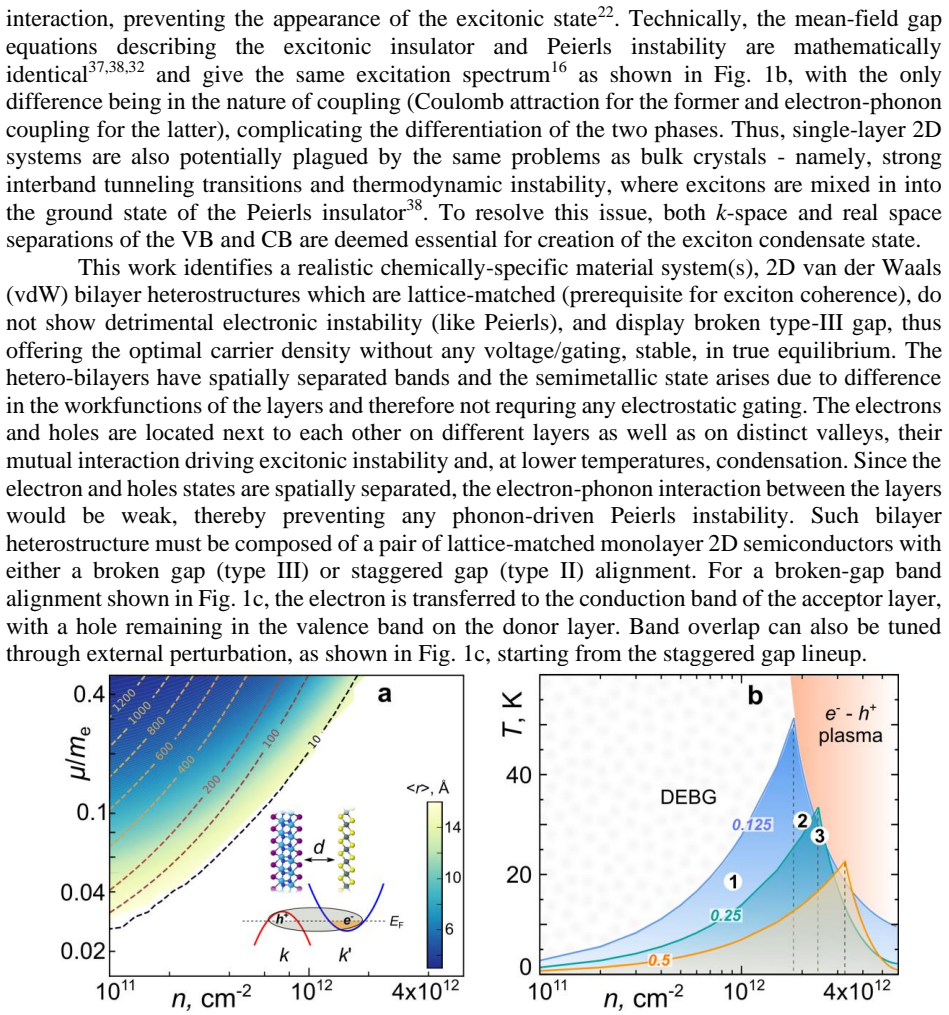
The load-bearing object is the doubly-indirect broken-gap heterobilayer: two lattice-matched monolayer semiconductors stacked with van der Waals spacing, with the valence-band maximum on one layer at one valley and the conduction-band minimum on the other layer at another valley. The quantitative estimates ride on two pieces of machinery: an RPA-screened interlayer Coulomb potential used in a two-band effective-mass Hamiltonian to compute exciton binding energies and radii, and a self-consistent BCS-type gap equation whose order parameter satisfies $k_B T_c = 0.57 \Delta$. The resulting phase diagram organizes the BKT superfluid phase at low density and the BCS regime at high density, with the optimal carrier-density window around $10^{11}$ to $10^{12}$ cm$^{-2}$.
What would settle it
A clean falsifier would be a many-body calculation (hybrid functional or GW) of the stacked pairs: if the conduction-band minimum no longer lies below the valence-band maximum, or the overlap falls below roughly 1 meV, the carrier density leaves the condensate window. The experimental counterpart is angle-resolved photoemission and inverse photoemission on exfoliated stacks: a staggered (type-II) alignment for any of the three pairs would rule out the equilibrium excitonic condensate.
Extended reading notes
Core claim
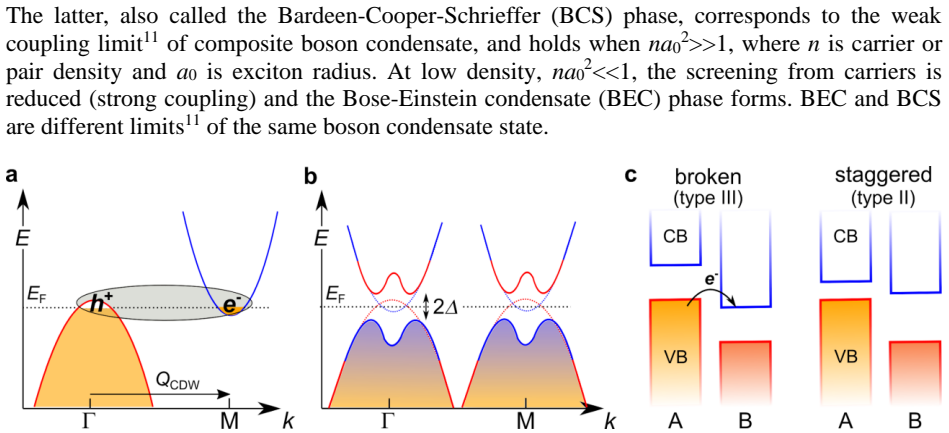
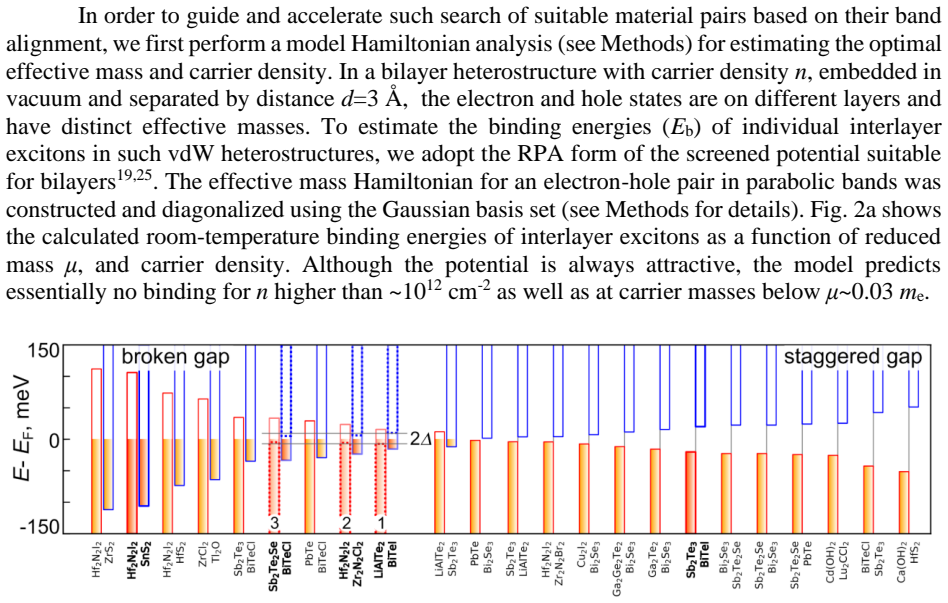
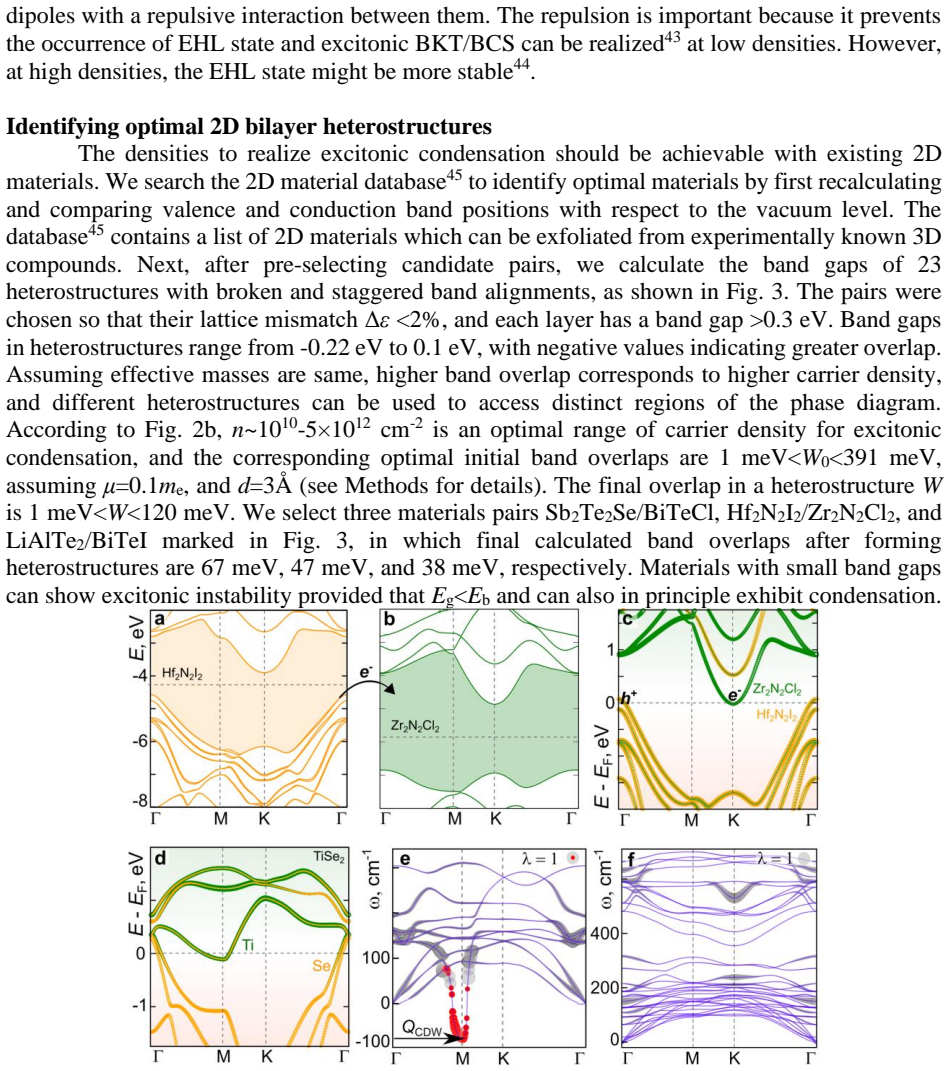
The paper's central claim is that the excitonic condensate can be the intrinsic ground state of certain 2D semiconductor heterobilayers, requiring no optical pumping and no electrostatic gating. The essential electronic configuration is a doubly-indirect band overlap: the valence-band maximum lies on one layer at one valley, while the conduction-band minimum lies on the other layer at a different valley, separating the electron and hole in both real space and momentum space. In that geometry the interlayer Coulomb attraction drives spontaneous pairing, while the spatial separation keeps interlayer electron-phonon coupling weak enough that no Peierls distortion or charge-density-wave reconstruction preempts the electronic condensate. From a high-throughput search of exfoliable 2D materials, the paper singles out Sb2Te2Se/BiTeCl, Hf2N2I2/Zr2N2Cl2, and LiAlTe2/BiTeI, with calculated band overlaps of 67, 47, and 38 meV after stacking, carrier densities above $10^{12}$ cm$^{-2}$, and a highest estimated critical temperature of about 31 K for Hf2N2I2/Zr2N2Cl2. The same phase diagram places these materials across the BEC-BCS crossover, which the paper argues can be traversed by strain or electric-field fine-tuning.
Load-bearing premise
The prediction rests on LDA band alignments relative to vacuum giving the right type-III overlaps for the three pairs; if a more accurate functional moves the bands apart or into a staggered lineup, the proposed materials fall outside the condensate region.
Editorial extensions
If this is right
- If the prediction is right, these three heterobilayers are equilibrium excitonic superfluids: the condensate forms without applied voltage, avoids leakage currents, and is mediated by purely electronic interactions rather than lattice coupling.
- The estimated carrier densities and critical temperatures place the materials near the BEC-BCS crossover, so they could be used to study strong- and weak-coupling exciton condensation in a single tunable system.
- Because electrons and holes occupy opposite layers, the condensate should show enhanced interlayer Josephson-like tunneling and dissipationless charge counterflow, both measurable in transport experiments.
- External tuning by an electric field of order 1 V/nm shifts the carrier density by about $10^{12}$ cm$^{-2}$, which would let experiments move along the phase diagram and raise $T_c$.
- The design rule—lattice-matched type-III heterobilayers with doubly-indirect band overlap—extends beyond the three specific pairs to other combinations from the 2D materials family.
Reading between the lines
- The same screening logic could be rerun with hybrid functionals or GW band structures; better band-edge accuracy might move the three named pairs but still leave other lattice-matched combinations inside the condensate window.
- A natural control experiment would be to twist one of the layers: the commensurability loss should destroy the momentum-matched condensate, confirming that the doubly-indirect overlap is the operative mechanism.
- If the equilibrium condensate exists, it should reveal itself in single-particle spectra as a gap $2\Delta$ at the Fermi level and in response functions as a softened collective mode, distinguishing it from a conventional charge-density-wave state.
- The same type-III design might extend to bent or cylindrical heterobilayers, where flexoelectric charge separation would supply an additional tuning knob beyond the flat-layer electric-field control the paper quantifies.
Signed reviews
Editorial analysis
A structured set of objections, weighed in public.
Referee Report
Summary. The paper proposes that intrinsically stable 2D semiconductor heterobilayers with doubly indirect, type-III broken-gap band alignments can host spontaneous excitonic condensation in true equilibrium, without external gating. The authors combine a model RPA/BCS phase diagram for interlayer excitons with a database screening of 258 exfoliable 2D materials, identifying three lattice-matched pairs—Sb2Te2Se/BiTeCl, Hf2N2I2/Zr2N2Cl2, and LiAlTe2/BiTeI—as the most promising. For Hf2N2I2/Zr2N2Cl2 they present projected band structures and phonon spectra showing the absence of a Peierls-like instability, and they estimate critical temperatures up to about 31 K. The central claim is that these chemically specific, lattice-matched, broken-gap heterobilayers provide an optimal material platform for excitonic superfluidity.
Significance. If the central claim holds, this would be a valuable step toward equilibrium excitonic condensates in two-dimensional materials, with concrete, falsifiable predictions of specific material pairs and estimated critical temperatures. The paper is strongest in its systematic database screening, its explicit attention to lattice matching and thermal stability, and its phonon calculation for the primary candidate showing no detrimental CDW-like instability. The conceptual distinction from voltage-doped nonequilibrium bilayers and from monolayer Peierls-prone systems is well motivated. However, the quantitative predictions are not yet fully load-bearing because they depend on electronic-structure approximations and model parameters whose robustness is not established for the final candidates; the current evidence is suggestive rather than definitive.
major comments (3)
- [Results, 'Identifying optimal 2D bilayer heterostructures' and Discussion] The selection of Sb2Te2Se/BiTeCl, Hf2N2I2/Zr2N2Cl2, and LiAlTe2/BiTeI as optimal rests on LDA Kohn-Sham band alignments relative to vacuum, with final overlaps W = 67, 47, and 38 meV that set the carrier density n > 10^12 cm^-2 and hence the Tc marks in Fig. 2b. LDA is known to underestimate gaps and can misplace band edges by hundreds of meV; a hybrid or GW calculation could change W by enough to move a pair out of the condensate region or even reverse the sign of the overlap. The Discussion only states that a functional-dependent spread in n would change Tc estimates without changing the conclusion, but no hybrid/GW data or error bar is presented for the selected pairs. Because the headline quantitative claim (Tc up to ~31 K) is n-sensitive, this is a load-bearing uncertainty rather than a presentation issue.
- [Methods, Model Hamiltonian and BCS mean-field gap equations] The phase diagram in Fig. 2 and the quantitative Tc values are obtained with fixed model choices d = 3 Å, κ = 1, T = 300 K for screening, and isotropic parabolic bands with equal carrier masses. The RPA potential of Eq. (2) and the BCS equations (3)-(5) are sensitive to these parameters; for real heterobilayers d is determined by vdW relaxation, κ is affected by the environment and other layers, and the bands in Fig. 4c are neither isotropic nor equal-mass. The manuscript reports no sensitivity analysis for d or κ in the main text, so the quoted Tc values and the placement of the three materials in Fig. 2b should be read as semi-quantitative; the claim that these particular materials sit in the optimal window needs robustness checks.
- [Discussion] The paper itself states that in Sb2Te2Se/BiTeCl and LiAlTe2/BiTeI the zero modulation vector leads to band crossing and hybridization, and that single-particle hybridization can fix the phase of the order parameter and destroy superfluidity, with hBN insertion proposed as a remedy. No calculation of the interlayer tunneling matrix element or of the hBN-spaced geometry is shown. Since two of the three headline candidates are affected, the statement that all three 'emerge promising' is not yet fully supported; quantitative treatment of hybridization (or explicit demonstration that the hBN spacer suppresses it) is needed.
minor comments (3)
- [Methods, First-principles DFT calculation] The statement that LDA 'fortuitously captures well' interlayer van der Waals interactions is supported by a single bilayer-graphene reference; a sentence acknowledging the limited benchmark or citing broader validation would be helpful.
- [Fig. 2 caption] The caption refers to materials labelled (1, 2, and 3) in Fig. 3, but the mapping of these labels to the three named pairs is left implicit in the main text; a sentence listing the pairs and their final overlaps would improve readability.
- [Methods, Charge transfer model] The distinction between the initial overlap W0 and the final overlap W, and how each is obtained from the heterostructure calculation, could be stated more explicitly; the numerical formulas are clear but the connection to Fig. 3's ΔE values is not spelled out.
Circularity Check
No circularity: material parameters are DFT inputs to an independently constructed phase diagram, not fitted targets.
full rationale
The derivation is self-contained. The authors first solve an independent model Hamiltonian with an RPA-screened interlayer Coulomb potential and standard BCS gap equations, producing a general phase diagram in (n, mu) space (Fig. 2) that contains no material-specific fitted parameters; the screening criteria and optimal band-overlap window are then used to search a DFT database. The three candidate pairs are selected from independently calculated LDA band alignments, lattice matching, and phonon stability, and the resulting band overlaps W, effective masses, and carrier densities n are DFT outputs, not parameters fitted to reproduce Tc. The Tc marks in Fig. 2b are read from the pre-computed phase diagram at the DFT-obtained n and mu, so the target result is not an input to the model by construction. The sole self-citation (ref. 51, on flexoelectricity in carbon nanotubes) appears only in a speculative final sentence and is not load-bearing. Concerns about LDA band-edge accuracy are a correctness or robustness issue, not circularity.
Assumptions & free parameters
free parameters (4)
- interlayer distance d =
3 Å
- background dielectric constant κ =
1
- temperature for screening =
300 K
- effective masses μ =
from LDA band structures (Supplementary Table 1)
assumptions (6)
- domain assumption RPA screened potential (Eq. 2) describes interlayer electron-hole attraction in a metallic bilayer.
- domain assumption BCS mean-field gap equations (Eqs. 3-5) capture the excitonic insulator order parameter and critical temperature.
- domain assumption LDA band alignments relative to vacuum determine type-III overlaps and carrier densities.
- domain assumption Interlayer electron-phonon coupling is too weak to cause Peierls-like instability in the selected heterobilayers.
- domain assumption Excitons act as oriented dipoles with repulsive interactions preventing electron-hole liquid formation at relevant densities.
- domain assumption Spin-triplet excitonic order can be neglected.
Cite this review
Pith. "Pith review of Heterobilayers of 2D materials as a platform for excitonic superfluidity." pith.science (2026). https://pith.science/paper/5SU4QYQP
@misc{pith2026190807513,
  author       = {Pith},
  title        = {Pith review of: Heterobilayers of 2D materials as a platform for excitonic superfluidity},
  year         = {2026},
  howpublished = {\url{https://pith.science/paper/5SU4QYQP}},
  note         = {Machine review of arXiv:1908.07513}
}
read the original abstract
Excitonic condensate has been long-sought within bulk indirect-gap semiconductors, quantum wells, and 2D material layers, all tried as carrying media. Here we propose intrinsically stable 2D semiconductor heterostructures with doubly-indirect overlapping bands as optimal platforms for excitonic condensation. After screening hundreds of 2D materials, we identify candidates where spontaneous excitonic condensation mediated by purely electronic interaction should occur, and hetero-pairs Sb2Te2Se/BiTeCl, Hf2N2I2/Zr2N2Cl2, and LiAlTe2/BiTeI emerge promising. Unlike monolayers, where excitonic condensation is hampered by Peierls instability, or other bilayers, where doping by applied voltage is required, rendering them essentially non-equilibrium systems, the chemically-specific heterostructures predicted here are lattice-matched, show no detrimental electronic instability, and display broken type-III gap, thus offering optimal carrier density without any gate voltages, in true-equilibrium. Predicted materials can be used to access different parts of electron-hole phase diagram, including BEC-BCS crossover, enabling tantalizing applications in superfluid transport, Josephson-like tunneling, and dissipationless charge counterflow.
Figures
Figures from the paper (1 more)
Reference graph
Works this paper leans on
-
[1]
R., Patel, V., Chen, W., Tolpygo, S
Friedman, J. R., Patel, V., Chen, W., Tolpygo, S. K. & Lukens, J. E. Quantum superposition of distinct macroscopic states. Nature 406, 43 (2000)
work page 2000
-
[2]
Dadras, S., Gresch, A., Groiseau, C., Wimberger, S. & Summy, G. S. Quantum Walk in Momentum Space with a Bose-Einstein Condensate. Phys. Rev. Lett. 121, 070402 (2018)
work page 2018
-
[3]
Byrnes, T., Wen, K. & Yamamoto, Y. Macroscopic quantum computation using Bose-Einstein condensates. Phys. Rev. A 85, 040306 (2012)
work page 2012
-
[4]
Liu, X., Watanabe, K., Taniguchi, T., Halperin, B. I. & Kim, P. Quantum Hall drag of exciton condensate in graphene. Nat. Phys. 13, 746–750 (2017)
2017
-
[5]
Burg, G. W. et al. Strongly Enhanced Tunneling at Total Charge Neutrality in Double-Bilayer Graphene-WSe2 Heterostructures. Phys. Rev. Lett. 120, 177702 (2018)
work page 2018
-
[6]
Fundamentals and New Frontiers of Bose-Einstein Condensation
Ueda, M. Fundamentals and New Frontiers of Bose-Einstein Condensation. (World Scientific, 2010)
work page 2010
-
[7]
Preskill, J. Magnetic Monopoles. Annu. Rev. Nucl. Part. Sci. 34, 461–530 (1984)
work page 1984
-
[8]
Kiselev, N. S., Bogdanov, A. N., Schäfer, R. & R ̈oßler, U. K. Chiral skyrmions in thin magnetic films: new objects for magnetic storage technologies? J. Phys. Appl. Phys. 44, 392001 (2011)
work page 2011
Show all 58 references
-
[9]
& Sampaio, J
Fert, A., Cros, V. & Sampaio, J. Skyrmions on the track. Nat. Nanotechnol. 8, 152–156 (2013)
2013
-
[10]
& Kozlov, A
Keldysh, L. & Kozlov, A. Collective properties of excitons in semiconductors. Sov. Phys. JETP 27, 521 (1968)
1968
-
[11]
& Schmitt-Rink, S
Nozières, P. & Schmitt-Rink, S. Bose condensation in an attractive fermion gas: From weak to strong 10 coupling superconductivity. J. Low Temp. Phys. 59, 195–211 (1985)
1985
-
[12]
Spontaneous Bose Coherence of Excitons and Polaritons
Snoke, D. Spontaneous Bose Coherence of Excitons and Polaritons. Science 298, 1368–1372 (2002)
2002
-
[13]
M., Butov, L
Fogler, M. M., Butov, L. V. & Novoselov, K. S. High-temperature superfluidity with indirect excitons in van der Waals heterostructures. Nat. Commun. 5, 4555 (2014)
2014
-
[14]
Mott, N. F. The transition to the metallic state. Philos. Mag. J. Theor. Exp. Appl. Phys. 6, 287–309 (1961)
1961
-
[15]
Jérome, D., Rice, T. M. & Kohn, W. Excitonic Insulator. Phys Rev 158, 462–475 (1967)
1967
-
[16]
On the origin of charge-density waves in select layered transition-metal dichalcogenides
Rossnagel, K. On the origin of charge-density waves in select layered transition-metal dichalcogenides. J. Phys. Condens. Matter 23, 213001 (2011)
2011
-
[17]
& Maksimov, L
Kozlov, A. & Maksimov, L. The metal-dielectric divalent crystal phase transition. Sov. Phys. JETP 2, 790 (1965)
1965
-
[18]
Halperin, B. I. & Rice, T. M. Possible Anomalies at a Semimetal-Semiconductor Transition. Rev Mod Phys 40, 755–766 (1968)
1968
-
[19]
Lozovik, Y. E. & Yudson, V. Feasibility of superfluidity of paired spatially separated electrons and holes; a new superconductivity mechanism. JETP Lett 22, 274–276 (1975)
1975
-
[20]
Datta, S., Melloch, M. R. & Gunshor, R. L. Possibility of an excitonic ground state in quantum wells. Phys Rev B 32, 2607–2609 (1985)
1985
-
[21]
B., Hybertsen, M
Zhu, X., Littlewood, P. B., Hybertsen, M. S. & Rice, T. M. Exciton Condensate in Semiconductor Quantum Well Structures. Phys Rev Lett 74, 1633–1636 (1995)
1995
-
[22]
& Keldysh, L
Guseinov, R. & Keldysh, L. Nature of the Phase Transition under the Conditions of an ‘Excitonic’ Instability in the Electronic Spectrum of a Crystal. Sov. Phys. JETP 36, 1193 (1973)
1973
-
[23]
& MacDonald, A
Min, H., Bistritzer, R., Su, J.-J. & MacDonald, A. H. Room-temperature superfluidity in graphene bilayers. Phys Rev B 78, 121401 (2008)
2008
-
[24]
Kharitonov, M. Yu. & Efetov, K. B. Electron screening and excitonic condensation in double-layer graphene systems. Phys Rev B 78, 241401 (2008)
2008
-
[25]
E., Ogarkov, S
Lozovik, Yu. E., Ogarkov, S. L. & Sokolik, A. A. Condensation of electron-hole pairs in a two-layer 11 graphene system: Correlation effects. Phys Rev B 86, 045429 (2012)
2012
-
[26]
& Hamilton, A
Perali, A., Neilson, D. & Hamilton, A. R. High-Temperature Superfluidity in Double-Bilayer Graphene. Phys Rev Lett 110, 146803 (2013)
2013
-
[27]
Li, J. I. A., Taniguchi, T., Watanabe, K., Hone, J. & Dean, C. R. Excitonic superfluid phase in double bilayer graphene. Nat. Phys. 13, 751 (2017)
2017
-
[28]
& Fal’ko, V
McCann, E. & Fal’ko, V. I. Landau-Level Degeneracy and Quantum Hall Effect in a Graphite Bilayer. Phys Rev Lett 96, 086805 (2006)
2006
-
[29]
B., Straley, J
Kolomeisky, E. B., Straley, J. P. & Abrams, D. L. Space charge and screening in bilayer graphene. J. Phys. Condens. Matter 28, 47LT01 (2016)
2016
-
[30]
Debnath, B., Barlas, Y., Wickramaratne, D., Neupane, M. R. & Lake, R. K. Exciton condensate in bilayer transition metal dichalcogenides: Strong coupling regime. Phys. Rev. B 96, 174504 (2017)
2017
-
[31]
Wang, Z. et al. Evidence of high-temperature exciton condensation in two-dimensional atomic double layers. Nature 574, 76–80 (2019)
2019
-
[32]
Kogar, A. et al. Signatures of exciton condensation in a transition metal dichalcogenide. Science 358, 1314–1317 (2017)
2017
-
[33]
& Pereira, V
Chen, C., Singh, B., Lin, H. & Pereira, V. M. Reproduction of the Charge Density Wave Phase Diagram in 1T TiSe2 Exposes its Excitonic Character. Phys Rev Lett 121, 226602 (2018)
2018
-
[34]
& Mauri, F
Bianco, R., Calandra, M. & Mauri, F. Electronic and vibrational properties of TiSe2 in the charge- density-wave phase from first principles. Phys Rev B 92, 094107 (2015)
2015
-
[35]
& Yazyev, O
Pasquier, D. & Yazyev, O. V. Excitonic effects in two-dimensional TiSe2 from hybrid density functional theory. Phys Rev B 98, 235106 (2018)
2018
-
[36]
& Schwingenschlögl, U
Zhu, Z., Cheng, Y. & Schwingenschlögl, U. Origin of the charge density wave in 1T-TiSe2. Phys Rev B 85, 245133 (2012)
2012
-
[37]
Gor’kov, L. P. & Grüner, G. CHAPTER 1 - Introduction. in Charge Density Waves in Solids (eds. GOR’KOV, L. P. & GRÜNER, G.) vol. 25 1–13 (Elsevier, 1989)
1989
-
[38]
Rice, M. J. & Gartstein, Y. N. The excitonic ground state of the half-filled Peierls insulator. J. Phys. 12 Condens. Matter 17, 4615–4620 (2005)
2005
-
[39]
Kosterlitz, J. M. & Thouless, D. J. Ordering, metastability and phase transitions in two-dimensional systems. J. Phys. C Solid State Phys. 6, 1181–1203 (1973)
1973
-
[40]
Nelson, D. R. & Kosterlitz, J. M. Universal Jump in the Superfluid Density of Two-Dimensional Superfluids. Phys Rev Lett 39, 1201–1205 (1977)
1977
-
[41]
Lozovik, Y. E. & Yudson, V. A new mechanism for superconductivity: pairing between spatially separated electrons and holes. Zh Eksp Teor Fiz 71, 738–753 (1976)
1976
-
[42]
Bardeen, J., Cooper, L. N. & Schrieffer, J. R. Theory of Superconductivity. Phys Rev 108, 1175– 1204 (1957)
1957
-
[43]
Butov, L. V. Cold exciton gases in coupled quantum well structures. J. Phys. Condens. Matter 19, 295202 (2007)
2007
-
[44]
& MacDonald, A
Wu, F.-C., Xue, F. & MacDonald, A. H. Theory of two-dimensional spatially indirect equilibrium exciton condensates. Phys. Rev. B 92, 165121 (2015)
2015
-
[45]
Mounet, N. et al. Two-dimensional materials from high-throughput computational exfoliation of experimentally known compounds. Nat. Nanotechnol. 13, 246–252 (2018)
2018
-
[46]
Hellgren, M. et al. Critical Role of the Exchange Interaction for the Electronic Structure and Charge- Density-Wave Formation in TiSe2. Phys Rev Lett 119, 176401 (2017)
2017
-
[47]
& Beck, H
Zenker, B., Fehske, H. & Beck, H. Fate of the excitonic insulator in the presence of phonons. Phys. Rev. B 90, 195118 (2014)
2014
-
[48]
& Huse, D
Tutuc, E., Shayegan, M. & Huse, D. A. Counterflow Measurements in Strongly Correlated GaAs Hole Bilayers: Evidence for Electron-Hole Pairing. Phys. Rev. Lett. 93, 036802 (2004)
2004
-
[49]
K., Register, L
Banerjee, S. K., Register, L. F., Tutuc, E., Reddy, D. & MacDonald, A. H. Bilayer PseudoSpin Field- Effect Transistor (BiSFET): A Proposed New Logic Device. IEEE Electron Device Lett. 30, 158–160 (2009)
2009
-
[50]
A., Kopaev, Yu
Volkov, B. A., Kopaev, Yu. V. & Rusinov, A. I. Theory of ‘excitonic’ ferromagnetism. Sov. Phys. JETP 41, 952 (1975). 13
1975
-
[51]
I., Gupta, S., Kutana, A
Artyukhov, V. I., Gupta, S., Kutana, A. & Yakobson, B. I. Flexoelectricity and Charge Separation in Carbon Nanotubes. Nano Lett. 20, 3240–3246 (2020)
2020
-
[52]
Giannozzi, P. et al. Advanced capabilities for materials modelling with Quantum ESPRESSO. J. Phys. Condens. Matter 29, 465901 (2017)
2017
-
[53]
Pseudopotentials periodic table: From H to Pu
Dal Corso, A. Pseudopotentials periodic table: From H to Pu. Comput. Mater. Sci. 95, 337–350 (2014)
2014
-
[54]
& Furthmüller, J
Kresse, G. & Furthmüller, J. Efficiency of ab-initio total energy calculations for metals and semiconductors using a plane-wave basis set. Comput. Mater. Sci. 6, 15–50 (1996)
1996
-
[55]
Mostaani, E., Drummond, N. D. & Fal’ko, V. I. Quantum Monte Carlo Calculation of the Binding Energy of Bilayer Graphene. Phys. Rev. Lett. 115, 115501 (2015)
2015
-
[56]
& Yakobson, B
Wang, L., Kutana, A. & Yakobson, B. I. Many-body and spin-orbit effects on direct-indirect band gap transition of strained monolayer MoS2 and WS2. Ann. Phys. 526, L7–L12 (2014)
2014
-
[57]
Okada, M. et al. Direct and Indirect Interlayer Excitons in a van der Waals Heterostructure of hBN/WS2/MoS2/hBN. ACS Nano 12, 2498–2505 (2018)
2018
-
[58]
& Senatore, G
De Palo, S., Rapisarda, F. & Senatore, G. Excitonic Condensation in a Symmetric Electron-Hole Bilayer. Phys. Rev. Lett. 88, 206401 (2002)
2002
Reviewed August 14, 2026 · model on record in the stance chip above.
Discussion (0). Continue with ORCID to comment.