REVIEW 3 major objections 6 minor 40 references
P2L: Predicting Transfer Learning for Images and Semantic Relations
T0 review · 3 major / 6 minor · reviewed 2026-08-14 · deepseek-v4-flash
Pith's one-line read Cheap score picks best transfer source in 13 of 21 tasks
desk verdict A held-out-tested estimator for transfer source selection, with a reference-model confound that limits but does not destroy the claim. read the letter →
The pith
A machine-rendered reading of the paper's core claim, the machinery that carries it, and where it could break.
The reading
What carries the argument
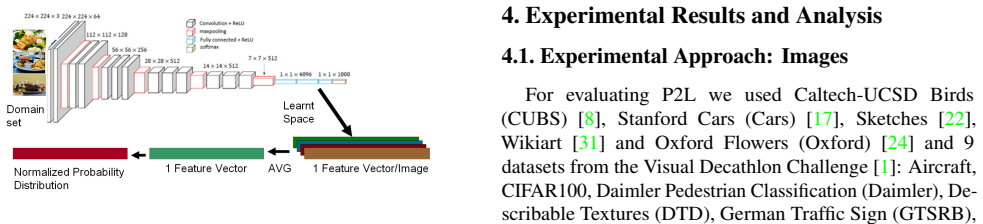
The load-bearing object is the estimator $E(t_i,s_j)$ itself. Each dataset is reduced to a single summary vector: the mean of penultimate-layer feature activations from a reference model (VGG16 for images, PCNN for relations), L1-normalized. $D(t_i,s_j)$ is then a divergence between those summaries, with KL and cityblock working well; $\log(|s_j|)$ encodes the empirically saturating benefit of larger sources; the $z$-scoring makes the two terms comparable; and $k$, tuned once on a small collection of tasks, balances them. Because the target needs only one forward pass through the reference network, the whole ranking costs seconds to minutes rather than a training run per candidate.
What would settle it
Run P2L on a set of source tasks that are entirely absent from the reference model's training data, exhaustively fine-tune all sources on the targets, and compare the predicted and true rankings; if the Spearman correlation drops to near zero, the distance signal is an artifact of the reference model rather than a general transfer property.
Extended reading notes
Core claim
The central claim is that transfer improvement $I(t_i,s_j)=P(M(t_i,s_j))-P(M(t_i,\phi))$ is ranked accurately by the embedding-divergence estimator $E(t_i,s_j)=z(\log(|s_j|))+k\,z(D(t_i,s_j))$, where $|s_j|$ is source dataset size, $D$ is a distance between dataset summaries in the penultimate layer of a fixed reference network, and $k$ is a single tuned scalar. The paper validates this by fine-tuning every source-target pair for 14 image tasks and 7 semantic-relation tasks, and reports Spearman correlations of 0.707 and 0.763 between predicted and true rankings in the two domains. It also reports that merging source datasets (ImageNet22K plus Places2) does not reliably beat the better individual source, which supports the view that transfer depends on compositional match, not just total data.
Load-bearing premise
The ranking collapses if the distance between source and target summaries in one fixed reference model's feature space is not a reliable proxy for fine-tuning improvement, especially since that reference model is trained on one of the candidate sources (ImageNet1K for images).
Editorial extensions
If this is right
- A cloud service can recommend a fine-tuning source for a new customer dataset in about a minute per thousand images rather than training every candidate model.
- The largest-dataset heuristic is not safe: across 21 tasks P2L outperforms it in mean accuracy and in the number of times the best source is selected.
- The same estimator and the same tuned $k$ transfer across domains, working for both image classification and semantic-relation prediction.
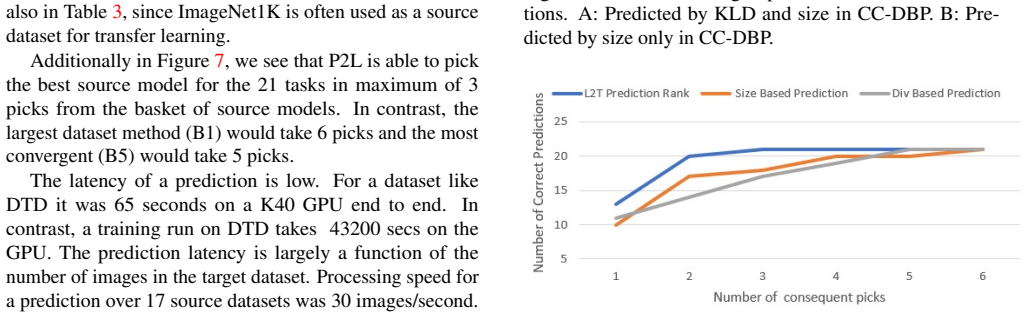
- The best source is usually near the top of P2L's ranking: the paper reports that finding it required at most three P2L picks for all 21 tasks, versus six for the largest-dataset method and five for the least-divergent method.
Reading between the lines
- A natural extension is to pre-compute summary vectors for every model in a model zoo, turning source selection into a nearest-neighbor lookup in feature-vector space; the paper's setup already supplies the once-per-source computation.
- Because the distance term is measured through one reference network, the method's reliability may depend on that reference; a testable variant would average the ranking over several reference networks trained on different data before trusting the recommendation.
- The merged-dataset result suggests a counterintuitive practical rule: when expanding training data, adding examples from unrelated categories can reduce transfer value even as dataset size grows; this is an inference beyond the paper's experiments, but consistent with its size-versus-divergence trade-off.
Signed reviews
Editorial analysis
A structured set of objections, weighed in public.
Referee Report
Summary. The paper proposes P2L (Predict To Learn), an estimator E(t_i, s_j) = z(log(|s_j|)) + k·z(D(t_i, s_j)) that ranks candidate source models for transfer learning to a target task, using only the source dataset size and a feature-space distance between target and source datasets. The distance is computed by passing each dataset through a fixed reference model (VGG16 pretrained on ImageNet1K for images, a PCNN for semantic relations) and comparing the mean penultimate-layer activations. The parameter k is tuned on 9 ImageNet22K-derived tasks and then evaluated on 14 image tasks and 7 semantic-relation tasks, reporting Spearman correlations of 0.703 and 0.763 and an average accuracy of 67.22% versus 64.47% for the largest-dataset baseline and 64.86% for the least-divergent baseline (Table 1). The paper also presents an experiment on merged source datasets showing that a larger merged dataset does not always transfer better than ImageNet1K.
Significance. If the proposed estimator is a reliable predictor of transferability, it offers a practical and inexpensive way to select among pre-trained source models, which is of direct use for cloud-based training services. The held-out evaluation design—tuning k on one set of tasks and evaluating on disjoint image and relation tasks—is a genuine strength, as is the cross-domain transfer of k from images to relations. The merged-dataset experiment provides a useful counterexample to the assumption that larger sources are always better. However, the evidence is weakened by the possible confound in the distance measure, the lack of statistical significance reporting, and some presentation issues that affect the comparability of the headline numbers.
major comments (3)
- [Section 3.2 and Section 4.1] The distance D(t_i, s_j) is computed in the feature space of VGG16 pretrained on ImageNet1K, which is itself one of the 17 candidate source datasets listed in Section 4.1. Several target datasets (CUBS, Cars, Oxford, Wikiart) contain object categories that overlap ImageNet1K's class distribution. The penultimate-layer features of VGG16 are therefore optimized to separate exactly the categories that distinguish these sources and targets, which can make D(t, ImageNet1K) artificially small and inflate P2L's ranking accuracy without measuring true transferability. The paper provides no control experiment with a reference model trained on a domain disjoint from the candidate sources and targets. Without such a control, the reported Spearman correlations (Table 2 and Figure 6A) may reflect this overlap rather than a general property of the feature space. Please add an experiment using a reference model trained on a disjoint dataset (or a randomly initialized network) to demonstrate that the method is not reliant on the source pool being matched to the reference model's training data.
- [Section 4.3, Tables 1-4] The comparisons in Table 1 rely on point estimates with no confidence intervals or significance tests. Per-target Spearman rho values in Table 2 range from 0.52 to 0.95, and with only 17 sources per target, the uncertainty in each correlation is substantial. For semantic relations, the reported gain of 71.79 versus 70.6 for the largest-dataset baseline is small and may be within noise. To support the claim that P2L outperforms the baselines, please report task-level error bars or confidence intervals, and where meaningful, paired statistical tests across the 21 tasks.
- [Abstract and Table 1] The abstract states that P2L was validated 'across 95 tasks' and that the largest-dataset baseline selected the best model in only 55 cases, whereas the body evaluates 21 tasks and reports that P2L picked the best model in 13 cases; this discrepancy must be resolved. Additionally, Table 1 labels all values as 'Mean Top-1 Accuracy' even though the semantic-relations results are area under the PR curve, and the 'Average over 21 tasks' row averages raw values from two different metrics, which is not meaningful. Please report the two domains separately with their appropriate metrics and either remove the combined average or justify it explicitly.
minor comments (6)
- [Section 3.1 and Section 4.3.1] The paper says the estimator form was chosen 'based on extensive experimentation' but does not report the tuned value of k or the range over which it was searched; reporting these would improve reproducibility.
- [Section 4.1] The description of how target datasets are created from ImageNet22K partitions is ambiguous: 'One-tenth of the third partition was used to create a transfer learning target' does not specify the resulting number of training images per target task. Please clarify the exact construction procedure.
- [Section 5] There are typos in the Future Work section, including 'oc more enriched relationships' and 'may be provide'; the manuscript would benefit from a careful proofreading pass.
- [Section 4.3.3] The merged-dataset experiment with LC and ImageNet1K is interesting but is not explicitly connected to the P2L evaluation; state how this observation supports the main claim about the importance of both size and divergence.
- [Figure 5] The caption for Figure 5 is incomplete ('Log10(Size) of sourcesTv'); please provide a full caption describing the contents.
- [Table 3] The column header 'Least Divergent' refers to baseline B5, which uses the distance D; clarify this definition in the table caption or in the text.
Circularity Check
No significant circularity: the P2L estimator is tuned on a disjoint 9-task set and evaluated on held-out image and relation tasks; the ImageNet reference-model overlap is a confound rather than a definitional reduction.
full rationale
The paper's estimator E(t_i,s_j)=z(log|s_j|)+k z(D(t_i,s_j)) (Eq. 2) is not fitted to the evaluation targets. Section 4.1 states that k is tuned on 9 ImageNet22K target tasks (St,Tt) and that 'The k value thus generated was used for evaluation on the workloads in the 14 target tasks (referred to above as Tv), as well as 7 tasks for Semantic Relations.' The image targets (CUBS, Cars, Sketches, Wikiart, Oxford, and the Visual Decathlon datasets) are distinct from those 9 tuning splits, and the relation targets are a separate domain. The ground-truth improvement I(t_i,s_j) is defined independently by fine-tuning (Eq. 1), while D(t_i,s_j) is computed from feature vectors of a reference network without using target-model accuracy. No equation defines E in terms of I, and no fitted parameter is renamed as a prediction on the held-out tasks. The only self-citations, [11] (related work on automatic labeling) and [14] (dataset source by a co-author), are descriptive and not load-bearing for the central estimator. The overlap of the VGG16 reference model's ImageNet1K pretraining with one candidate source and some targets is a genuine empirical confound that a strict evaluation should control for, but it does not make the reported ranking success equivalent to the input by construction; it is a benchmark-validity concern, not circularity.
Assumptions & free parameters
free parameters (2)
- k =
not reported in text
- distance metric D =
not explicitly reported; text suggests KL-divergence and cityblock work well, and Section 4.3.2 uses KLD
assumptions (4)
- domain assumption The reference model (VGG16 for images, PCNN for relations) provides a feature space in which dataset distance correlates with transfer improvement.
- ad hoc to paper The estimator E(t,s) = z(log|s|) + k z(D(t,s)) is the correct functional form for predicting transfer improvement.
- domain assumption A single learned weight k, fit on 9 ImageNet22K target tasks, generalizes to all image and semantic relation targets.
- domain assumption The evaluation datasets are representative of real transfer learning tasks.
Cite this review
Pith. "Pith review of P2L: Predicting Transfer Learning for Images and Semantic Relations." pith.science (2026). https://pith.science/paper/ZAMXNMWC
@misc{pith2026190807630,
  author       = {Pith},
  title        = {Pith review of: P2L: Predicting Transfer Learning for Images and Semantic Relations},
  year         = {2026},
  howpublished = {\url{https://pith.science/paper/ZAMXNMWC}},
  note         = {Machine review of arXiv:1908.07630}
}
read the original abstract
Transfer learning enhances learning across tasks, by leveraging previously learned representations -- if they are properly chosen. We describe an efficient method to accurately estimate the appropriateness of a previously trained model for use in a new learning task. We use this measure, which we call "Predict To Learn" ("P2L"), in the two very different domains of images and semantic relations, where it predicts, from a set of "source" models, the one model most likely to produce effective transfer for training a given "target" model. We validate our approach thoroughly, by assembling a collection of candidate source models, then fine-tuning each candidate to perform each of a collection of target tasks, and finally measuring how well transfer has been enhanced. Across 95 tasks within multiple domains (images classification and semantic relations), the P2L approach was able to select the best transfer learning model on average, while the heuristic of choosing model trained with the largest data set selected the best model in only 55 cases. These results suggest that P2L captures important information in common between source and target tasks, and that this shared informational structure contributes to successful transfer learning more than simple data size.
Figures


Figures from the paper (4 more)



Reference graph
Works this paper leans on
- [1]
-
[2]
Task2vec: Task embedding for meta learning
Rahul Tewari Avinash Ravichandran Subhransu Maji Charless Fowlkes Stefano Soatto Pietro Perona Alessandro Achille1, Michael Lam. Task2vec: Task embedding for meta learning. arXiv preprint arXiv:1902.03545, 2019
arXiv 1902
-
[3]
Dbpedia: A nucleus for a web of open data
Sören Auer, Christian Bizer, Georgi Kobilarov, Jens Lehmann, and Zachary Ives. Dbpedia: A nucleus for a web of open data. In In 6th Int’l Semantic Web Confer- ence, Busan, Korea, pages 11–15. Springer, 2007
work page 2007
-
[4]
Factors of Transferability for a Generic ConvNet Representation
Hossein Azizpour, Ali Sharif Razavian, Josephine Sul- livan, Atsuto Maki, and Stefan Carlsson. Factors of Transferability for a Generic ConvNet Representation. In IEEE Transactions on Pattern Analysis and Machine Intelligence, volume 38, pages 1790–1802, 2016
work page 2016
-
[5]
J. Xiao A. Torralba B. Zhou, A. Lapedriza and A. Oliva. Learning deep features for scene recognition using places database. Proc. Advances Neural Inf. Process, 2014
work page 2014
-
[6]
Relation adaptation: learning to extract novel relations with minimum supervision
Danushka Bollegala, Yutaka Matsuo, and Mitsuru Ishizuka. Relation adaptation: learning to extract novel relations with minimum supervision. In Proceedings of the Twenty-Second international joint conference on Artificial Intelligence-Volume Volume Three, pages 2205–2210. AAAI Press, 2011
-
[7]
Léon Bottou. Stochastic gradient tricks. In Gré- goire Montavon, Genevieve B. Orr, and Klaus-Robert Müller, editors, Neural Networks, Tricks of the Trade, Reloaded, Lecture Notes in Computer Science (LNCS 7700), pages 430–445. Springer, 2012
work page 2012
-
[8]
P. Welinder P. Perona C. Wah, S. Branson and S. Belongie. The caltech-ucsd birds-200-2011 dataset. 2011
work page 2011
Show all 40 references
-
[9]
Boosting for transfer learning
Wenyuan Dai, Qiang Yang, Gui-Rong Xue, and Yong Yu. Boosting for transfer learning. Intl Conf on Ma- chine Learning, pages 193–200, 2007
2007
-
[10]
Document Image Classification with Intra-Domain Transfer Learning and Stacked Generalization of Deep Convolutional Neural Networks
Arindam Das, Saikat Roy, and Ujjwal Bhattacharya. Document Image Classification with Intra-Domain Transfer Learning and Stacked Generalization of Deep Convolutional Neural Networks. 2018
2018
-
[11]
Automatic labeling of data for transfer learning
Parijat Dube, Bishwaranjan Bhattacharjee, Siyu Huo, Patrick Watson, Brian Belgodere, and John R Kender. Automatic labeling of data for transfer learning. nature, 192255:241, 2019
2019
-
[12]
Model-agnostic meta-learning for fast adaptation of deep networks
Chelsea Finn, Pieter Abbeel, and Sergey Levine. Model-agnostic meta-learning for fast adaptation of deep networks. CoRR, abs/1703.03400, 2017
2017 arXiv
-
[13]
Borrowing treasures from the wealthy: Deep transfer learning through selective joint fine-tuning
Weifeng Ge and Yizhou Yu. Borrowing treasures from the wealthy: Deep transfer learning through selective joint fine-tuning. In Proc. IEEE Conference on Com- puter Vision and Pattern Recognition, Honolulu, HI , volume 6, 2017
2017
-
[14]
A Dataset for Web- scale Knowledge Base Population
Michael Glass and Alfio Gliozzo. A Dataset for Web- scale Knowledge Base Population. In Proceedings of the 15th Extended Semantic Web Conference, 2018
2018
-
[15]
Diamos, Heewoo Jun, Hassan Kianinejad, Md
Joel Hestness, Sharan Narang, Newsha Ardalani, Gre- gory F. Diamos, Heewoo Jun, Hassan Kianinejad, Md. Mostofa Ali Patwary, Yang Yang, and Yanqi Zhou. Deep learning scaling is predictable, empiri- cally. CoRR, abs/1712.00409, 2017
2017 arXiv
-
[16]
Socher L.-J
R. Socher L.-J. Li K. Li J. Deng, W. Dong and L. Fei-Fei. Imagenet: A large-scale hierarchical image database. IEEE Computer Vision and Pattern Recogni- tion (CVPR), 2009
2009
-
[17]
J. Deng J. Krause, M. Stark and L. Fei-Fei. 3D object representations for fine-grained categorization. In In ICCV Workshop on Workshop on 3D Representation and Recognition, 2013
2013
-
[18]
Multi-task transfer learning for weakly- supervised relation extraction
Jing Jiang. Multi-task transfer learning for weakly- supervised relation extraction. In 4th International Joint Conference on Natural Language Processing. As- sociation for Computational Linguistics, 2009
2009
-
[19]
The effects of training set size for performance of support vector machines and decision trees
Taskin Kavzoglu and Ismail Colkesen. The effects of training set size for performance of support vector machines and decision trees. Symposium on Spatial Accuracy Assessment in Natural Resources, 2012
2012
-
[20]
Metalearning: a survey of trends and technologies
Christiane Lemke, Marcin Budka, and Bogdan Gabrys. Metalearning: a survey of trends and technologies. Ar- tificial Intelligence Review, 44(1):117–130, Jun 2015
2015
-
[21]
Label efficient learning of transferable representations across domains and tasks
Zelun Luo, Yuliang Zou, Judy Hoffman, and Li Fei-Fei. Label efficient learning of transferable representations across domains and tasks. In NIPS, 2017
2017
-
[22]
J. Hays M. Eitz and M. Alexa. How do humans sketch objects? ACM Transactions on Graphics, 31(4):44–1, 2012
2012
-
[23]
A Two-stage Approach for Extend- ing Event Detection to New Types via Neural Net- works
Thien Huu Nguyen, Lisheng Fu, Kyunghyun Cho, and Ralph Grishman. A Two-stage Approach for Extend- ing Event Detection to New Types via Neural Net- works. ACL Representation Learning for NLP Work- shop, 2016
2016
-
[24]
Nilsback and A
M.-E. Nilsback and A. Zisserman. Automated flower classification over a large number of classes. In In Indian Conference on Computer Vision, Graphics & Image Processing, 2008
2008
-
[25]
Berg Li Fei-Fei Olga Russakovsky, Jia Deng
Hao Su Jonathan Krause Sanjeev Satheesh Sean Ma Zhiheng Huang Andrej Karpathy Aditya Khosla Michael Bernstein Alexander C. Berg Li Fei-Fei Olga Russakovsky, Jia Deng. Imagenet large scale visual recognition challenge. International Journal of Computer Vision, 2015
2015
-
[26]
A Survey on Transfer Learning
Sinno Jialin Pan and Qiang Yang. A Survey on Transfer Learning. IEEE Transactions on knowledge and data engineering, 22(10):1–15, 2010
2010
-
[27]
Learning to learn, from transfer learning to domain adaptation: A unify- ing perspective
Novi Patricia and Barbara Caputo. Learning to learn, from transfer learning to domain adaptation: A unify- ing perspective. Conference on Computer Vision and Pattern Recognition, 2014
2014
-
[28]
CNN features off-the- shelf: an astounding baseline for recognition
Ali Sharif Razavian, Hossein Azizpour, Josephine Sul- livan, and Stefan Carlsson. CNN features off-the- shelf: an astounding baseline for recognition. CoRR, abs/1403.6382, 2014
2014 arXiv
-
[29]
To transfer or not to transfer
Michael T Rosenstein, Zvika Marx, Leslie Pack Kael- bling, and Thomas G Dietterich. To transfer or not to transfer. In NIPS 2005 workshop on transfer learning, 2005
2005
-
[30]
Learning to select data for transfer learning with bayesian optimization
Sebastian Ruder and Barbara Plank. Learning to select data for transfer learning with bayesian optimization. CoRR, abs/1707.05246, 2017
2017 arXiv
-
[31]
Saleh and A
B. Saleh and A. Elgammal. Large-scale classification of fineart paintings: Learning the right metric on the right feature. 2015
2015
-
[32]
Manning, and Andrew Y
Richard Socher, Milind Ganjoo, Hamsa Sridhar, Osbert Bastani, Christopher D. Manning, and Andrew Y . Ng. Zero-Shot Learning Through Cross-Modal Transfer. pages 935–943, 2013
2013
-
[33]
David Sussillo and L. Abbott. Transferring learning from external to internal weights in Echo-State net- works with sparse connectivity. PLoS ONE, 2012
2012
-
[34]
Transfer learning
Lisa Torrey and Jude Shavlik. Transfer learning. In Handbook of research on machine learning applica- tions and trends: algorithms, methods, and techniques, pages 242–264. IGI Global, 2010
2010
-
[35]
Learning to transfer
Ying Wei, Yu Zhang, and Qiang Yang. Learning to transfer. CoRR, abs/1708.05629, 2017
2017 arXiv
-
[36]
Khoshgoftaar, and DingDing Wang
Karl Weiss, Taghi M. Khoshgoftaar, and DingDing Wang. A survey of transfer learning. Journal of Big Data, 3(1):9, May 2016
2016
-
[37]
Transfer learning via learning to transfer
Wei Ying, Yu Zhang, Junzhou Huang, and Qiang Yang. Transfer learning via learning to transfer. In Interna- tional Conference on Machine Learning, pages 5072– 5081, 2018
2018
-
[38]
How transferable are features in deep neural networks? In NIPS, 2014
Jason Yosinski, Jeff Clune, Yoshua Bengio, and Hod Lipson. How transferable are features in deep neural networks? In NIPS, 2014
2014
-
[39]
Shen, Leonidas J
Amir Roshan Zamir, Alexander Sax, William B. Shen, Leonidas J. Guibas, Jitendra Malik, and Silvio Savarese. Taskonomy: Disentangling task transfer learning. CoRR, abs/1804.08328, 2018
2018 arXiv
-
[40]
Distant supervision for relation extraction via piece- wise convolutional neural networks
Daojian Zeng, Kang Liu, Yubo Chen, and Jun Zhao. Distant supervision for relation extraction via piece- wise convolutional neural networks. In EMNLP, pages 1753–1762, 2015
2015
Reviewed August 14, 2026 · model on record in the stance chip above.
Discussion (0). Continue with ORCID to comment.