REVIEW 3 major objections 6 minor 51 references
Dialog State Tracking with Reinforced Data Augmentation
T0 review · 3 major / 6 minor · reviewed 2026-08-14 · deepseek-v4-flash
Pith's one-line read The paper claims that a reinforcement-learned span-replacement policy can generate high-quality training instances for dialog state tracking, lifting joint goal accuracy to 90.7% on WoZ and 86.7% on MultiWoZ (restaurant).
desk verdict Solid RL-based augmentation paper for DST, but the shared validation split for reward and model selection is an unaddressed robustness risk. read the letter →
The pith
A machine-rendered reading of the paper's core claim, the machinery that carries it, and where it could break.
The reading
What carries the argument
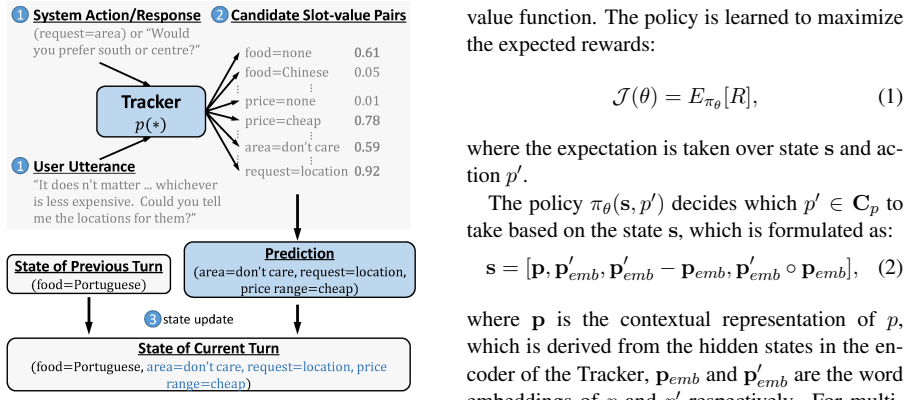
The central object is the contextual-bandit generator: a policy network $\pi_\theta(s,p')$ that chooses a replacement span $p'$ from a candidate set $C_p$ for an original span $p$ in sentence $x$, with state $s=[p;\,p'_{\mathrm{emb}};\,p'_{\mathrm{emb}}-p_{\mathrm{emb}};\,p'_{\mathrm{emb}}\circ p_{\mathrm{emb}}]$. The policy is trained by policy gradient to maximize expected reward, where each action receives a bag-level reward $R^B_j$ from Eq. 5 — the scaled joint-goal accuracy of a tracker retrained on a sampled bag — plus an instance-level reward $R^I_{i,j}$ from Eq. 6 that favors large-loss examples. The contextual representation of the span comes from the tracker's own encoder, tying the generator's view of context to the model it is trying to help. Alternate training (Algorithm 1) is what turns the bandit into an adaptive filter: as the tracker improves, the reward signal changes, and the generator is re-initialized each epoch to keep exploring useful replacements.
What would settle it
On a fixed dataset, hold out a test set before training, run RDA with rewards computed on a validation subset, and compare the chosen tracker's test accuracy with the same tracker trained on the same number of generated instances selected by random candidate choice; if random selection matches or beats the learned policy on the untouched test set, the claim that the learned policy filters noise is refuted.
Extended reading notes
Core claim
The discovery is that a tracker's own learning signal can be recycled to train a data generator, closing a loop that improves both. The generator samples replacement phrases for spans in existing utterances; the tracker is then retrained on the original data plus the generated instances. The generator's reward combines a bag-level score — how much a whole batch of replacements improves tracker accuracy on a validation subset — with an instance-level score that favors generated examples the current tracker answers incorrectly. Because the two modules alternate, the policy is continually re-targeted at the tracker it is feeding. On the two restaurant-domain benchmarks, this loop pushes an attentive baseline tracker from 88.3% to 90.7% and from 83.6% to 86.7% joint goal accuracy, and it improves an older convolutional tracker by even larger margins.
Load-bearing premise
The loop's reward and its final model selection both rely on the tracker's accuracy on a subsampled validation set, so the entire method assumes that optimizing this validation signal keeps transferring to unseen test dialogs instead of overfitting to that set.
Editorial extensions
If this is right
- Data-scarce dialog domains can be improved without new human annotations, as long as paraphrase candidates for frequent spans can be harvested automatically.
- The augmentation policy is not tied to one tracker architecture; it improves both an attentive tracker and a convolutional tracker, so it can be layered onto future trackers.
- Unfiltered paraphrase augmentation can hurt a tracker, so the selection policy, not the candidate list, is the source of the gains.
- In 10–20% training-data regimes the reported gains are around ten accuracy points, making bootstrap training of a new task-oriented dialog system from a small seed dataset the most promising application.
- Adding generated data beyond roughly twice the original training set yields diminishing returns, so the practical recipe is bounded augmentation with policy quality, not raw quantity.
Reading between the lines
- An implication left implicit in the paper is that the same span-replacement bandit should transfer to other slot-based language understanding tasks, such as spoken language understanding, wherever candidate replacements can be harvested from existing data.
- A testable extension would couple the bandit with a learned paraphrase generator; because the bag reward in Eq. 5 is normalized against other sampled bags, the policy's ceiling is set by the candidate set, so a stronger candidate generator should raise that ceiling.
- The paper uses a subsampled validation set to blunt overfitting, but an independent repeated-split test protocol would separate genuine generalization from selection on the validation signal.
Signed reviews
Editorial analysis
A structured set of objections, weighed in public.
Referee Report
Summary. The paper proposes a reinforced data augmentation (RDA) framework for dialog state tracking. A contextual-bandit generator selects replacements for text spans (from PPDB paraphrases or same-slot values) to produce new training instances; a tracker is retrained on the original plus augmented data. The generator is trained with rewards derived from the tracker's joint goal accuracy on a subsampled validation set, and the two modules are updated alternately. Experiments on WoZ and MultiWoZ (restaurant) with GLAD* and NBT-CNN report consistent gains over both the base trackers and a non-reinforced data augmentation baseline (DA), with headline test accuracies of 90.7% and 86.7% for GLAD*+RDA, and larger gains under 10%/20% training-data subsampling.
Significance. If the empirical claims hold under a clean evaluation protocol, this is a worthwhile contribution: RDA is a generic augmentation wrapper that improves two different trackers on two datasets, and the main results include a DA baseline that controls for augmentation volume. The coarse-to-fine generation idea, where a learned policy filters noisy candidate replacements, is sensible and could transfer to other structured prediction tasks. The ablations show that both bag-level and instance-level rewards contribute non-trivially. The manuscript does not provide code or a release of the modified GLAD* architecture, and the central empirical claims rest on a validation-driven optimization that is not stress-tested; the significance to the field is therefore moderate until those concerns are addressed.
major comments (3)
- [§3.2, §2.2 Eq. (5), Algorithm 1 line 17]
- [Table 2 and §3.4]
- [Table 1 and §3.4]
minor comments (6)
- [§2.2, Eq. (5)]
- [Algorithm 1, lines 1 and 3]
- [§3.2]
- [Figure 4]
- [Table 4 and §3.6]
- [§2.1]
Circularity Check
No significant circularity: RDA's central claim is an empirical test-set measurement, not a definitional consequence of its reward or selection criteria.
full rationale
The paper's central claim is that the RDA framework improves joint goal accuracy on WoZ and MultiWoZ (restaurant), with results reported on held-out test sets. The Generator is trained with rewards derived from the Tracker's joint goal accuracy on a subsampled validation split (Eq. 5), and Algorithm 1 (line 17) selects the Tracker with the best validation performance across alternate-learning epochs; this creates a shared-split optimization loop that could overfit the validation set, but it does not make the reported test accuracy equal to the reward by construction. No equation in the paper reduces a predicted quantity to a fitted parameter, and no load-bearing claim depends on a self-citation. The comparison against external baselines and held-out test accuracy provides independent empirical content. The shared validation split is a robustness and overfitting concern rather than a circularity, so no circular step is identified.
Assumptions & free parameters
free parameters (13)
- c =
0.5
- n (augmentation multiplier) =
5 on WoZ, 3 on MultiWoZ (restaurant)
- augmented data sampling ratio =
0.4 on WoZ, 0.3 on MultiWoZ (restaurant)
- validation subsample ratio =
0.3
- L =
5
- N =
200
- M =
2
- bag size =
25
- hidden state dimension =
200
- learning rate =
1e-3
- batch size =
16
- multi-head attention heads =
4
- word dropout rate =
0.2
assumptions (4)
- standard math The policy gradient estimator in Eq. 4 provides an unbiased estimate of the gradient of the expected reward.
- domain assumption Validation-set accuracy of the Tracker is a reliable reward signal for the quality of generated data.
- domain assumption Candidate replacements from PPDB and same-slot values preserve the validity of the dialog state label for the new sentence.
- ad hoc to paper Alternate learning between Generator and Tracker converges to a beneficial policy rather than a degenerate self-confirming loop.
Cite this review
Pith. "Pith review of Dialog State Tracking with Reinforced Data Augmentation." pith.science (2026). https://pith.science/paper/DA2NFOWI
@misc{pith2026190807795,
  author       = {Pith},
  title        = {Pith review of: Dialog State Tracking with Reinforced Data Augmentation},
  year         = {2026},
  howpublished = {\url{https://pith.science/paper/DA2NFOWI}},
  note         = {Machine review of arXiv:1908.07795}
}
read the original abstract
Neural dialog state trackers are generally limited due to the lack of quantity and diversity of annotated training data. In this paper, we address this difficulty by proposing a reinforcement learning (RL) based framework for data augmentation that can generate high-quality data to improve the neural state tracker. Specifically, we introduce a novel contextual bandit generator to learn fine-grained augmentation policies that can generate new effective instances by choosing suitable replacements for the specific context. Moreover, by alternately learning between the generator and the state tracker, we can keep refining the generative policies to generate more high-quality training data for neural state tracker. Experimental results on the WoZ and MultiWoZ (restaurant) datasets demonstrate that the proposed framework significantly improves the performance over the state-of-the-art models, especially with limited training data.
Figures


Figures from the paper (1 more)

Reference graph
Works this paper leans on
-
[1]
URL: " 'urlintro :=
ENTRY address author booktitle chapter edition editor howpublished institution journal key month note number organization pages publisher school series title type volume year eprint doi pubmed url lastchecked label extra.label sort.label short.list INTEGERS output.state before.all mid.sentence after.sentence after.block STRINGS urlintro eprinturl eprintpr...
-
[2]
write newline
" write newline "" before.all 'output.state := FUNCTION n.dashify 't := "" t empty not t #1 #1 substring "-" = t #1 #2 substring "--" = not "--" * t #2 global.max substring 't := t #1 #1 substring "-" = "-" * t #2 global.max substring 't := while if t #1 #1 substring * t #2 global.max substring 't := if while FUNCTION word.in bbl.in capitalize " " * FUNCT...
-
[3]
Pawe Budzianowski, Tsung-Hsien Wen, Bo-Hsiang Tseng, I \ n igo Casanueva, Stefan Ultes, Osman Ramadan, and Milica Gasic. 2018. Multiwoz-a large-scale multi-domain wizard-of-oz dataset for task-oriented dialogue modelling. In EMNLP, pages 5016--5026
work page 2018
-
[4]
Asli Celikyilmaz, Antoine Bosselut, Xiaodong He, and Yejin Choi. 2018. Deep communicating agents for abstractive summarization. In NAACL, volume 1, pages 1662--1675
work page 2018
-
[5]
Ekin D Cubuk, Barret Zoph, Dandelion Mane, Vijay Vasudevan, and Quoc V Le. 2018. Autoaugment: Learning augmentation policies from data. arXiv preprint arXiv:1805.09501
arXiv 2018
-
[6]
David DeVault and Matthew Stone. 2007. Managing ambiguities across utterances in dialogue. In Decalog, pages 49--56
work page 2007
-
[7]
Yue Dong, Yikang Shen, Eric Crawford, Herke van Hoof, and Jackie Chi Kit Cheung. 2018. Banditsum: Extractive summarization as a contextual bandit. In EMNLP, pages 3739--3748
work page 2018
-
[8]
Miroslav Dudik, Daniel Hsu, Satyen Kale, Nikos Karampatziakis, John Langford, Lev Reyzin, and Tong Zhang. 2011. Efficient optimal learning for contextual bandits. arXiv preprint arXiv:1106.2369
arXiv 2011
Show all 51 references
-
[9]
Jun Feng, Minlie Huang, Li Zhao, Yang Yang, and Xiaoyan Zhu. 2018. Reinforcement learning for relation classification from noisy data
2018
-
[10]
Jianfeng Gao, Michel Galley, and Lihong Li. 2018. Neural approaches to conversational ai. arXiv preprint arXiv:1809.08267
2018 arXiv
-
[11]
Bo Han, Quanming Yao, Xingrui Yu, Gang Niu, Miao Xu, Weihua Hu, Ivor Tsang, and Masashi Sugiyama. 2018. Co-teaching: Robust training of deep neural networks with extremely noisy labels. In NeurIPS, pages 8527--8537
2018
-
[12]
Kazuma Hashimoto, caiming xiong, Yoshimasa Tsuruoka, and Richard Socher. 2017. A joint many-task model: Growing a neural network for multiple nlp tasks. In EMNLP, pages 1923--1933
2017
-
[13]
Matthew Henderson, Blaise Thomson, and Jason D Williams. 2014 a . The second dialog state tracking challenge. In SIGDIAL, pages 263--272
2014
-
[14]
Matthew Henderson, Blaise Thomson, and Steve Young. 2014 b . Word-based dialog state tracking with recurrent neural networks. In SIGDIAL, pages 292--299
2014
-
[15]
Yutai Hou, Yijia Liu, Wanxiang Che, and Ting Liu. 2018. Sequence-to-sequence data augmentation for dialogue language understanding. In COLING, pages 1234--1245
2018
-
[16]
Dongyeop Kang, Tushar Khot, Ashish Sabharwal, and Eduard Hovy. 2018. Adversarial training for textual entailment with knowledge-guided examples. In ACL
2018
-
[17]
Diederik P Kingma and Jimmy Ba. 2015. Adam: A method for stochastic optimization. ICLR
2015
-
[18]
Tom Ko, Vijayaditya Peddinti, Daniel Povey, and Sanjeev Khudanpur. 2015. Audio augmentation for speech recognition. In Interspeech
2015
-
[19]
Sosuke Kobayashi. 2018. Contextual augmentation: Data augmentation by words with paradigmatic relations. In NAACL
2018
-
[20]
Alex Krizhevsky, Ilya Sutskever, and Geoffrey E Hinton. 2012. Imagenet classification with deep convolutional neural networks. In NeurIPS, pages 1097--1105
2012
-
[21]
Jiwei Li, Will Monroe, Alan Ritter, Dan Jurafsky, Michel Galley, and Jianfeng Gao. 2016. Deep reinforcement learning for dialogue generation. In EMNLP
2016
-
[22]
Zichao Li, Xin Jiang, Lifeng Shang, and Hang Li. 2018. Paraphrase generation with deep reinforcement learning. In EMNLP, pages 3865--3878
2018
-
[23]
Zhouhan Lin, Minwei Feng, Cicero Nogueira dos Santos, Mo Yu, Bing Xiang, Bowen Zhou, and Yoshua Bengio. 2017. A structured self-attentive sentence embedding. ICLR
2017
-
[24]
Angeliki Metallinou, Dan Bohus, and Jason Williams. 2013. Discriminative state tracking for spoken dialog systems. In ACL, pages 466--475
2013
-
[25]
Nikola Mrk s i \'c , Diarmuid \'O S \'e aghdha, Tsung-Hsien Wen, Blaise Thomson, and Steve Young. 2017. Neural belief tracker: Data-driven dialogue state tracking. In ACL, pages 1777--1788
2017
-
[26]
Karthik Narasimhan, Adam Yala, and Regina Barzilay. 2016. Improving information extraction by acquiring external evidence with reinforcement learning. In EMNLP, pages 2355--2365
2016
-
[27]
Elnaz Nouri and Ehsan Hosseini-Asl. 2018. Toward scalable neural dialogue state tracking model. arXiv preprint arXiv:1812.00899
2018 arXiv
-
[28]
Romain Paulus, Caiming Xiong, and Richard Socher. 2017. A deep reinforced model for abstractive summarization. arXiv preprint arXiv:1705.04304
2017 arXiv
-
[29]
Jeffrey Pennington, Richard Socher, and Christopher D. Manning. 2014. Glove: Global vectors for word representation. In EMNLP, pages 1532--1543
2014
-
[30]
Pengda Qin, XU Weiran, and William Yang Wang. 2018 a . Robust distant supervision relation extraction via deep reinforcement learning. In Proceedings of the 56th Annual Meeting of the Association for Computational Linguistics (Volume 1: Long Papers), pages 2137--2147
2018
-
[31]
Pengda Qin, Weiran XU, and William Yang Wang. 2018 b . Dsgan: Generative adversarial training for distant supervision relation extraction. In ACL
2018
-
[32]
Osman Ramadan, Pawe Budzianowski, and Milica Gasic. 2018. Large-scale multi-domain belief tracking with knowledge sharing. In ACL, pages 432--437
2018
-
[33]
Marc'Aurelio Ranzato, Sumit Chopra, Michael Auli, and Wojciech Zaremba. 2015. Sequence level training with recurrent neural networks. arXiv preprint arXiv:1511.06732
2015 arXiv
-
[34]
Avik Ray, Yilin Shen, and Hongxia Jin. 2018. Robust spoken language understanding via paraphrasing. arXiv preprint arXiv:1809.06444
2018 arXiv
-
[35]
Liliang Ren, Kaige Xie, Lu Chen, and Kai Yu. 2018. Towards universal dialogue state tracking. In EMNLP, pages 2780--2786
2018
-
[36]
Marco Tulio Ribeiro, Sameer Singh, and Carlos Guestrin. 2018. Semantically equivalent adversarial rules for debugging NLP models. In ACL, pages 856--865
2018
-
[37]
Sanuj Sharma, Prafulla Kumar Choubey, and Ruihong Huang. 2019. Improving dialogue state tracking by discerning the relevant context
2019
-
[38]
Satinder P Singh, Michael J Kearns, Diane J Litman, and Marilyn A Walker. 2000. Reinforcement learning for spoken dialogue systems. In NeurIPS, pages 956--962
2000
-
[39]
Richard S Sutton and Andrew G Barto. 2018. Reinforcement learning: An introduction, pages 329--331. MIT press
2018
-
[40]
Ashish Vaswani, Noam Shazeer, Niki Parmar, Jakob Uszkoreit, Llion Jones, Aidan N Gomez, ukasz Kaiser, and Illia Polosukhin. 2017. Attention is all you need. In NeurIPS, pages 5998--6008
2017
-
[41]
Tsung-Hsien Wen, David Vandyke, Nikola Mrk s i \'c , Milica Gasic, Lina M Rojas Barahona, Pei-Hao Su, Stefan Ultes, and Steve Young. 2017. A network-based end-to-end trainable task-oriented dialogue system. In EACL, pages 438--449
2017
-
[42]
Jason Williams, Antoine Raux, and Matthew Henderson. 2016. The dialog state tracking challenge series: A review. Dialogue & Discourse, 7(3):4--33
2016
-
[43]
Jason Williams, Antoine Raux, Deepak Ramachandran, and Alan Black. 2013. The dialog state tracking challenge. In SIGDIAL, pages 404--413
2013
-
[44]
Jason D Williams. 2008. Exploiting the asr n-best by tracking multiple dialog state hypotheses. In Interspeech
2008
-
[45]
Jiawei Wu, Lei Li, and William Yang Wang. 2018. Reinforced co-training. In NAACL, pages 1252--1262
2018
-
[46]
Wenhan Xiong, Thien Hoang, and William Yang Wang. 2017. Deeppath: A reinforcement learning method for knowledge graph reasoning. In EMNLP, pages 564--573
2017
-
[47]
Kang Min Yoo, Youhyun Shin, and Sang-goo Lee. 2018. Data augmentation for spoken language understanding via joint variational generation. arXiv preprint arXiv:1809.02305
2018 arXiv
-
[48]
Xiang Zhang, Junbo Zhao, and Yann LeCun. 2015. Character-level convolutional networks for text classification. In NeurIPS
2015
-
[49]
Shiqi Zhao, Xiang Lan, Ting Liu, and Sheng Li. 2009. Application-driven statistical paraphrase generation. In ACL, pages 834--842
2009
-
[50]
Victor Zhong, Caiming Xiong, and Richard Socher. 2018. Global-locally self-attentive encoder for dialogue state tracking. In ACL
2018
-
[51]
Victor Zue, Stephanie Seneff, James R Glass, Joseph Polifroni, Christine Pao, Timothy J Hazen, and Lee Hetherington. 2000. Juplter: a telephone-based conversational interface for weather information. TASLP, pages 85--96
2000
Reviewed August 14, 2026 · model on record in the stance chip above.
Discussion (0). Continue with ORCID to comment.