REVIEW 3 major objections 6 minor 45 references
A Multi-level Neural Network for Implicit Causality Detection in Web Texts
T0 review · 3 major / 6 minor · reviewed 2026-08-14 · deepseek-v4-flash
Pith's one-line read The paper's MCDN combines word-level Transformer context with segment-level causal reasoning and reports F1 81.47/82.50 on AltLex, beating fine-tuned BERT at a fraction of the compute.
desk verdict Solid empirical paper with a genuinely new segment-level relation network for causality detection; the AltLex results are credible, but the SOTA claim needs scoping because the model depends on a known cue at test time. read the letter →
The pith
A machine-rendered reading of the paper's core claim, the machinery that carries it, and where it could break.
The reading
What carries the argument
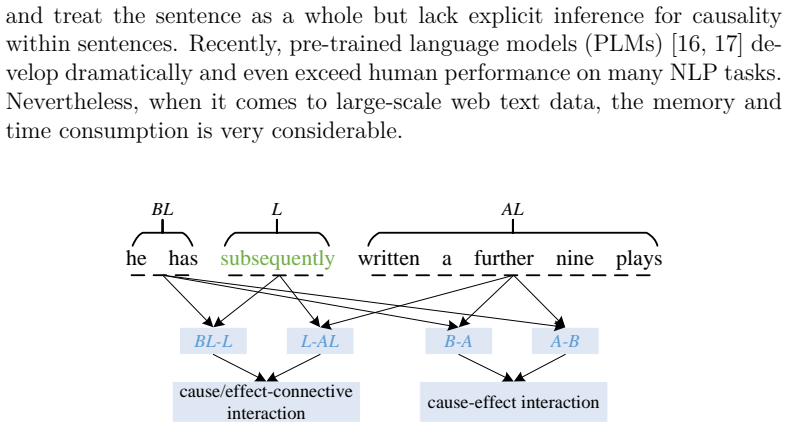
The load-bearing mechanism is the segment-level Self Causal Relation Network (SCRN) built on the three-way split of a sentence at its AltLex cue: the segment before the cue (BL), the cue itself (L), and the segment after it (AL). A three-column CNN compresses each segment into a vector, a bi-GRU encodes the whole sentence, and SCRN then forms four concatenated object-pairs, BL–L, L–AL, BL–AL, and AL–BL, each augmented with the sentence state, and maps them through two feed-forward networks to produce a segment-level representation. This pairwise operation is what explicitly models the causal reasoning step. The word-level Transformer encoder is the second pillar: it supplies local and long-distance context, and its output is concatenated with the segment-level output before a softmax classifier. The classification is trained with focal loss to counter the heavy imbalance between causal and non-causal sentences.
What would settle it
Run MCDN on a test set of naturally occurring implicit causal and non-causal sentences that contain no AltLex cue from the paper's list, or from which all listed cues have been removed. If detection on those cue-free sentences stays near or above the reported AltLex F1, the word-level Transformer is doing the work and the relational segment module is not load-bearing; if performance collapses, the reported gains are contingent on cue availability rather than general causal reasoning. A second check is already inside the paper: on the counterfactual recognition set, where the AltLex list is a poor fit, MCDN falls below BERT.
Extended reading notes
Core claim
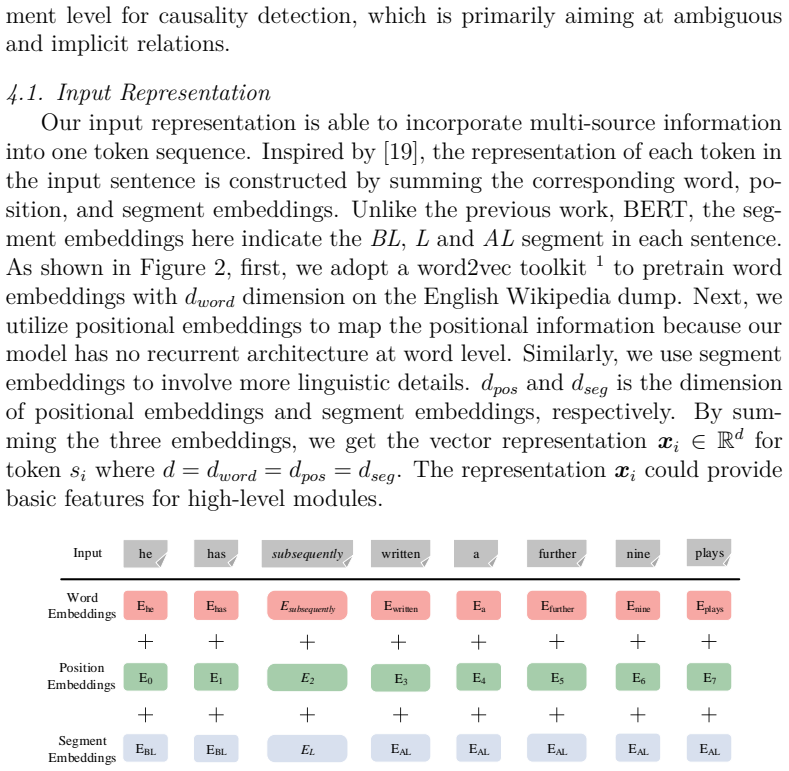
The central discovery, stated on the authors' terms, is that a multi-level architecture with explicit relational reasoning outperforms both traditional feature-engineering systems and end-to-end neural classifiers, including pretrained language models, on implicit causality detection. MCDN's word level is a Transformer encoder whose input sums word, position, and segment embeddings; its segment level is the Self Causal Relation Network, which converts the before-cue, cue, and after-cue segments into object vectors via a three-column CNN, forms four ordered object pairs (before with cue, cue with after, before with after, and after with before), concatenates each pair with a bi-GRU sentence state, and feeds these through feed-forward layers. The paper reports that removing the segment-level SCRN drops AltLex F1 from 81.47 to 62.08 on the Training split, and that the full model transfers zero-shot to a constructed corpus better than fine-tuned BERT. The paper claims this is the first application of a Relation Network to causality detection, and that the multilevel combination is what lets the model handle ambiguous and implicit causal relations.
Load-bearing premise
The whole segment-level argument depends on every sentence containing a causal cue that appears in the paper's AltLex list, because the relational reasoning starts from where that cue sits; if the cue is absent or unrecognized, the segment boundaries are wrong and the causal inference collapses, and the paper's zero-shot test only used cue-bearing sentences, so this failure mode is not measured.
Editorial extensions
If this is right
- If the reported results hold, MCDN sets a new state of the art on the AltLex implicit causality detection benchmark, with F1 81.47 on the Training split and 82.50 on the Bootstrapped split.
- The ablation result implies that segment-level relational reasoning is responsible for a large share of the gain: removing SCRN drops Training-split F1 from 81.47 to 62.08.
- Because MCDN reaches about 87 percent of BERT's counterfactual-recognition F1 with 4.62x fewer parameters and 13.9x faster inference, the architecture is a practical fit for large-scale web-text processing where pretrained-model cost is prohibitive.
- The zero-shot transfer result implies that the model generalizes to a different causal corpus better than fine-tuned BERT, with F1 76.84/77.79 versus 58.55/53.02.
- The case analysis implies that neither word-level nor segment-level information alone is sufficient for ambiguous causal markers, and that their combination is what produces the correct decisions on hard examples.
Reading between the lines
- An implication the authors do not develop is that the segment-splitting idea could be made robust by learning cue boundaries jointly or using a soft, attention-based segmentation, which would extend the approach to sentences without an AltLex marker.
- I read the four ordered pairings as a directional template: the same BL–L, L–AL, BL–AL, and AL–BL scheme could be transplanted to other discourse relations, such as contrast or concession, or to cause-effect pair extraction, where direction matters.
- The reported robustness across different word embeddings, word2vec, fastText, and GloVe, suggests the relational structure rather than the embedding source carries the signal; a testable extension would be to see how far performance degrades when the segment embeddings are removed entirely.
Signed reviews
Editorial analysis
A structured set of objections, weighed in public.
Referee Report
Summary. The paper proposes MCDN, a causality-detection model for web texts that combines a word-level Transformer encoder with a segment-level Self Causal Relation Network (SCRN). The sentence is split into before-AltLex (BL), AltLex (L), and after-AltLex (AL) segments; word and segment representations are fused for binary classification. Experiments on the AltLex dataset report F1 81.47 (Training) and 82.50 (Bootstrapped), above all listed baselines including fine-tuned BERT (66.90 and 79.98), with lower latency and parameter count. Experiments on SemEval-2020 Task5 subtask-1 (counterfactual recognition) report F1 73.59, below BERT (84.21); the paper attributes this to AltLex vocabulary mismatch. The paper also reports ablations, data-proportion analysis, embedding robustness, and a zero-shot transfer to a filtered SemEval-2010-Task8 corpus.
Significance. The core AltLex result is credible and useful: the gains over the listed baselines are large and consistent across two training splits, supported by ablations showing the SCRN module contributes substantially, and the efficiency comparison is clearly reported. The authors release code and data, and the word-embedding robustness analysis is a nice addition. However, the headline 'state-of-the-art' claim is broader than the evidence: the model requires an AltLex cue at test time, the comparison set omits recent published models on the same dataset, and the segmentation procedure is underspecified. With these scoped appropriately, the contribution would be a solid empirical study of a segment-level relational-reasoning module for cue-based causality detection.
major comments (3)
- [§4.3, §5.4, §6.4] The central claim 'MCDN improves the SOTA performance of implicit causality detection' is only established for sentences in which an AltLex cue is present and identifiable. The segment-level SCRN in Eq. (6)-(9) operates on BL/L/AL objects that exist only after a cue-based split, and the paper's own analysis in §5.4 attributes the lower SemEval result (73.59 vs. BERT's 84.21) partly to AltLex vocabulary mismatch and degraded segment quality. The zero-shot experiment in §6.4 filters the corpus to AltLex-positive sentences, so it does not test the failure mode in which no cue or an out-of-lexicon cue appears. Please either scope the SOTA claim to AltLex-cued sentences or add experiments that quantify performance when cues are absent, ambiguous, or detected automatically; otherwise the title/abstract promise of implicit causality detection in general web texts is not supported.
- [§5.3-§5.4] The comparison set does not justify the phrase 'state-of-the-art.' The baselines are the original feature-based systems from Hidey and McKeown (2016), generic text classifiers, and BERT/DistilBERT; no published model specifically developed for implicit causality detection on the AltLex dataset after 2016 is included. At minimum, the claim should be qualified as 'outperforming the listed baselines,' or the authors should add a systematic comparison with recent published results on the same data (and, if none exist, say so explicitly when making the SOTA claim).
- [§4.1, §4.3, §5.2] The construction of the BL/L/AL segments at test time is not reproducible as written. The text says only that the sentence is split 'according to the position of AltLex'; it does not state whether that position is an annotation provided by the dataset, a lexicon match against the AltLex set, or the output of a separate detector, nor does it specify matching for multiword expressions, lemmatization, longest-match, or OOV cues. This matters because the SCRN's reasoning depends entirely on correct segment boundaries, and because a fair comparison with BERT requires making explicit whether MCDN receives an input signal that the baselines do not. Please specify the procedure and report its accuracy (e.g., gold-cue upper bound vs. automatic detection).
minor comments (6)
- [Eq. (5)] The two projections are both written as W1; the second should be W2.
- [§5.4] The text contains the typo 'nerual,' and the abstract's 'insufficiency' should be 'insufficient.'
- [§5.2] Give the word-embedding dimension and corpus statistics; the current description says only that a word2vec toolkit was used on an English Wikipedia dump.
- [§5.1, Table 4] Specify that the F1 scores are for the counterfactual (positive) class and report the official SemEval-2020 Task5 evaluation protocol if it differs from the reported one.
- [§6.3, Table 7] 'attribute to' in the case study text should be 'attributed to' to match the example, and the red-highlighted score in Table 7 should be indicated by a symbol for grayscale printing.
- [Section 4.4, Eq. (11)] The focal loss is credited to [37], but the original formulation is Lin et al. (2017, ICCV); cite the original source as well.
Circularity Check
No circularity: MCDN is trained and evaluated on held-out data; the AltLex segmentation dependency is a scope/fairness limitation, not a logical reduction of prediction to input.
full rationale
The paper's derivation chain is self-contained: MCDN is trained with focal loss on labeled AltLex sentences and evaluated on an unseen test set (Section 5, Table 3), on the external SemEval-2020 Task 5 benchmark (Table 4), and in a zero-shot transfer to a filtered SemEval-2010 Task 8 corpus (Section 6.4, Table 9). The segment-level SCRN receives as inputs the BL/L/AL segmentation produced from the AltLex lexicon, and the word-level Transformer yields h_w; the final prediction is h_u = h_w || h_s fed through an FFN/softmax (Eqs. 6-10). No equation defines the output as equivalent to the input cue or to a fitted parameter. The self-citations ([28], [29]) appear only in related-work summaries and are not load-bearing for the architecture or results. The main caveat, stated by the authors in Section 5.4, is that the AltLex-based segmentation may be degraded when the lexicon is mismatched to the target domain ('non-causal and long-tail terms will impact the segment quality'), and the zero-shot test in Section 6.4 filters to AltLex-positive sentences. That is a scope limitation and a benchmarking-fairness concern against raw-text baselines, but it is not a circular derivation: the model still learns the causal/non-causal decision from labels, and the test labels are not used to construct the segmentation.
Assumptions & free parameters
free parameters (4)
- focal loss balance weight alpha =
0.75
- focal loss focusing parameter beta =
4
- TC-CNN kernel configuration =
window sizes 2,3,4; k=150 total kernels
- Transformer stack configuration =
N=4 blocks, h=4 heads
assumptions (3)
- domain assumption The AltLex lexicon from Hidey and McKeown is available and sufficient to locate the cue word in every input sentence at test time.
- domain assumption The cause and effect parts of a causal sentence lie on opposite sides of the AltLex cue, making the BL-L and L-AL pair comparisons informative.
- standard math Standard backpropagation and Adam optimization converge for this architecture with the stated hyperparameters.
Cite this review
Pith. "Pith review of A Multi-level Neural Network for Implicit Causality Detection in Web Texts." pith.science (2026). https://pith.science/paper/JNAJCMAS
@misc{pith2026190807822,
  author       = {Pith},
  title        = {Pith review of: A Multi-level Neural Network for Implicit Causality Detection in Web Texts},
  year         = {2026},
  howpublished = {\url{https://pith.science/paper/JNAJCMAS}},
  note         = {Machine review of arXiv:1908.07822}
}
read the original abstract
Mining causality from text is a complex and crucial natural language understanding task corresponding to the human cognition. Existing studies at its solution can be grouped into two primary categories: feature engineering based and neural model based methods. In this paper, we find that the former has incomplete coverage and inherent errors but provide prior knowledge; while the latter leverages context information but causal inference of which is insufficiency. To handle the limitations, we propose a novel causality detection model named MCDN to explicitly model causal reasoning process, and furthermore, to exploit the advantages of both methods. Specifically, we adopt multi-head self-attention to acquire semantic feature at word level and develop the SCRN to infer causality at segment level. To the best of our knowledge, with regards to the causality tasks, this is the first time that the Relation Network is applied. The experimental results show that: 1) the proposed approach performs prominent performance on causality detection; 2) further analysis manifests the effectiveness and robustness of MCDN.
Figures

Figures from the paper (2 more)


Reference graph
Works this paper leans on
- [1]
-
[2]
S. Zhao, M. Jiang, M. Liu, B. Qin, T. Liu, Causaltriad: Toward pseudo causal relation discovery and hypotheses generation from medical text data, in: Proceedings of the 2018 ACM International Conference on Bioinformatics, Computational Biology, and Health Informatics, ACM, pp. 184–193
work page 2018
-
[3]
J.-H. Oh, K. Torisawa, C. Kruengkrai, R. Iida, J. Kloetzer, Multi- column convolutional neural networks with causality-attention for why- question answering, in: Proceedings of the Tenth ACM International Conference on Web Search and Data Mining, ACM, pp. 415–424
-
[4]
S. Zhao, T. Liu, S. Zhao, Y. Chen, J.-Y. Nie, Event causality extraction based on connectives analysis, Neurocomputing 173 (2016) 1943–1950
work page 2016
-
[5]
S. Heindorf, Y. Scholten, H. Wachsmuth, A.-C. Ngonga Ngomo, M. Pot- thast, Causenet: Towards a causality graph extracted from the web, in: Proceedings of the 29th ACM International Conference on Information & Knowledge Management, pp. 3023–3030
-
[6]
X. Ding, Z. Li, T. Liu, K. Liao, ELG: an event logic graph, arXiv preprint arXiv:1907.08015 (2019). 26
arXiv 2019
-
[7]
Q. X. Do, Y. S. Chan, D. Roth, Minimally supervised event causality identification, in: Proceedings of the Conference on Empirical Methods in Natural Language Processing, Association for Computational Lin- guistics, pp. 294–303
- [8]
Show all 45 references
-
[9]
Caselli, P
T. Caselli, P. Vossen, The event StoryLine corpus: A new benchmark for causal and temporal relation extraction, in: Proceedings of the Events and Stories in the News Workshop, pp. 77–86
-
[10]
Hidey, K
C. Hidey, K. McKeown, Identifying causal relations using parallel wikipedia articles, in: Proceedings of the 54th Annual Meeting of the Association for Computational Linguistics (Volume 1: Long Papers), volume 1, pp. 1424–1433
-
[11]
Z. Luo, Y. Sha, K. Q. Zhu, S.-w. Hwang, Z. Wang, Commonsense causal reasoning between short texts, in: Fifteenth International Conference on the Principles of Knowledge Representation and Reasoning, pp. 421– 430
-
[12]
Kao, C.-C
P.-W. Kao, C.-C. Chen, H.-H. Huang, H.-H. Chen, NTUNLPL at Fin- Causal 2020, task 2:improving causality detection using Viterbi decoder, in: Proceedings of the 1st Joint Workshop on Financial Narrative Pro- cessing and MultiLing Financial Summarisation, pp. 69–73
2020
-
[13]
Z. Li, Q. Li, X. Zou, J. Ren, Causality extraction based on self-attentive bilstm-crf with transferred embeddings, Neurocomputing 423 (2021) 207–219
2021
-
[14]
X. Yang, S. Obadinma, H. Zhao, Q. Zhang, S. Matwin, X. Zhu, Semeval- 2020 task 5: Counterfactual recognition, in: Proceedings of the Four- teenth Workshop on Semantic Evaluation, pp. 322–335
2020
-
[15]
Mariko, H
D. Mariko, H. Abi-Akl, E. Labidurie, S. Durfort, H. De Mazancourt, M. El-Haj, The financial document causality detection shared task (fin- causal 2020), in: Proceedings of the 1st Joint Workshop on Financial 27 Narrative Processing and MultiLing Financial Summarisation, pp. 23– 32
2020
-
[16]
V. Sanh, L. Debut, J. Chaumond, T. Wolf, Distilbert, a distilled version of bert: smaller, faster, cheaper and lighter, arXiv preprint arXiv:1910.01108 (2019)
2019 arXiv
-
[17]
Devlin, M
J. Devlin, M. Chang, K. Lee, K. Toutanova, BERT: pre-training of deep bidirectional transformers for language understanding, in: Proceedings of the 2019 Conference of the North American Chapter of the Asso- ciation for Computational Linguistics: Human Language Technologies, NA...
2019
-
[18]
L. Yabloko, Ethan at semeval-2020 task 5: Modelling causal reasoning in language using neuro-symbolic cloud computing, in: Proceedings of the Fourteenth Workshop on Semantic Evaluation, pp. 645–652
2020
-
[19]
Vaswani, N
A. Vaswani, N. Shazeer, N. Parmar, J. Uszkoreit, L. Jones, A. N. Gomez, /suppress L. Kaiser, I. Polosukhin, Attention is all you need, in: Advances in Neural Information Processing Systems, pp. 5998–6008
-
[20]
Girju, P
R. Girju, P. Nakov, V. Nastase, S. Szpakowicz, P. Turney, D. Yuret, Semeval-2007 task 04: Classification of semantic relations between nomi- nals, in: Proceedings of the Fourth International Workshop on Semantic Evaluations (SemEval-2007), pp. 13–18
2007
-
[21]
Hendrickx, S
I. Hendrickx, S. N. Kim, Z. Kozareva, P. Nakov, D. ´O. S´ eaghdha, S. Pad´ o, M. Pennacchiotti, L. Romano, S. Szpakowicz, Semeval-2010 task 8: Multi-way classification of semantic relations between pairs of nominals, in: Proceedings of the 5th International Workshop on Seman- t...
2010
-
[22]
Hashimoto, K
C. Hashimoto, K. Torisawa, J. Kloetzer, M. Sano, I. Varga, J.-H. Oh, Y. Kidawara, Toward future scenario generation: Extracting event causality exploiting semantic relation, context, and association features, in: Proceedings of the 52nd Annual Meeting of the Association for Co...
-
[23]
T. N. De Silva, X. Zhibo, Z. Rui, M. Kezhi, Causal relation identifica- tion using convolutional neural networks and knowledge based features, World Academy of Science, Engineering and Technology, International Journal of Mechanical and Mechatronics Engineering 4 (2017) 697–702
2017
-
[24]
S. Zhao, Q. Wang, S. Massung, B. Qin, T. Liu, B. Wang, C. Zhai, Constructing and embedding abstract event causality networks from text snippets, in: Proceedings of the Tenth ACM International Conference on Web Search and Data Mining, ACM, pp. 335–344
-
[25]
Kayesh, M
H. Kayesh, M. S. Islam, J. Wang, On event causality detection in tweets., arXiv preprint arXiv:1901.03526 (2019)
2019 arXiv
-
[26]
J. Liu, Y. Chen, J. Zhao, Knowledge enhanced event causality identi- fication with mention masking generalizations, in: Proceedings of the Twenty-Ninth International Joint Conference on Artificial Intelligence, IJCAI 2020, pp. 3608–3614
2020
-
[27]
X. Zuo, Y. Chen, K. Liu, J. Zhao, Knowdis: Knowledge enhanced data augmentation for event causality detection via distant supervision, in: Proceedings of the 28th International Conference on Computational Linguistics, pp. 1544–1550
-
[28]
J. Xu, W. Zuo, S. Liang, X. Zuo, A review of dataset and labeling meth- ods for causality extraction, in: Proceedings of the 28th International Conference on Computational Linguistics, pp. 1519–1531
-
[29]
Jinghang, Z
X. Jinghang, Z. Wanli, L. Shining, W. Ying, Causal relation extraction based on graph attention networks, Journal of Computer Research and Development 57 (2020) 159
2020
-
[30]
Santoro, D
A. Santoro, D. Raposo, D. G. Barrett, M. Malinowski, R. Pascanu, P. Battaglia, T. Lillicrap, A simple neural network module for relational reasoning, in: Advances in neural information processing systems, pp. 4967–4976
-
[31]
R. Palm, U. Paquet, O. Winther, Recurrent relational networks, in: Advances in Neural Information Processing Systems, pp. 3368–3378. 29
-
[32]
Y. Duan, Y. Zheng, J. Lu, J. Zhou, Q. Tian, Structural relational reasoning of point clouds, in: Proceedings of the IEEE/CVF Conference on Computer Vision and Pattern Recognition (CVPR)
-
[33]
Zheng, L
W. Zheng, L. Li, Z. Zhang, Y. Huang, L. Wang, Relational network for skeleton-based action recognition, in: 2019 IEEE International Confer- ence on Multimedia and Expo (ICME), pp. 826–831
2019
-
[34]
Pavez, H
J. Pavez, H. Allende, H. Allende-Cid, Working memory networks: Aug- menting memory networks with a relational reasoning module, arXiv preprint arXiv:1805.09354 (2018)
2018 arXiv
-
[35]
Prasad, N
R. Prasad, N. Dinesh, A. Lee, E. Miltsakaki, L. Robaldo, A. K. Joshi, B. L. Webber, The penn discourse treebank 2.0, in: LREC, Citeseer, pp. 2961–2968
-
[36]
Hendrycks, K
D. Hendrycks, K. Gimpel, Gaussian error linear units (gelus), arXiv preprint arXiv:1606.08415 (2016)
2016 arXiv
-
[37]
Y. Shi, J. Meng, J. Wang, H. Lin, Y. Li, A normalized encoder-decoder model for abstractive summarization using focal loss, in: CCF Interna- tional Conference on Natural Language Processing and Chinese Com- puting, Springer, pp. 383–392
-
[38]
D. P. Kingma, J. Ba, Adam: A method for stochastic optimization, arXiv preprint arXiv:1412.6980 (2014)
2014 arXiv
-
[39]
Kim, Convolutional neural networks for sentence classification, in: Proceedings of the 2014 Conference on Empirical Methods in Natural Language Processing (EMNLP), pp
Y. Kim, Convolutional neural networks for sentence classification, in: Proceedings of the 2014 Conference on Empirical Methods in Natural Language Processing (EMNLP), pp. 1746–1751
2014
-
[40]
Z. Lin, M. Feng, C. N. d. Santos, M. Yu, B. Xiang, B. Zhou, Y. Ben- gio, A structured self-attentive sentence embedding, arXiv preprint arXiv:1703.03130 (2017)
2017 arXiv
-
[41]
Johnson, T
R. Johnson, T. Zhang, Deep pyramid convolutional neural networks for text categorization, in: Proceedings of the 55th Annual Meeting of the Association for Computational Linguistics (Volume 1: Long Papers), pp. 562–570. 30
-
[42]
B. Wang, Disconnected recurrent neural networks for text categoriza- tion, in: Proceedings of the 56th Annual Meeting of the Association for Computational Linguistics (Volume 1: Long Papers), pp. 2311–2320
-
[43]
X. Ou, S. Liu, H. Li, Ynu-oxz at semeval-2020 task 5: Detecting coun- terfactuals based on ordered neurons lstm and hierarchical attention network, in: Proceedings of the Fourteenth Workshop on Semantic Evaluation, pp. 683–689
2020
-
[44]
Grave, P
E. Grave, P. Bojanowski, P. Gupta, A. Joulin, T. Mikolov, Learning word vectors for 157 languages, in: Proceedings of the International Conference on Language Resources and Evaluation (LREC 2018), pp. 3483–3487
2018
-
[45]
Pennington, R
J. Pennington, R. Socher, C. D. Manning, Glove: Global vectors for word representation, in: Empirical Methods in Natural Language Pro- cessing (EMNLP), pp. 1532–1543. 31
Reviewed August 14, 2026 · model on record in the stance chip above.
Discussion (0). Continue with ORCID to comment.