REVIEW 4 major objections 5 minor 47 references
Branching random graph model of rough surfaces describes thermal properties of the effective molecular potential
T0 review · 4 major / 5 minor · reviewed 2026-08-14 · deepseek-v4-flash
Pith's one-line read The effective interaction between a fluid molecule and a rough solid surface gains a low-temperature topology term that depends on the hierarchical branching structure of the roughness, not just on local height fluctuations.
desk verdict Nice idea and a plausible-looking final formula, but the paper never actually derives the sparse-coupling model from the branching-tree ensemble it claims to simulate — Eq. (9) has the wrong scaling for tree pairs, so the topology term is, as written, unsupported. read the letter →
The pith
A machine-rendered reading of the paper's core claim, the machinery that carries it, and where it could break.
The reading
What carries the argument
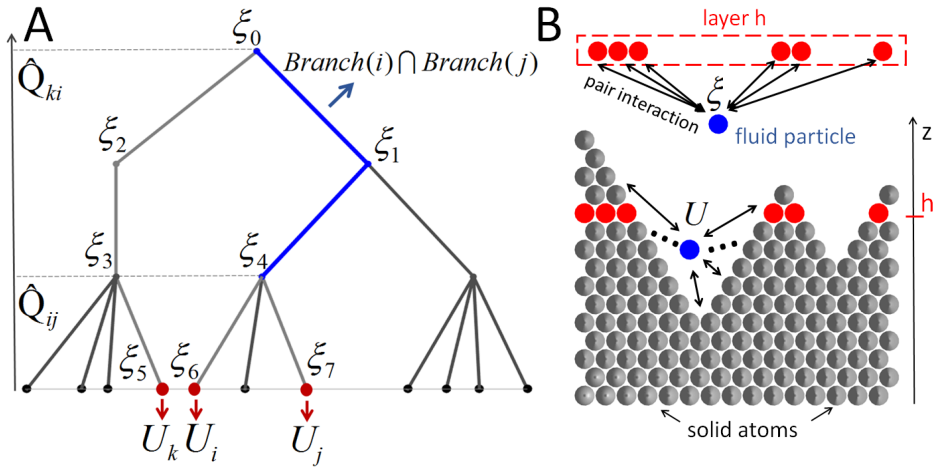
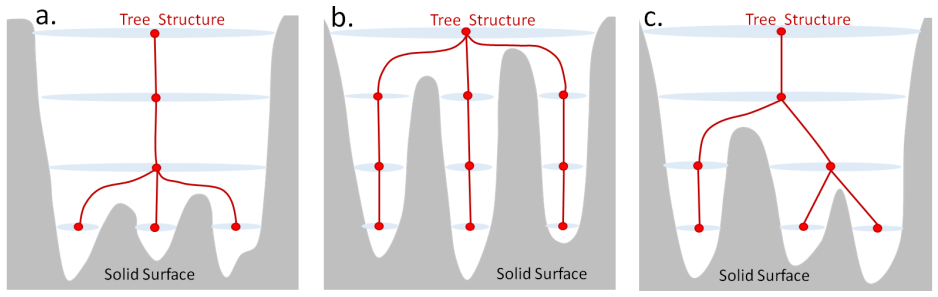
The central object is a branching random tree (BRT) whose vertices are the 'islands' of the rough surface at successive layers, with the field $U_i$ in island $i$ written as a sum of independent random vertex contributions along the unique branch from the root to leaf $i$. Pairwise correlations are then determined by the common path depth $Q_{ij}$, so the effective distances between islands are ultrametric rather than Euclidean. Averaging the free energy with replicas converts the problem into a statistical model of virtual clusters with random pair couplings drawn from a multimodal distribution; finite connectivity forces a replica-symmetric ansatz and a self-consistent equation for the local-field distribution $W(h)$, which is solved numerically by population dynamics. The final effective potential assembles $U_0$, the Gaussian fluctuation term $-\beta\sigma^2/2$, and the topology term built from $W_0(h)$ and the averaged structure parameter $\bar{\alpha}$.
What would settle it
Generate two ensembles of random branching graphs that share the same pair-depth distribution $\rho(Q_{ij})$ but differ in triplet correlations, for example one enforcing the ultrametric inequality $Q_{ij}\ge\min(Q_{ik},Q_{jk})$ and one not, then compute the free energy by direct Monte Carlo at low temperature with fixed field variance and connectivity and compare with $U_{\mathrm{eff}}(\beta)$ from equation (32); if the two ensembles give different free energies while the formula gives the same value, the factorization assumption fails.
Extended reading notes
Core claim
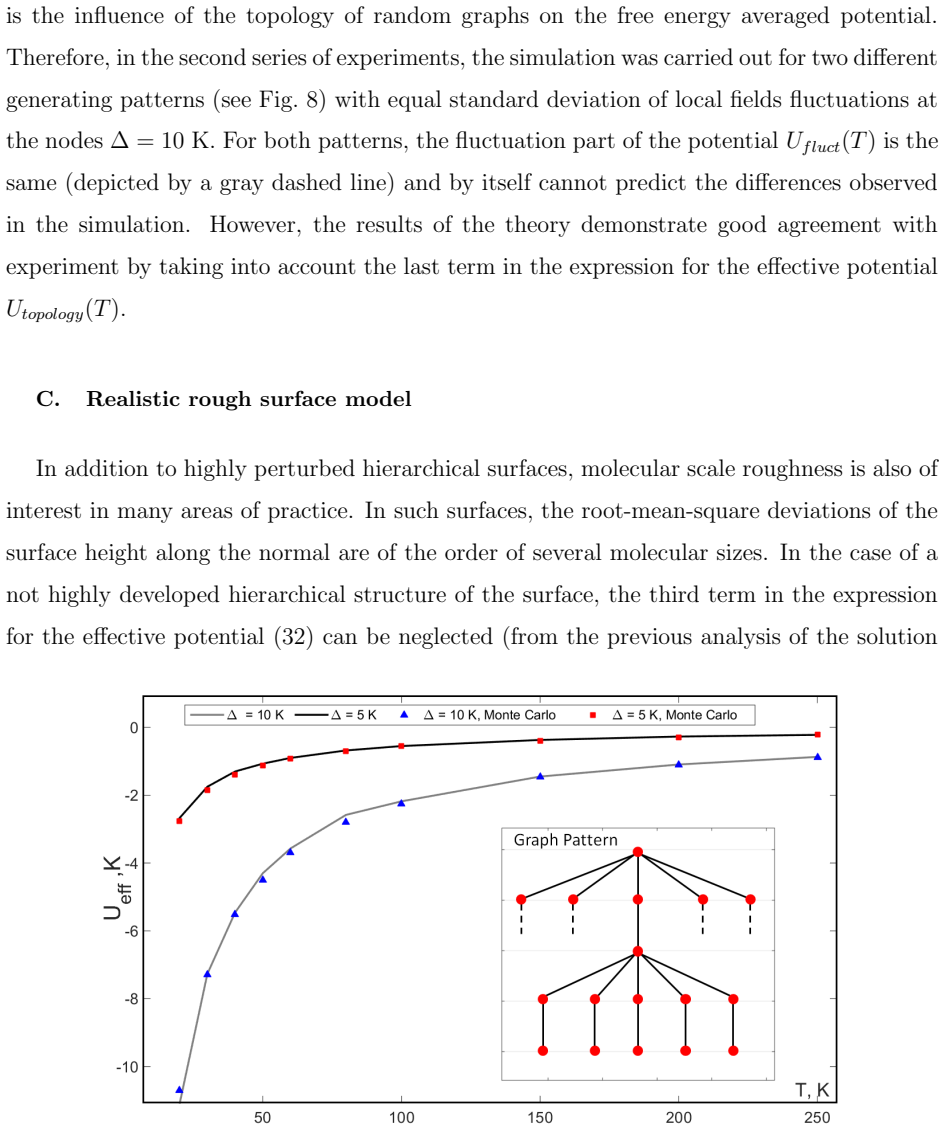
The central claim is that the free-energy-averaged solid-fluid interaction for a single molecule at inverse temperature $\beta$ is $U_{\mathrm{eff}}(\beta)=U_0-\beta\sigma^2/2+\frac{\bar{\alpha}}{\beta}\left(\frac{2m_0}{Z_0}e^{-\beta^2\sigma^2/2}-\frac{1}{\beta}\frac{m_0^2}{Z_0^2}e^{-\beta^2\sigma^2}\right)$, where the first two terms are the standard Gaussian fluctuation result and the last term, the topology term, arises from the branching-random-tree representation of the rough surface. The material-dependent quantity $\bar{\alpha}$ is an average over the graph generation pattern, and $m_0$ is an integral of the replica-symmetric local-field distribution $W_0(h)$ obtained from a self-consistent equation. The paper argues that at low temperature this topology term is substantial and carries the influence of the hierarchical structure of random geometry, and that the predictions coincide with direct Monte Carlo simulations on random branching graphs with different generation patterns. It also demonstrates on a realistic carbon-surface model that deeper slices inside the rough solid have approximately Gaussian energy distributions, while slices near the surface become asymmetric, supporting the model's use of a multivariate Gaussian field deep in the solid.
Load-bearing premise
The load-bearing premise is that the common-path depths between different pairs of branches are independent across pairs, so the random couplings become independent and identically distributed; real branching trees impose ultrametric constraints among triplets, and if those constraints matter for rough-surface geometry, the product measure and the resulting topology term lose their justification.
Editorial extensions
If this is right
- At low temperatures the effective fluid-solid potential depends on the branching topology of surface roughness, so two surfaces with the same height variance and correlation length can produce different adsorption thermodynamics.
- The derived effective potential supplies a temperature-dependent input for density-functional or molecular-dynamics treatments of adsorption, extending earlier high-temperature FEA potentials into the strongly heterogeneous regime.
- Once the graph generation statistics are specified, the population-dynamics solution of the self-consistent equation yields $U_{\mathrm{eff}}(\beta)$ without direct simulation of the fluid.
- The model predicts that interaction-energy distributions deep inside a rough solid are close to Gaussian, while distributions near the surface become asymmetric, matching the authors' realistic surface calculations.
Reading between the lines
- An unstated but testable consequence is that isosteric heats of adsorption at cryogenic temperatures should distinguish two adsorbents with identical statistical roughness parameters but different hierarchical branching patterns; a calorimetric series on engineered porous carbons could separate the fluctuation and topology contributions without simulation.
- The same replica-plus-branching-tree construction could be applied to other quenched-disorder systems whose disorder is hierarchical, such as transport through disordered porous media or random-field spin models; the paper gestures at this but does not work out concrete cross-system predictions.
- The factorization assumption behind the independent pair couplings can be tested directly by generating branching graphs with prescribed triplet constraints $Q_{ij}\ge\min(Q_{ik},Q_{jk})$ and checking whether the Monte Carlo free energy follows the product-measure prediction.
Signed reviews
Editorial analysis
A structured set of objections, weighed in public.
Referee Report
Summary. The manuscript proposes a theoretical model for the temperature-dependent effective fluid-solid interaction near rough surfaces. A branching random tree is introduced to represent the hierarchical geometry of the solid, and the single-molecule free energy averaged over random field configurations is computed with a replica calculation. The main result is the effective potential in Eq. (32), which adds a "topology" term to the standard Gaussian fluctuation term and is claimed to capture the low-temperature contribution of hierarchical roughness. The authors solve the replica-symmetric self-consistency equation by population dynamics, compare the resulting effective potential with Monte Carlo simulations on random branching-tree ensembles, and also apply the formula to a realistic corrugated carbon surface using fitted U0(z) and sigma(z). The paper ends with a discussion of broader applications to social and biological networks.
Significance. The intended contribution is potentially significant: a closed-form effective potential with an explicit topology-dependent term would be useful for density functional theory and molecular dynamics studies of adsorption on rough materials. The paper also contains useful numerical machinery (population dynamics for finite-connectivity replica equations) and a physically motivated Monte Carlo validation protocol. However, the significance is not established as written, because the model that is actually solved in the replica calculation is a sparse random-network model, not the branching-tree model that motivates the paper and that is used in the Monte Carlo comparisons. The central claim that hierarchical tree geometry induces the low-temperature topology term is therefore unsupported by the derivation presented.
major comments (4)
- [Section II.A, Eqs. (8)-(9) and Eq. (18)] The sparse normalization p_k = a_k/N is incompatible with the branching-tree ensemble. In any rooted tree with N leaves, all N^2 leaf pairs share the root-to-first-divergence path, so the probability mass at the shallowest intersection levels is O(1), not O(1/N); the same is true for any level separating a subtree that contains a finite fraction of the leaves. Equation (9), which implies that only O(N) pairs share any given intersection depth, cannot be derived from the tree ensemble, and the coupling distribution (18), which connects each cluster to O(1) others, does not describe the covariance generated by the tree. The replica-symmetric solution (26) and the topology term in Eq. (32) are therefore derived from a different, sparse random-network model.
- [Section II.A, Eq. (8)] The product measure P(Q)=prod rho(Q_ij) discards the ultrametric constraints that any tree imposes. For any three leaves i,j,k in a tree, the two smallest values among Q_ij, Q_ik, Q_jk are equal; independent sampling from rho assigns zero probability to this constraint. Thus the averaged Gaussian measure in Eq. (10) is not the joint distribution of fields generated by the branching-tree model, and the paper gives no argument that the independent-pair marginal statistics suffice. This is a load-bearing issue because the entire replica calculation and the resulting topology term rest on this factorized representation.
- [Section II.B, Eqs. (20)-(32)] The truncation of the multi-scale pair potential (20) to a single exponential J(sigma,tau)=c(e^{beta alpha sigma tau}-1), followed by the reintroduction of the averaged alpha_bar in Eq. (32), is uncontrolled. The text states only that the principal term is kept; no estimate of the omitted terms is provided, and the connection between the single c_max used in the replica solution and the alpha_bar used in the final free energy is not derived. In addition, the manuscript does not report the numerical values of a_l, c_l, alpha_l, alpha_bar, or c used in the comparisons, so the theoretical curves in Figs. 7-8 cannot be reproduced.
- [Section III.B, Figs. 7-8] The Monte Carlo validation is not quantitative as reported. The tree generating patterns, the resulting a_l and alpha_bar values, and the coupling constant c used in Eq. (26) are not given, and no error bars or statistical uncertainties are provided. More importantly, because the theory is derived from the sparse random-coupling model of Eq. (18) rather than from the tree ensemble used in the simulations, agreement in Figs. 7-8, even if visually good, does not validate the branching-tree derivation. The comparison therefore does not support the paper's central claim that the hierarchical structure of random tree geometry controls the low-temperature behavior.
minor comments (5)
- [Section II.A] There is a typo in "Lenndrd-Jones" in the first paragraph, and the abbreviations RBT and BRT are used interchangeably for the branching random tree.
- [Page 8, text near Fig. 3] The sentence "Figure 10 demonstrates schematic illustration..." appears to refer to Fig. 3; no Figure 10 exists in the manuscript.
- [Eq. (32)] The units and dimensions of sigma, alpha_bar, and m0 are not defined consistently; the text switches between kelvin and reduced units without stating how Eq. (32) is converted.
- [Figs. 5-6] The captions and text do not fully define the axes and parameters of the plotted distributions, in particular the ordinate of W(h) and the meaning of the discrete peaks in the distributions.
- [Section III.C] The topology term is dropped for the realistic surface model, so this section does not test the central claim; the manuscript should state explicitly that the realistic-surface application uses only the Gaussian fluctuation term and therefore cannot validate the topology contribution.
Circularity Check
No significant circularity: the central effective-potential result is a replica calculation checked against direct Monte Carlo, not a restatement of its inputs.
full rationale
The derivation chain is self-contained and non-circular. The branching-tree ensemble (Sec. II.A) defines random fields via sums along tree branches (Eq. 5); the replica calculation (Eqs. 11-16) transforms the averaged free energy into a finite-connectivity cluster model (Eqs. 18-20); the RS self-consistency condition (Eq. 26) is solved numerically; and the final U_eff formula (Eq. 32) contains a fluctuation term and a topology term whose temperature dependence is not fixed by the input U0 or sigma. The validation in Sec. III.B compares Eq. (32) with direct Monte Carlo on tree ensembles with different variances and generation patterns (Figs. 7-8); the topology term is the only source of pattern dependence, so the test is non-vacuous. alpha_bar is stated to be obtained from the graph generation pattern, and no fitted alpha_bar values are reported, so there is no exhibited reduction of a prediction to a fitted parameter. Self-citations [3,4,22] are used only to motivate the FEA mapping and prior high-T limit, not as the proof of the new topology term; the finite-connectivity and RS machinery is taken from external references [28-30]. The concern raised about Eq. (9) (p_k = a_k/N vs. O(1) pair fractions in a real tree) is a modeling-consistency issue, not circularity: even if the sparse-coupling limit fails to match the simulated tree ensemble, that would be a wrong-model problem, not an identity between the derivation and its inputs.
Assumptions & free parameters
free parameters (3)
- U0(z) =
estimated from Monte Carlo energy samples for each slice
- sigma(z) =
estimated from Monte Carlo energy samples for each slice
- alpha_bar (average connectivity-coupling product) =
not reported in the text
assumptions (6)
- domain assumption The Free Energy Averaging (FEA) mapping from [21,22] defines the effective 1D potential by equating the disorder-averaged free energy to that of a reference system in an external field U_eff.
- domain assumption The solid-fluid interaction energy at a location can be represented as a sum of independent random contributions along a path in a branching tree, Eq. (5).
- ad hoc to paper The joint distribution of tree intersection depths factorizes into independent per-pair distributions, Eq. (8).
- ad hoc to paper The coupling distribution (18) treats all pairs as independent discrete random couplings, mapping the problem to a union of finite-connectivity small-world networks.
- ad hoc to paper The pair potential (20) is truncated to its leading exponential term J(sigma,tau)=c(e^{beta alpha sigma tau}-1) with alpha=beta c_max/2, and later the averaged alpha_bar is used in the final free energy.
- domain assumption The replica-symmetric ansatz (24) holds for the solution of the self-consistent equation (26).
invented entities (2)
-
Virtual clusters (phi_i)
-
Effective random fields (theta_i)
Cite this review
Pith. "Pith review of Branching random graph model of rough surfaces describes thermal properties of the effective molecular potential." pith.science (2026). https://pith.science/paper/TEN2YC5R
@misc{pith2026190808002,
  author       = {Pith},
  title        = {Pith review of: Branching random graph model of rough surfaces describes thermal properties of the effective molecular potential},
  year         = {2026},
  howpublished = {\url{https://pith.science/paper/TEN2YC5R}},
  note         = {Machine review of arXiv:1908.08002}
}
read the original abstract
Fluid properties near rough surfaces are crucial in describing fundamental surface phenomena and modern industrial material design implementations. One of the most powerful approaches to model real rough materials is based on the surface representation in terms of random geometry. Understanding the influence of random solid geometry on the low-temperature fluid thermodynamics is a cutting edge problem. Therefore this work extends recent studies bypassing high-temperature expansion and small heterogeneity scale. We introduce random branching trees whose topology reflects the hierarchical properties of a random solid geometry. This mathematical representation allows us to obtain averaged free energy using a statistical model of virtual clusters interacting through random ultrametric pairwise potentials. Our results demonstrate that a significant impact to fluid-solid interface energy is induced by the hierarchical structure of random geometry at low temperature. These calculations coincide with direct Monte Carlo simulations. Due to the study's interdisciplinary nature, the developed approach can be applied to a wide range of quenched disorder systems on random graphs.
Figures

Figures from the paper (8 more)




Reference graph
Works this paper leans on
-
[1]
Quenched solid density functional theory and pore size analysis of micro-mesoporous carbons
Alexander V Neimark, Yangzheng Lin, Peter I Ravikovitch, and Matthias Thommes. Quenched solid density functional theory and pore size analysis of micro-mesoporous carbons. Carbon, 47(7):1617–1628, 2009
work page 2009
-
[2]
Density functional theory model of adsorption on amorphous and microporous silica materials
Peter I Ravikovitch and Alexander V Neimark. Density functional theory model of adsorption on amorphous and microporous silica materials. Langmuir, 22(26):11171–11179, 2006
work page 2006
-
[3]
Density functional theory formulation for fluid ad- sorption on correlated random surfaces
Timur Aslyamov and Aleksey Khlyupin. Density functional theory formulation for fluid ad- sorption on correlated random surfaces. The Journal of chemical physics , 147(15):154703, 2017
work page 2017
-
[4]
Random surface statistical associat- ing fluid theory: Adsorption of n-alkanes on rough surface
Timur Aslyamov, Vera Pletneva, and Aleksey Khlyupin. Random surface statistical associat- ing fluid theory: Adsorption of n-alkanes on rough surface. The Journal of chemical physics , 150(5):054703, 2019
work page 2019
-
[5]
Stepan Hlushak. Heat of adsorption, adsorption stress, and optimal storage of methane in slit and cylindrical carbon pores predicted by classical density functional theory. Physical Chemistry Chemical Physics , 20(2):872–888, 2018
work page 2018
-
[6]
Density functional theory meth- ods for characterization of porous materials
John Landers, Gennady Yu Gor, and Alexander V Neimark. Density functional theory meth- ods for characterization of porous materials. Colloids and Surfaces A: Physicochemical and Engineering Aspects, 437:3–32, 2013
work page 2013
-
[7]
Carbon slit pore model incorporating surface energetical heterogeneity and geometrical corrugation
Jacek Jagiello and James P Olivier. Carbon slit pore model incorporating surface energetical heterogeneity and geometrical corrugation. Adsorption, 19(2-4):777–783, 2013
work page 2013
-
[8]
Theoretical approach to rough surfaces characterization for silica materials
Timur Aslyamov, Aleksey Khlyupin, Vera Pletneva, and Iskander S Akhatov. Theoretical approach to rough surfaces characterization for silica materials. The Journal of Physical Chemistry C, 2019
work page 2019
Show all 47 references
-
[9]
Effects of smooth random surface on fluid monolayer thermodynamics
AN Khlyupin. Effects of smooth random surface on fluid monolayer thermodynamics. Journal 24 of Physics: Conference Series , 774(1):012024, 2016
2016
-
[10]
Wetting transition of nonpolar neutral molecule system on a neutral and atomic length scale roughness substrate
Shiqi Zhou. Wetting transition of nonpolar neutral molecule system on a neutral and atomic length scale roughness substrate. Journal of Statistical Physics , 170(5):979–998, 2018
2018
-
[11]
Mechanisms for enhanced hydrophobicity by atomic-scale roughness
Yumi Katasho, Yunfeng Liang, Sumihiko Murata, Yasuhiro Fukunaka, Toshifumi Matsuoka, and Satoru Takahashi. Mechanisms for enhanced hydrophobicity by atomic-scale roughness. Scientific reports, 5:13790, 2015
2015
-
[12]
Universal phase diagram for wetting on mesoscale roughness
Stephan Herminghaus. Universal phase diagram for wetting on mesoscale roughness. Physical review letters, 109(23):236102, 2012
2012
-
[13]
Classical density functional study of wetting transitions on nanopatterned surfaces
P Yatsyshin, AO Parry, C Rasc´ on, and S Kalliadasis. Classical density functional study of wetting transitions on nanopatterned surfaces. Journal of Physics: Condensed Matter , 29(9):094001, 2017
2017
-
[14]
Molecular dynamics simulation of frictional properties of couette flow with striped superhydrophobic surfaces under different loads
Chengzhi Hu, Dawei Tang, Jizu Lv, Minli Bai, and Xiaoliang Zhang. Molecular dynamics simulation of frictional properties of couette flow with striped superhydrophobic surfaces under different loads. Physical Chemistry Chemical Physics , 2019
2019
-
[15]
Investigating the asymmetry in the edl response of c 60/graphene supercapacitors
Eudes E Fileti and Guilherme Colherinhas. Investigating the asymmetry in the edl response of c 60/graphene supercapacitors. Physical Chemistry Chemical Physics , 2019
2019
-
[16]
The model thin film alumina catalyst support suitable for catalysis-oriented surface science studies
Anna V Nartova, Andrey V Bukhtiyarov, Ren I Kvon, and Valerii I Bukhtiyarov. The model thin film alumina catalyst support suitable for catalysis-oriented surface science studies. Ap- plied Surface Science, 349:310–318, 2015
2015
-
[17]
Molecular dy- namics investigation of surface roughness scale effect on interfacial thermal conductance at solid-liquid interfaces
Donatas Surblys, Yoshiaki Kawagoe, Masahiko Shibahara, and Taku Ohara. Molecular dy- namics investigation of surface roughness scale effect on interfacial thermal conductance at solid-liquid interfaces. The Journal of chemical physics , 150(11):114705, 2019
2019
-
[18]
Adsorption, intrusion and freezing in porous silica: the view from the nanoscale
Benoit Coasne, Anne Galarneau, Roland JM Pellenq, and Francesco Di Renzo. Adsorption, intrusion and freezing in porous silica: the view from the nanoscale. Chemical Society Reviews, 42(9):4141–4171, 2013
2013
-
[19]
Geometric control of bacterial surface accu- mulation
Rachel Mok, J¨ orn Dunkel, and Vasily Kantsler. Geometric control of bacterial surface accu- mulation. Physical Review E, 99(5):052607, 2019
2019
-
[20]
Bottom-up approach to the coarse-grained surface model: Effective solid–fluid potentials for adsorption on heterogeneous surfaces
Kaihang Shi, Erik E Santiso, and Keith E Gubbins. Bottom-up approach to the coarse-grained surface model: Effective solid–fluid potentials for adsorption on heterogeneous surfaces. Lang- muir, 35(17):5975–5986, 2019
2019
-
[21]
Effective coarse-grained 25 solid–fluid potentials and their application to model adsorption of fluids on heterogeneous surfaces
Esther Forte, Andrew J Haslam, George Jackson, and Erich A M¨ uller. Effective coarse-grained 25 solid–fluid potentials and their application to model adsorption of fluids on heterogeneous surfaces. Physical Chemistry Chemical Physics , 16(36):19165–19180, 2014
2014
-
[22]
Random process theory approach to geometric hetero- geneous surfaces: Effective fluid–solid interaction
Aleksey Khlyupin and Timur Aslyamov. Random process theory approach to geometric hetero- geneous surfaces: Effective fluid–solid interaction. Journal of Statistical Physics, 167(6):1519– 1545, 2017
2017
-
[23]
Deter- mination of isosteric heat of adsorption by quenched solid density functional theory.Langmuir, 33(8):1769–1779, 2017
Richard T Cimino, Piotr Kowalczyk, Peter I Ravikovitch, and Alexander V Neimark. Deter- mination of isosteric heat of adsorption by quenched solid density functional theory.Langmuir, 33(8):1769–1779, 2017
2017
-
[24]
Spin glass theory and beyond: An Intro- duction to the Replica Method and Its Applications , volume 9
Marc M´ ezard, Giorgio Parisi, and Miguel Virasoro. Spin glass theory and beyond: An Intro- duction to the Replica Method and Its Applications , volume 9. World Scientific Publishing Company, 1987
1987
-
[25]
Random-field instability of the ferromagnetic state
T Schneider and Erling Pytte. Random-field instability of the ferromagnetic state. Physical Review B, 15(3):1519, 1977
1977
-
[26]
Solvable model of a spin-glass
David Sherrington and Scott Kirkpatrick. Solvable model of a spin-glass. Physical review letters, 35(26):1792, 1975
1975
-
[27]
The bethe lattice spin glass revisited.The European Physical Journal B-Condensed Matter and Complex Systems , 20(2):217–233, 2001
Marc M´ ezard and Giorgio Parisi. The bethe lattice spin glass revisited.The European Physical Journal B-Condensed Matter and Complex Systems , 20(2):217–233, 2001
2001
-
[28]
Replicated transfer matrix analysis of ising spin models on ‘small world’lattices
T Nikoletopoulos, ACC Coolen, I P´ erez Castillo, NS Skantzos, JPL Hatchett, and B Wem- menhove. Replicated transfer matrix analysis of ising spin models on ‘small world’lattices. Journal of Physics A: Mathematical and General , 37(25):6455, 2004
2004
-
[29]
Phase transitions in the three-state ising spin-glass model with finite connectivity
R Erichsen Jr and WK Theumann. Phase transitions in the three-state ising spin-glass model with finite connectivity. Physical Review E, 83(6):061126, 2011
2011
-
[30]
Multicritical points and topology- induced inverse transition in the random-field blume-capel model in a random network
R Erichsen Jr, Amanda Azevedo Lopes, and SG Magalhaes. Multicritical points and topology- induced inverse transition in the random-field blume-capel model in a random network. Phys- ical Review E, 95(6):062113, 2017
2017
-
[31]
Spectra of sparse random matrices
Reimer K¨ uhn. Spectra of sparse random matrices. Journal of Physics A: Mathematical and Theoretical, 41(29):295002, 2008
2008
-
[32]
Cavity approach to the spectral density of sparse symmetric random matrices
Tim Rogers, Isaac P´ erez Castillo, Reimer K¨ uhn, and Koujin Takeda. Cavity approach to the spectral density of sparse symmetric random matrices. Physical Review E, 78(3):031116, 2008
2008
-
[33]
Spectral density of random graphs with topological constraints
Tim Rogers, Conrad P´ erez Vicente, Koujin Takeda, and Isaac P´ erez Castillo. Spectral density of random graphs with topological constraints. Journal of Physics A: Mathematical and 26 Theoretical, 43(19):195002, 2010
2010
-
[34]
An approximation scheme for the density of states of the laplacian on random graphs
DS Dean. An approximation scheme for the density of states of the laplacian on random graphs. Journal of Physics A: Mathematical and General , 35(12):L153, 2002
2002
-
[35]
Thermodynamics of small systems
Terrell L Hill. Thermodynamics of small systems . Courier Corporation, 1994
1994
-
[36]
Exactly solvable models: The road towards a rigorous treatment of phase transitions in finite systems
Kyrill A Bugaev. Exactly solvable models: The road towards a rigorous treatment of phase transitions in finite systems. Physics of Particles and Nuclei , 38(4):447–468, 2007
2007
-
[37]
Complex pole approach in thermodynamic description of fluid mixtures with small number of molecules
Timur Aslyamov and Oleg Dinariev. Complex pole approach in thermodynamic description of fluid mixtures with small number of molecules. Physics Letters A , 378(47):3497–3500, 2014
2014
-
[38]
On some thermodynamic effects in small molecular systems
TF Aslyamov and O Yu Dinariev. On some thermodynamic effects in small molecular systems. JETP letters, 99(8):452–455, 2014
2014
-
[39]
Functional control of network dynamics using designed laplacian spectra
Aden Forrow, Francis G Woodhouse, and J¨ orn Dunkel. Functional control of network dynamics using designed laplacian spectra. Physical Review X, 8(4):041043, 2018
2018
-
[40]
Thermodynamics of evolutionary games
Christoph Adami and Arend Hintze. Thermodynamics of evolutionary games. Physical Review E, 97(6):062136, 2018
2018
-
[41]
Evolution arrests invasions of cooperative populations
Kirill S Korolev. Evolution arrests invasions of cooperative populations. Physical review letters, 115(20):208104, 2015
2015
-
[42]
Model of col- lective fish behavior with hydrodynamic interactions
Audrey Filella, Fran¸ cois Nadal, Cl´ ement Sire, Eva Kanso, and Christophe Eloy. Model of col- lective fish behavior with hydrodynamic interactions. Physical review letters, 120(19):198101, 2018
2018
-
[43]
Large-scale patterns in a minimal cognitive flock- ing model: incidental leaders, nematic patterns, and aggregates
Lucas Barberis and Fernando Peruani. Large-scale patterns in a minimal cognitive flock- ing model: incidental leaders, nematic patterns, and aggregates. Physical review letters , 117(24):248001, 2016
2016
-
[44]
Statistical analysis of loopy belief propagation in random fields
Muneki Yasuda, Shun Kataoka, and Kazuyuki Tanaka. Statistical analysis of loopy belief propagation in random fields. Physical Review E, 92(4):042120, 2015
2015
-
[45]
Finite connectivity attractor neural networks
B Wemmenhove and ACC Coolen. Finite connectivity attractor neural networks. Journal of Physics A: Mathematical and General , 36(37):9617, 2003
2003
-
[46]
Determining computational complexity from characteristic ‘phase transitions’
R´ emi Monasson, Riccardo Zecchina, Scott Kirkpatrick, Bart Selman, and Lidror Troyan- sky. Determining computational complexity from characteristic ‘phase transitions’. Nature, 400(6740):133, 1999
1999
-
[47]
Euclidean random matrices, the glass transition and the boson peak
Parisi G. Euclidean random matrices, the glass transition and the boson peak. The European Physical Journal E , 9(3):213–218, 2002. 27
2002
Reviewed August 14, 2026 · model on record in the stance chip above.
Discussion (0). Continue with ORCID to comment.