REVIEW 4 major objections 4 minor 75 references
Small polarons and the Janus nature of $\text{TiO}_\text{2}(110)$
T0 review · 4 major / 4 minor · reviewed 2026-08-14 · deepseek-v4-flash
Pith's one-line read On rutile TiO2(110), a single small surface polaron suppresses water dissociation at the polaronic Ti5c site by roughly 240 meV while slightly assisting it at some non-polaronic sites.
desk verdict A solid DFT study showing surface polarons suppress water dissociation at polaronic Ti5c sites; the secondary energetics need error bars but the core effect holds. read the letter →
The pith
A machine-rendered reading of the paper's core claim, the machinery that carries it, and where it could break.
The reading
What carries the argument
The central object is the small surface polaron: an excess electron localized on a Ti 3d orbital of a five-fold-coordinated titanium atom, stabilized by a local distortion of the surrounding lattice. It does two kinds of work in the argument. First, it acts as a local negative charge that electrostatically repels the negatively charged terminal hydroxide (OtH) produced by water dissociation, which explains why dissociation is suppressed specifically at the polaronic site while molecular water, which is neutral, binds slightly more strongly there. Second, it increases the valence charge on the terminal oxygen of adsorbed water and hydroxide, turning those groups into better hydrogen-bond acceptors and shortening the hydrogen bonds to them; this partially offsets the suppression when water dissociation products are connected by hydrogen bonds. The site-dependence is captured by comparing adsorption energies at the polaronic site and at neighboring non-polaronic sites in a 2x4 supercell.
What would settle it
Measure water or D2O dissociation on reduced rutile(110) as a function of controlled polaron population, for example by varying vacuum-reduction level or UV illumination, using scanning tunneling microscopy and photoemission. If the claim is right, water sitting on a polaronic Ti5c site should almost never remain dissociated (reverse barrier near zero), while water on neighboring non-polaronic sites should show a small but measurable increase in dissociation; seeing no site-selective suppression would falsify the mechanism.
Extended reading notes
Core claim
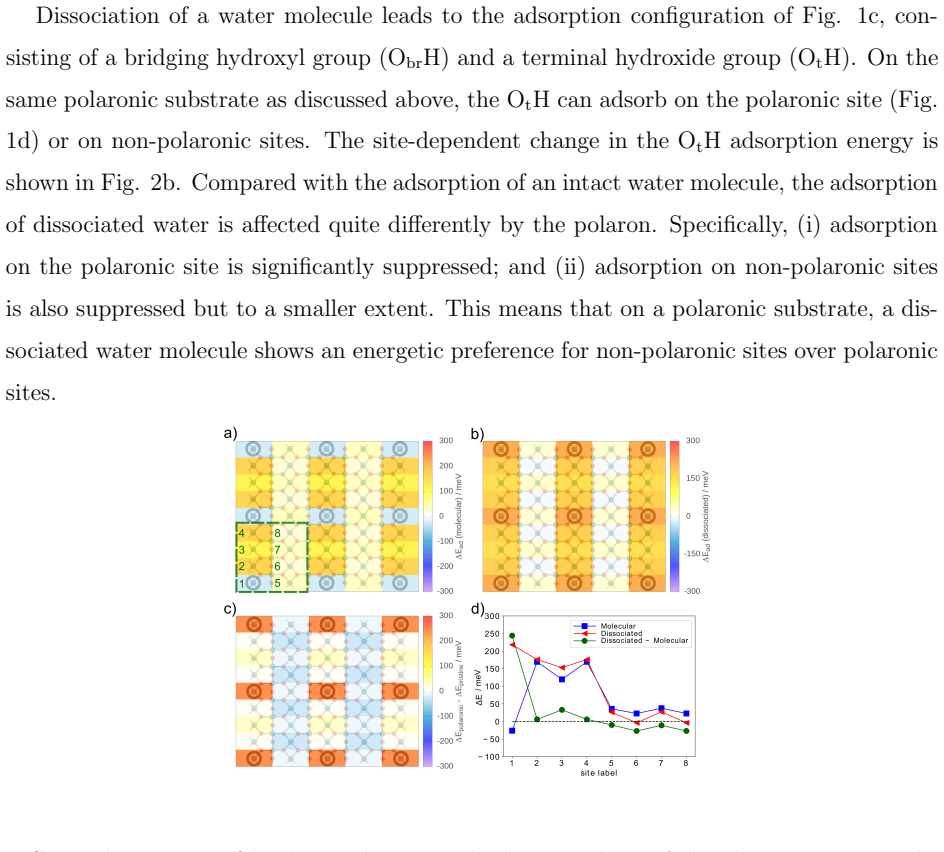
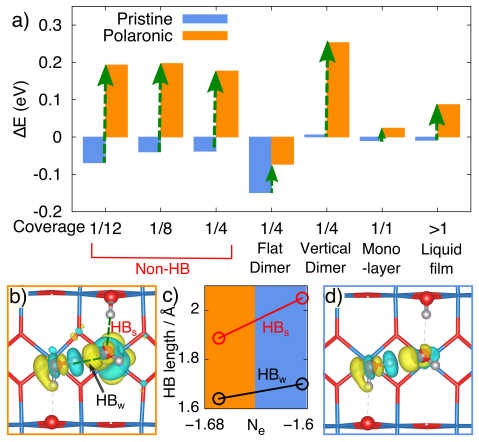
The central claim is that on the (110) surface of rutile titania, a small polaron localized on a five-fold-coordinated titanium site has a Janus effect on water chemistry. Water molecules bind favorably to the polaronic site, yet the terminal hydroxide left by dissociation is negatively charged and is repelled by the polaron's excess electron; the net effect is a suppression of water dissociation by about 240 meV on that site, with the reverse dissociation barrier dropping from about 0.18 eV to nearly zero (about 0.01 eV). On non-polaronic Ti5c sites the dissociation energy can shift by up to about 30 meV in either direction, so a small enhancement is possible. The same suppression is found with PBE+U and HSE functionals and when polarons are created by oxygen vacancies rather than by an excess electron. In hydrogen-bonded water structures the polaron strengthens hydrogen bonds, mainly because the terminal oxygen of an adsorbed water or hydroxide becomes a better hydrogen-bond acceptor when the polaron is nearby.
Load-bearing premise
The whole picture rests on the assumption that adding one excess electron to a 2x4 supercell and treating it with PBE+U or HSE gives the right polaron shape, and that the computed energy differences among molecular, dissociated, and hydrogen-bonded states are accurate to within a few tens of millielectronvolts, with no reported correction for zero-point energy, temperature, or supercell size.
Editorial extensions
If this is right
- Water placed on a polaronic Ti5c site will overwhelmingly stay molecular: the barrier to dissociation rises to 0.22 eV and the barrier for the reverse reaction is essentially zero (about 0.01 eV).
- Polaronic substrates present a patchwork of adsorption sites; water on some non-polaronic sites can dissociate up to about 30 meV more easily than on the pristine surface.
- At higher water coverages, including monolayers and liquid films, the polaronic suppression persists, though hydrogen-bond strengthening partially offsets it.
- The key conclusions do not depend on how the polaron is made: the same suppression appears when the polaron comes from an oxygen vacancy or from an excess electron, and with both PBE+U and HSE treatments.
- Polarons should be considered when interpreting experiments on wet titania: samples with different reduction states or polaron populations could give different water-dissociation answers.
Reading between the lines
- If the mechanism is electrostatic site selection, then other anionic adsorbates such as methoxide, halides, or carboxylates should also be repelled from polaron sites while neutral lone-pair donors are attracted; this could be tested with a series of probe molecules on reduced rutile.
- Because polaron mobility depends on temperature and photoexcitation, measured dissociation rates on a real TiO2 surface should correlate with polaron population at the adsorption site; a controlled experiment varying electron dose or photon flux could directly probe the 240 meV suppression.
- The strengthening of hydrogen bonds by polarons implies polaron formation could shift O-H vibrational frequencies and alter proton-transfer dynamics of interfacial water, a prediction accessible to infrared or sum-frequency spectroscopy.
- The quantitative energies rely on a small supercell with one polaron; finite-size and zero-point corrections could shift the 240 meV value, so the most robust prediction is the sign and site-selectivity of the effect rather than the exact energy.
Signed reviews
Editorial analysis
A structured set of objections, weighed in public.
Referee Report
Summary. The manuscript reports DFT calculations of water adsorption, dissociation, and hydrogen bonding on the rutile TiO2(110) surface in the presence of a small polaron. Using PBE+U (U = 4.2 eV) as the primary method, with HSE and oxygen-vacancy-created polarons as checks, the authors find that a polaron localized on a Ti5c site suppresses water dissociation on that site by about 240 meV (with the NEB barrier rising from 0.14 eV to 0.22 eV), while dissociation on some non-polaronic sites is slightly enhanced by up to about 30 meV. They further report that polarons strengthen hydrogen bonds, especially the O-H...O bonds involving hydroxide groups, which modifies dissociation energetics at higher coverages. The authors connect these findings to ongoing debates about water dissociation on rutile(110) and suggest that polaronic effects are generally important for oxide-water interfaces.
Significance. If the central claim holds, this is an important contribution: it establishes a concrete, site-resolved mechanism by which a small surface polaron — a common defect in titania and other oxides — can act as a local suppressor of water dissociation while slightly promoting dissociation elsewhere. The robustness checks are a genuine strength: the suppression is reproduced with HSE and with polarons created by oxygen vacancies, and the NEB barrier confirms the trend. The paper also makes a falsifiable connection to prior photoemission experiments on polaron segregation. The claim is not circular: the Hubbard U is taken from literature and varied in the SI, and the excess-electron model is a standard way to create a polaron. The main caveat is quantitative: the ~30 meV non-polaronic enhancements and the reported hydrogen-bond strengthening are within the expected error of the DFT+U electronic structure and supercell approximations, and the paper does not yet provide the convergence evidence needed to secure those finer numbers.
major comments (4)
- [Fig. 2 and Methods] The site-resolved heat maps in Fig. 2 rest on the assumption that the polaron remains centered on the chosen Ti5c site during geometry optimization for every adsorption configuration. The main text says only that specific Ti-O bonds were sometimes elongated before optimization 'to direct the excess electron'; it does not state that the polaron position was monitored or constrained in each of the adsorption calculations used to build the maps. If the polaron hops when water or OH is placed on a non-polaronic site, the reported energy differences mix polaron migration energy with adsorption energy, and the heat maps become ill-defined. Please specify, for each site in Fig. 2, whether the gap-state charge density remained localized on the intended Ti atom after relaxation, and list any cases where it did not.
- [Fig. 2 and computational details] All quantitative claims, including the ~30 meV non-polaronic enhancements and the ~240 meV suppression, are based on total-energy differences in a single 2x4 supercell with one excess electron and a compensating background charge. No supercell-size convergence test, no charged-cell correction, and no estimate of polaron-image interactions is reported in the main text. Since the polaron is a localized change in both charge and lattice strain, its elastic and electrostatic fields could interact with periodic images at this cell size; the magnitude of this effect is precisely the meV scale of the non-polaronic site dependence. Please provide a convergence study with larger cells (e.g., 2x6 or 2x8) at least for the key configurations that give the largest non-polaronic enhancement and the polaronic-site suppression, or explicitly justify why image interactions are negligible for the 30 meV numbers.
- [Fig. 3a] The HSE and oxygen-vacancy checks in Fig. 3a convincingly show that the qualitative suppression at the polaronic site is not an artifact of the PBE+U model. However, the same checks do not yet establish the quantitative value of the suppression (ca. 240 meV) or the sign and size of the non-polaronic effects, because those numbers are reported only for PBE+U. Given that the non-polaronic enhancement is up to about 30 meV — comparable to zero-point energy differences and to the typical accuracy of DFT+U for such adsorption energies — the paper should either report the site-resolved dissociation energies from HSE for at least the polaronic and most-enhanced non-polaronic sites, or explicitly discuss why the HSE and PBE+U site-resolved patterns are expected to match at this level. Without that, the quantitative 'Janus' claim (enhancement on non-polaronic sites) remains a PBE+U-only result.
- [Fig. 3b] The NEB calculation reports a single barrier for the pristine surface and a single barrier for the polaronic surface, but the text does not say whether the product and reactant states on the polaronic surface both have the polaron on the same Ti5c site, or whether the polaron moves during the climb. If the polaron migrates along the reaction coordinate, the barrier of 0.22 eV is not simply the dissociation barrier at a fixed polaronic site but includes polaron migration energetics. Please clarify the polaron position along the NEB path and, if it moves, provide a path with the polaron constrained to the reactive Ti5c site to separate the electronic suppression from polaron mobility.
minor comments (4)
- [Fig. 2] The heat maps in Fig. 2 would be easier to interpret if the color scale and the exact quantity plotted (change in adsorption energy relative to pristine surface, with positive values suppressing adsorption) were printed directly in the figure rather than only in the caption.
- [Fig. 2a] The sentence 'water adsorption on non-polaronic sites can be significantly destabilized, with the largest suppression up to ca. 170 meV' is followed by a statement that adsorption at the polaronic site is favored. Please reconcile these two sentences explicitly: the polaronic site is the most stable, but the map shows that some non-polaronic sites are strongly destabilized, which is consistent but could be stated with more precision.
- [Page 8] When reporting the hydrogen-bond shortening (1.76 Å to 1.71 Å and 2.02 Å to 1.62 Å), please state whether these are O-H...O distances or H...O distances, and whether they are from PBE+U or another functional. This will help readers compare with the literature.
- [General] The phrase 'Janus nature' in the title is evocative but the main text does not define it; consider adding one sentence in the introduction that explains the two faces (suppression at polaronic sites, slight enhancement at non-polaronic sites) to orient the reader.
Circularity Check
No circularity: the computed polaron effects are independent of fitted inputs and are cross-checked with HSE and oxygen-vacancy models.
full rationale
The paper's central claims are derived from direct DFT total-energy comparisons rather than from fitted inputs or from prior work that already contains the target result. Polarons are created either by adding an excess electron with a compensating background charge or by removing an oxygen atom, and the paper explicitly verifies that the key suppression of water dissociation on polaronic sites is reproduced with HSE, with PBE+U at different U values (in the SI), and with oxygen-vacancy-created polarons. The Hubbard U = 4.2 eV is taken from prior literature, not fitted to the water adsorption or dissociation energies, and the site-resolved adsorption, dissociation, and NEB barrier energies are computed total-energy differences with no target quantity used as an input. The only self-citation, Ref. 23 (Yim et al.), is used as experimental context for polaron segregation toward water-covered rutile (110) and as a consistency statement, not as the load-bearing source of the computed suppression. Consequently, none of the paper's equations reduce to their inputs by construction, and the derivation is self-contained. The reader's and skeptic's concerns about supercell-size effects, charged-cell corrections, and polaron position tracking are legitimate finite-size and modeling risks, but they are correctness risks, not circularity.
Assumptions & free parameters
free parameters (1)
- Hubbard U for Ti 3d (PBE+U) =
4.2 eV
assumptions (4)
- domain assumption DFT+U with U=4.2 eV (and HSE) accurately describes small-polaron formation and the relative energetics of water adsorption and dissociation on rutile(110).
- domain assumption A single excess electron in a 2x4 supercell with compensating background charge models an isolated surface polaron without significant spurious interactions.
- domain assumption Static 0 K energies from geometry optimization capture the experimentally relevant polaron effect on water dissociation.
- ad hoc to paper Elongating a specific Ti-O bond by 0.03 Å biases to a representative polaronic site without altering the qualitative energy landscape.
Cite this review
Pith. "Pith review of Small polarons and the Janus nature of $\text{TiO}_\text{2}(110)$." pith.science (2026). https://pith.science/paper/VTLURIOF
@misc{pith2026190808008,
  author       = {Pith},
  title        = {Pith review of: Small polarons and the Janus nature of $\textTiO_\text2(110)$},
  year         = {2026},
  howpublished = {\url{https://pith.science/paper/VTLURIOF}},
  note         = {Machine review of arXiv:1908.08008}
}
read the original abstract
Polarons are ubiquitous in many semiconductors and have been linked with conductivity and optical response of materials for photovoltaics and heterogeneous catalysis, yet how surface polarons influence adsorption remains unclear. Here, by modelling the surface of rutile titania using density functional theory, we reveal the effect of small surface polarons on water adsorption, dissociation, and hydrogen bonding. On the one hand the presence of such polarons significantly suppresses dissociation of water molecules that are bonded directly to polaronic sites. On the other hand, polarons facilitate water dissociation at certain non-polaronic sites. Furthermore, polarons strengthen hydrogen bonds, which in turn affects water dissociation in hydrogen bonded overlayer structures. This study reveals that polarons at the rutile surface have complex, multi-faceted, effects on water adsorption, dissociation and hydrogen bonding, highlighting the importance of polarons on water structure and dynamics on such surfaces. We expect that many of the physical properties of surface polarons identified here will apply more generally to surfaces and interfaces that can host small polarons, beyond titania.
Figures


Figures from the paper (1 more)
Reference graph
Works this paper leans on
-
[1]
Fujishima, X
A. Fujishima, X. Zhang, and D. A. Tryk, Surf. Sci. Rep. 63, 515 (2008)
2008
- [2]
-
[3]
H. Kuhlenbeck, S. Shaikhutdinov, and H.-J. Freund, Chem. Rev. 113, 3986 (2013)
work page 2013
-
[4]
G. C. Sosso, J. Chen, S. J. Cox, M. Fitzner, P. Pedevilla, A. Zen, and A. Michaelides, Chem. Rev. 116, 7078 (2016)
work page 2016
-
[5]
K. Onda, B. Li, J. Zhao, K. D. Jordan, J. Yang, and H. Petek, Science 308, 1154 (2005)
work page 2005
-
[6]
T. L. Thompson and J. T. Yates, Chem. Rev. 106, 4428 (2006)
work page 2006
-
[7]
C. Di Valentin, G. Pacchioni, and A. Selloni, Phys. Rev. Lett. 97, 166803 (2006)
work page 2006
- [8]
Show all 75 references
-
[9]
M. A. Henderson, Surf. Sci. Rep. 66, 185 (2011)
2011
-
[10]
J. E. Katz, X. Zhang, K. Attenkofer, K. W. Chapman, C. Frandsen, P. Zarzycki, K. M. Rosso, R. W. Falcone, G. A. Waychunas, and B. Gilbert, Science 337, 1200 (2012)
2012
-
[11]
C. L. Pang, R. Lindsay, and G. Thornton, Chem. Rev. 113, 3887 (2013)
2013
-
[12]
Paier, C
J. Paier, C. Penschke, and J. Sauer, Chem. Rev. 113, 3949 (2013)
2013
-
[13]
Z. Wang, B. Wen, Q. Hao, L.-M. Liu, C. Zhou, X. Mao, X. Lang, W.-J. Yin, D. Dai, A. Selloni, and X. Yang, J. Am. Chem. Soc. 137, 9146 (2015)
2015
-
[14]
Wen, W.-J
B. Wen, W.-J. Yin, A. Selloni, and L.-M. Liu, J. Phys. Chem. Lett. 9, 5281 (2018)
2018
-
[15]
W.-J. Yin, B. Wen, C. Zhou, A. Selloni, and L.-M. Liu, Surf. Sci. Rep. 73, 58 (2018)
2018
-
[16]
L. Zhou, J. Zhang, Z. Zhuo, L. Kou, W. Ma, B. Shao, A. Du, S. Meng, and T. Frauenheim, J. Phys. Chem. Lett. 7, 1880 (2016)
2016
-
[17]
T. A. Pham, Y. Ping, and G. Galli, Nature Materials 16, 401 (2017)
2017
-
[18]
B. Wen, Q. Hao, W.-J. Yin, L. Zhang, Z. Wang, T. Wang, C. Zhou, A. Selloni, X. Yang, and L.-M. Liu, Phys. Chem. Chem. Phys. 20, 17658 (2018). 11
2018
-
[19]
M. O. Atambo, D. Varsano, A. Ferretti, S. S. Ataei, M. J. Caldas, E. Molinari, and A. Selloni, Phys. Rev. Materials 3, 045401 (2019)
2019
-
[20]
Diebold, J
U. Diebold, J. Chem. Phys. 147, 040901 (2017)
2017
-
[21]
C. T. Campbell and J. Sauer, Chem. Rev. 113, 3859 (2013)
2013
-
[22]
Selcuk and A
S. Selcuk and A. Selloni, Nat. Mater. 15, 1107 (2016)
2016
-
[23]
C. M. Yim, J. Chen, Y. Zhang, B.-J. Shaw, C. L. Pang, D. C. Grinter, H. Bluhm, M. Salmeron, C. A. Muryn, A. Michaelides, and G. Thornton, J. Phys. Chem. Lett. 9, 4865 (2018)
2018
-
[24]
Reticcioli, I
M. Reticcioli, I. Sokolovi´ c, M. Schmid, U. Diebold, M. Setvin, and C. Franchini, Phys. Rev. Lett. 122, 016805 (2019)
2019
-
[25]
Gaberle and A
J. Gaberle and A. Shluger, RSC Advances 9, 12182 (2019)
2019
-
[26]
L. M. Carneiro, S. K. Cushing, C. Liu, Y. Su, P. Yang, A. P. Alivisatos, and S. R. Leone, Nat. Mater. 16, 819 (2017)
2017
-
[27]
A. L. Shluger and A. M. Stoneham, J. Phys.: Condens. Matter 5, 3049 (1993)
1993
-
[28]
Spreafico and J
C. Spreafico and J. VandeVondele, Phys. Chem. Chem. Phys. 16, 26144 (2014)
2014
-
[29]
Aschauer, Y
U. Aschauer, Y. He, H. Cheng, S.-C. Li, U. Diebold, and A. Selloni, J. Phys. Chem. C 114, 1278 (2010)
2010
-
[30]
P. M. Kowalski, M. F. Camellone, N. N. Nair, B. Meyer, and D. Marx, Phys. Rev. Lett. 105, 146405 (2010)
2010
-
[31]
Setvin, C
M. Setvin, C. Franchini, X. Hao, M. Schmid, A. Janotti, M. Kaltak, C. G. Van de Walle, G. Kresse, and U. Diebold, Phys. Rev. Lett. 113, 086402 (2014)
2014
-
[32]
C. Yim, M. Watkins, M. Wolf, C. Pang, K. Hermansson, and G. Thornton, Phys. Rev. Lett. 117, 116402 (2016)
2016
-
[33]
Reticcioli, M
M. Reticcioli, M. Setvin, M. Schmid, U. Diebold, and C. Franchini, Phys. Rev. B 98, 045306 (2018)
2018
-
[34]
J. T. Yates, Surf. Sci. 603, 1605 (2009)
2009
-
[35]
Serrano, B
G. Serrano, B. Bonanni, M. Di Giovannantonio, T. Kosmala, M. Schmid, U. Diebold, A. Di Carlo, J. Cheng, J. VandeVondele, K. Wandelt, and C. Goletti, Adv. Mater. Inter- faces 2, 1500246 (2015)
2015
-
[36]
Hussain, G
H. Hussain, G. Tocci, T. Woolcot, X. Torrelles, C. L. Pang, D. S. Humphrey, C. M. Yim, D. C. Grinter, G. Cabailh, O. Bikondoa, R. Lindsay, J. Zegenhagen, A. Michaelides, and G. Thornton, Nat. Mater. 16, 461 (2017). 12
2017
-
[37]
Balajka, M
J. Balajka, M. A. Hines, W. J. I. DeBenedetti, M. Komora, J. Pavelec, M. Schmid, and U. Diebold, Science 361, 786 (2018)
2018
-
[38]
Schaub, P
R. Schaub, P. Thostrup, N. Lopez, E. Lægsgaard, I. Stensgaard, J. K. Nørskov, and F. Be- senbacher, Phys. Rev. Lett. 87, 266104 (2001)
2001
-
[39]
I. M. Brookes, C. A. Muryn, and G. Thornton, Phys. Rev. Lett. 87, 266103 (2001)
2001
-
[40]
Wendt, J
S. Wendt, J. Matthiesen, R. Schaub, E. K. Vestergaard, E. Lægsgaard, F. Besenbacher, and B. Hammer, Phys. Rev. Lett. 96, 066107 (2006)
2006
-
[41]
Bikondoa, C
O. Bikondoa, C. L. Pang, R. Ithnin, C. A. Muryn, H. Onishi, and G. Thornton, Nat. Mater. 5, 189 (2006)
2006
-
[42]
Zhang, Y
Z. Zhang, Y. Du, N. G. Petrik, G. A. Kimmel, I. Lyubinetsky, and Z. Dohn´ alek, J. Phys. Chem. C 113, 1908 (2009)
2009
-
[43]
H. H. Kristoffersen, J. O. Hansen, U. Martinez, Y. Y. Wei, J. Matthiesen, R. Streber, R. Bech- stein, E. Lægsgaard, F. Besenbacher, B. Hammer, and S. Wendt, Phys. Rev. Lett.110, 146101 (2013)
2013
-
[44]
L. E. Walle, A. Borg, P. Uvdal, and A. Sandell, Phys. Rev. B 80, 235436 (2009)
2009
-
[45]
D. A. Duncan, F. Allegretti, and D. P. Woodruff, Phys. Rev. B 86, 045411 (2012)
2012
-
[46]
Wang, Y.-G
Z.-T. Wang, Y.-G. Wang, R. Mu, Y. Yoon, A. Dahal, G. K. Schenter, V.-A. Glezakou, R. Rousseau, I. Lyubinetsky, and Z. Dohn´ alek, Proc. Nat. Aca. Sci. 114, 1801 (2017)
2017
-
[47]
Kresse and J
G. Kresse and J. Furthm¨ uller, Phys. Rev. B 54, 11169 (1996)
1996
-
[48]
VandeVondele, M
J. VandeVondele, M. Krack, F. Mohamed, M. Parrinello, T. Chassaing, and J. Hutter, Comp. Phys. Commun. 167, 103 (2005)
2005
-
[49]
See Online Supplementary Material for the Supporting Information
-
[50]
Kresse and D
G. Kresse and D. Joubert, Phys. Rev. B 59, 1758 (1999)
1999
-
[51]
J. Heyd, G. E. Scuseria, and M. Ernzerhof, J. Chem. Phys. 118, 8207 (2003)
2003
-
[52]
J. Heyd, G. E. Scuseria, and M. Ernzerhof, J. Chem. Phys. 124, 219906 (2006)
2006
-
[53]
J. P. Perdew, K. Burke, and M. Ernzerhof, Phys. Rev. Lett. 77, 3865 (1996)
1996
-
[54]
S. L. Dudarev, G. A. Botton, S. Y. Savrasov, C. J. Humphreys, and A. P. Sutton, Phys. Rev. B 57, 1505 (1998)
1998
-
[55]
Goedecker, M
S. Goedecker, M. Teter, and J. Hutter, Phys. Rev. B 54, 1703 (1996)
1996
-
[56]
VandeVondele and J
J. VandeVondele and J. Hutter, J. Chem. Phys. 127, 114105 (2007). 13
2007
-
[57]
Guidon, J
M. Guidon, J. Hutter, and J. VandeVondele, Journal of Chemical Theory and Computation 6, 2348 (2010)
2010
-
[58]
Komsa and A
H.-P. Komsa and A. Pasquarello, Phys. Rev. Lett. 110, 095505 (2013)
2013
-
[59]
L.-M. Liu, C. Zhang, G. Thornton, and A. Michaelides, Phys. Rev. B 82, 161415 (2010)
2010
-
[60]
Cococcioni and S
M. Cococcioni and S. de Gironcoli, Phys. Rev. B 71, 035105 (2005)
2005
-
[61]
Grimme, J
S. Grimme, J. Antony, S. Ehrlich, and H. Krieg, J. Chem. Phys. 132, 154104 (2010)
2010
-
[62]
Grimme, S
S. Grimme, S. Ehrlich, and L. Goerigk, Journal of Computational Chemistry 32, 1456
-
[63]
Klimeˇ s, D
J. Klimeˇ s, D. R. Bowler, and A. Michaelides, J. Phys.: Condens. Matter 22, 022201 (2010)
2010
-
[64]
Klimeˇ s, D
J. Klimeˇ s, D. R. Bowler, and A. Michaelides, Phys. Rev. B 83, 195131 (2011)
2011
-
[65]
Matthiesen, J
J. Matthiesen, J. O. Hansen, S. Wendt, E. Lira, R. Schaub, E. Lægsgaard, F. Besenbacher, and B. Hammer, Phys. Rev. Lett. 102, 226101 (2009)
2009
-
[66]
J. Lee, D. C. Sorescu, X. Deng, and K. D. Jordan, J. Phys. Chem. Lett. 4, 53 (2013)
2013
-
[67]
Pacchioni, J
G. Pacchioni, J. Chem. Phys. 128, 182505 (2008)
2008
-
[68]
C. J. Cramer and D. G. Truhlar, Phys. Chem. Chem. Phys. 11, 10757 (2009)
2009
-
[69]
De Angelis, C
F. De Angelis, C. Di Valentin, S. Fantacci, A. Vittadini, and A. Selloni, Chem. Rev. 114, 9708 (2014)
2014
-
[70]
Henkelman, B
G. Henkelman, B. P. Uberuaga, and H. J´ onsson, J. Chem. Phys. 113, 9901 (2000)
2000
-
[71]
Michaelides, Faraday Discuss
A. Michaelides, Faraday Discuss. 136, 287 (2007)
2007
-
[72]
Tanaka, M
K. Tanaka, M. F. V. Capule, and T. Hisanaga, Chemical Physics Letters 187, 73 (1991)
1991
-
[73]
H. Tang, K. Prasad, R. Sanjin` es, P. E. Schmid, and F. L´ evy, J. Appl. Phys.75, 2042 (1994)
1994
-
[74]
M. Xu, Y. Gao, E. M. Moreno, M. Kunst, M. Muhler, Y. Wang, H. Idriss, and C. W¨ oll, Phys. Rev. Lett. 106, 138302 (2011)
2011
-
[75]
Silber, P
D. Silber, P. M. Kowalski, F. Traeger, M. Buchholz, F. Bebensee, B. Meyer, and C. W¨ oll, Nat. Commun. 7, 12888 (2016). 14
2016
Reviewed August 14, 2026 · model on record in the stance chip above.
Discussion (0). Continue with ORCID to comment.