REVIEW 3 major objections 6 minor 2 cited by
First-forbidden transitions in the reactor anomaly
T0 review · 3 major / 6 minor · reviewed 2026-08-14 · deepseek-v4-flash
Pith's one-line read Microscopic treatment of first-forbidden beta decays yields antineutrino spectral changes of several percent, with a bump in the 4–7 MeV range.
desk verdict A solid shell-model calculation of 36 first-forbidden shape factors that shows a few-percent effect on reactor antineutrino spectra, but the headline claim that it solves both the rate anomaly and the spectral shoulder depends on an uncomputed allowed-shape slope. read the letter →
The pith
A machine-rendered reading of the paper's core claim, the machinery that carries it, and where it could break.
The reading
What carries the argument
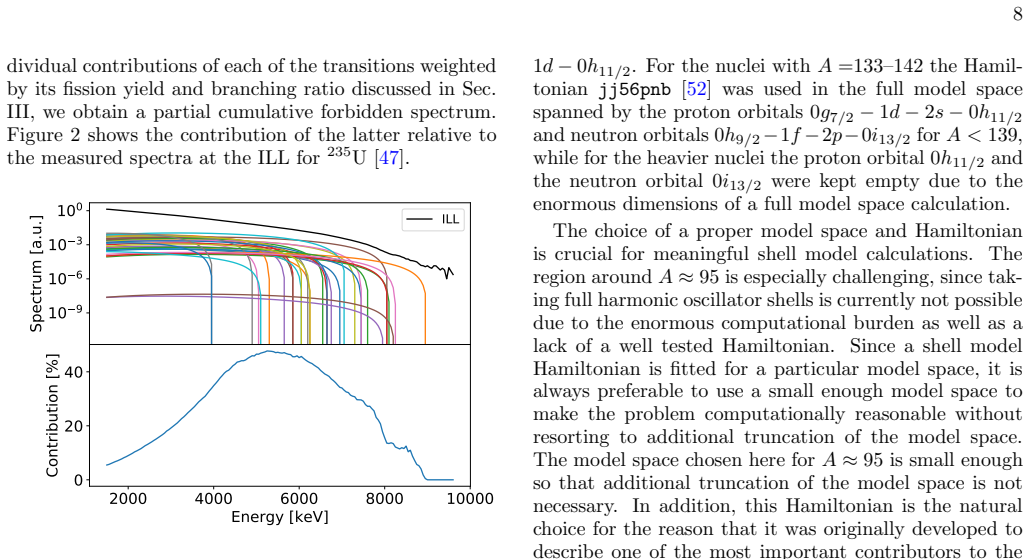
The load-bearing object is the $\beta$-decay shape factor $C(Z,W)$, the energy-dependent multiplier in the spectrum formula that contains all nuclear-structure information; in the Behrens–Bühring formalism it is built from Coulomb functions such as $\lambda_k$, lepton phase-space factors, and nuclear form factors obtained from shell-model wave functions. The argument works by computing these shape factors fully for 36 dominant first-forbidden transitions instead of setting them to $C=1$ or to the standard weak-magnetism term, and then comparing cumulative electron and antineutrino spectra built with the calculated shapes against spectra built with those allowed approximations. The comparison is what converts a small change in electron spectra into a several-percent change in antineutrino spectra, because the steeply falling cumulative flux amplifies any reweighting of the high-energy tail.
What would settle it
A high-statistics measurement of the beta spectrum of a dominant fission fragment such as 92Rb or 96Y, converted into an extracted shape factor, would settle the claim: if the measured shape factor is flat instead of the calculated downward-sloping curve, the predicted several-percent antineutrino bump shrinks or disappears.
Extended reading notes
Core claim
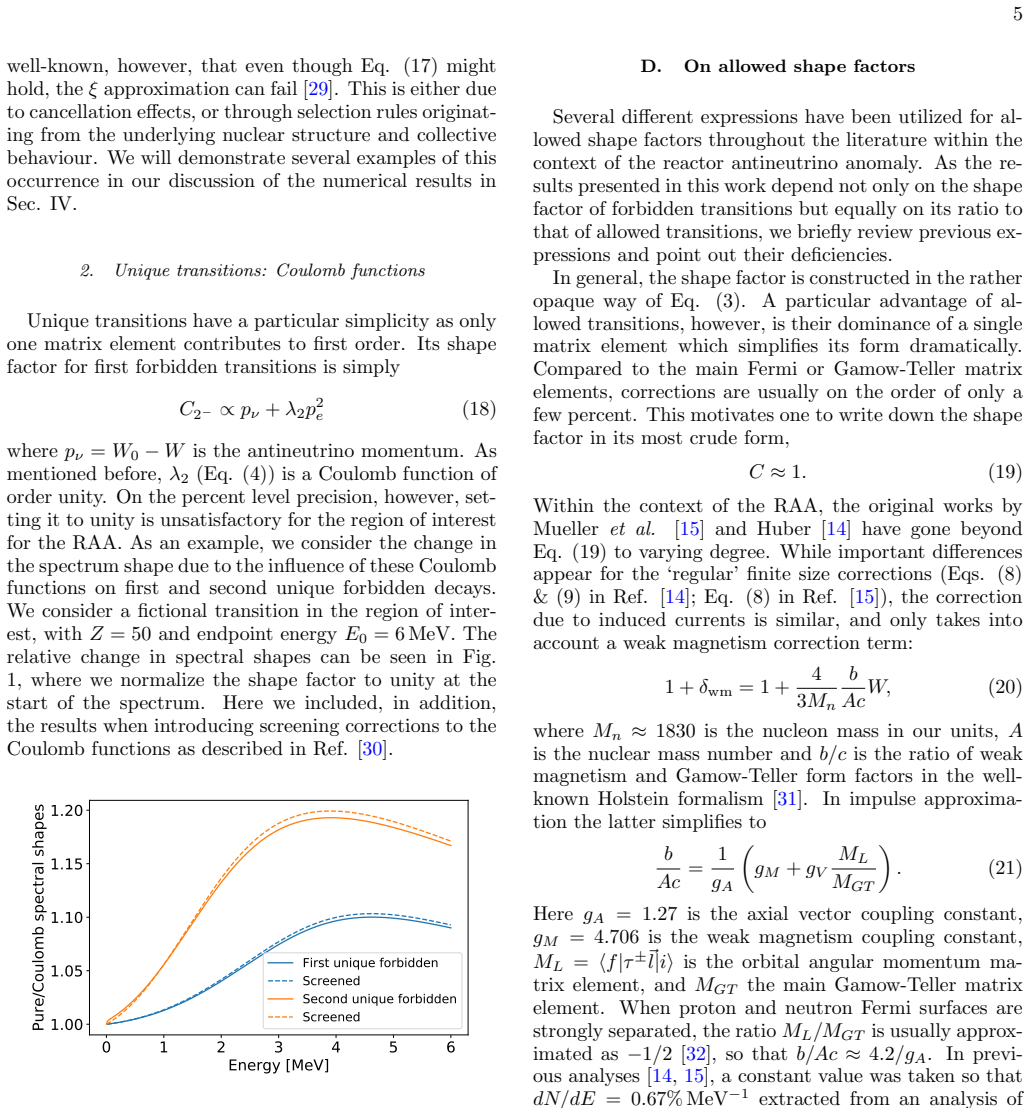
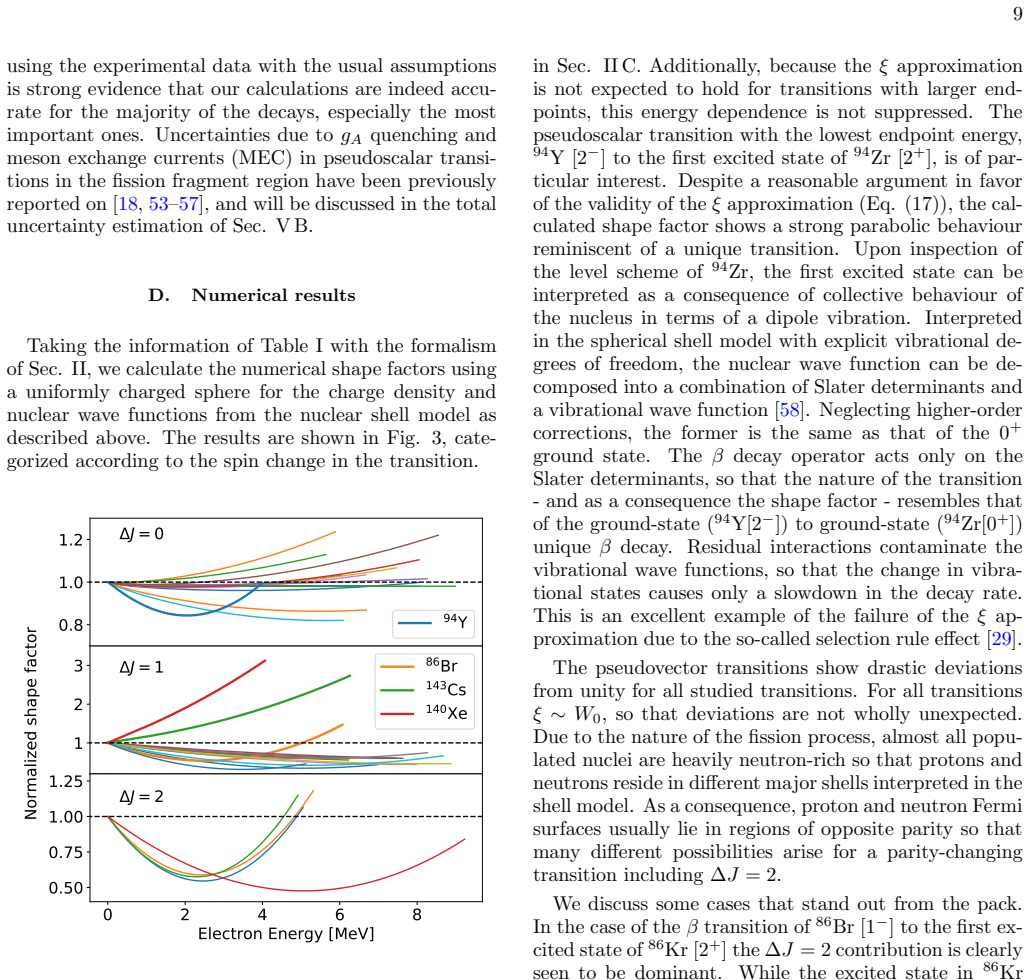
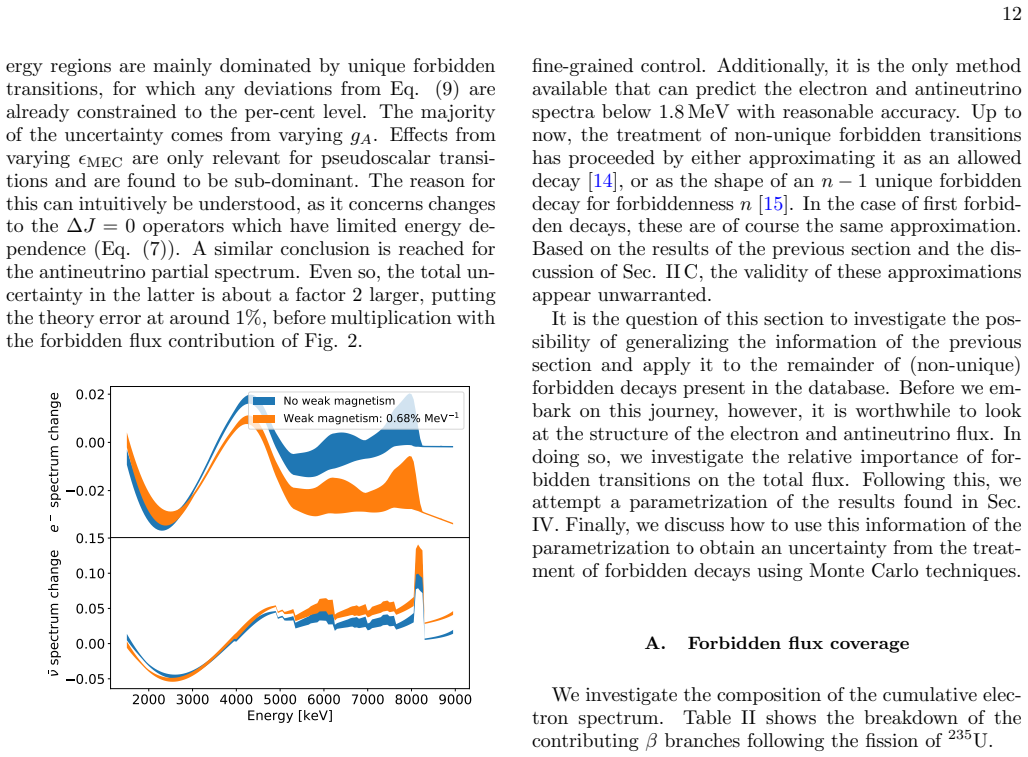
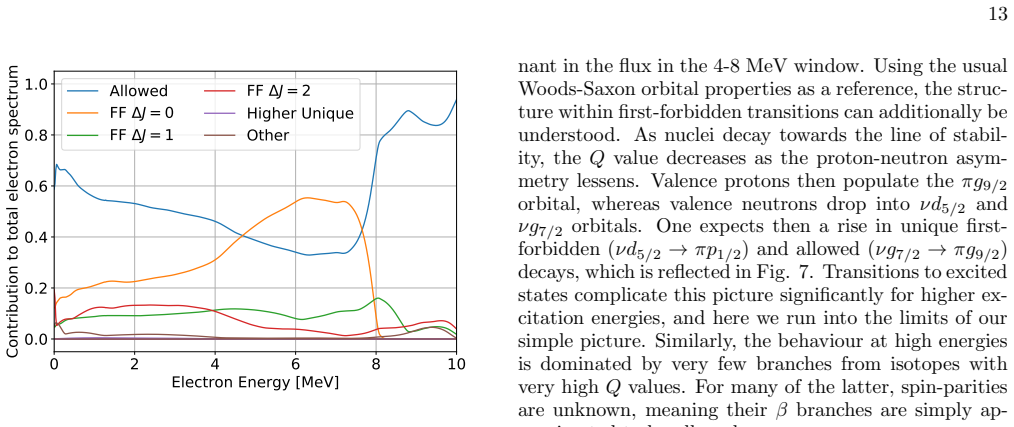
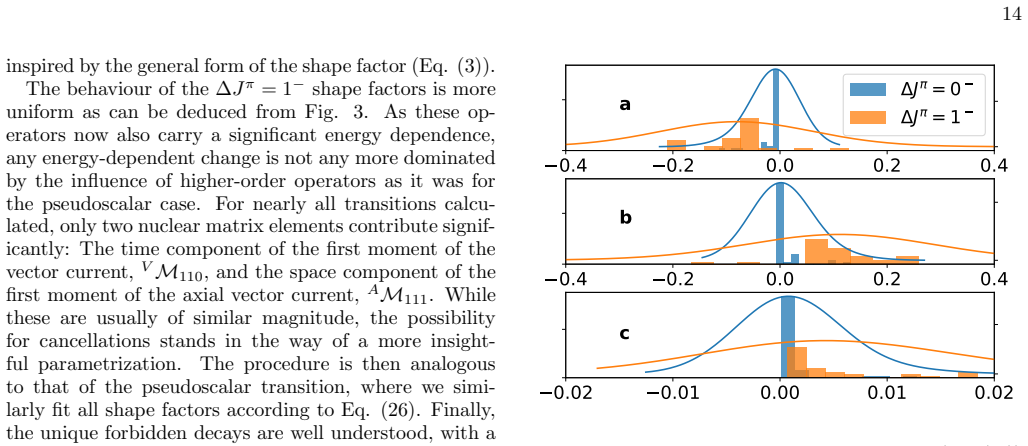
On its own terms, the paper establishes that first-forbidden transitions are not a small correction in reactor antineutrino spectra but a dominant component above 4 MeV, and that their true shapes change the predicted flux in exactly the region where experiments see an excess. For 36 transitions selected by their fission yield and branching ratio, the paper evaluates the full shape factor in the Behrens–Bühring formalism without the usual $\xi$-approximation, including Coulomb distortion of the electron wave function and finite-size effects. The calculated shape factors for many pseudovector transitions slope downward with energy, while some pseudoscalar transitions show strong quadratic behaviour from higher-order operators, and unique transitions require the Coulomb function $\lambda_2$ for percent-level accuracy. When these shapes are folded into summation and composite spectra matched to measured electron data, the electron spectrum changes by only about 1–2%, but the antineutrino spectrum rises by several percent in the 4–7 MeV window, with the exact magnitude depending on the allowed shape to which the comparison is made.
Load-bearing premise
The central quantitative claim assumes that the 'allowed' spectral shape used as the comparison is the right baseline, even though the paper itself lists missing corrections to that baseline; a different allowed slope would change both the size and the shape of the predicted bump.
Editorial extensions
If this is right
- Spectral-shape analyses that assume forbidden decays are allowed will mis-estimate the high-energy antineutrino flux by several percent, so the 5 MeV excess cannot be interpreted without a forbidden-transition correction.
- The forbidden-transition contribution adds a correlated spectral uncertainty comparable to or larger than the leading systematic uncertainties of the standard summation model, so previous significance estimates for the rate anomaly were missing a major error term.
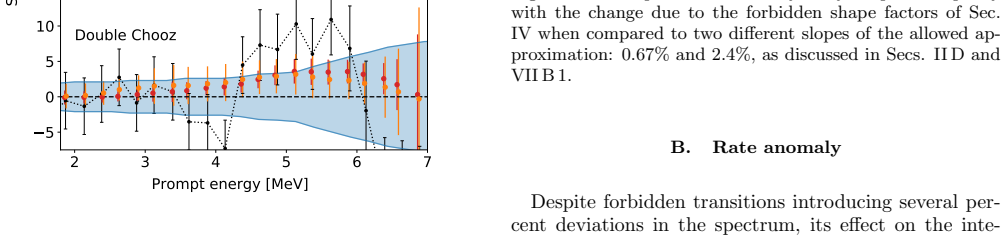
- With the 36 numerical shape factors alone, the predicted inverse-beta-decay rate rises by about 0.8(5)%; including the parametrized shapes for all other forbidden branches raises the shift to about 2.3(13)%, which shifts but does not remove the anomaly.
- If the true average slope of allowed shapes is near 2.4% per MeV rather than the standard 0.67% per MeV, the forbidden-transition bump reaches the size of the observed shoulder, offering a single mechanism for both the rate and shape discrepancies.
- Because the effect is nearly identical for the main fission actinides, small differences in reactor fuel composition do not change the predicted distortion, making the correction robust for current and near-future experiments.
Reading between the lines
- A direct shell-model survey of the allowed-shape slopes for the dominant fission fragments would decide whether the 2.4%/MeV baseline is physical; the paper motivates it but does not compute it.
- High-statistics beta-spectrum measurements of individual dominant fragments (for example 92Rb or 96Y) could extract their shape factors and anchor or falsify the parametrization before it is applied to reactor data.
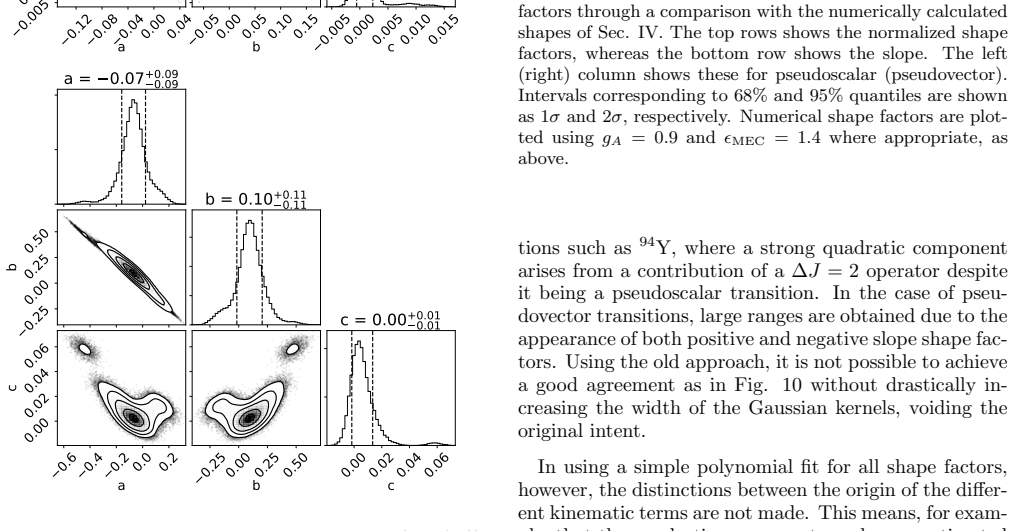
- The heavy-tailed, multimodal parameter distributions suggest that older Gaussian-style uncertainty propagation for forbidden transitions underestimates the high-energy spectral error; the Monte Carlo approach used here may be the safer template for future summation calculations.
- If sterile-neutrino searches continue to rely on reactor spectral predictions, the size of this forbidden-transition uncertainty will matter as much as detector systematics in the 4–7 MeV region.
Signed reviews
Editorial analysis
A structured set of objections, weighed in public.
Referee Report
Summary. The paper presents microscopic shell-model calculations of the dominant first-forbidden beta transitions contributing to reactor antineutrino spectra above 4 MeV, using the Behrens-Bühring formalism with full Coulomb corrections. The authors calculate shape factors for 36 transitions, find strong deviations from the allowed approximation, and use these to construct both a direct numerical correction and a Monte Carlo parametrization covering the remaining forbidden branches in summation calculations. They then compare the resulting electron and antineutrino spectra with the ILL data and with the Huber-Mueller model, concluding that a correct treatment of forbidden transitions is indispensable for both the normalization anomaly and the spectral shoulder, and proposing that a larger allowed-shape slope (2.4%/MeV) could resolve both simultaneously when combined with their forbidden corrections.
Significance. If the main results hold, this is a significant contribution to the reactor antineutrino problem. The work applies a standard and sophisticated formalism (Behrens-Bühring with shell-model matrix elements) to a much larger set of forbidden transitions than previous microscopic studies, and it provides a transparent uncertainty treatment by varying gA and epsilon_MEC. The comparison with the independent ILL electron data through a composite approach is a strength, as is the favorable reproduction of the 140Xe shape factor against Fang and Brown. The paper also ships a detailed parametrization procedure and Monte Carlo code logic, which is useful for future summation calculations. However, the central quantitative claim about simultaneously solving the anomaly and shoulder depends on an uncomputed baseline slope for allowed transitions, and the paper itself identifies several transitions (86Br, 89Br, 136Te) where the calculations are not fully validated. The significance of the paper is therefore real but conditional on resolving these load-bearing uncertainties.
major comments (3)
- [Sec. VII B 1, Fig. 15, and Sec. II D] The claim that a proper treatment of forbidden transitions can simultaneously solve the normalization anomaly and spectral shoulder rests on the 2.4%/MeV slope of the allowed shape factor, which is never computed. In Sec. II D the authors list the missing induced-tensor term (Eq. 23), the full weak-magnetism expression (Eq. 22), and the Lambda-prime finite-size correction (Eq. 24), and state that these will be investigated in future work. The forbidden-only bump in Fig. 14 reaches only about 4.5% when compared with the simplified 0.67%/MeV weak-magnetism slope, whereas Fig. 15 shows an 8.5% bump only after replacing that baseline with an ad hoc 2.4%/MeV slope. Since the true yield-weighted average allowed slope in the 4-7 MeV region is not computed, the central conclusion in Sec. IX that an increased allowed slope 'can yield a solution' is a proposal rather than a demonstrated result. This is the most load-bearing quantitative assertion of the paper and needs to be either supported by an explicit calculation of the allowed shape factors for the dominant allowed branches or softened accordingly.
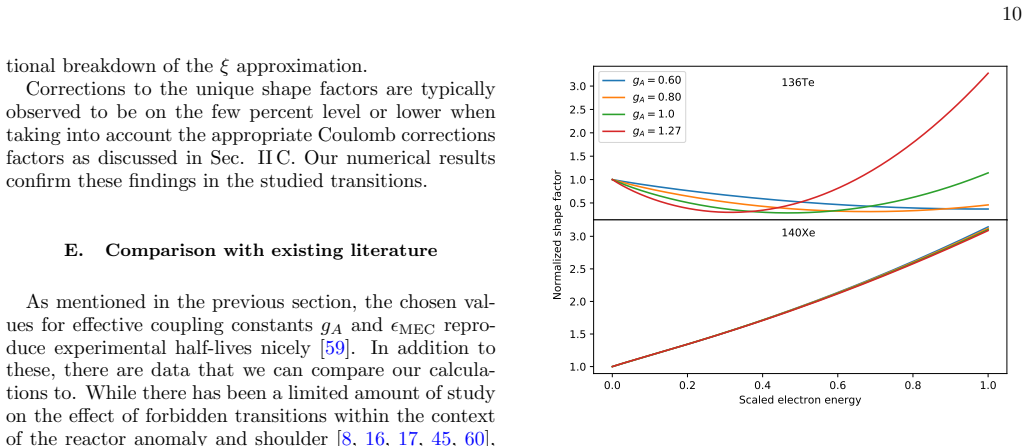
- [Sec. IV C, IV D, and IV E; Table I] The reliability of the numerical shape factors is not uniform across the 36 transitions, and the paper acknowledges unresolved discrepancies. The half-lives of 86Br and 89Br are not reproduced even with the larger jj45pna model space (Sec. IV C), and the 136Te shape-factor slope is sensitive to the phase convention and to the gA/gV ratio (Sec. IV E). Since 86Br (Delta J = 1) and 89Br contribute to the highest-energy part of the spectrum and show some of the largest deviations in Fig. 3, these unresolved cases could disproportionately affect the magnitude of the bump in the 4-7 MeV region. The paper should quantify how the final cumulative spectral changes in Figs. 14 and 16 would shift if the problematic transitions were assigned conservative alternative shape factors (e.g., the allowed shape or the unique-first-forbidden shape), or should explicitly state which transitions dominate the bump and show that they are among the validated cases.
- [Sec. VI B, Fig. 10, and Sec. VII B 2] The parametrized shape-factor distributions are validated against the same numerical shape factors to which the polynomial of Eq. (26) was fitted, so Fig. 10 is not an independent test of the parametrization's predictive power. The paper then applies this parametrization to roughly 1600 forbidden branches in the database, assuming the 36 selected transitions are representative, an assumption stated explicitly in Sec. VI B 1. The authors themselves note in Sec. VII B 2 that the 2-4 MeV enhancement in the parametrized results 'could be a true verifiable feature or a limitation of our parametrization' and in Sec. VIII A that the increased spread in shape factors 'is possibly a limitation of our current approach.' Given that the parametrization uncertainty is comparable to or larger than the main systematic uncertainties in the Huber-Mueller model (Appendix), the paper should provide a more direct test of representativeness, for example by using a leave-one-out cross-validation on the 36 transitions or by comparing the parametrized shape-factor distributions to the few available experimental shape-factor measurements beyond half-lives.
minor comments (6)
- [Abstract and Sec. IV C] The abstract uses the phrase 'ab initio electron cumulative spectra,' but the calculations are shell-model calculations with effective interactions, not ab initio; please rephrase to avoid confusion.
- [Sec. IV C] The sentence 'This has for many isotopes resulted in a correction of branching ratios to high-lying states which had previously gone eluded due to the pandemonium effect' contains a typo; 'gone eluded' should be 'escaped detection' or 'been missed.'
- [Sec. II C 2, Eq. (18)] The symbol for antineutrino momentum in Eq. (18) is written as pν, but elsewhere the paper uses p with W0 - W; please define pν and p_e explicitly in the text preceding Eq. (18) for clarity.
- [Table III and Sec. VII C] In Table III, the row labels φ and R_IBD are not defined in the caption or in the text before the table; please define them as the integrated antineutrino flux and the inverse-beta-decay-weighted flux, respectively.
- [Sec. VII A and Fig. 11] The caption of Fig. 11 mentions 'ENDF Q' but the legend in the figure shows 'ENDF Q' and the text refers to the Qβ approximation; please make the label consistent and explain the acronym in the caption.
- [Sec. VIII A, Fig. 18] The figure caption labels the curves as '0.67%' and '2.4%' but does not state that these are slopes in units of %/MeV; please specify the units explicitly.
Circularity Check
Central forbidden-bump calculation is independent; only in-sample parametrization validation and a speculative allowed-slope extrapolation limit the combined-solution claim.
full rationale
The paper's central numerical result—the 4-5% antineutrino bump from the 36 explicitly calculated shell-model shape factors (Secs. IV and VII B 1, Figs. 5 and 14)—is not circular. The shape factors are computed in the Behrens-Bühring formalism with shell-model wave functions, calibrated only to external half-lives through gA and εMEC, and the cumulative electron spectra are matched to the independent ILL electron data via virtual branches; the antineutrino result is therefore an inversion rather than a fit to the observed bump. No load-bearing self-citation chain is present: the earlier paper [18] is the same group's shorter report of this calculation, and the formalism itself cites standard external references. The two genuine weaknesses are (i) the in-sample parametrization validation flagged above, which affects the Monte Carlo uncertainty and the 2-4 MeV parametrized features but not the main 4.5% forbidden bump, and (ii) the combined rate-plus-shoulder solution in Secs. VII B 1 and IX, which depends on an uncomputed 2.4%/MeV allowed-slope baseline and is explicitly described as a proposal 'currently under investigation.' These are limitations and extrapolations rather than reductions of the central derivation to its own inputs, so the overall circularity score is low.
Assumptions & free parameters
free parameters (5)
- gA (effective axial coupling) =
0.9 central; varied 0.7, 0.9, 1.0, 1.27
- epsilon_MEC (axial charge meson-exchange enhancement) =
1.4 central; varied 1.4, 1.7, 2.0
- gV quenching for pure Delta J = 1 transitions =
not specified
- Parametrization coefficients a, b, c (Eq. 26) =
Delta J=0: a ~ 0.01, b ~ 0.00, c ~ 0.00; Delta J=1: a ~ 0.07, b ~ 0.10, c ~ 0.00
- Virtual branch parameters (average Z, endpoint energies) =
randomized within fit uncertainties
assumptions (6)
- domain assumption The Behrens-Buhring formalism with the impulse approximation and a uniformly charged sphere describes beta-decay shape factors accurately.
- domain assumption The shell-model effective Hamiltonians (glepn, jj45pna, jj56pnb) describe the relevant nuclear states for all 36 transitions.
- ad hoc to paper The 36 selected transitions are a representative sample of all ~1600 forbidden branches in the region of interest.
- ad hoc to paper The allowed reference shape factors (C=1 or weak magnetism 0.67%/MeV) are adequate baselines against which forbidden effects are measured.
- domain assumption Screening corrections to the Coulomb functions are negligible for cumulative reactor spectra.
- ad hoc to paper The residual electron flux between the summation model and ILL data can be represented by a small number of virtual branches.
Cite this review
Pith. "Pith review of First-forbidden transitions in the reactor anomaly." pith.science (2026). https://pith.science/paper/ELXY6GWW
@misc{pith2026190808302,
  author       = {Pith},
  title        = {Pith review of: First-forbidden transitions in the reactor anomaly},
  year         = {2026},
  howpublished = {\url{https://pith.science/paper/ELXY6GWW}},
  note         = {Machine review of arXiv:1908.08302}
}
read the original abstract
We describe here microscopic calculations performed on the dominant forbidden transitions in reactor antineutrino spectra above 4 MeV using the nuclear shell model. By taking into account Coulomb corrections in the most complete way, we calculate the shape factor with the highest fidelity and show strong deviations from allowed approximations and previously published results. Despite small differences in the ab initio electron cumulative spectra, large differences on the order of several percents are found in the antineutrino spectra. Based on the behaviour of the numerically calculated shape factors we propose a parametrization of forbidden spectra. Using Monte Carlo techniques we derive an estimated spectral correction and uncertainty due to forbidden transitions. We establish the dominance and importance of forbidden transitions in both the reactor anomaly and spectral shoulder analysis. Based on these results, we conclude that a correct treatment of forbidden transitions is indispensable in both the normalization anomaly and spectral shoulder.
Figures
Figures from the paper (14 more)




Forward citations
Cited by 2 Pith papers
-
Calibration Methods of Silicon Photomultiplier for JUNO-TAO Central Detector
Calibration methods for SiPM parameters in JUNO-TAO achieve quantified biases below 3% and limit impacts on vertex precision and energy resolution to under 3%.
-
New Physics Opportunities at Neutrino Facilities: BSM Physics at Accelerator, Atmospheric, and Reactor Neutrino Experiments
A workshop-based review maps beyond-Standard-Model discovery opportunities at accelerator, reactor, atmospheric, and cosmic neutrino facilities, with emphasis on East Asian programs.
Reference graph
Works this paper leans on
-
[1]
Parametrized forbidden shape factors The expected shape factor contribution from pseu- doscalar operators is approximately equal to unity (see, e.g. Eq. (7)), so that nearly all of the deviations observed in Fig. 3 arise from higher-order operators contributing to the Jπ→ J−π transition. Depending on the sign of these contributions one arrives at a positi...
-
[2]
The summation calculations proceed as normal, with the exception of forbidden transitions
Monte Carlo procedure The jump to a generalized summation calculation tak- ing into account all first forbidden transitions is now straightforward. The summation calculations proceed as normal, with the exception of forbidden transitions. Here, the spin-parity change is determined and the corre- sponding approximate shape factor is taken as described in th...
-
[3]
IV into the summation and composite calculations
Numerical shape factors The central result of this work is the direct effect of in- cluding the numerically calculated shape factors of Sec. IV into the summation and composite calculations. For the former, the results were already demonstrated in Fig. 5, where the shaded areas correspond to the total differ- ence in both electron and antineutrino spectra. ...
-
[4]
Including parametrized forbidden shape factors Following the discussion of Sec. VI, we go one step further and use the parametrization derived there to look at the additional effects of including all other known for- bidden transitions in a stochastic way. Since the explic- itly calculated transitions already constitute a significant part of the total flux (...
-
[5]
G. Mention, M. Fechner, T. Lasserre, T. A. Mueller, D. Lhuillier, M. Cribier, and A. Letourneau, Physical Review D 83, 073006 (2011), arXiv:1101.2755
arXiv 2011
-
[6]
C. Athanassopoulos, L. B. Auerbach, R. L. Burman, D. O. Caldwell, E. D. Church, I. Cohen, J. B. Don- ahue, A. Fazely, F. J. Federspiel, G. T. Garvey, R. M. Gunasingha, R. Imlay, K. Johnston, H. J. Kim, W. C. Louis, R. Majkic, K. McIlhany, G. B. Mills, R. A. Reeder, V. Sandberg, D. Smith, I. Stancu, W. Strossman, R. Tay- loe, G. J. VanDalen, W. Vernon, N. ...
work page 1998
-
[7]
J. M. Conrad, W. C. Louis, and M. H. Shaevitz, Annual Review of Nuclear and Particle Science 63, 45 (2013), arXiv:1306.6494
work page Pith review arXiv 2013
-
[8]
F. Kaether, W. Hampel, G. Heusser, J. Kiko, and T. Kirsten, Physics Letters, Section B: Nuclear, Elemen- tary Particle and High-Energy Physics 685, 47 (2010), arXiv:1001.2731v1
arXiv 2010
Show all 76 references
-
[9]
A. A. Aguilar-Arevalo, B. C. Brown, L. Bugel, G. Cheng, J. M. Conrad, R. L. Cooper, R. Dharmapalan, A. Diaz, Z. Djurcic, D. A. Finley, R. Ford, F. G. Garcia, G. T. Garvey, J. Grange, E.-C. Huang, W. Huelsnitz, C. Ig- narra, R. A. Johnson, G. Karagiorgi, T. Katori, T. Ko- bilar...
2018 arXiv
-
[10]
F. P. An, A. B. Balantekin, H. R. Band, M. Bishai, S. Blyth, I. Butorov, D. Cao, G. F. Cao, J. Cao, W. R. Cen, Y. L. Chan, J. F. Chang, L. C. Chang, Y. Chang, H. S. Chen, Q. Y. Chen, S. M. Chen, Y. X. Chen, Y. X. Chen, J. H. Cheng, J. H. Cheng, Y. P. Cheng, J. J. Cher- winka, ...
2016 arXiv
-
[11]
K. N. Abazajian, M. A. Acero, S. K. Agarwalla, A. A. Aguilar-Arevalo, C. H. Albright, S. Antusch, C. A. Ar- guelles, A. B. Balantekin, G. Barenboim, V. Barger, P. Bernardini, F. Bezrukov, O. E. Bjaelde, S. A. Bogacz, N. S. Bowden, A. Boyarsky, A. Bravar, D. B. Berguno, S. J. B...
2012 arXiv
-
[12]
J. R. Jordan, Y. Kahn, G. Krnjaic, M. Moschella, and J. Spitz, Physical Review Letters 122, 081801 (2019), arXiv:1810.07185
2019 arXiv
-
[13]
A. C. Hayes, J. L. Friar, G. T. Garvey, D. Ibeling, G. Jungman, T. Kawano, and R. W. Mills, Physical Review D 92, 033015 (2015), arXiv:1506.00583
2015 arXiv
-
[14]
Huber, Physical Review Letters 118, 042502 (2017), arXiv:1609.03910
P. Huber, Physical Review Letters 118, 042502 (2017), arXiv:1609.03910
2017 arXiv
-
[15]
T. A. Mueller, D. Lhuillier, M. Fallot, A. Letourneau, S. Cormon, M. Fechner, L. Giot, T. Lasserre, J. Martino, G. Mention, A. Porta, and F. Yermia, Physical Review C - Nuclear Physics 83, 054615 (2011), arXiv:1101.2663
2011 arXiv
-
[16]
Y. Abe, J. C. dos Anjos, J. C. Barriere, E. Baussan, I. Bekman, M. Bergevin, T. J. C. Bezerra, L. Bezrukov, E. Blucher, C. Buck, J. Busenitz, A. Cabrera, E. Caden, L. Camilleri, R. Carr, M. Cerrada, P.-J. Chang, E. Chau- veau, P. Chimenti, A. P. Collin, E. Conover, J. M. Con- ...
2014 arXiv
-
[17]
S. H. Seo, W. Q. Choi, H. Seo, J. H. Choi, Y. Choi, H. I. Jang, J. S. Jang, K. K. Joo, B. R. Kim, H. S. Kim, J. Y. Kim, S. B. Kim, S. Y. Kim, W. Kim, E. Kwon, D. H. Lee, Y. C. Lee, I. T. Lim, M. Y. Pac, I. G. Park, J. S. Park, R. G. Park, Y. G. Seon, C. D. Shin, J. H. Yang, J....
2018 arXiv
-
[18]
A. C. Hayes and P. Vogel, Annual Review of Nuclear and Particle Science 66, 219 (2016), arXiv:1605.02047
2016 arXiv
-
[19]
Huber, Physical Review C 84, 24617 (2011); Physical Review C 85, 029901 (2012)
P. Huber, Physical Review C 84, 24617 (2011); Physical Review C 85, 029901 (2012)
2011
-
[20]
B. R. Holstein, Physical Review C 19, 1544 (1979)
1979
-
[21]
A. C. Hayes, J. L. Friar, G. T. Garvey, G. Jungman, 27 and G. Jonkmans, Physical Review Letters 112, 202501 (2014), arXiv:1309.4146
2014 arXiv
-
[22]
Fang and B
D.-L. Fang and B. A. Brown, Physical Review C 91, 025503 (2015), arXiv:1502.02246
2015 arXiv
-
[23]
Hayen, J
L. Hayen, J. Kostensalo, N. Severijns, and J. Suhonen, Physical Review C 99, 031301(R) (2019)
2019
-
[24]
Stech and L
B. Stech and L. Sch¨ ulke, Zeitschrift f¨ ur Physik179, 314 (1964)
1964
-
[25]
Baumann, M
P. Baumann, M. Bounajma, F. Didierjean, a. Huck, a. Knipper, M. Ramdhane, G. Walter, G. Marguier, C. Richard-Serre, and B. Brown, Physical Review C 58, 1970 (1998)
1998
-
[26]
Hayen, N
L. Hayen, N. Severijns, K. Bodek, D. Rozpedzik, and X. Mougeot, Reviews of Modern Physics 90, 015008 (2018), arXiv:1709.07530
2018 arXiv
-
[27]
Behrens and W
H. Behrens and W. B¨ uhring, Nuclear Physics A162, 111 (1971)
1971
-
[28]
Behrens and W
H. Behrens and W. B¨ uhring, Electron radial wave func- tions and nuclear beta-decay (Clarendon Press, Oxford, 1982)
1982
-
[29]
E. K. Warburton and I. S. Towner, Physics Reports 242, 103 (1994)
1994
-
[30]
B¨ uhring, Nuclear Physics A430, 1 (1984)
W. B¨ uhring, Nuclear Physics A430, 1 (1984)
1984
-
[31]
Behrens and J
H. Behrens and J. J¨ anecke, Landolt-B¨ ornstein Tables, Gruppe I, Band 4 (Springer, 1969)
1969
-
[32]
Morita and R
M. Morita and R. S. Morita, Physical Review 109, 2048 (1958)
1958
-
[33]
H. F. Schopper, Weak Interactions and Nuclear Beta De- cay (North-Holland Publishing Company, 1966)
1966
-
[34]
Kotani, Physical Review 114, 795 (1959)
T. Kotani, Physical Review 114, 795 (1959)
1959
-
[35]
Zakari-Issoufou, M
A.-A. Zakari-Issoufou, M. Fallot, A. Porta, A. Algora, J. L. Tain, E. Valencia, S. Rice, V. M. Bui, S. Cormon, M. Estienne, J. Agramunt, J. ¨Ayst¨ o, M. Bowry, J. A. Briz, R. Caballero-Folch, D. Cano-Ott, A. Cucoanes, V.- V. Elomaa, T. Eronen, E. Est´ evez, G. F. Farrelly, A. ...
2015 arXiv
-
[36]
Holstein, Reviews of Modern Physics 46, 789 (1974)
B. Holstein, Reviews of Modern Physics 46, 789 (1974)
1974
-
[37]
X. B. Wang and A. C. Hayes, Physical Review C 95, 064313 (2017), arXiv:1702.07520
2017 arXiv
-
[38]
Fallot, S
M. Fallot, S. Cormon, M. Estienne, A. Algora, V. M. Bui, A. Cucoanes, M. Elnimr, L. Giot, D. Jordan, J. Martino, A. Onillon, A. Porta, G. Pronost, A. Remoto, J. L. Ta´ ın, F. Yermia, and A.-A. Zakari-Issoufou, Physical Review Letters 109, 202504 (2012), arXiv:1208.3877
2012 arXiv
-
[39]
Algora, D
A. Algora, D. Jordan, J. L. Ta´ ın, B. Rubio, J. Agra- munt, A. B. Perez-Cerdan, F. Molina, L. Caballero, E. N´ acher, A. Krasznahorkay, M. D. Hunyadi, J. Guly´ as, A. Vit´ ez, M. Csatl´ os, L. Csige, J. ¨Aysto, H. Pent- til¨ a, I. D. Moore, T. Eronen, A. Jokinen, A. Nieminen,...
2010
-
[40]
Kellett, O
M. Kellett, O. Bersillon, and R. Mills, The JEFF-3.1/- 3.1.1 RadioActive Decay Data and Fission Yields Sub- Libraries, Tech. Rep. JEFF Report 20 (2009)
2009
-
[41]
S. Rice, A. Algora, J. L. Tain, E. Valencia, J. Agra- munt, B. Rubio, W. Gelletly, P. H. Regan, A.-A. Zakari- Issoufou, M. Fallot, A. Porta, J. Rissanen, T. Eronen, J. ¨Ayst¨ o, L. Batist, M. Bowry, V. M. Bui, R. Caballero- Folch, D. Cano-Ott, V.-V. Elomaa, E. Estevez, G. F. F...
2017
-
[42]
J. C. Hardy, L. C. Carraz, B. Jonson, and P. G. Hansen, Physics Letters B 71, 307 (1977)
1977
-
[43]
Navratil, M
P. Navratil, M. Dunn, M. Sin, I. Sirakov, G. Nobre, R. Wright, B. Sleaford, C. Bates, J. Conlin, A. Kon- ing, V. Pronyaev, F. Brown, J. Lestone, D. Neudecker, M. Herman, S. Kopecky, T. Gaines, P. Romano, E. Soukhovitskii, A. Sonzogni, M. Zerkle, L. Welser- Sherrill, B. Becker,...
2018
-
[44]
S. C. Van der Marck, Nuclear Data Sheets 113, 2935 (2012)
2012
-
[45]
A. A. Sonzogni, T. D. Johnson, and E. A. McCutchan, Physical Review C 91, 011301 (2015)
2015
-
[46]
Private Communication,
M. Fallot and A. Sonzogni, “Private Communication,”
-
[47]
Herman and A
M. Herman and A. Trkov, Brookhaven National Labora- tory, Tech. Rep. (2010)
2010
-
[48]
Chadwick, M
M. Chadwick, M. Herman, P. Obloˇ zinsk´ y, M. Dunn, Y. Danon, A. Kahler, D. Smith, B. Pritychenko, G. Ar- banas, R. Arcilla, R. Brewer, D. Brown, R. Capote, A. Carlson, Y. Cho, H. Derrien, K. Guber, G. Hale, S. Hoblit, S. Holloway, T. Johnson, T. Kawano, B. Kiedrowski, H. Kim,...
2011
-
[49]
Kawano, P
T. Kawano, P. M¨ oller, and W. B. Wilson, Physical Re- view C 78, 054601 (2008)
2008
-
[50]
Machleidt, Physical Review C 63, 024001 (2001), arXiv:0006014 [nucl-th]
R. Machleidt, Physical Review C 63, 024001 (2001), arXiv:0006014 [nucl-th]
2001
-
[51]
Hayen and N
L. Hayen and N. Severijns, Computer Physics Commu- nications 240, 152 (2019), arXiv:1803.00525
2019 arXiv
-
[52]
N. Haag, W. Gelletly, F. von Feilitzsch, L. Oberauer, W. Potzel, K. Schreckenbach, and A. A. Sonzogni, (2014), arXiv:1405.3501
2014 arXiv
-
[53]
B. A. Brown and W. D. M. Rae, Nuclear Data Sheets 120, 115 (2014)
2014
-
[54]
H. Mach, E. K. Warburton, R. L. Gill, R. F. Casten, J. A. Becker, B. A. Brown, and J. A. Winger, Physical 28 Review C 41, 226 (1990)
1990
-
[55]
Kostensalo, M
J. Kostensalo, M. Haaranen, and J. Suhonen, Physical Review C 95, 044313 (2017)
2017
-
[56]
Lalkovski, A
S. Lalkovski, A. M. Bruce, A. Jungclaus, M. G´ orska, M. Pf¨ utzner, L. C´ aceres, F. Naqvi, S. Pietri, Z. Podoly´ ak, G. S. Simpson, K. Andgren, P. Bednarczyk, T. Beck, J. Benlliure, G. Benzoni, E. Casarejos, B. Cederwall, F. C. L. Crespi, J. J. Cuenca-Garc´ ıa, I. J. Cullen,...
2013 arXiv
-
[57]
B. A. Brown, Unpublished (2012)
2012
-
[58]
Suhonen, Frontiers in Physics 5, 55 (2017), arXiv:1712.01565
J. Suhonen, Frontiers in Physics 5, 55 (2017), arXiv:1712.01565
2017 arXiv
-
[59]
Kostensalo and J
J. Kostensalo and J. Suhonen, Physics Letters, Section B: Nuclear, Elementary Particle and High-Energy Physics 781, 480 (2018)
2018
-
[60]
A. A. Sonzogni, E. A. McCutchan, and A. C. Hayes, Physical Review Letters 119, 112501 (2017)
2017
-
[61]
Haaranen, J
M. Haaranen, J. Kotila, and J. Suhonen, Physical Re- view C 95, 024327 (2017)
2017
-
[62]
Bodenstein-Dresler, Y
L. Bodenstein-Dresler, Y. Chu, D. Gehre, C. G¨ oßling, A. Heimbold, C. Herrmann, R. Hodak, J. Kosten- salo, K. Kr¨ oninger, J. K¨ uttler, C. Nitsch, T. Quante, E. Rukhadze, I. Stekl, J. Suhonen, J. Tebr¨ ugge, R. Tem- minghoff, J. Volkmer, S. Zatschler, and K. Zuber, (2018), ar...
2018 arXiv
-
[63]
J. P. Davidson, Collective Models of the Nucleus (Aca- demic Press, New York and London, 1968)
1968
-
[64]
Suhonen and J
J. Suhonen and J. Kostensalo, Frontiers in Physics 7, 29 (2019)
2019
-
[65]
D. A. Dwyer and T. J. Langford, Physical Review Letters 114, 012502 (2015), arXiv:1407.1281
2015 arXiv
-
[66]
Fang, Private Communication
D.-L. Fang, Private Communication
-
[67]
Yoshida, T
T. Yoshida, T. Tachibana, S. Okumura, and S. Chiba, Physical Review C 98, 41303 (2018)
2018
-
[68]
D. W. Scott, Multivariate Density Estimation: Theory, Practice, and Visualization (John Wiley\& Sons, 1992)
1992
-
[69]
Foreman-Mackey, The Journal of Open Source Soft- ware 1, 24 (2016)
D. Foreman-Mackey, The Journal of Open Source Soft- ware 1, 24 (2016)
2016
-
[70]
F. P. An, J. Z. Bai, A. B. Balantekin, H. R. Band, D. Beavis, W. Beriguete, M. Bishai, S. Blyth, K. Boddy, R. L. Brown, B. Cai, G. F. Cao, J. Cao, R. Carr, W. T. Chan, J. F. Chang, Y. Chang, C. Chasman, H. S. Chen, H. Y. Chen, S. J. Chen, S. M. Chen, X. C. Chen, X. H. Chen, X....
2012 arXiv
-
[71]
and Double Chooz [11], all have different configura- tions of the fractional contributions Ri. All three exper- iments have, however, published results showing a bump in the 4-6 MeV region of the prompt positron energy (Eprompt ≈ Eν− 0.782 MeV) spectrum relative to the Huber-Mue...
-
[72]
Estienne, M
M. Estienne, M. Fallot, A. Algora, J. Briz-Monago, V. M. Bui, S. Cormon, W. Gelletly, L. Giot, V. Guadilla, D. Jordan, L. Le Meur, A. Porta, S. Rice, B. Rubio, J. L. Ta´ ın, E. Valencia, and A.-A. Zakari-Issoufou, Physical Review Letters 123, 022502 (2019), arXiv:1904.09358
2019 arXiv
-
[73]
Vogel and J
P. Vogel and J. F. Beacom, Physical Review D 60, 10 (1999), arXiv:9903554 [hep-ph]
1999
-
[74]
Strumia and F
A. Strumia and F. Vissani, Physics Letters, Section B: Nuclear, Elementary Particle and High-Energy Physics 564, 42 (2003), arXiv:0302055 [astro-ph]
2003
-
[75]
Kurylov, M
A. Kurylov, M. J. Ramsey-Musolf, and P. Vogel, Physical Review C 67, 035502 (2003), arXiv:0211306v1 [arXiv:hep-ph]
2003
-
[76]
J. K. Ahn, S. Chebotaryov, J. H. Choi, S. Choi, W. Choi, Y. Choi, H. I. Jang, J. S. Jang, E. J. Jeon, I. S. Jeong, K. K. Joo, B. C. R. Kim, B. C. R. Kim, H. S. Kim, J. Y. Kim, S. H. B. Y. Kim, S. H. B. Y. Kim, S. H. B. Y. Kim, W. Kim, Y. D. Kim, J. K. Lee, J. K. Lee, I. T. Lim...
2012 arXiv
Reviewed August 14, 2026 · model on record in the stance chip above.
Discussion (0). Continue with ORCID to comment.