REVIEW 2 major objections 3 minor 47 references
On the convergence of single-call stochastic extra-gradient methods
T0 review · 2 major / 3 minor · reviewed 2026-08-14 · deepseek-v4-flash
Pith's one-line read Single-call extra-gradient keeps the optimal O(1/t) convergence rate.
desk verdict A genuinely useful unification of single-call extragradient variants, with a new local stochastic O(1/t) last-iterate result that appears correct; the main flaw is a presentation overclaim on the ergodic rate. read the letter →
The pith
A machine-rendered reading of the paper's core claim, the machinery that carries it, and where it could break.
The reading
What carries the argument
The load-bearing mechanism is the regularity condition: the Jacobian Jac V(x*) is positive definite along every nonzero tangent direction to the feasible set at x*. A technical lemma converts this into local strong monotonicity and local Lipschitz bounds on a small neighborhood U. The stochastic proof then wraps this local strong monotonicity in an event-stability argument: it constructs nested events that control weighted sums of noise and gradient norms, proves that these events force the iterates to remain in U, shows that this happens with probability at least 1 − δ for a large enough step decay offset b, and applies a one-dimensional recurrence lemma to the resulting quasi-Fejér inequality to extract the 1/t rate.
What would settle it
Run Past Extra-Gradient on a smooth non-monotone variational inequality whose origin satisfies z^T Jac V(0) z > 0 for all tangent directions, with zero-mean bounded-variance noise and step-size γ/(t+b); if the fraction of trajectories that remain in the designated neighborhood U is less than 1 − δ for arbitrarily large b, or the conditional mean-square last-iterate error does not decay like 1/t, the theorem's claim is contradicted.
Extended reading notes
Core claim
The paper's central claim is that the single-call penalty vanishes asymptotically. Theorem 1 shows that in deterministic monotone Lipschitz variational inequalities, Past Extra-Gradient, Reflected Gradient, and Optimistic Gradient all achieve the optimal O(1/t) ergodic error with a constant step-size, matching the two-call Extra-Gradient method. The paper then goes beyond monotone problems: Theorem 6 states that if x* is a regular solution, meaning the Jacobian of the operator at x* is positive definite along every nonzero tangent direction, then the Past Extra-Gradient method run with a stochastic oracle and step-size γ/(t+b) satisfies E[||X_t − x*||^2 | E∞] ≤ $4γ^{2}$($M^{2}$ + $σ^{2}$)/((αγ − 1)(1 − δ)) · 1/t + o(1/t), where E∞ is the event that all iterates stay in a fixed neighborhood of x*, which occurs with probability at least 1 − δ. Thus, even with noise and non-monotonicity, the last iterate converges in mean square at the optimal local 1/t rate.
Load-bearing premise
The load-bearing premise is that the solution is regular, meaning the Jacobian there is positive definite on all tangent directions, and that the algorithm starts inside a small unquantified ball around it with a step decay offset b that is large enough but never given a concrete threshold.
Editorial extensions
If this is right
- In deterministic monotone variational inequalities, the single-call variants match the two-call Extra-Gradient method's optimal O(1/t) ergodic rate, halving the per-iteration gradient cost.
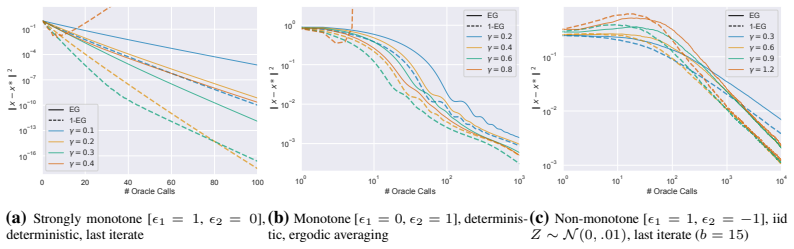
- In stochastic strongly monotone problems, the last iterate of Past Extra-Gradient converges at mean-square O(1/t), and the ergodic average at O(log t / t), under a zero-mean bounded-variance oracle.
- In non-monotone stochastic problems with a regular solution, the last iterate converges locally at O(1/t) conditioned on staying near the solution, which occurs with probability at least 1 − δ.
- Because isotropic stochastic noise rules out geometric convergence, O(1/t) is the best possible order, so the single-call penalty disappears in the asymptotic rate.
Reading between the lines
- The same event-based template should carry over to the Reflected Gradient and Optimistic Gradient variants, since all three updates coincide in the unconstrained case; the paper's explicit stochastic analysis is written for Past Extra-Gradient only.
- If the local theorem is right, near a stable equilibrium of a min-max game halving the gradient oracle cost costs nothing asymptotically; the missing practical ingredient is a computable rule for the decay offset b and the initialization ball, since the proof only says they must be large enough.
- A testable extension would derive a non-asymptotic tail bound on the escape event E∞; the current result only guarantees P(E∞) ≥ 1 − δ and bounds the conditional mean-square error.
- The proof technique suggests that local non-monotone convergence rates can be obtained for other stochastic methods with diminishing step-sizes, provided a local strong-monotonicity neighborhood can be certified.
Signed reviews
Editorial analysis
A structured set of objections, weighed in public.
Referee Report
Summary. The paper studies single-call extra-gradient (1-EG) methods for variational inequalities: Past Extra-Gradient (PEG), Reflected Gradient (RG), and Optimistic Gradient (OG). It develops a synthetic quasi-descent framework (Lemma 2) and uses it to prove that, in deterministic monotone problems with Lipschitz operators, all three variants achieve the optimal O(1/t) ergodic convergence rate (Theorem 1). It then analyzes the stochastic PEG variant: under strong monotonicity, it proves O(1/t) last-iterate convergence and O(log t/t) ergodic convergence (Theorem 5), and, near a regular solution of a possibly non-monotone VI, it proves a high-probability local O(1/t) last-iterate rate conditionally on the iterates staying in a neighborhood of the solution (Theorem 6). The appendix contains detailed proofs, including a careful event-based treatment of the conditioning bias in the stochastic local analysis.
Significance. If correct, the paper closes an important gap by showing that single-call extra-gradient methods retain the optimal rate of the two-call Extra-Gradient method in deterministic monotone problems, and it provides the first stochastic local rate guarantee for non-monotone variational inequalities under a second-order sufficient condition. The unified treatment of PEG, OG, and RG via Lemma 2 is a useful organizational contribution. The proof of Theorem 6 is careful and self-contained: it handles the zero-mean noise property under the stay-in-neighborhood filtration, controls the probability of the large-deviation events via a martingale-type recurrence, and only then applies Chung's lemma. The paper's rate claims are concrete and falsifiable, and the numerical experiments are consistent with the stated rates.
major comments (2)
- [Section 4.1, Theorem 1 and Appendix B.1] The statement of Theorem 1, Eq. (9), uses the error function Err_R defined in Eq. (4) with X_R = X ∩ B_R(0). However, the proof of Lemma 2 in Appendix B.1 explicitly replaces this by X_R = X ∩ B_R(X_1) (the ball centered at X_1). With the original definition, the bound should involve sup_{p in X∩B_R(0)} ||X_1 - p||^2, which depends on ||X_1|| and is not bounded by R^2 in general. Thus the theorem as stated is not valid under the paper's own definition of Err_R. This is load-bearing for the first contribution's quantitative claim, although the O(1/t) rate is preserved once the statement is corrected. Please either redefine Err_R in the theorem statement as centered at X_1 or adjust the right-hand side accordingly.
- [Section 4.2, Theorem 4 and Appendix B.4] Theorem 4 claims local geometric convergence for every 1-EG method under Definition 3 (regularity along rays tangent to X). But the proof in Appendix B.4 states that, since RG can evaluate V at infeasible points, the regularity condition (12) must be strengthened to hold for all z in the tangent span of X rather than only for z tangent to X. Therefore the theorem as stated overclaims for the RG variant. This is a genuine gap in the statement's generality; it should be fixed by either restricting Theorem 4 to PEG and OG or stating the stronger regularity condition for RG.
minor comments (3)
- [Abstract, Table 1, and Theorem 5] The abstract and Table 1 state an O(1/t) stochastic ergodic rate, while Eq. (14) gives O(log t / t) for the ergodic average. The table's footnote 'logarithmic factors ignored' softens this, but the main text near Theorem 5 says 'both the last iterate and the ergodic average of 1-EG achieve a O(1/t) convergence rate'; this should be reworded to avoid a strict misstatement.
- [Lemma C.2] The symbol M is overloaded: in the proof, M := 4M^2 + 4σ^2 + 4r^2σ^2 is introduced after using M = sup_{x in U} ||V(x)|| from Theorem 6. Please use a different symbol, e.g., M_bar, for the new constant to avoid confusion.
- [Theorem 6] The condition 'large enough b' is left unquantified; the proof only shows existence via Γ ≤ δ ε / M. Since the theorem is an existential local result this is acceptable, but an explicit lower bound on b in terms of α, γ, r, M, σ, and δ would strengthen the statement.
Circularity Check
No significant circularity: the convergence proofs are self-contained derivations from stated assumptions, with no fitted parameters or load-bearing self-citations.
full rationale
The paper's central claims are derived, not fitted. Theorem 1 follows from Lemma 2, a template quasi-descent inequality that is established separately for PEG, OG, and RG from projection lemmas and the stated Lipschitz/monotonicity assumptions. Theorem 5 is proved by a self-contained recursion (C.1)-(C.11) using Chung's Lemma A.3, an elementary external result whose proof is included in the appendix. Theorem 6 is likewise proved from Lemma A.4, which converts the second-order regularity condition (Definition 3, Eq. (12)) into local strong monotonicity and Lipschitz bounds on a neighborhood U; the quantities M and alpha in Theorem 6 are consequences of this lemma, not fitted inputs. The high-probability 'stay in U' event is proved via the H_t/Q_t estimates (C.25)-(C.41), and the conditional rate (C.49)-(C.51) does not assume the conclusion: it bounds E[||X_t-x*||^2 1_{E_{t-1}}] by an explicit recursion and divides by P(E_infinity)>=1-delta, which is valid because E_infinity is a subset of E_{t-1}. The few self-citations ([29], [30], [6]) are contextual or terminological and none closes a logical gap; the geometric convergence cited in Theorem 2 comes from Malitsky [26], Gidel et al. [19], and Mokhtari et al. [32], external sources, and is not the load-bearing input for the stochastic claims. Unquantified constants (b large enough, sizes of U/U1) are limitations on explicitness, not circularity: no step of the derivation reduces by construction to its own inputs.
Assumptions & free parameters
assumptions (6)
- domain assumption The solution set X* of (VI) is nonempty (Assumption 1).
- domain assumption The operator V is beta-Lipschitz continuous (Assumption 2, Eq. 5).
- domain assumption V is monotone (Assumption 3, Eq. 2).
- domain assumption V is alpha-strongly monotone (Assumption 3(s), Eq. 6).
- domain assumption The stochastic oracle is zero-mean with bounded variance (Eqs. 7 and 8).
- domain assumption x* is a regular solution: z^T Jac V(x*) z > 0 for all nonzero tangent z (Definition 3, Eq. 12).
Cite this review
Pith. "Pith review of On the convergence of single-call stochastic extra-gradient methods." pith.science (2026). https://pith.science/paper/V7VGSTGY
@misc{pith2026190808465,
  author       = {Pith},
  title        = {Pith review of: On the convergence of single-call stochastic extra-gradient methods},
  year         = {2026},
  howpublished = {\url{https://pith.science/paper/V7VGSTGY}},
  note         = {Machine review of arXiv:1908.08465}
}
abstract
Variational inequalities have recently attracted considerable interest in machine learning as a flexible paradigm for models that go beyond ordinary loss function minimization (such as generative adversarial networks and related deep learning systems). In this setting, the optimal $\mathcal{O}(1/t)$ convergence rate for solving smooth monotone variational inequalities is achieved by the Extra-Gradient (EG) algorithm and its variants. Aiming to alleviate the cost of an extra gradient step per iteration (which can become quite substantial in deep learning applications), several algorithms have been proposed as surrogates to Extra-Gradient with a \emph{single} oracle call per iteration. In this paper, we develop a synthetic view of such algorithms, and we complement the existing literature by showing that they retain a $\mathcal{O}(1/t)$ ergodic convergence rate in smooth, deterministic problems. Subsequently, beyond the monotone deterministic case, we also show that the last iterate of single-call, \emph{stochastic} extra-gradient methods still enjoys a $\mathcal{O}(1/t)$ local convergence rate to solutions of \emph{non-monotone} variational inequalities that satisfy a second-order sufficient condition.
Figures
Reference graph
Works this paper leans on
-
[1]
Adolphs, Leonard, Hadi Daneshmand, Aurelien Lucchi, Thomas Hofmann. 2019. Local saddle point optimization: a curvature exploitation approach. AISTATS ’19: Proceedings of the 22nd International Conference on Artificial Intelligence and Statistics
work page 2019
-
[2]
Bach, Francis, Kfir Y . Levy. 2019. A universal algorithm for variational inequalities adaptive to smoothness and noise. COLT ’19: Proceedings of the 32nd Annual Conference on Learning Theory
work page 2019
-
[3]
Balduzzi, David, Sebastien Racaniere, James Martens, Jakob Foerster, Karl Tuyls, Thore Graepel. 2018. The mechanics of n-player differentiable games. ICML ’18: Proceedings of the 35th International Conference on Machine Learning
work page 2018
- [4]
-
[5]
Bertsekas, Dimitri P. 1997. Nonlinear programming. Journal of the Operational Research Society 48(3) 334–334
work page 1997
-
[6]
Bo¸ t, Radu Ioan, Panayotis Mertikopoulos, Mathias Staudigl, Phan Tu Vuong. 2019. Forward-backward- forward methods with variance reduction for stochastic variational inequalities. https://arxiv.org/ abs/1902.03355. 9
work page Pith review arXiv 2019
-
[7]
Bubeck, Sébastien. 2015. Convex optimization: Algorithms and complexity. Foundations and Trends in Machine Learning 8(3-4) 231–358
work page 2015
-
[8]
Chambolle, Antonin, Thomas Pock. 2011. A first-order primal-dual algorithm for convex problems with applications to imaging. Journal of Mathematical Imaging and Vision 40(1) 120–145
work page 2011
Show all 47 references
-
[9]
Chavdarova, Tatjana, Gauthier Gidel, François Fleuret, Simon Lacoste-Julien. 2019. Reducing noise in GAN training with variance reduced extragradient. https://arxiv.org/abs/1904.08598
2019 arXiv
-
[10]
Chiang, Chao-Kai, Tianbao Yang, Chia-Jung Lee, Mehrdad Mahdavi, Chi-Jen Lu, Rong Jin, Shenghuo Zhu. 2012. Online optimization with gradual variations. COLT ’12: Proceedings of the 25th Annual Conference on Learning Theory
2012
-
[11]
Chung, Kuo-Liang. 1954. On a stochastic approximation method. The Annals of Mathematical Statistics 25(3) 463–483
1954
-
[12]
Combettes, Patrick L. 2001. Quasi-Fejérian analysis of some optimization algorithms. Dan Butnariu, Yair Censor, Simeon Reich, eds., Inherently Parallel Algorithms in Feasibility and Optimization and Their Applications. Elsevier, New York, NY , USA, 115–152
2001
-
[13]
Combettes, Patrick L., Jean-Christophe Pesquet. 2015. Stochastic quasi-Fejér block-coordinate fixed point iterations with random sweeping. SIAM Journal on Optimization 25(2) 1221–1248
2015
-
[14]
Shanbhag
Cui, Shisheng, Uday V . Shanbhag. 2016. On the analysis of reflected gradient and splitting methods for monotone stochastic variational inequality problems. CDC ’16: Proceedings of the 57th IEEE Annual Conference on Decision and Control
2016
-
[15]
Daskalakis, Constantinos, Andrew Ilyas, Vasilis Syrgkanis, Haoyang Zeng. 2018. Training GANs with optimism. ICLR ’18: Proceedings of the 2018 International Conference on Learning Representations
2018
-
[16]
Daskalakis, Constantinos, Ioannis Panageas. 2018. The limit points of (optimistic) gradient descent in min-max optimization. NIPS’18: Proceedings of the 31st International Conference on Neural Information Processing Systems
2018
-
[17]
Facchinei, Francisco, Christian Kanzow. 2007. Generalized Nash equilibrium problems. 4OR 5(3) 173–210
2007
-
[18]
Facchinei, Francisco, Jong-Shi Pang. 2003. Finite-Dimensional Variational Inequalities and Complemen- tarity Problems. Springer Series in Operations Research, Springer
2003
-
[19]
Gidel, Gauthier, Hugo Berard, Gaëtan Vignoud, Pascal Vincent, Simon Lacoste-Julien. 2019. A variational inequality perspective on generative adversarial networks.ICLR ’19: Proceedings of the 2019 International Conference on Learning Representations
2019
-
[20]
Gidel, Gauthier, Reyhane Askari Hemmat, Mohammad Pezehski, Rémi Le Priol, Gabriel Huang, Simon Lacoste-Julien, Ioannis Mitliagkas. 2019. Negative momentum for improved game dynamics. AISTATS ’19: Proceedings of the 22nd International Conference on Artificial Intelligence and Statistics
2019
-
[21]
Goodfellow, Ian J., Jean Pouget-Abadie, Mehdi Mirza, Bing Xu, David Warde-Farley, Sherjil Ozair, Aaron Courville, Yoshua Bengio. 2014. Generative adversarial nets. NIPS ’14: Proceedings of the 27th International Conference on Neural Information Processing Systems
2014
-
[22]
Oliveira, Philip Thompson
Iusem, Alfredo N., Alejandro Jofré, Roberto I. Oliveira, Philip Thompson. 2017. Extragradient method with variance reduction for stochastic variational inequalities. SIAM Journal on Optimization 27(2) 686–724
2017
-
[23]
Juditsky, Anatoli, Arkadi Semen Nemirovski, Claire Tauvel. 2011. Solving variational inequalities with stochastic mirror-prox algorithm. Stochastic Systems 1(1) 17–58
2011
-
[24]
Korpelevich, G. M. 1976. The extragradient method for finding saddle points and other problems. Èkonom. i Mat. Metody 12 747–756
1976
-
[25]
Liang, Tengyuan, James Stokes. 2019. Interaction matters: A note on non-asymptotic local convergence of generative adversarial networks. AISTATS ’19: Proceedings of the 22nd International Conference on Artificial Intelligence and Statistics
2019
-
[26]
Malitsky, Yura. 2015. Projected reflected gradient methods for monotone variational inequalities. SIAM Journal on Optimization 25(1) 502–520
2015
-
[27]
Malitsky, Yura. 2019. Golden ratio algorithms for variational inequalities. Mathematical Programming 1–28
2019
-
[28]
Mazumdar, Eric V , Michael I Jordan, S Shankar Sastry. 2019. On finding local nash equilibria (and only local nash equilibria) in zero-sum games. https://arxiv.org/abs/1901.00838
2019 arXiv
-
[29]
Mertikopoulos, Panayotis, Bruno Lecouat, Houssam Zenati, Chuan-Sheng Foo, Vijay Chandrasekhar, Georgios Piliouras. 2019. Optimistic mirror descent in saddle-point problems: Going the extra (gradient) mile. ICLR ’19: Proceedings of the 2019 International Conference on Learning ...
2019
-
[30]
Mertikopoulos, Panayotis, Zhengyuan Zhou. 2019. Learning in games with continuous action sets and unknown payoff functions. Mathematical Programming 173(1-2) 465–507. 10
2019
-
[31]
Mokhtari, Aryan, Asuman Ozdaglar, Sarath Pattathil. 2019. Convergence rate ofO(1/k) for optimistic gradient and extra-gradient methods in smooth convex-concave saddle point problems. https://arxiv. org/pdf/1906.01115.pdf
2019 arXiv
-
[32]
Mokhtari, Aryan, Asuman Ozdaglar, Sarath Pattathil. 2019. A unified analysis of extra-gradient and optimistic gradient methods for saddle point problems: proximal point approach. https://arxiv.org/ abs/1901.08511v2
2019 arXiv
-
[33]
Nemirovski, Arkadi Semen. 2004. Prox-method with rate of convergenceO(1/t) for variational inequalities with Lipschitz continuous monotone operators and smooth convex-concave saddle point problems. SIAM Journal on Optimization 15(1) 229–251
2004
-
[34]
Nesterov, Yurii. 2004. Introductory Lectures on Convex Optimization: A Basic Course. No. 87 in Applied Optimization, Kluwer Academic Publishers
2004
-
[35]
Nesterov, Yurii. 2007. Dual extrapolation and its applications to solving variational inequalities and related problems. Mathematical Programming 109(2) 319–344
2007
-
[36]
Nesterov, Yurii. 2009. Primal-dual subgradient methods for convex problems. Mathematical Programming 120(1) 221–259
2009
-
[37]
Nikaido, Hukukane, Kazuo Isoda. 1955. Note on non-cooperative convex games. Pacific Journal of Mathematics 5 807–815
1955
-
[38]
Peng, Wei, Yu-Hong Dai, Hui Zhang, Lizhi Cheng. 2019. Training GANs with centripetal acceleration. https://arxiv.org/abs/1902.08949
2019 arXiv
-
[39]
Popov, Leonid Denisovich. 1980. A modification of the Arrow–Hurwicz method for search of saddle points. Mathematical Notes of the Academy of Sciences of the USSR 28(5) 845–848
1980
-
[40]
Rakhlin, Alexander, Karthik Sridharan. 2013. Online learning with predictable sequences. COLT ’13: Proceedings of the 26th Annual Conference on Learning Theory
2013
-
[41]
Rakhlin, Alexander, Karthik Sridharan. 2013. Optimization, learning, and games with predictable se- quences. NIPS ’13: Proceedings of the 26th International Conference on Neural Information Processing Systems
2013
-
[42]
Ratliff, Lillian J, Samuel A Burden, S Shankar Sastry. 2013. Characterization and computation of local nash equilibria in continuous games. 2013 51st Annual Allerton Conference on Communication, Control, and Computing (Allerton). IEEE, 917–924
2013
-
[43]
Rosen, J. B. 1965. Existence and uniqueness of equilibrium points for concaveN-person games. Econo- metrica 33(3) 520–534
1965
-
[44]
Tseng, Paul. 1995. On linear convergence of iterative methods for the variational inequality problem. Journal of Computational and Applied Mathematics 60(1-2) 237–252
1995
-
[45]
Tseng, Paul. 2000. A modified forward-backward splitting method for maximal monotone mappings. SIAM Journal on Control and Optimization 38(2) 431–446
2000
-
[46]
E and notF
Yadav, Abhay, Sohil Shah, Zheng Xu, David Jacobs, Tom Goldstein. 2018. Stabilizing adversarial nets with prediction methods. ICLR ’18: Proceedings of the 2018 International Conference on Learning Representations. 11 A Technical lemmas Lemma A.1. Letx,y∈ Rd andC⊆ Rd be a closed...
2018
-
[47]
SinceX 3 2 ∈X , it follows thatX 3 2 ∈U
On the other hand, 2‖X 3 2 −X1‖2 = 2‖ΠX (X1−γ1V 1 2 )− ΠX (X1)‖2≤ 2γ1‖V 1 2 ‖2 =Q0 (C.19) For any realization in H0, we have 2γ1‖V 1 2 ‖2 ≤ r2 8 ; and so we can deduce from (C.18) that ‖X 3 2 −x⋆‖2≤ r2 4 <r 2. SinceX 3 2 ∈X , it follows thatX 3 2 ∈U. This means thatH0⊆E1. Indu...
Reviewed August 14, 2026 · model on record in the stance chip above.
Discussion (0). Continue with ORCID to comment.