REVIEW 2 major objections 5 minor 13 references
Stackelberg Punishment and Bully-Proofing Autonomous Vehicles
T0 review · 2 major / 5 minor · reviewed 2026-08-14 · deepseek-v4-flash
Pith's one-line read A self-driving car that retaliates against bullying with a computed Stackelberg punishment—capping the human driver's reward while maximizing its own—significantly reduces repeat bullying in a simulated bridge-crossing game.
desk verdict Clean theoretical extension, but the experiment confounds the punishment policy with horn signaling, so the empirical headline is weaker than the data. read the letter →
The pith
A machine-rendered reading of the paper's core claim, the machinery that carries it, and where it could break.
The reading
What carries the argument
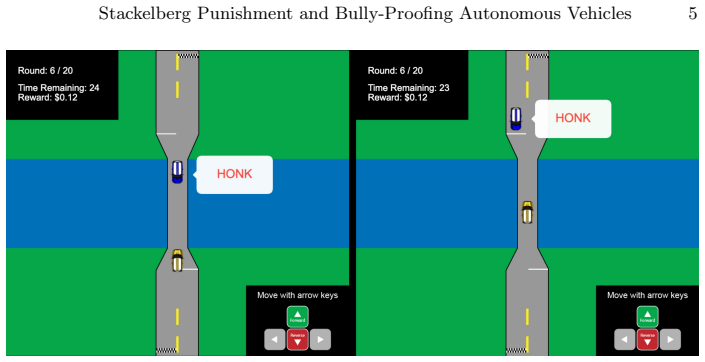
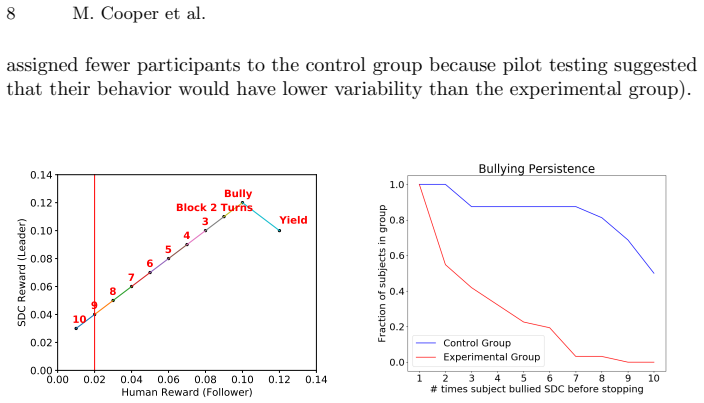
The load-bearing object is the Stackelberg punishment policy computed on a tree-based alternating-move game: a tree whose nonterminal states are partitioned between leader-controlled and follower-controlled nodes, with terminal rewards, where the leader maximizes its own expected value against the follower's best response subject to the follower's value being at most $\theta$. The paper shows that the Letchford-Conitzer line-segment representation of achievable payoffs for a Stackelberg equilibrium can be adapted by inspecting, for each payoff segment, the endpoints and the point where the follower's value equals $\theta$, preserving the $O(mn^2)$ running time. On the 16-state abstraction of the one-lane bridge (a tree with 2,621,437 nodes and 1,572,862 leaves), setting $\theta = \$0.02$ yields a 'block' policy: the self-driving car crosses first and drives slowly for nine steps, capping the human's reward. A tit-for-tat mode-switching rule—cooperative after fair play, punishing after bullying—together with the horn signal is the enforcement mechanism that converts the static punishment into a repeated-game deterrent.
What would settle it
Compare repeat-bullying rates in a condition where the cautious self-driving car honks exactly as often as the punishing car while still always yielding, and in a condition where the punishing policy is silent. If the cautious-honking condition reproduces the reported reduction, or the silent-punishing condition does not, the paper's attribution of the effect to the Stackelberg punishment policy is refuted.
Extended reading notes
Core claim
The central claim is that a tit-for-tat enforcement policy built on a Stackelberg punishment reduces repeat bullying by human drivers in a social driving scenario. Formally, a Stackelberg punishment is the policy a leader would commit to while assuming the follower best-responds, under the additional constraint that the follower's expected payoff stays at or below a cap $\theta$; this generalizes a Stackelberg equilibrium, which is the $\theta = \infty$ case. The authors adapt an existing efficient algorithm for Stackelberg equilibria in tree-based games to compute such punishments without increasing the $O(mn^2)$ complexity, by checking the endpoints and intersection points of the payoff line segments. In the experiment, the punishment policy computed at $\theta = \$0.02$ made the virtual car take the bridge first and drive slowly enough to cap the participant's reward, and the car switched to this mode for the round after any bullying, using honks to signal its state. Among participants who bullied at least once, 14 of 31 experimental participants bullied only once versus 0 of 16 control participants, with Fisher exact $p = 0.0016$; the authors interpret this as evidence that the adaptive Stackelberg punishment policy significantly discouraged repeat bullying, while noting that further work is needed to separate the policy's effect from the effect of honking.
Load-bearing premise
The load-bearing assumption is that the adaptive Stackelberg punishment policy—not the horn—causes the reduction in repeat bullying; the experimental condition differed from control in both the policy and horn usage, a confound the paper itself flags as unresolved.
Editorial extensions
If this is right
- If the result replicates, autonomous vehicles can deter exploitation in repeated interactions without learning unsafe behaviors such as ramming, because the punishment is selected to be the best the car can do while still limiting the other driver's payoff.
- The same computation runs in polynomial time on any tree-based game for which a Stackelberg equilibrium can be computed, so the approach transfers to other structured social-negotiation settings at no additional algorithmic cost.
- A tit-for-tat response rule—cooperate after fair play, punish after bullying—appears sufficient to change most human drivers' behavior after a single punishing round, suggesting a simple and interpretable enforcement rule for early deployment.
- The paper itself notes that scaling to richer driving scenarios will require more efficient algorithms, because allowing stochastic transitions, simultaneous actions, or DAG-structured transitions makes the Stackelberg punishment problem NP-hard.
- The adoption of a horn as a social signaling device is presented as a contribution in its own right, opening a new design consideration for how self-driving cars communicate intent to human road users.
Reading between the lines
- The horn is a confound the paper itself flags: the punishing condition honks the entire round, the cooperative condition honks while bullied, and the control never honks. A natural next experiment would hold horn usage constant across conditions; if honking alone explains the behavioral change, the policy attribution would fail.
- Because participants were recruited only from the United States, the right-of-way norm tested here is one cultural convention; the same Stackelberg-punishment machinery could be tuned to different norms by changing the reward cap and the definition of bullying.
- The Stackelberg-punishment formulation is not tied to driving: any repeated human-agent interaction in which the agent can impose delay or cost—queue entry, pedestrian-robot negotiation, resource allocation—can be tuned by the single harshness parameter $\theta$.
- The sample is small (31 versus 16 participants who bullied at least once), so the reported p-value is suggestive; a pre-registered replication with more participants and pre-specified outcomes would give a sharper estimate of the effect size.
Signed reviews
Editorial analysis
A structured set of objections, weighed in public.
Referee Report
Summary. The paper defines 'Stackelberg punishment' as a constrained variant of a Stackelberg equilibrium in alternating-move tree games: the leader maximizes its own payoff against a best-responding follower subject to the follower's expected payoff being at most θ. It sketches an extension of the Letchford-Conitzer algorithm that preserves the O(mn^2) complexity by checking line-segment endpoints and intersections. The idea is applied to a one-lane bridge driving game played online: a simulated self-driving car uses a tit-for-tat policy—cooperative after compliant behavior, and a blocking Stackelberg punishment (θ = $0.02) after being bullied, with horn signals. In a Mechanical Turk study (18 control, 37 experimental participants), the experimental group showed fewer repeat bullying incidents (Fisher exact p = 0.0016), and the paper concludes that Stackelberg punishment discourages bullying.
Significance. The Stackelberg-punishment formulation is a natural and useful generalization of Stackelberg equilibrium, and the proposed algorithmic extension is elegant and complexity-preserving if correct. The driving scenario is a compelling application area for computational game theory. The paper is also commendably clear about the limits of the current experiment in Section 4.3. However, because the empirical treatment differs from control in both the adaptive policy and horn use, the current data do not isolate the effect of the punishment policy; the abstract and conclusions overstate what the evidence supports. With additional experimental conditions or suitably narrowed claims, the work could be a valuable contribution to human-agent interaction and social driving.
major comments (2)
- [§4.3, Fig. 1] The experimental manipulation confounds the adaptive Stackelberg policy with horn signaling. In the experimental group the SDC honks while being bullied in cooperative mode and for the entire round in punishing mode, while in the control group the SDC never honks. The paper itself states that 'Further experimentation is necessary to decorrelate the effects of honking from the effects of the adaptive policy,' yet the Abstract and Section 5 attribute the reduction in repeat bullying to the adaptive policy. Since an aversive auditory signal could plausibly deter bullying independently of the computed punishment, the significant Fisher exact test (p = 0.0016) does not establish the causal role of the Stackelberg punishment policy. The exit-survey self-reports cannot resolve this confound. The authors should either add a horn-only control condition (or a 2x2 policy-by-horn design) or explicitly reframe the finding as an effect of the combined intervention rather than of the Stackelberg punishment alone.
- [§2] The theoretical claim that the constrained Stackelberg-punishment search can be performed within the original O(mn^2) bound is stated informally. The paper provides no formal theorem or correctness proof for the constrained variant, nor does it state the invariant that the maintained point/line-segment sets are exactly the leader-optimal frontier after the follower-best-response reduction. As the algorithm is a central contribution, a rigorous correctness proof (or a precise reference to a proof in a longer version) is needed to support the optimality and complexity claims.
minor comments (5)
- [§4.4, Table 1] The Fisher exact test is reported as p = 0.0016, but no effect size, confidence interval, or alternative measure of association is given; please report an odds ratio or risk difference with a confidence interval to help readers judge the magnitude of the effect.
- [§4.3] The paper does not report the exact wording of the post-experiment survey questions or the response scales for the fairness ratings, which limits the interpretability of the self-report results.
- [§2] The notation 'sr' for the root state is easy to confuse with an index or subscript; using 's_r' or 's0' would improve readability.
- [§4.1] The tree statistics (2,621,437 nodes and 1,572,862 leaves) are not obviously consistent with a full ternary tree; please state how early termination is handled so that readers can reproduce the game-tree construction.
- [General] No code or anonymized data are provided; for an empirical human-subjects study, making the experimental interface, logging code, and analysis scripts available would materially improve reproducibility.
Circularity Check
No circularity: the Stackelberg-punishment derivation is externally grounded and the experiment tests it independently; the horn confound is an experimental validity concern, not a circularity.
full rationale
The paper's theoretical chain is not circular. Stackelberg punishment is defined as argmax_{π_A: V_B(π_A,M(π_A)) ≤ θ} V_A(π_A,M(π_A)) (Section 2), extending the external Letchford-Conitzer Stackelberg equilibrium algorithm; the threshold θ = $0.02 is a design parameter, not fitted to the outcome data. The empirical claim that the adaptive policy reduces repeat bullying is tested with a Fisher exact test (Section 4.4) against a control group, so the conclusion is not forced by the equations. The paper explicitly flags the horn confound: 'Further experimentation is necessary to decorrelate the effects of honking from the effects of the adaptive policy' (Section 4.3). That admission is a validity limitation, not a circular reduction: the honking condition is bundled with the policy in the experimental manipulation, but no fitted constant or definitional identity makes the behavioral result true by construction. The self-citations to [8,10] for the folk-theorem switching rule are not load-bearing; they support a standard repeated-game incentive structure, while the main algorithm relies on the external Letchford-Conitzer approach. No equation, fitted parameter, or cited theorem makes the conclusion equivalent to its inputs.
Assumptions & free parameters
free parameters (1)
- theta (follower reward cap) =
$0.02
assumptions (3)
- domain assumption The follower adopts a best response to the leader's policy (M(pi_A)).
- standard math The repeated-game folk theorem structure (tit-for-tat cooperation with punishment) stabilizes cooperative behavior.
- domain assumption The abstracted four-position, depth-20 tree game captures the essential strategic structure of the one-lane bridge scenario.
Cite this review
Pith. "Pith review of Stackelberg Punishment and Bully-Proofing Autonomous Vehicles." pith.science (2026). https://pith.science/paper/AN6OJ652
@misc{pith2026190808641,
  author       = {Pith},
  title        = {Pith review of: Stackelberg Punishment and Bully-Proofing Autonomous Vehicles},
  year         = {2026},
  howpublished = {\url{https://pith.science/paper/AN6OJ652}},
  note         = {Machine review of arXiv:1908.08641}
}
read the original abstract
Mutually beneficial behavior in repeated games can be enforced via the threat of punishment, as enshrined in game theory's well-known "folk theorem." There is a cost, however, to a player for generating these disincentives. In this work, we seek to minimize this cost by computing a "Stackelberg punishment," in which the player selects a behavior that sufficiently punishes the other player while maximizing its own score under the assumption that the other player will adopt a best response. This idea generalizes the concept of a Stackelberg equilibrium. Known efficient algorithms for computing a Stackelberg equilibrium can be adapted to efficiently produce a Stackelberg punishment. We demonstrate an application of this idea in an experiment involving a virtual autonomous vehicle and human participants. We find that a self-driving car with a Stackelberg punishment policy discourages human drivers from bullying in a driving scenario requiring social negotiation.
Figures
Reference graph
Works this paper leans on
-
[1]
Basu, C., Yang, Q., Hungerman, D., Singhal, M., Dragan, A.D.: Do you want your autonomous car to drive like you? In: ACM/IEEE International Conference on Human-Robot Interaction. pp. 417–425 (2017)
work page 2017
-
[2]
Berkeley Technology Law Journal 31, 851– 878 (2016)
Brodsky, J.S.: Autonomous vehicle regulation: How an uncertain legal landscape may hit the brakes on self-driving cars. Berkeley Technology Law Journal 31, 851– 878 (2016)
work page 2016
-
[3]
Brooks, R.: Unexpected consequences of self driving cars (2017), blog post: rodneybrooks.com/unexpected-consequences-of-self-driving-cars/
work page 2017
-
[4]
Bruce, A.: Planning for human-robot interaction: Representing time and human intention (2005), phD thesis, Thesis, Robotics Institute, Carnegie Mellon Univer- sity
work page 2005
-
[5]
Chesterman, S.: Do driverless cars dream of electric sheep? SSRN (2016), available at SSRN: https://ssrn.com/abstract=2833701 or http://dx.doi.org/10.2139/ssrn.2833701
-
[6]
Information and Computation 96(2), 203–224 (February 1992)
Condon, A.: The complexity of stochastic games. Information and Computation 96(2), 203–224 (February 1992)
work page 1992
-
[7]
In: Proceedings of the 11th ACM Conference on Electronic Commerce
Letchford, J., Conitzer, V.: Computing optimal strategies to commit to in extensive-form games. In: Proceedings of the 11th ACM Conference on Electronic Commerce. pp. 83–92. ACM (2010)
work page 2010
-
[8]
Decision Support Systems 39(1), 55–66 (2005)
Littman, M.L., Stone, P.: A polynomial-time Nash equilibrium algorithm for re- peated games. Decision Support Systems 39(1), 55–66 (2005)
work page 2005
Show all 13 references
-
[9]
Littman, M.L.: Algorithms for Sequential Decision Making. Ph.D. thesis, Depart- ment of Computer Science, Brown University (February 1996), also Technical Re- port CS-96-09
1996
-
[10]
In: 24th Conference on Uncertainty in Artificial Intelligence (UAI’08) (2008)
Munoz de Cote, E., Littman, M.L.: A polynomial-time Nash equilibrium algorithm for repeated stochastic games. In: 24th Conference on Uncertainty in Artificial Intelligence (UAI’08) (2008)
2008
-
[11]
The MIT Press (1994)
Osborne, M.J., Rubinstein, A.: A Course in Game Theory. The MIT Press (1994)
1994
-
[12]
Proceedings of the National Academy of Sciences of the United States of America 39, 1095–1100 (1953) Stackelberg Punishment and Bully-Proofing Autonomous Vehicles 11
Shapley, L.: Stochastic games. Proceedings of the National Academy of Sciences of the United States of America 39, 1095–1100 (1953) Stackelberg Punishment and Bully-Proofing Autonomous Vehicles 11
1953
-
[13]
Tennant, C., Howard, S., Franks, B., Bauer, M.W.: Autonomous vehicles: Nego- tiating a place on the road (2016), online report: http://www.lse.ac.uk/website- archive/newsAndMedia/PDF/AVs-negociating-a-place-on-the-road-1110.pdf
2016
Reviewed August 14, 2026 · model on record in the stance chip above.
Discussion (0). Continue with ORCID to comment.