REVIEW 4 major objections 6 minor 25 references
A BLSTM Network for Printed Bengali OCR System with High Accuracy
T0 review · 4 major / 6 minor · reviewed 2026-08-14 · deepseek-v4-flash
Pith's one-line read A single-layer BLSTM-CTC network trained on 47,720 printed text lines achieves 99.32% character and 96.65% word accuracy on Bengali, beating Google Drive OCR and Tesseract 4.0.
desk verdict A useful engineering report on a Bengali line-level OCR with plausible numbers, but the train/test split and no-peephole/dropout claims are not documented well enough to take the headline accuracy on faith. read the letter →
The pith
A machine-rendered reading of the paper's core claim, the machinery that carries it, and where it could break.
The reading
What carries the argument
The load-bearing object is the BLSTM-CTC stack: a bidirectional long short-term memory network with a forward and a backward sub-layer of 128 units each, whose outputs are combined and fed into a connectionist temporal classification output layer with one unit per class plus a blank label. The CTC layer learns to align each input line image directly with its Unicode ground truth, eliminating word and character segmentation; during testing it decodes with beam search. The paper's additional trick is using Unicode's hasant (halant) convention to represent compound characters as consonant-hasant-consonant sequences, so that 166 labels can generate the script's hundreds of conjunct shapes.
What would settle it
Scan a fresh set of printed Bengali pages in fonts not included among the roughly twenty training fonts, at the same 300 dpi, and run the released system; if per-font character accuracy on those out-of-training fonts averages well below 99.32%, the central generalization claim is falsified.
Extended reading notes
Core claim
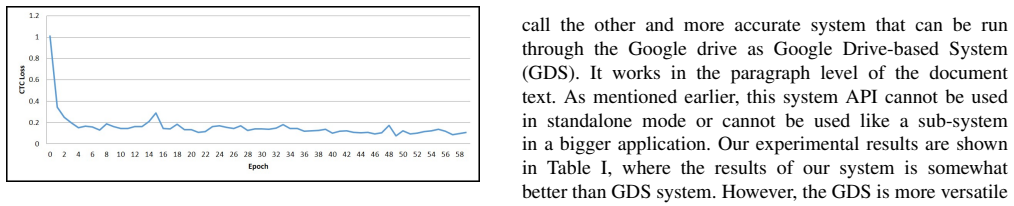
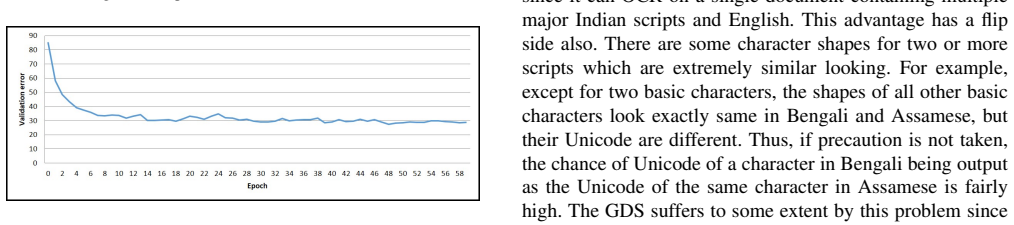
On the paper's own terms, the central discovery is that a deliberately simplified network—one hidden BLSTM layer with 128 units per direction, no peephole connections, no dropout, and a CTC output layer—is sufficient to recognize printed Bengali text lines at high accuracy. Trained on 47,720 line images (including 4,500 English lines), validated on 1,500, and tested on 6,645 lines from about 20 common fonts, the system attains 99.32% character accuracy and 96.65% word accuracy by minimum edit distance. This is reported as higher than the Google Drive OCR (98.54% character, 92.86% word) and Tesseract 4.0 (91.79% character, 76.31% word). The paper attributes the accuracy partly to the absence of peephole connections, which reduced CTC loss, and partly to representing Bengali compound characters through Unicode hasant sequences, so that 166 output labels cover the roughly 400 glyph shapes of the script. A further claimed advantage is freedom from Bengali-Assamese Unicode confusion, because the system is Bengali-only.
Load-bearing premise
The test set of 6,645 lines is representative of printed Bengali documents and does not overlap with the training lines in fonts or content, so the 99.32% and 96.65% figures measure generalization rather than memorization.
Editorial extensions
If this is right
- If these numbers hold, printed Bengali OCR can be built from a single BLSTM hidden layer and roughly 48,000 training lines, without segmentation-dependent preprocessing.
- This accuracy level makes the system usable as a standalone OCR component for Bengali-English documents, unlike online multi-script services that cannot be embedded.
- The line-based, segmentation-free design shifts error burden to line detection; better line extraction, such as combining with the CTPN detector the authors mention, should further improve end-to-end accuracy.
- Expanding from Bengali to Assamese becomes an incremental label-extension task, since the scripts share nearly all glyph shapes; the challenge is preventing the Unicode substitution errors the paper identifies in multi-script systems.
- Since 128 units beat 156 units, the paper suggests performance on this training set is data-limited rather than capacity-limited; more training data may unlock deeper architectures.
Reading between the lines
- The reported test accuracy should be read as an upper bound for clean 300-dpi scans in common Bengali fonts; performance on degraded documents, unusual typefaces, or historical fonts such as the excluded Lino-Monotype faces is untested and likely lower.
- The ambiguity about whether the "about 20" training fonts and the "20 different" test fonts overlap leaves open the possibility that part of the accuracy reflects font familiarity rather than script-level generalization; a font-disjoint evaluation would settle it.
- Because the system outputs Unicode sequences, it inherits the Unicode representation of Bengali compound characters as hasant sequences; users who prefer precomposed conjunct glyphs may need a post-processing normalization step.
- The Bengali-only design is what avoids Assamese confusion, so extending to Assamese will reintroduce exactly the cross-script ambiguity noted in the Google system unless the model adds script-specific context or separate output labels.
Signed reviews
Editorial analysis
A structured set of objections, weighed in public.
Referee Report
Summary. The paper proposes a printed Bengali (and English) OCR system based on a single-hidden-layer BLSTM with a CTC output layer, trained on 47,720 text lines and evaluated on 6,645 lines. It reports 99.32% character accuracy and 96.65% word accuracy, outperforming Tesseract 4.0 and the Google Drive OCR system on the same test set. The abstract and Section III also claim that omitting peephole connections and dropout improves accuracy. The system is made available online. The core contribution is empirical: a relatively simple, line-level BLSTM-CTC model with a small training set achieves high accuracy on printed Bengali, and its performance is compared against two widely used systems.
Significance. If the reported accuracies are reliable, the system represents a practically useful Bengali OCR with a modest training-data requirement, and the comparison with Google Drive OCR and Tesseract is valuable for practitioners. The paper provides concrete numbers, a reproducible architecture description (equations for the LSTM cell and BLSTM combination), and an online deployment, which are strengths. However, the evaluation is under-specified in ways that directly affect the central claim: the overlap between training and test fonts is ambiguous, the comparison protocol with the other systems is not described, and no error bars or per-font results are given. The claimed benefit of removing peephole connections and dropout is stated without an ablation. These gaps prevent the reader from assessing whether the headline accuracy reflects generalization to unseen Bengali documents or in-distribution performance on the same font population used in training.
major comments (4)
- [Section IV, first paragraph] The report does not establish that the test set is disjoint from the training set in the way required by the central generalization claim. The paper says training uses 'about 20' common fonts and testing is over '20 different Bengali fonts,' but it never states whether the two font sets are disjunct, whether any test line or source document was also used in training, or how the 6,645 test lines were sampled from the stated categories (books, letters, newspapers, notices, magazines). If test fonts overlap training fonts, the CTC model can memorize font-specific rendering patterns, and the reported 99.32% character accuracy measures in-distribution fit rather than generalization. Please specify the exact font lists, the disjointness of documents/lines, and the sampling procedure.
- [Section IV, Table I and preceding paragraph] The comparison against Tesseract 4.0 and Google Drive OCR is not sufficiently controlled. The text does not state whether all three systems received exactly the same line images (or the same page images, in the case of the paragraph-level Google Drive system), whether the same ground-truth strings and evaluation script were used, or whether any automatic line segmentation was applied before feeding images to the proposed system. Because the proposed system is line-based while GDS is paragraph-based, differences in preprocessing alone could explain part of the 0.78 percentage-point character-accuracy gap, which corresponds to roughly 2,900 characters out of 369,931. The authors should describe the exact input protocol for each system, including how line images were produced and whether all systems shared them.
- [Section III, Proposed Method and Abstract] The claim that removing peephole connections and dropout improves accuracy is not supported by any experimental evidence. The text states that deletion of peephole 'reduced the CTC loss substantially' and the abstract asserts it 'helped us in getting better accuracy,' but no ablation results, loss values, or accuracy numbers with and without these components are reported. Since this is a stated finding, it should be documented, for instance by reporting validation/test accuracy for the configurations with and without peephole and dropout.
- [Section IV, results discussion] No confidence intervals, per-font breakdowns, or error analyses are provided. The reported accuracies are point estimates on a single test set; without an estimate of variance or a per-font table, the 0.78% advantage over GDS cannot be distinguished from sampling fluctuation. The authors should provide, at minimum, per-font character and word accuracies and a confidence interval for the aggregate accuracy, or an explicit statement that the test set size makes these differences statistically reliable.
minor comments (6)
- [Section IV, last paragraph before Table I] The sentence 'The experimental results are shows in Table I' contains a grammatical error ('are shows' should be 'are shown').
- [Section IV, first paragraph] The phrase 'about 20' common fonts in training and '20 different Bengali fonts' in testing is ambiguous. Please clarify how many fonts are in each set and whether the test font list is exactly known and distinct from the training list.
- [Section III, line detection description] The text line detection method is referred to as 'our previous unpublished method' with a brief description, but no reference or algorithmic detail is given. Since line detection is part of the end-to-end OCR pipeline, this makes the method not fully reproducible. Please cite a publication or provide pseudocode.
- [Equations in Section III] The BLSTM equations as typeset contain garbled subscripts and superscripts (e.g., the notation for the forward and backward weight matrices and the hidden-state recurrence). Please correct the mathematical typesetting so the equations are unambiguous.
- [Section IV, discussion of GDS] The assertion that 'Our OCR is free from such errors' (referring to Bengali/Assamese Unicode confusion) is presented without quantitative evidence. It would be more precise to state that no such errors were observed in the reported test set, rather than making an absolute claim.
- [Reference [11]] The phrase 'to be available online' is awkward and outdated; the reference should indicate the actual availability status or simply state the repository URL.
Circularity Check
No circularity: the reported OCR accuracy is an empirically measured test-set result with standard validation-based model selection, not a quantity forced by the paper's definitions or self-citations.
full rationale
The paper makes no first-principles derivation whose conclusion is equivalent to its input. Its central claim is the measured character accuracy (99.32%) and word accuracy (96.65%) on a 6,645-line test set, computed by the explicit Minimum Edit Distance formulas in Section IV; these formulas are evaluation definitions, not a derivation that presupposes the result. The BLSTM-CTC architecture is standard, and the stated choices (128 units, no peephole connections, no dropout, 48 epochs) are justified by validation-set CTC loss and validation error, which is conventional model selection rather than fitting the test set or renaming a fitted parameter as a prediction. The comparison with Google Drive OCR and Tesseract 4.0 is an external benchmark, not an input to the method. The only self-citation with overlapping authorship, reference [6] by Chaudhuri and Pal, is used for historical context about early Bengali OCR and is not load-bearing for the current architecture or results. The concern that training and test fonts or lines may overlap is a data-protocol validity question; if true it would undermine generalization claims, but it does not make the reported numbers circular, because they are not forced by construction or by any cited result. The paper is self-contained as an empirical evaluation, so the circularity score is 0.
Assumptions & free parameters
free parameters (7)
- hidden_units =
128
- learning_rate =
0.0001
- momentum =
0.9
- max_epochs =
80
- line_height =
48 pixels
- peephole_connections =
disabled
- dropout =
disabled
assumptions (4)
- domain assumption The 6,645 test lines are representative of Bengali printed documents and independent of the training set.
- domain assumption A normalized line height of 48 pixels preserves enough information for recognition.
- ad hoc to paper Removing peephole connections and dropout improves accuracy.
- domain assumption The 166 CTC labels plus the Unicode hasant composition rule cover all Bengali characters, including compound characters.
Cite this review
Pith. "Pith review of A BLSTM Network for Printed Bengali OCR System with High Accuracy." pith.science (2026). https://pith.science/paper/3NPIWHVY
@misc{pith2026190808674,
  author       = {Pith},
  title        = {Pith review of: A BLSTM Network for Printed Bengali OCR System with High Accuracy},
  year         = {2026},
  howpublished = {\url{https://pith.science/paper/3NPIWHVY}},
  note         = {Machine review of arXiv:1908.08674}
}
read the original abstract
This paper presents a printed Bengali and English text OCR system developed by us using a single hidden BLSTM-CTC architecture having 128 units. Here, we did not use any peephole connection and dropout in the BLSTM, which helped us in getting better accuracy. This architecture was trained by 47,720 text lines that include English words also. When tested over 20 different Bengali fonts, it has produced character level accuracy of 99.32% and word level accuracy of 96.65%. A good Indic multi script OCR system is also developed by Google. It sometimes recognizes a character of Bengali into the same character of a non-Bengali script, especially Assamese, which has no distinction from Bengali, except for a few characters. For example, Bengali character for 'RA' is sometimes recognized as that of Assamese, mainly in conjunct consonant forms. Our OCR is free from such errors. This OCR system is available online at https://banglaocr.nltr.org
Figures


Figures from the paper (3 more)

Reference graph
Works this paper leans on
-
[1]
S. Hochreiter and J. Schmidhuber, “Long short-term memory,” Neural Comput. , vol. 9, no. 8, pp. 1735–1780, Nov. 1997. [Online]. Available: http://dx.doi.org/10.1162/ neco.1997.9.8.1735
work page 1997
-
[2]
Bidirectional recurrent neural networks,
M. Schuster and K. K. Paliwal, “Bidirectional recurrent neural networks,” IEEE Transactions on Signal Processing , vol. 45, no. 11, pp. 2673–2681, Nov 1997
work page 1997
-
[3]
A. Graves, S. Fern ´andez, F. Gomez, and J. Schmidhuber, “Connectionist temporal classification: Labelling unseg- mented sequence data with recurrent neural networks,” in Proceedings of the 23rd International Conference on Machine Learning , ser. ICML ’06. New York, NY , USA: ACM, 2006, pp. 369–376. [Online]. Available: http://doi.acm.org/10.1145/1143844.1143891
-
[4]
Offline handwriting recognition with multidimensional recurrent neural networks,
A. Graves and J. Schmidhuber, “Offline handwriting recognition with multidimensional recurrent neural networks,” in Proceedings of the 21st International Conference on Neural Information Processing Systems, ser. NIPS’08. USA: Curran Associates Inc., 2008, pp. 545–552. [Online]. Available: http://dl.acm.org/citation.cfm?id=2981780.2981848
-
[5]
Unconstrained on-line handwriting recogni- tion with recurrent neural networks,
A. Graves, M. Liwicki, H. Bunke, J. Schmidhuber, and S. Fern ´andez, “Unconstrained on-line handwriting recogni- tion with recurrent neural networks,” in Advances in Neural Information Processing Systems 20 , J. C. Platt, D. Koller, Y . Singer, and S. T. Roweis, Eds. Curran Associates, Inc., 2008, pp. 577–584
work page 2008
-
[6]
A complete printed bangla OCR system,
B. B. Chaudhuri and U. Pal, “A complete printed bangla OCR system,” Pattern Recognition , vol. 31, no. 5, pp. 531–549, 1998. [Online]. Available: https://doi.org/10.1016/ S0031-3203(97)00078-2
work page 1998
-
[7]
A complete OCR system for gurmukhi script,
G. S. Lehal and C. Singh, “A complete OCR system for gurmukhi script,” in Structural, Syntactic, and Statistical Pattern Recognition, Joint IAPR International Workshops SSPR 2002 and SPR 2002, Windsor, Ontario, Canada, August 6-9, 2002, Proceedings , 2002, pp. 358–367. [Online]. Available: https://doi.org/10.1007/3-540-70659-3 37
-
[8]
A gurmukhi script recognition system,
G. S. Lehal and C. Singh, “A gurmukhi script recognition system,” in Proceedings 15th International Conference on Pattern Recognition. ICPR-2000, vol. 2, Sep. 2000, pp. 557– 560 vol.2
work page 2000
Show all 25 references
-
[9]
A bilingual ocr for hindi-telugu documents and its applications,
C. V . Jawahar, M. N. S. S. K. Pavan Kumar, and S. S. Ravi Kiran, “A bilingual ocr for hindi-telugu documents and its applications,” in Seventh International Conference on Document Analysis and Recognition, 2003. Proceedings., Aug 2003, pp. 408–412 vol.1
2003
-
[10]
High-performance ocr for printed english and fraktur using lstm networks,
T. M. Breuel, A. Ul-Hasan, M. A. Al-Azawi, and F. Shafait, “High-performance ocr for printed english and fraktur using lstm networks,” in 2013 12th International Conference on Document Analysis and Recognition, Aug 2013, pp. 683–687
2013
-
[11]
Ocropus - open source document analysis and ocr system
“Ocropus - open source document analysis and ocr system.” [Online]. Available: https://code.google.com/p/ocropus
-
[12]
Thai printed character recog- nition using long short-term memory and vertical component shifting,
T. Emsawas and B. Kijsirikul, “Thai printed character recog- nition using long short-term memory and vertical component shifting,” in Proceedings of the 14th Pacific Rim Interna- tional Conference on Trends in Artificial Intelligence , ser. PRICAI’16. Switzerland: Springer, 2016...
2016
-
[13]
Offline printed urdu nastaleeq script recognition with bidirectional lstm networks,
A. Ul-Hasan, S. B. Ahmed, F. Rashid, F. Shafait, and T. M. Breuel, “Offline printed urdu nastaleeq script recognition with bidirectional lstm networks,” in 2013 12th International Conference on Document Analysis and Recognition , Aug 2013, pp. 1061–1065
2013
-
[14]
Recognition of printed devanagari text using blstm neural network,
N. Sankaran and C. V . Jawahar, “Recognition of printed devanagari text using blstm neural network,” in Proceedings of the 21st International Conference on Pattern Recognition (ICPR2012), Nov 2012, pp. 322–325
2012
-
[15]
Towards a robust ocr system for indic scripts,
P. Krishnan, N. Sankaran, A. K. Singh, and C. V . Jawahar, “Towards a robust ocr system for indic scripts,” in 2014 11th IAPR International Workshop on Document Analysis Systems, April 2014, pp. 141–145
2014
-
[16]
Text recognition using deep blstm networks,
A. Ray, S. Rajeswar, and S. Chaudhury, “Text recognition using deep blstm networks,” in 2015 Eighth International Conference on Advances in Pattern Recognition (ICAPR), Jan 2015, pp. 1–6
2015
-
[17]
Multilingual ocr for indic scripts,
M. Mathew, A. K. Singh, and C. V . Jawahar, “Multilingual ocr for indic scripts,” in 2016 12th IAPR Workshop on Document Analysis Systems (DAS) , April 2016, pp. 186–191
2016
-
[18]
A segmentation- free approach for printed devanagari script recognition,
T. Karayil, A. Ul-Hasan, and T. M. Breuel, “A segmentation- free approach for printed devanagari script recognition,” in 2015 13th International Conference on Document Analysis and Recognition (ICDAR) , Aug 2015, pp. 946–950
2015
-
[19]
A hybrid deep architecture for robust recognition of text lines of degraded printed documents,
C. Biswas, P. Sarathi Mukherjee, K. Ghosh, U. Bhattacharya, and S. K. Parui, “A hybrid deep architecture for robust recognition of text lines of degraded printed documents,” 08 2018, pp. 3174–3179
2018
-
[20]
Printed text recognition using blstm and mdlstm for indian languages,
V . Chavan, A. Malage, K. Mehrotra, and M. K. Gupta, “Printed text recognition using blstm and mdlstm for indian languages,” in 2017 Fourth International Conference on Im- age Information Processing (ICIIP) , Dec 2017, pp. 1–6
2017
-
[21]
Tesseract - tesseract open source ocr engine
“Tesseract - tesseract open source ocr engine.” [Online]. Available: https://github.com/tesseract-ocr/tesseract
-
[22]
Scanning neural network for text line recognition,
S. F. Rashid, F. Shafait, and T. M. Breuel, “Scanning neural network for text line recognition,” in2012 10th IAPR Interna- tional Workshop on Document Analysis Systems, March 2012, pp. 105–109
2012
-
[23]
Detecting text in natural image with connectionist text proposal net- work,
Z. Tian, W. Huang, H. Tong, P. He, and Y . Qiao, “Detecting text in natural image with connectionist text proposal net- work,” vol. 9912, 10 2016, pp. 56–72
2016
-
[24]
Hybrid speech recog- nition with deep bidirectional lstm,
A. Graves, N. Jaitly, and A. Mohamed, “Hybrid speech recog- nition with deep bidirectional lstm,” in 2013 IEEE Workshop on Automatic Speech Recognition and Understanding , Dec 2013, pp. 273–278
2013
-
[25]
Understanding the difficulty of training deep feedforward neural networks,
X. Glorot and Y . Bengio, “Understanding the difficulty of training deep feedforward neural networks,” in Proceedings of the Thirteenth International Conference on Artificial Intelligence and Statistics , ser. Proceedings of Machine Learning Research, Y . W. Teh and M. Tittering...
2010
Reviewed August 14, 2026 · model on record in the stance chip above.
Discussion (0). Continue with ORCID to comment.