REVIEW 3 major objections 5 minor 1 cited by
MEx: Multi-modal Exercises Dataset for Human Activity Recognition
T0 review · 3 major / 5 minor · reviewed 2026-08-14 · deepseek-v4-flash
Pith's one-line read Four-sensor exercise dataset sets per-sensor activity benchmarks
desk verdict MEx is a genuinely useful new dataset for physiotherapy exercise recognition, and the HAR benchmark work is competent, but the paper's exercise-quality claim is backed only by an n=1 visual comparison and should be treated as an exploratory suggestion, not a finding. read the letter →
The pith
A machine-rendered reading of the paper's core claim, the machinery that carries it, and where it could break.
The reading
What carries the argument
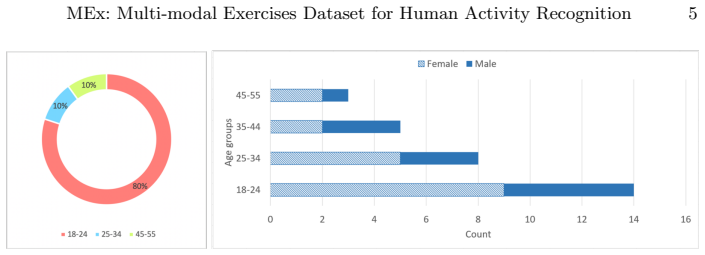
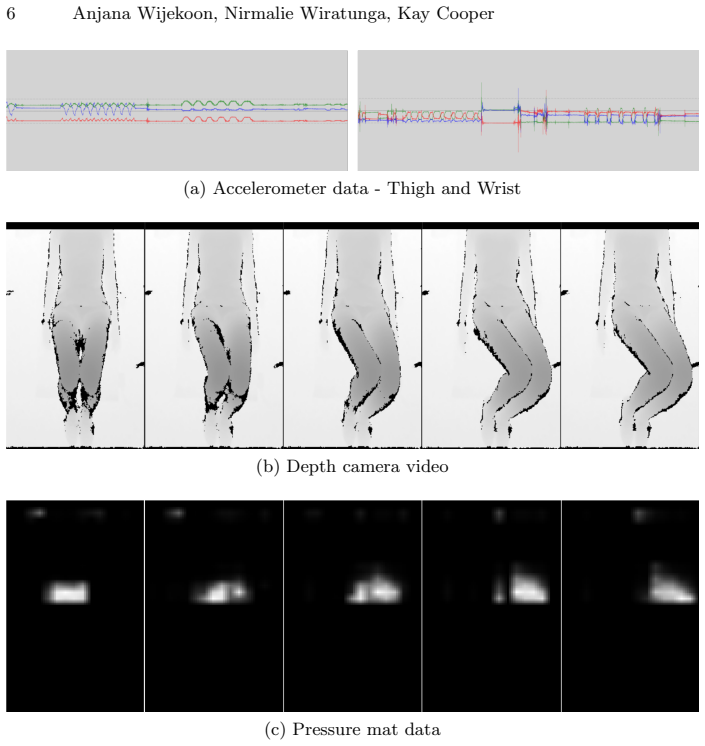
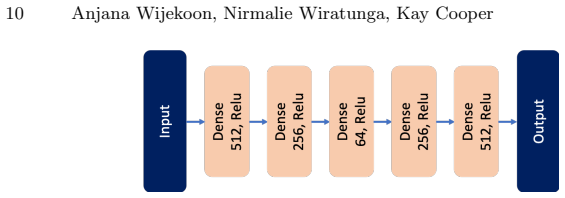
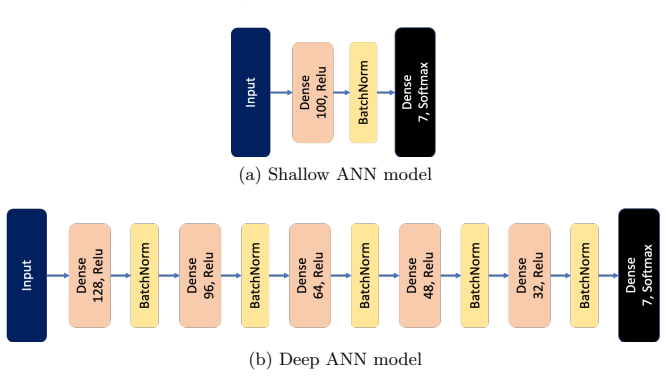
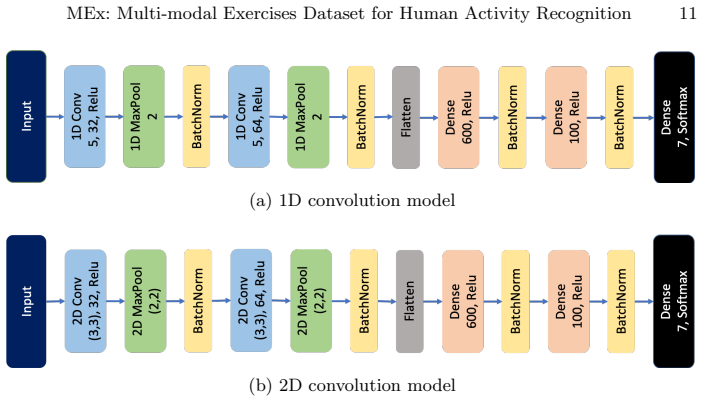
The central object is the MEx dataset itself: seven physiotherapist-selected exercises (knee-rolling, bridging, pelvic tilt, the clam, repeated extension in lying, prone punches, superman) recorded from 30 healthy volunteers with four synchronized sensors — an Orbbec Astra depth camera (15 fps, 320×240), a Sensing Tex pressure mat (75 fps, 32×16), and two Axivity AX3 accelerometers on wrist and thigh (100 Hz). Pre-processing uses 5-second windows with 3-second overlap, frame-rate reduction to 1 fps for visual sensors, DCT with top-60 coefficients per axis for accelerometers, and auto-encoder or convolutional embeddings for visual data. The mechanism doing the argumentative work is the controlled comparison of feature representations (raw, DCT, auto-encoder, shallow/deep ANN, 1D/2D CNN, LSTM variants) under 5-user-fold cross-validation with macro F-measure, which exposes which sensor type favors which architecture.
What would settle it
Train a quality-assessment model on pressure mat data from supervised patients whose exercise form is independently rated by physiotherapists; if the mat-based quality scores do not correlate with the expert ratings across a held-out patient group, the claim that pressure mat data captures exercise quality is refuted.
Extended reading notes
Core claim
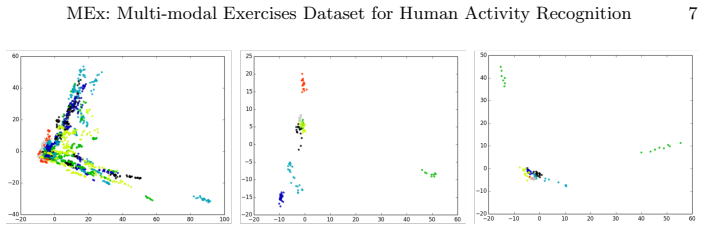
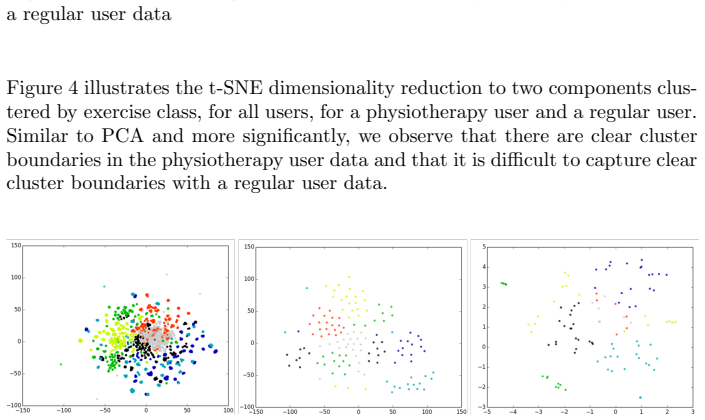
The central claim is that MEx provides a usable benchmark for multi-modal, multi-sensor exercise recognition, with clear per-sensor baselines: for pressure mat and depth camera frames, 2D-CNN architectures give the highest macro F-measures (0.8634 for DC, 0.7049 for PM), while for wrist and thigh accelerometers, DCT-transformed features with a time-distributed 1D-CNN plus LSTM perform best (0.8892 for ACT, 0.6499 for ACW). The paper further argues, from cluster visualizations, that pressure mat data carries information about exercise performance quality distinct from simple activity class, and that personalized training data improves recognition substantially, especially for wrist accelerometer and pressure mat, which capture the most personal nuance.
Load-bearing premise
The dataset's usefulness for MSD self-management assumes that exercise data from 30 healthy university volunteers, recorded for up to 60 seconds without physiotherapist feedback, faithfully represents how MSD patients perform these exercises at home.
Editorial extensions
If this is right
- Pressure mat and depth camera data should be treated as visual: 2D convolutional models give the top macro F-measures (0.8634 for DC, 0.7049 for PM), outperforming raw-input kNN, SVM, and 1D temporal models.
- Accelerometer data should be DCT-compressed before temporal modeling: DCT beats raw by 18.66% (thigh) and 22.41% (wrist) with LSTM models.
- Personalization matters: including end-user data in training improves recognition by 9.80% (thigh), 27.78% (wrist), 13.22% (depth camera), and 26.94% (pressure mat).
- The per-sensor baselines provide a reference for future multi-modal fusion algorithms that combine heterogeneous sensor types.
Reading between the lines
- Editorial inference: a quantitative study linking pressure-mat signals to physiotherapist quality ratings would settle whether the dataset supports exercise quality assessment; the current evidence is visual cluster separation only.
- Editorial inference: the large personalized-gain gap (27.78% for wrist, 26.94% for pressure mat) suggests few-shot personalization or meta-learning is a promising next step that the paper does not explore.
- Editorial inference: the window, frame-rate, and compression trade-offs reported in the appendix indicate that low-memory embedded deployment may be feasible without losing much accuracy, since smaller frames and lower rates can compensate.
Signed reviews
Editorial analysis
A structured set of objections, weighed in public.
Referee Report
Summary. This paper introduces MEx, a publicly released multimodal dataset for human activity recognition in physiotherapy exercises, recorded from 30 volunteers performing seven physiotherapist-selected exercises while four sensors captured data: a pressure mat, a depth camera, and two accelerometers worn on the wrist and thigh. The authors describe the data collection protocol, preprocessing pipeline, and a reference benchmark in which single-sensor classification is evaluated with kNN, SVM, MLP, CNN, and LSTM variants under user-disjoint 5-user fold cross-validation with repeated runs, macro F-measure, and t-test-based significance comparisons. The paper also presents PCA and t-SNE visualizations of pressure mat data, from which the authors suggest that pressure mat data may capture exercise performance quality, and reports exploratory results on personalised vs non-personalised settings and on preprocessing hyperparameters in an appendix.
Significance. The dataset addresses a real gap: there are few publicly available multimodal datasets for physiotherapy exercise recognition, and the heterogeneous sensor combination (pressure mat, depth camera, two accelerometers) is genuinely useful for research on multimodal fusion and on realistic deployment of HAR systems. The benchmark methodology is generally solid: user-disjoint folds emulate an unseen-user setting, repeated runs are used for stochastic models, macro F-measure is appropriate for the balanced class setup, and the authors provide both the dataset and the code. If the exercise-quality claim for the pressure mat were quantitatively supported, the dataset would also be significant for MSD self-management, but that claim is currently exploratory and is not backed by the presented evidence. The reference performances for standard algorithms are a useful contribution in themselves, provided the limitations discussed below are addressed.
major comments (3)
- [Sections 3.2, 3.3, and 6] The claim that pressure mat (PM) data capture exercise performance quality is based on PCA and t-SNE visualizations of one physiotherapy-trained user and one regular user. With n=1 per group and no quantitative separation metric, the visual cluster separation cannot be attributed to execution quality rather than body shape, weight, personal movement style, or other confounding factors. The dataset already contains 8 physiotherapy-trained volunteers (Section 2.3), so a quantitative comparison across all 8 versus the other 22 should be feasible (e.g., class separability measures, distances in embedding space, or a supervised classifier distinguishing expert from non-expert execution). Without such evidence, the abstract and Section 6 overstate the conclusion; the PM quality-capture claim should be explicitly labeled as an anecdotal observation pending further analysis.
- [Section 5, Table 5, and t-test reporting] Table 5 reports mean F-measure values without standard deviations or confidence intervals, yet the text repeatedly asserts that certain models 'significantly outperform' others or are 'significantly similar' based on a t-test at 95% confidence. The test procedure is not specified: it is unclear whether the t-test is paired, how many replicates it uses, and how multiple comparisons are handled. Without variability information and a precise significance-test description, a reader cannot verify the comparative claims. Please report standard deviations (or confidence intervals) for the reported means and provide full details of the significance testing procedure.
- [Section 4.1 and Appendix (Tables 7 and 8)] Several important preprocessing choices used in the reference benchmark, including window size, overlap, DCT component count, autoencoder bottleneck dimension, PM/DC frame rate, and depth camera frame size, were selected through exploratory experiments on the same dataset (the appendix explicitly frames these as an 'empirical study' and 'exploratory study'). This means the reported reference numbers may be optimistically biased because the configuration was tuned on the benchmark data rather than on a held-out validation set. The authors should clarify whether any of this tuning was performed outside the test folds, and if not, they should state that the reported results correspond to a configuration tuned on the data and discuss the implications. Providing sensitivity ranges from Tables 7 and 8 would also help readers judge the stability of the benchmark scores.
minor comments (5)
- [Section 2.2] The depth camera manufacturer is written as 'Obbrec Astra'; the standard spelling is 'Orbbec Astra'. Please correct this and check the official product names for the pressure mat as well for consistency.
- [Section 4.2] The phrase '5-user fold cross validation creating 6 folds' is ambiguous; with 30 users and 5 test users per fold, this is a 6-fold user-disjoint cross-validation. Please state it plainly as such.
- [Equation (1)] Equation (1) writes F1 as a sum over labels, but the text says the final value is a non-weighted mean. The equation should include a 1/n normalization (or otherwise match the described mean computation).
- [Section 3.3] The t-SNE description would benefit from a citation to the original t-SNE paper, and Figures 3 and 4 should include captions explaining the colour labels and the distinction between 'physiotherapy user' and 'regular user' in the figure panels.
- [Section 5] Percentage differences such as '18.66% and 22.41%' should be stated as percentage-point differences in F-measure to avoid ambiguity about relative versus absolute improvement.
Circularity Check
No significant circularity: the paper is a dataset-and-benchmark report, not a derivation, and its central claims are empirical measurements rather than predictions fitted to themselves.
full rationale
The paper's central content is the collection of the MEx dataset and the measurement of single-sensor classification benchmarks. There is no derivation chain in which an output is defined in terms of its own input. The benchmark numbers in Table 5 are empirical results produced by training and evaluating standard classifiers on the collected data, not quantities forced by construction. The hyperparameter study in the Appendix (Tables 7-8) selects window sizes, overlaps, frame rates, and compression settings using PM data and then reports PM results with those settings; this is model selection on the same benchmark, which may affect generalizability, but it is not circularity because the paper does not present the tuned configuration as an independent prediction. The claim about pressure-mat quality capture is explicitly hedged as 'the visualisations also suggests that the potential of PM data to capture exercise performance quality' and 'we will exploit in future', so it is a stated exploratory observation rather than a result derived from the data by construction. The one self-citation, reference [5] (Sani, Massie, Wiratunga, Cooper), is used only as supporting literature for the empirical observation that DCT features outperform raw accelerometer data; the same observation is independently measured in the present paper, so the self-citation is not load-bearing. No step reduces to its own inputs, no fitted parameter is renamed as a prediction, and no uniqueness or ansatz is imported from the authors' prior work. Accordingly, the appropriate finding is no significant circularity.
Assumptions & free parameters
free parameters (6)
- window size =
5 seconds
- overlap =
3 seconds
- DCT component count per axis =
60 (180 total)
- AE bottleneck dimension =
64
- frame rate for PM and DC =
1 frame per second
- depth camera frame size after resize =
12 x 16 pixels
assumptions (4)
- domain assumption The seven selected exercises are representative of exercises recommended for MSD prevention and management.
- domain assumption Sensor placement (wrist, thigh, under-body pressure mat, overhead depth camera) captures sufficient information for exercise recognition and fusion.
- domain assumption Unsupervised performance without therapist feedback produces realistic home-exercise variation.
- domain assumption PAR-Q screening correctly identified volunteers fit to exercise.
Cite this review
Pith. "Pith review of MEx: Multi-modal Exercises Dataset for Human Activity Recognition." pith.science (2026). https://pith.science/paper/OSD7FQAN
@misc{pith2026190808992,
  author       = {Pith},
  title        = {Pith review of: MEx: Multi-modal Exercises Dataset for Human Activity Recognition},
  year         = {2026},
  howpublished = {\url{https://pith.science/paper/OSD7FQAN}},
  note         = {Machine review of arXiv:1908.08992}
}
read the original abstract
MEx: Multi-modal Exercises Dataset is a multi-sensor, multi-modal dataset, implemented to benchmark Human Activity Recognition(HAR) and Multi-modal Fusion algorithms. Collection of this dataset was inspired by the need for recognising and evaluating quality of exercise performance to support patients with Musculoskeletal Disorders(MSD). We select 7 exercises regularly recommended for MSD patients by physiotherapists and collected data with four sensors a pressure mat, a depth camera and two accelerometers. The dataset contains three data modalities; numerical time-series data, video data and pressure sensor data posing interesting research challenges when reasoning for HAR and Exercise Quality Assessment. This paper presents our evaluation of the dataset on number of standard classification algorithms for the HAR task by comparing different feature representation algorithms for each sensor. These results set a reference performance for each individual sensor that expose their strengths and weaknesses for the future tasks. In addition we visualise pressure mat data to explore the potential of the sensor to capture exercise performance quality. With the recent advancement in multi-modal fusion, we also believe MEx is a suitable dataset to benchmark not only HAR algorithms, but also fusion algorithms of heterogeneous data types in multiple application domains.
Figures
Figures from the paper (5 more)

Forward citations
Cited by 1 Pith paper
-
TxP: Reciprocal Generation of Ground Pressure Dynamics and Activity Descriptions for Improving Human Activity Recognition
A bidirectional text-pressure model with a learned codebook generates synthetic pressure data from activity descriptions and classifies real pressure sequences via LLM-generated text, gaining up to 12.4 macro-F1 point...
Reference graph
Works this paper leans on
-
[1]
The Lancet 390(10100), 1211--1259 (2017)
Abajobir, A.A., Abate, K.H., Abbafati, C., Abbas, K.M., Abd-Allah, F., Abdulkader, R.S., Abdulle, A.M., Abebo, T.A., Abera, S.F., Aboyans, V., et al.: Global, regional, and national incidence, prevalence, and years lived with disability for 328 diseases and injuries for 195 countries, 1990--2016: a systematic analysis for the global burden of disease stud...
work page 2017
-
[2]
In: International Conference on Machine Learning
Ioffe, S., Szegedy, C.: Batch normalization: Accelerating deep network training by reducing internal covariate shift. In: International Conference on Machine Learning. pp. 448--456 (2015)
work page 2015
-
[3]
Ord \'o \ n ez, F.J., Roggen, D.: Deep convolutional and lstm recurrent neural networks for multimodal wearable activity recognition. Sensors 16(1), 115 (2016)
work page 2016
-
[4]
Radu, V., Lane, N.D., Bhattacharya, S., Mascolo, C., Marina, M.K., Kawsar, F.: Towards multimodal deep learning for activity recognition on mobile devices. In: Proceedings of the 2016 ACM International Joint Conference on Pervasive and Ubiquitous Computing: Adjunct. pp. 185--188. ACM (2016)
work page 2016
-
[5]
In: International Conference on Knowledge Science, Engineering and Management
Sani, S., Massie, S., Wiratunga, N., Cooper, K.: Learning deep and shallow features for human activity recognition. In: International Conference on Knowledge Science, Engineering and Management. pp. 469--482. Springer (2017)
work page 2017
-
[6]
In: Proceedings of the 26th International Conference on World Wide Web
Yao, S., Hu, S., Zhao, Y., Zhang, A., Abdelzaher, T.: Deepsense: A unified deep learning framework for time-series mobile sensing data processing. In: Proceedings of the 26th International Conference on World Wide Web. pp. 351--360. International World Wide Web Conferences Steering Committee (2017)
work page 2017
-
[7]
, " * write output.state after.block = add.period write
ENTRY address author booktitle chapter doi edition editor eid howpublished institution journal key month note number organization pages publisher school series title type url volume year label INTEGERS output.state before.all mid.sentence after.sentence after.block FUNCTION init.state.consts #0 'before.all := #1 'mid.sentence := #2 'after.sentence := #3 '...
-
[8]
write newline
" write newline "" before.all 'output.state := FUNCTION n.dashify 't := "" t empty not t #1 #1 substring "-" = t #1 #2 substring "--" = not "--" * t #2 global.max substring 't := t #1 #1 substring "-" = "-" * t #2 global.max substring 't := while if t #1 #1 substring * t #2 global.max substring 't := if while FUNCTION word.in bbl.in capitalize ":" * " " *...
Reviewed August 14, 2026 · model on record in the stance chip above.
Discussion (0). Continue with ORCID to comment.