REVIEW 3 major objections 3 minor 23 references
Local Unsupervised Learning for Image Analysis
T0 review · 3 major / 3 minor · reviewed 2026-08-14 · deepseek-v4-flash
Pith's one-line read A local, label-free Hebbian-style rule trains convolutional filters to nearly the accuracy of end-to-end backpropagation on CIFAR-10 and ImageNet-32
desk verdict The CIFAR-10 result is solid, but the ImageNet32 'same ballpark' claim is not established because the end-to-end baseline got only 5 epochs of training. read the letter →
The pith
A machine-rendered reading of the paper's core claim, the machinery that carries it, and where it could break.
The reading
What carries the argument
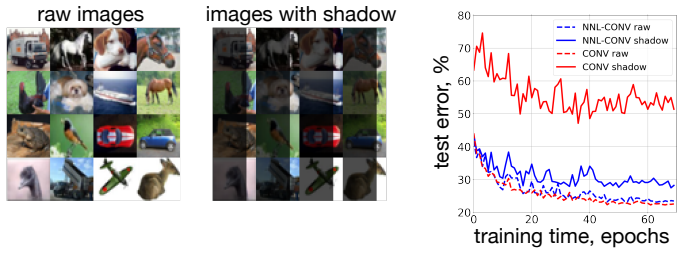
The load-bearing object is the local unsupervised learning rule (1), whose activation is a rank-based gating: the strongest-driven channel gets update weight +1, the m-th strongest gets a small negative anti-Hebbian constant -\$\Delta$, and all others get zero. Filters are then used in NNL-CONV layers, where each image patch is normalized to unit length, making the dot product a cosine similarity, and the result passes through the steep nonlinearity f(x)=[ReLU(x)]^n for large n. This combination lets a shallow network trained only at the top reach near-backprop accuracy, and the patch normalization is what provides the shadow robustness.
What would settle it
Train the same ImageNet 32x32 architecture end-to-end for as long as the local pipeline (50 filter-training epochs plus 48 classifier epochs) instead of only 5 epochs. If its top-1 error drops materially below the local model's 84.13%, the claim that locally learned filters are comparable would be refuted; if it stays near 79-80%, the claim holds as stated.
Extended reading notes
Core claim
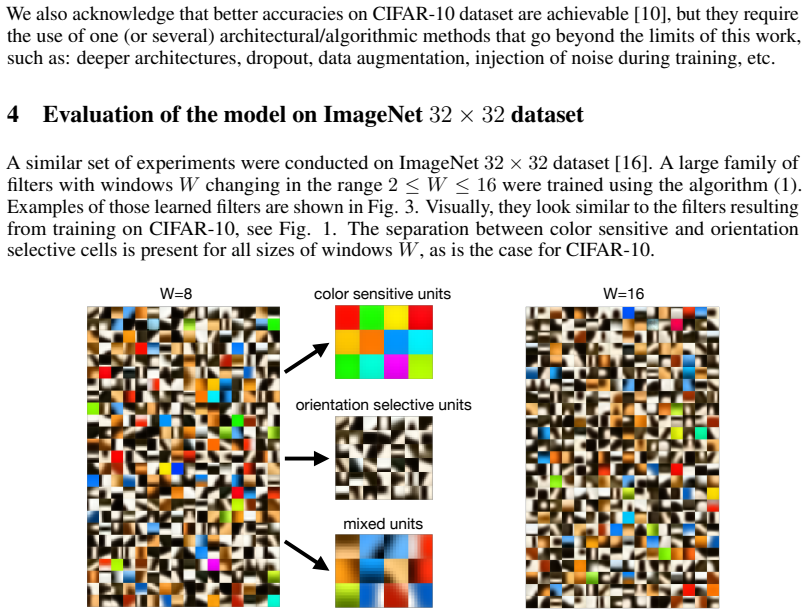
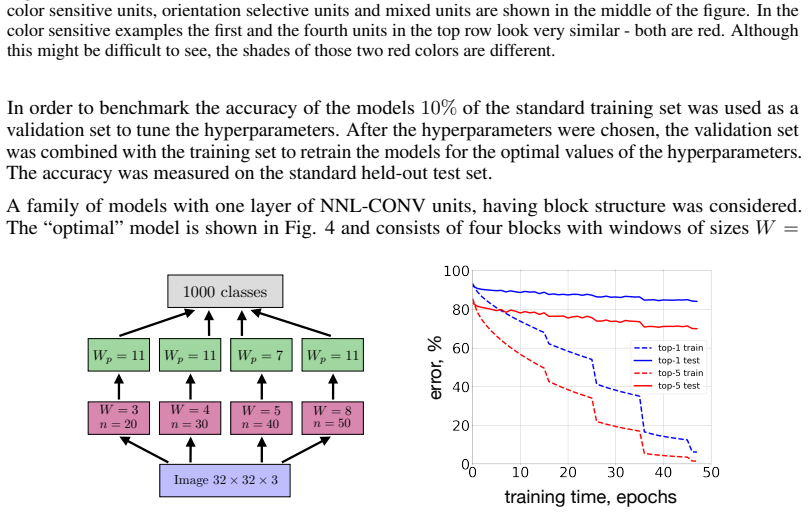
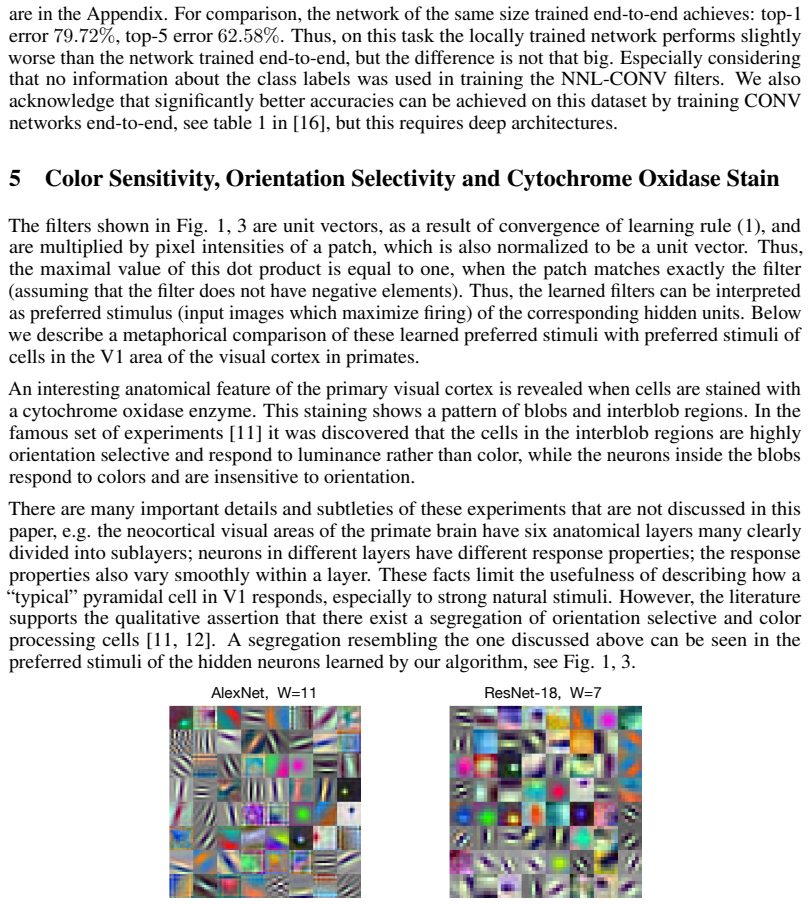
The central claim is that local Hebbian learning, long regarded as inferior to backpropagation, can produce convolutional filters whose classification accuracy is almost the same as that of same-capacity networks trained end-to-end. The evidence is CIFAR-10 (23.40% versus 22.57% error) and ImageNet 32x32 (84.13% versus 79.72% top-1 error and 70.00% versus 62.58% top-5 error), with only the final classifier trained by gradient descent. The learned filters split into orientation-selective color-blind units and color-sensitive units, a separation the paper compares to the blob and interblob pathways of primate V1. Patch normalization, in which each patch is normalized to unit length before the dot product with unit-norm filters, is essential: without it, locally learned filters give very poor accuracy when substituted into a conventional convnet, and with it the network tolerates large illumination changes such as shadows. Transfer experiments show that filters trained on one dataset can be frozen and reused on another with accuracy comparable to directly trained end-to-end filters.
Load-bearing premise
The load-bearing premise is that the end-to-end comparison networks are trained enough to be fair baselines: on ImageNet 32x32 the backprop model ran for only 5 epochs at a fixed learning rate, while the local pipeline used 50 filter-training epochs plus 48 classifier epochs.
Editorial extensions
If this is right
- First-layer filters do not need to encode the task: the same frozen filters support a CIFAR-10 classifier and, after retraining the top layer on more data, a 1000-class ImageNet-32 classifier.
- Patch normalization plus steep nonlinearities can replace illumination augmentation: a network trained on raw images keeps about 28% error on shadowed CIFAR-10 images, while a standard convnet's error rises above 50%.
- Local training is memory-light: only one layer's weights and activations need to reside on the accelerator at a time, which is well suited to low-memory GPUs.
- Locally learned filters transfer between datasets and architectures without retraining, so blocks of pretrained filters can be composed modularly.
Reading between the lines
- If the single-layer result stacks through multiple layers, a fully local pipeline with supervision only at the top might close the small remaining gap to backprop; the paper does not test this.
- The smoothness and the color-orientation separation of the learned filters could make them useful for studying adversarial robustness and network interpretability, directions the paper names but does not evaluate.
- The synthetic-shadow result suggests that patch normalization could reduce illumination sensitivity in deployed vision systems without collecting shadowed training data, but real-scene lighting variations remain untested.
Signed reviews
Editorial analysis
A structured set of objections, weighed in public.
Referee Report
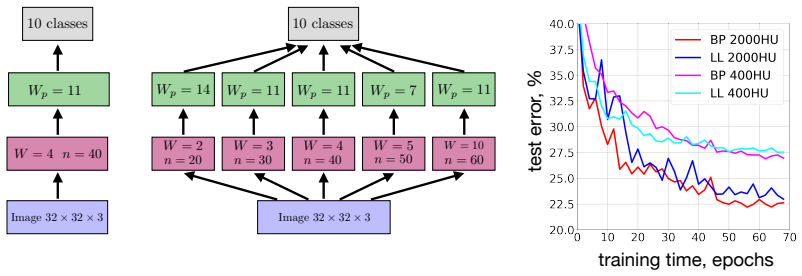
Summary. The paper proposes an unsupervised, local (Hebbian/anti-Hebbian) learning rule for training convolutional filters, and combines the resulting filters with per-patch normalization and steep power nonlinearities in what it calls NNL-CONV layers. The learned filters are frozen and used as the first layer of shallow networks whose top classifier is trained with backpropagation. On CIFAR-10 the locally trained networks reach test errors of 27.80% (single block) and 23.40% (multi-block), compared with 27.11% and 22.57% for standard CONV networks of similar capacity trained end-to-end. On ImageNet 32x32 the local model reaches 84.13% top-1 error versus 79.72% for the end-to-end baseline. The paper additionally presents a shadow-robustness experiment showing that patch normalization improves robustness to a multiplicative shadow mask, and transfer experiments in both directions between CIFAR-10 and ImageNet 32x32.
Significance. If the central claim is established, the paper would provide a meaningful counterexample to the assumption that end-to-end gradient training is necessary for competitive image classification, and it would introduce a fast, memory-efficient alternative for learning transferable visual features. The strongest assets of the paper are the clearly specified learning rule (Eq. 1), the matched training schedule used in the CIFAR-10 comparison, and the explicit reporting of mean and standard deviation over five runs for the transfer experiments. The biological analogy to blob/interblob V1 cells is plausible and adds interpretability. However, the large-scale ImageNet comparison rests on an under-trained baseline, and the CIFAR-10 comparison confounds the training algorithm with a change of architecture; both issues must be addressed before the main claim is fully supported.
major comments (3)
- [Appendix, experiments for Fig. 4; Section 4] The ImageNet 32x32 end-to-end baseline is trained for only 5 epochs at learning rate 1e-4 with minibatch size 200, while the local pipeline trains convolutional filters for 50 epochs and then trains the classifier for 48 epochs under schedule (5). A 5-epoch run of a 1000-way classifier is unlikely to be converged, and additional training would plausibly improve the backprop baseline and widen the reported gap (84.13% vs 79.72% top-1 error). Since Section 4 uses this comparison to claim that the local model is in the same ballpark at scale, the claim is not yet established. The baseline should be trained for a comparable number of epochs, or the authors should report a learning curve showing that the 5-epoch result is representative.
- [Section 3 and Appendix (Fig. 2 middle)] The comparison confounds the training algorithm with the network architecture. The locally trained model uses NNL-CONV layers with per-patch normalization and high-power nonlinearities, while the end-to-end baseline uses standard CONV layers with ReLU. The paper itself states in Section 9 that the learned filters yield poor accuracy if substituted into a standard convolutional network, confirming that the architecture is essential to the result. Therefore the observed near-parity on CIFAR-10 could be due to patch normalization and steep nonlinearities rather than to the local unsupervised learning rule per se. A backprop-trained NNL-CONV network with the same architecture would provide the missing control and is needed to support the conclusion that local training is competitive.
- [Section 3, Fig. 2 (right); Section 4] The headline accuracy numbers are single runs without error bars. The CIFAR-10 multi-block gap is only 0.83 percentage points (23.40% vs 22.57%), and without repeated-seed variance it is unclear whether the differences are meaningful. Since the transfer experiments in Section 7 report mean and standard deviation over five runs, the same practice should be applied to the main comparisons, at least for the best configurations.
minor comments (3)
- [Section 2] There is a typo in the sentence introducing the two modifications: "Frist" should be "First".
- [Section 4 and Appendix] The phrase "in the same ballpark" is informal; specifying a quantitative criterion (e.g., within X percentage points) would make the claim more precise.
- [Section 6] The shadow experiment compares NNL-CONV with patch normalization against standard CONV without it; this is an architectural comparison, not a test of local learning. The text mostly frames it correctly as an illustration of patch normalization, but the narrative in the abstract and introduction should avoid implying that the shadow robustness demonstrates superiority of local learning.
Circularity Check
No significant circularity: the central accuracy claims are empirical benchmark comparisons, not results derived from fitted inputs or self-citation.
full rationale
The paper's central claim is that filters trained by the local unsupervised rule of Eq. (1) come close to end-to-end backpropagation accuracy. The rule itself is explicitly attributed to prior work [6] and is used as the method under test, not as evidence for the outcome. Filter weights are learned unsupervised from image patches; the only supervised training is the top-layer classifier, and the reported CIFAR-10 and ImageNet32 errors are measurements on held-out test sets after a standard validation-split hyperparameter search. No equation defines the reported accuracy in terms of the patch normalization or the learning rule, so there is no fitted input renamed as a prediction. Patch normalization does make shadow robustness structurally plausible, but the paper presents that result as an experiment rather than as a theorem derived from first principles, and the comparison against a standard CONV network is an empirical measurement. Self-citations to [6]-[9] supply the learning rule, activation function, and open-source implementation, but they are not invoked as an external proof that local training matches backprop, and the benchmark numbers are computed in this paper against independently trained baselines. The ImageNet32 end-to-end baseline was trained for only 5 epochs while the local pipeline used more epochs, which is a legitimate fairness/correctness concern about the strength of the comparison, but it is not circularity. No definitional, self-citation, or ansatz-smuggling reduction of the central claim is present.
Assumptions & free parameters
free parameters (9)
- m (rank for anti-Hebbian suppression) =
2 for all blocks
- Delta (anti-Hebbian strength) =
[0.1,0.1,0.2,0.15,0.2] for CIFAR five-block; [0.1,0.2,0.2,0.2] for ImageNet; [0,0.1,0.2,0.2,0.2] for transfer
- Number of channels K =
400 for main CIFAR models; range 100 to 2000 explored
- Convolutional window sizes W =
CIFAR: [2,3,4,5,8]; ImageNet: [3,4,5,8]
- Nonlinearity exponents n =
20, 30, 40, 50, 60 per block; n=40 for simple net
- Pooling window sizes Wp =
11 for simple net; [14,11,11,7,11] for CIFAR e2e baseline
- Strides ST and STp =
1 and 2
- Learning rates and epochs =
Filter learning rate linearly decays from 1e-4 to 0 over 50 or 500 epochs; classifier schedules in equations (4) and (5)
- Minibatch sizes =
1000 or 10000 patches for local training; 200 or 300 images for top-layer training
assumptions (4)
- domain assumption Learning rule (1) converges to unit-norm useful filters.
- domain assumption Cosine similarity via unit normalization is a valid input representation for classification.
- domain assumption Patch normalization approximates retinal light adaptation closely enough for the shadow and biological conclusions.
- domain assumption Standard train/validation/test splits measure generalization.
Cite this review
Pith. "Pith review of Local Unsupervised Learning for Image Analysis." pith.science (2026). https://pith.science/paper/C7OX6SZZ
@misc{pith2026190808993,
  author       = {Pith},
  title        = {Pith review of: Local Unsupervised Learning for Image Analysis},
  year         = {2026},
  howpublished = {\url{https://pith.science/paper/C7OX6SZZ}},
  note         = {Machine review of arXiv:1908.08993}
}
read the original abstract
Local Hebbian learning is believed to be inferior in performance to end-to-end training using a backpropagation algorithm. We question this popular belief by designing a local algorithm that can learn convolutional filters at scale on large image datasets. These filters combined with patch normalization and very steep non-linearities result in a good classification accuracy for shallow networks trained locally, as opposed to end-to-end. The filters learned by our algorithm contain both orientation selective units and unoriented color units, resembling the responses of pyramidal neurons located in the cytochrome oxidase 'interblob' and 'blob' regions in the primary visual cortex of primates. It is shown that convolutional networks with patch normalization significantly outperform standard convolutional networks on the task of recovering the original classes when shadows are superimposed on top of standard CIFAR-10 images. Patch normalization approximates the retinal adaptation to the mean light intensity, important for human vision. We also demonstrate a successful transfer of learned representations between CIFAR-10 and ImageNet 32x32 datasets. All these results taken together hint at the possibility that local unsupervised training might be a powerful tool for learning general representations (without specifying the task) directly from unlabeled data.
Figures

Figures from the paper (3 more)
Reference graph
Works this paper leans on
-
[1]
Pehlevan, C., Hu, T. and Chklovskii, D.B., 2015. A hebbian/anti-hebbian neural network for linear subspace learning: A derivation from multidimensional scaling of streaming data. Neural computation, 27(7), pp.1461-1495
work page 2015
-
[2]
Pehlevan, C., Sengupta, A.M. and Chklovskii, D.B., 2018. Why do similarity matching objec- tives lead to Hebbian/anti-Hebbian networks?. Neural computation, 30(1), pp.84-124
work page 2018
-
[3]
Cui, Y ., Ahmad, S. and Hawkins, J., 2016. Continuous online sequence learning with an unsupervised neural network model. Neural computation, 28(11), pp.2474-2504
work page 2016
-
[4]
Seung, H.S. and Zung, J., 2017. A correlation game for unsupervised learning yields computa- tional interpretations of Hebbian excitation, anti-Hebbian inhibition, and synapse elimination. arXiv preprint arXiv:1704.00646
arXiv 2017
-
[5]
Bahroun, Y . and Soltoggio, A., 2017. Online representation learning with single and multi-layer Hebbian networks for image classification. In International Conference on Artificial Neural Networks (pp. 354-363), Springer
work page 2017
-
[6]
Krotov, D. and Hopfield, J., 2019. Unsupervised learning by competing hidden units, Proceed- ings of the National Academy of Sciences, 116 (16) 7723-7731; DOI: 10.1073/pnas.1820458116
-
[7]
GitHub repository "Biological Learning", https://github.com/DimaKrotov/Biological_Learning
-
[8]
Krotov, D. and Hopfield, J.J., 2016. Dense associative memory for pattern recognition. In Advances in neural information processing systems (pp. 1172-1180)
work page 2016
Show all 23 references
-
[9]
and Hopfield, J., 2018
Krotov, D. and Hopfield, J., 2018. Dense associative memory is robust to adversarial inputs. Neural computation, 30(12), pp.3151-3167. 10
2018
-
[10]
See for a example a current leader board: https://benchmarks.ai/cifar-10
-
[11]
and Hubel, D.H., 1984
Livingstone, M.S. and Hubel, D.H., 1984. Anatomy and physiology of a color system in the primate visual cortex. Journal of Neuroscience, 4(1), pp.309-356
1984
-
[12]
and Shapley, R., 2008
Johnson, E.N., Hawken, M.J. and Shapley, R., 2008. The orientation selectivity of color- responsive neurons in macaque V1. Journal of Neuroscience, 28(32), pp.8096-8106
2008
-
[13]
and Hinton, G.E., 2012
Krizhevsky, A., Sutskever, I. and Hinton, G.E., 2012. Imagenet classification with deep convolu- tional neural networks. In Advances in neural information processing systems (pp. 1097-1105)
2012
-
[14]
and Sun, J., 2016
He, K., Zhang, X., Ren, S. and Sun, J., 2016. Deep residual learning for image recognition. In Proceedings of the IEEE conference on computer vision and pattern recognition (pp. 770-778)
2016
-
[15]
and Eastman, G., 2018
Appelhans, D., Auerbach, G., Averill, D., Black, R., Brown, A., Buono, D., Cash, R., Chen, D., Deindl, M., Duffy, D. and Eastman, G., 2018. Functionality and performance of NVLink with IBM POWER9 processors. IBM Journal of Research and Development, 62(4-5)
2018
-
[16]
and Hutter, F., A Downsampled Variant of ImageNet as an Alternative to the CIFAR datasets
Chrabaszcz, P., Loshchilov, I. and Hutter, F., A Downsampled Variant of ImageNet as an Alternative to the CIFAR datasets. CoRR abs/1707.0 (2017)
2017
-
[17]
and Rieke, F., 2007
Dunn, F.A., Lankheet, M.J. and Rieke, F., 2007. Light adaptation in cone vision involves switching between receptor and post-receptor sites. Nature, 449(7162), p.603
2007
-
[18]
D. Heeger. Perception Lecture Notes: Light/Dark Adaptation. Available: http://www.cns.nyu.edu/∼david/courses/perception/lecturenotes/light-adapt/light-adapt.html
-
[19]
Distinctive image features from scale-invariant keypoints
Lowe, D.G., 2004. Distinctive image features from scale-invariant keypoints. International journal of computer vision, 60(2), pp.91-110
2004
-
[20]
Lecture 7: Correspondence Matching
R.Collins. Lecture 7: Correspondence Matching. Available: http://www.cse.psu.edu/∼rtc12/CSE486/lecture07.pdf
-
[21]
and Brox, T., 2014
Dosovitskiy, A., Springenberg, J.T., Riedmiller, M. and Brox, T., 2014. Discriminative unsuper- vised feature learning with convolutional neural networks. In Advances in neural information processing systems (pp. 766-774)
2014
-
[22]
and Darrell, T., 2016
Donahue, J., Krähenbühl, P. and Darrell, T., 2016. Adversarial feature learning. arXiv preprint arXiv:1605.09782
2016 arXiv
-
[23]
and Yuille, A.L., 2016
Premachandran, V . and Yuille, A.L., 2016. Unsupervised learning using generative adversarial training and clustering. 11
2016
Reviewed August 14, 2026 · model on record in the stance chip above.
Discussion (0). Continue with ORCID to comment.