REVIEW 4 major objections 4 minor 12 references
Geometrical Regret Matching
T0 review · 4 major / 4 minor · reviewed 2026-08-14 · deepseek-v4-flash
Pith's one-line read This paper argues that a smooth, geometry-based regret update is sufficient to steer play toward Nash equilibrium.
desk verdict A simple smooth regret-matching heuristic with correct local results, but its own 3X3-1eq3sp example disproves the sufficiency claim in the abstract. read the letter →
The pith
A machine-rendered reading of the paper's core claim, the machinery that carries it, and where it could break.
The reading
What carries the argument
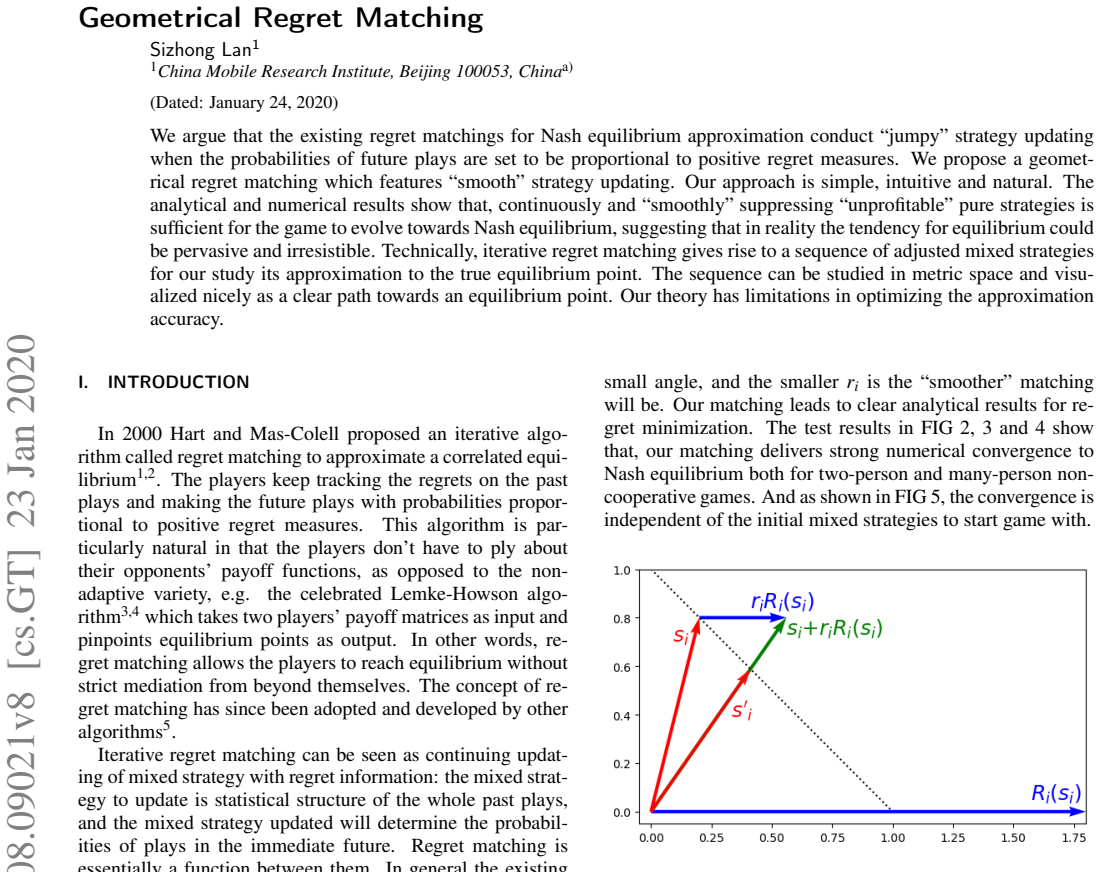
The load-bearing object is the regret vector $R_i(s_i)$, whose components $\phi_{ij}(s_i) = \max\{0, \bar p_i(\pi_{ij}; S) - p_i(s_i)\}$ are the payoff gains a player would have received by switching unilaterally to each pure strategy. The update in Eq. (5) forms a normalized combination of the current mixed strategy and this regret vector, keeping the result inside the simplex; Theorem 1 states that this operation never increases the angle between the mixed strategy and the regret vector. A small adjustment rate $r_i$ makes the movement smooth, which is what lets the paper treat simultaneous adjustments as approximately unilateral and interpret the rule behaviorally as suppressing below-average pure strategies. The fixed-point framing comes from observing that an equilibrium is exactly a point at which every player's regret vector is zero, so the iteration $\Psi^t(S_0)$ is a fixed-point search for $\Psi$.
What would settle it
A simple numerical test settles it: choose a 3x3 game with a unique fully mixed equilibrium and iterate Eq. (5) from a nearby starting point; if the iterates orbit the equilibrium as they do in the paper's own 3X3-1eq3sp example, the blanket sufficiency claim is false as stated.
Extended reading notes
Core claim
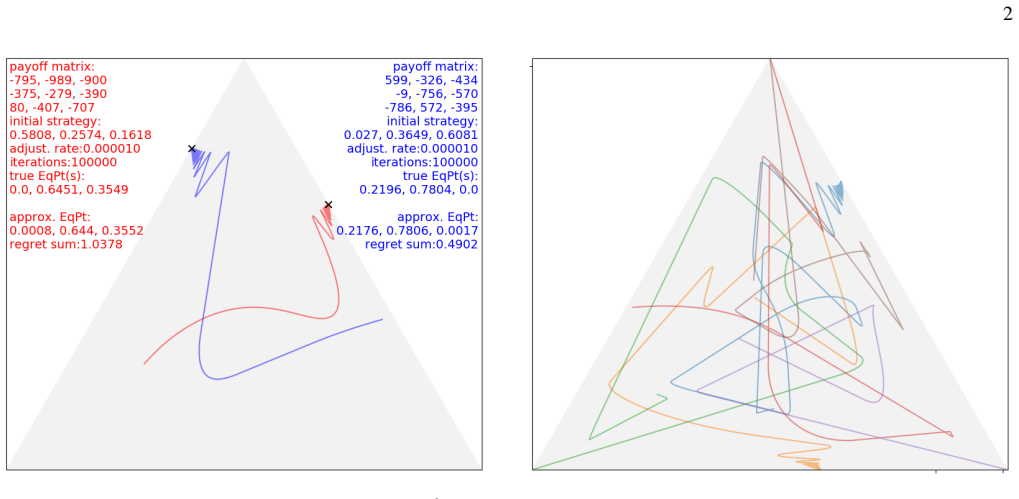
The paper's central claim, stated in the abstract, is that continuously and smoothly suppressing "unprofitable" pure strategies is sufficient for a game to evolve toward Nash equilibrium. The mechanism is the geometric update of Eq. (5), $s_i' = \frac{s_i + r_i R_i(s_i)}{1 + r_i \lvert R_i(s_i) \rvert}$, which moves the mixed strategy toward the regret vector rather than jumping proportionally to positive regret. For a single player this update never lowers payoff and never increases the regret sum, unless the strategy is already optimal; the paper interprets the classic proportional-to-positive-regret rule as the limit $r_i \to \infty$ of this smoother rule. The paper extends the update to simultaneous play and reports numerical convergence for two-person and n-person examples, with motion toward the equilibrium largely independent of the initial mixed strategies. It also reports that for at least one game with a unique interior equilibrium the sequence cycles around that equilibrium rather than converging, which it treats as a limitation of approximation accuracy rather than a breakdown of the behavioral principle.
Load-bearing premise
The central claim depends on the assumption that sufficiently small adjustment rates make simultaneous strategy changes behave like unilateral ones, so that a single player's monotone improvement carries over to the joint dynamics; the paper states this as a hope and never quantifies how small the rates must be, and its own examples show joint regret sums can rise.
Editorial extensions
If this is right
- A player following the unilateral update never sees its payoff fall or its regret sum rise, and reaches a fixed point exactly when its mixed strategy is optimal against the opponents' current strategy.
- With small adjustment rates, simultaneous play should approximate the unilateral property, so the paper's examples exhibit paths that land on attractor equilibria and avoid repellor equilibria.
- The classical proportional-to-positive-regret rule is recovered as the limit of large $r_i$, giving that rule a rationale: it is the aggressive end of smooth suppression.
- The construction needs only local regret information, so if the conclusion holds, it describes a distributed process by which players can converge to equilibrium without knowing payoff matrices or the existence of an equilibrium.
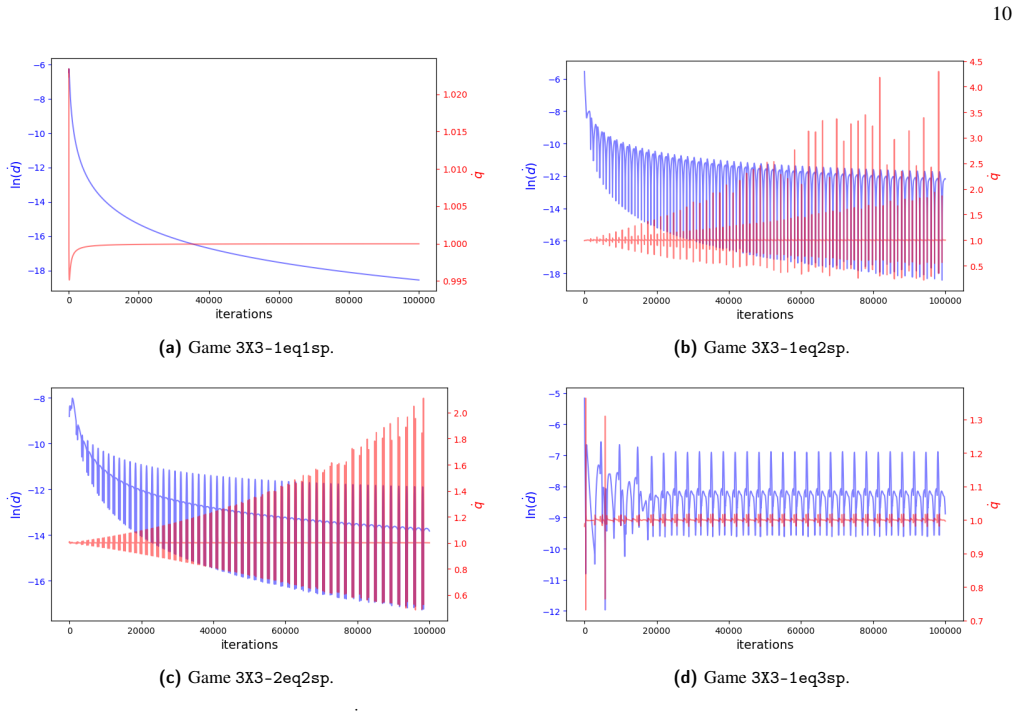
- Because convergence fails for repellor equilibria, the paper's own metric-based diagnostics ($\dot d$, $\dot q$) can serve as empirical accuracy measures for approximate equilibria.
Reading between the lines
- A testable extension would be to classify games by the stability of equilibrium under Eq. (5): if the unique equilibrium is interior and the Jacobian of $\Psi$ at the fixed point has an eigenvalue outside the unit disk, the sequence should cycle rather than converge, matching the reported repellor case.
- If the sufficiency claim held, the same smooth-suppression principle should transfer to settings with many players and noisy payoffs, since the update requires no cross-player information beyond observed play.
- The generalized form of Eq. (23), with component-wise functions $\alpha_{ij}$, suggests a family of dynamics indexed by how aggressively each pure strategy is pruned; comparing members of this family could reveal a minimal smoothing level needed for convergence.
- The paper leaves open the convergence criterion that it admits it lacks; supplying a function $\chi$ from payoff matrices to attractor/repellor status would turn the empirical observation into a theorem.
Signed reviews
Editorial analysis
A structured set of objections, weighed in public.
Referee Report
Summary. The paper proposes a "geometrical regret matching" update, Eq. (5), in which each player's mixed strategy is moved a small step toward its current regret vector, with the step controlled by a positive adjustment rate r_i. The authors prove three local results: the update increases the angle closeness to the regret vector, weakly increases the player's own payoff, and weakly decreases the player's own regret sum when the player adjusts unilaterally (Theorems 1-3). They then consider the joint iteration in which all players update simultaneously, define the induced sequence of strategy profiles, and claim in the abstract and conclusion that continuously and smoothly suppressing unprofitable pure strategies is sufficient for the game to evolve toward a Nash equilibrium. The paper supports this claim with numerical experiments on several 3x3 games, a 60x40 game, and an n-person game, and discusses approximation accuracy through regret sums, step sizes, and a candidate contraction ratio. The paper candidly acknowledges in Section V that regret sums fluctuate, that convergence cannot be predicted from a formula, and that one of its own examples, 3X3-1eq3sp, does not converge.
Significance. If the central claim were established, the paper would provide a simple, decentralized learning rule with monotone payoff and regret improvement for unilateral adjustments, and it would give a general argument for why equilibrium tendencies might be pervasive. The local unilateral theorems are elementary and appear correct, and the paper is transparent about its numerical evidence, including a case of non-convergence, and provides source code. However, the advertised sufficiency claim is not proven, and it is contradicted by the paper's own 3X3-1eq3sp example, where the unique equilibrium is a repellor and the trajectory forms a periodic circle. The manuscript therefore offers a useful heuristic and a collection of numerical observations, but not a general convergence theory for the proposed iteration.
major comments (4)
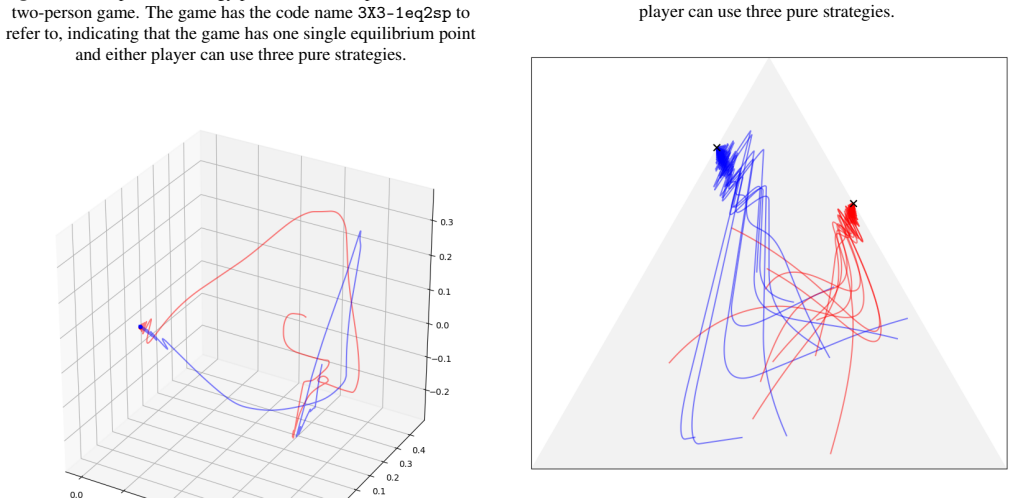
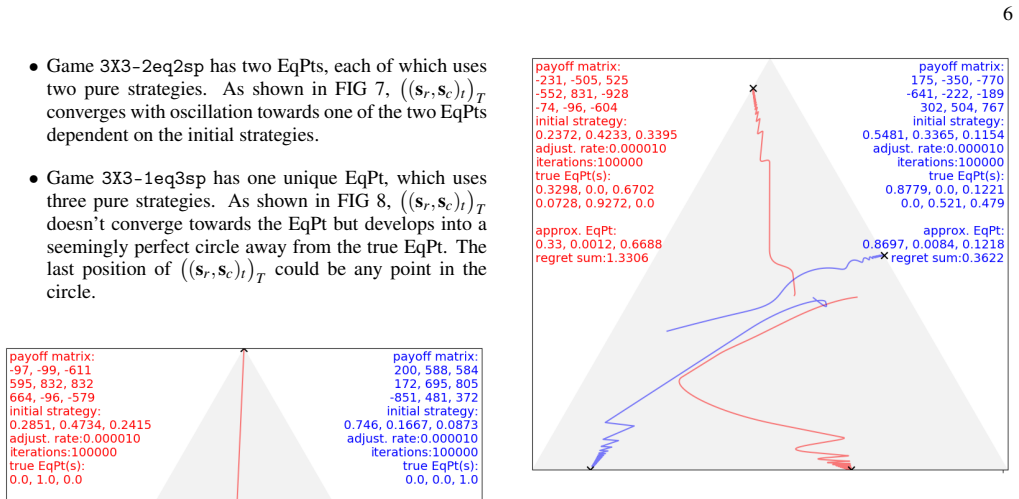
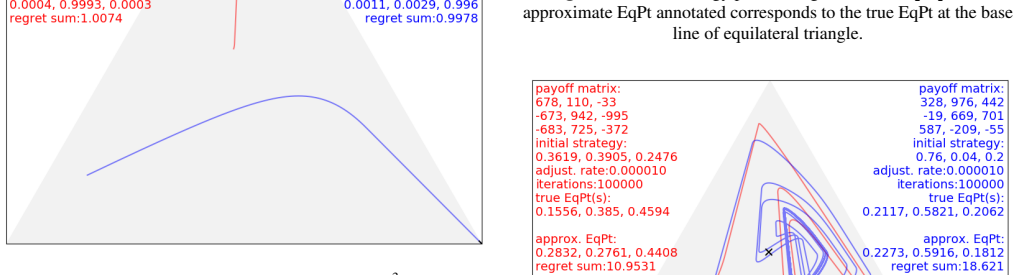
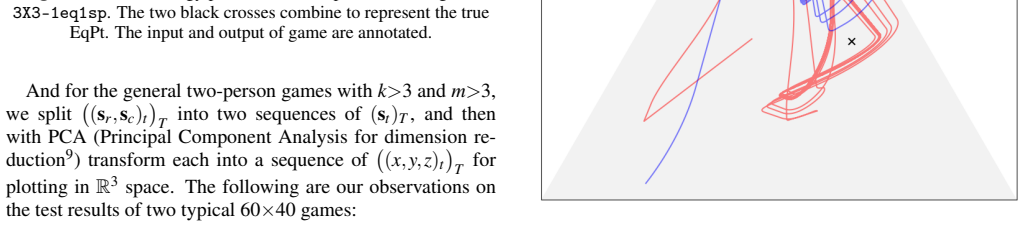
- [Abstract and Section IV (3X3-1eq3sp, Figs. 8 and 11)] The abstract and Section VII claim that continuously and smoothly suppressing unprofitable pure strategies is sufficient for the game to evolve towards a Nash equilibrium. This claim is directly contradicted by the paper's own example 3X3-1eq3sp in Section IV: the game has a unique equilibrium, that equilibrium is described as a "repellor" (Fig. 11), and the generated sequence does not converge but develops into a seemingly perfect circle away from the equilibrium (Fig. 8). Since this example uses exactly the same smooth update rule advertised in the abstract, the universal sufficiency statement cannot stand as written.
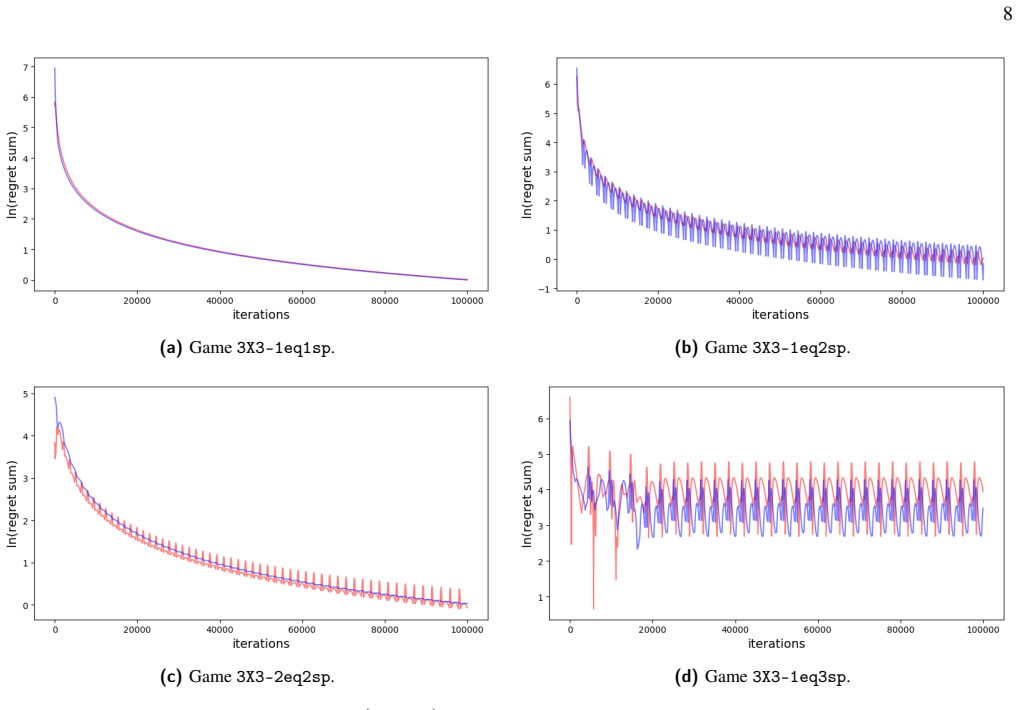
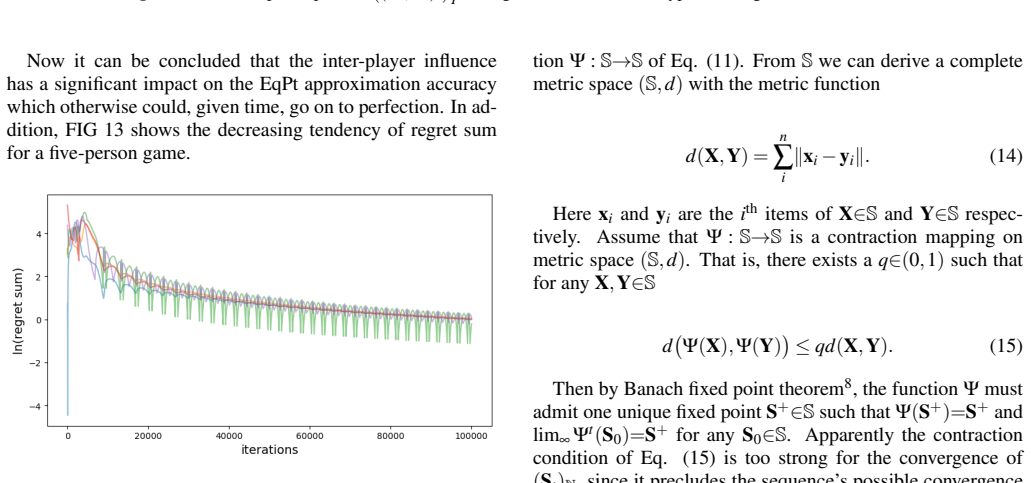
- [Section III, Eqs. (11)-(12) and Theorems 2-3] Theorems 2 and 3 are proven only for a unilateral adjustment of one player while the strategies of the other players are held fixed. The extension to the joint iteration, where all players update simultaneously, rests on the informal hope, stated in Section III, that "infinitesimal" adjustment rates make simultaneous adjustments approximately unilateral. This assumption is never quantified, and no theorem is provided to show that the per-player monotonicity survives in the joint dynamics. Section V explicitly reports that regret sums do fluctuate along the joint iteration, so the local unilateral results do not imply convergence of the coupled system.
- [Section IV, Algorithm 1, steps 6-9] Algorithm 1 outputs the strategy profile that achieved a new minimum of the overall regret sum during the iteration, rather than the limit of the generated sequence. This selection can hide non-convergence: for a periodic trajectory such as that of 3X3-1eq3sp, some point on the cycle may have a small regret sum even though the sequence never approaches the equilibrium. Claims about convergence or approximation to a Nash equilibrium should be evaluated from the generated sequence itself, and the paper's numerical evidence should be reported accordingly.
- [Section V, discussion after Eq. (18)] The paper explicitly concedes that it cannot provide a function chi(A,B,r_r,r_c,S0) to determine whether a given initial condition leads to convergence, nor a function chi(A,B,r_r,r_c) to determine whether every initial condition converges. This admission, together with the non-convergent 3X3-1eq3sp example, means the paper's evidence for its central claim is a small set of numerical simulations rather than a mathematically supported sufficiency result. The conclusion should be weakened to a conjecture or a heuristic claim for games whose dynamics are attracted to equilibrium.
minor comments (4)
- [Section III, after Eq. (5)] The sentence stating that there is "less proportion of pure strategy pi_ij used in s_i than in s'_i" when the corresponding regret component is zero appears to have the comparison reversed; the update decreases the weight of strategies with zero regret component, so the proportion should be smaller in s'_i than in s_i.
- [Section III, first paragraph of Section III] The sentence "We define each player's regret matching to be a function R_i,S : I_i -> I_i" appears to contain a typo; the symbol being defined is the matching function psi_i,S, not the regret vector R_i,S.
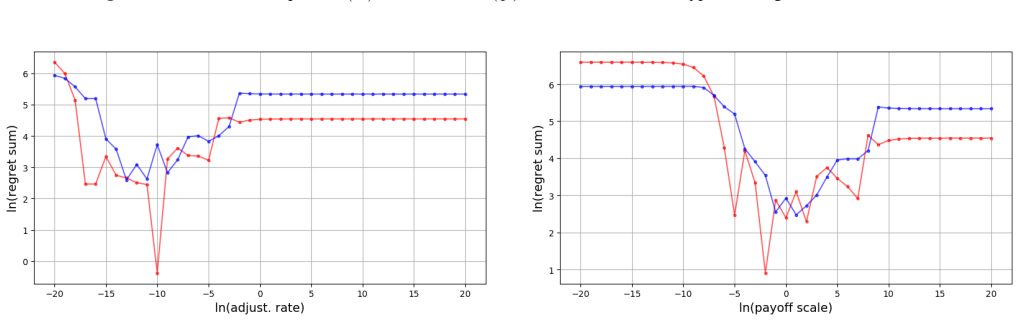
- [Section V, Figs. 15 and 16] The discussion of scaling factors (a_r,a_c) and offsets (b_r,b_c) would be clearer if the figures showed the payoff scales and adjustment rates used, since the comparison of regret sums across different parameter values is otherwise difficult to interpret.
- [Section VI] The connection between the neural firing papers cited as references 11 and 12 and the game-theoretic fixed point iteration in this paper is stated only briefly; a short explanation of how the FPI 2 results support the current claims would help the reader assess the relevance.
Circularity Check
No significant circularity: the local theorems are algebraic consequences of the paper's definitions, and the convergence claim is an empirical observation that the paper itself qualifies with explicit limitations.
full rationale
The paper's core analytical results, Theorems 2 and 3, are derived directly from the definitions in Eqs. (2), (4), and (5): the update rule is substituted into the payoff formula and the algebra is carried out to show non-negative payoff increment and regret-sum decrease under unilateral adjustment. These are genuine mathematical implications, not inputs disguised as outputs. The broader claim that smooth suppression of unprofitable strategies suffices for convergence to Nash equilibrium is presented as supported by "analytical and numerical results," but the numerical part is an empirical observation over tested games, not a fitted parameter renamed as a prediction. Crucially, Section IV's game 3X3-1eq3sp is a stated counterexample in which the unique equilibrium is a repellor and the iterates form a non-convergent cycle, and Section V explicitly concedes that no function is provided to determine convergence from the game data. That concession shows the convergence claim is not force-derived from the update rule; it is a heuristic generalization, which is a correctness limitation, not a circular step. The only self-citations appear in Section VI, where the author mentions prior neural-firing work as a special case of a generalized fixed-point iteration; this reference is not load-bearing for the paper's central claim about regret matching in games. No equation in the derivation is equivalent by construction to the target result, and no fitted quantity is later relabeled as a prediction. Accordingly, the appropriate finding is no significant circularity.
Assumptions & free parameters
free parameters (2)
- adjustment rate r_i =
User-chosen; examples use r_r = r_c, with sweeps in Fig. 15
- payoff scale factors (a_r, a_c) =
User-chosen; Fig. 16 sweeps with a_r = a_c, b = 0
assumptions (4)
- domain assumption Finite n-player game with known payoff functions and full observation of opponents' current mixed strategies.
- standard math Payoff linearity: p_bar_i(S) = <s_i, v_i>.
- ad hoc to paper Assumption that 'infinitesimal' adjustment rates make simultaneous updates approximately unilateral.
- ad hoc to paper The numerical observations on a handful of games are assumed to indicate a general tendency.
Cite this review
Pith. "Pith review of Geometrical Regret Matching." pith.science (2026). https://pith.science/paper/NHPYCEPV
@misc{pith2026190809021,
  author       = {Pith},
  title        = {Pith review of: Geometrical Regret Matching},
  year         = {2026},
  howpublished = {\url{https://pith.science/paper/NHPYCEPV}},
  note         = {Machine review of arXiv:1908.09021}
}
read the original abstract
We argue that the existing regret matchings for Nash equilibrium approximation conduct "jumpy" strategy updating when the probabilities of future plays are set to be proportional to positive regret measures. We propose a geometrical regret matching which features "smooth" strategy updating. Our approach is simple, intuitive and natural. The analytical and numerical results show that, continuously and "smoothly" suppressing "unprofitable" pure strategies is sufficient for the game to evolve towards Nash equilibrium, suggesting that in reality the tendency for equilibrium could be pervasive and irresistible. Technically, iterative regret matching gives rise to a sequence of adjusted mixed strategies for our study its approximation to the true equilibrium point. The sequence can be studied in metric space and visualized nicely as a clear path towards an equilibrium point. Our theory has limitations in optimizing the approximation accuracy.
Figures
Figures from the paper (9 more)
Reference graph
Works this paper leans on
-
[1]
S. Hart and A. Mas-Colell. A simple adaptive procedure leading to correlated equilibrium. Econometrica , 68:1127--1150, 2000
work page 2000
-
[2]
S. Hart and A. Mas-Colell. A general class of adaptive strategies. Journal of Economic Theory , 98:26--54, 2001
work page 2001
-
[3]
C. Lemke and J. Howson. Equilibrium points of bimatrix games. Journal of the Society for Industrial and Applied Mathematics , 12:413--423, 1964
work page 1964
-
[4]
C. Lemke. Bimatrix equilibrium points and mathematical programming. Management Science , 11(7):681--689, 1965
work page 1965
-
[5]
M. Zinkevich, M. Johanson, B. Michael, and C. Piccione. Regret minimization in games with incomplete information. In Advances in Neural Information Processing Systems 20 , pages 1729--1736. Curran Associates, Inc., 2008
work page 2008
-
[6]
J. Nash. Non-cooperative games. The Annals of Mathematics , 54(2):286, 1951
work page 1951
-
[7]
K. Judd. Numerical methods in economics (second edition) . MIT Press, 1998
work page 1998
- [8]
Show all 12 references
-
[9]
Jolliffe
I. Jolliffe. Principal component analysis (second edition) . Springer-Verlag New York, 2002
2002
-
[10]
Mendelson
B. Mendelson. Introduction to topology . Allyn and Bacon, 1974
1974
-
[11]
S. Lan. One-to-one mapping between stimulus and neural state: Memory and classification. AIP Advances , 9(4):045225, 2019
2019
-
[12]
S. Lan. The equilibrium of neural firing: A mathematical theory. AIP Advances , 4(12):127133, 2014
2014
Reviewed August 14, 2026 · model on record in the stance chip above.
Discussion (0). Continue with ORCID to comment.