REVIEW 2 major objections 4 minor 28 references
Holographic Code Rate
T0 review · 2 major / 4 minor · reviewed 2026-08-14 · deepseek-v4-flash
Pith's one-line read For holographic codes grown on regular hyperbolic tessellations, hyperbolic geometry bounds the code rate by the ratio of tile side length to tile area, giving guaranteed quantum error correction for every inflation rule when this ratio…
desk verdict The isoperimetric code-rate bound is a clean, checkable result; the leap from χ<1 to guaranteed quantum error correction is unsupported and likely false for the full logical space. read the letter →
The pith
A machine-rendered reading of the paper's core claim, the machinery that carries it, and where it could break.
The reading
What carries the argument
The central object is the hyperbolic isoperimetric inequality $L^2 \ge A(4\pi + A)$, applied to a growing code region whose boundary length is $L = \ell_{p,q} N_{\text{boundary}}$ and whose area is $A = a_{p,q} N_{\text{bulk}}$; taking the infinite-layer limit gives the code-rate bound $\chi_{p,q} = \ell_{p,q}/a_{p,q}$. For the tile-completion inflation rule, the argument also uses the quasi-crystal growth matrix $M_{\tau_C}(p,q)$, an integer matrix of unit determinant in $SL(2,\mathbb{Z})$, whose largest eigenvalue gives the growth rate $\lambda_{\tau_C}(p,q)$ that enters the exact code-rate formula.
What would settle it
Find one holographic code with code rate below one on a regular hyperbolic tessellation whose boundary erasure threshold is zero; that would break the claimed guarantee. Alternatively, exhibit any inflation rule and simply connected seed on a {p,q} tiling with p greater than three and q in the claimed range whose asymptotic code rate exceeds $\ell_{p,q}/a_{p,q}$, which would refute the geometric bound itself.
Extended reading notes
Core claim
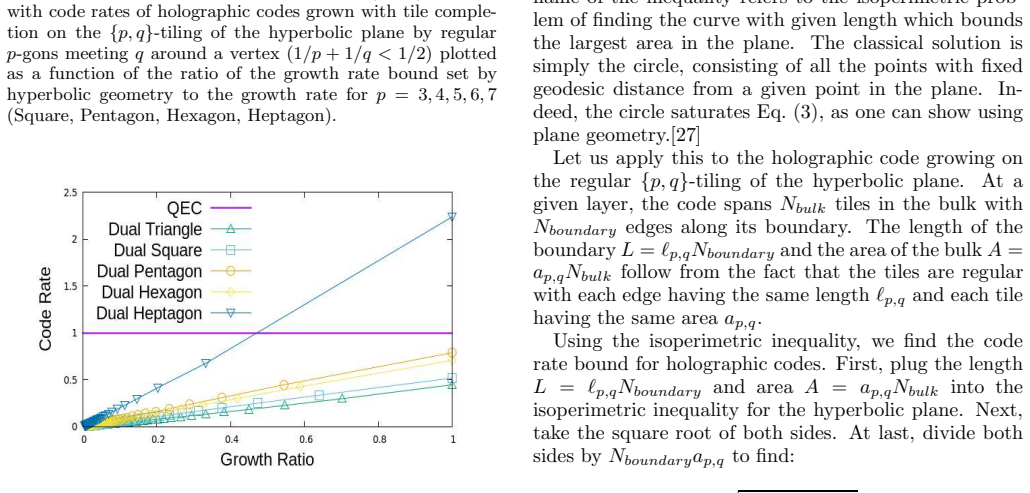
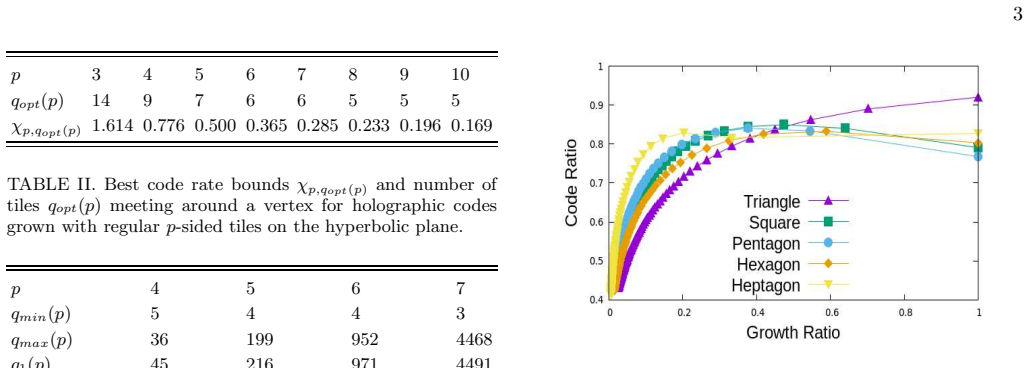
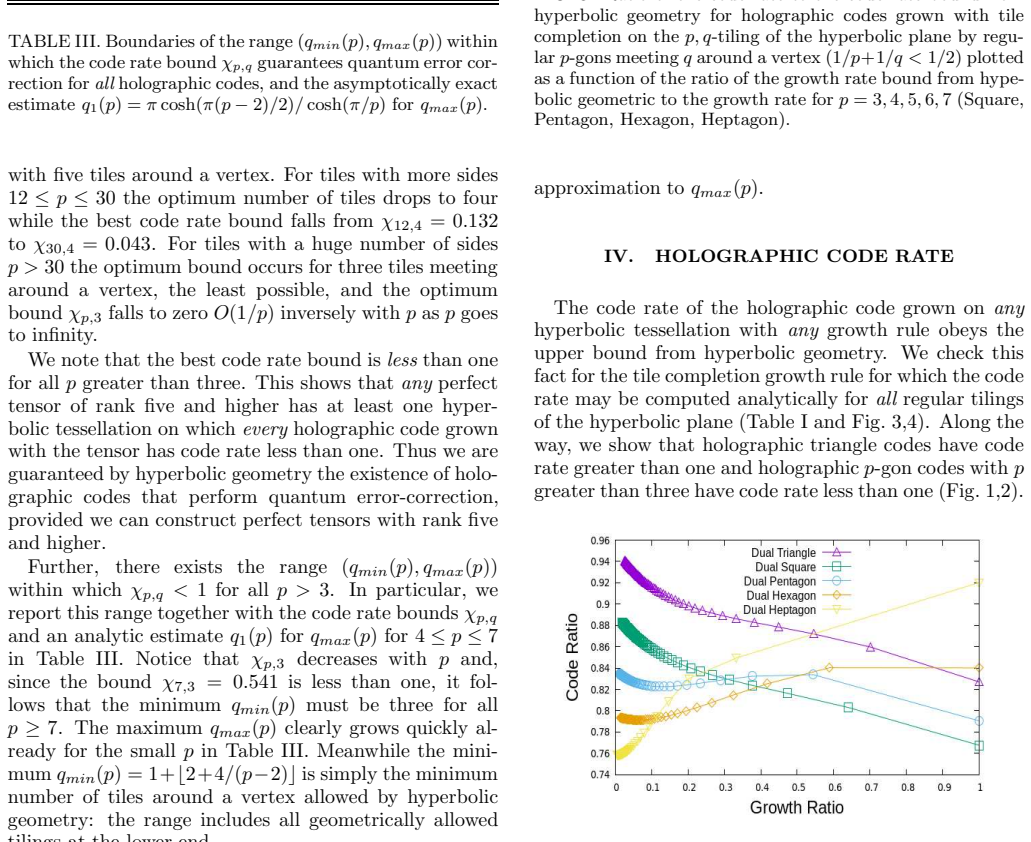
The paper claims that for any holographic code grown on the regular {p,q}-tessellation of the hyperbolic plane by an inflation rule from any simply connected seed set, the asymptotic code rate satisfies $\chi_{\tau}(p,q) \le \ell_{p,q}/a_{p,q}$, where $\ell_{p,q}$ is the side length of the regular p-gon tile and $a_{p,q}$ is its area. It then shows that for every p greater than three there is a range of q values, whose upper end grows exponentially as $O(e^{\pi p/2})$, in which this geometric bound is below one; hence every holographic code grown on those tilings has code rate below one and, by the assumed threshold criterion, performs quantum error correction. For the tile-completion rule the code rate is computed exactly: triangle codes have rate greater than one, while square, pentagon, hexagon, and all higher p-gon codes have rate less than one, and all computed rates obey the geometric bound.
Load-bearing premise
The conclusion that codes with rate below one actually perform quantum error correction depends on the unproven assumption that code rate below one is sufficient for a nonzero erasure threshold, which the paper supports only by numerical simulation.
Editorial extensions
If this is right
- For every regular hyperbolic tessellation with p-gon tiles, p greater than three, and q in the stated range, quantum error correction is guaranteed for all holographic codes regardless of the inflation rule or seed tiles.
- The tile-completion rule yields holographic codes with code rate below one for all p greater than three, while holographic triangle codes have code rate above one, making triangle codes the exception.
- Any perfect tensor of rank five or higher has at least one hyperbolic tessellation on which every holographic code grown from it has code rate below one, so the construction of such tensors directly yields error-correcting codes.
- The upper end of the error-correcting range grows exponentially with p, so the family of guaranteed-correcting tilings expands rapidly as the tile side count increases.
- The geometric bound applies to any quasi-crystal growth rule with finitely many cell types, not only to tile completion, so the result is a universal constraint on code rate for this class of constructions.
Reading between the lines
- If the numerical threshold criterion is correct, the gap $1 - \chi_{p,q}$ can be read as a rough indicator of how much boundary erasure a code can tolerate; codes with rate just below one would be expected to have very small thresholds, offering a concrete finite-size scaling test.
- The triangle-code result suggests that the tile-completion triangle codes, with rate above one, should show no nonzero erasure threshold; verifying this numerically would cleanly separate the geometric bound from the threshold assumption.
- The bound implies that no finite-cell inflation rule can beat the geometric ratio $\ell_{p,q}/a_{p,q}$, so optimizing a holographic code within a fixed tessellation amounts to choosing the growth rule that saturates or approaches the bound.
- Because the bound is purely geometric, it may carry over to physical implementations of hyperbolic lattices where boundary erasure is the natural noise model, protecting the stored information independently of the microscopic tensor choice.
Editorial analysis
A structured set of objections, weighed in public.
Referee Report
Summary. The paper derives a geometric upper bound on the code rate of holographic codes grown on regular hyperbolic tessellations. Using the hyperbolic isoperimetric inequality, the authors show that for any inflation rule and any simply connected seed, the asymptotic code rate is at most chi_{p,q}=ell_{p,q}/a_{p,q}, where ell is the side length and a the area of the regular p-gon tile. They then study the range of q for which chi_{p,q}<1, compute exact code rates for the tile-completion growth rule via SL(2,Z) growth matrices, and report that triangle codes have code rate greater than one while all p-gon codes with p>3 have code rate less than one. The paper concludes that hyperbolic geometry guarantees quantum error correction for these codes.
Significance. The geometric rate bound in Section II is clean, parameter-free, and potentially useful: it gives a universal upper bound on the holographic code rate for any growth rule on any regular hyperbolic tessellation. The growth-matrix computations in Section V check out, and the explicit formulas for tile-completion code rates are a concrete contribution that other researchers can build on. However, the advertised conclusion that a code rate below one 'guarantees quantum error correction' is not supported. The paper's own footnote [25] concedes that the converse of 'rate < 1' is only numerically suggested, and the construction actually produces constant-weight logical operators for outer-layer tiles with p-2 dangling edges when p>=5, which destroys the worst-case erasure threshold for the full logical space. The valid contribution is the rate bound itself, not the error-correction guarantee.
major comments (2)
- [Abstract; Sections III and IV; footnote [25]] The central claim that chi_{p,q}<1 'guarantees quantum error correction' is not established and, under the paper's own definition of an erasure threshold, is actually false for the full logical space. The proof in Section II only bounds the code rate; the additional step from rate below one to a nonzero erasure threshold is assumed, as the authors concede in footnote [25] where they write that numerical simulations only 'suggest' the converse. More seriously, the tile-completion construction itself produces constant-weight logical operators. In Section V the authors identify two cell types for q>3, with hanging-edge counts p-3 and p-2. For p>=5, p-2 >= (p+1)/2, so the perfect-tensor property described in footnote [24] allows a logical operator on the bulk index of such a tile to be transferred to its p-2 boundary dangling edges alone. That logical operator has constant weight independent of the code size. Erasing its support removes a fraction of the boundary that tends to zero as the number of layers grows, so no positive erasure threshold exists for the full logical space. Therefore the statement that all p>3 codes 'perform quantum error correction' is contradicted by the construction, and the abstract's stronger claim that hyperbolic geometry 'guarantees' QEC for any inflation rule is likewise unsupported.
- [Section IV; Section V] The proof that tile-completion code rates are below one for all p>3 rests on an unproven monotonicity assertion. The authors claim that chi_{tau C}(p,q) decreases with p at fixed q and with q at fixed p, and use this to reduce the verification to three codes ({7,3}, {5,4}, {4,5}) plus the triangle-code case. However, Section V only establishes the asymptotic limits: chi -> 0 as p -> infinity at fixed q, and chi -> ((p-3)+(p-2))/((p-3)^2+(p-2)^2) as q -> infinity at fixed p. These limits do not imply global monotonicity in p and q for all finite values. Since the domination argument is load-bearing for the claim that every p>3 tile-completion code has rate below one, a direct proof of the monotonicity (for example by differentiating the explicit expression in Eq. (9)) or a documented finite verification is required.
minor comments (4)
- [Footnote [25]] The footnote correctly states that the sufficiency of code rate below one is only numerically suggested; the abstract and Section III should be reworded to present the error-correction conclusion as conditional on that conjecture, not as a proven guarantee.
- [Section V, Eq. (9)] There is a typographical inconsistency in the subscript of the growth rate: lambda_{tau c}(p,q) appears in Eq. (9) while the rest of the text uses lambda_{tau C}(p,q).
- [Section III] The word 'asymptoticaly' should be 'asymptotically', and the estimate q1(p) is called 'asymptoticaly exact' but it is obtained using the large-argument approximation to cosh^{-1}; the wording should be softened to 'asymptotic approximation'.
- [Section IV] The finite search over p<=30 that supports the statement that the maximum of chi_{tau C}/chi_{p,q} occurs at {3,7} is not documented; including the search data or a short script would make the claim reproducible.
Circularity Check
No circularity found: the code rate bound follows from the isoperimetric inequality and explicit growth matrices, with no fitted input relabeled as a prediction and no load-bearing self-citation.
full rationale
The paper's central bound, Eq. (2), and its finite-layer form Eq. (4) are derived directly from the classical isoperimetric inequality Eq. (3), with the saturation check for hyperbolic circles given in footnote [27]. The code rate is not defined in terms of the bound; it is defined independently as a limit of bulk-to-boundary degrees of freedom in Eq. (1). The tile-completion code rates are computed from explicit growth matrices in Eqs. (5)-(7) and the general rate formula in Eq. (9); no parameter is fitted to a subset of data and then presented as a prediction, and the comparison with the geometric bound is a genuine check rather than a construction. References [1] and [3] supply the tensor-network setup and the inflation-rule framework, but they are not authored by the present authors, so there is no self-citation chain carrying the argument. The one potentially questionable inference is the sufficiency direction stated in footnote [25]: the paper says numerical simulations 'suggest' that code rate less than one implies a nonzero erasure threshold, and the abstract upgrades this to 'guarantees quantum error correction.' That is an unsupported external inference and a correctness risk, not a circular reduction: the claim does not reduce to its own input by definition, and no equation in the paper forces the converse. The skeptical concern about constant-weight logical operators likewise challenges the validity of the QEC conclusion, not the circularity of the derivation. Accordingly, under the hard rules requiring a specific exhibited reduction, the appropriate circularity score is 0.
Assumptions & free parameters
assumptions (5)
- standard math Isoperimetric inequality in the hyperbolic plane, A(4π + A) ≤ L².
- standard math Regular hyperbolic tessellations exist exactly when 1/p + 1/q < 1/2.
- domain assumption Perfect tensors give an isometric map from physical to logical Hilbert space.
- ad hoc to paper Code rate less than one implies a finite nonzero erasure threshold.
- domain assumption Tile completion growth produces two cell types after finitely many layers.
Cite this review
Pith. "Pith review of Holographic Code Rate." pith.science (2026). https://pith.science/paper/FU3AFT2A
@misc{pith2026190809253,
  author       = {Pith},
  title        = {Pith review of: Holographic Code Rate},
  year         = {2026},
  howpublished = {\url{https://pith.science/paper/FU3AFT2A}},
  note         = {Machine review of arXiv:1908.09253}
}
read the original abstract
Holographic codes grown with perfect tensors on regular hyperbolic tessellations using an inflation rule protect quantum information stored in the bulk from errors on the boundary provided the code rate is less than one. Hyperbolic geometry bounds the holographic code rate and guarantees quantum error correction for codes grown with any inflation rule on all regular hyperbolic tessellations in a class whose size grows exponentially with the rank of the perfect tensors for rank five and higher. For the tile completion inflation rule, holographic triangle codes have code rate more than one but all others perform quantum error correction.
Figures

Figures from the paper (1 more)
Reference graph
Works this paper leans on
-
[25]
The quantum error correction property we have in mind is simply the existence of a finite, non-zero threshold for the fraction of quantum erasures of physical degrees of freedom below which the logical degrees of freedom can be recovered, in the limit of large code size. A necessary condition for this quantum error-correcting property is that the code rate...
-
[24]
a ik } and B = {aik+1 , a ik+2 ,
To see the isometry, split the perfect tensor index list into two pieces A = {ai1 , a i2 , . . . a ik } and B = {aik+1 , a ik+2 , . . . a ip+1 }, with k = |A| less than or equal to half of p + 1 the rank of the perfect tensor. Then view the perfect tensor as a linear map TAB from the Hilbert space HA to the Hilbert space HB. For any such split, the perfec...
-
[1]
F. Pastawski, B. Yoshida, D. Harlow, and J. Preskill, Holographic quantum error-correcting codes: toy models for the bulk/boundary correspondence, Journal of High Energy Physics 2015, 149 (2015), hep-th/1503.06237
arXiv 2015
-
[2]
A. Jahn, M. Gluza, F. Pastawski, and J. Eisert, Hologra- phy and criticality in matchgate tensor networks, Science Advances 5 (2019)
work page 2019
-
[3]
Conformal Quasicrystals and Holography
L. Boyle, B. Dickens, and F. Flicker, Conformal qua- sicrystals and holography (2018), hep-th/1805.02665
work page Pith review arXiv 2018
-
[4]
W. Thurston, Three-dimensional geometry and topology (Princeton University Press, Princeton, NJ, 1997) pp. 55– 85
work page 1997
-
[5]
A. J. Koll´ ar, M. Fitzpatrick, and A. A. Houck, Hy- perbolic lattices in circuit quantum electrodynamics, Nature 571, 45 (2019), quant-ph/1802.09549
arXiv 2019
-
[6]
P. W. Shor, Fault-tolerant quantum computation, in Proc. 37th Conf. on Foundations of Comp. Sci. (1996) pp. 56–65, quant-ph/960511
work page 1996
Show all 28 references
-
[7]
A. R. Calderbank and P. W. Shor, Good quantum error- correcting codes exist, Phys. Rev. A 54, 1098 (1996)
1996
-
[8]
Steane, Multiple-particle interfer- 7 ence and quantum error correction, Proc
A. Steane, Multiple-particle interfer- 7 ence and quantum error correction, Proc. Roy. Soc. (London) A 452, 2551 (1996), quant-ph/9601029
1996 arXiv
-
[9]
Aharonov and M
D. Aharonov and M. Ben-Or, Fault-tolerant quantum computation with constant error, in Proc. 29th ACM Symp. on Theory of Computing , STOC ’97 (ACM, New York, NY, USA, 1997) pp. 176–188
1997
-
[10]
Cleve, D
R. Cleve, D. Gottesman, and H.-K. Lo, How to share a quantum secret, Phys. Rev. Lett. 83, 648 (1999)
1999
-
[11]
M. D. Reed, L. DiCarlo, S. E. Nigg, L. Sun, L. Frun- zio, S. M. Girvin, and R. J. Schoelkopf, Realization of three-qubit quantum error correction with superconduct- ing circuits, Nature 482, 382 (2012)
2012
-
[12]
Helwig, W
W. Helwig, W. Cui, J. I. Latorre, A. Riera, and H.-K. Lo, Absolute maximal entanglement and quantum secret sharing, Phys. Rev. A 86, 052335 (2012)
2012
-
[13]
Helwig, Absolutely maximally entangled qudit graph states (2013), quant-ph/13062879
W. Helwig, Absolutely maximally entangled qudit graph states (2013), quant-ph/13062879
2013
-
[14]
R. J. Harris, N. A. McMahon, G. K. Brennen, and T. M. Stace, Calderbank-shor-steane holographic quantum error-correcting codes, Phys. Rev. A 98, 052301 (2018)
2018
-
[15]
J. D. Brown and M. Hennaux, Central charges in the canonical realization of asymptotic symmetries: An ex- ample from three-dimensional gravity, Commun. Math. Phys. 104, 207 (1986)
1986
-
[16]
Witten, 2+1-dimensional gravity as an exactly solub le system, Nucl
E. Witten, 2+1-dimensional gravity as an exactly solub le system, Nucl. Phys. B 311, 46 (1988)
1988
-
[17]
Strominger, Black hole entropy from near-horizon mi - crostates, JHEP 9802, 009, hep-th/9712251
A. Strominger, Black hole entropy from near-horizon mi - crostates, JHEP 9802, 009, hep-th/9712251
-
[18]
Witten, Anti de sitter space and holography, Adv.Theor.Math.Phys
E. Witten, Anti de sitter space and holography, Adv.Theor.Math.Phys. 2, 253 (1998)
1998
-
[19]
Vidal, Class of quantum many-body states that can be efficiently simulated, Phys
G. Vidal, Class of quantum many-body states that can be efficiently simulated, Phys. Rev. Lett. 101, 110501 (2008)
2008
-
[20]
Qi, Exact holographic mapping and emergent space-time geometry (2013), hep-th/1309.6282
X.-L. Qi, Exact holographic mapping and emergent space-time geometry (2013), hep-th/1309.6282
2013 arXiv
-
[21]
Yoshida, Information storage capacity of discrete s pin systems, Ann
B. Yoshida, Information storage capacity of discrete s pin systems, Ann. Phys. 338, 134 (2013)
2013
-
[22]
J. I. Latorre and G. Sierra, Holographic codes (2015), quant-ph/150206618
2015
-
[23]
Pastawski and J
F. Pastawski and J. Preskill, Code properties from holo - graphic geometries, Phys. Rev. X 7, 021022 (2017)
2017
-
[26]
Courant and D
R. Courant and D. Hilbert, Methods of mathematical physics (Wiley, New York, 1953) pp. 166–167
1953
-
[27]
The circle of radius s in the hyperbolic plane has circum- ference L(s) = 2 π sinh(s) = 4 π sinh(s/ 2) cosh(s/ 2) and area A(s) = 4 π sinh2(s/ 2). Using the relation between hyperbolic sine and cosine 1 + sinh 2(s/ 2) = cosh 2(s/ 2), we find the circumference and area of the ci...
-
[28]
The duality transformation joins the centers of the regular p- gon tiles with segments
Tile completion on the {p, q }-tiling gives the same code as vertex completion on the {q, p }-tiling by duality. The duality transformation joins the centers of the regular p- gon tiles with segments. These segments form faces with q segments around a face, and p faces meeting...
Reviewed August 14, 2026 · model on record in the stance chip above.
Discussion (0). Continue with ORCID to comment.