REVIEW 3 major objections 4 minor 21 references
Thickness-dependent optical properties of layered hybrid organic-inorganic halide perovskites: A tight-binding GW-BSE study
T0 review · 3 major / 4 minor · reviewed 2026-08-14 · deepseek-v4-flash
Pith's one-line read A semiempirical tight-binding GW-BSE model reproduces the thickness-dependent exciton binding energies of layered lead-halide perovskites, from 302 meV at n=1 to 37 meV in bulk.
desk verdict A cheap, non-circular tight-binding GW-BSE model that gets the n-dependent exciton energies of layered lead-iodide perovskites right, but whose classical dielectric self-energy would benefit from a layered ab initio transferability check. read the letter →
The pith
A machine-rendered reading of the paper's core claim, the machinery that carries it, and where it could break.
The reading
What carries the argument
The engine of the calculation is a semiempirical tight-binding Hamiltonian for the Pb 6s/6p and I 5s/5p orbitals, built from a bulk DFT calculation plus two nonperturbative spin-orbit coupling constants; into that Hamiltonian the paper inserts five orbital-resolved GW self-energies and a conduction-band scissors shift, all fitted to reproduce the ab initio GW band structure of bulk MAPbI3. For a layered structure the only additional ingredient is the electrostatic self-energy δΣ(z) of Eq. (5), obtained from the classical screened Coulomb interaction in a stack of alternating inorganic and organic dielectric slabs, applied through the perturbative expectation values of Eqs. (6a)-(6b). Optical spectra follow from solving the Bethe-Salpeter equation with the two-electron integrals built from the same classical W, using tight-binding momentum and dipole matrix elements. This machinery is what lets the paper treat unit cells with many atoms while keeping the mean-field, self-energy, and exciton problems on the same footing.
What would settle it
Measure the 2s-2p splitting of the n=1 exciton by high-field magneto-optics or two-photon spectroscopy: the model predicts it is about 1 meV (2p lower), and the 1s binding energy near 302 meV in bulk crystals. If experiment finds near-degenerate 2s/2p or a binding energy far outside 250-350 meV, the dielectric-confinement picture fails.
Extended reading notes
Core claim
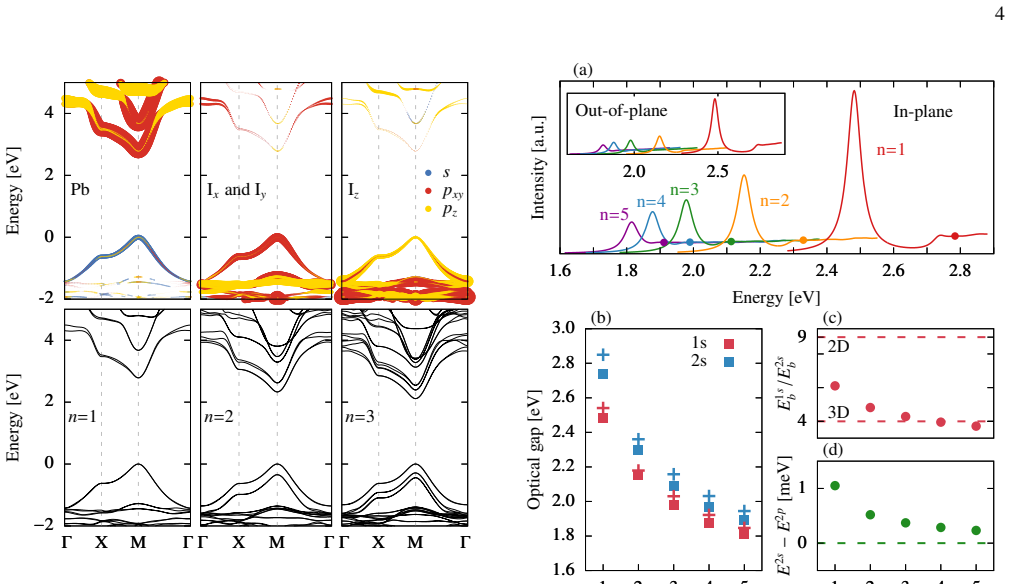
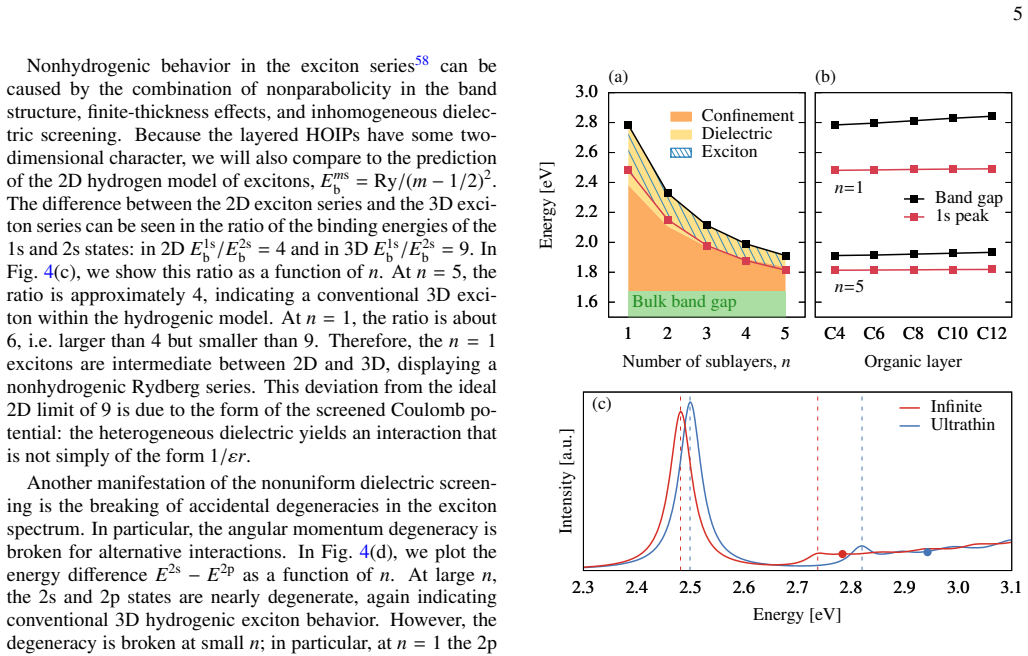
The core claim is that a single set of bulk-derived tight-binding and GW parameters, combined with a classical dielectric-confinement self-energy, quantitatively explains the evolution of excitons from two to three dimensions in layered lead-iodide perovskites. The paper reports 1s exciton binding energies of 302 meV (n=1), 177 meV (n=2), 135 meV (n=3), 112 meV (n=4), and 97 meV (n=5), with the bulk limit estimated at 37 meV, and shows that the calculated 1s and 2s excitation energies track experimental values within 0.1 eV for all n. It also finds a nonhydrogenic exciton series: at n=1 the 1s/2s binding-energy ratio is about 6, intermediate between the 2D limit of 4 and the 3D limit of 9, and the 2s-2p degeneracy is broken by about 1 meV at n=1 while recovering degeneracy at large n. In an exfoliated n=1 bilayer the model predicts a 1s binding energy of 444 meV and an absorption peak at 2.50 eV, matching the measured 2.53 eV.
Load-bearing premise
The model assumes that the only difference between bulk and layered perovskites is the classical electrostatic environment; if the atomic-scale electronic screening in thin layers is genuinely different from bulk, the predicted exciton energies would move.
Editorial extensions
If this is right
- The thickness dependence of the optical gap is set mainly by quantum confinement, not by dielectric contrast, because the increase in exciton binding energy almost cancels the dielectric self-energy shift.
- The 1s absorption energy is nearly independent of the organic spacer length, so chemical tuning of the band gap (e.g., from butyl to dodecyl ammonium) should leave the lowest exciton peak roughly fixed.
- Exfoliated ultrathin layers are predicted to show substantially larger exciton binding energies (444 meV for a single n=1 bilayer) and a 2s state that blue-shifts more than the 1s state.
- The nonhydrogenic 1s/2s ratio and the ~1 meV 2s-2p splitting at n=1 are specific fingerprints that high-resolution magneto-optical experiments could confirm.
- The same parameterization can be transferred to other large-unit-cell layered compounds, avoiding full ab initio GW-BSE calculations in materials where the bulk parameters are known.
Reading between the lines
- If the electrostatic-confinement picture holds, the same classical W could be used to predict trion and biexciton binding energies in these layered perovskites, giving definite numbers to compare with the multi-carrier complexes the paper mentions as future work.
- A sharp test of the model would be a direct measurement of the 2s-2p splitting in n=1; the predicted ~1 meV splitting is small but resolvable with high-field magneto-optics, and would discriminate a purely dielectric model from models with additional quantum-confinement corrections.
- Because the model retains atomistic orbital character (e.g., the different roles of in-plane versus vertical iodine orbitals at the valence band edge), it could be extended to study how chemical substitutions on the halide site shift the exciton series, a connection the paper does not pursue.
- The near-cancellation of dielectric self-energy and exciton binding suggests a general design rule for layered semiconductors: changes in the environment will move the band gap but barely move the lowest exciton peak, which could matter for heterogeneous device architectures such as perovskite-on-substrate junctions.
Signed reviews
Editorial analysis
A structured set of objections, weighed in public.
Referee Report
Summary. The manuscript presents a semiempirical tight-binding model for layered Ruddlesden-Popper lead-iodide perovskites. The mean-field Hamiltonian is built from a DFT/Wannier tight-binding parametrization with spin-orbit coupling; quasiparticle corrections are introduced as orbital-dependent diagonal self-energies fitted to a bulk GW band structure and are combined, for layered systems, with a classical electrostatic self-energy delta-Sigma(z). Excitonic spectra are obtained by solving the Bethe-Salpeter equation with a classical screened Coulomb interaction. The authors report thickness-dependent 1s and 2s exciton energies for n=1-5, compare them with experiment in Fig. 4(b), extract binding energies, and analyze the nonhydrogenic Rydberg series and the 2s-2p degeneracy breaking.
Significance. If the central claim is accepted, this work provides a computationally affordable atomistic route to excitonic properties of layered perovskites and a useful quantitative decomposition into carrier-confinement, dielectric, and exciton-binding contributions. The agreement with experiment for both 1s and 2s energies across n is a concrete, falsifiable prediction, and the term-by-term mechanism analysis is a genuine strength. The explicit treatment of the full Brillouin zone goes beyond effective-mass models. However, the strength of the claim depends on the transferability of bulk-fitted self-energy parameters and on the classical model of dielectric screening; the paper does not benchmark either against an independent layered first-principles calculation.
major comments (3)
- [Fig. 4(c) and following paragraph] The sentence 'At n=5, the ratio is approximately 4, indicating a conventional 3D exciton within the hydrogenic model' is inconsistent with the definitions given two sentences earlier, where the 3D hydrogenic ratio is 9 and the 2D ratio is 4. A ratio of approximately 4 at n=5 would indicate 2D-like behavior, contradicting the paper's own conclusion that conventional hydrogenic 3D behavior is recovered at large n. The text and Fig. 4(c) should be checked and the interpretation corrected.
- [Abstract and 'Excitons in semiconductors' paragraph] The bulk value E_1s^b = 37 meV for n=infinity is not produced by the BSE calculation used for n=1-5; it is obtained from the hydrogenic formula Ry = mu/(2 epsilon^2) with mu = 0.10 m0 and epsilon = 6.1. Listing this in the abstract as 'calculated to be' obscures the distinction between a many-body calculation and an analytic estimate, and the text should label it accordingly.
- [Eqs. (5)-(6) and Fig. 4(b)] The thickness-dependent quasiparticle correction is the classical electrostatic self-energy delta-Sigma(z) of Eq. (5), added perturbatively via Eq. (6) to self-energies fitted to bulk GW. No comparison to an independent layered ab initio GW or other first-principles calculation is provided to validate the transferability of the bulk self-energy constants to monolayers. Since the claimed agreement with experiment within 0.1 eV in Fig. 4(b) depends on this assumption, the authors should either provide a benchmark for at least one small-n system or clearly state the resulting uncertainty in the predicted quasiparticle gaps and binding energies.
minor comments (4)
- [Results after Fig. 4] In the sentence reporting binding energies, '112 mev' should be '112 meV'.
- [Fig. 4(c) caption] The caption phrase 'a ratio of 9 or 4 is the prediction of an ideal 2D or 3D hydrogenic model' is ambiguous; it should be rephrased to state explicitly that 9 corresponds to the 3D model and 4 to the 2D model.
- [Title and abstract] The term 'GW-BSE study' may overstate the level of theory for the layered systems, where the self-energy is a fitted diagonal shift plus a classical electrostatic image-potential correction rather than an ab initio GW self-energy; this should be stated more prominently.
- [Bulk parameterization paragraph] The numerical values of the fitted parameters (Delta_Pb_SOC, Delta_I_SOC, the five Sigma_mu, and Sigma_CB) are not reported, which would improve reproducibility and facilitate comparison with other tight-binding parametrizations.
Circularity Check
No significant circularity: the layered exciton predictions are genuine outputs of a model parameterized by external bulk GW/DFT data and standard electrostatics.
full rationale
The derivation chain is self-contained against external references. The tight-binding and spin-orbit parameters are determined from a bulk DFT/Wannier calculation, and the five orbital self-energies, two SOC constants, and scissors shift are optimized to reproduce the ab initio GW band structure of MAPbI3 from Ref. 16 (Brivio et al.), an external reference not authored by the present authors. The layered band structures, 1s/2s exciton energies, binding energies, and 2s-2p splittings are genuine outputs of Eq. 6 and the BSE, not fits to the experimental data used for validation (Refs. 9 and 10). The classical electrostatic delta-Sigma(z) and screened interaction W are taken from standard image-charge and dielectric-slab results (Refs. 43-45). The bulk 37 meV binding energy is explicitly obtained from the hydrogenic formula using the model's reduced mass and a literature dielectric constant epsilon=6.1; it is an estimate derived from the model, not a fitted reproduction of a target value. No equation reduces to its own input by construction, and no load-bearing premise is justified solely by a self-citation. The only self-citations (Refs. 58-59) are contextual references to nonhydrogenic Rydberg series and dielectric-environment insensitivity in other materials; they are not used to define or force the paper's central results. The comparison with experiment is therefore a genuine validation of independent predictions.
Assumptions & free parameters
free parameters (3)
- Spin-orbit coupling constants ΔPb_SOC and ΔI_SOC =
1.18 eV and 1.06 eV
- Five orbital self-energies Σμ (Pb s, Pb p, I s, I p_perp, I p_para) =
Not reported
- Scissors shift ΣCB =
Not reported
assumptions (5)
- domain assumption The layered structure can be modeled as alternating slabs with uniform dielectric constants εi=6.1 and εo=2.1
- domain assumption Neglect hybridization between perovskite layers due to long organic spacers
- domain assumption All structures approximated as cubic Pm-3m, ignoring orthorhombic distortion and Rashba effects
- domain assumption Tight-binding parameters from cubic CsPbI3 are transferable to layered HOIPs with different organic cations
- domain assumption Neglect of differential overlap in two-electron integrals, and inclusion of only two valence and two conduction bands
Cite this review
Pith. "Pith review of Thickness-dependent optical properties of layered hybrid organic-inorganic halide perovskites: A tight-binding GW-BSE study." pith.science (2026). https://pith.science/paper/NH35EKBH
@misc{pith2026190809436,
  author       = {Pith},
  title        = {Pith review of: Thickness-dependent optical properties of layered hybrid organic-inorganic halide perovskites: A tight-binding GW-BSE study},
  year         = {2026},
  howpublished = {\url{https://pith.science/paper/NH35EKBH}},
  note         = {Machine review of arXiv:1908.09436}
}
abstract
We present a many-body calculation of the band structure and optical spectrum of the layered hybrid organic-inorganic halide perovskites in the Ruddlesden-Popper phase with the general formula A$^{'}_{2}$A$_{n-1}$M$_{n}$X$_{3n+1}$, focusing specifically on the lead iodide family. We calculate the mean-field band structure with spin-orbit coupling, quasiparticle corrections within the GW approximation, and optical spectra using the Bethe-Salpeter equation. The model is parameterized by first-principles calculations and classical electrostatic screening, enabling an accurate but cost-effective study of large unit cells and corresponding thickness-dependent properties. A transition of the electronic and optical properties from quasi-two-dimensional behavior to three-dimensional behavior is shown for increasing $n$ and the nonhydrogenic character of the excitonic Rydberg series is analyzed. The thickness-dependent 1s and 2s exciton energy levels are in good agreement with recently reported experiments and the 1s exciton binding energy is calculated to be 302 meV for $n=1$, 97 meV for $n=5$, and 37 meV for $n=\infty$ (bulk MAPbI3).
Figures


Figures from the paper (1 more)
Reference graph
Works this paper leans on
-
[1]
Thickness-dependent optical properties of layered hybrid organic-inorganic halide perovskites: A tight-binding GW-BSE study Yeongsu Cho1 and Timothy C. Berkelbach 2, 3 1Department of Chemistry and James Franck Institute, University of Chicago, Chicago, Illinois 60637, USA 2Department of Chemistry, Columbia University, New York, New York 10027, USA 3Center...
work page Pith review arXiv 1908
-
[2]
Physical Review Letters 2014, 113, 076802. 59 Cho, Y .; Berkelbach, T. C. Environmentally sensitive theory of electronic and optical transitions in atomically thin semiconduc- tors. Physical Review B 2018, 97, 041409. 60 Men´endez-Proupin, E.; Palacios, P.; Wahn´on, P.; Conesa, J. Self- consistent relativistic band structure of the CH 3 NH 3 PbI 3 per- ov...
work page 2014
-
[4]
Physical Review B 1990, 42, 11099. 30 Knutson, J. L.; Martin, J. D.; Mitzi, D. B. Tuning the band gap in hybrid tin iodide perovskite semiconductors using structural tem- plating. Inorganic chemistry 2005, 44, 4699–4705. 31 Mayers, M. Z.; Tan, L. Z.; Egger, D. A.; Rappe, A. M.; Reich- man, D. R. How lattice and charge fluctuations control carrier dy- namic...
work page 1990
-
[10]
The 2s exciton state, having a smaller binding energy, exhibits a larger increase by 90 meV
The 1s peak of the ultrathin bilayer is located at 2.50 eV , only 20 meV higher than the case of the infinite number of alternating layers and in good agreement with the experimental value of 2.53 eV . The 2s exciton state, having a smaller binding energy, exhibits a larger increase by 90 meV . The band gap increase of 160 meV shows the ma- jor consequence...
work page 2019
-
[18]
68 Elkins, M. H.; Pensack, R.; Proppe, A. H.; V oznyy, O.; Quan, L. N.; Kelley, S. O.; Sargent, E. H.; Scholes, G. D. Biex- citon Resonances Reveal Exciton Localization in Stacked Per- ovskite Quantum Wells. The Journal of Physical Chemistry Let- ters 2017, 8, 3895–3901. 69 Thouin, F.; Neutzner, S.; Cortecchia, D.; Dragomir, V . A.; Soci, C.; Salim, T.; L...
work page 2017
-
[189]
50 Rohlfing, M.; Louie, S. G. Electron-hole excitations and optical spectra from first principles. Physical Review B 2000, 62,
work page 2000
-
[312]
P.; Sadoughi, G.; Rehman, W.; Eperon, G
4 McMeekin, D. P.; Sadoughi, G.; Rehman, W.; Eperon, G. E.; Saliba, M.; H ¨orantner, M. T.; Haghighirad, A.; Sakai, N.; Ko- rte, L.; Rech, B.; Johnston, M. B.; Herz, L. M.; Snaith, H. J. A mixed-cation lead mixed-halide perovskite absorber for tandem solar cells. Science 2016, 351, 151–155. 5 Tanaka, K.; Kondo, T. Bandgap and exciton binding energies in l...
work page 2016
-
[430]
8 57 Tanaka, K.; Takahashi, T.; Ban, T.; Kondo, T.; Uchida, K.; Miura, N. Comparative study on the excitons in lead-halide- based perovskite-type crystals CH3NH3PbBr3 CH3NH3PbI3. Solid state communications 2003, 127, 619–623. 58 Chernikov, A.; Berkelbach, T. C.; Hill, H. M.; Rigosi, A.; Li, Y .; Aslan, O. B.; Reichman, D. R.; Hybertsen, M. S.; Heinz, T. F...
work page 2003
Show all 21 references
-
[440]
9 Blancon, J.-C. et al. Scaling law for excitons in 2D perovskite quantum wells. Nature communications 2018, 9,
2018
-
[582]
Coulomb interaction and excitons in a superlattice
42 Guseinov, R. Coulomb interaction and excitons in a superlattice. physica status solidi (b) 1984, 125, 237–243. 43 Cavalcante, L.; Chaves, A.; Van Duppen, B.; Peeters, F.; Re- ichman, D. Electrostatics of electron-hole interactions in van der Waals heterostructures. Physical...
1984
-
[1418]
S.; Louie, S
40 Hybertsen, M. S.; Louie, S. G. Electron correlation in semicon- ductors and insulators: Band gaps and quasiparticle energies. Physical Review B 1986, 34,
1986
-
[2254]
M.; Zhong, Y .; Velauthapil- lai, A.; van der Zande, A.; Owen, J
10 Yaffe, O.; Chernikov, A.; Norman, Z. M.; Zhong, Y .; Velauthapil- lai, A.; van der Zande, A.; Owen, J. S.; Heinz, T. F. Excitons in ultrathin organic-inorganic perovskite crystals.Physical Review B 2015, 92, 045414. 11 Blancon, J.-C. et al. Extremely efficient internal exciton...
2015
-
[2867]
C.; Soe, C
8 Stoumpos, C. C.; Soe, C. M. M.; Tsai, H.; Nie, W.; Blancon, J.-C.; Cao, D. H.; Liu, F.; Traor´e, B.; Katan, C.; Even, J.; Mohite, A. D.; Kanatzidis, M. G. High members of the 2D Ruddlesden-Popper halide perovskites: synthesis, optical properties, and solar cells of (CH3 (CH2...
2017
-
[3865]
A.; Yates, J
34 Mostofi, A. A.; Yates, J. R.; Pizzi, G.; Lee, Y .-S.; Souza, I.; Van- derbilt, D.; Marzari, N. An updated version of wannier90: A tool for obtaining maximally-localised Wannier functions. Computer Physics Communications 2014, 185, 2309–2310. 35 Even, J.; Pedesseau, L.; Jancu...
2014
-
[4467]
R.; Verdi, C.; Giustino, F
19 Filip, M. R.; Verdi, C.; Giustino, F. GW band structures and carrier e ffective masses of CH3NH3PbI3 and hypothetical per- ovskites of the type APbI3: A = NH4, PH4, AsH4, and SbH4. The Journal of Physical Chemistry C 2015, 119, 25209–25219. 20 Mosconi, E.; Umari, P.; De Ange...
2015
-
[4692]
Mag- netoabsorption of the lowest exciton in perovskite-type compound (CH3NH3) PbI3
56 Hirasawa, M.; Ishihara, T.; Goto, T.; Uchida, K.; Miura, N. Mag- netoabsorption of the lowest exciton in perovskite-type compound (CH3NH3) PbI3. Physica B: Condensed Matter 1994, 201, 427–
1994
-
[4927]
H.; Pereira, V
51 Ridolfi, E.; Lewenkopf, C. H.; Pereira, V . M. Excitonic structure of the optical conductivity in MoS2 monolayers. Physical Review B 2018, 97, 205409. 52 Pedersen, T. G.; Pedersen, K.; Kriestensen, T. B. Optical matrix elements in tight-binding calculations. Physical Review ...
2018
-
[5390]
T.-W.; Stranks, S
41 Miyata, A.; Mitioglu, A.; Plochocka, P.; Portugall, O.; Wang, J. T.-W.; Stranks, S. D.; Snaith, H. J.; Nicholas, R. J. Direct mea- surement of the exciton binding energy and e ffective masses for charge carriers in organic–inorganic tri-halide perovskites.Nature Physics 2015, 11,
2015
-
[5571]
Excitonic and nonlinear-optical properties of dielectric quantum-well structures
45 Kumagai, M.; Takagahara, T. Excitonic and nonlinear-optical properties of dielectric quantum-well structures. Physical Review B 1989, 40, 12359. 46 Sham, L. J.; Rice, T. M. Many-Particle Derivation of the Effective- Mass Equation for the Wannier Exciton. Physical Review 1966...
1989
-
[6904]
Z.; Liu, S.; Rappe, A
26 Zheng, F.; Tan, L. Z.; Liu, S.; Rappe, A. M. Rashba spin–orbit coupling enhanced carrier lifetime in CH3NH3PbI3. Nano letters 2015, 15, 7794–7800. 27 Boyer-Richard, S.; Katan, C.; Traore, B.; Scholz, R.; Jancu, J.-M.; Even, J. Symmetry-based tight binding modeling of halide...
2015
-
[6961]
Excitons in self-organized semiconductor /insulator superlattices: PbI-based perovskite compounds
13 Muljarov, E.; Tikhodeev, S.; Gippius, N.; Ishihara, T. Excitons in self-organized semiconductor /insulator superlattices: PbI-based perovskite compounds. Physical Review B 1995, 51, 14370. 14 Tanaka, K.; Takahashi, T.; Kondo, T.; Umebayashi, T.; Asai, K.; Ema, K. Image char...
1995
Reviewed August 14, 2026 · model on record in the stance chip above.
Discussion (0). Continue with ORCID to comment.