REVIEW 2 major objections 5 minor 2 cited by
Lorentzian angles and trigonometry including lightlike vectors
T0 review · 2 major / 5 minor · reviewed 2026-08-14 · deepseek-v4-flash
Pith's one-line read Marking null edges makes Lorentzian angles finite and additive
desk verdict The paper genuinely solves the null-angle additivity problem and proves a simplicial Lorentzian Gauss-Bonnet theorem, but the sign of the theorem is fixed by an imported branch convention, not by the angle calculus itself. read the letter →
The pith
A machine-rendered reading of the paper's core claim, the machinery that carries it, and where it could break.
The reading
What carries the argument
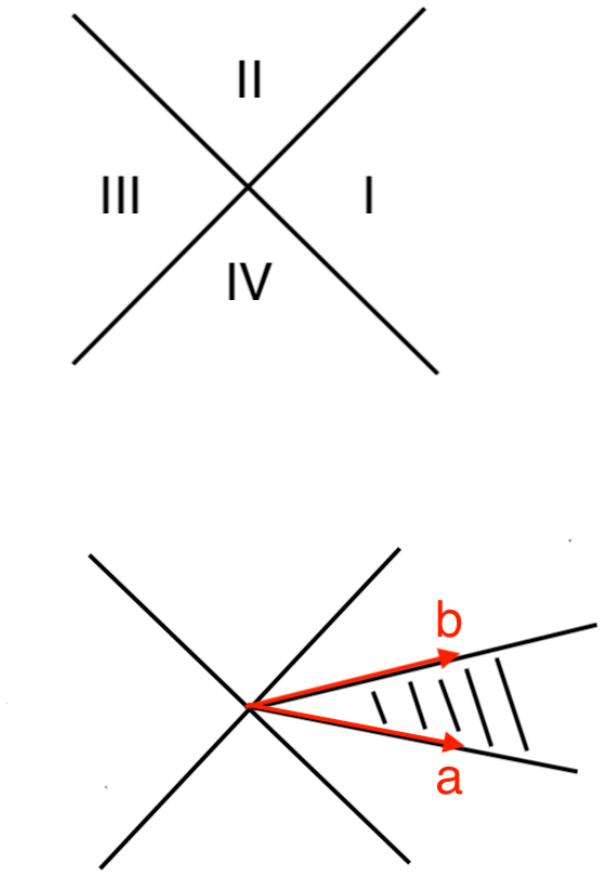
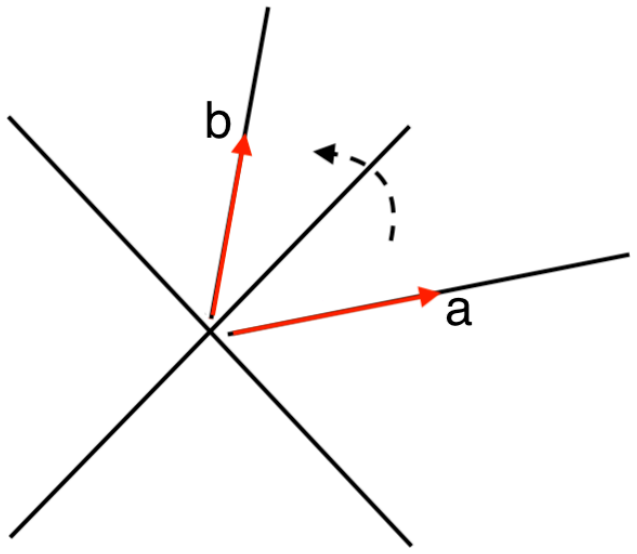
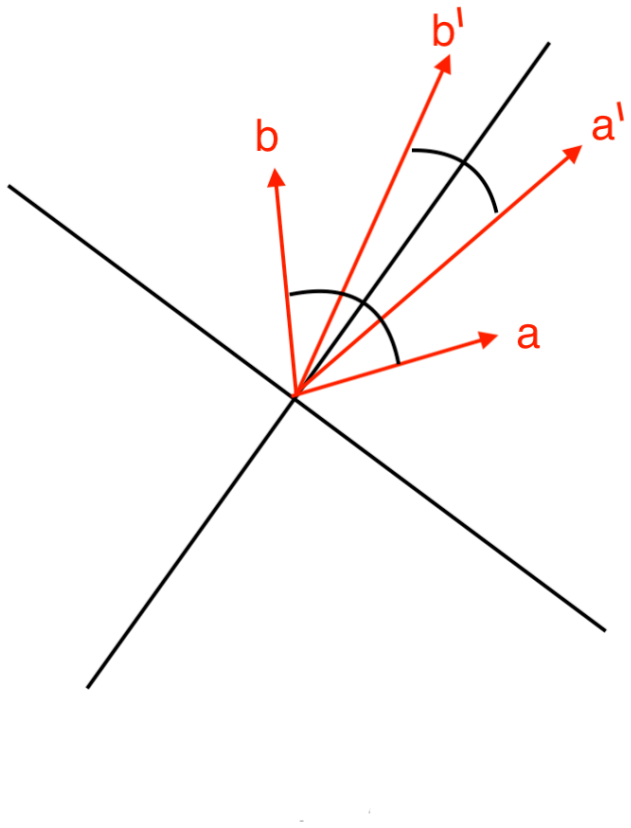
The load-bearing object is the opening angle of a marked wedge, not the angle between unmarked rays: a wedge is marked by its edges and, when a null edge is present, by a marking point that restores the lost rescaling information. The argument runs on two algebraic identities for $Z(a,b)=a\cdot b+\|a\wedge b\|$ and $\bar Z(a,b)=a\cdot b-\|a\wedge b\|$: the product identity $Z\bar Z=|a|^2|b|^2$ and the three-vector composition identity $Z(a,b)Z(b,c)=|b|^2Z(a,c)$ when $b$ lies between $a$ and $c$. Analytic continuation of the basic quadrant-I formula $\theta=\log(Z/(|a||b|))$ across the light cone, with the $i\varepsilon$ prescription selecting the branch where the logarithm gains an imaginary part $-i\pi/2$ for a timelike vector, fixes the signs and imaginary parts; a reference length $\ell_0$ makes the logarithms dimensionless and cancels out of additive sums. The mnemonic rule is that each null edge contributes $-i\pi/4$ to the angle.
What would settle it
Take a Minkowski triangle with one lightlike side, assign marks, and compute its three opening angles using equations (18), (19), and (22); the theorem asserts the sum is $-i\pi$ for any choice of reference length $\ell_0$ and any placement of marks. An explicit coordinate calculation that yields a sum depending on $\ell_0$, or differing from $-i\pi$, would show the additivity claim is not consistent.
Extended reading notes
Core claim
The central discovery is that the obstruction to defining angles with null directions, namely the divergence of boost parameters, can be removed by tracking the rescaling information carried by a null edge. The paper builds a complete additive calculus of opening angles of marked wedges in Minkowski space, with explicit formulas: for a spacelike vector $a$ and a null vector $n$, $\theta(a,n)=\log\frac{2|a\cdot n|}{\|a\|\ell_0}-i\pi/4$; for two null vectors in the same quadrant, $\theta(a,b)=\log\frac{2|a\cdot b|}{\ell_0^2}-i\pi/2$; and for antiparallel null vectors, $\theta(a,b)=\log(-a:b)-i\pi$. These definitions make angle addition exact under subdivision, make the angles of every Lorentzian triangle sum to $h=-i\pi$, and deliver the simplicial Gauss-Bonnet identity $S=-2\pi i\chi$ for any two-dimensional Lorentzian simplicial complex, including unorientable complexes and those with boundary.
Load-bearing premise
The whole construction rests on one branch choice: when a timelike vector is analytically continued through the light cone, the $i\varepsilon$ prescription assigns the logarithm an imaginary part of $-i\pi/2$, and if that sheet were chosen differently every null angle would shift by an additive constant while additivity itself would survive.
Editorial extensions
If this is right
- Regge-calculus defect angles, including boundary and corner terms, become defined for hinges that are spacelike, timelike, or null; null hinges carry area zero and therefore contribute nothing to the action.
- The full gravitational action on a simplicial spacetime with boundary is additive under gluing, which in the continuum implies the existence and concrete form of corner terms and implies action-stationarity under variations that fix the induced boundary metric.
- Every two-dimensional Lorentzian triangle has angle sum $-i\pi$, so the simplicial Lorentzian Gauss-Bonnet theorem $S=-2\pi i\chi$ holds for any topology, orientable or not, with or without boundary.
- For the trousers cobordism the action comes out $+2\pi i$, so the quantum amplitude $e^{iS}$ acquires a damping factor $e^{-2\pi}$, whereas the yarmulke cobordism is enhanced.
- Angles involving null vectors lose conformal invariance under metric rescaling unless $\ell_0$ is adjusted, but the $\ell_0$-dependence cancels in the closed sums, such as the total defect angle, that define physically meaningful quantities.
Reading between the lines
- If $\ell_0$-dependence truly cancels only in additive combinations, then the physically meaningful quantities are the $\ell_0$-independent combinations; one could search for such combinations in quasi-local energy or entropy formulas and see whether a natural reference length emerges.
- The same marking prescription may transfer to higher-dimensional null boundaries, where corner terms at intersections of null and non-null segments would be fixed by the same per-null-edge phase rule, giving testable predictions for the action in null-boundary regions.
- Because the splitting of the imaginary contribution between two null-adjacent wedges is convention-dependent, a quantum-gravity input would be needed to decide whether $\ell_0$ is physical or a gauge choice; the paper itself leaves that question open.
Signed reviews
Editorial analysis
A structured set of objections, weighed in public.
Referee Report
Summary. The paper defines a notion of Lorentzian angle in the two-dimensional Minkowski plane that remains finite and additive even when one or both of the vectors defining a wedge is null. Starting from the standard boost angle for a spacelike wedge, the author uses two algebraic identities, analytic continuation with an iε prescription borrowed from reference [1], and a reference length l0 to define angles for spacelike–null, timelike–null, and null–null wedges, as well as for null slivers. The construction is then applied to prove that the interior angles of any Lorentzian triangle sum to a straight angle h = −iπ, and to derive a simplicial Lorentzian Gauss–Bonnet theorem S = −2πiχ for two-dimensional Lorentzian simplicial complexes, with a discussion of the trousers cobordism and boundary/corner terms for the gravitational action.
Significance. If the construction is fully rigorous, it fills a genuine gap in Lorentzian Regge calculus and in the treatment of null boundaries and corners, and it provides a very short proof of a simplicial Lorentzian Gauss–Bonnet theorem. The paper is written in a clear and honest style: the algebraic identities (2) and (3) are proven explicitly, the limiting derivations of the null-angle formulas are concrete and repeatable, and the author repeatedly flags which steps are conventional (the iε branch choice, the −iπ/4 apportionment, the reference length l0). The sliver analysis in Section 7 is particularly valuable because it exposes a subtlety that a naive definition would miss. The main value of the paper is thus not a single surprising prediction but a coherent, well-motivated calculus whose additivity properties are exactly what Regge calculus and action-boundary arguments require.
major comments (2)
- [§8, and also §6–§7] The central claim that the opening angle of an arbitrary wedge is obtained by subdividing it into primitive wedges and summing the resulting angles is stated but not proven. Section 8 says that 'it suffices to subdivide' and that the sum is then the opening angle, but no lemma establishes that the result is independent of the chosen subdivision. This is not a purely cosmetic gap: Section 7 shows that a null sliver's angle changes sign when the sliver is flipped relative to the adjacent wedge, so subdivision independence requires a precise consistency condition for how slivers are oriented inside W. Since the triangle theorem (34) and the Gauss–Bonnet theorem (35) rely on additivity of angles around a point and along the sides of a triangle, the proof of these theorems rests on an unproved assertion. Please add a proof that for any two admissible subdivisions of the same marked wedge, the sums of the sub-angles agree, including the cases in which the subdivision introduces null edges.
- [§3 and §9, Eqs. (7)–(8), (18)–(24), (35)] The sign of the imaginary part of every null angle, and hence the sign of the straight angle h and of the Gauss–Bonnet result, is fixed by an imported convention rather than derived from the additivity requirement. If one replaces a·a → a·a + iε by a·a → a·a − iε, then Eqs. (7)–(8), (18)–(19), and (22)–(24) acquire the opposite imaginary sign, h becomes +iπ, and Eq. (35) becomes S = +2πiχ. The paper's own justification that 'the Lorentzian Gauss-Bonnet theorem also requires it' is circular if the theorem is meant to be a consequence of the angle calculus. The additivity cancellations are insensitive to this overall sign, so the existence of an additive null-angle calculus is not threatened, but the specific statement of the Gauss–Bonnet theorem and the associated damping-versus-enhancement discussion for the trousers cobordism are convention-dependent. The theorem should be stated as S = 2hχ with h = −iπ for the particular branch choice adopted here, and the application to the trousers amplitude should be presented as a consistency check with reference [1] rather than as an independent prediction of the angle construction.
minor comments (5)
- [§5, Eq. (11)] The overline notation on Z is easy to lose in the display: the line 'Z(a,b) Z(b,c) Z(b,c) = ...' should read 'Z(a,b) Z(b,c) \bar Z(b,c) = ...' for identity (2) to apply. The final result (12) is correct, but the intermediate display is confusing as printed.
- [§6, Eq. (24)] The colon notation 'a : b' is used before it is defined; please define the ratio explicitly at the point of first use.
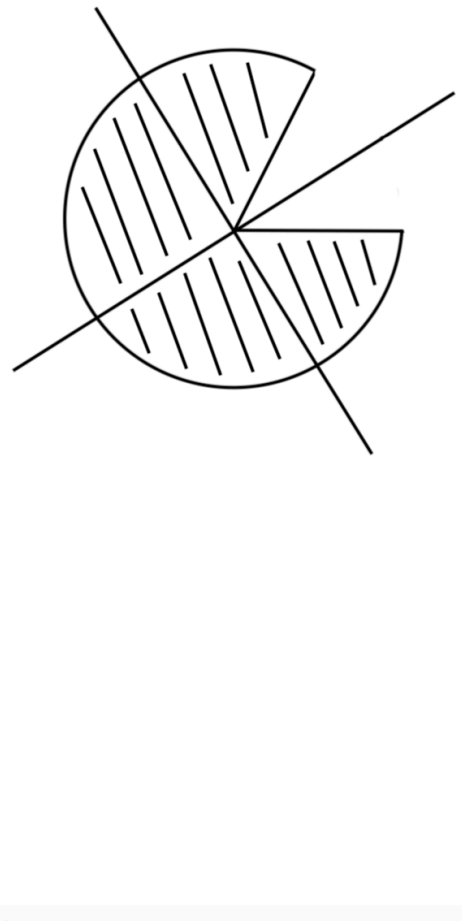
- [§9, after Eq. (27)] The statement that 'the total angle surrounding a point in M^2 equals −2πi' is asserted rather than derived. Since this value is the flat-space reference in the Regge defect formula (27), a short derivation from the preceding formulas would make the Gauss–Bonnet proof easier to follow.
- [§9, trousers discussion] The continuum limit from the simplicial Gauss–Bonnet theorem to the trousers cobordism is only sketched. The paper honestly says 'If our theorem (35) persists in the continuum limit', but it would be helpful to state explicitly that the proven theorem is simplicial and that the continuum application is an extrapolation.
- [§3, penultimate paragraph] The sentence 'the Lorentzian Gauss-Bonnet theorem also requires it' can be misread as a circular justification. Since Section 9 later clarifies that the sign is a convention, it would improve the paper to state this explicitly at the point where the branch is chosen.
Circularity Check
Gauss-Bonnet sign is put in by the branch convention and then recovered; additivity itself is genuine but the headline theorem is convention-dependent.
-
self definitional
[Section 3, Remark after Eq. (8)]
"Additivity alone would not have forced the angle to be complex, but the requirement that the usual formulas of trigonometry continue to hold for Lorentzian metrics does demand it (see [2]), and the Lorentzian Gauss-Bonnet theorem also requires it."
The sign of the imaginary part of the angle is chosen with the intended Gauss-Bonnet theorem already in view. The paper then derives S = -2πi χ in Section 9 from precisely that choice. Reversing the iε prescription would reverse the imaginary parts and would give S = +2πi χ, so the theorem is not an independent consequence of the angle definition; it is an input that the definition was selected to reproduce.
-
self definitional
[Section 9, paragraph before Eq. (27)]
"As we have seen the total angle surrounding a point in M 2 equals − 2πi with the conventions we have adopted."
Equation (27) uses this value as the 'flat-value' from which the defect angle is computed, and the combinatorial count (36)-(38) then turns it into S = -2πi χ. Thus the Gauss-Bonnet sign is inserted by hand as a total-angle convention; the QED proof does not derive that sign. The phrase 'as we have seen' refers to the conventions fixed earlier, not to a derivation independent of the target theorem.
1 more flagged steps
-
ansatz smuggled in via citation
[Section 9, trousers-cobordism paragraph after Eq. (35)]
"Of course the agreement in sign (damping vs. enhancement) is not entirely accidental. It stems from the choice we made in analytically continuing (6) past the branch point at b·b = 0 to obtain (8), and our choice involved a closely related kind of complexified metric to that employed in [1]."
The physical conclusion of damping for the trousers cobordism is explicitly traced back to the earlier analytic-continuation choice, which in Section 3 was imported as the 'iε prescription' of reference [1], a paper by the same author. The agreement with [1] is therefore agreement with an input, not with an independent prediction. The additive null-angle calculus would survive with the opposite branch; only the value of the straight angle h and the sign of the topological action would flip.
full rationale
The core construction of additive Lorentzian angles is not circular: identity (3) is a genuine algebraic identity, and the limit procedures in Sections 5-6 determine null-angle formulas from the non-null cases in a consistent way once the branch is fixed. The paper is also unusually explicit about its conventions, including the reference length l0 and the -iπ/4 apportionment. However, the specific imaginary parts of the null angles, and hence the sign of the total angle around a point, are not derived from additivity; they are chosen to match the iε prescription of reference [1] and to make the Lorentzian Gauss-Bonnet theorem come out with the sign -2πi. The paper itself states that the Gauss-Bonnet theorem 'requires' the complex angle and later admits that the trousers sign 'is not entirely accidental' but stems from the same analytic-continuation choice. Consequently, the headline theorem S = -2πi χ and the suppression/enhancement application reduce, by construction, to conventions imported from prior work by the same author, while the additive angle calculus itself retains independent content. This is partial circularity, not a wholesale collapse of the derivation.
Assumptions & free parameters
free parameters (1)
- reference length l0
assumptions (2)
- domain assumption Additivity of opening angles under juxtaposition of wedges is the correct guiding principle for defining Lorentzian angles.
- ad hoc to paper The iε prescription of [1] (metric acquires a positive-definite imaginary part) selects the correct branch of the logarithm when |b| passes through zero.
Cite this review
Pith. "Pith review of Lorentzian angles and trigonometry including lightlike vectors." pith.science (2026). https://pith.science/paper/NDAWYIZX
@misc{pith2026190810022,
  author       = {Pith},
  title        = {Pith review of: Lorentzian angles and trigonometry including lightlike vectors},
  year         = {2026},
  howpublished = {\url{https://pith.science/paper/NDAWYIZX}},
  note         = {Machine review of arXiv:1908.10022}
}
read the original abstract
We define a concept of Lorentzian angle that works even when one or both of the directions involved is null (lightlike). Such angles play a role in Regge-Calculus, in the boundary- and corner- terms for the gravitational action, and in the Lorentzian Gauss-Bonnet theorem (for which we provide a proof).
Figures
Figures from the paper (7 more)


Forward citations
Cited by 2 Pith papers
-
Studying replica wormholes and the Page curve with simplicial quantum gravity
A coarse simplicial quantum gravity model produces semiclassical saddles whose swap entropy rises and then falls, reproducing the Page transition at n→1+.
-
(2+1) Lorentzian quantum cosmology from spin-foams: opportunities and obstacles for semi-classicality
A 2+1 Lorentzian spin-foam cosmology model with a Hessian-derived measure and a massive scalar field yields convergent partition functions, with semi-classical expectation values only in the causally regular sector an...
Reference graph
Works this paper leans on
-
[1]
Complex Actions in two-dimensional topology change
Jorma Louko and Rafael D Sorkin, “Complex Actions in two-dimensional topology change”, Class. Quant. Grav. 14 : 179-203 (1997), gr-qc/9511023 http://www.pitp.ca/personal/rsorkin/some.papers/87.jorma.yarmulke.pdf
arXiv 1997
-
[2]
Sorkin, Development of Simplicial Methods for the Metrical and Electromag- netic Fields , Ph.D
Rafael D. Sorkin, Development of Simplicial Methods for the Metrical and Electromag- netic Fields , Ph.D. Thesis, California Institute of Technology (1974), https://thesis.library.caltech.edu/2978/1/Sorkin rd 1974.pdf
work page 1974
-
[3]
The Time-evolution Problem in Regge Calculus
Rafael Sorkin, “The Time-evolution Problem in Regge Calculus”, Phys. Rev. D 12 : 385-396 (1974) and 23 : 565 (1981)
work page 1974
-
[4]
The null-surface boundary term in the variation of the gravitational action-functional
Rafael D. Sorkin, “The null-surface boundary term in the variation of the gravitational action-functional”, lecture delivered at:
-
[5]
Perimeter Institute, Meeting of Quantum-Gravity group (15 april 2015)
work page 2015
-
[6]
Peyresq Physics 20: Micro and macro structure of spacetime
“Peyresq Physics 20: Micro and macro structure of spacetime”, conference held Peyresq, Haute Provence, France (June 2015)
work page 2015
- [7]
-
[8]
Boundary and Corner terms in the Action for General Relativity
Ian Jubb, Joseph Samuel, Rafael D. Sorkin, Sumati Surya, “Boundary and Corner terms in the Action for General Relativity”, Class. Quantum Grav. 34, 065006 (2017) arxiv:1612.00149
arXiv 2017
Show all 17 references
-
[9]
General relativity without coordinates
Tullio Regge, “General relativity without coordinates”, Nuovo Cimento 19 : 558–571 (1961)
1961
-
[10]
A Boundary Term for the Action in ‘Regge Calculus’
James B. Hartle and Rafael D. Sorkin, “A Boundary Term for the Action in ‘Regge Calculus’ ”, Gen. Rel. Grav. 13 : 541-549 (1981)
1981
-
[11]
Is the gravitational action additive?
Dieter Brill and Geoff Hayward “Is the gravitational action additive?” Phys. Rev. D 50 : 4914-4919 (1994) arXiv:gr-qc/9403018
1994 arXiv
-
[12]
Gravitational action with null boundaries
Luis Lehner, Robert C. Myers, Eric Poisson, and Rafael D. Sorkin, “Gravitational action with null boundaries” Phys. Rev. D 94 : 084046 (2016) http://arxiv.org/abs/1609.00207
2016 arXiv
-
[13]
Semi-classical Limits of Simplicial Quantum Gravity
J.W. Barrett and T.J. Foxon, “Semi-classical Limits of Simplicial Quantum Gravity”, Class. Quant. Grav. 11 : 543-556 (1994)
1994
-
[14]
Trigonometry in Lorentzian Geometry
Graciela S. Birman and Katsumi Nomizu, “Trigonometry in Lorentzian Geometry” The American Mathematical Monthly 91(9) : 543-549 (1984)
1984
-
[15]
The Sorkin-Johnston State in a Patch of the Trousers Spacetime
Michel Buck, Fay Dowker, Ian Jubb, Rafael D. Sorkin, “The Sorkin-Johnston State in a Patch of the Trousers Spacetime”, Class. Quantum Grav. 34 : 055002 (2017) arXiv:1609.03573 28 DIAGRAMS Figures 1 and 2
2017 arXiv
-
[16]
A wedge marked by the vectors [ OA ] and [ OB ]
-
[17]
closely” as desired 35 Figure 9. The opening angle of a wedge with two lightlike edges: three sub-cases 36 Figure 10. Two ways to glue an “infinitesimal wedge
Three vectors with b between a and c 29 Figure 3. The four quadrants and a wedge in quadrant I 30 Figure 4. A wedge W spanning two quadrants. The edge marked by a is in quadrant I, the b-edge is in quadrant II. We analytically continue the upper edge of W from a to b 31 Figure...
Reviewed August 14, 2026 · model on record in the stance chip above.
Discussion (0). Continue with ORCID to comment.