REVIEW 4 major objections 5 minor 59 references
Physics-Based Rendering for Improving Robustness to Rain
T0 review · 4 major / 5 minor · reviewed 2026-08-14 · deepseek-v4-flash
Pith's one-line read Physics-based rendering of rain is realistic and useful enough that finetuning object detectors and semantic segmentation networks on it improves their performance on real rainy images.
desk verdict A useful physics-based rain augmentation system with a solid synthetic evaluation, but the missing fine-tuning control keeps the real-rain robustness claim from being fully established. read the letter →
The pith
A machine-rendered reading of the paper's core claim, the machinery that carries it, and where it could break.
The reading
What carries the argument
The pipeline's central object is the per-streak compositing operation: each raindrop streak drawn from the Garg and Nayar database is warped by the physical simulator to match drop dynamics, scaled by a weighted mean of the estimated environment map (94% refracted light plus 6% reflected light), defocused with a circle of confusion, and blended with a fog-attenuated background under exposure correction. This mechanism is what connects a physical rainfall rate to pixel-level appearance, and it is what makes the synthetic rain photometrically consistent enough to transfer to real rain.
What would settle it
Take images whose true lighting is known from HDR panoramas but where the sky is largely hidden from the camera view, render rain with the paper's estimated-lighting pipeline, and compare per-streak brightness against renderings made with the true HDR environment: if the estimated-lighting streaks diverge strongly whenever the sky is not visible, the underlying lighting assumption fails.
Extended reading notes
Core claim
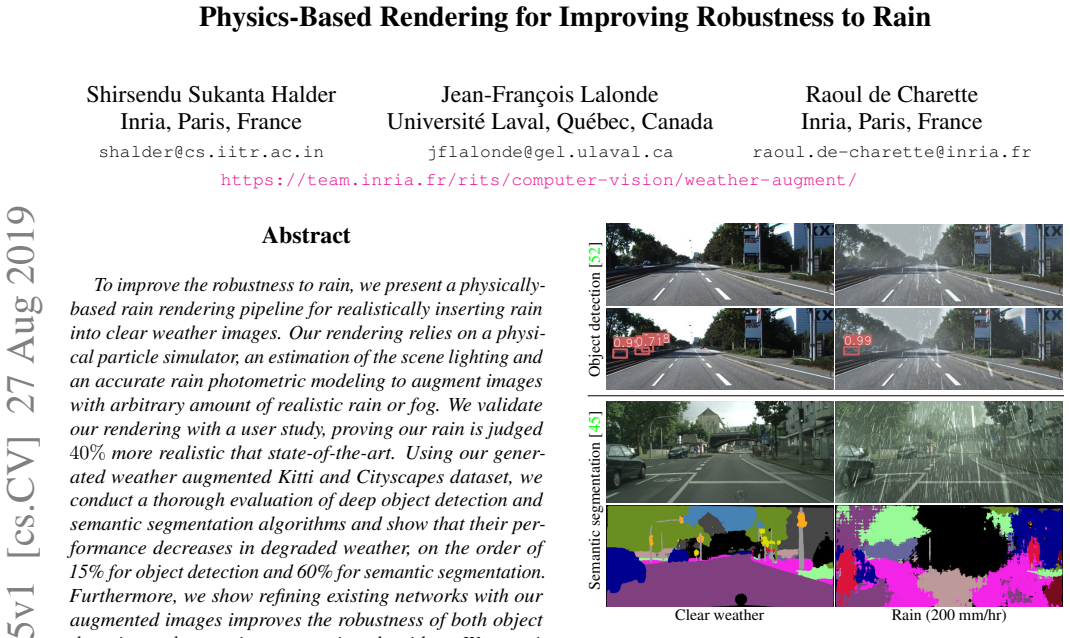
The paper's central claim is that rain can be inserted into clear-weather images by combining a physical raindrop particle simulator, a per-drop estimate of scene lighting, and a photometric model of how falling drops form streaks, and that the resulting augmented images are calibrated by true rainfall rate. This physical grounding lets the authors measure performance loss as a function of rain intensity, then use the augmented data for curriculum finetuning. The load-bearing result is that finetuning on this synthetic rain transfers to real rain: on nuScenes, object detection mAP rises from 10.1 to 11.6 (a 14.9% relative gain) and semantic segmentation AP from 18.7 to 25.6 (a 36.6% relative gain), with clear-weather performance essentially unchanged.
Load-bearing premise
The whole pipeline assumes that the lighting around every raindrop, reconstructed from the single input image, is close enough to the true scene lighting that the rendered streaks have correct brightness.
Editorial extensions
If this is right
- Training on physically rendered rain can improve real-rain robustness for both object detection and semantic segmentation without sacrificing clear-weather accuracy.
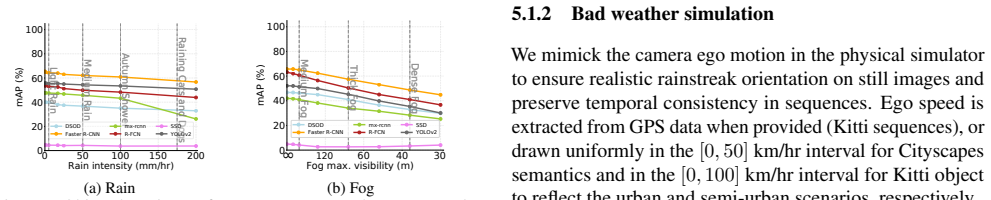
- Rain-induced degradation is not uniform across algorithms: some detectors lose 25–30% mAP under 200 mm/hr rain while others lose about 12%, so weather robustness should be evaluated as a function of calibrated rainfall rate.
- Semantic segmentation is much more sensitive to rain than object detection, with performance dropping by up to roughly 60%, suggesting segmentation models need more weather-aware training.
- Because the rendering accepts any rainfall rate, the same pipeline can generate continuous weather conditions for benchmarking or curriculum training rather than relying on arbitrary rain appearance.
- The finetuning schedule matters: training from scratch on rainy data fails to converge, while ascending rain-intensity curriculum finetuning succeeds.
Reading between the lines
- If the single-image lighting estimate is the main bottleneck, replacing it with a stronger lighting-estimation method could further improve streak photometry and transfer, especially in scenes where the sky is partially occluded.
- The same recipe could plausibly extend to other adverse weather such as snow, spray, or dust by changing the particle dynamics and photometric model while keeping the compositing pipeline intact.
- The reported degradation likely understates real-world impact because the pipeline does not model wet surfaces or raindrop splashes, so robustness gains could be even larger when those effects are included.
- Preserving clear-weather performance while gaining real-rain robustness suggests a simple, practical rule for safety-critical vision systems: augment training data with physically calibrated weather, then finetune by increasing weather intensity.
Signed reviews
Editorial analysis
A structured set of objections, weighed in public.
Referee Report
Summary. The paper proposes a physics-based rain rendering pipeline that inserts controllable, intensity-calibrated rain into clear-weather images. The pipeline combines a particle simulator, a single-image environment-map estimate, a precomputed raindrop streak database, and photometric blending with a fog-like attenuation term. The authors augment KITTI and Cityscapes with rain and fog, evaluate 12 object detectors and segmentation networks under multiple rainfall rates and fog levels, and show that performance degrades substantially. They then fine-tune Faster R-CNN and PSPNet on rain-augmented data using curriculum learning and report improved robustness on synthetic rain and on real rainy nuScenes images. The paper also includes a user study claiming that the rendered rain is judged more realistic than previous synthetic rain approaches. Code and augmented datasets are released.
Significance. If the claims hold, the paper would supply a useful, physically motivated tool for controlled weather augmentation and provide evidence that such augmentation transfers to real rainy conditions. The work has notable strengths: the rendering builds on established photometric and particle models from the prior literature; the evaluation spans 12 algorithms and multiple weather intensities; the nuScenes experiments are external to the training data; and the code and datasets are made available. The main shortcoming is experimental: the real-rain robustness claim conflates the proposed rain rendering with additional fine-tuning, and the supporting user study and 50-image real-rain segmentation evaluation lack statistical grounding. The central idea is defensible, but the evidence presented does not yet isolate the contribution of the physics-based rendering.
major comments (4)
- [§6.1–6.3] The central transfer claim is confounded by the fine-tuning itself. Section 6.1 states that each of the four refinement passes uses 1000 images and 10 epochs, and Section 6.3 compares the resulting model only against the untuned pretrained model. This design does not isolate the physical rain content from the additional 40 epochs of training on 4000 images. A control model fine-tuned on the same number of clear images, or on a non-physical rain overlay with the same schedule, is required to attribute the reported +14.9% object-detection and +36.6% segmentation gains to the proposed rendering. Without such a control, the improvement could be due to continued training rather than to the physics-based augmentation.
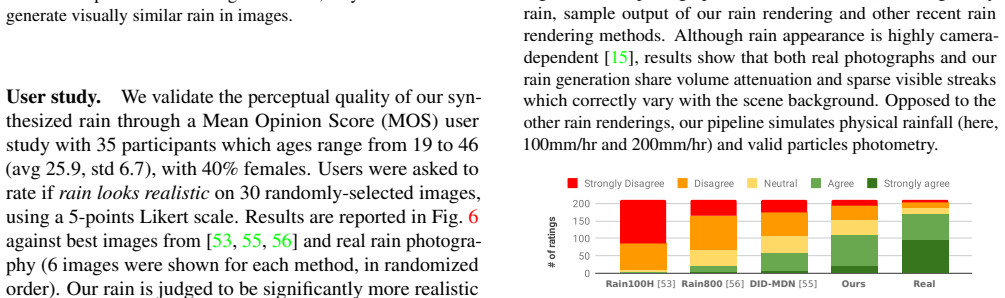
- [§4] The user-study claim that the rendered rain is 'significantly more realistic' than state-of-the-art lacks statistical support. The MOS results are reported as mean values over 35 participants and apparently 6 images per method, but no confidence intervals, per-image variance, or significance tests are provided. A paired significance test against each competitor, along with effect sizes, is needed to support the word 'significantly' and to guard against a few distinctive images driving the means.
- [§6.3] The real-rain segmentation evaluation on nuScenes rests on 50 self-annotated images (25 rainy), with no annotation protocol, inter-annotator agreement, or category breakdown. The AP for a 25-image split will have wide error bars, and the paper does not report variance. The object-detection evaluation also does not specify how the clear/rainy clustering was performed or whether the same classes as KITTI were measured. These details are needed before the external validity of the +36.6% segmentation gain can be assessed.
- [§3.3.2 and Limitations] The environment-map estimate from a single image is acknowledged in the Limitations section to 'under/over estimate the scene radiance when the sky is not/too visible,' and it directly affects the photometry of every rendered streak through Eq. (4). Figure 4 shows only qualitative agreement on a small number of examples. A quantitative sensitivity study, such as varying the estimated environment map and measuring the resulting streak radiance or downstream task performance, would substantially strengthen the realism and utility claims.
minor comments (5)
- [Abstract] The phrase '40% more realistic that state-of-the-art' should read '40% more realistic than state-of-the-art.'
- [§5.1.1] For Cityscapes, intrinsic calibration is taken 'from camera manufacturer' and extrinsics are 'assumed similar to Kitti'; this is a substantial assumption for all Cityscapes-based quantitative results and should be stated more prominently.
- [Eq. (5)] The composition formula is hard to parse as typeset, especially the exposure-correction term involving T, τ0, and τ1. Please clarify the notation and define all symbols before first use.
- [§3.1] The text refers to 'βHG, the standard Heynyey-Greenstein coefficient,' but the Henyey-Greenstein model normally has an asymmetry parameter; please specify the value or definition used.
- [Fig. 6] The y-axis label in Fig. 6 is ambiguous; please state the exact Likert question and scale in the caption, and indicate whether the plotted values are means over participants or over images.
Circularity Check
No significant circularity: rendering uses external physics models, and the nuScenes transfer test is an external measurement; the missing clear-weather fine-tuning control is a confound, not a circular reduction.
full rationale
I walked the paper's derivation chain. The rendering pipeline in Sec. 3 is assembled from external photometric and optical models (Garg and Nayar [16,17], the multiscale rain model [51], the lens/aperture model [39]) and from a pre-existing particle simulator [11]. Although [11] is co-authored by one of the present authors, it is used as a published tool, not as an unverified self-citation invoked to force a conclusion; the paper even acknowledges external reuse of the simulator in the acknowledgements. The environment-map approximation from [6] used for streak photometry is an input to the rendering, not a quantity fitted to the downstream robustness result, and Sec. 7 explicitly concedes it 'may under/over estimate the scene radiance when the sky is not/too visible' — a real modeling limitation, but not a circular step. The central transfer claim in Sec. 6.3 is tested on nuScenes real-rain images that were not used to fit any parameter, and the reported +14.9% object and +36.6% segmentation improvements are measured externally rather than derived from the rendering equations by construction. The skeptical concern that no control model was fine-tuned on the same number of clear images is a legitimate experimental confound about attributing the gain to the rain content, but it does not make the prediction equivalent to its input: the fine-tuned model is not defined in terms of the nuScenes test outputs, and the test images are not part of the training objective. I find no circular step.
Assumptions & free parameters
free parameters (4)
- Rainfall rate R =
0, 1, 5, 17, 25, 50, 100, 200 mm/hr
- Ego speed for streak orientation =
uniform in [0,50] km/h for Cityscapes, [0,100] km/h for KITTI
- Cityscapes exposure and extrinsic calibration =
5 ms exposure; extrinsic assumed similar to KITTI
- Defocus focus plane fp =
6 m
assumptions (6)
- domain assumption Marshall-Palmer raindrop size distribution from Ottawa, Canada governs drop sizes in all rendered scenes.
- domain assumption The Garg-Nayar streak database captures the photometry of a drop in any scene.
- domain assumption A single-image environment map estimate is a sufficient proxy for the full spherical lighting around each drop.
- domain assumption Depth maps from sparse plus dense estimation for KITTI and MonoDepth for Cityscapes are accurate enough for attenuation and fog rendering after guided filtering.
- domain assumption The binary distinction between fog-like sub-pixel rain and individual streak drops at the 1-pixel threshold is valid.
- domain assumption Cityscapes camera intrinsics from the manufacturer and KITTI-like extrinsics correctly model the imaging sensor.
Cite this review
Pith. "Pith review of Physics-Based Rendering for Improving Robustness to Rain." pith.science (2026). https://pith.science/paper/65SVIEZX
@misc{pith2026190810335,
  author       = {Pith},
  title        = {Pith review of: Physics-Based Rendering for Improving Robustness to Rain},
  year         = {2026},
  howpublished = {\url{https://pith.science/paper/65SVIEZX}},
  note         = {Machine review of arXiv:1908.10335}
}
read the original abstract
To improve the robustness to rain, we present a physically-based rain rendering pipeline for realistically inserting rain into clear weather images. Our rendering relies on a physical particle simulator, an estimation of the scene lighting and an accurate rain photometric modeling to augment images with arbitrary amount of realistic rain or fog. We validate our rendering with a user study, proving our rain is judged 40% more realistic that state-of-the-art. Using our generated weather augmented Kitti and Cityscapes dataset, we conduct a thorough evaluation of deep object detection and semantic segmentation algorithms and show that their performance decreases in degraded weather, on the order of 15% for object detection and 60% for semantic segmentation. Furthermore, we show refining existing networks with our augmented images improves the robustness of both object detection and semantic segmentation algorithms. We experiment on nuScenes and measure an improvement of 15% for object detection and 35% for semantic segmentation compared to original rainy performance. Augmented databases and code are available on the project page.
Figures


Figures from the paper (8 more)



Reference graph
Works this paper leans on
-
[1]
Doppler radar characteristics of precipitation at vertical incidence
David Atlas, RC Srivastava, and Rajinder S Sekhon. Doppler radar characteristics of precipitation at vertical incidence. Re- views of Geophysics, 11(1):1–35, 1973. 3
work page 1973
-
[2]
Analysis of rain and snow in frequency space
Peter C Barnum, Srinivasa Narasimhan, and Takeo Kanade. Analysis of rain and snow in frequency space. International Journal of Computer Vision, 86(2-3):256, 2010. 2, 3
work page 2010
-
[3]
Jonathan T Barron and Ben Poole. The fast bilateral solver. In European Conference on Computer Vision, 2016. 6
work page 2016
-
[4]
Yoshua Bengio, Jérôme Louradour, Ronan Collobert, and Jason Weston. Curriculum learning. In International Con- ference on Machine Learning, pages 41–48. ACM, 2009. 2, 7
work page 2009
-
[5]
nuscenes: A multimodal dataset for autonomous driving
Holger Caesar and et al. nuscenes: A multimodal dataset for autonomous driving. preprint arXiv:1903.11027, 2019. 8
arXiv 1903
-
[6]
Hallucinating environment maps from single images
Christopher Cameron. Hallucinating environment maps from single images. Technical report, 2005. 3
work page 2005
-
[7]
A generalized low-rank ap- pearance model for spatio-temporally correlated rain streaks
Yi-Lei Chen and Chiou-Ting Hsu. A generalized low-rank ap- pearance model for spatio-temporally correlated rain streaks. In IEEE International Conference on Computer Vision, pages 1968–1975, 2013. 2
work page 1968
-
[8]
The cityscapes dataset for semantic urban scene understanding
Marius Cordts, Mohamed Omran, Sebastian Ramos, Timo Rehfeld, Markus Enzweiler, Rodrigo Benenson, Uwe Franke, Stefan Roth, and Bernt Schiele. The cityscapes dataset for semantic urban scene understanding. In IEEE Conference on Computer Vision and Pattern Recognition, 2016. 1, 2, 5
work page 2016
Show all 59 references
-
[9]
R4: Realistic rain render- ing in realtime
Carles Creus and Gustavo A Patow. R4: Realistic rain render- ing in realtime. Computers & Graphics, 37(1-2):33–40, 2013. 2
2013
-
[10]
R-fcn: Object detection via region-based fully convolutional networks
Jifeng Dai, Yi Li, Kaiming He, and Jian Sun. R-fcn: Object detection via region-based fully convolutional networks. In Advances in Neural Information Processing Systems, pages 379–387, 2016. 6, 7
2016
-
[11]
Fast reactive control for illumination through rain and snow
Raoul de Charette, Robert Tamburo, Peter C Barnum, An- thony Rowe, Takeo Kanade, and Srinivasa G Narasimhan. Fast reactive control for illumination through rain and snow. In International Conference on Computational Photography,
-
[12]
Restoring an image taken through a window covered with dirt or rain
David Eigen, Dilip Krishnan, and Rob Fergus. Restoring an image taken through a window covered with dirt or rain. In IEEE International Conference on Computer Vision, pages 633–640, 2013. 2
2013
-
[13]
Material based splashing of water drops
Kshitiz Garg, Gurunandan Krishnan, and Shree K Nayar. Material based splashing of water drops. In Eurographics Conference on Rendering Techniques, 2007. 8
2007
-
[14]
Detection and removal of rain from videos
Kshitiz Garg and Shree K Nayar. Detection and removal of rain from videos. In IEEE Conference on Computer Vision and Pattern Recognition, 2004. 2
2004
-
[15]
When does a camera see rain? In IEEE International Conference on Computer Vision, volume 2, pages 1067–1074
Kshitiz Garg and Shree K Nayar. When does a camera see rain? In IEEE International Conference on Computer Vision, volume 2, pages 1067–1074. IEEE, 2005. 2, 5, 8
2005
-
[16]
Photorealistic rendering of rain streaks
Kshitiz Garg and Shree K Nayar. Photorealistic rendering of rain streaks. In ACM Transactions on Graphics (SIGGRAPH), volume 25, pages 996–1002. ACM, 2006. 2, 3, 4
2006
-
[17]
Vision and rain
Kshitiz Garg and Shree K Nayar. Vision and rain. Interna- tional Journal of Computer Vision, 75(1):3–27, 2007. 2, 3, 4, 8
2007
-
[18]
Im- age style transfer using convolutional neural networks
Leon A Gatys, Alexander S Ecker, and Matthias Bethge. Im- age style transfer using convolutional neural networks. In IEEE Conference on Computer Vision and Pattern Recogni- tion, 2016. 2
2016
-
[19]
Vision meets robotics: The kitti dataset
Andreas Geiger, Philip Lenz, Christoph Stiller, and Raquel Urtasun. Vision meets robotics: The kitti dataset. Interna- tional Journal of Robotics Research, 2013. 6
2013
-
[20]
Are we ready for autonomous driving? The KITTI vision benchmark suite
Andreas Geiger, Philip Lenz, and Raquel Urtasun. Are we ready for autonomous driving? The KITTI vision benchmark suite. In IEEE Conference on Computer Vision and Pattern Recognition, 2012. 1, 2, 5, 6
2012
-
[21]
Clément Godard, Oisin Mac Aodha, and Gabriel J. Brostow. Unsupervised monocular depth estimation with left-right con- sistency. In IEEE Conference on Computer Vision and Pattern Recognition, 2017. 6, 8
2017
-
[22]
Raindrop detection on car windshields using geometric-photometric environment con- struction and intensity-based correlation
Jad C Halimeh and Martin Roser. Raindrop detection on car windshields using geometric-photometric environment con- struction and intensity-based correlation. In IEEE Intelligent Vehicles Symposium, pages 610–615. IEEE, 2009. 2
2009
-
[23]
Deep sky modeling for single image out- door lighting estimation
Yannick Hold-Geoffroy, Akshaya Athawale, and Jean- François Lalonde. Deep sky modeling for single image out- door lighting estimation. In IEEE Conference on Computer Vision and Pattern Recognition, 2019. 4, 5
2019
-
[24]
Robot vision
Berthold Horn, Berthold Klaus, and Paul Horn. Robot vision. MIT press, 1986. 3
1986
-
[25]
Consis- tent temporal variations in many outdoor scenes
Nathan Jacobs, Nathaniel Roman, and Robert Pless. Consis- tent temporal variations in many outdoor scenes. In IEEE Conference on Computer Vision and Pattern Recognition ,
-
[26]
Sparse and dense data with CNNs: Depth completion and semantic segmentation
Maximilian Jaritz, Raoul de Charette, Emilie Wirbel, Xavier Perrotton, and Fawzi Nashashibi. Sparse and dense data with CNNs: Depth completion and semantic segmentation. In International Conference on 3D Vision, 2018. 6
2018
-
[27]
Perceptual losses for real-time style transfer and super-resolution
Justin Johnson, Alexandre Alahi, and Li Fei-Fei. Perceptual losses for real-time style transfer and super-resolution. In European Conference on Computer Vision, 2016. 2
2016
-
[28]
Driving in the matrix: Can virtual worlds replace human- generated annotations for real world tasks? In International Conference on Robotics and Automation, 2016
Matthew Johnson-Roberson, Charles Barto, Rounak Mehta, Sharath Nittur Sridhar, Karl Rosaen, and Ram Vasudevan. Driving in the matrix: Can virtual worlds replace human- generated annotations for real world tasks? In International Conference on Robotics and Automation, 2016. 2
2016
-
[29]
Influence of Fog on Computer Vision Algorithms
Sule Kahraman and Raoul de Charette. Influence of Fog on Computer Vision Algorithms. Research report, Inria Paris, Sept. 2017. 5
2017
-
[30]
Transient attributes for high-level under- standing and editing of outdoor scenes
Pierre-Yves Laffont, Zhile Ren, Xiaofeng Tao, Chao Qian, and James Hays. Transient attributes for high-level under- standing and editing of outdoor scenes. ACM Transactions on Graphics (SIGGRAPH), 33(4), 2014. 2
2014
-
[31]
Webcam clip art: Appearance and illuminant transfer from time-lapse sequences
Jean-François Lalonde, Alexei A Efros, and Srinivasa G Narasimhan. Webcam clip art: Appearance and illuminant transfer from time-lapse sequences. In ACM Transactions on Graphics (SIGGRAPH Asia), volume 28, page 131, 2009. 2
2009
-
[32]
Tan, and Loong-Fah Cheong
Ruoteng Li, Robby T. Tan, and Loong-Fah Cheong. Robust optical flow in rainy scenes. In European Conference on Computer Vision, September 2018. 8
2018
-
[33]
Rain streak removal using layer priors
Yu Li, Robby T Tan, Xiaojie Guo, Jiangbo Lu, and Michael S Brown. Rain streak removal using layer priors. In IEEE Conference on Computer Vision and Pattern Recognition , pages 2736–2744, 2016. 2
2016
-
[34]
Ssd: Single shot multibox detector
Wei Liu, Dragomir Anguelov, Dumitru Erhan, Christian Szegedy, Scott Reed, Cheng-Yang Fu, and Alexander C Berg. Ssd: Single shot multibox detector. In European Conference on Computer Vision, 2016. 6
2016
-
[35]
Removing rain from a single image via discriminative sparse coding
Yu Luo, Yong Xu, and Hui Ji. Removing rain from a single image via discriminative sparse coding. InIEEE International Conference on Computer Vision, pages 3397–3405, 2015. 2, 5
2015
-
[36]
1 Year, 1000km: The Oxford RobotCar Dataset
Will Maddern, Geoff Pascoe, Chris Linegar, and Paul New- man. 1 Year, 1000km: The Oxford RobotCar Dataset. In- ternational Journal of Robotics Research, 36(1):3–15, 2017. 2
2017
-
[37]
The distribution of raindrops with size
John S Marshall and W Mc K Palmer. The distribution of raindrops with size. Journal of meteorology, 5(4):165–166,
-
[38]
All the images of an outdoor scene
Srinivasa G Narasimhan, Chi Wang, and Shree K Nayar. All the images of an outdoor scene. In European Conference on Computer Vision, 2002. 2
2002
-
[39]
A lens and aper- ture camera model for synthetic image generation
Michael Potmesil and Indranil Chakravarty. A lens and aper- ture camera model for synthetic image generation. ACM SIGGRAPH Computer Graphics, 15(3):297–305, 1981. 4
1981
-
[40]
Atmospheric effects on availability of free space optics systems
Ales Prokes. Atmospheric effects on availability of free space optics systems. Optical Engineering, 48(6):066001, 2009. 5
2009
-
[41]
Yolo9000: better, faster, stronger
Joseph Redmon and Ali Farhadi. Yolo9000: better, faster, stronger. In IEEE Conference on Computer Vision and Pattern Recognition, 2017. 6, 7
2017
-
[42]
Faster r-cnn: Towards real-time object detection with region proposal networks
Shaoqing Ren, Kaiming He, Ross Girshick, and Jian Sun. Faster r-cnn: Towards real-time object detection with region proposal networks. In Advances in Neural Information Pro- cessing Systems, pages 91–99, 2015. 6, 7, 8
2015
-
[43]
Erfnet: Efficient residual factorized con- vnet for real-time semantic segmentation
Eduardo Romera, José M Alvarez, Luis M Bergasa, and Roberto Arroyo. Erfnet: Efficient residual factorized con- vnet for real-time semantic segmentation. IEEE Transactions on Intelligent Transportation Systems, 19(1):263–272, 2018. 6, 7
2018
-
[44]
Realistic real-time rain rendering
Pierre Rousseau, Vincent Jolivet, and Djamchid Ghazanfar- pour. Realistic real-time rain rendering. Computers & Graph- ics, 30(4):507–518, 2006. 2, 3
2006
-
[45]
Espnet: Efficient spatial pyramid of dilated convolutions for semantic segmentation
Mohammad Rastegari Sachin Mehta, Anat Caspi, Linda Shapiro, and Hannaneh Hajishirzi. Espnet: Efficient spatial pyramid of dilated convolutions for semantic segmentation. In European Conference on Computer Vision, 2018. 1, 6, 7
2018
-
[46]
Semantic foggy scene understanding with synthetic data
Christos Sakaridis, Dengxin Dai, and Luc Van Gool. Semantic foggy scene understanding with synthetic data. International Journal of Computer Vision, 126(9):973–992, Sep 2018. 2, 5
2018
-
[47]
Dsod: Learning deeply su- pervised object detectors from scratch
Zhiqiang Shen, Zhuang Liu, Jianguo Li, Yu-Gang Jiang, Yurong Chen, and Xiangyang Xue. Dsod: Learning deeply su- pervised object detectors from scratch. In IEEE International Conference on Computer Vision, 2017. 6
2017
-
[48]
Artist-directable real-time rain rendering in city environments
Natalya Tatarchuk. Artist-directable real-time rain rendering in city environments. In ACM SIGGRAPH Courses, pages 23–64. ACM, 2006. 2
2006
-
[49]
Learn- ing to adapt structured output space for semantic segmenta- tion
Yi-Hsuan Tsai, Wei-Chih Hung, Samuel Schulter, Kihyuk Sohn, Ming-Hsuan Yang, and Manmohan Chandraker. Learn- ing to adapt structured output space for semantic segmenta- tion. In IEEE Conference on Computer Vision and Pattern Recognition, 2018. 6
2018
-
[50]
Numerical model for the fall speed of rain drops in a rain fall simulator
John H van Boxel et al. Numerical model for the fall speed of rain drops in a rain fall simulator. In Workshop on wind and water erosion, pages 77–85, 1997. 2
1997
-
[51]
A multiscale model for rain rendering in real- time
Yoann Weber, Vincent Jolivet, Guillaume Gilet, and Djamchid Ghazanfarpour. A multiscale model for rain rendering in real- time. Computers & Graphics, 50:61–70, 2015. 2, 3
2015
-
[52]
Exploit all the layers: Fast and accurate cnn object detector with scale dependent pooling and cascaded rejection classifiers
Fan Yang, Wongun Choi, and Yuanqing Lin. Exploit all the layers: Fast and accurate cnn object detector with scale dependent pooling and cascaded rejection classifiers. In IEEE Conference on Computer Vision and Pattern Recognition ,
-
[53]
Deep joint rain detection and removal from a single image
Wenhan Yang, Robby T Tan, Jiashi Feng, Jiaying Liu, Zong- ming Guo, and Shuicheng Yan. Deep joint rain detection and removal from a single image. In IEEE Conference on Computer Vision and Pattern Recognition, pages 1357–1366,
-
[54]
Bdd100k: A diverse driving video database with scalable annotation tooling
Fisher Yu, Wenqi Xian, Yingying Chen, Fangchen Liu, Mike Liao, Vashisht Madhavan, and Trevor Darrell. Bdd100k: A diverse driving video database with scalable annotation tooling. arXiv preprint arXiv:1805.04687, 2018. 2
2018 arXiv
-
[55]
Density-aware single image de-raining using a multi-stream dense network
He Zhang and Vishal M Patel. Density-aware single image de-raining using a multi-stream dense network. In IEEE Conference on Computer Vision and Pattern Recognition , pages 695–704, 2018. 4, 5
2018
-
[56]
Image de-raining using a conditional generative adversarial network
He Zhang, Vishwanath Sindagi, and Vishal M Patel. Image de-raining using a conditional generative adversarial network. arXiv preprint arXiv:1701.05957, 2017. 2, 4, 5
2017 arXiv
-
[57]
Icnet for real-time semantic segmenta- tion on high-resolution images
Hengshuang Zhao, Xiaojuan Qi, Xiaoyong Shen, Jianping Shi, and Jiaya Jia. Icnet for real-time semantic segmenta- tion on high-resolution images. In European Conference on Computer Vision, 2017. 6, 7
2017
-
[58]
Pyramid scene parsing network
Hengshuang Zhao, Jianping Shi, Xiaojuan Qi, Xiaogang Wang, and Jiaya Jia. Pyramid scene parsing network. In IEEE Conference on Computer Vision and Pattern Recogni- tion, 2017. 6, 7, 8
2017
-
[59]
Unpaired image-to-image translation using cycle-consistent adversarial networks
Jun-Yan Zhu, Taesung Park, Phillip Isola, and Alexei A Efros. Unpaired image-to-image translation using cycle-consistent adversarial networks. 2017. 2
2017
Reviewed August 14, 2026 · model on record in the stance chip above.
Discussion (0). Continue with ORCID to comment.