REVIEW 1 major objections 1 minor 55 references
Gluonic Probe for the Short Range Correlation in Nucleus
T0 review · 1 major / 1 minor · reviewed 2026-08-14 · deepseek-v4-flash
Pith's one-line read This paper predicts that sub-threshold heavy-flavor production on nuclei yields the same SRC pair-count ratios as measured in deep-inelastic structure functions, providing a gluonic universality test.
desk verdict A short, genuinely testable proposal for gluonic SRC universality: the sub-threshold heavy-flavor ratios are the real contribution, while the charm EMC collapse basically follows from the input parameterization. read the letter →
The pith
A machine-rendered reading of the paper's core claim, the machinery that carries it, and where it could break.
The reading
What carries the argument
The central machinery is the two-body SRC ansatz—treating short-range correlations as proton–neutron pairs in close contact—for the nuclear gluon distribution, $g_A(x,Q^2)=A g_p(x,Q^2)+2n_{src}^A\,\delta\tilde g(x,Q^2)$, together with the energy-fraction variable $\chi_\gamma=M_{J/\psi}^2/(2E_\gamma M_p)+M_{J/\psi}/E_\gamma$. Below the single-nucleon threshold, the free-nucleon term is kinematically forbidden, so the cross section is controlled by the pair term; replacing $M_p$ by $2M_p$ in $\chi_\gamma$ shifts the effective threshold down and makes the SRC process kinematically allowed. The model writes $\sigma_{\gamma(pn)\to J/\psi}=\sigma_0^{(pn)}(1-\tilde\chi_\gamma)^{\beta_2}$, and because this unknown function appears in both numerator and denominator, the ratio in Eq. (14) reduces to the pair-count ratio $n_{src}^A/n_{src}^d$, which is independently measured by DIS structure functions at $1.5<x_B<2.0$. The same $n_{src}^A$ enters the gluon distribution, producing the universal scaling $[R_A^{c\bar c}-1]/a_2^A$ in the charm structure function.
What would settle it
Measure the three ratios in Eq. (14) (J/psi, Upsilon, and open charm) on at least three targets in the window $W_{\gamma p}<M_p+M_{J/\psi}$ and compare them with $F_2^A(x_B)/F_2^d(x_B)$ at $1.5<x_B<2.0$; disagreement between any two of these ratios, or with the DIS ratio, beyond the quoted nuclear-absorption corrections would falsify the claim.
Extended reading notes
Core claim
The paper's core claim is a chain of equalities: after accounting for nuclear absorption, the sub-threshold cross-section ratios for J/psi, Upsilon, and open charm all equal $n_{src}^A/n_{src}^d$, which in turn equals the measured structure-function ratio $F_2^A(x_B)/F_2^d(x_B)$ in the interval $1.5<x_B<2.0$. The reason is that below $W_{\gamma p}=M_p+M_{J/\psi}$, single-nucleon production is kinematically closed, so the SRC pair term alone survives; the pair-production cross section, which is not known from first principles, cancels in the ratio. On the structure-function side, the paper derives from the same SRC parameterization that the nuclear modification of the charm structure function obeys a universal scaling law once divided by the SRC factor. The authors present this as a direct, testable prediction of SRC universality in the gluon sector.
Load-bearing premise
The entire prediction rests on the assumption that below threshold the J/psi (and similarly heavy-flavor) yield comes exclusively from photons striking one nucleon inside a two-nucleon SRC pair, with single-nucleon production, non-SRC multi-nucleon effects, and mesonic or hadronic fluctuations negligible or exactly cancelling.
Editorial extensions
If this is right
- Sub-threshold J/psi production in photon-nucleus collisions becomes a direct counter of SRC pairs per nucleon, $n_{src}^A/n_{src}^d$, independent of the unknown pair-production cross section.
- The same pair-count ratio must appear in open-charm, Upsilon, and open-bottom channels; a clean open-charm measurement avoids quarkonium nuclear absorption and isolates the SRC contribution.
- In the EMC region, the charm structure function modification, once divided by the SRC factor, should be a single universal curve for all nuclei.
- Comparing sub-threshold charmonium with open charm separates the nuclear absorption correction for J/psi and thereby constrains the J/psi-nucleon interaction.
- If the equality with the DIS structure-function ratio is confirmed, SRC universality extends from the quark sector to the gluon sector.
Reading between the lines
- If Eq. (14) is confirmed, the same data would also pin down the sub-threshold energy dependence $\beta_2$, which the model leaves free in the range $n_2=1$--$3$, because a measured $d\sigma/dE_\gamma$ curve would constrain it directly.
- For nuclei with strong proton-neutron asymmetry, an apparent violation of the equality could signal isospin breaking in gluon SRC rather than a failure of universality; comparing symmetric and asymmetric targets would separate the two.
- Agreement between the open-charm ratio (which has no final-state absorption) and the J/psi ratio would turn the comparison into a direct measurement of the quarkonium nuclear absorption factor $R_{abs}$.
- A tagged-spectator measurement in $eA$ sub-threshold production would test the exclusivity assumption: the SRC mechanism predicts the spectator carries the missing momentum, whereas single-nucleon contamination would show a different spectator distribution.
Signed reviews
Editorial analysis
A structured set of objections, weighed in public.
Referee Report
Summary. The paper proposes two gluonic probes of nucleon-nucleon short-range correlations (SRC) in nuclei. First, it studies the nuclear modification of the charm structure function F_2^{c\bar c} in the EMC region, using the universality of SRC to relate nuclear gluon distributions through an SRC-ratio parameterization, and shows that the ratio [R_A^{c\bar c}-1]/a_2^A is predicted to be universal across nuclei. Second, it proposes sub-threshold heavy-flavor production in \gamma A collisions (e.g., J/\psi, \Upsilon, open charm) as a new probe: below the \gamma p threshold, the cross section is assumed to arise solely from two-body SRC pairs, leading to the central prediction Eq. (14) that the nuclear-to-deuteron ratios of these production cross sections all equal the SRC ratio n_src^A/n_src^d, which in turn equals the measured structure-function ratio F_2^A/F_2^d for 1.5 < x_B < 2.0. The paper includes phenomenological estimates of sub-threshold cross sections and discusses experimental feasibility at JLab and intermediate-energy EIC.
Significance. If Eq. (14) holds, the paper introduces a falsifiable, multi-channel test of SRC universality in the gluonic sector, complementing existing quark-channel measurements. A key strength is that the prediction is expressed as a ratio of cross sections that can be directly compared with already measured F_2 ratios, providing a concrete experimental target. The isospin symmetry of gluons simplifies the nuclear correction and avoids the isospin complications of the quark channel. The EMC part also provides a specific observable for gluon EMC studies at future facilities. However, the central sub-threshold prediction rests on a strong factorization assumption that is not derived or quantitatively supported within the manuscript, and the EMC universality plot partially follows by construction. These issues do not invalidate the proposal, but they require clarification and additional support before the claims can be considered established.
major comments (1)
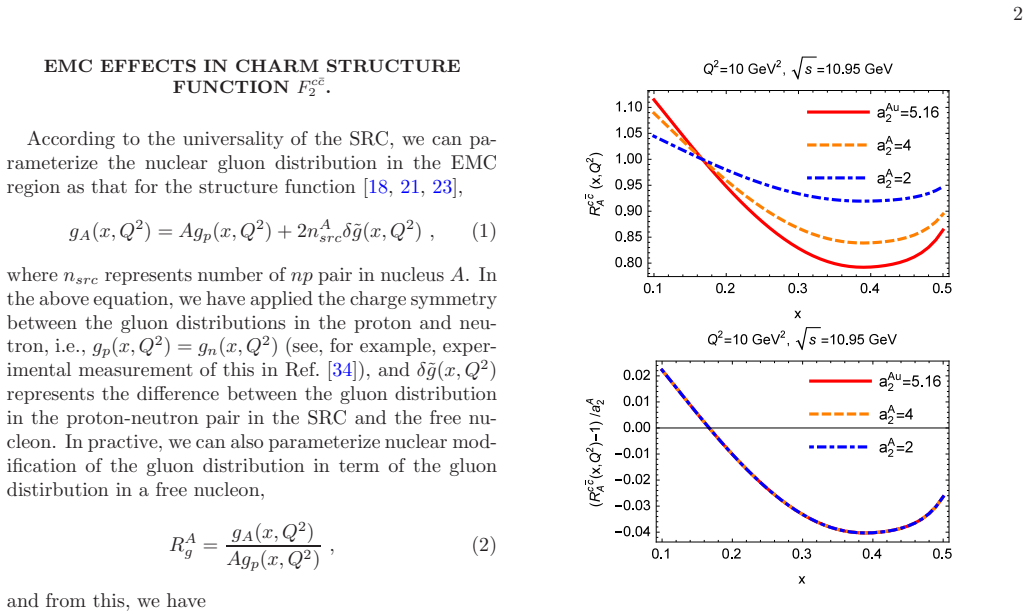
- [Section 2, Eq. (4) and Fig. 1 lower panel] The 'universal collapse' in the lower panel of Fig. 1 follows by construction from the parameterization in Eq. (4). Setting R_A^g = (a_2^A/a_2^B)(R_B^g - 1) + 1 guarantees that [R_A^g - 1]/a_2^A is independent of A for any input R_B^g. Therefore, the observed single curve in the lower panel does not provide independent evidence for SRC universality; it is a direct consequence of the assumed linear relationship. The authors should clarify that the lower panel is a prediction of the universality hypothesis to be tested against data, not a demonstration of universality. This distinction is important for the paper's logical structure and for the interpretation of future measurements.
minor comments (1)
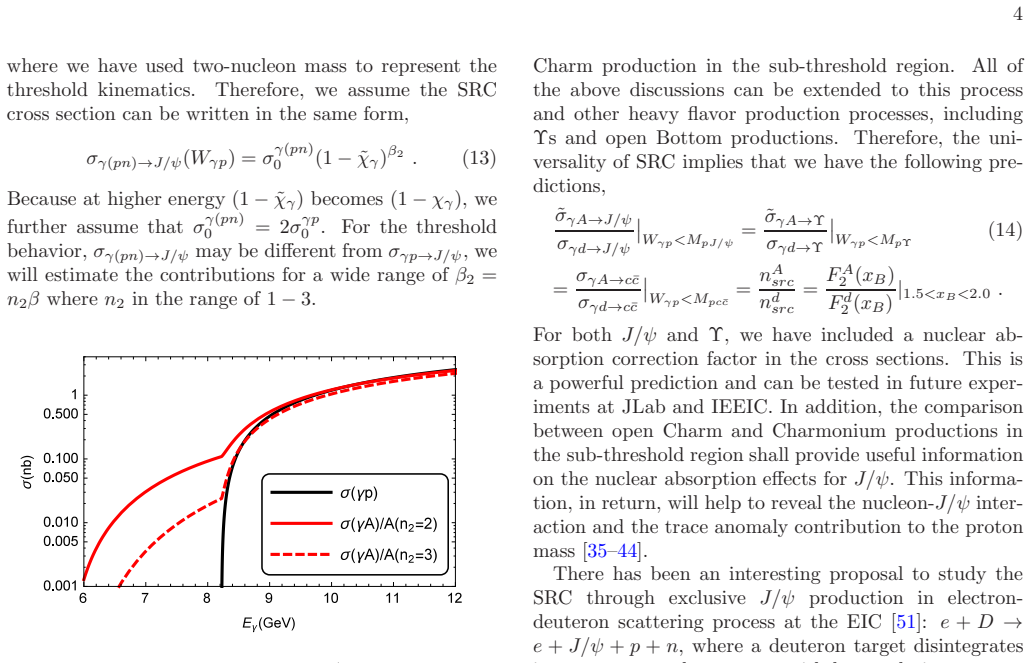
- [Throughout] The parameterization in Eqs. (11)-(13) for the SRC cross section introduces a free parameter n_2 with a range 1-3; the authors should state explicitly that the ratio prediction Eq. (14) is independent of this parameter, so that Fig. 2 is only an illustration of rates and not of the central prediction.
Circularity Check
No significant circularity: Eq. (14) is a testable universality prediction built from an explicit SRC-dominance assumption and external SRC measurements.
full rationale
The central prediction, Eq. (14), is a testable universality relation: it asserts that sub-threshold gamma-A heavy-flavor production ratios equal the measured SRC ratio n_src^A/n_src^d, which is independently measured in inclusive electron scattering and structure-function experiments. Nothing in the derivation fits the predicted ratio from the same data; Eq. (8) is an explicit physical assumption (sub-threshold production from two-body SRC pairs only), and the equality to F2 ratios is an external empirical input, not a definition. The near-threshold parameters sigma0 and beta are fitted to gamma-p data, but the ratios of Eqs. (9) and (14) cancel these parameters, so no fitted input is renamed as a prediction. The EMC lower-panel collapse in Fig. 1 does follow algebraically from Eq. (4), and the paper says so explicitly ('This is mainly because the reduced cross sections are directly proportional to the associated gluon distributions...'), so it is transparently a consequence of the stated universality ansatz, not a disguised fit or an independent derivation. The manuscript also acknowledges unquantified corrections: nuclear absorption effects and the possibility that 'the functional form may be totally different for the SRC contribution as compared to the gamma p cross section'; these are limitations on the model, not circular steps. No load-bearing self-citations appear; references [17, 21, 23] are external experimental and theoretical works.
Assumptions & free parameters
free parameters (4)
- sigma0 =
11.3 nb
- beta =
1.3
- n2 =
1-3 range chosen by hand
- a2 SRC ratios =
2, 4, 5.16
assumptions (4)
- domain assumption In the EMC region, the nuclear gluon distribution is a sum of the free-nucleon contribution plus a universal SRC correction delta tilde g that is independent of the nucleus (Eq. 1).
- domain assumption The charm reduced cross section at leading order is proportional to the gluon distribution, so R_A^{ccbar} is proportional to R_g^A.
- domain assumption Below the gamma-proton threshold, the only contribution to gamma-A J/psi production is from two-body SRC pairs (Eq. 8).
- domain assumption Isospin symmetry gp = gn is valid, and the SRC cross section sigma_{gamma(pn)} is twice the free proton cross section (sigma0^{pn} = 2 sigma0).
Cite this review
Pith. "Pith review of Gluonic Probe for the Short Range Correlation in Nucleus." pith.science (2026). https://pith.science/paper/7FN2TCKL
@misc{pith2026190810413,
  author       = {Pith},
  title        = {Pith review of: Gluonic Probe for the Short Range Correlation in Nucleus},
  year         = {2026},
  howpublished = {\url{https://pith.science/paper/7FN2TCKL}},
  note         = {Machine review of arXiv:1908.10413}
}
abstract
We investigate the gluonic probe to the nucleon-nucleon short range correlation (SRC) in nucleus through heavy flavor production in deep inelastic scattering (DIS). The relevant EMC effects of $F_2^{c\bar c}$ structure function will provide a universality test of the SRCs which have been extensively studied in the quark-channel. These SRCs can also be studied through the sub-threshold production of heavy flavor in $eA$ collisions at the intermediate energy electron-ion collider, including open Charm and $J/\psi$ ($\Upsilon$) production.
Figures
Reference graph
Works this paper leans on
-
[1]
We clearly see that the three dif- ferent curves in the upper panel shrink into one single line in the lower panel. This is mainly because the reduced cross sections are directly proportional to the associated gluon distributions: Rc¯c A (x,Q 2) ∝ RA g (τx,Q 2). Accord- ing to the universality Eq. ( 4), we should have a universal function of [ Rc¯c A − 1]...
-
[2]
J. Arrington, D. W. Higinbotham, G. Rosner and M. Sargsian, Prog. Part. Nucl. Phys. 67, 898 (2012) doi:10.1016/j.ppnp.2012.04.002 [arXiv:1104.1196 [nucl - ex]]
arXiv 2012
-
[3]
In terms of constraining the gluon distribu- tion in nucleus, the measurements from the future IEEIC shall provide complementary information to that from an EIC [ 31]. SUB-THRESHOLD HEA VY FLA VOR PRODUCTION AT JLAB AND EIC The near threshold J/ψ production in γp collisions has gained tremendous attentions in the last few years. One focus in these studies...
-
[4]
This gives a very good description of previous experimental data [ 47–49] in the near threshold region, and especially the very recent data from GlueX collaboration at JLab [ 49]. It is also consistent, at least near the threshold region, with the calculation based on the AdS/CFT correspondence [ 43, 44]. Going to the case of γ(pn) → J/ψ , we argue the ba...
-
[5]
L. Frankfurt, M. Sargsian and M. Strik- man, Int. J. Mod. Phys. A 23, 2991 (2008) doi:10.1142/S0217751X08041207 [arXiv:0806.4412 [nucl-th]]
arXiv 2008
-
[6]
16, aA 2 = 4 and aA 2 = 2 respec- tively
and (lower)[ Rc¯c A − 1 ] /a A 2 for different aA 2 : the solid red, orange and blue lines correspond to aAu 2 = 5. 16, aA 2 = 4 and aA 2 = 2 respec- tively. (EicC) [ 24]. This shows that the EicC has a great po- tential to explore the nuclear EMC effects for the gluon distributions. From the cross sections for ep andeA collisions, we can evaluate the nucle...
-
[7]
O. Hen, D. W. Higinbotham, G. A. Miller, E. Piasetzky and L. B. Weinstein, Int. J. Mod. Phys. E 22, 1330017 (2013) doi:10.1142/S0218301313300178 [arXiv:1304.2813 [nucl-th]]
arXiv 2013
-
[8]
O. Hen, G. A. Miller, E. Piasetzky and L. B. We- instein, Rev. Mod. Phys. 89, no. 4, 045002 (2017) doi:10.1103/RevModPhys.89.045002 [arXiv:1611.09748 [nucl-ex]]
arXiv 2017
Show all 55 references
-
[9]
Fomin, D
N. Fomin, D. Higinbotham, M. Sargsian and P. Solvignon, Ann. Rev. Nucl. Part. Sci. 67, 129 (2017) doi:10.1146/annurev-nucl-102115-044939 [arXiv:1708.08581 [nucl-th]]
2017 arXiv
-
[10]
I. C. Cloet et al. , arXiv:1902.10572 [nucl-ex]
1902 arXiv
-
[11]
K. S. Egiyan et al. [CLAS Collabora- tion], Phys. Rev. Lett. 96, 082501 (2006) doi:10.1103/PhysRevLett.96.082501 [nucl-ex/0508026]
2006 arXiv
-
[12]
Seely et al
J. Seely et al. , Phys. Rev. Lett. 103, 202301 (2009) doi:10.1103/PhysRevLett.103.202301 [arXiv:0904.4448 [nucl-ex]]
2009 arXiv
-
[13]
L. B. Weinstein, E. Piasetzky, D. W. Higinbotham, J. Gomez, O. Hen and R. Shneor, Phys. Rev. Lett. 106, 052301 (2011) doi:10.1103/PhysRevLett.106.052301 [arXiv:1009.5666 [hep-ph]]
2011 arXiv
-
[14]
Fomin et al
N. Fomin et al. , Phys. Rev. Lett. 108, 092502 (2012) doi:10.1103/PhysRevLett.108.092502 [arXiv:1107.3583 [nucl-ex]]
2012 arXiv
-
[15]
O. Hen, E. Piasetzky and L. B. Weinstein, Phys. Rev. C 85, 047301 (2012) doi:10.1103/PhysRevC.85.047301 [arXiv:1202.3452 [nucl-ex]]
2012 arXiv
-
[16]
Arrington, A
J. Arrington, A. Daniel, D. Day, N. Fomin, D. Gaskell and P. Solvignon, Phys. Rev. C 86, 065204 (2012) doi:10.1103/PhysRevC.86.065204 [arXiv:1206.6343 [nucl-ex]]
2012 arXiv
-
[17]
Hen et al
O. Hen et al. , Science 346, 614 (2014) doi:10.1126/science.1256785 [arXiv:1412.0138 [nucl- ex]]
2014 arXiv
-
[18]
E. O. Cohen et al. [CLAS Collaboration], Phys. Rev. Lett. 121, no. 9, 092501 (2018) doi:10.1103/PhysRevLett.121.092501 [arXiv:1805.01981 [nucl-ex]]
2018 arXiv
-
[19]
Duer et al
M. Duer et al. [CLAS Collaboration], Nature 560, no. 7720, 617 (2018). doi:10.1038/s41586-018-0400-z
2018 doi
-
[20]
Duer et al
M. Duer et al. [CLAS Collaboration], Phys. Rev. Lett. 122, no. 17, 172502 (2019) doi:10.1103/PhysRevLett.122.172502 [arXiv:1810.05343 [nucl-ex]]
2019 arXiv
-
[21]
Schmookler et al
B. Schmookler et al. [CLAS Collaboration], Nature 566, no. 7744, 354 (2019). doi:10.1038/s41586-019-0925-9
2019 doi
-
[22]
J. W. Chen, W. Detmold, J. E. Lynn and A. Schwenk, Phys. Rev. Lett. 119, no. 26, 262502 (2017) doi:10.1103/PhysRevLett.119.262502 [arXiv:1607.03065 [hep-ph]]
2017 arXiv
-
[23]
J. E. Lynn, D. Lonardoni, J. Carlson, J.-W. Chen, W. Detmold, S. Gandolfi and A. Schwenk, arXiv:1903.12587 [nucl-th]
1903 arXiv
-
[24]
J. E. Lynn, I. Tews, S. Gandolfi and A. Lovato, [arXiv:1901.04868 [nucl-th]]
1901 arXiv
-
[25]
L. L. Frankfurt, M. I. Strikman, D. B. Day and M. Sargsian, Phys. Rev. C 48, 2451 (1993). doi:10.1103/PhysRevC.48.2451
1993 doi
-
[26]
Piasetzky, M
E. Piasetzky, M. Sargsian, L. Frankfurt, M. Strikman and J. W. Watson, Phys. Rev. Lett. 97, 162504 (2006) doi:10.1103/PhysRevLett.97.162504 [nucl-th/0604012]
2006 arXiv
-
[27]
E. P. Segarra, A. Schmidt, D. W. Higinbotham, T. Kutz, E. Piasetzky, M. Strikman, L. B. Weinstein and O. Hen, arXiv:1908.02223 [nucl-th]
1908 arXiv
-
[28]
Nu Xu, private communications
-
[29]
K. J. Eskola, P. Paakkinen, H. Paukkunen and C. A. Salgado, Eur. Phys. J. C 77, no. 3, 163 (2017) doi:10.1140/epjc/s10052-017-4725-9 [arXiv:1612.05741 [hep-ph]]
2017 arXiv
-
[30]
Kovarik et al
K. Kovarik et al. , Phys. Rev. D 93, no. 8, 085037 (2016) doi:10.1103/PhysRevD.93.085037 [arXiv:1509.00792 [hep-ph]]
2016 arXiv
-
[31]
Khanpour and S
H. Khanpour and S. Atashbar Tehrani, Phys. Rev. D 93, no. 1, 014026 (2016) doi:10.1103/PhysRevD.93.014026 [arXiv:1601.00939 [hep-ph]]
2016 arXiv
-
[32]
de Florian, R
D. de Florian, R. Sassot, P. Zurita and M. Stratmann, Phys. Rev. D 85, 074028 (2012) doi:10.1103/PhysRevD.85.074028 [arXiv:1112.6324 [hep-ph]]
2012 arXiv
-
[33]
Abdul Khalek et al
R. Abdul Khalek et al. [NNPDF Collaboration], Eur. Phys. J. C 79, no. 6, 471 (2019) doi:10.1140/epjc/s10052- 019-6983-1 [arXiv:1904.00018 [hep-ph]]
2019 arXiv
-
[34]
M. Walt, I. Helenius and W. Vogelsang, arXiv:1908.0335 5 [hep-ph]
1908
-
[35]
E. C. Aschenauer, S. Fazio, M. A. C. Lamont, H. Paukkunen and P. Zurita, Phys. Rev. D 96, no. 11, 114005 (2017) doi:10.1103/PhysRevD.96.114005 [arXiv:1708.05654 [nucl-ex]]
2017 arXiv
- [36]
- [37]
-
[38]
L. Y. Zhu et al. [NuSea Collaboration], Phys. Rev. Lett. 100, 062301 (2008) doi:10.1103/PhysRevLett.100.062301 [arXiv:0710.2344 [hep-ex]]
2008 arXiv
-
[39]
M. E. Peskin, Nucl. Phys. B 156, 365 (1979). doi:10.1016/0550-3213(79)90199-8
1979 doi
-
[40]
Bhanot and M
G. Bhanot and M. E. Peskin, Nucl. Phys. B 156, 391 (1979). doi:10.1016/0550-3213(79)90200-1
1979 doi
-
[41]
M. E. Luke, A. V. Manohar and M. J. Savage, Phys. Lett. B 288, 355 (1992) doi:10.1016/0370-2693(92)91114- O [hep-ph/9204219]
1992 arXiv
-
[42]
Kharzeev, H
D. Kharzeev, H. Satz, A. Syamtomov and G. Zinovjev, Eur. Phys. J. C 9, 459 (1999) doi:10.1007/s100529900047 [hep-ph/9901375]
1999 arXiv
-
[43]
Kharzeev, H
D. Kharzeev, H. Satz, A. Syamtomov and G. Zinovev, Nucl. Phys. A 661, 568 (1999). doi:10.1016/S0375- 6 9474(99)85090-8
1999 doi
-
[44]
S. J. Brodsky, E. Chudakov, P. Hoyer and J. M. Laget, Phys. Lett. B 498, 23 (2001) doi:10.1016/S0370- 2693(00)01373-3 [hep-ph/0010343]
2001 arXiv
-
[45]
Frankfurt and M
L. Frankfurt and M. Strikman, Phys. Rev. D 66, 031502 (2002) doi:10.1103/PhysRevD.66.031502 [hep- ph/0205223]
2002
-
[46]
Gryniuk and M
O. Gryniuk and M. Vanderhaeghen, Phys. Rev. D 94, no. 7, 074001 (2016) doi:10.1103/PhysRevD.94.074001 [arXiv:1608.08205 [hep-ph]]
2016 arXiv
-
[47]
Hatta and D
Y. Hatta and D. L. Yang, Phys. Rev. D 98, no. 7, 074003 (2018) doi:10.1103/PhysRevD.98.074003 [arXiv:1808.02163 [hep-ph]]
2018 arXiv
- [48]
-
[49]
X. D. Ji, Phys. Rev. Lett. 74, 1071 (1995) doi:10.1103/PhysRevLett.74.1071 [hep-ph/9410274]
1995 arXiv
-
[50]
R. L. Anderson et al. , Phys. Rev. Lett. 38, 263 (1977). doi:10.1103/PhysRevLett.38.263
1977 doi
-
[51]
Gittelman, K
B. Gittelman, K. M. Hanson, D. Larson, E. Loh, A. Sil- verman and G. Theodosiou, Phys. Rev. Lett. 35, 1616 (1975). doi:10.1103/PhysRevLett.35.1616
1975 doi
-
[52]
Camerini et al
U. Camerini et al. , Phys. Rev. Lett. 35, 483 (1975). doi:10.1103/PhysRevLett.35.483
1975 doi
- [53]
-
[54]
Bosted et al
P. Bosted et al. , Phys. Rev. C 79, 015209 (2009) doi:10.1103/PhysRevC.79.015209 [arXiv:0809.2284 [nucl-ex]]
2009 arXiv
-
[55]
G. A. Miller, M. D. Sievert and R. Venu- gopalan, Phys. Rev. C 93, no. 4, 045202 (2016) doi:10.1103/PhysRevC.93.045202 [arXiv:1512.03111 [nucl-th]]
2016 arXiv
Reviewed August 14, 2026 · model on record in the stance chip above.
Discussion (0). Continue with ORCID to comment.