REVIEW 2 major objections 5 minor 95 references
Analysis of aligning active local searchers orbiting around their common home position
T0 review · 2 major / 5 minor · reviewed 2026-08-14 · deepseek-v4-flash
Pith's one-line read Above a critical alignment, searchers spontaneously rotate as a group around their home.
desk verdict Clean mean-field treatment of aligning central-place searchers with a robust critical coupling, though the quantitative overcritical predictions rest on an imposed closure condition that should be justified or tested. read the letter →
The pith
A machine-rendered reading of the paper's core claim, the machinery that carries it, and where it could break.
The reading
What carries the argument
The machine is the nonlinear mean-field Fokker-Planck equation for the joint density of the distance $r$ and the angle $z=\varphi-\beta$ between a searcher's heading and its position vector. With a small sensing radius and rotational symmetry, the alignment force reduces to $\mu(u_z\cos z-u_r\sin z)$, which closes the reduced $(r,z)$ dynamics. The stationary angular density is a von Mises distribution $\rho_z(z)\propto\exp\left(\mu u_z v_0\sin z/\sigma^2\right)$, whose self-consistency equation yields the pitchfork bifurcation at $\mu_{\rm crit}=2\sigma^2/v_0^2$. This von Mises form is then used to decouple third-order moments in the transport equations, producing the overcritical velocities, variances, and spatial density.
What would settle it
Measure, in simulation or tracking, the squared mean orbital velocity as a function of alignment $\mu$ at fixed $v_0$ and $\sigma$; the theory fails if the onset is not at $\mu=2\sigma^2/v_0^2$ or if the overcritical orbital variance does not scale as $2\sigma^4/(\mu^2 v_0^2)$. Alternatively, condition on the angle $z$ and compute $\langle 1/r-1/r_c+\mu u_r/v_0^2\rangle_z$: if it is not near zero across $z$, the assumed symmetry behind the von Mises density is broken.
Extended reading notes
Core claim
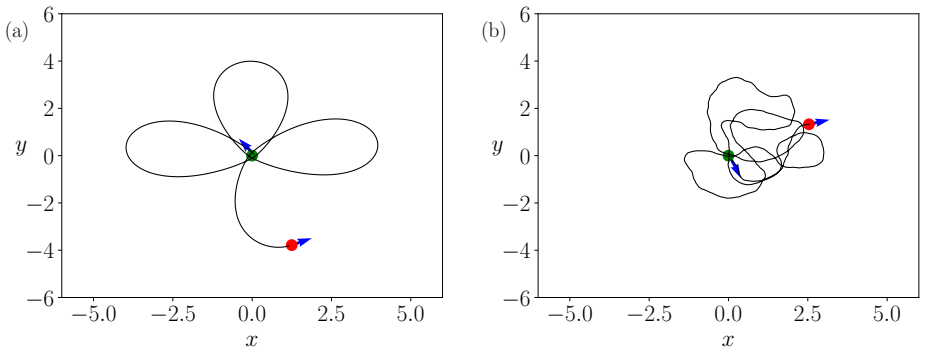
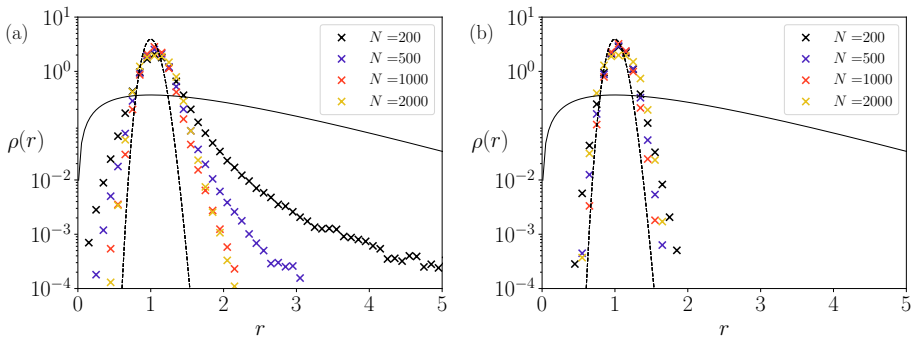
For an ensemble of $N$ searchers moving at speed $v_0$, attracted to a common home with strength $\kappa$, and aligning with neighbours inside a sensing radius with strength $\mu$, the paper establishes that collective circular motion sets in only above $\mu_{\rm crit}=2\sigma^2/v_0^2$. In the ordered state the mean orbital velocity obeys $u_z^2=v_0^2-(\sigma^2/\mu)(1+2\sigma^2/(\mu v_0^2))$, the radial velocity variance is $\sigma_{rr}^2=\sigma^2/\mu$, and the orbital variance is $\sigma_{zz}^2=2\sigma^4/(\mu^2 v_0^2)$; the stationary spatial density takes the form $\rho(r)=C\left[r\exp(-\kappa r/v_0)\right]^{v_0^2\mu/\sigma^2-1}$. Below the threshold the variances are equal to $v_0^2/2$ and the density reduces to the single-searcher exponential $\rho(r)=(r/r_c^2)\exp(-r/r_c)$ with $r_c=v_0/\kappa$. The paper verifies these predictions against simulations of up to 2000 particles and finds good agreement.
Load-bearing premise
The load-bearing premise is that the averaged combination $\langle 1/r-1/r_c+\mu u_r/v_0^2\rangle_r$ vanishes for every angle $z$, imposed to match the numerically observed $z$-symmetry rather than derived, so if that bracket is only approximately zero the von Mises density and all overcritical moments inherit the error, although the critical coupling itself survives because it also follows from linear stability.
Editorial extensions
If this is right
- Below $\mu_{\rm crit}=2\sigma^2/v_0^2$, the angular distribution is uniform, the two velocity variances equal $v_0^2/2$, and the spatial density is the same exponential form as for an isolated searcher.
- Above the threshold, the squared mean orbital velocity grows continuously from zero and saturates at $v_0^2$; the radial velocity variance is $\sigma^2/\mu$ and the orbital variance is $2\sigma^4/(\mu^2 v_0^2)$, so orbital fluctuations are suppressed more strongly than radial ones.
- In the rotating state the stationary spatial density becomes $\propto\left[r\exp(-\kappa r/v_0)\right]^{v_0^2\mu/\sigma^2-1}$: it vanishes at the home for strong coupling, and its peak stays at $r_{\max}=v_0/\kappa$ independent of $\mu$.
- The transition is a second-order pitchfork: at $\mu=\mu_{\rm crit}$ the overcritical density coincides with the undercritical one, and the chosen rotation direction depends on the initial state, as reported for Daphnia swarms around a light shaft.
- In the overdamped limit both regimes obey a Smoluchowski equation with an effective diffusion coefficient that depends on distance from the threshold; undercritical spreading speeds up with $\mu$ while overcritical spreading slows.
Reading between the lines
- The paper does not draw this out, but the effective diffusion coefficient $D_{\rm eff}=v_0^2/|\mu-\mu_{\rm crit}|$ from the Smoluchowski limit implies critical slowing of spatial spreading near the transition, which could be measured independently of the velocity moments.
- Because the overcritical moments and the threshold do not contain $\kappa$, one can test the theory by varying the homing strength: the onset of rotation should stay put while the spatial density narrows or widens.
- The reduced angle $z=\varphi-\beta$ between heading and position vector is a natural single-particle observable; tracking data could extract $\mu u_z v_0/\sigma^2$ from the fitted von Mises shape and then predict the onset from the noise level alone.
- For a finite sensing radius the approximation $\beta_i\approx\beta_j$ used in the alignment force will break down near the home, so finite-$N$ swarms should show apparent critical couplings that shift with the sensing radius, suggesting a finite-size scaling check.
Signed reviews
Editorial analysis
A structured set of objections, weighed in public.
Referee Report
Summary. This manuscript analyzes a mean-field model of N identical active searchers that move at constant speed v0, are attracted to a common home by a torque of strength κ, align their headings with neighbors within a sensing radius, and experience angular white noise of strength σ. The central analytical results are a pitchfork transition of the mean orbital velocity at the critical coupling µ_crit = 2σ²/v0² (Eq. 36), the stationary marginal spatial density ρ(r) = C [r exp(-κr/v0)]^(v0²µ/σ² - 1) (Eq. 48), and closed-form expressions for the overcritical radial variance σ²_rr = σ²/µ (Eq. 46) and orbital variance σ²_zz = 2σ⁴/(µ²v0²) (Eq. 53). These are derived from a nonlinear mean-field Fokker-Planck equation (Eq. 23) using a von Mises closure for the angular distribution, and are compared with agent-based simulations (Figs. 5, 7-9). The paper also derives overdamped Smoluchowski equations for the marginal density in both regimes.
Significance. If the reported results hold, the paper provides a rare analytically tractable description of a collective-motion transition in a central-place foraging context. The critical coupling µ_crit = 2σ²/v0² is parameter-free and follows from a simple linear-stability analysis of the orientationally uniform state (Eq. 38), independently of the von Mises closure. The explicit formulas for the stationary densities and velocity variances are falsifiable and are tested against simulations, with generally reasonable agreement. The comparison between von Mises and Gaussian decoupling schemes (Appendix B) is instructive and shows which closure better captures the periodicity of the angular variable. The manuscript is clearly written and the simulation data are presented in a reproducible manner.
major comments (2)
- [Section IV C, Eqs. (33)-(35)] The derivation of the von Mises angular density (34) and the self-consistent mean orbital velocity (35) rests on the condition that the conditional average ⟨1/r − 1/r_c + µu_r/v0²⟩_r vanishes for every z, which the authors impose 'to obey the numerically found asymptotic z-symmetry.' This condition is not derived from the stationary Fokker-Planck equation or from the microscopic dynamics, and the manuscript reports no direct numerical measurement of this conditional bracket. Since the decoupling identities (41)-(43) and the overcritical expressions for the mean orbital velocity (52) and orbital variance (53) inherit the von Mises form, the error incurred by this ansatz is uncontrolled. The authors should either derive the condition from the assumed z-symmetry and the stationary FPE, or provide a direct simulation test showing that the conditional average is small in the overcritical regime and quantify the resulting error in (52)-(53).
- [Section IV D 2 and Fig. 7] The paper presents two distinct analytical predictions for the overcritical orbital velocity: the self-consistent von Mises result (35) and the transport-equation result (52). These two expressions visibly differ for moderate µ (e.g., µ ≈ 0.4 in Fig. 7), and the simulation data lie between them. The authors attribute the difference to finite particle number, but no finite-size scaling or error estimates are provided to support this attribution. Because the difference between the two analytical predictions is of the same order as the simulation scatter, the manuscript should quantify the finite-size corrections or discuss which closure error is responsible, rather than invoking finite N qualitatively.
minor comments (5)
- [Eq. (27)] The definitions of the variances in Eq. (27) contain a typo: the integrals should involve v0² cos²(z) and v0² sin²(z), respectively, for dimensional consistency with the subtracted u²_r ρ and u²_z ρ terms; the current expressions with a single factor v0 are dimensionally inconsistent.
- [Section IV C, Eq. (33)] The notation 'ρz(z.t)' in the sentence before Eq. (33) should read 'ρz(z,t)'.
- [Abstract] The abstract contains a typo: 'rhytmically' should be 'rhythmically'.
- [Fig. 7 caption] The caption of Fig. 7(b) is confusing: 'according to Eq. (46) as red dotted line as dashed line' mixes line styles and equations; please rephrase to clearly identify each curve.
- [Reference [38]] Reference [38] appears malformed ('arXiv:q-bio 325, 0404018 (2004)') and should be corrected.
Circularity Check
Overcritical von Mises closure is imposed from simulated z-symmetry; critical coupling still has independent derivation.
-
fitted input called prediction
[Section IV C, Eqs. (33)-(35)]
"In simulations this dependence on z appeared to be weak. In order to obey the numerically found asymptotic z-symmetry, the bracket in front of the sin(z) function in (33) should disappear for arbitrary z-values. ... Therefore, it holds ⟨1/r− 1/rc +µur/v0²⟩r = 0."
The marginal angular FPE (33) is closed by imposing ⟨1/r−1/rc+µur/v0²⟩_r=0, a condition chosen to reproduce the z-symmetry already seen in simulations. This immediately yields the von Mises density (34), so the 'derivation' of ρz is actually an ansatz, not a consequence of the Fokker-Planck dynamics. The decoupling identities (41)-(43), and therefore the overcritical predictions (46), (52), and (53), all depend on that assumed von Mises form. Only the critical coupling µcrit=2σ²/v0² is independent, since Eq. (38) and the Gaussian closure in Appendix B yield the same value without the bracket condition. Hence the quantitative overcritical predictions are conditional on a simulation-tuned input, i.e. partly circular.
full rationale
The central transition point µcrit=2σ²/v0² is derived from the transport equations without the disputed closure: Eq. (38) sets ∂t u_z = (µ/2 − (σ/v0)²) u_z, and the same value is recovered by the independent Gaussian decoupling in Appendix B. The paper's genuinely circular element is the von Mises closure in Section IV C: the bracket in Eq. (33) is made to vanish 'in order to obey the numerically found asymptotic z-symmetry,' after which Eq. (34), the self-consistency relation (35), and the overcritical formulas (46), (52), and (53) follow. This is an ansatz informed by the simulations rather than a derived consequence of the Fokker-Planck dynamics, so comparing those formulas to the same simulations is a weaker test than the paper's language suggests. No load-bearing self-citation or imported uniqueness theorem was found; the single-particle model is cited from the authors' prior work but the ensemble transition is derived within the paper. Overall, the phase-transition claim is supported by independent linear-stability reasoning, while the quantitative overcritical predictions carry a simulation-motivated closure assumption; score 4 reflects this partial circularity.
Assumptions & free parameters
assumptions (5)
- domain assumption Mean-field molecular chaos: the N-particle pdf factorizes into a product of one-particle pdfs.
- domain assumption β_i ≈ β_j inside the sensing radius, reducing sin(z_j - z_i + β_j - β_i) to sin(z_j - z_i).
- ad hoc to paper The conditional average ⟨1/r - 1/r_c + µu_r/v0²⟩_r vanishes.
- domain assumption The covariance σ_rz between radial and orbital velocity fluctuations is zero.
- domain assumption Rotational symmetry of the asymptotic state: ρ(r,β,t) ≈ ρ(r,t) and velocities independent of β after t > τ_φ.
Cite this review
Pith. "Pith review of Analysis of aligning active local searchers orbiting around their common home position." pith.science (2026). https://pith.science/paper/UHOLI3AZ
@misc{pith2026190810658,
  author       = {Pith},
  title        = {Pith review of: Analysis of aligning active local searchers orbiting around their common home position},
  year         = {2026},
  howpublished = {\url{https://pith.science/paper/UHOLI3AZ}},
  note         = {Machine review of arXiv:1908.10658}
}
read the original abstract
We discuss effects of pairwise aligning interactions in an ensemble of central place foragers or of searchers that are connected to a common home. In a wider sense, we also consider self moving entities that are attracted to a central place such as, for instance, the zooplankton Daphnia being attracted to a beam of light. Single foragers move with constant speed due to some propulsive mechanism. They explore at random loops the space around and return rhytmically to their home. In the ensemble, the direction of the velocity of a searcher is aligned to the motion of its neighbors. At first, we perform simulations of this ensemble and find a cooperative behavior of the entities. Above an over-critical interaction strength the trajectories of the searcher qualitatively changes and searchers start to move along circles around the home position. Thereby, all searchers rotate either clockwise or anticlockwise around the central home position as it was reported for the zooplankton Daphnia. At second, the computational findings are analytically explained by the formulation of transport equations outgoing from the nonlinear mean field Fokker-Planck equation of the considered situation. In the asymptotic stationary limit, we find expressions for the critical interaction strength, the mean radial and orbital velocities of the searchers and their velocity variances. We also obtain the marginal spatial and angular densities in the under-critical regime where the foragers behave like individuals as well as in the over-critical regime where they rotate collectively around the considered home. We additionally elaborate the overdamped Smoluchowski-limit for the ensemble.
Figures


Figures from the paper (10 more)



Reference graph
Works this paper leans on
-
[1]
Search for Food of Birds, Fish and Insects,
R. Klages, “Search for Food of Birds, Fish and Insects,” in Diffusive Spreading in Nature, Technology and Society , edited by A. Bunde, J. Caro, J. K¨ arger, and G. Vogl (Springer, Cham, 2017) pp. 49–69
2017
-
[2]
Mittelstaedt and H
M. Mittelstaedt and H. Mittelstaedt, Naturwissenwschaften 67, 566 (1980)
1980
-
[3]
B´ enichou, C
O. B´ enichou, C. Loverdo, M. Moreau, and R. Voituriez, Rev. Mod. Phys. 83, 81 (2011)
2011
-
[4]
Cheng, in Psychology of Learning and Motivation , Psychology of Learning and Motivation, Vol
K. Cheng, in Psychology of Learning and Motivation , Psychology of Learning and Motivation, Vol. 33 (Academic Press, 1995) pp. 1 – 21
1995
-
[5]
R. F. Wang, in Cognitive Vision, Psychology of Learning and Motivation, Vol. 42 (Academic Press, 2003) pp. 109 – 156
2003
-
[6]
J. D. Seelig and V. Jayaraman, Nature 521, 186 (2015)
2015
-
[7]
Green, A
J. Green, A. Adachi, K. K. Shah, J. D. Hirokawa, P. S. Magani, and G. Maimon, Nature 546, 101 (2017)
2017
-
[8]
Zeil, Cur
J. Zeil, Cur. Opinion in Neurobiology 22, 285 (2012)
2012
Show all 95 references
-
[9]
Wehner and M
R. Wehner and M. V. Srinivasan, Journal of Comparative Physiology A 142, 315 (1981). 39
1981
-
[10]
Ronacher, Myrmecological News 11, 53 (2008)
B. Ronacher, Myrmecological News 11, 53 (2008)
2008
-
[11]
Collett, L
M. Collett, L. Chittka, and T. S. Collett, Current Biology 23, R789 (2013)
2013
-
[12]
el Jundi, Current Biology 27, R748 (2017)
B. el Jundi, Current Biology 27, R748 (2017)
2017
-
[13]
I. S. Kim and M. H. Dickinson, Current Biology 27, 2227 (2017)
2017
-
[14]
Wehner, B
R. Wehner, B. Michel, and P. Antonsen, Journal of Experimental Biology 199, 129 (1996)
1996
-
[15]
R. J. Vickerstaff and E. A. Di Paolo, in Advances in Artificial Life, edited by M. S. Capcarr` ere, A. A. Freitas, P. J. Bentley, C. G. Johnson, and J. Timmis (Springer Berlin Heidelberg, Berlin, Heidelberg, 2005) pp. 221–230
2005
-
[16]
R. J. Vickerstaff and T. Merkle, Journal of Theoretical Biology 307, 1 (2012)
2012
-
[17]
Waldner and T
F. Waldner and T. Merkle, Journal of Comparative Physiology A 204, 985 (2018)
2018
-
[18]
Chien and K
S. Chien and K. L. Wagstaff, Science Robotics 2 (2017)
2017
-
[19]
Local-Search Strategy for Active Localization of Multiple Invasive Fish,
J. V. Hook, P. Tokekar, E. Branson, P. G. Bajer, P. W. Sorensen, and V. Isler, “Local-Search Strategy for Active Localization of Multiple Invasive Fish,” in Experimental Robotics: The 13th International Symposium on Experimental Robotics , edited by J. P. Desai, G. Dudek, O. K...
2013
-
[20]
Girdhar, A
Y. Girdhar, A. Xu, B. B. Dey, M. Meghjani, F. Shkurti, I. Rekleitis, and G. Dudek, IEEE/RSJ , 5048 (2011)
2011
-
[21]
Leonard, D
N. Leonard, D. Paley, F. Lekien, R. Sepulchre, D. Fratantoni, and R. Davis, Proceedings of the IEEE 95, 48 (2007)
2007
-
[22]
Dubowsky, K
S. Dubowsky, K. Iagnemma, S. Liberatore, D. Lambeth, J. Plante, and P. J. Boston, Space Technology International Forum , 1449 (2005)
2005
-
[23]
Duarte, V
M. Duarte, V. Costa, J. Gomes, T. Rodrigues, F. Silva, S. M. Oliveira, and A. L. Christensen, PLOS ONE 11, 1 (2016)
2016
-
[24]
Nirmal and D
P. Nirmal and D. Lyons, Robotica 34, 2741 (2016)
2016
-
[25]
Insect Strategies of Visual Homing in Mobile Robots,
R. M¨ oller, D. Lambrinos, T. Roggendorf, and R. P. R. Wehner, “Insect Strategies of Visual Homing in Mobile Robots,” in Biorobotics. Methods and Applications, edited by B. Webb and T. R. Consi (AAAI Press / MIT Press, 2001) pp. 37–66
2001
-
[26]
Noetel, V
J. Noetel, V. L. S. Freitas, E. E. N. Macau, and L. Schimansky-Geier, Phys. Rev. E 98, 022128 (2018)
2018
-
[27]
Noetel, V
J. Noetel, V. L. S. Freitas, E. E. N. Macau, and L. Schimansky-Geier, Chaos 28, 106302 (2018). 40
2018
-
[28]
Okubo, Advances in Biophysics 22, 1 (1986)
A. Okubo, Advances in Biophysics 22, 1 (1986)
1986
-
[29]
Gorbonos, R
D. Gorbonos, R. Ianconescu, J. G. Puckett, R. Ni, N. T. Ouellette, and N. S. Gov, New Journal of Physics 18, 073042 (2016)
2016
-
[30]
A. M. Reynolds, M. Sinhuber, and N. T. Ouellette, The European Physical Journal E 40, 46 (2017)
2017
-
[31]
A. M. Reynolds, Journal of The Royal Society Interface 15 (2018), 10.1098/rsif.2017.0806
2018
-
[32]
Schweitzer and L
F. Schweitzer and L. Schimansky-Geier, Physica A 206, 359 (1994)
1994
-
[33]
Chavanis, The European Physical Journal B 87, 120 (2014)
P.-H. Chavanis, The European Physical Journal B 87, 120 (2014)
2014
-
[34]
Delcourt, N
J. Delcourt, N. Bode, and M. Deno´ el, The Quarterly Review of Biology 91, 1 (2016)
2016
-
[35]
Ordemann, Biol
A. Ordemann, Biol. Physicist 2, 5 (2002)
2002
-
[36]
Ordemann, G
A. Ordemann, G. Balazsi, and F. Moss, Physica A: Statistical Mechanics and its Applications 325, 260 (2003)
2003
-
[37]
Ordemann, G
A. Ordemann, G. Balaszi, and F. Moss, Nova Acta Leopoldina 88, 87 (2003)
2003
-
[38]
Erdmann, W
U. Erdmann, W. Ebeling, L. Schimansky-Geier, A. Ordemann, and F. Moss, arXiv:q-bio 325, 0404018 (2004)
2004
-
[39]
Garcia, F
R. Garcia, F. Moss, A. Nihongi, J. Strickler, S. G¨ oller, U. Erdmann, L. Schimansky-Geier, and I. Sokolov, Mathematical Biosciences 207, 165 (2007)
2007
-
[40]
N. Dees, S. Bahar, and F. Moss, Physical Biology 5, 044001 (2008)
2008
-
[41]
Erdmann and W
U. Erdmann and W. Ebeling, Fluctuation and Noise Letters 3, L145 (2009)
2009
-
[42]
Vollmer, A
J. Vollmer, A. Vegh, C. Lange, and B. Eckhardt, Physical Review E 73, 061924 (2006)
2006
-
[43]
Mach and F
R. Mach and F. Schweitzer, Bulletin of Mathematical Biology 69, 539 (2007)
2007
-
[44]
Levine, W.-J
H. Levine, W.-J. Rappel, and I. Cohen, Physical Review E 63, 017101 (2001)
2001
-
[45]
Strefler, U
J. Strefler, U. Erdmann, and L. Schimansky-Geier, Physical Review E 78, 031927 (2008)
2008
-
[46]
Thouma, A
J. Thouma, A. Shreim, and L. Klushin, Physical Review E 81, 066106 (2010)
2010
-
[47]
Okubo and S
A. Okubo and S. Levin, Diffusion and Ecological Problems: Modern Perspectives (Springer, Berlin, 2nd ed., 2002) interdisciplinary Applied Mathematics Vol.14
2002
-
[48]
Vicsek, A
T. Vicsek, A. Czir´ ok, E. Ben-Jacob, I. Cohen, and O. Shochet, Phys. Rev. Lett. 75, 1226 (1995)
1995
-
[49]
Chat´ e , F
H. Chat´ e , F. Ginelli, G. Gr´ egoire, and F. Raynaud, Physical Review E77, 046113 (2008)
2008
-
[50]
Chat´ e , F
H. Chat´ e , F. Ginelli, G. Gr´ egoire, F. Peruani, and F. Raynaud, European Physical Journal B 64, 451 (2008). 41
2008
-
[51]
Peruani, A
F. Peruani, A. Deutsch, and M. B¨ ar, European Physical Journal Special Topics 157, 111 (2008)
2008
-
[52]
Romanczuk, M
P. Romanczuk, M. B¨ ar, W. Ebeling, B. Lindner, and L. Schimansky-Geier, European Physical Journal Special Topics 202, 1 (2012)
2012
-
[53]
Vicsek and A
T. Vicsek and A. Zafeiris, Physics Reports 517, 71 (2012)
2012
-
[54]
Großmann, P
R. Großmann, P. Romanczuk, M. B¨ ar, and L. Schimansky-Geier, Phys. Rev. Lett. 113, 258104 (2014)
2014
-
[55]
Kuramoto, Chemical Oscillations, Waves, and Turbulence (Springer-Verlag, New York, 1984)
Y. Kuramoto, Chemical Oscillations, Waves, and Turbulence (Springer-Verlag, New York, 1984)
1984
-
[56]
Pikovsky, M
A. Pikovsky, M. Rosenblum, and J. Kurths, Synchronization: A universal concept in nonlinear sciences (Pres Syndicate of the University of Cambridge, Cambridge, 2001)
2001
-
[57]
Lauga and T
E. Lauga and T. Powers, Reports on Progress in Physics 72, 096601 (2009)
2009
-
[58]
M. T. Downton and H. Stark, Journal of Physics: Condensed Matter 21, 204101 (2009)
2009
-
[59]
Schwarzendahl and M
F. Schwarzendahl and M. Mazza, Soft Matter 14, 4666 (2018)
2018
-
[60]
Schwarzendahl and M
F. Schwarzendahl and M. Mazza, The Journal of Chemical Physics 150, 184902 (2019)
2019
-
[61]
S. J. Russel and P. Norvig, The Organization of Learning (The MIT Press, Cambridge MA, US, 2010)
2010
-
[62]
Mittelstaedt, Annual Review of Entomology 7, 177 (1962)
H. Mittelstaedt, Annual Review of Entomology 7, 177 (1962)
1962
-
[63]
Forucassie and J
V. Forucassie and J. Traniello, Animal Behavior 48, 69 (1994)
1994
-
[64]
Freska and D
C. Freska and D. Mark, Spatial Information Theory, Vol. 1661 (Springer, Berlin, 1999)
1999
-
[65]
Vickerstaff and A
R. Vickerstaff and A. Cheung, Journal of Theoretical Biology 263, 242 (2010)
2010
-
[66]
Hoffmann, Behavioral Ecology and Sociobiology 13, 81 (1983)
G. Hoffmann, Behavioral Ecology and Sociobiology 13, 81 (1983)
1983
-
[67]
Wehner, K
R. Wehner, K. Gallizzi, C. Frei, and M. Vesely, J. Comp. Physiol. A 188, 683 (2002)
2002
-
[68]
Collett, Proceedings of the National Academy of Science USA 107, 11638 (2010)
M. Collett, Proceedings of the National Academy of Science USA 107, 11638 (2010)
2010
-
[69]
Capaldi, J
E. Capaldi, J. Smith, A.D. ad Osborne, S. Fahrbach, S. Farris, D. Reynolds, A. Edwards, A. Martin, G. Robinson, G. Poppy, and J. Riley, Nature 403, 537 (2000)
2000
-
[70]
Osborne, A
J. Osborne, A. Smith, S. Clark, D. Reynolds, M. Barron, K. Lim, and A. Reynolds, PLOS One 8, e78681 (2013)
2013
-
[71]
Reynolds, A
A. Reynolds, A. Smith, U. Greggers, D. Reynolds, and J. Riley, Ecology 88, 1955 (2007)
2007
-
[72]
Reynolds, A
A. Reynolds, A. Smith, D. Reynolds, N. Carreck, and J. Osborne, Journal of Experimental Biology 210, 3763 (2007). 42
2007
-
[73]
F. Lenz, A. Chechkin, and R. Klages, PLOS One 8, e59036 (2013)
2013
-
[74]
Collett, Nature 403, 488 (2000)
T. Collett, Nature 403, 488 (2000)
2000
-
[75]
Makinson, J
J. Makinson, J. Woodgate, A. Reynolds, E. Capaldi, J. Clint, and L. Chittka, Scientific Reports 9, 4651 (2019)
2019
-
[76]
Mikhailov and D
A. Mikhailov and D. Meink¨ ohn, in Stochastic Dynamics, edited by L. Schimansky-Geier and T. P¨ oschel (Springer Berlin Heidelberg, Berlin, Heidelberg, 1997) pp. 334–345
1997
-
[77]
N¨ otel, I
J. N¨ otel, I. M. Sokolov, and L. Schimansky-Geier, Journal of Physics A: Mathematical and Theoretical 50, 034003 (2017)
2017
-
[78]
Stratonovich, Topics in the Theory of Random Noise , Vol
R. Stratonovich, Topics in the Theory of Random Noise , Vol. II (Gordon and Breach, Science publisher, New York, 1967) p. 234ff
1967
-
[79]
K¨ ursten and T
R. K¨ ursten and T. Ihle, Journal of Statistical Mechanics: Theory and Experiment 2017/3, 033202 (2017)
2017
-
[80]
Slater, Physical Review 81, 385 (1959)
J. Slater, Physical Review 81, 385 (1959)
1959
-
[81]
Balescu, The Physics of Fluids 3, 52 (1960)
R. Balescu, The Physics of Fluids 3, 52 (1960)
1960
-
[82]
Mukamel, I
S. Mukamel, I. Proccacia, and J. Ross, The Journal of Chemical Physics 68, 1205 (1978)
1978
-
[83]
Stanley, Mean Field Theory of Magnetic Phase Transitions (Phenomena
H. Stanley, Mean Field Theory of Magnetic Phase Transitions (Phenomena. Oxford University Press, 1971)
1971
-
[84]
L. P. Kadanoff, Jounral of Statistical Physics , 777 (2009)
2009
-
[85]
C. V. den Broeck, J. Parrondo, R. Toral, and R. Kawai, Physical Review E 55, 4084 (1997)
1997
-
[86]
Sagu´ es, J
F. Sagu´ es, J. Sancho, and J. Garca-Ojalvo, Review of Modern Physics 79, 829 (2007)
2007
-
[87]
S. H. Strogatz, Physica D 143, 1 (2000)
2000
-
[88]
Bonilla and C
L. Bonilla and C. Trenado, Physical Review E 98, 062603 (2018)
2018
-
[89]
Erdmann, W
U. Erdmann, W. Ebeling, and A. Mikhailov, Physical Review E 71, 051904 (2005)
2005
-
[90]
Enculescu and H
M. Enculescu and H. Stark, Physical Review Letters 107, 058301 (2011)
2011
-
[91]
Attanasi, A
A. Attanasi, A. Cavagna, L. Del Castello, S. Giardina, S. Melillo, L. Parisi, O. Pohl, B. Rossaro, E. Shen, E. Silvestri, and M. Viale, Physical Review Letters 113, 238102 (2014)
2014
-
[92]
Attanasi, A
A. Attanasi, A. Cavagna, L. Del Castello, S. Giardina, S. Melillo, L. Parisi, O. Pohl, B. Rossaro, E. Shen, E. Silvestri, and M. Viale, PLOS Computational Biology 10, e1003697 (2014)
2014
-
[93]
Kramers, Physica 7, 284 (1940)
H. Kramers, Physica 7, 284 (1940)
1940
-
[94]
H’walisz, P
L. H’walisz, P. Jung, P. H¨ anggi, P. Talkner, and L. Schimansky-Geier, Zeitschrift f¨ ur Physik 43 B Condensed Matter 77, 471 (1989)
1989
-
[95]
Bonilla and C
L. Bonilla and C. Trenado, Physical Review E 99, 012612 (2019). 44
2019
Reviewed August 14, 2026 · model on record in the stance chip above.
Discussion (0). Continue with ORCID to comment.