REVIEW 2 major objections 7 minor 67 references
Searches for stochastic gravitational-wave backgrounds
T0 review · 2 major / 7 minor · reviewed 2026-08-14 · deepseek-v4-flash
Pith's one-line read A Bayesian search could cut detection of the black-hole background from roughly 40 months to about a day.
desk verdict Useful lecture notes with a clean pedagogical arc, but the flashy '~1 day' BBH detection projection in §9.3 is built on a mismatched baseline and should be corrected before the notes are used as a reference. read the letter →
The pith
A machine-rendered reading of the paper's core claim, the machinery that carries it, and where it could break.
The reading
What carries the argument
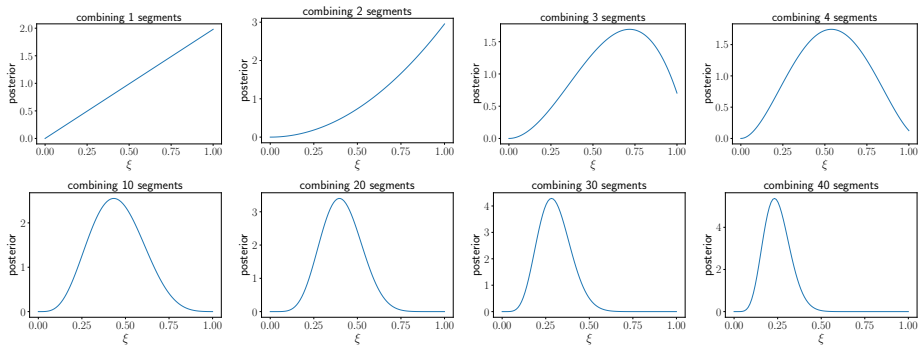
The load-bearing object is the mixture signal prior $p(h|\xi,\lambda)=\xi\,\delta\big(h-\mathrm{chirp}(\lambda)\big)+(1-\xi)\delta(h)$, combined with a segmentation of the data into short (e.g., 4-second) intervals that contain at most one merger. Marginalizing the per-segment likelihood over the chirp parameters leaves a likelihood that is linear in the merger-fraction parameter $\xi$; multiplying these per-segment likelihoods and applying Bayes' theorem yields a posterior for $\xi$. This structure lets the search use noise-only segments as evidence and restricts the search volume to chirp-like tracks. By contrast, the standard method's optimal filter is $\tilde{Q}(f)\propto \Gamma_{12}(f)H(f)/(P_1(f)P_2(f))$, tuned to a stationary Gaussian background.
What would settle it
Inject simulated design-sensitivity data where the merger rate is high enough that a 4-second segment sometimes contains two mergers, run the mixture search, and check whether the time to 3-sigma detection still falls by roughly a factor of 1000; the assumption of at most one chirp per segment is what fails first.
Extended reading notes
Core claim
The notes' central claim is that a background consisting of discrete, non-overlapping merger events is better searched for by a likelihood that models each short data segment as either a known chirp waveform or pure noise, rather than by the usual cross-correlation statistic that assumes a stationary Gaussian background. After segmenting the data and marginalizing over chirp parameters, the only remaining parameter is the fraction of segments containing a merger, and the full likelihood is the product of per-segment mixture likelihoods. In toy simulations, this Bayesian search achieves a signal-to-noise ratio of 15.3 versus 8.9 for standard cross-correlation on the same data, and the cited simulations [47] indicate a factor-of-approximately-1000 reduction in time to detection. The notes therefore conclude that at design sensitivity the black-hole-merger background, previously expected to require 40 months of observation, could be detected in roughly one day.
Load-bearing premise
The method assumes that each short segment contains at most one black-hole-merger signal and that the chirp waveform shape and duration are known exactly for every segment.
Editorial extensions
If this is right
- A 3-sigma detection of the stellar-mass black-hole-merger background could come after roughly a day of design-sensitivity observation, instead of the 40 months predicted for cross-correlation.
- Because the background is persistent, a claimed detection could be confirmed over time by the same search as the signal-to-noise ratio grows with observation time.
- The search measures the merger-fraction parameter directly, so data from segments with no merger still tighten the posterior rather than simply diluting the average correlation.
- The method can use two detectors to reject glitches, so the advantage of the mixture likelihood does not come at the cost of giving up instrumental-artifact rejection.
Reading between the lines
- The notes do not draw the race implication, but if the factor-of-1000 timing holds, ground-based interferometers might announce an astrophysical stochastic background before pulsar timing arrays announce the supermassive-black-hole background, despite the decades of pulsar-timing limits.
- The success of the mixture prior suggests a general principle: for backgrounds made of rare, well-modeled transients, detection time is set by the event rate and waveform-model accuracy, not by total background power; this could be exported to searches for subthreshold bursts in other detectors.
- A practical test the notes do not perform would be to replace the idealized known-chirp prior with a waveform bank or an explicit model of waveform mismatch, and quantify how the factor-of-1000 advantage degrades as template error grows.
Editorial analysis
A structured set of objections, weighed in public.
Referee Report
Summary. These lecture notes provide a pedagogical introduction to searches for stochastic gravitational-wave backgrounds (GWBs). Part I covers the mathematical characterization of GWBs, including the plane-wave expansion, ensemble averages, and the energy-density spectrum, and develops the cross-correlation method with optimal filtering for simple examples. Part II addresses non-trivial detector response, overlap functions for interferometers, pulsar timing arrays, and electric dipole antennas, and presents a Bayesian mixture method for detecting the popcorn-like stellar-mass binary black-hole (BBH) background. The notes include a toy simulation of the Bayesian method, a comparison with the standard cross-correlation search, and a central quantitative claim that the Bayesian method reduces the time to detection by roughly a factor of 1000, from 40 months to about one day at design sensitivity. The paper is written as lecture notes with appended exercises.
Significance. The pedagogical value of these notes is high: they present standard material in a clear, self-contained way, with derivations sketched and consolidated in an appendix, and with code and simulated data publicly available. The exposition of the Bayesian mixture search for the BBH background is a useful entry point to [47]. However, the paper is a review rather than a new research contribution, and its significance depends on the accuracy of its attributions. The factor-of-1000 speedup claim, if correct, would be a strong motivation for early detection of the BBH background; as presented, the claim rests on an unsupported conversion of the 40-month total-background estimate into a one-day projection for the BBH-only background, which requires correction.
major comments (2)
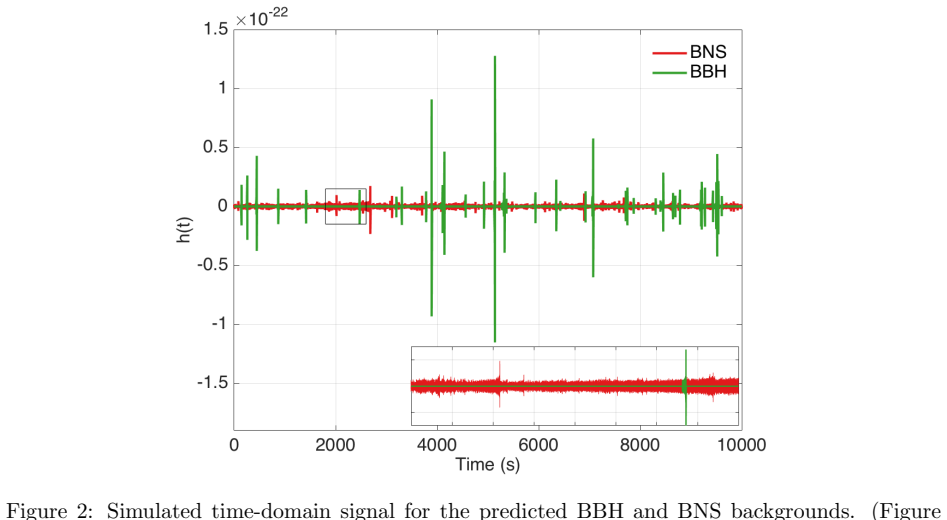
- [Section 9.3, Figure 3] The sentence '40 months of observation to detect the BBH background at the 3-σ level using the standard cross-correlation method (see Figure 3)' misidentifies the baseline: Figure 3 and the 40-month estimate come from [4] and refer to the median total BNS+BBH background, not the BBH component alone. Since the BBH-only contribution is smaller, its cross-correlation detection time at design sensitivity is longer than 40 months, so the conversion 40 months / 1000 ≈ 1 day is not a valid arithmetic shortcut. The claim as stated is internally inconsistent with Section 1.2, which correctly describes the 40-month estimate for the combined background.
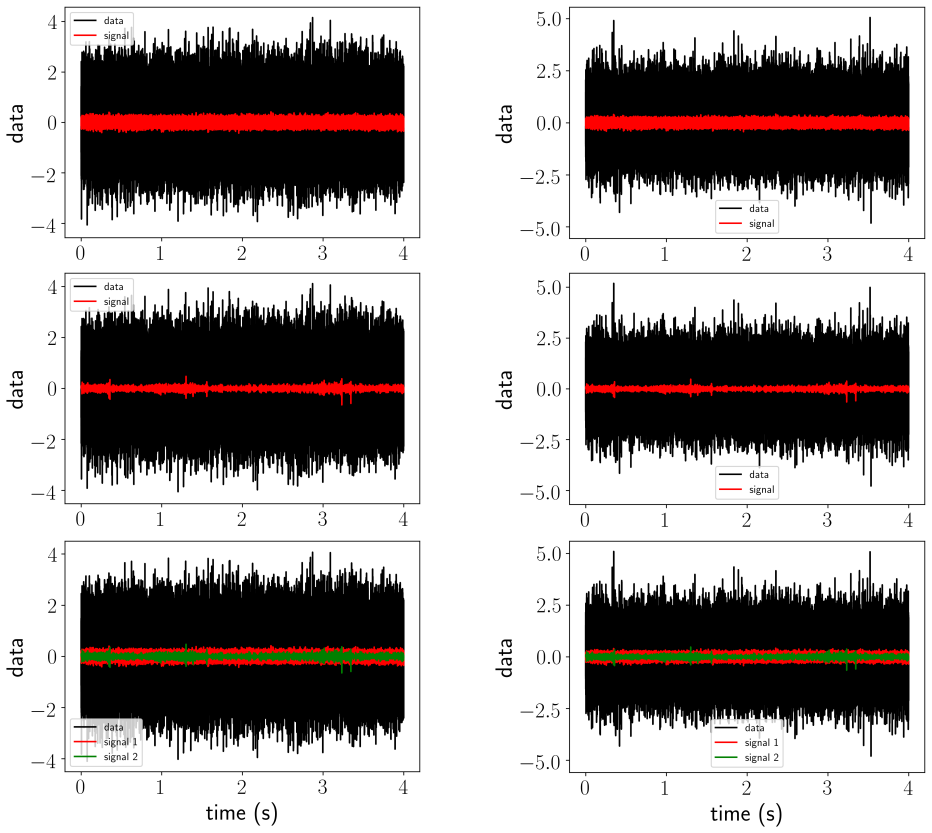
- [Sections 9.2 and 9.3, Eq. (9.1)] The factor-of-1000 reduction in time to detection is attributed to [47] and is not derived or verified in these notes. The toy simulation in Section 9.2 assumes a known chirp shape and duration and marginalizes only over amplitude and arrival time, so the quoted speedup is conditional on that idealized model. The notes do not provide the BBH-only cross-correlation baseline or an analysis of how the speedup depends on segment length, merger rate, or waveform systematics; therefore the projection of 'about one day' at design sensitivity is not supported without additional calculation, and Section 10's concluding statement should be correspondingly qualified.
minor comments (7)
- [Section 10] The word 'stochatic' should be 'stochastic'.
- [Section 5.1] The word 'ampltitude' should be 'amplitude'; also, 'agree to 3.5%' should be 'agree to within 3.5%' (or 'disagree by 3.5%').
- [Section 6.3.2] The words 'reponse' and 'senstive' should be 'response' and 'sensitive', respectively.
- [Section 8.3] The word 'probabilites' should be 'probabilities'.
- [Section 1.2 and Figure 2 caption] The text gives the BBH in-band duration as roughly 1 s, while the reprinted caption from [4] says 14 s on average; please reconcile these definitions or clarify that they refer to different frequency bands.
- [Figure 2 caption] The caption in the manuscript includes extraneous text from the source paper; please rewrite it to clearly credit [4] and remove unrelated content.
- [Section 9.3] The phrase 'converted the signal+noise to noise-only Bayes factor B10(d) to a signal-to-noise ratio using (8.19) and (8.9)' is confusing; please specify that B10(d) is the Bayes factor for model M1 (signal+noise) versus M0 (noise-only) and that Eq. (8.19) is applied in the informative-data limit.
Circularity Check
No circularity: the lecture notes are a review whose Section 9 speedup claim is cited to Smith and Thrane, and the foundational methods are derived or standard background material.
full rationale
The paper is a review/lecture-note introduction, not a self-contained derivation of a new result. The cross-correlation formalism in Sections 4-7 is derived from stated assumptions (e.g., the optimal filter in Eq. (4.20) is obtained by maximizing SNR, with the derivation assigned to Exercise A.4), and the standard references [9, 41] are background citations, not load-bearing self-citations that force the paper's conclusions. The Bayesian mixture search of Section 9 is explicitly attributed to Smith and Thrane [47], including the mixture prior (9.1), the segmented likelihood (9.3), and the quoted factor-of-1000 speedup; the notes do not claim to derive that factor. The toy simulation in Section 9.2 is an injection-recovery exercise that reports a posterior peaked at the injected value xi=0.25; it is not a fitted parameter being relabeled as a prediction. The only questionable step is the end of Section 9.3, where '40 months of observation to detect the BBH background' refers to a 40-month SNR=3 estimate that, per the caption of Figure 3 taken from [4], is for the median total (BNS+BBH) background, not the BBH-only component. This is an arithmetic/attribution concern about the extrapolation rather than a circular reduction, because the 40-month number and the factor-1000 come from different external sources and the paper does not construct one from the other by definition. Accordingly, no circularity step is exhibited, and the score is 0.
Assumptions & free parameters
assumptions (4)
- domain assumption Gravitational waves are transverse-traceless perturbations of spacetime, described by the plane-wave expansion in Eq. (3.1).
- domain assumption The stochastic background is Gaussian, stationary, isotropic, and unpolarized in the basic formalism (Section 3.2, Eq. 3.5).
- domain assumption Detector noise is uncorrelated between detectors (Section 4.1).
- domain assumption For the Bayesian BBH search, each 4-second data segment contains at most one BBH merger signal, and the chirp waveform shape and duration are known (Sections 9.1 and 9.2).
Cite this review
Pith. "Pith review of Searches for stochastic gravitational-wave backgrounds." pith.science (2026). https://pith.science/paper/ISA6W3P2
@misc{pith2026190900269,
  author       = {Pith},
  title        = {Pith review of: Searches for stochastic gravitational-wave backgrounds},
  year         = {2026},
  howpublished = {\url{https://pith.science/paper/ISA6W3P2}},
  note         = {Machine review of arXiv:1909.00269}
}
read the original abstract
These lecture notes provide a brief introduction to methods used to search for a stochastic background of gravitational radiation -- a superposition of gravitational-wave signals that are either too weak or too numerous to individually detect. The focus of these notes is on relevant data analysis techniques, not on the particular astrophysical or cosmological sources that are responsible for producing the background. The lecture notes are divided into two main parts: (i) an overview, consisting of a description of different types of gravitational-wave backgrounds and an introduction to the method of cross-correlating data from multiple detectors, which can be used to extract the signal from the noise; (ii) details, extending the previous discussion to non-trivial detector response, non-trivial overlap functions, and a recently proposed Bayesian method to search for the gravitational-wave background produced by stellar-mass binary black hole mergers throughout the universe. Suggested exercises for the reader are given throughout the text, and compiled in an appendix.
Figures


Figures from the paper (17 more)




Reference graph
Works this paper leans on
-
[4]
Abbott, B. P. et al., “GW170817: Implications for the Stochastic Gravitational-Wave Back- ground from Compact Binary Coalescences”, Phys. Rev. Lett., 120(9), 091101 (Mar 2018). [DOI], [ADS], [arXiv:1710.05837 [gr-qc]]
arXiv 2018
-
[47]
Optimal Search for an Astrophysical Gravitational-Wave Background
Smith, Rory and Thrane, Eric, “Optimal Search for an Astrophysical Gravitational-Wave Background”, Phys. Rev. X , 8, 021019 (Apr 2018). [DOI]URL: https://link.aps.org/doi/10.1103/PhysRevX.8.021019
-
[1]
GW150914: Implications for the stochastic gravitational wave background from binary black holes
Abbott, B. P. et al. (Virgo, LIGO Scientific), “GW150914: Implications for the stochastic gravitational wave background from binary black holes”, Phys. Rev. Lett. , 116(13), 131102 (2016). [DOI], [arXiv:1602.03847 [gr-qc]]
arXiv 2016
-
[2]
Observation of Gravitational Waves from a Binary Black Hole Merger
Abbott, B. P. et al., “Observation of Gravitational Waves from a Binary Black Hole Merger”, Physical Review Letters , 116(6), 061102 (February 2016). [DOI], [ADS], [arXiv:1602.03837 [gr- qc]]
arXiv 2016
-
[3]
GW170817: Observation of Gravitational Waves from a Binary Neutron Star Inspiral
Abbott, B. P. et al., “GW170817: Observation of Gravitational Waves from a Binary Neutron Star Inspiral”, Phys. Rev. Lett., 119(16), 161101 (Oct 2017). [DOI], [ADS], [arXiv:1710.05832 [gr-qc]]
arXiv 2017
-
[5]
Discriminating between a Stochastic Gravita- tional Wave Background and Instrument Noise
Adams, Matthew R. and Cornish, Neil J., “Discriminating between a Stochastic Gravita- tional Wave Background and Instrument Noise”, Phys. Rev. , D82, 022002 (2010). [DOI], [arXiv:1002.1291 [gr-qc]]
arXiv 2010
-
[6]
Adams, Matthew R. and Cornish, Neil J., “Detecting a Stochastic Gravitational Wave Back- ground in the presence of a Galactic Foreground and Instrument Noise”, Phys. Rev., D89(2), 022001 (2014). [DOI], [arXiv:1307.4116 [gr-qc]]
arXiv 2014
-
[7]
The Stochastic Gravity-Wave Background: Sources and Detection
Allen, B., “The Stochastic Gravity-Wave Background: Sources and Detection”, in Marck, J.- A. and Lasota, J.-P., eds., Relativistic Gravitation and Gravitational Radiation, p. 373, (1997). [ADS], [gr-qc/9604033]
arXiv 1997
Show all 67 references
-
[8]
Detection of anisotropies in the gravitational-wave stochastic background
Allen, B. and Ottewill, A. C., “Detection of anisotropies in the gravitational-wave stochastic background”, Phys. Rev. D, 56, 545–563 (July 1997). [DOI], [ADS], [gr-qc/9607068]
1997 arXiv
-
[9]
Detecting a stochastic background of gravitational radiation: Signal processing strategies and sensitivities
Allen, Bruce and Romano, Joseph D., “Detecting a stochastic background of gravitational radiation: Signal processing strategies and sensitivities”, Phys. Rev. D, 59(10), 102001 (May 1999). [DOI], [ADS], [arXiv:gr-qc/9710117 [gr-qc]]
1999 arXiv
-
[10]
Confusion noise level due to galactic and extragalactic binaries
Bender, P. L. and Hils, D., “Confusion noise level due to galactic and extragalactic binaries”, Classical and Quantum Gravity , 14, 1439–1444 (June 1997). [DOI], [ADS]
1997
-
[11]
Stochastic backgrounds in alternative theories of gravity: Overlap reduction functions for pulsar timing arrays
Chamberlin, S. J. and Siemens, X., “Stochastic backgrounds in alternative theories of gravity: Overlap reduction functions for pulsar timing arrays”, Phys. Rev. D, 85(8), 082001 (April 2012). [DOI], [ADS], [arXiv:1111.5661 [astro-ph.HE]]
2012 arXiv
-
[12]
Optimal detection strategies for measuring the stochastic gravitational ra- diation background with laser interferometric antennas
Christensen, N., “Optimal detection strategies for measuring the stochastic gravitational ra- diation background with laser interferometric antennas”, Phys. Rev. D, 55, 448–454 (January 1997). [DOI], [ADS]
1997
-
[13]
Subtraction of correlated noise in global networks of gravitational-wave interferometers
Coughlin, Michael W. et al., “Subtraction of correlated noise in global networks of gravitational-wave interferometers” (2016). [arXiv:1606.01011 [gr-qc]]. 51
2016 arXiv
-
[14]
Anisotropy of the astrophysical grav- itational wave background: Analytic expression of the angular power spectrum and correla- tion with cosmological observations
Cusin, Giulia, Pitrou, Cyril and Uzan, Jean-Philippe, “Anisotropy of the astrophysical grav- itational wave background: Analytic expression of the angular power spectrum and correla- tion with cosmological observations”, Phys. Rev. D, 96(10), 103019 (Nov 2017). [DOI], [ADS], [...
2017 arXiv
-
[15]
Pulsar timing measurements and the search for gravitational waves
Detweiler, S., “Pulsar timing measurements and the search for gravitational waves”, ApJ, 234, 1100–1104 (December 1979). [DOI], [ADS]
1979
-
[16]
Cosmic Black-Body Radia- tion
Dicke, R. H., Peebles, P. J. E., Roll, P. G. and Wilkinson, D. T., “Cosmic Black-Body Radia- tion.”, ApJ, 142, 414–419 (July 1965). [DOI], [ADS]
1965
-
[17]
Time delay analysis of LISA gravi- tational wave data: Elimination of spacecraft motion effects
Estabrook, F. B., Tinto, Massimo and Armstrong, J. W., “Time delay analysis of LISA gravi- tational wave data: Elimination of spacecraft motion effects”, Phys. Rev., D62, 042002 (2000). [DOI]
2000
-
[18]
Sensitivity of the Laser Interferometer Gravitational Wave Observatory to a stochastic background, and its dependence on the detector orientations
Flanagan, ´Eanna ´E., “Sensitivity of the Laser Interferometer Gravitational Wave Observatory to a stochastic background, and its dependence on the detector orientations”, Phys. Rev. D, 48, 2389 (1993)
1993
-
[19]
Mapping gravitational- wave backgrounds using methods from CMB analysis: Application to pulsar timing arrays
Gair, J., Romano, J. D., Taylor, S. and Mingarelli, C. M. F., “Mapping gravitational- wave backgrounds using methods from CMB analysis: Application to pulsar timing arrays”, Phys. Rev. D, 90(8), 082001 (October 2014). [DOI], [ADS], [arXiv:1406.4664 [gr-qc]]
2014 arXiv
-
[20]
Mapping gravitational-wave backgrounds of arbitrary polarisation using pulsar timing arrays
Gair, J. R., Romano, J. D. and Taylor, S. R., “Mapping gravitational-wave backgrounds of arbitrary polarisation using pulsar timing arrays”, Phys. Rev. D, 92(10), 102003 (November 2015). [DOI], [ADS], [arXiv:1506.08668 [gr-qc]]
2015 arXiv
-
[21]
Gregory, Phil C., Bayesian Logical Data Analysis for the Physical Sciences: A Comparative Approach with Mathematica Support, (Cambridge University Press, Cambridge, UK, New York, NY, 2005)
2005
-
[22]
Primordial gravitons and possibility of their observation
Grishchuk, L. P., “Primordial gravitons and possibility of their observation”, Journal of Ex- perimental and Theoretical Physics Letters , 23, 293 (1976)
1976
-
[23]
Hartle, James B., Gravity: An Introduction to Einstein’s General Relativity , (Addison Wesley, 2002)
2002
-
[24]
Upper limits on the istotropic gravitational radiation background from pulsar timing analysis
Hellings, R. W. and Downs, G. S., “Upper limits on the istotropic gravitational radiation background from pulsar timing analysis”, ApJ, 265, L39–L42 (1983)
1983
-
[25]
Helstrom, Carl W., Statistical Theory of Signal Detection, 2nd edition , (Pergamon Press, Oxford, London, Edinburgh, New York, Toronto, Sydney, Paris, Braunschweig, 1968)
1968
-
[26]
Understanding the gravitational-wave Hellings and Downs curve for pulsar timing arrays in terms of sound and electromagnetic waves
Jenet, F. A. and Romano, J. D., “Understanding the gravitational-wave Hellings and Downs curve for pulsar timing arrays in terms of sound and electromagnetic waves”,American Journal of Physics, 83, 635–645 (July 2015). [DOI], [ADS], [arXiv:1412.1142 [gr-qc]]
2015 arXiv
-
[27]
Anisotropies in the stochastic gravitational- wave background: Formalism and the cosmic string case
Jenkins, Alexander C. and Sakellariadou, Mairi, “Anisotropies in the stochastic gravitational- wave background: Formalism and the cosmic string case”, Phys. Rev. D, 98(6), 063509 (Sep 2018). [DOI], [ADS], [arXiv:1802.06046 [astro-ph.CO]]
2018 arXiv
-
[28]
The Primordial Inflation Explorer (PIXIE): a nulling polarimeter for cos- mic microwave background observations
Kogut, A. et al., “The Primordial Inflation Explorer (PIXIE): a nulling polarimeter for cos- mic microwave background observations”, Journal of Cosmology and Astro-Particle Physics , 2011(7), 025 (Jul 2011). [DOI], [ADS], [arXiv:1105.2044 [astro-ph.CO]]. 52
2011 arXiv
-
[29]
Kolb, E. W. and Turner, M., The Early Universe , (Addison Wesley, 1990)
1990
-
[30]
Detecting Gravitational Waves of Alternative Theories Using Pulsar Timing
Lee, K., Jenet, F. and Price, R., “Detecting Gravitational Waves of Alternative Theories Using Pulsar Timing”, in American Astronomical Society Meeting Abstracts , Bulletin of the American Astronomical Society, 39, 102.07, (December 2007). [ADS]
2007
-
[31]
Gravitational wave experiments and early universe cosmology
Maggiore, M., “Gravitational wave experiments and early universe cosmology”, Phys. Rep., 331, 283–367 (July 2000). [DOI], [ADS], [gr-qc/9909001]
2000 arXiv
-
[32]
The BOOMERanG experiment and the curvature of the universe
Masi, S., “The BOOMERanG experiment and the curvature of the universe”, Progress in Particle and Nuclear Physics , 48(1), 243–261 (Jan 2002). [DOI], [ADS], [arXiv:astro-ph/0201137 [astro-ph]]
2002 arXiv
-
[33]
Characterizing gravitational wave stochastic background anisotropy with pulsar timing arrays
Mingarelli, C. M. F., Sidery, T., Mandel, I. and Vecchio, A., “Characterizing gravitational wave stochastic background anisotropy with pulsar timing arrays”, Phys. Rev. D, 88(6), 062005 (September 2013). [DOI], [ADS], [arXiv:1306.5394 [astro-ph.HE]]
2013 arXiv
-
[34]
W., Thorne, K
Misner, C. W., Thorne, K. S. and Wheeler, J. A., Gravitation, (W.H. Freeman and Company, San Francisco, 1973)
1973
-
[35]
Component Separation of a Isotropic Gravitational Wave Background
Parida, Abhishek, Mitra, Sanjit and Jhingan, Sanjay, “Component Separation of a Isotropic Gravitational Wave Background”, Journal of Cosmology and Astroparticle Physics , 2016 (10 2015). [DOI]
2016
-
[36]
A Measurement of Excess Antenna Temperature at 4080 Mc/s
Penzias, A. A. and Wilson, R. W., “A Measurement of Excess Antenna Temperature at 4080 Mc/s.”, ApJ, 142, 419–421 (July 1965). [DOI], [ADS]
1965
-
[37]
Gravitational Radiation from Point Masses in a Keplerian Orbit
Peters, P. C. and Mathews, J., “Gravitational Radiation from Point Masses in a Keplerian Orbit”, Phys. Rev., 131, 435–440 (Jul 1963). [DOI]URL: https://link.aps.org/doi/10.1103/PhysRev.131.435
1963 doi
-
[38]
A Practical Theorem on Gravitational Wave Backgrounds
Phinney, E. S., “A Practical Theorem on Gravitational Wave Backgrounds”, arXiv e-prints , astro-ph/0108028 (Aug 2001). [ADS], [arXiv:astro-ph/0108028 [astro-ph]]
2001 arXiv
-
[39]
Planck 2018 results. VII. Isotropy and Statistics of the CMB
Planck Collaboration et al., “Planck 2018 results. VII. Isotropy and Statistics of the CMB”, arXiv e-prints, arXiv:1906.02552 (Jun 2019). [ADS], [arXiv:1906.02552 [astro-ph.CO]]
2018 arXiv
-
[40]
The LISA optimal sensitivity
Prince, Thomas A., Tinto, Massimo, Larson, Shane L. and Armstrong, J. W., “The LISA optimal sensitivity”, Phys. Rev., D66, 122002 (2002). [DOI], [arXiv:gr-qc/0209039 [gr-qc]]
2002 arXiv
-
[41]
Detection methods for stochastic gravitational- wave backgrounds: a unified treatment
Romano, Joseph D. and Cornish, Neil. J., “Detection methods for stochastic gravitational- wave backgrounds: a unified treatment”, Living Reviews in Relativity, 20(1), 2 (Apr 04, 2017). [DOI]URL: https://doi.org/10.1007/s41114-017-0004-1
2017 doi
-
[42]
Expected properties of the first gravitational wave signal detected with pulsar timing arrays
Rosado, Pablo A., Sesana, Alberto and Gair, Jonathan, “Expected properties of the first gravitational wave signal detected with pulsar timing arrays”, Mon. Not. Roy. Astron. Soc. , 451(3), 2417–2433 (2015). [DOI], [arXiv:1503.04803 [astro-ph.HE]]
2015 arXiv
-
[43]
Ryden, B., Introduction to cosmology, (Cambridge University Press, 2016)URL: http://www.cambridge.org/de/academic/subjects/astronomy/ cosmology-and-relativity/introduction-cosmology-2nd-edition-1?format=HB . 53
2016
-
[44]
Opportunities for detecting ultralong gravitational waves
Sazhin, M. V., “Opportunities for detecting ultralong gravitational waves”, Soviet Ast., 22, 36–38 (February 1978). [ADS]
1978
-
[45]
Signature of gravity waves in polarization of the mi- crowave background
Seljak, Uros and Zaldarriaga, Matias, “Signature of gravity waves in polarization of the mi- crowave background”, Phys. Rev. Lett. , 78, 2054–2057 (1997). [DOI], [arXiv:astro-ph/9609169 [astro-ph]]
1997 arXiv
-
[46]
The stochastic background: scaling laws and time to detection for pulsar timing arrays
Siemens, X., Ellis, J., Jenet, F. and Romano, J. D., “The stochastic background: scaling laws and time to detection for pulsar timing arrays”, Classical and Quantum Gravity , 30(22), 224015 (November 2013). [DOI], [ADS], [arXiv:1305.3196 [astro-ph.IM]]
2013 arXiv
-
[48]
Structure in the COBE Differential Microwave Radiometer First-Year Maps
Smoot, G. F. et al., “Structure in the COBE Differential Microwave Radiometer First-Year Maps”, ApJ, 396, L1 (Sep 1992). [DOI], [ADS]
1992
-
[49]
Are We There Yet? Time to Detection of Nanohertz Gravitational Waves Based on Pulsar-timing Array Limits
Taylor, S. R., Vallisneri, M., Ellis, J. A., Mingarelli, C. M. F., Lazio, T. J. W. and van Haasteren, R., “Are We There Yet? Time to Detection of Nanohertz Gravitational Waves Based on Pulsar-timing Array Limits”, ApJ, 819, L6 (March 2016). [DOI], [ADS], [arXiv:1511.05564 [ast...
2016 arXiv
-
[50]
Binary Black Hole Mergers in the first Advanced LIGO Observing Run
The LIGO Scientific Collaboration et al., “Binary Black Hole Mergers in the first Advanced LIGO Observing Run”, ArXiv e-prints (June 2016). [ADS], [arXiv:1606.04856 [gr-qc]]
2016 arXiv
-
[51]
GWTC-1: A Gravitational-Wave Transient Cata- log of Compact Binary Mergers Observed by LIGO and Virgo during the First and Second Observing Runs
The LIGO Scientific Collaboration et al., “GWTC-1: A Gravitational-Wave Transient Cata- log of Compact Binary Mergers Observed by LIGO and Virgo during the First and Second Observing Runs”, arXiv e-prints, arXiv:1811.12907 (Nov 2018). [ADS], [arXiv:1811.12907 [astro- ph.HE]]
2018 arXiv
-
[52]
Probing the anisotropies of a stochastic gravitational-wave background using a network of ground-based laser interferometers
Thrane, E., Ballmer, S., Romano, J. D., Mitra, S., Talukder, D., Bose, S. and Mandic, V., “Probing the anisotropies of a stochastic gravitational-wave background using a network of ground-based laser interferometers”, Phys. Rev. D, 80(12), 122002 (December 2009). [DOI], [ADS],...
2009 arXiv
-
[53]
Correlated magnetic noise in global networks of gravitational-wave detectors: Observations and implications
Thrane, E., Christensen, N. and Schofield, R. M. S., “Correlated magnetic noise in global networks of gravitational-wave detectors: Observations and implications”, Phys. Rev. D, 87, 123009 (Jun 2013). [DOI]URL: http://link.aps.org/doi/10.1103/PhysRevD.87.123009
2013 doi
-
[54]
Correlated noise in networks of gravitational-wave detectors: Subtraction and mitigation
Thrane, E., Christensen, N., Schofield, R. M. S. and Effler, A., “Correlated noise in networks of gravitational-wave detectors: Subtraction and mitigation”, Phys. Rev. D, 90, 023013 (Jul 2014). [DOI]URL: http://link.aps.org/doi/10.1103/PhysRevD.90.023013
2014 doi
-
[55]
http://bicepkeck.org/
“ http://bicepkeck.org/”
-
[56]
http://litebird.jp/eng/?page_id=2
“ http://litebird.jp/eng/?page_id=2”
-
[57]
https://github.com/josephromano/leshouches/tree/master/code
“ https://github.com/josephromano/leshouches/tree/master/code”
-
[58]
https://gwcenter.icrr.u-tokyo.ac.jp/en/
“ https://gwcenter.icrr.u-tokyo.ac.jp/en/”. 54
-
[59]
https://lambda.gsfc.nasa.gov/product/cobe/
“ https://lambda.gsfc.nasa.gov/product/cobe/”
-
[60]
https://map.gsfc.nasa.gov
“ https://map.gsfc.nasa.gov”
-
[61]
https://www.cosmos.esa.int/web/planck
“ https://www.cosmos.esa.int/web/planck”
-
[62]
https://www.elisascience.org
“ https://www.elisascience.org”
-
[63]
https://www.gw-openscience.org
“ https://www.gw-openscience.org”
-
[64]
http://www.gw-indigo.org
“ http://www.gw-indigo.org”
-
[65]
http://www.ligo.caltech.edu/
“ http://www.ligo.caltech.edu/”
-
[66]
http://www.virgo-gw.eu
“ http://www.virgo-gw.eu”
-
[67]
Wainstein, L. A. and Zubakov, V. D., Extractions of Signals from Noise , (Dover Publications Inc., 1971). 55
1971
Reviewed August 14, 2026 · model on record in the stance chip above.
Discussion (0). Continue with ORCID to comment.