REVIEW 4 major objections 5 minor 78 references
Temperatures and chemical potentials at kinetic freeze-out in relativistic heavy ion collisions from coarse grained transport simulations
T0 review · 4 major / 5 minor · reviewed 2026-08-14 · deepseek-v4-flash
Pith's one-line read Kinetic freeze-out is not a single point in the phase diagram
desk verdict Useful five-energy map of kinetic freeze-out from UrQMD coarse-graining; the continuous-freeze-out claim holds up, but the quantitative tension with Blast-Wave is model-dependent and not yet error-barred. read the letter →
The pith
A machine-rendered reading of the paper's core claim, the machinery that carries it, and where it could break.
The reading
What carries the argument
The argument rests on a coarse-graining procedure that converts the microscopic output of a hadron cascade into continuum thermodynamic fields. At fixed times, the net-baryon four-current and energy-momentum tensor are computed in cells of size roughly 0.8 fm, the Eckart frame is used to define the fluid velocity, and the local rest-frame energy density $\varepsilon$ and net-baryon density $\rho_B$ are mapped to temperature and baryon chemical potential through a tabulated Hadron Resonance Gas equation of state with the same degrees of freedom as the cascade. These continuum values are then assigned to the space-time point of each hadron's last interaction, defining the kinetic freeze-out hypersurface. This machinery allows the paper to attach thermodynamic meaning to the decoupling distribution and to compare the resulting averages with Blast-Wave fits.
What would settle it
Measure the momentum distribution of two hadron species (say pions and protons) at the same coarse-grained freeze-out cell and check whether both are described by the same temperature and chemical potential; if the species-dependent temperatures differ by more than the claimed 10% at any cell, the equilibrium mapping fails. Alternatively, if rerunning the analysis with a lattice-based equation of state or with a cascade that includes a hydrodynamically evolving quark-gluon plasma stage changes the average kinetic freeze-out temperature by more than about 10%, the tension with Blast-Wave fits would not be robust.
Extended reading notes
Core claim
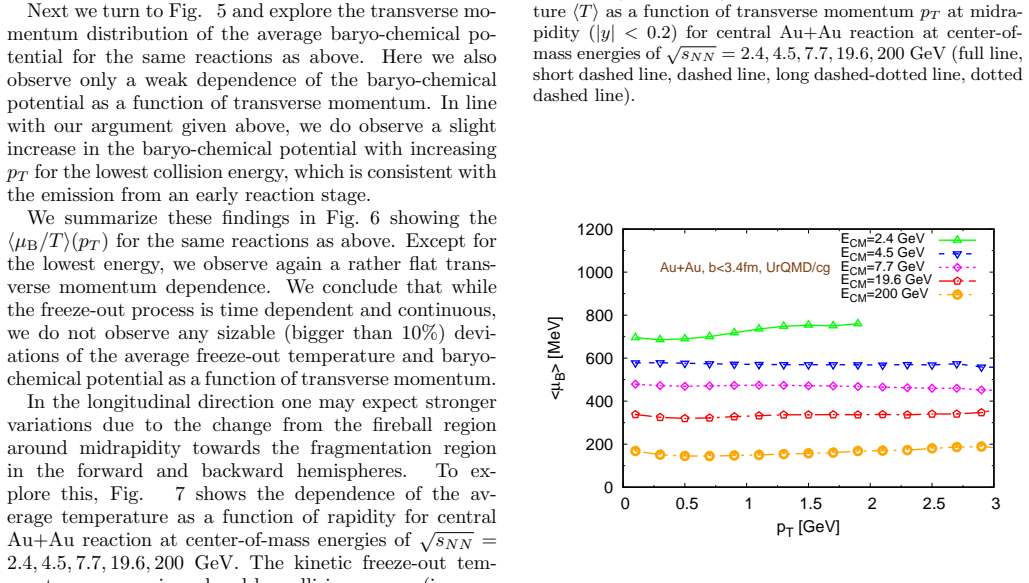
The central discovery is that kinetic freeze-out is a continuous, dynamical process rather than a sharp moment. On the decoupling hypersurface defined by the last interaction of each hadron (including strong decays), the temperature and baryon chemical potential are spread over wide ranges whose widths reflect the expansion dynamics and energy-dependent cross sections: for example, at intermediate beam energies the baryon chemical potential distribution is particularly broad because the system transitions from baryon-dominated to meson-dominated matter. Averaged over the hypersurface, however, the temperatures and chemical potentials order smoothly with collision energy, with the average temperature rising and the average baryon chemical potential falling as $\sqrt{s_{NN}}$ increases from 2.4 to 200 GeV, and the averaged values vary by less than 10% with transverse momentum and only mildly with rapidity. The paper further claims that the average kinetic freeze-out temperature at high energy exceeds the Blast-Wave fitted value, which it attributes to the weaker transverse expansion generated by the pure hadron cascade without a hydrodynamic or quark-gluon plasma stage.
Load-bearing premise
The whole extraction assumes that the local mix of hadrons at a freeze-out cell is close enough to thermal equilibrium that a single temperature and baryon chemical potential, read off from an equilibrium hadron-resonance-gas equation of state, can meaningfully describe the cell's energy and baryon densities.
Editorial extensions
If this is right
- Freeze-out parameters should be reported as distributions on a decoupling hypersurface rather than as a single point in the $(T,\mu_B)$ plane if one wants to capture the actual dynamics.
- The weak transverse-momentum and rapidity dependence of the averages means that a single average $(\langle T\rangle, \langle\mu_B\rangle)$ per collision energy remains a useful summary despite the underlying spread.
- At high collision energy the kinetic freeze-out temperature is higher than Blast-Wave fits suggest, indicating that the hadron cascade produces weaker transverse expansion than the data; this points to the need for a hydrodynamic or particlization stage or a reassessment of Blast-Wave fit assumptions.
- The separation between chemical and kinetic freeze-out temperatures grows from roughly 5-10 MeV at low energies to more than 40-50 MeV at high energies, quantifying the strength of the expansion between the two stages.
Reading between the lines
- The same coarse-grained freeze-out extraction could be applied species-by-species (pions, kaons, protons) to test whether different hadrons decouple at systematically different temperatures and to search for the species-splitting that a single freeze-out temperature cannot capture.
- The broad spread in $(T,\mu_B)$ at freeze-out implies that inclusive momentum-space observables average over many different thermodynamic conditions; this may contribute to apparent temperatures extracted from slope ratios and may be connected to transverse-momentum-dependent fluctuations.
- If the tension with Blast-Wave fits stems from the absence of a quark-gluon plasma stage, extending the analysis to hybrid transport-hydrodynamic models at RHIC and LHC energies would be a direct test; the method could also be applied to smaller systems such as pp or pA collisions.
- The claimed time-extended decoupling of 15-20 fm/c suggests that two-particle correlations and interferometry measurements carry information about the freeze-out duration; comparing the coarse-grained emission function with measured correlations would provide an independent check.
Editorial analysis
A structured set of objections, weighed in public.
Referee Report
Summary. The paper extracts kinetic freeze-out temperatures and baryon chemical potentials from UrQMD cascade simulations combined with a coarse-graining procedure. For central Au+Au collisions at five beam energies from 2.4 to 200 GeV, the authors define kinetic freeze-out as the last interaction point of each hadron, compute coarse-grained energy density and net-baryon density around those points, and map the resulting (ε, ρB) values to (T, μB) using a tabulated hadron resonance gas equation of state. They present freeze-out time, temperature, and chemical-potential distributions, study the transverse-momentum and rapidity dependence of the averaged freeze-out parameters, and compare their average (T, μB) points with Blast-Wave fit results and statistical hadronization model results. The central qualitative claim is that kinetic freeze-out is a continuous process occurring over 15–20 fm/c and over broad ranges of T and μB, so that representing it by a single point in the QCD phase diagram is an oversimplification. The paper also claims a tension with Blast-Wave fits, particularly at high collision energy.
Significance. If the quantitative extraction is accepted, the paper provides a useful phenomenological benchmark showing that single-point freeze-out parameters hide a substantial spread in decoupling conditions, and it offers a direct microscopic definition of the kinetic freeze-out hypersurface in a transport approach. Strengths of the paper are its large event statistics, the transparent step-by-step presentation of the coarse-graining and mapping procedure, and the explicit listing of limitations in Section IV, including the equilibrium-EoS assumption and the absence of a particlization stage. The qualitative claim about the continuous nature of freeze-out is robust because it follows directly from the last-interaction samples, whereas the quantitative claims about average T and μB, the 10% flatness statement, and the comparison with Blast-Wave fits depend on the unvalidated equilibrium mapping of non-equilibrium cascade cells.
major comments (4)
- [Section II, Eqs. (2)–(5) and interpolation step] The central quantitative step is the mapping of coarse-grained (ε, ρB) from non-equilibrium UrQMD cells to unique (T, μB) via the hadron resonance gas EoS. This assumes local thermal and chemical equilibrium in every cell, but UrQMD is a non-equilibrium cascade and no test in the paper checks whether cell-level momentum or species distributions are thermal. The manuscript itself concedes in Section IV that the EoS 'might introduce a bias' for a system out of chemical equilibrium. Because this mapping feeds directly into the average ⟨T⟩, the pT- and y-dependence claims, and the Blast-Wave comparison in Fig. 11, the authors should quantify the bias, for example by comparing coarse-grained cell momentum distributions with thermal fits, by repeating the extraction with a lattice-based EoS at high T, or by restricting the analysis to cells where an equilibrium criterion is satisfied. Without such a test, the quantitative values are conditional on an unquantified assumption.
- [Section III.C, Fig. 11] The claimed tension with Blast-Wave fits at high collision energy is interpreted as weaker transverse expansion in the cascade. However, Blast-Wave Tkin is a fit parameter strongly correlated with the fitted transverse velocity and with the selected pT ranges, so a direct comparison of the present average freeze-out temperature with the Blast-Wave parameter is not apples-to-apples. The paper notes the pT cuts and resonance feed-down as possible sources of difference but does not quantify them. A quantitative robustness test is needed, for instance by applying the same Blast-Wave fitting procedure to UrQMD-generated spectra and comparing the resulting Tkin with the coarse-grained ⟨T⟩, or by varying the pT ranges used in the data fits. This is load-bearing for the paper's comparison and for the interpretation that the cascade produces weaker radial flow than the data.
- [Section II, coarse-graining acceptance at √sNN=200 GeV] The sentence 'except at √sNN = 200 GeV, where we drop at ≈ 85%' is ambiguous and potentially serious. If 85% of the kinetically frozen-out hadrons are discarded because their cells have fewer than 100 particles, the 200 GeV results in Figs. 4–11 are based on only about 15% of the freeze-out sample, which could bias the averages and distributions toward high-density central cells. The authors should clarify the retention fraction and, if the drop is indeed 85%, quantify the selection bias by comparing the accepted and rejected samples or by lowering the acceptance threshold with a statistical correction.
- [Section III.B and Section IV] The claim that the average freeze-out temperature and baryon chemical potential are 'essentially independent of rapidity and transverse momentum' is too strong as stated. The paper itself notes that at √sNN = 2.4 GeV the pT dependence is not flat (Figs. 4–6 show a pronounced rise of ⟨T⟩ and ⟨μB⟩ with pT at the lowest energy), and the conclusion is already qualified in the body of Section III.B. The abstract and conclusions should either explicitly restrict the flatness claim to √sNN ≥ 4.5 GeV or quantify the size of the deviations at each energy, since the 10% statement is one of the paper's quantitative results.
minor comments (5)
- [Throughout] There are several typos and inconsistencies: 'for for high collision energies' in Section III.A, 'UrMQD' in Section IV, the comma in '√sNN = 2.4, GeV' in Section III.A, and the axis label 'T [Mev]' in Fig. 10. These should be corrected.
- [Section III.C] The text refers to √sNN = 7 GeV when the simulated energies are 7.7 GeV and 19.6 GeV; please make the numbers consistent.
- [Fig. 12 caption] The caption of Fig. 12 describes a density profile in the (T, μB) plane but does not state the axis labels or the meaning of the color scale. Please clarify what is plotted and how the density is normalized.
- [References] Reference [49] appears incomplete (no year or journal information is given), and Refs. [45] and [49] share the same authors; please provide full bibliographic information and check for duplication.
- [Section III.A] The statement that the peak emission temperature 'does not rise above a certain threshold of approx. 150 MeV' is based on the HRG EoS used in the mapping; this should be stated together with the caveat that the EoS itself restricts the accessible temperature range, as is already partially acknowledged later in the same paragraph.
Circularity Check
No significant circularity: T and muB are model extractions via an external HRG EoS, the comparison benchmarks are external, and the paper openly states its limitations.
full rationale
The derivation chain is self-contained and does not feed the target result back into the inputs. UrQMD defines kinetic freeze-out points as the space-time locations of last interactions; coarse graining computes average energy density and net-baryon density from the UrQMD ensemble; a tabulated Hadron Resonance Gas EoS, taken from external literature (Zschiesche et al. 2002), converts those densities into T and muB; and the resulting averages are compared with Blast-Wave and statistical-model values taken from the literature. No parameter is fitted to the Blast-Wave points or to the experimental spectra used in the comparison. The paper explicitly states that the chosen hadronic EoS may be inadequate for hot cells and for a system out of chemical equilibrium (“The inadequacy of our chosen EoS to describe a system out of chemical equilibrium might introduce a bias, as well”), which is a validity caveat rather than circularity. The central claim that freeze-out is a continuous process is a direct readout of the UrQMD last-interaction distribution; the model could in principle have produced a narrow distribution, so the breadth is not true by construction. Self-citations to UrQMD and to the coarse-graining method identify the code and the technique; they do not import the target result or forbid alternatives. No step reduces a predicted quantity to an input by definition, and no fitted parameter is renamed as a prediction. Therefore no circular step is present.
Assumptions & free parameters
assumptions (4)
- domain assumption Coarse-grained energy density and net-baryon density at freeze-out cells map through an equilibrium hadron-resonance-gas EoS to unique values of temperature and baryon chemical potential.
- domain assumption The hadron-resonance-gas EoS remains adequate for cells with temperatures up to about 200 MeV.
- domain assumption Pure cascade UrQMD without a QGP or hydrodynamic stage reproduces the freeze-out dynamics well enough for quantitative comparison with Blast-Wave fits.
- standard math The Eckart frame fluid four-velocity, defined from the net-baryon current (Eq. 4), is the correct frame for the local rest frame densities.
Cite this review
Pith. "Pith review of Temperatures and chemical potentials at kinetic freeze-out in relativistic heavy ion collisions from coarse grained transport simulations." pith.science (2026). https://pith.science/paper/ZTBVX4SR
@misc{pith2026190900643,
  author       = {Pith},
  title        = {Pith review of: Temperatures and chemical potentials at kinetic freeze-out in relativistic heavy ion collisions from coarse grained transport simulations},
  year         = {2026},
  howpublished = {\url{https://pith.science/paper/ZTBVX4SR}},
  note         = {Machine review of arXiv:1909.00643}
}
abstract
Using the UrQMD/coarse graining approach we explore the kinetic freeze-out stage in central Au + Au collisions at various energies. These studies allow us to obtain detailed information on the thermodynamic properties (e.g. temperature and chemical potential) of the system during the kinetic decoupling stage. We explore five relevant collision energies in detail, ranging from $\sqrt{s_{NN}}=2.4\,\mathrm{GeV}$ (GSI-SIS) to $\sqrt{s_{NN}}=200\,\mathrm{GeV}$ (RHIC). By adopting a standard Hadron Resonance Gas equation of state, we determine the average temperature $\langle T \rangle$ and the average baryon chemical potential $\langle\mu_{\mathrm{B}}\rangle$ on the space-time hyper-surface of last interaction. The results highlight the nature of the kinetic freeze-out as a continuous process. This differential decoupling is an important aspect often missed when summarizing data as single points in the phase diagram as e.g. done in Blast-Wave fits. We compare the key properties of the system derived by using our approach with other models and we briefly review similarities and differences.
Figures


Figures from the paper (7 more)



Reference graph
Works this paper leans on
-
[1]
Adams et al
J. Adams et al. (STAR Collaboration), Nucl. Phys. A 757, 102 (2005)
2005
- [2]
-
[3]
J.-P. Blaizot and J.-Y. Ollitrault, Phys. Rev. Lett. 77, 1703 (1996), hep-ph/9606289
arXiv 1996
-
[4]
S. A. Bass, M. Gyulassy, H. Stoecker, and W. Greiner, J. Phys. G25, R1 (1999), hep-ph/9810281
arXiv 1999
-
[5]
K. J. Eskola, in Proceedings, International Europhysics Conference on High energy physics (EPS-HEP 1999): Tampere, Finland, July 15-21, 1999 , 231–250 (1999), hep-ph/9911350
work page Pith review arXiv 1999
- [6]
-
[7]
Matsui and H
T. Matsui and H. Satz, Phys. Lett. B178, 416 (1986)
1986
- [8]
Show all 78 references
-
[9]
Rapp, PoS HardProbes2018, 029 (2019), 1901.06440
R. Rapp, PoS HardProbes2018, 029 (2019), 1901.06440
2019 arXiv
-
[10]
T. Song, H. Berrehrah, D. Cabrera, J. M. Torres-Rincon, L. Tolos, W. Cassing, and E. Bratkovskaya, Phys. Rev. C92, 014910 (2015), 1503.03039
2015 arXiv
-
[11]
Bleicher, B
M. Bleicher, B. Buchle, S. Endres, T. Lang, and G. Grf, Acta Phys. Polon. Supp. 7, 173 (2014)
2014
-
[12]
L.-G. Pang, K. Zhou, N. Su, H. Petersen, H. Stcker, and X.-N. Wang, Nucl. Phys. A982, 867 (2019)
2019
- [13]
-
[14]
Petersen, D
H. Petersen, D. Oliinychenko, M. Mayer, J. Stauden- maier, and S. Ryu, Nucl. Phys. A982, 399 (2019), 1808.06832
2019 arXiv
-
[15]
Gallmeister, M
K. Gallmeister, M. Beitel, and C. Greiner, Phys. Rev. C98, 024915 (2018), 1712.04018
2018 arXiv
- [16]
-
[17]
Nahrgang, M
M. Nahrgang, M. Bluhm, T. Schaefer, and S. A. Bass, Phys. Rev. D99, 116015 (2019), 1804.05728
2019 arXiv
-
[18]
Schenke, C
B. Schenke, C. Shen, and P. Tribedy, Phys. Rev. C99, 044908 (2019), 1901.04378
2019 arXiv
-
[19]
Wang, in 13th International Workshop on High-pT Physics in the RHIC/LHC Era (HPT 2019) Knoxville, TN, USA, March 19-22, 2019 (2019), 1906.11998
X.-N. Wang, in 13th International Workshop on High-pT Physics in the RHIC/LHC Era (HPT 2019) Knoxville, TN, USA, March 19-22, 2019 (2019), 1906.11998
2019 arXiv
-
[20]
Tu (CMS), Nucl
Z. Tu (CMS), Nucl. Phys. A982, 527 (2019)
2019
- [21]
-
[22]
Bellwied, H
R. Bellwied, H. Caines, and T. J. Humanic, Phys. Rev. C62, 054906 (2000), hep-ph/0003264
2000 arXiv
-
[23]
V. K. Magas, C. Anderlik, L. P. Csernai, F. Grassi, W. Greiner, Y. Hama, T. Kodama, Z. I. Lazar, and H. Stoecker, Heavy Ion Physics 9, 193 (1999), nucl- th/9903045
1999
-
[24]
Molnar, L
E. Molnar, L. P. Csernai, V. K. Magas, A. Nyiri, and K. Tamosiunas, Phys. Rev. C74, 024907 (2006), nucl- th/0503047
2006
-
[25]
Cleymans and K
J. Cleymans and K. Redlich, Phys. Rev. C60, 054908 (1999), nucl-th/9903063
1999 arXiv
-
[26]
Florkowski and W
W. Florkowski and W. Broniowski, Phys. Lett. B477, 73 (2000), nucl-th/9910016
2000 arXiv
-
[27]
Braun-Munzinger, J
P. Braun-Munzinger, J. Stachel, and C. Wetterich, Phys. Lett. B596, 61 (2004), nucl-th/0311005
2004 arXiv
-
[28]
Broniowski and W
W. Broniowski and W. Florkowski, Phys. Rev. Lett. 87, 272302 (2001), nucl-th/0106050
2001 arXiv
-
[29]
Broniowski and W
W. Broniowski and W. Florkowski, Phys. Rev. C65, 064905 (2002), nucl-th/0112043
2002 arXiv
-
[30]
Baran, W
A. Baran, W. Broniowski, and W. Florkowski, Acta Phys. Polon. B35, 779 (2004), nucl-th/0305075
2004 arXiv
-
[31]
Prorok, Acta Phys
D. Prorok, Acta Phys. Polon. B40, 2825 (2009), nucl- th/0702042
2009
-
[32]
Chatterjee, S
S. Chatterjee, S. Das, L. Kumar, D. Mishra, B. Mohanty, R. Sahoo, and N. Sharma, Adv. High Energy Phys.2015, 349013 (2015)
2015
- [33]
- [34]
-
[35]
S. A. Bass, A. Dumitru, M. Bleicher, L. Bravina, E. Zabrodin, H. Stoecker, and W. Greiner, Phys. Rev. C60, 021902 (1999), nucl-th/9902062
1999 arXiv
-
[36]
Cleymans, H
J. Cleymans, H. Oeschler, K. Redlich, and S. Wheaton, Phys. Rev. C73, 034905 (2006), hep-ph/0511094
2006 arXiv
-
[37]
Cleymans, B
J. Cleymans, B. Kampfer, M. Kaneta, S. Wheaton, and N. Xu, Phys. Rev. C71, 054901 (2005), hep-ph/0409071
2005 arXiv
-
[38]
Andronic, P
A. Andronic, P. Braun-Munzinger, K. Redlich, and J. Stachel, Nature 561, 321 (2018), 1710.09425
2018 arXiv
-
[39]
Becattini and U
F. Becattini and U. W. Heinz, Z. Phys. C76, 269 (1997), [Erratum: Z. Phys.C76,578(1997)], hep-ph/9702274
1997 arXiv
-
[40]
Braun-Munzinger and J
P. Braun-Munzinger and J. Stachel, Phys. Lett. B490, 196 (2000), nucl-th/0007059
2000 arXiv
-
[41]
Becattini, P
F. Becattini, P. Castorina, J. Manninen, and H. Satz, Eur. Phys. J. C56, 493 (2008), 0805.0964
2008 arXiv
-
[42]
Andronic, F
A. Andronic, F. Beutler, P. Braun-Munzinger, K. Redlich, and J. Stachel, Phys. Lett. B675, 312 (2009), 0804.4132
2009 arXiv
-
[43]
Wei, F.-H
H.-R. Wei, F.-H. Liu, and R. A. Lacey, Eur. Phys. J. A52, 102 (2016), 1601.07045
2016 arXiv
-
[44]
Schnedermann, J
E. Schnedermann, J. Sollfrank, and U. W. Heinz, Phys. Rev. C48, 2462 (1993), nucl-th/9307020
1993 arXiv
- [45]
-
[46]
B. I. Abelev et al. (STAR), Phys. Rev. C79, 034909 (2009), 0808.2041
2009 arXiv
- [47]
- [48]
- [49]
-
[50]
S. P. Rode, P. P. Bhaduri, A. Jaiswal, and A. Roy, Phys. Rev. C98, 024907 (2018), 1805.11463
2018 arXiv
-
[51]
Cimerman, B
J. Cimerman, B. Tom´ aˇ sik, M. Csanad, and S. Lokos, Eur. Phys. J. A53, 161 (2017), 1702.01735
2017 arXiv
-
[52]
S. Bass, M. Belkacem, M. Bleicher, M. Brandstetter, L. Bravina, et al., Prog. Part. Nucl. Phys.41, 255 (1998)
1998
-
[53]
Bleicher, E
M. Bleicher, E. Zabrodin, C. Spieles, S. Bass, C. Ernst, et al., J. Phys. G 25, 1859 (1999). 10
1999
-
[54]
Huovinen, M
P. Huovinen, M. Belkacem, P. J. Ellis, and J. I. Kapusta, Phys. Rev. C 66, 014903 (2002)
2002
-
[55]
Endres, H
S. Endres, H. van Hees, J. Weil, and M. Bleicher, Phys. Rev. C 91, 054911 (2015)
2015
-
[56]
L. V. Bravina et al., Phys. Lett. B434, 379 (1998), nucl- th/9804008
1998
-
[57]
L. V. Bravina et al., J. Phys. G25, 351 (1999), nucl- th/9810036
1999
-
[58]
Endres, H
S. Endres, H. van Hees, and M. Bleicher, PoS CPOD2013, 052 (2013)
2013
-
[59]
Endres, H
S. Endres, H. van Hees, J. Weil, and M. Bleicher, Phys. Rev. C 92, 014911 (2015)
2015
-
[60]
Endres, H
S. Endres, H. van Hees, and M. Bleicher, Phys. Rev. C 93, 054901 (2016)
2016
-
[61]
Inghirami, H
G. Inghirami, H. van Hees, S. Endres, J. M. Torres- Rincon, and M. Bleicher, Eur. Phys. J. C79, 52 (2019), 1804.07751
2019 arXiv
-
[62]
Eckart, Phys
C. Eckart, Phys. Rev. 58, 919 (1940)
1940
-
[63]
Zschiesche, S
D. Zschiesche, S. Schramm, J. Schaffner-Bielich, H. Stoecker, and W. Greiner, Phys. Lett. B547, 7 (2002)
2002
-
[64]
Florkowski and R
W. Florkowski and R. Ryblewski, Phys. Rev. C83, 034907 (2011), 1007.0130
2011 arXiv
-
[65]
Moreau, O
P. Moreau, O. Soloveva, L. Oliva, T. Song, W. Cassing, and E. Bratkovskaya, Phys. Rev. C100, 014911 (2019), 1903.10257
2019 arXiv
-
[66]
Adamczewski-Musch et al
J. Adamczewski-Musch et al. (HADES), Eur. Phys. J. A54, 85 (2018), 1712.07993
2018 arXiv
- [67]
- [68]
-
[69]
Blume (NA49), J
C. Blume (NA49), J. Phys. G31, S685 (2005), nucl- ex/0411039
2005
-
[70]
Odyniec, PoS CPOD2013, 043 (2013)
G. Odyniec, PoS CPOD2013, 043 (2013)
2013
-
[71]
M. He, R. J. Fries, and R. Rapp, Phys. Rev. C85, 044911 (2012), 1112.5894
2012 arXiv
-
[72]
Borsanyi, G
S. Borsanyi, G. Endrodi, Z. Fodor, A. Jakovac, S. D. Katz, S. Krieg, C. Ratti, and K. K. Szabo, JHEP 11, 077 (2010), 1007.2580
2010 arXiv
-
[73]
Reisdorf and H
W. Reisdorf and H. G. Ritter, Ann. Rev. Nucl. Part. Sci. 47, 663 (1997)
1997
-
[74]
Andronic, P
A. Andronic, P. Braun-Munzinger, and J. Stachel, Nucl. Phys. A772, 167 (2006), nucl-th/0511071
2006 arXiv
-
[75]
Huovinen and H
P. Huovinen and H. Petersen, Eur. Phys. J. A 48, 171 (2012)
2012
-
[76]
Yang (STAR), Nucl
C. Yang (STAR), Nucl. Phys. A967, 800 (2017)
2017
-
[77]
Friman, C
B. Friman, C. Hohne, J. Knoll, S. Leupold, J. Randrup, R. Rapp, and P. Senger, Lect. Notes Phys. 814, pp.1 (2011)
2011
-
[78]
Syresin et al., in Proceedings, 10th International Par- ticle Accelerator Conference (IPAC2019): Melbourne, Australia, May 19-24, 2019 , MOPMP014 (2019)
E. Syresin et al., in Proceedings, 10th International Par- ticle Accelerator Conference (IPAC2019): Melbourne, Australia, May 19-24, 2019 , MOPMP014 (2019)
2019
Reviewed August 14, 2026 · model on record in the stance chip above.
Discussion (0). Continue with ORCID to comment.