REVIEW 3 major objections 6 minor 19 references
Context-aware Deep Model for Entity Recommendation in Search Engine at Alibaba
T0 review · 3 major / 6 minor · reviewed 2026-08-14 · deepseek-v4-flash
Pith's one-line read The paper claims that a deep model jointly embedding queries and entities, trained on click logs, can recommend knowledge-graph entities for queries with no explicit entity; the deployed system's online A/B test showed CTR up 5.1% and PV…
desk verdict Genuinely new task framing (entity recommendation for entity-less queries) with a plausible but lightly-evidenced deployment; the offline results are thin and the A/B section is too thin to carry the 5.1%/5.5% claim. read the letter →
The pith
A machine-rendered reading of the paper's core claim, the machinery that carries it, and where it could break.
The reading
What carries the argument
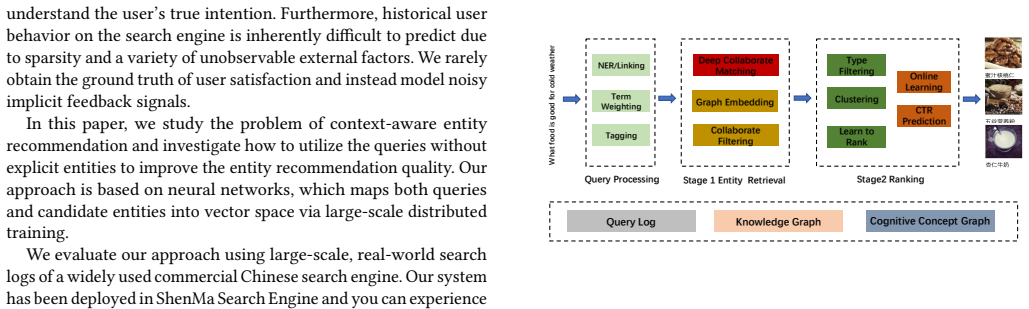
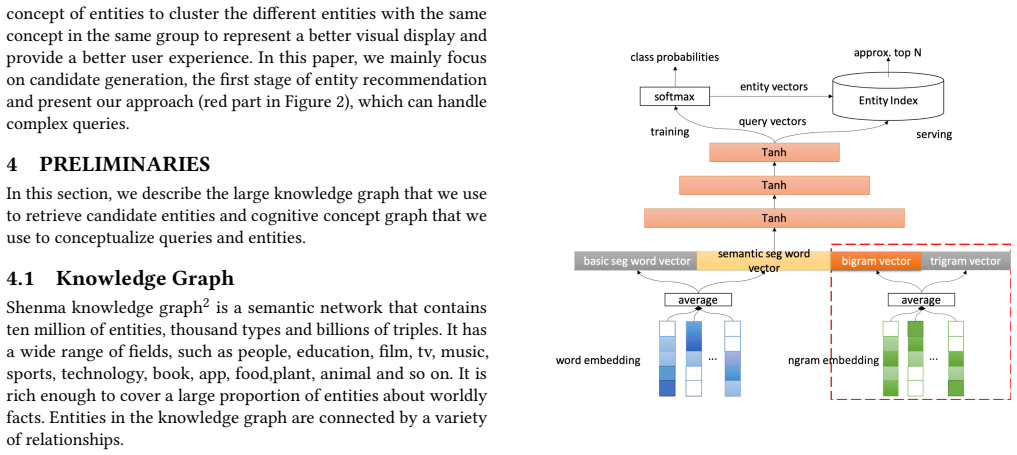
The central mechanism is a joint query-entity embedding space trained by a sampled-softmax classifier over millions of entity classes. A query is encoded by word and ngram features, then by a Bi-directional LSTM, and the hidden states are weighted and summed by a self-attention vector to produce the query embedding; entity embeddings are learned in the same pass from click-derived labels. At serving time, a vector search index returns the entities whose embeddings are most similar to the query embedding, enabling candidate recall within a few milliseconds. A cognitive concept graph is used separately to cluster recommended entities into concept groups for display.
What would settle it
Rerun the online A/B test with the same model but shuffle entity positions inside the recommendation panel; if the 5.1% CTR and 5.5% PV gains disappear, the improvements came from panel placement rather than from the learned query-entity similarity. A complementary check is to have human raters judge the relevance of the model's top entities for entity-free queries and compare those ratings with the click-derived ground truth on identical query-entity pairs.
Extended reading notes
Core claim
The central discovery is that entity recommendation can be treated as large-scale multi-classification over a knowledge graph: given a query, the model scores every candidate entity by cosine similarity between a learned query vector and learned entity vectors. The query vector is built from word embeddings, ngram embeddings, and the outputs of a Bi-directional LSTM pooled by a self-attention weight vector. The entity vectors are learned jointly from four kinds of query-entity training pairs, with clicked entities and entities extracted from clicked documents' titles and summaries as the main supervision. Offline, the attention-based Bi-LSTM encoder reaches P@1 of 7.34, compared with 6.53 for the DNN baseline; online, the deployed system reports a statistically significant 5.1% CTR gain and 5.5% PV gain over seven days.
Load-bearing premise
The load-bearing premise is that clicks mark genuine relevance, meaning the clicked entities and the entities extracted from clicked documents' titles and summaries are treated as ground truth for what the query's user actually wanted; if position bias or visual salience drives those clicks, the training labels and offline precision numbers stop measuring relevance.
Editorial extensions
If this is right
- If the central claim is correct, any query, however colloquial or free of explicit entities, can be paired with relevant knowledge-graph entities, extending entity recommendation beyond the explicit-entity cases previous systems handled.
- The joint embeddings give a reusable, task-trained semantic representation of queries and entities; the paper's examples show universities clustering together, so the same space could serve downstream query-understanding tasks.
- The training recipe — click logs plus entities extracted from titles and summaries — produces billions of labeled pairs, so the approach scales to commercial search volumes.
- The attention weights over query tokens provide a lightweight diagnostic: the model visibly up-weights content words and down-weights stop words, which can support query-intent analysis.
- The online gains imply that better entity recommendations can raise overall engagement in a real search product, not just offline ranking metrics.
Reading between the lines
- The reported offline precision numbers should be read as precision against click-derived relevance, not human-judged relevance; if clicks are biased by position or visual salience, the offline and online numbers could both overstate true relevance.
- A clean test of that label bias would be to shuffle entity positions inside the recommendation panel and see whether the model's training labels track panel slots or the model's scores.
- The same joint-embedding recipe could transfer to app stores, product search, or video recommendations wherever click logs and an item or entity space exist.
- Using entities in clicked document titles and summaries as labels makes the document text a weak teacher; weighting labels by entity-extraction confidence might improve the precision numbers further.
Signed reviews
Editorial analysis
A structured set of objections, weighed in public.
Referee Report
Summary. The paper addresses entity recommendation for search queries that do not not contain an explicit entity. It proposes a deep collaborative matching model, based on a BiLSTM encoder with self-attention, that maps arbitrary queries and knowledge-graph entities into a shared embedding space using sampled softmax over candidate entities. Training data are generated from query click logs, entities extracted from clicked documents, query-query pairs, and query-tag pairs. The authors report offline P@N results comparing three variants of their architecture (Table 1) and an online A/B test in Alibaba's ShenMa search engine claiming a 5.1% CTR increase and a 5.5% PV increase.
Significance. If the claims could be supported, the contribution is practically important: it targets the large fraction of queries (over 50%, per the authors) without explicit entities, and the deployment in a commercial search engine demonstrates feasibility at scale. The paper is also honest about its limitations, explicitly stating the absence of published baselines for entity-less queries and the inability to quantitatively evaluate entity embedding quality. However, the current evidence is too thin to establish the headline results: the offline evaluation uses a small set of self-derived baselines and click-derived ground truth, and the online A/B report lacks controls and statistical detail.
major comments (3)
- [Section 6.4 (Online A/B Test)] The central deployment claim, a 5.1% CTR gain and 5.5% PV gain, is not supported by the reported protocol. The control bucket's candidate-generation mechanism is not described, the method of user assignment to buckets and the bucket sizes are omitted, and no confidence intervals or p-values are provided despite the phrase 'statistically significant'. Additionally, Section 6.7 reports a concurrent product change, conceptualized multi-dimensional recommendation, that independently achieved a 4.1% CTR gain; the paper does not state whether that change was active during the same seven-day test, so the 5.1% figure may conflate the deep collaborative match model with the conceptualization change. Please provide the missing experimental protocol and either isolate the deep match model or decompose the gains.
- [Sections 6.1 and 6.3 (Data Sets; Offline Evaluation)] The offline P@N evaluation does not currently demonstrate that the model generalizes beyond the training distribution. The positive training labels are defined by clicks ('choose the clicked entities with relatively high CTR') and by entities extracted from clicked documents, and the test set is also collected from online click logs; this creates a circularity in which P@N largely measures reconstruction of observed click behavior rather than true entity relevance. The baseline set is also too narrow: Table 1 compares only DNN and DNN+ngram against att-BiLSTM, all variants of the same architecture, and the paper itself notes that 'there are no other baselines of entity recommendation for complex queries with no entities at all.' Please add at least one non-neural or published entity-recommendation baseline (for example, entity linking plus related-entity ranking, or memory-based session methods) and report variance or significance over test queries.
- [Section 6.3, Table 1] The text claims that 'att-BiLSTM is slightly better than +ngram,' but Table 1 shows att-BiLSTM lower than +ngram on P@20 (41.56 vs. 41.57) and P@30 (56.02 vs. 56.49). This inconsistency undermines the stated offline conclusion and should be corrected; the comparison should be described as mixed, or the numbers and experimental setup should be verified.
minor comments (6)
- [Section 5.3] The dimensions of the attention mechanism are inconsistent: with W in R^{k x 2m} and U in R^{1 x k}, the softmax output has length n (one weight per token), not R^{1 x k} as stated; the subsequent summation over i=1..n confirms this. Please correct the declared dimensions.
- [Section 5.3] The phrase 'which is not a good hypnosis' is a typo; it should read 'hypothesis' (or 'assumption').
- [Section 6.1] The sentence 'about one thousand billion unique queries' is implausible and appears to be a typo; please clarify the intended number and whether the unit is queries or query-entity pairs.
- [Section 6.3] The test set is described only as 'unseen and real online search click log'; please state whether it is temporally disjoint from the two-month training window, since click-derived labels can leak across periods.
- [Section 6.7] The metric 'total coverage of 49.8%' is not defined; please define what total coverage means and how it is measured.
- [References] References [16] and [17] are relation-extraction papers and do not appear to support the sentence about query assistance for knowledge graphs in Section 2; please verify the citations.
Circularity Check
No definitional circularity found: the proposed model is evaluated on held-out click logs and a live A/B test, and the self-cited references are not load-bearing.
full rationale
The paper does not reduce any prediction to its fitted inputs by construction. The deep collaborative match model is trained on query-entity pairs generated from click logs and semantic resources, but its claimed effectiveness is measured offline on an unseen test set and online against a control bucket. Section 6.3 states that the test set is collected 'From unseen and real online search click log,' and Section 6.4 describes a bucket comparison in which one bucket uses the deep collaborative match model and another does not. These evaluations are external to the training objective, so the offline P@N and the reported 5.1% CTR and 5.5% PV gains are not tautological. The click-derived labels are a data-quality assumption rather than a circular definition: the model is not predicting the exact training labels in the offline test, and the online A/B test measures user engagement rather than reconstruction of the training distribution. The self-citations [16,17] appear only in the related-work discussion and are not used to justify the proposed method, its architecture, or its evaluation. The absence of baselines for entity-less queries and the lack of detail about A/B test isolation are experimental limitations, not instances of circular reasoning. Accordingly, the paper is self-contained in its derivations and receives a circularity score of 0.
Assumptions & free parameters
free parameters (4)
- Model hyperparameters (embedding dimension, FC widths, BiLSTM hidden size, attention width) =
embedding dim 128; FC widths 512-256-128; LSTM and attention sizes not reported
- Negative sample count for sampled softmax =
5000
- CTR threshold for positive Query-Click-Entity samples =
not reported
- Data filtering and sub-sampling rates =
not reported
assumptions (5)
- domain assumption Clicked entities are positive labels for query relevance.
- domain assumption Entities in titles or summaries of clicked documents are relevant to the query.
- domain assumption Predefined entity tags are reliable positive labels for certain queries.
- standard math Sampled softmax with 5000 negatives approximates the full softmax loss well enough for this task.
- domain assumption Approximate nearest-neighbor search in the embedding space retrieves the true top-K entities.
Cite this review
Pith. "Pith review of Context-aware Deep Model for Entity Recommendation in Search Engine at Alibaba." pith.science (2026). https://pith.science/paper/GDVE7A7P
@misc{pith2026190904493,
  author       = {Pith},
  title        = {Pith review of: Context-aware Deep Model for Entity Recommendation in Search Engine at Alibaba},
  year         = {2026},
  howpublished = {\url{https://pith.science/paper/GDVE7A7P}},
  note         = {Machine review of arXiv:1909.04493}
}
read the original abstract
Entity recommendation, providing search users with an improved experience via assisting them in finding related entities for a given query, has become an indispensable feature of today's search engines. Existing studies typically only consider the queries with explicit entities. They usually fail to handle complex queries that without entities, such as "what food is good for cold weather", because their models could not infer the underlying meaning of the input text. In this work, we believe that contexts convey valuable evidence that could facilitate the semantic modeling of queries, and take them into consideration for entity recommendation. In order to better model the semantics of queries and entities, we learn the representation of queries and entities jointly with attentive deep neural networks. We evaluate our approach using large-scale, real-world search logs from a widely used commercial Chinese search engine. Our system has been deployed in ShenMa Search Engine and you can fetch it in UC Browser of Alibaba. Results from online A/B test suggest that the impression efficiency of click-through rate increased by 5.1% and page view increased by 5.5%.
Figures

Figures from the paper (6 more)


Reference graph
Works this paper leans on
-
[1]
Guy Blanc and Steffen Rendle. 2017. Adaptive sampled softmax with kernel based sampling. arXiv preprint arXiv:1712.00527 (2017)
work page Pith review arXiv 2017
-
[2]
Roi Blanco, Berkant Barla Cambazoglu, Peter Mika, and Nicolas Torzec. 2013. Entity recommendations in web search. InInternational Semantic Web Conference. Springer, 33–48
work page 2013
-
[3]
Paul Covington, Jay Adams, and Emre Sargin. 2016. Deep neural networks for youtube recommendations. In Proceedings of the 10th ACM conference on recommender systems. ACM, 191–198
work page 2016
-
[4]
Jacob Devlin, Ming-Wei Chang, Kenton Lee, and Kristina Toutanova. 2018. Bert: Pre-training of deep bidirectional transformers for language understanding.arXiv preprint arXiv:1810.04805 (2018)
arXiv 2018
-
[5]
Ignacio Fernández-Tobías and Roi Blanco. 2016. Memory-based recommendations of entities for web search users. In Proceedings of the 25th ACM International on Conference on Information and Knowledge Management . ACM, 35–44
work page 2016
-
[6]
Aditya Grover and Jure Leskovec. 2016. node2vec: Scalable feature learning for networks. In Proceedings of the 22nd ACM SIGKDD international conference on Knowledge discovery and data mining . ACM, 855–864
2016
-
[7]
Jizhou Huang, Wei Zhang, Yaming Sun, Haifeng Wang, and Ting Liu. 2018. Improving Entity Recommendation with Search Log and Multi-Task Learning.. In IJCAI. 4107–4114
work page 2018
-
[8]
Jizhou Huang, Shiqi Zhao, Shiqiang Ding, Haiyang Wu, Mingming Sun, and Haifeng Wang. 2016. Generating Recommendation Evidence Using Translation 7 Model.. In IJCAI. 2810–2816
work page 2016
Show all 19 references
-
[9]
Nandish Jayaram, Mahesh Gupta, Arijit Khan, Chengkai Li, Xifeng Yan, and Ramez Elmasri. 2014. GQBE: Querying knowledge graphs by example entity tuples. In 2014 IEEE 30th International Conference on Data Engineering . IEEE, 1250–1253
2014
-
[10]
Armand Joulin, Edouard Grave, Piotr Bojanowski, Matthijs Douze, Hérve Jégou, and Tomas Mikolov. 2016. Fasttext. zip: Compressing text classification models. arXiv preprint arXiv:1612.03651 (2016)
2016 arXiv
-
[11]
Steffen Metzger, Ralf Schenkel, and Marcin Sydow. 2013. Qbees: query by entity examples. In Proceedings of the 22nd ACM international conference on Information & Knowledge Management. ACM, 1829–1832
2013
-
[12]
Tomas Mikolov, Ilya Sutskever, Kai Chen, Greg S Corrado, and Jeff Dean. 2013. Distributed representations of words and phrases and their compositionality. In Advances in neural information processing systems . 3111–3119
2013
-
[13]
Davide Mottin, Matteo Lissandrini, Yannis Velegrakis, and Themis Palpanas. 2014. Exemplar queries: Give me an example of what you need. Proceedings of the VLDB Endowment 7, 5 (2014), 365–376
2014
-
[14]
Hongwei Wang, Fuzheng Zhang, Xing Xie, and Minyi Guo. 2018. DKN: Deep knowledge-aware network for news recommendation. In Proceedings of the 2018 World Wide Web Conference. International World Wide Web Conferences Steering Committee, 1835–1844
2018
-
[15]
Zhilin Yang, Zihang Dai, Yiming Yang, Jaime Carbonell, Ruslan Salakhutdinov, and Quoc V Le. 2019. XLNet: Generalized Autoregressive Pretraining for Lan- guage Understanding. arXiv preprint arXiv:1906.08237 (2019)
2019 arXiv
-
[16]
Ningyu Zhang, Shumin Deng, Zhanlin Sun, Xi Chen, Wei Zhang, and Huajun Chen. 2018. Attention-based capsule networks with dynamic routing for relation extraction. arXiv preprint arXiv:1812.11321 (2018)
2018 arXiv
-
[17]
Ningyu Zhang, Shumin Deng, Zhanlin Sun, Guanying Wang, Xi Chen, Wei Zhang, and Huajun Chen. 2019. Long-tail Relation Extraction via Knowledge Graph Embeddings and Graph Convolution Networks. arXiv preprint arXiv:1903.01306 (2019)
2019 arXiv
-
[18]
Han Zhu, Xiang Li, Pengye Zhang, Guozheng Li, Jie He, Han Li, and Kun Gai
-
[2018]
InProceedings of the 24th ACM SIGKDD International Conference on Knowledge Discovery & Data Mining
Learning Tree-based Deep Model for Recommender Systems. InProceedings of the 24th ACM SIGKDD International Conference on Knowledge Discovery & Data Mining. ACM, 1079–1088. 8
Reviewed August 14, 2026 · model on record in the stance chip above.
Discussion (0). Continue with ORCID to comment.