Driven spin dynamics enhances cryptochrome magnetoreception: Towards live quantum sensing
Pith reviewed 2026-05-24 12:14 UTC · model grok-4.3
The pith
Periodic modulation of inter-radical distance overcomes strong coupling to enhance geomagnetic sensitivity in cryptochrome radical pairs.
A machine-rendered reading of the paper's core claim, the machinery that carries it, and where it could break.
Core claim
Driving the spin system through modulation of the inter-radical distance markedly enhances geomagnetic field sensitivity in strongly coupled radical pairs via a Landau-Zener type transition between singlet and triplet states, allowing a live harmonically driven magnetoreceptor to be more sensitive than its static counterpart.
What carries the argument
Harmonic modulation of inter-radical distance that induces Landau-Zener transitions between singlet and triplet states in the radical-pair spin dynamics.
If this is right
- Strongly coupled radical pairs retain high sensitivity to weak geomagnetic fields when distance is modulated.
- The driven system produces a larger response to the magnetic field than the equivalent static radical pair.
- Inter-radical interactions that were thought to block magnetoreception no longer do so under periodic driving.
- The radical-pair mechanism remains viable in cryptochrome even when dipolar coupling is strong.
Where Pith is reading between the lines
- Similar distance-modulation effects could be tested in other radical-pair systems outside cryptochrome.
- In vitro setups with controlled oscillation of radical separation might isolate the Landau-Zener contribution.
- The approach points toward engineered quantum sensors that use mechanical driving to maintain coherence against fixed interactions.
Load-bearing premise
A biologically realistic periodic modulation of inter-radical distance can be realized without other relaxation or decoherence channels overwhelming the driven dynamics.
What would settle it
An experiment or simulation that applies periodic distance modulation to a strongly coupled radical pair and measures whether the singlet-triplet transition rate and resulting magnetic sensitivity increase as predicted.
Figures


read the original abstract
The mechanism underlying magnetoreception has long eluded explanation. A popular hypothesis attributes this sense to the quantum coherent spin dynamics of spin-selective recombination reactions of radical pairs in the protein cryptochrome. However, concerns about the validity of the hypothesis have been raised as unavoidable inter-radical interactions, such as strong electron-electron dipolar coupling, appear to suppress its sensitivity. We demonstrate that this can be overcome by driving the spin system through a modulation of the inter-radical distance. It is shown that this dynamical process markedly enhances geomagnetic field sensitivity in strongly coupled radical pairs via a Landau-Zener type transition between singlet and triplet states. These findings suggest that a "live" harmonically driven magnetoreceptor can be more sensitive than its "dead" static counterpart.
Editorial analysis
A structured set of objections, weighed in public.
Referee Report
Summary. The manuscript claims that time-dependent modulation of the inter-radical distance in cryptochrome radical pairs induces Landau-Zener-type singlet-triplet transitions, restoring and markedly enhancing geomagnetic-field sensitivity even when static dipolar coupling is strong; the driven ('live') system is asserted to outperform the static ('dead') counterpart via improved reaction-yield anisotropy.
Significance. If the central derivation holds, the work supplies a concrete dynamical mechanism that could reconcile the radical-pair hypothesis with the presence of strong inter-radical interactions, thereby strengthening the case for quantum coherence in biological magnetoreception. The explicit mapping of periodic driving onto an enhanced anisotropy constitutes a falsifiable, parameter-dependent prediction that can be tested numerically or experimentally.
major comments (2)
- [Model / Hamiltonian section] The central claim rests on the time-dependent dipolar term producing a clean Landau-Zener crossing; the manuscript must specify the explicit form of the driven Hamiltonian (including the functional dependence of the dipolar coupling on the modulated distance) and demonstrate that the reported enhancement survives when the modulation frequency and amplitude are varied over the range compatible with cryptochrome structural fluctuations.
- [Results / Numerical section] The numerical results showing enhanced anisotropy are presented for selected driving parameters; to support the claim that the driven system is 'more sensitive,' the paper should include a systematic scan (or analytic bound) establishing the minimal modulation depth required to overcome a given static dipolar strength, with the corresponding reaction-yield curves.
minor comments (2)
- [Abstract] The abstract introduces the phrase 'live harmonically driven magnetoreceptor' without a preceding definition; a single-sentence clarification of what 'live' versus 'dead' denotes would improve readability.
- [Discussion] The discussion of biological realizability is presented as a suggestion rather than a quantitative estimate; adding a short paragraph comparing the required modulation frequency/amplitude to known cryptochrome vibrational or conformational timescales (with appropriate references) would strengthen the bridge to experiment without altering the theoretical core.
Simulated Author's Rebuttal
We thank the referee for their supportive review and constructive comments, which will help strengthen the manuscript. We address each major comment below.
read point-by-point responses
-
Referee: [Model / Hamiltonian section] The central claim rests on the time-dependent dipolar term producing a clean Landau-Zener crossing; the manuscript must specify the explicit form of the driven Hamiltonian (including the functional dependence of the dipolar coupling on the modulated distance) and demonstrate that the reported enhancement survives when the modulation frequency and amplitude are varied over the range compatible with cryptochrome structural fluctuations.
Authors: We agree that the explicit Hamiltonian form is needed for clarity. In the revision we will add the driven Hamiltonian H(t) = H_Zeeman + H_hyperfine + D(r(t)) S1·S2 term, with the standard dipolar coupling D(r) ∝ 1/r^3 and r(t) = r0 + A sin(ωt). Additional simulations confirming robustness for modulation frequencies 1–100 kHz and relative amplitudes 0.1–0.5 (consistent with cryptochrome fluctuations) will be included in the main text and SI. revision: yes
-
Referee: [Results / Numerical section] The numerical results showing enhanced anisotropy are presented for selected driving parameters; to support the claim that the driven system is 'more sensitive,' the paper should include a systematic scan (or analytic bound) establishing the minimal modulation depth required to overcome a given static dipolar strength, with the corresponding reaction-yield curves.
Authors: We accept this point. The revised manuscript will add a systematic scan of reaction-yield anisotropy versus modulation depth for several fixed dipolar strengths, together with the corresponding yield curves. A brief analytic estimate based on the Landau-Zener formula will bound the minimal depth required to restore sensitivity. revision: yes
Circularity Check
No significant circularity
full rationale
The paper introduces an external periodic modulation of inter-radical distance as a driving term in the radical-pair spin Hamiltonian and demonstrates via numerical solution of the time-dependent Schrödinger equation that this induces Landau-Zener singlet-triplet transitions restoring geomagnetic sensitivity. The drive amplitude and frequency are treated as free external parameters rather than fitted quantities or quantities derived from the target sensitivity itself. No equations reduce the reported enhancement to a self-definition, a renamed fit, or a load-bearing self-citation chain; the central claim remains a direct consequence of the driven Hamiltonian dynamics under stated assumptions.
Axiom & Free-Parameter Ledger
axioms (2)
- domain assumption Radical-pair spin dynamics in cryptochrome underlie magnetoreception
- ad hoc to paper Periodic modulation of inter-radical distance is feasible and dominant over other time-dependent effects
Lean theorems connected to this paper
-
IndisputableMonolith/Cost/FunctionalEquation.leanwashburn_uniqueness_aczel echoes?
echoesECHOES: this paper passage has the same mathematical shape or conceptual pattern as the Recognition theorem, but is not a direct formal dependency.
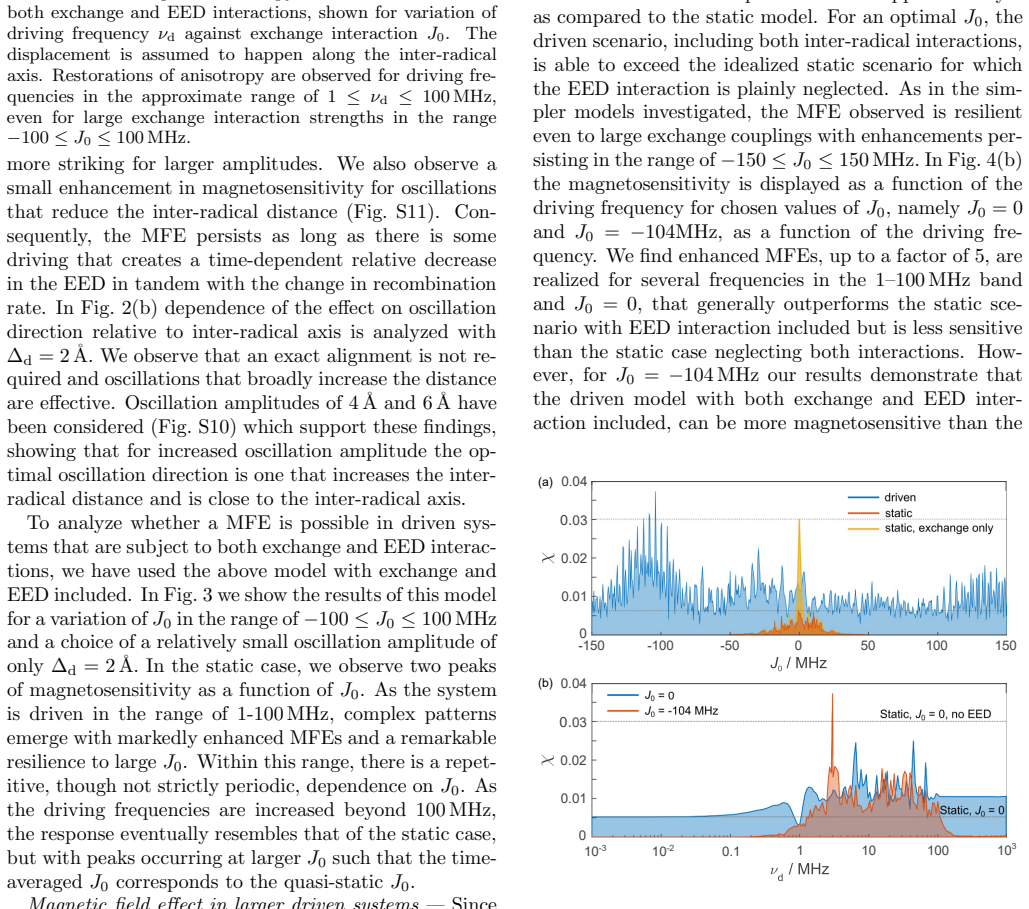
modulation of the inter-radical distance... Landau-Zener type transition between singlet and triplet states... Floquet theory... r(t)=Δd/2[1-cos(2πνd t)]+r0, J(t)=J0 exp[-β(r(t)-r0)]
-
IndisputableMonolith/Foundation/ArithmeticFromLogic.leanLogicNat (8-tick / period forcing) echoes?
echoesECHOES: this paper passage has the same mathematical shape or conceptual pattern as the Recognition theorem, but is not a direct formal dependency.
periodic driving... 1-100 MHz band... Floquet modes
What do these tags mean?
- matches
- The paper's claim is directly supported by a theorem in the formal canon.
- supports
- The theorem supports part of the paper's argument, but the paper may add assumptions or extra steps.
- extends
- The paper goes beyond the formal theorem; the theorem is a base layer rather than the whole result.
- uses
- The paper appears to rely on the theorem as machinery.
- contradicts
- The paper's claim conflicts with a theorem or certificate in the canon.
- unclear
- Pith found a possible connection, but the passage is too broad, indirect, or ambiguous to say the theorem truly supports the claim.
Reference graph
Works this paper leans on
- [1]
-
[2]
S¨ onke Johnsen and Kenneth J. Lohmann. The physics and neurobiology of magnetoreception. Nat. Rev. Neu- rosci., 6(9):703–712, aug 2005
work page 2005
-
[3]
S¨ onke Johnsen and Kenneth J. Lohmann. Magnetore- ception in animals. Phys. Today, 61(3):29, mar 2008
work page 2008
-
[4]
The radical-pair mechanism as a paradigm for the emerging science of quantum biology
Iannis K Kominis. The radical-pair mechanism as a paradigm for the emerging science of quantum biology. Mod. Phys. Lett. B , 29(Supplement 1):1530013, 2015
work page 2015
-
[5]
Long-distance navigation and magne- toreception in migratory animals
Henrik Mouritsen. Long-distance navigation and magne- toreception in migratory animals. Nature, 558(7708):50– 59, jun 2018
work page 2018
-
[6]
Magnetoreception in birds and its use for long-distance migration
Henrik Mouritsen. Magnetoreception in birds and its use for long-distance migration. In Colin G Scanes, ed- itor, Sturkie’s Avian Physiology , pages 113–133. Aca- demic Press, sixth edition, 2015
work page 2015
-
[7]
Roswitha Wiltschko and Wolfgang Wiltschko. Mag- netoreception in birds. J. R. Soc. Interface , 16(158):20190295, jan 2019
work page 2019
-
[8]
Nordmann, Tobias Hochstoeger, and David A
Gregory C. Nordmann, Tobias Hochstoeger, and David A. Keays. Magnetoreception—A sense without a receptor. PLOS Biol., 15(10):e2003234, oct 2017
work page 2017
-
[9]
Physics of life: The dawn of quantum biol- ogy
Philip Ball. Physics of life: The dawn of quantum biol- ogy. Nature, 474(7351):272–274, jun 2011
work page 2011
-
[10]
Neill Lambert, Yueh Nan Chen, Yuan Chung Cheng, Che Ming Li, Guang Yin Chen, and Franco Nori. Quan- tum biology. Nat. Phys., 9(1):10–18, 2013
work page 2013
-
[11]
Masoud Mohseni, Yasser Omar, Gregory S. Engel, and Martin B. Plenio. Quantum effects in biology. Cambridge University Press, 2014
work page 2014
-
[12]
Adriana Marais, Betony Adams, Andrew K. Ringsmuth, Marco Ferretti, J. Michael Gruber, Ruud Hendrikx, Maria Schuld, Samuel L. Smith, Ilya Sinayskiy, Tjaart P.J. Kr¨ uger, Francesco Petruccione, and Rienk van Grondelle. The future of quantum biology. J. R. Soc. Interface, 15(148):20180640, nov 2018
work page 2018
-
[13]
Youngchan Kim, Federico Bertagna, Edeline M. D’Souza, Derren J. Heyes, Linus O. Johannissen, Eveliny T. Nery, Antonio Pantelias, Alejandro Sanchez- Pedre˜ no Jimenez, Louie Slocombe, Michael G. Spencer, Jim Al-Khalili, Gregory S. Engel, Sam Hay, Suzanne M. Hingley-Wilson, Kamalan Jeevaratnam, Alex R. Jones, Daniel R. Kattnig, Rebecca Lewis, Marco Sacchi, ...
work page 2021
-
[14]
Klaus Schulten, Charles E. Swenberg, and Albert Weiler. A Biomagnetic Sensory Mechanism Based on Magnetic Field Modulated Coherent Electron Spin Motion. Z Phys. Chem., 111(1):1–5, jan 1978. 6
work page 1978
-
[15]
A model for photoreceptor-based magnetoreception in birds
Thorsten Ritz, Salih Adem, and Klaus Schulten. A model for photoreceptor-based magnetoreception in birds. Bio- phys. J., 78(2):707–718, feb 2000
work page 2000
-
[16]
P. J. Hore and Henrik Mouritsen. The radical-pair mechanism of magnetoreception. Annu. Rev. Biophys. , 45:299–344, jul 2016
work page 2016
-
[17]
Gauger, Elisabeth Rieper, John J
Erik M. Gauger, Elisabeth Rieper, John J. L. Morton, Simon C. Benjamin, and Vlatko Vedral. Sustained quan- tum coherence and entanglement in the avian compass. Phys. Rev. Lett., 106(4):040503, jan 2011
work page 2011
-
[18]
Hannah J. Hogben, Till Biskup, and P. J. Hore. En- tanglement and sources of magnetic anisotropy in radi- cal pair-based avian magnetoreceptors. Phys. Rev. Lett., 109(22):220501, nov 2012
work page 2012
-
[20]
Yiteng Zhang, Gennady P. Berman, and Sabre Kais. Sen- sitivity and entanglement in the avian chemical compass. Phys. Rev. E , 90(4):042707, oct 2014
work page 2014
-
[21]
Alejandro Carrillo, Marcio F. Cornelio, and Marcos C. de Oliveira. Environment-induced anisotropy and sensi- tivity of the radical pair mechanism in the avian compass. Phys. Rev. E , 92(1):012720, jul 2015
work page 2015
-
[22]
Thao P. Le and Alexandra Olaya-Castro. Basis- independent system-environment coherence is necessary to detect magnetic field direction in an avian-inspired quantum magnetic sensor. nov 2020
work page 2020
-
[23]
I. K. Kominis. Quantum relative entropy shows singlet- triplet coherence is a resource in the radical-pair mech- anism of biological magnetic sensing. Phys. Rev. Res. , 2(2):023206, may 2020
work page 2020
-
[24]
Poonia, Kasturi Saha, Di- pankar Saha, and Swaroop Ganguly
Rakshit Jain, Vishvendra S. Poonia, Kasturi Saha, Di- pankar Saha, and Swaroop Ganguly. The avian compass can be sensitive even without sustained electron spin co- herence. Proc. R. Soc. A, 477(2250):20200778, jun 2021
work page 2021
-
[25]
Jianming Cai, Gian Giacomo Guerreschi, and Hans J. Briegel. Quantum control and entanglement in a chemi- cal compass. Phys. Rev. Lett., 104(22):220502, jun 2010
work page 2010
-
[26]
Alpha A. Lee, Jason C. S. Lau, Hannah J. Hogben, Till Biskup, Daniel R. Kattnig, and P. J. Hore. Alternative radical pairs for cryptochrome-based magnetoreception. J. R. Soc. Interface , 11(95):20131063, jun 2014
work page 2014
-
[27]
Hiscock, Susannah Worster, Daniel R
Hamish G. Hiscock, Susannah Worster, Daniel R. Kat- tnig, Charlotte Steers, Ye Jin, David E. Manolopoulos, Henrik Mouritsen, and P. J. Hore. The quantum needle of the avian magnetic compass. Proc. Natl. Acad. Sci. U. S. A. , 113(17):4634–4639, apr 2016
work page 2016
-
[28]
Chadsley Atkins, Kieran Bajpai, Jeremy Rumball, and Daniel R. Kattnig. On the optimal relative orientation of radicals in the cryptochrome magnetic compass. J. Chem. Phys., 151(6):065103, aug 2019
work page 2019
-
[29]
Thomas P. Fay, Lachlan P. Lindoy, David E. Manolopou- los, and P. J. Hore. How quantum is radical pair magne- toreception? Faraday Discuss., 221(0):77–91, dec 2019
work page 2019
-
[30]
Smith, Jean Deviers, and Daniel R
Luke D. Smith, Jean Deviers, and Daniel R. Kattnig. Ob- servations about utilitarian coherence in the avian com- pass. Scientific Reports, 12(1):1–10, apr 2022
work page 2022
-
[31]
Daniel R. Kattnig, Emrys W. Evans, Victoire D´ ejean, Charlotte A. Dodson, Mark I. Wallace, Stuart R. Mackenzie, Christiane R. Timmel, and P. J. Hore. Chem- ical amplification of magnetic field effects relevant to avian magnetoreception. Nat. Chem. , 8(4):384–391, feb 2016
work page 2016
-
[32]
Christian Kerpal, Sabine Richert, Jonathan G. Storey, Smitha Pillai, Paul A. Liddell, Devens Gust, Stuart R. Mackenzie, P. J. Hore, and Christiane R. Timmel. Chem- ical compass behaviour at microtesla magnetic fields strengthens the radical pair hypothesis of avian magne- toreception. Nat. Commun., 10(1):1–7, aug 2019
work page 2019
-
[33]
Jarocha, Tilo Zollitsch, Marcin Konowalczyk, Kevin B
Jingjing Xu, Lauren E. Jarocha, Tilo Zollitsch, Marcin Konowalczyk, Kevin B. Henbest, Sabine Richert, Matthew J. Golesworthy, Jessica Schmidt, Victoire D´ ejean, Daniel J. C. Sowood, Marco Bassetto, Ji- ate Luo, Jessica R. Walton, Jessica Fleming, Yujing Wei, Tommy L. Pitcher, Gabriel Moise, Maike Her- rmann, Hang Yin, Haijia Wu, Rabea Bart¨ olke, Ste- fa...
work page 2021
-
[34]
Light-dependent magnetoreception in birds: the cru- cial step occurs in the dark
Roswitha Wiltschko, Margaret Ahmad, Christine Nießner, Dennis Gehring, and Wolfgang Wiltschko. Light-dependent magnetoreception in birds: the cru- cial step occurs in the dark. J. R. Soc. Interface , 13(118):20151010, may 2016
work page 2016
-
[35]
M. Hammad, M. Albaqami, M. Pooam, E. Kernevez, J. Witczak, T. Ritz, C. Martino, and M. Ahmad. Cryp- tochrome mediated magnetic sensitivity in Arabidopsis occurs independently of light-induced electron transfer to the flavin. Photochem. Photobiol. Sci., 19(3):341–352, mar 2020
work page 2020
-
[36]
Kiminori Maeda, Alexander J. Robinson, Kevin B. Henbest, Hannah J. Hogben, Till Biskup, Margaret Ah- mad, Erik Schleicher, Stefan Weber, Christiane R. Tim- mel, and P. J. Hore. Magnetically sensitive light-induced reactions in cryptochrome are consistent with its pro- posed role as a magnetoreceptor. Proc. Natl. Acad. Sci. U. S. A. , 109(13):4774–4779, mar 2012
work page 2012
-
[37]
Daniel R. Kattnig, Ilia A. Solov’yov, and P. J. Hore. Elec- tron spin relaxation in cryptochrome-based magnetore- ception. Phys. Chem. Chem. Phys. , 18(18):12443–12456, may 2016
work page 2016
-
[38]
Dmitry Kobylkov, Joe Wynn, Michael Winklhofer, Raisa Chetverikova, Jingjing Xu, Hamish Hiscock, P. J. Hore, and Henrik Mouritsen. Electromagnetic 0.1–100 kHz noise does not disrupt orientation in a night-migrating songbird implying a spin coherence lifetime of less than 10 µs. J. R. Soc. Interface , 16(161):20190716, dec 2019
work page 2019
-
[39]
Anthony R. O’Dea, Ailsa F. Curtis, Nicholas J.B. Green, Christiane R. Tinunel, and P. J. Hore. Influence of Dipo- lar Interactions on Radical Pair Recombination Reac- tions Subject to Weak Magnetic Fields. J. Phys. Chem. A, 109(5):869–873, feb 2005
work page 2005
-
[40]
Hamish G. Hiscock, Daniel R. Kattnig, David E. Manolopoulos, and P. J. Hore. Floquet theory of rad- ical pairs in radiofrequency magnetic fields. J. Chem. Phys., 145(12):124117, sep 2016
work page 2016
-
[41]
Hiscock, Henrik Mouritsen, David E
Hamish G. Hiscock, Henrik Mouritsen, David E. Manolopoulos, and P. J. Hore. Disruption of Mag- netic Compass Orientation in Migratory Birds by Ra- diofrequency Electromagnetic Fields. Biophys. J. , 113(7):1475–1484, oct 2017
work page 2017
-
[42]
Nathan S. Babcock and Daniel R. Kattnig. Elec- tron–electron dipolar interaction poses a challenge to the 7 radical pair mechanism of magnetoreception. J. Phys. Chem. Lett., 11(7):2414–2421, apr 2020
work page 2020
-
[43]
Olav Schiemann and Thomas F. Prisner. Long-range distance determinations in biomacromolecules by EPR spectroscopy. Q. Rev. Biophys. , 40(1):1–53, feb 2007
work page 2007
-
[44]
Daniel Nohr, Bernd Paulus, Ryan Rodriguez, Asako Okafuji, Robert Bittl, Erik Schleicher, and Stefan We- ber. Determination of Radical–Radical Distances in Light-Active Proteins and Their Implication for Bio- logical Magnetoreception. Angew. Chemie Int. Ed. , 56(29):8550–8554, jul 2017
work page 2017
-
[45]
Olga Efimova and P. J. Hore. Role of Exchange and Dipolar Interactions in the Radical Pair Model of the Avian Magnetic Compass. Biophys. J., 94(5):1565–1574, mar 2008
work page 2008
-
[46]
A. T. Dellis and I. K. Kominis. The quantum Zeno effect immunizes the avian compass against the deleterious ef- fects of exchange and dipolar interactions. Biosystems, 107(3):153–157, mar 2012
work page 2012
-
[47]
Daniel R. Kattnig and P. J. Hore. The sensitivity of a radical pair compass magnetoreceptor can be signifi- cantly amplified by radical scavengers. Sci. Rep., 7(1):1– 12, sep 2017
work page 2017
-
[48]
Daniel R. Kattnig. Radical-Pair-Based Magnetorecep- tion Amplified by Radical Scavenging: Resilience to Spin Relaxation. J. Phys. Chem. B, 121(44):10215–10227, nov 2017
work page 2017
-
[49]
Keens, Salil Bedkihal, and Daniel R
Robert H. Keens, Salil Bedkihal, and Daniel R. Kattnig. Magnetosensitivity in dipolarly coupled three-Spin sys- tems. Phys. Rev. Lett., 121(9):096001, aug 2018
work page 2018
-
[50]
Nathan Sean Babcock and Daniel R. Kattnig. Radical scavenging could answer the challenge posed by elec- tron–electron dipolar interactions in the cryptochrome compass model. JACS Au, 14:jacsau.1c00332, oct 2021
work page 2021
-
[51]
Daniel R. Kattnig, Jakub K. Sowa, Ilia A. Solov’Yov, and P. J. Hore. Electron spin relaxation can enhance the performance of a cryptochrome-based magnetic compass sensor. New J. Phys. , 18(6):063007, jun 2016
work page 2016
-
[52]
Kattnig, Claus Nielsen, and Ilia A
Daniel R. Kattnig, Claus Nielsen, and Ilia A. Solov’Yov. Molecular dynamics simulations disclose early stages of the photo-activation of cryptochrome 4. New J. Phys. , 20(8):083018, aug 2018
work page 2018
-
[53]
Ulrich E. Steiner and Thomas Ulrich. Magnetic field ef- fects in chemical kinetics and related phenomena. Chem. Rev., 89(1):51–147, 1989
work page 1989
-
[54]
Christopher C. Moser, Jonathan M. Keske, Kurt Warncke, Ramy S. Farid, and P. Leslie Dutton. Nature of biological electron transfer. Nature, 355(6363):796–802, 1992
work page 1992
-
[55]
T. Baumgratz, M. Cramer, and M. B. Plenio. Quantify- ing coherence. Phys. Rev. Lett., 113(14):140401, 2014
work page 2014
-
[56]
John C. Tully. Perspective: Nonadiabatic dynamics the- ory. J. Chem. Phys. , 137(22):22A301, oct 2012
work page 2012
-
[57]
Tammie R. Nelson, Alexander J. White, Josiah A. Bjor- gaard, Andrew E. Sifain, Yu Zhang, Benjamin Neb- gen, Sebastian Fernandez-Alberti, Dmitry Mozyrsky, Adrian E. Roitberg, and Sergei Tretiak. Non-adiabatic excited-state molecular dynamics: Theory and applica- tions for modeling photophysics in extended molecular materials. Chem. Rev., 120(4):2215–2287, feb 2020
work page 2020
-
[58]
Susannah Worster, Henrik Mouritsen, and P. J. Hore. A light-dependent magnetoreception mechanism insensi- tive to light intensity and polarization. J. R. Soc. Inter- face, 14(134):20170405, sep 2017
work page 2017
-
[59]
Jianming Cai, Sandu Popescu, and Hans J. Briegel. Dy- namic entanglement in oscillating molecules and poten- tial biological implications. Phys. Rev. E , 82(2):021921, aug 2010
work page 2010
-
[60]
Nonequilibrium Statistical Mechanics
Robert Zwanzig. Nonequilibrium Statistical Mechanics . Oxford University Press, 2001
work page 2001
-
[61]
Anthony Mittermaier and Lewis E. Kay. New tools pro- vide new insights in NMR studies of protein dynamics. Science, 312(5771):224–228, apr 2006
work page 2006
-
[62]
Environment-assisted quantum walks in photosynthetic energy transfer
Masoud Mohseni, Patrick Rebentrost, Seth Lloyd, and Al´ an Aspuru-Guzik. Environment-assisted quantum walks in photosynthetic energy transfer. J. Chem. Phys., 129:174106, 2008
work page 2008
-
[63]
Environment-assisted quantum transport
Patrick Rebentrost, Masoud Mohseni, Ivan Kassal, Seth Lloyd, and Al´ an Aspuru-Guzik. Environment-assisted quantum transport. New J. Phys. , 11(3):033003, mar 2009
work page 2009
- [64]
-
[65]
S. F. Huelga and M. B. Plenio. Vibrations, quanta and biology. Contemp. Phys., 54(27):181–207, 2013
work page 2013
-
[66]
Solov’yov, Tom´ aˇ s Kubaˇ r, and Marcus Elstner
Gesa L¨ udemann, Ilia A. Solov’yov, Tom´ aˇ s Kubaˇ r, and Marcus Elstner. Solvent driving force ensures fast for- mation of a persistent and well-separated radical pair in plant cryptochrome. J. Am. Chem. Soc. , 137(3):1147– 1156, jan 2015
work page 2015
-
[67]
Jianshu Cao, Richard J. Cogdell, David F. Coker, Hong Guang Duan, J¨ urgen Hauer, Ulrich Kleinekath¨ ofer, Thomas L.C. Jansen, Tom´ aˇ s Manˇ cal, R. J. Dwayne Miller, Jennifer P. Ogilvie, Valentyn I. Prokhorenko, Thomas Renger, Howe Siang Tan, Roel Tempelaar, Michael Thorwart, Erling Thyrhaug, Sebastian Westen- hoff, and Donatas Zigmantas. Quantum biology...
work page 2020
-
[68]
The The- ory of Open Quantum Systems
Heinz-Peter Breuer and Francesco Petruccione. The The- ory of Open Quantum Systems . OUP, Oxford, 2007
work page 2007
- [69]
-
[70]
Colloquium: Non-Markovian dy- namics in open quantum systems
Heinz-Peter Breuer, Elsi-Mari Laine, Jyrki Piilo, and Bassano Vacchini. Colloquium: Non-Markovian dy- namics in open quantum systems. Rev. Mod. Phys. , 88(2):021002, apr 2016
work page 2016
-
[71]
Dynamics of non- Markovian open quantum systems
In´ es De Vega and Daniel Alonso. Dynamics of non- Markovian open quantum systems. Rev. Mod. Phys. , 89(1):015001, 2017
work page 2017
-
[72]
Numerically “exact” approach to open quantum dynamics: The hierarchical equations of motion (HEOM)
Yoshitaka Tanimura. Numerically “exact” approach to open quantum dynamics: The hierarchical equations of motion (HEOM). J. Chem. Phys. , 153(2):020901, jul 2020
work page 2020
-
[73]
Rouse, Jake Iles-Smith, Aidan Strathearn, Henry Maguire, Peter Kirton, Ahsan Nazir, Erik M
Dominic Gribben, Dominic M. Rouse, Jake Iles-Smith, Aidan Strathearn, Henry Maguire, Peter Kirton, Ahsan Nazir, Erik M. Gauger, and Brendon W. Lovett. Exact dynamics of nonadditive environments in non-markovian open quantum systems. PRX Quantum, 3(1):010321, feb 2022
work page 2022
-
[74]
Scientific CO2nduct, raising awareness for the cli- mate impact of science. https://scientific-conduct. github.io. 8 Supplemental Material: Driven spin dynamics enhances cryptochrome magnetoreception In this supporting material, we present further justification and analysis of the claims made in the main text. Firstly, the computational details for our mode...
work page 2091
-
[75]
We make use of both basis representations to elucidate specific features with respect to driving. As the density matrix of the radical pair system is time-dependent, so too are measures of coherence thus far discussed. However, to analyze coherence as the exchange interaction J0 and driving frequency νd are altered, we integrate the measure over a time per...
-
[76]
We have already described how the inclusion of driving introduces a Landau-Zener type transition that mediates transitions between the |S⟩ and|T0⟩ state. Here, by comparing ˆH⊥ and ˆH∥, it is revealed that ˆH⊥ allows further evolution to |T±⟩ states, whereas no additional coherent interconversion with|T±⟩ states is possible for ˆH∥. This contributes to th...
-
[77]
The numpy array: a structure for efficient numerical computation
St´ efan van der Walt, S Chris Colbert, and Gael Varoquaux. The numpy array: a structure for efficient numerical computation. Comp. Sci. Eng. , 13(2):22–30, 2011
work page 2011
-
[78]
Virtanen et al. and SciPy 1. 0 Contributors. SciPy 1.0: Fundamental Algorithms for Scientific Computing in Python. Nature Methods, 17:261–272, 2020
work page 2020
-
[79]
Qutip: An open-source Python framework for the dynamics of open quantum systems
J Robert Johansson, Paul D Nation, and Franco Nori. Qutip: An open-source Python framework for the dynamics of open quantum systems. Comp. Phys. Comm. , 183(8):1760–1772, 2012
work page 2012
-
[80]
J. D. Hunter. Matplotlib: A 2d graphics environment. Comp. Sci. Eng. , 9(3):90–95, 2007
work page 2007
-
[81]
Jon H. Shirley. Solution of the schr¨ odinger equation with a hamiltonian periodic in time.Phys. Rev., 138:B979– B987, May 1965
work page 1965
discussion (0)
Sign in with ORCID, Apple, or X to comment. Anyone can read and Pith papers without signing in.