Hot band sound
Pith reviewed 2026-05-24 11:23 UTC · model grok-4.3
The pith
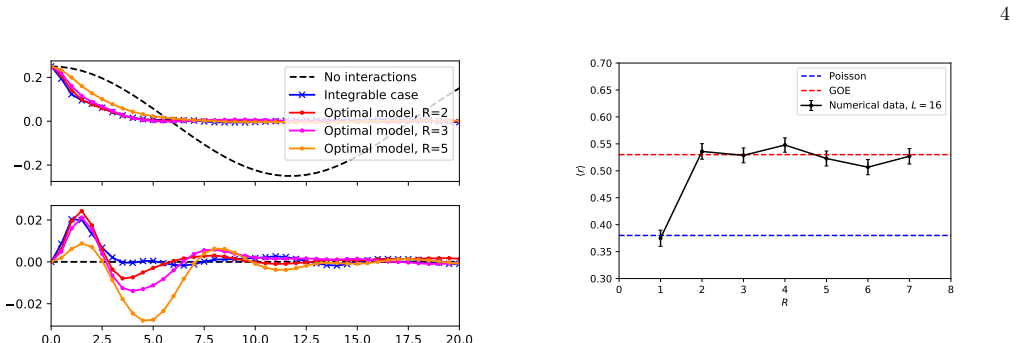
Tuning long-range interactions in chaotic fermion chains produces underdamped hot band sound at infinite temperature.
A machine-rendered reading of the paper's core claim, the machinery that carries it, and where it could break.
Core claim
By appropriately tuning the inter-particle interactions, lattice models of chaotic fermions at infinite temperature can be made to cross over from an overdamped regime of diffusion to an underdamped regime of hot band sound. In a family of one-dimensional spinless fermion chains with long-range density-density interactions, the damping time of sound waves can be made arbitrarily long even as an effective interaction strength is held fixed.
What carries the argument
Long-range density-density interactions in one-dimensional spinless fermion chains, which allow the sound damping time to be extended arbitrarily at fixed effective interaction strength while preserving chaos.
Load-bearing premise
The models remain chaotic and non-integrable while the interaction range is tuned to make the sound damping time arbitrarily long at fixed effective interaction strength.
What would settle it
Numerical or experimental observation that increasing the interaction range in these fermion chains either fails to extend the sound damping time or causes the system to lose chaotic behavior.
Figures

read the original abstract
Chaotic lattice models at high temperature are generically expected to exhibit diffusive transport of all local conserved charges. Such diffusive transport is usually associated with overdamped relaxation of the associated currents. Here we show that by appropriately tuning the inter-particle interactions, lattice models of chaotic fermions at infinite temperature can be made to cross over from an overdamped regime of diffusion to an underdamped regime of ``hot band sound''. We study a family of one-dimensional spinless fermion chains with long-range density-density interactions, in which the damping time of sound waves can be made arbitrarily long even as an effective interaction strength is held fixed. Our results demonstrate that underdamped sound waves of charge density can arise within a single band, with strong interactions and far from integrability, and at very high temperature.
Editorial analysis
A structured set of objections, weighed in public.
Referee Report
Summary. The manuscript introduces a family of one-dimensional spinless fermion chains with tunable long-range density-density interactions at infinite temperature. It claims that increasing the interaction range (while holding an effective interaction strength fixed) produces a crossover from overdamped diffusive transport to underdamped 'hot band sound' propagation of charge density, with the sound damping time made arbitrarily long, all while the models remain chaotic and non-integrable.
Significance. If the central claim holds, the result is significant: it would demonstrate that underdamped collective modes of a conserved charge can emerge inside a single band, at strong coupling and infinite temperature, without integrability or additional bands. This challenges the generic expectation of purely diffusive transport in chaotic many-body systems and supplies concrete lattice models for further study.
major comments (1)
- [§3] The load-bearing assumption is that non-integrability and chaos persist as the interaction range is increased to make the damping time diverge at fixed effective strength. §3 (or the equivalent model-definition section) and the associated numerics must explicitly demonstrate that the largest Lyapunov exponent (or equivalent chaos diagnostic) remains positive and does not approach zero in the long-range limit used for the underdamped regime; without this, the crossover could occur outside the claimed chaotic setting.
minor comments (2)
- [Fig. 2] Figure captions should state the precise definition of the effective interaction strength that is held fixed when the range is varied.
- [§4] The abstract states the damping time 'can be made arbitrarily long'; the main text should quantify the scaling of the damping time with the range parameter and show the data collapse or fit that supports this statement.
Simulated Author's Rebuttal
We thank the referee for their positive assessment of the significance of our work and for the constructive major comment. We address the point below.
read point-by-point responses
-
Referee: [§3] The load-bearing assumption is that non-integrability and chaos persist as the interaction range is increased to make the damping time diverge at fixed effective strength. §3 (or the equivalent model-definition section) and the associated numerics must explicitly demonstrate that the largest Lyapunov exponent (or equivalent chaos diagnostic) remains positive and does not approach zero in the long-range limit used for the underdamped regime; without this, the crossover could occur outside the claimed chaotic setting.
Authors: We agree that an explicit demonstration of persistent chaos is required to substantiate the central claim. The original manuscript supported non-integrability via level repulsion in the many-body spectrum and the absence of extra conserved quantities. To directly meet the referee's request, the revised manuscript will add, in §3, numerical results for the largest Lyapunov exponent (computed via the classical limit or an equivalent quantum diagnostic such as the growth rate of out-of-time-order correlators) at the long-range parameters realizing the underdamped regime. These data will show that the exponent remains positive and does not approach zero when the interaction range is increased at fixed effective strength, confirming that the crossover occurs inside the chaotic phase. revision: yes
Circularity Check
No significant circularity; derivation is self-contained
full rationale
The paper defines a family of long-range interacting fermion chains, tunes the interaction range while holding an effective strength fixed, and reports that the sound damping time diverges while the model remains chaotic. No step reduces a claimed prediction to a fitted parameter by construction, no self-citation is invoked as a uniqueness theorem or load-bearing premise, and no ansatz is smuggled in. The central result is obtained by direct study of the defined models rather than by re-labeling inputs; the skeptic concern about hidden integrability is a question of model validity, not a circular reduction in the derivation chain itself.
Axiom & Free-Parameter Ledger
Reference graph
Works this paper leans on
-
[1]
V. J. Emery and S. A. Kivelson, Phys. Rev. Lett. 74, 3253 (1995)
work page 1995
-
[2]
O. Gunnarsson, M. Calandra, and J. E. Han, Rev. Mod. Phys. 75, 1085 (2003)
work page 2003
-
[3]
N. E. Hussey, K. Takenaka, and H. Tak- agi, Philosophical Magazine 84, 2847 (2004), https://doi.org/10.1080/14786430410001716944
- [4]
-
[5]
P. W. Phillips, N. E. Hussey, and P. Ab- bamonte, Science 377, eabh4273 (2022), https://www.science.org/doi/pdf/10.1126/science.abh4273
-
[6]
P. T. Brown, D. Mitra, E. Guardado-Sanchez, R. Nourafkan, A. Reymbaut, C.-D. H´ ebert, S. Berg- eron, A.-M. S. Tremblay, J. Kokalj, D. A. Huse, P. Schauß, and W. S. Bakr, Science 363, 379 (2019), https://www.science.org/doi/pdf/10.1126/science.aat4134
- [7]
- [8]
-
[9]
E. Ilievski, J. De Nardis, M. Medenjak, and T. Prosen, Phys. Rev. Lett. 121, 230602 (2018)
work page 2018
-
[10]
U. Agrawal, S. Gopalakrishnan, R. Vasseur, and B. Ware, Physical Review B 101, 224415 (2020)
work page 2020
- [11]
-
[12]
D. Wei, A. Rubio-Abadal, B. Ye, F. Machado, J. Kemp, K. Srakaew, S. Hollerith, J. Rui, S. Gopalakrishnan, N. Y. Yao, I. Bloch, and J. Zeiher, Science 376, 716 (2022), https://www.science.org/doi/pdf/10.1126/science.abk2397
-
[13]
V. B. Bulchandani, S. Gopalakrishnan, and E. Ilievski, Journal of Statistical Mechanics: Theory and Experi- ment 2021, 084001 (2021)
work page 2021
-
[14]
V. B. Bulchandani, C. Karrasch, and J. E. Moore, Pro- ceedings of the National Academy of Sciences 117, 12713 (2020)
work page 2020
-
[15]
O. A. Castro-Alvaredo, B. Doyon, and T. Yoshimura, Phys. Rev. X 6, 041065 (2016)
work page 2016
-
[16]
B. Bertini, M. Collura, J. De Nardis, and M. Fagotti, Phys. Rev. Lett. 117, 207201 (2016)
work page 2016
-
[17]
V. B. Bulchandani, R. Vasseur, C. Karrasch, and J. E. Moore, Physical Review B 97, 10.1103/Phys- RevB.97.045407 (2018), arXiv:1702.06146
work page internal anchor Pith review Pith/arXiv arXiv doi:10.1103/phys- 2018
- [18]
-
[19]
A. Bastianello, J. De Nardis, and A. De Luca, Phys. Rev. B 102, 161110 (2020)
work page 2020
-
[20]
E. M. Lifshitz and L. P. Pitaevskii, Statistical physics: theory of the condensed state , Vol. 9 (Elsevier, 2013)
work page 2013
-
[21]
This model in fact exhibits superdiffusive charge transport8,9,11–13. Tuning the effective XXZ anisotropy ∆ = U1 of the integrable reference point in our con- strained optimization problem is equivalent to tuning the value of the interaction constraint σ2 V . We have checked that even when σ2 V/L < 1/4, which corresponds to an anisotropy|∆| < 1 and hence ba...
-
[22]
See Supplementary Material for a derivation
- [23]
-
[24]
V. B. Bulchandani and D. A. Huse, in preparation
-
[25]
M. Mierzejewski, J. Wronowicz, and J. Herbrych, Quasi- ballistic transport within long-range anisotropic heisen- berg model (2022), arXiv:2206.05960
- [26]
-
[27]
S. Korenblit, D. Kafri, W. C. Campbell, R. Islam, E. E. Edwards, Z.-X. Gong, G.-D. Lin, L.-M. Duan, J. Kim, K. Kim, and C. Monroe, New Journal of Physics 14, 095024 (2012)
work page 2012
-
[28]
L. Erd˝ os, M. Salmhofer, and H.-T. Yau, Journal of Sta- tistical Physics 116, 367 (2004). Quantum Boltzmann equation for hot band sound In this Appendix, we argue that the dynamics of optimal models forR≫ 1 and infinite temperature is approximated by a linearized Boltzmann equation of the form ∂tδρk +vk∂xδρk =D∂2 kδρk, (26) where the effective pseudomoment...
work page 2004
discussion (0)
Sign in with ORCID, Apple, or X to comment. Anyone can read and Pith papers without signing in.