Ultrasonic determination of crystallographic texture by transmitted field fitting regardless of medium dispersivity
Pith reviewed 2026-05-20 16:01 UTC · model grok-4.3
The pith
Ultrasonic fitting of transmitted fields recovers crystallographic texture coefficients across arbitrary thicknesses and symmetries.
A machine-rendered reading of the paper's core claim, the machinery that carries it, and where it could break.
Core claim
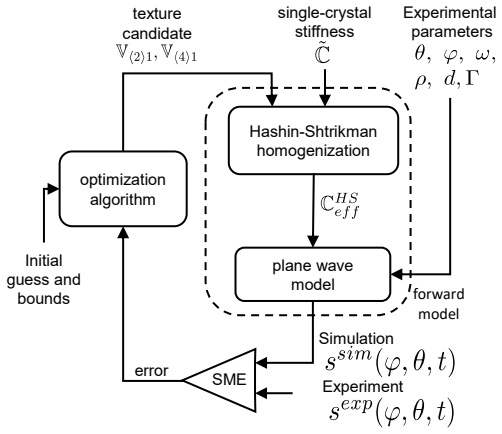
By directly comparing a simulated transmitted ultrasonic field to measured data and inverting for the orientation distribution function without bulk-wave or plate-wave approximations, the method determines the texture coefficients of generally anisotropic aggregates. The Hashin-Shtrikman framework supplies the effective moduli that constrain the admissible parameter space during optimization, enabling convergence for both strongly and weakly anisotropic materials and for specimen thicknesses that would invalidate conventional ultrasonic texture techniques.
What carries the argument
Full-field transmitted ultrasonic wave simulation and direct comparison to measurements inside a GPU-accelerated nonlinear optimizer, with effective moduli supplied by Hashin-Shtrikman homogenization.
If this is right
- The technique applies to both thin and thick specimens without geometric restrictions.
- No orthotropic or other macroscopic symmetry needs to be assumed for the aggregate.
- Textures with weak elastic anisotropy remain recoverable.
- A complete measurement and inversion cycle finishes in approximately ten minutes.
Where Pith is reading between the lines
- Inline process monitoring of texture in rolling or extrusion lines becomes feasible where diffraction access is limited.
- The same fitting logic could be adapted to invert other wave-propagation data, such as in acoustic emission or ultrasonic tomography settings.
- Extension to lower-symmetry crystal classes or to media with stronger dispersion would test the limits of the current homogenization step.
Load-bearing premise
The Hashin-Shtrikman homogenization scheme accurately supplies the effective elastic constants that link the unknown texture coefficients to the observed wave field.
What would settle it
Systematic mismatch between the ultrasonically recovered texture coefficients and independent diffraction measurements performed on the identical set of samples would show that the field-fitting inversion does not recover the true orientation distribution.
Figures




read the original abstract
The determination of crystallographic texture through elastic wave propagation offers a cost-effective, nondestructive means of obtaining through-thickness information with minimal sample preparation. Existing ultrasonic approaches rely on either bulk-wave or guided-wave velocity measurements for texture inversion. These strategies impose geometric constraints: bulk-wave methods become impractical for thin specimens, whereas guided-wave techniques are limited to relatively small thicknesses. Furthermore, many formulations assume orthotropic symmetry of the aggregate, thereby restricting their applicability to materials with higher anisotropy. In this work, a full-field wave fitting strategy is developed in which the transmitted ultrasonic field is simulated and directly compared to experimental measurements. Because the approach does not rely on bulk-wave or plate-wave approximations, it remains applicable across a broad range of specimen thicknesses. Furthermore, no macroscopic symmetry assumptions are imposed on the aggregate, enabling the characterization of generally anisotropic materials. The effective elastic response is computed using a Hashin-Shtrikman homogenization framework, which provides tighter bounds than classical Voigt-Reuss-Hill averages and constrains the admissible search space during optimization, thereby improving convergence. The nonlinear inverse problem is solved using a GPU-accelerated optimization scheme. The methodology is validated on materials with hexagonal and cubic crystal symmetry over a range of specimen thicknesses. The inferred texture coefficients show consistent agreement with independent diffraction measurements. Additionally, textures with weak elastic anisotropy are successfully recovered, demonstrating the robustness and versatility of the proposed method. Complete measurement and inversion are achieved within approximately 10 minutes.
Editorial analysis
A structured set of objections, weighed in public.
Referee Report
Summary. The manuscript introduces a full-field ultrasonic method to determine crystallographic texture by simulating and fitting the transmitted wave field to experimental measurements. It computes the effective elastic stiffness via Hashin-Shtrikman homogenization without imposing macroscopic symmetry, solves the resulting nonlinear inverse problem with GPU-accelerated optimization, and validates the approach on hexagonal- and cubic-symmetry polycrystals over a range of thicknesses. The authors report consistent agreement between the inferred texture coefficients and independent diffraction data, successful recovery of weakly anisotropic textures, and a total measurement-plus-inversion time of approximately 10 minutes.
Significance. If the forward model is shown to remain accurate when dispersivity arises from grain scattering, the method would constitute a meaningful advance in nondestructive texture characterization: it removes the thickness and symmetry restrictions of conventional bulk- and guided-wave techniques while retaining practical speed and generality. The tighter bounds supplied by Hashin-Shtrikman homogenization and the GPU implementation are concrete strengths that could improve convergence and applicability.
major comments (2)
- [Abstract / methodology paragraph] Abstract / methodology paragraph: the claim that the procedure works “regardless of medium dispersivity” rests on the assumption that the Hashin-Shtrikman-homogenized stiffness tensor produces a forward simulation that faithfully reproduces the measured transmitted field for the true orientation distribution function. Because the effective-medium tensor is spatially homogeneous, it cannot capture coherent grain-scale scattering, frequency-dependent phase velocity, or attenuation that appear when wavelength approaches grain size; any unmodeled contributions could be absorbed into erroneous texture coefficients during optimization.
- [Validation paragraph] Validation paragraph: the abstract states that the inferred texture coefficients show “consistent agreement” with diffraction measurements, yet supplies no quantitative error metrics (RMS difference, correlation coefficient, or per-coefficient uncertainties), no exclusion criteria for outliers, and no description of regularization applied to the nonlinear inverse problem. Without these, the strength of the external validation cannot be assessed.
minor comments (1)
- [Abstract] The abstract would be clearer if it listed the specific materials, thickness range, and frequency band employed in the validation experiments.
Simulated Author's Rebuttal
We thank the referee for the constructive comments, which help clarify the scope and presentation of our work. We respond to each major comment below.
read point-by-point responses
-
Referee: [Abstract / methodology paragraph] the claim that the procedure works “regardless of medium dispersivity” rests on the assumption that the Hashin-Shtrikman-homogenized stiffness tensor produces a forward simulation that faithfully reproduces the measured transmitted field for the true orientation distribution function. Because the effective-medium tensor is spatially homogeneous, it cannot capture coherent grain-scale scattering, frequency-dependent phase velocity, or attenuation that appear when wavelength approaches grain size; any unmodeled contributions could be absorbed into erroneous texture coefficients during optimization.
Authors: We agree that a spatially homogeneous effective stiffness tensor cannot explicitly represent grain-scale scattering or the resulting frequency-dependent attenuation and phase velocity shifts. The Hashin-Shtrikman scheme supplies only the macroscopic effective properties that govern the coherent transmitted field. Our experimental validations on hexagonal- and cubic-symmetry polycrystals nevertheless show that the fitted texture coefficients remain consistent with diffraction data across the tested thickness and frequency range. The title phrase “regardless of medium dispersivity” is meant to convey that the method imposes neither the thin-plate nor the orthotropic-symmetry restrictions common in velocity-based ultrasonic texture measurements; those restrictions can be invalidated by dispersive scattering. To avoid overstatement, we will revise the abstract and add a short paragraph in the discussion that states the regime of applicability (wavelength appreciably larger than mean grain size) and notes that strong scattering may require a different forward model. revision: partial
-
Referee: [Validation paragraph] the abstract states that the inferred texture coefficients show “consistent agreement” with diffraction measurements, yet supplies no quantitative error metrics (RMS difference, correlation coefficient, or per-coefficient uncertainties), no exclusion criteria for outliers, and no description of regularization applied to the nonlinear inverse problem. Without these, the strength of the external validation cannot be assessed.
Authors: We accept that the current abstract and validation section lack the quantitative indicators needed for a rigorous assessment. In the revised manuscript we will report RMS differences and Pearson correlation coefficients between the ultrasonically recovered texture coefficients and the diffraction reference values, together with per-coefficient standard deviations obtained from the optimization covariance. We will also document the regularization term (a quadratic penalty on the deviation of the orientation distribution function from isotropy) that was used to stabilize the nonlinear inverse problem and to exclude non-physical solutions. revision: yes
Circularity Check
No circularity; external diffraction validation grounds the texture coefficients
full rationale
The paper's central procedure fits texture coefficients by minimizing the mismatch between measured transmitted ultrasonic fields and fields simulated from a Hashin-Shtrikman-homogenized effective stiffness tensor. Because the fitted coefficients are then compared to independent diffraction measurements on the same specimens, the result is not equivalent to its inputs by construction. No self-definitional relations, fitted parameters renamed as predictions, or load-bearing self-citations appear in the derivation chain. The absence of macroscopic symmetry assumptions and the use of a standard homogenization scheme further keep the forward operator independent of the target ODF coefficients.
Axiom & Free-Parameter Ledger
free parameters (1)
- texture coefficients
axioms (1)
- domain assumption Hashin-Shtrikman homogenization supplies tighter bounds than Voigt-Reuss-Hill averages for the effective elastic tensor of the polycrystal
Lean theorems connected to this paper
-
IndisputableMonolith/Cost/FunctionalEquationwashburn_uniqueness_aczel unclear?
unclearRelation between the paper passage and the cited Recognition theorem.
The effective elastic response is computed using a Hashin–Shtrikman homogenization framework... The nonlinear inverse problem is solved using a GPU-accelerated optimization scheme.
-
IndisputableMonolith/Foundation/AlexanderDualityalexander_duality_circle_linking unclear?
unclearRelation between the paper passage and the cited Recognition theorem.
textures with weak elastic anisotropy are successfully recovered... no macroscopic symmetry assumptions are imposed
What do these tags mean?
- matches
- The paper's claim is directly supported by a theorem in the formal canon.
- supports
- The theorem supports part of the paper's argument, but the paper may add assumptions or extra steps.
- extends
- The paper goes beyond the formal theorem; the theorem is a base layer rather than the whole result.
- uses
- The paper appears to rely on the theorem as machinery.
- contradicts
- The paper's claim conflicts with a theorem or certificate in the canon.
- unclear
- Pith found a possible connection, but the passage is too broad, indirect, or ambiguous to say the theorem truly supports the claim.
Reference graph
Works this paper leans on
-
[1]
H. J. Bunge, Texture Analysis in Materials Science, Elsevier, 1982. doi:10.1016/c2013-0-11769-2. URLhttps://doi.org/10.1016/c2013-0-11769-2
-
[2]
R. Sowerby, W. Johnson, A review of texture and anisotropy in relation to metal forming, Materials Science and Engineering 20 (1975) 101–111. doi:10.1016/0025-5416(75)90138-x. URLhttps://doi.org/10.1016/0025-5416(75)90138-x
-
[3]
K. L. Murty, I. Charit, Texture development and anisotropic deforma- tion of zircaloys, Progress in Nuclear Energy 48 (4) (2006) 325–359. doi:10.1016/j.pnucene.2005.09.011. URLhttps://doi.org/10.1016/j.pnucene.2005.09.011
-
[4]
B. Lan, T. B. Britton, T.-S. Jun, W. Gan, M. Hofmann, F. P. Dunne, M. J. Lowe, Direct volumetric measurement of crystallographic texture using acoustic waves, Acta Materialia 159 (2018) 384–394. 17 doi:10.1016/j.actamat.2018.08.037. URLhttps://doi.org/10.1016/j.actamat.2018.08.037
-
[5]
B. Lan, M. J. Lowe, F. P. Dunne, A spherical harmonic approach for the determinationofHCPtexturefromultrasound: Asolutiontotheinverse problem, Journal of the Mechanics and Physics of Solids 83 (2015) 179–
work page 2015
-
[6]
URLhttps://doi.org/10.1016/j.jmps.2015.06.014
doi:10.1016/j.jmps.2015.06.014. URLhttps://doi.org/10.1016/j.jmps.2015.06.014
-
[7]
B. Lan, M. J. Lowe, F. P. Dunne, A generalized spherical harmonic deconvolution to obtain texture of cubic materials from ultrasonic wave speed, Journal of the Mechanics and Physics of Solids 83 (2015) 221–
work page 2015
-
[8]
URLhttps://doi.org/10.1016/j.jmps.2015.06.012
doi:10.1016/j.jmps.2015.06.012. URLhttps://doi.org/10.1016/j.jmps.2015.06.012
-
[9]
J. Rossin, P. Leser, K. Pusch, C. Frey, S. P. Murray, C. J. Torbet, S. Smith, S. Daly, T. M. Pollock, Bayesian inference of elastic constants andtexturecoefficientsinadditivelymanufacturedcobalt-nickelsuperal- loys using resonant ultrasound spectroscopy, Acta Materialia 220 (2021) 117287. doi:10.1016/j.actamat.2021.117287. URLhttps://doi.org/10.1016/j.act...
-
[10]
M. L. Fernández, T. Böhlke, Representation of hashin–shtrikman bounds in terms of texture coefficients for arbitrarily anisotropic polycrystalline materials, Journal of Elasticity 134 (1) (2018) 1–38. doi:10.1007/s10659-018-9679-0. URLhttps://doi.org/10.1007/s10659-018-9679-0
-
[11]
M. Lobos, T. Böhlke, On optimal zeroth-order bounds of linear elas- tic properties of multiphase materials and application in materials de- sign, International Journal of Solids and Structures 84 (2016) 40–48. doi:10.1016/j.ijsolstr.2015.12.015. URLhttp://dx.doi.org/10.1016/j.ijsolstr.2015.12.015
-
[12]
Voigt, Lehrbuch der Kristallphysik, 1966
W. Voigt, Lehrbuch der Kristallphysik, 1966. doi:10.1007/978-3-663- 15884-4. URLhttps://doi.org/10.1007/978-3-663-15884-4
-
[13]
A. Reuss, Berechnung der fließgrenze von mischkristallen auf grund der plastizitätsbedingung für einkristalle ., ZAMM - Zeitschrift 18 für Angewandte Mathematik und Mechanik 9 (1) (1929) 49–58. doi:10.1002/zamm.19290090104. URLhttps://doi.org/10.1002/zamm.19290090104
-
[14]
R. Hill, Elastic properties of reinforced solids: Some theoretical prin- ciples, Journal of the Mechanics and Physics of Solids 11 (5) (1963) 357–372. doi:10.1016/0022-5096(63)90036-x. URLhttps://doi.org/10.1016/0022-5096(63)90036-x
-
[15]
Z. Hashin, S. Shtrikman, A variational approach to the theory of the elastic behaviour of polycrystals, Journal of the Mechanics and Physics of Solids 10 (4) (1962) 343–352. doi:10.1016/0022-5096(62)90005-4. URLhttps://doi.org/10.1016/0022-5096(62)90005-4
-
[16]
S. Forte, M. Vianello, Symmetry classes for elasticity tensors, Journal of Elasticity 43 (2) (1996) 81–108. doi:10.1007/bf00042505. URLhttp://dx.doi.org/10.1007/BF00042505
-
[17]
Bunge, Zur darstellung allgemeiner texturen, Zeitschrift für Met- allkunde 56 (1965) 872–874
H.-J. Bunge, Zur darstellung allgemeiner texturen, Zeitschrift für Met- allkunde 56 (1965) 872–874
work page 1965
-
[18]
T. Böhlke, M. Lobos, Representation of hashin–shtrikman bounds of cubic crystal aggregates in terms of texture coefficients with ap- plication in materials design, Acta Materialia 67 (2014) 324–334. doi:10.1016/j.actamat.2013.11.003. URLhttp://dx.doi.org/10.1016/j.actamat.2013.11.003
-
[19]
Z. Hashin, S. Shtrikman, A variational approach to the theory of the elastic behaviour of multiphase materials, Journal of the Mechan- ics and Physics of Solids 11 (2) (1963) 127–140. doi:10.1016/0022- 5096(63)90060-7. URLhttp://dx.doi.org/10.1016/0022-5096(63)90060-7
-
[20]
H. Ledbetter, Predicted monocrystal elastic constants of 304-type stainless steel, Physica B+C 128 (1) (1985) 1–4. doi:10.1016/0378- 4363(85)90076-2. URLhttp://dx.doi.org/10.1016/0378-4363(85)90076-2
-
[21]
D. Cowes, J. I. Mieza, M. P. Gómez, Ultrasonic character- ization of generally anisotropic elasticity implementing optimal 19 zeroth-order elastic bounds and a wave-fitting approach (2026). doi:10.48550/ARXIV.2604.09865. URLhttps://arxiv.org/abs/2604.09865
work page internal anchor Pith review Pith/arXiv arXiv doi:10.48550/arxiv.2604.09865 2026
-
[22]
D. A. Cowes, J. I. Mieza, M. P. Gómez, Polyvinylidene fluoride trans- ducer shape optimization for the characterization of anisotropic mate- rials, The Journal of the Acoustical Society of America 156 (6) (2024) 3943–3953. doi:10.1121/10.0034601. URLhttp://dx.doi.org/10.1121/10.0034601
-
[23]
G. Sha, A simultaneous non-destructive characterisation method for grain size and single-crystal elastic constants of cubic polycrystals from ultrasonic measurements, Insight - Non-Destructive Testing and Condi- tion Monitoring 60 (4) (2018) 190–193. doi:10.1784/insi.2018.60.4.190. URLhttps://doi.org/10.1784/insi.2018.60.4.190
-
[24]
R. Hooke, T. A. Jeeves, “ direct search” solution of numerical and statistical problems, Journal of the ACM 8 (2) (1961) 212–229. doi:10.1145/321062.321069. URLhttp://dx.doi.org/10.1145/321062.321069
- [25]
-
[26]
B. Lan, M. A. Carpenter, W. Gan, M. Hofmann, F. P. Dunne, M. J. Lowe, Rapid measurement of volumetric texture using reso- nant ultrasound spectroscopy, Scripta Materialia 157 (2018) 44–48. doi:10.1016/j.scriptamat.2018.07.029. URLhttps://doi.org/10.1016/j.scriptamat.2018.07.029
-
[27]
J. Rossin, GitHub - jrossin/texture-RUS: Inverse determination of texture from resonant frequencies (gathered by RUS) by pairing with the inverse solving python package SMCPy — github.com, https://github.com/jrossin/texture-RUS, [Accessed 15-Feb-2023]
work page 2023
-
[28]
E. S. Fisher, C. J. Renken, Single-crystal elastic moduli and the hcp→ bcc transformation in ti, zr, and hf, Physical Review 135 (2A) (1964) A482–A494. doi:10.1103/physrev.135.a482. URLhttp://dx.doi.org/10.1103/PhysRev.135.A482 20
-
[29]
G. Alers, J. Neighbours, The elastic constants of zinc between 4.2°and 670°k, Journal of Physics and Chemistry of Solids 7 (1) (1958) 58–64. doi:10.1016/0022-3697(58)90180-x. URLhttp://dx.doi.org/10.1016/0022-3697(58)90180-X
-
[30]
J. J. Hall, Electronic effects in the elastic constants of n-type silicon, Physical Review 161 (3) (1967) 756–761. doi:10.1103/physrev.161.756. URLhttp://dx.doi.org/10.1103/PhysRev.161.756
-
[31]
F. Bachmann, R. Hielscher, H. Schaeben, Texture analysis with mtex – free and open source software toolbox, Solid State Phenomena 160 (2010) 63–68. doi:10.4028/www.scientific.net/ssp.160.63. URLhttp://dx.doi.org/10.4028/www.scientific.net/SSP.160.63
-
[32]
Kearns, Report wapd-tm-472, Bettis Atomic Power Laboratory, West Mifflin, PA, USA (1965)
J. Kearns, Report wapd-tm-472, Bettis Atomic Power Laboratory, West Mifflin, PA, USA (1965)
work page 1965
-
[33]
A. J. Anderson, R. B. Thompson, C. S. Cook, Ultrasonic measure- ment of the kearns texture factors in zircaloy, zirconium, and titanium, Metallurgical and Materials Transactions A 30 (8) (1999) 1981–1988. doi:10.1007/s11661-999-0008-x. URLhttp://dx.doi.org/10.1007/s11661-999-0008-x
-
[34]
M. Lobos Fernández, Homogenization and materials design of mechani- cal properties of textured materials based on zeroth-, first- and second- order bounds of linear behavior, Schriftenreihe Kontinuumsmechanik im Maschinenbau / Karlsruher Institut fuer Technologie, Institut fuer Tech- nischeMechanik-BereichKontinuumsmechanik, KITScientificPublish- ing, 201...
work page 2018
-
[35]
H. J. Bunge, Texture and magnetic properties, Textures and Microstruc- tures 11 (2–4) (1989) 75–91. doi:10.1155/tsm.11.75. URLhttp://dx.doi.org/10.1155/TSM.11.75
-
[36]
S. Matthies, On the reproducibility of the orientation distribution func- tion of texture samples from pole figures (ghost phenomena), physica status solidi (b) 92 (2) (Apr. 1979). doi:10.1002/pssb.2220920254. URLhttp://dx.doi.org/10.1002/pssb.2220920254 21 Figure 1: Elastic Homogenization. a) Bounds for biphaseic materials [17]. b) Bounds for the Young m...
discussion (0)
Sign in with ORCID, Apple, or X to comment. Anyone can read and Pith papers without signing in.