Persuading an inattentive and privately informed receiver
Pith reviewed 2026-05-23 22:38 UTC · model grok-4.3
The pith
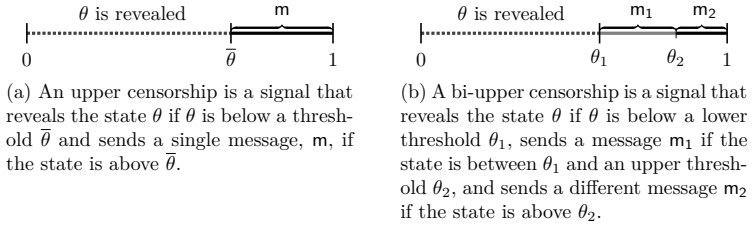
When receivers pay attention only at a cost, sender experiments become equivalent to direct persuasion mechanisms and optimally censor favorable states.
A machine-rendered reading of the paper's core claim, the machinery that carries it, and where it could break.
Core claim
By leveraging the supermodularity property of the receiver's utility in information and effort, the paper establishes an equivalence between experiments and persuasion mechanisms à la Kolotilin et al. (2017). In applications, the sender's optimal strategy involves censoring favorable states.
What carries the argument
supermodularity property in information and effort (the marginal value of information rises with effort), which maps experiments into equivalent direct mechanisms
Load-bearing premise
The receiver's utility is supermodular in information and effort; if this property fails the claimed equivalence between experiments and direct mechanisms no longer follows.
What would settle it
A concrete utility function violating supermodularity together with an optimal direct mechanism whose outcome cannot be replicated by any experiment that only varies the probability of attention.
Figures
read the original abstract
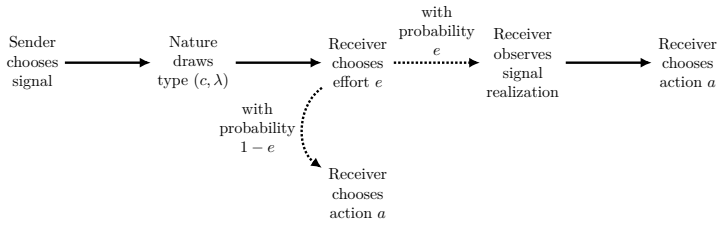
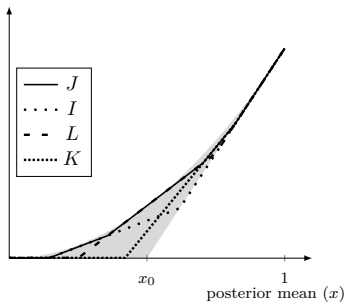
This paper studies the persuasion of a receiver who accesses information only if she exerts costly attention effort. A sender designs an experiment to persuade the receiver to take a specific action. The experiment affects the receiver's attention effort, that is, the probability that she updates her beliefs. Persuasion has two margins: an extensive (effort) and an intensive (action). The receiver's utility exhibits a supermodularity property in information and effort. By leveraging this property, we establish an equivalence between experiments and persuasion mechanisms \`a la Kolotilin et al.~(2017). In applications, the sender's optimal strategy involves censoring favorable states.
Editorial analysis
A structured set of objections, weighed in public.
Referee Report
Summary. The paper analyzes Bayesian persuasion where the receiver is privately informed and must exert costly effort to access the sender's experiment (i.e., attention is endogenous). The receiver's payoff is assumed supermodular in the precision of information received and the effort exerted. The central result is an equivalence between the design of experiments and direct persuasion mechanisms in the sense of Kolotilin et al. (2017). Applications of the equivalence are used to characterize the sender's optimum as involving censoring of favorable states.
Significance. If the equivalence result holds under the stated supermodularity condition, the paper provides a useful reduction that maps the problem with endogenous attention into a standard mechanism-design problem, extending the Kolotilin et al. framework to settings with inattentive receivers. This could facilitate analysis in applications where information processing is costly. The censoring result in applications is a concrete, testable implication.
minor comments (2)
- [Abstract and introduction] The abstract states that the equivalence 'follows from' supermodularity but does not indicate the precise steps (e.g., which direction of the equivalence uses which part of the supermodularity assumption). Adding a short proof sketch or reference to the relevant lemma in the main text would improve readability.
- [Section 3 (equivalence result)] The paper cites Kolotilin et al. (2017) for the direct-mechanism benchmark; it would be useful to clarify whether the equivalence preserves the same action space and whether any additional technical conditions (e.g., on the state space or action set) are inherited from that paper.
Simulated Author's Rebuttal
We thank the referee for the positive assessment of our paper and the recommendation for minor revision. The report correctly summarizes the main contribution—an equivalence between experiments and Kolotilin-style mechanisms under the supermodularity condition—and notes the concrete implications of the censoring result in applications.
Circularity Check
No significant circularity
full rationale
The paper states an exogenous supermodularity property of the receiver's utility as a modeling assumption and leverages it to derive equivalence to mechanisms in Kolotilin et al. (2017). This is a standard conditional argument with no reduction of the central claim to a self-citation chain, fitted input renamed as prediction, or self-definitional step. The derivation remains independent of the paper's own outputs.
Axiom & Free-Parameter Ledger
axioms (1)
- domain assumption Receiver's utility is supermodular in information and effort
Reference graph
Works this paper leans on
- [1]
-
[2]
American Economic Review, 106(11), 3590–3605
Alonso, Ricardo and Odilon C\^amara (2016), Persuading voters. American Economic Review, 106(11), 3590–3605. alonso_persuading_2016AER
work page 2016
-
[3]
Theoretical Economics, 18(1), 15--36
Arieli, Itai, Yakov Babichenko, Rann Smorodinsky, and Takuro Yamashita (2023), Optimal persuasion via bi-pooling. Theoretical Economics, 18(1), 15--36. arieli_optimal_2023
work page 2023
-
[4]
Journal of Political Economy, 131(1), 202--245
Au, Pak Hung and Mark Whitmeyer (2023), Attraction versus persuasion: Information provision in search markets. Journal of Political Economy, 131(1), 202--245. au_attraction_2023
work page 2023
-
[5]
Barreto (2024), Persuading a wishful thinker
Augias, Victor and Daniel M.\ A. Barreto (2024), Persuading a wishful thinker. Working Paper. augias_persuading_2023
work page 2024
-
[6]
Bauschke, Heinz H. and Patrick L. Combettes (2011), Convex Analysis and Monotone Operator Theory in Hilbert Spaces, second edition. Springer Cham. bauschke_convex_2017
work page 2011
-
[7]
Journal of Economic Theory, 179, 312--365
Beauch\^ene, Dorian, Jian Li, and Ming Li (2019), Ambiguous persuasion. Journal of Economic Theory, 179, 312--365. beauchene_ambiguous_2019
work page 2019
-
[8]
Journal of Economic Theory, 187, 105002
Bizzotto, Jacopo, Jesper R\"udiger, and Adrien Vigier (2020), Testing, disclosure and approval. Journal of Economic Theory, 187, 105002. bizzotto_testing_2020
work page 2020
-
[9]
American Economic Journal: Microeconomics, 13(2), 1–34
Bizzotto, Jacopo and Adrien Vigier (2021), Fees, reputation, and information production in the credit rating industry. American Economic Journal: Microeconomics, 13(2), 1–34. bizzotto_fees_2021
work page 2021
-
[10]
and Ilya Segal (2021), Persuading a Rationally Inattentive Agent
Bloedel, Alexander W. and Ilya Segal (2021), Persuading a Rationally Inattentive Agent . Working Paper. bloedel_persuading_2021
work page 2021
-
[11]
Journal of Political Economy, 126(5), 1965--2010
Board, Simon and Jay Lu (2018), Competitive information disclosure in search markets. Journal of Political Economy, 126(5), 1965--2010. board_competitive_2018
work page 2018
-
[12]
Marketing Science, 35(4), 605--618
Branco, Fernando, Monic Sun, and J.\ Miguel Villas-Boas (2016), Too much information? information provision and search costs. Marketing Science, 35(4), 605--618. branco_too_2016
work page 2016
-
[13]
Carrillo (2007), Influence through ignorance
Brocas, Isabelle and Juan D. Carrillo (2007), Influence through ignorance. The RAND Journal of Economics, 38(4), 931--947. brocas_influence_2007
work page 2007
-
[14]
Journal of Political Economy, 130(6), 1676--1715
Caplin, Andrew, Mark Dean, and John Leahy (2022), Rationally inattentive behavior: Characterizing and generalizing shannon entropy. Journal of Political Economy, 130(6), 1676--1715. caplin_rationally_2022
work page 2022
-
[15]
Journal of Political Economy, 131(7), 1797--1844
Che, Yeon-Koo, Kyungmin Kim, and Konrad Mierendorff (2023), Keeping the listener engaged: A dynamic model of bayesian persuasion. Journal of Political Economy, 131(7), 1797--1844. che_keeping_2023
work page 2023
-
[16]
Journal of Political Economy, 130(10), 2594--2642
de Clippel, Geoffroy and Xu Zhang (2022), Non-bayesian persuasion. Journal of Political Economy, 130(10), 2594--2642. declippel_nonbayesian_2022
work page 2022
-
[17]
American Economic Review, 112(10), 3215–59
Denti, Tommaso (2022), Posterior separable cost of information. American Economic Review, 112(10), 3215–59. denti_posterior_2022
work page 2022
-
[18]
American Economic Review, 112(9), 3106–23
Denti, Tommaso, Massimo Marinacci, and Aldo Rustichini (2022), Experimental cost of information. American Economic Review, 112(9), 3106–23. denti_experimental_2022
work page 2022
-
[19]
Journal of Political Economy, 127(5), 1993--2048
Dworczak, Piotr and Giorgio Martini (2019), The Simple Economics of Optimal Persuasion . Journal of Political Economy, 127(5), 1993--2048. dworczak_simple_2019
work page 2019
-
[20]
Econometrica, 90(5), 2017--2051
Dworczak, Piotr and Alessandro Pavan (2022), Preparing for the worst but hoping for the best: Robust (bayesian) persuasion. Econometrica, 90(5), 2017--2051. dworczak_preparing_2022
work page 2022
-
[21]
The Scandinavian Journal of Economics, 121(3), 1054--1087
Felgenhauer, Mike (2019), Endogenous persuasion with costly verification. The Scandinavian Journal of Economics, 121(3), 1054--1087. felgenhauer_endogenous_2019
work page 2019
-
[22]
Feng, Yiding, Chien - Ju Ho, and Wei Tang (2024), Rationality-robust information design: Bayesian persuasion under quantal response. In Proceedings of the 2024 ACM-SIAM Symposium on Discrete Algorithms, SODA 2024, Alexandria, VA, USA, January 7-10, 2024 (David P. Woodruff, ed.), 501--546, SIAM . feng_rationalityrobust_2024
work page 2024
-
[23]
Oxford University Press, Oxford
Floridi, Luciano (2014), The Fourth Revolution : How the Infosphere is Reshaping Human Reality . Oxford University Press, Oxford. floridi_fourth_2014
work page 2014
-
[24]
American Economic Review, 109(3), 996–1031
Galperti, Simone (2019), Persuasion: The art of changing worldviews. American Economic Review, 109(3), 996–1031. galperti_persuasion_2019
work page 2019
-
[25]
American Journal of Political Science, 59(1), 212--224
Gehlbach, Scott and Alberto Simpser (2015), Electoral manipulation as bureaucratic control. American Journal of Political Science, 59(1), 212--224. gehlbach_electoral_2015
work page 2015
-
[26]
Journal of Public Economics, 118, 163--171
Gehlbach, Scott and Konstantin Sonin (2014), Government control of the media. Journal of Public Economics, 118, 163--171. gehlbach_government_2014
work page 2014
-
[27]
American Economic Review, 106(5), 597--601
Gentzkow, Matthew and Emir Kamenica (2016), A Rothschild - Stiglitz Approach to Bayesian Persuasion . American Economic Review, 106(5), 597--601. gentzkow_rothschild-stiglitz_2016
work page 2016
-
[28]
Arda and Pooya Molavi (2023), Informational autocrats, diverse societies
Gitmez, A. Arda and Pooya Molavi (2023), Informational autocrats, diverse societies. gitmez_informational_2023
work page 2023
-
[29]
Guo, Yingni and Eran Shmaya (2019), The interval structure of optimal disclosure. Econometrica, 87(2), 653--675. guo_interval_2019
work page 2019
-
[30]
Honka, Elisabeth, Ali Horta c su, and Maria Ana Vitorino (2017), Advertising, consumer awareness, and choice: evidence from the u.s. banking industry. The RAND Journal of Economics, 48(3), 611--646. honka_advertising_2017
work page 2017
-
[31]
Hébert, Benjamin and Weijie Zhong (2024), Engagement maximization. ://arxiv.org/abs/2207.00685. hebert_engagement_2024
-
[32]
Jain, Vasudha and Mark Whitmeyer (2022), Competitive disclosure of information to a rationally inattentive agent. Working Paper. jain_competitive_2022
work page 2022
-
[33]
Annual Review of Economics, 11, 249--272
Kamenica, Emir (2019), Bayesian Persuasion and Information Design . Annual Review of Economics, 11, 249--272. kamenica_bayesian_2019
work page 2019
-
[34]
American Economic Review, 101(6), 2590--2615
Kamenica, Emir and Matthew Gentzkow (2011), Bayesian Persuasion . American Economic Review, 101(6), 2590--2615. kamenica_bayesian_2011
work page 2011
-
[35]
Econometrica, 89(4), 1557--1593
Kleiner, Andreas, Benny Moldovanu, and Philipp Strack (2021), Extreme Points and Majorization : Economic Applications . Econometrica, 89(4), 1557--1593. kleiner_extreme_2021
work page 2021
-
[36]
Knoepfle, Jan (2020), Dynamic competition for attention. Working Paper. knoepfle_dynamic_2020
work page 2020
-
[37]
Theoretical Economics, 13(2), 607--635
Kolotilin, Anton (2018), Optimal information disclosure: a linear programming approach. Theoretical Economics, 13(2), 607--635. kolotilin_optimal_2018
work page 2018
-
[38]
Theoretical Economics, 17(2), 561--585
Kolotilin, Anton, Timofiy Mylovanov, and Andriy Zapechelnyuk (2022), Censorship as optimal persuasion. Theoretical Economics, 17(2), 561--585. kolotilin_censorship_2022
work page 2022
-
[39]
Econometrica, 85(6), 1949--1964
Kolotilin, Anton, Tymofiy Mylovanov, Andriy Zapechelnyuk, and Ming Li (2017), Persuasion of a Privately Informed Receiver . Econometrica, 85(6), 1949--1964. kolotilin_persuasion_2017
work page 2017
-
[40]
Journal of Mathematical Economics, 97, 102534
Liao, Xiaoye (2021), Bayesian persuasion with optimal learning. Journal of Mathematical Economics, 97, 102534. liao_2021_bayesian
work page 2021
-
[41]
American Economic Journal: Microeconomics, 10(4), 67--93
Lipnowski, Elliot and Laurent Mathevet (2018), Disclosure to a psychological audience. American Economic Journal: Microeconomics, 10(4), 67--93. lipnowski_disclosure_2018
work page 2018
-
[42]
American Economic Review: Insights, 2(1), 17--32
Lipnowski, Elliot, Laurent Mathevet, and Dong Wei (2020), Attention management. American Economic Review: Insights, 2(1), 17--32. lipnowski_attention_2020
work page 2020
-
[43]
Games and Economic Behavior, 133, 170--180
Lipnowski, Elliot, Laurent Mathevet, and Dong Wei (2022), Optimal attention management: A tractable framework. Games and Economic Behavior, 133, 170--180. lipnowski_optimal_2022
work page 2022
-
[44]
Lipnowski, Elliot, Doron Ravid, and Denis Shishkin (2021), Persuasion via weak institutions. Working Paper. Electronic copy available at: https://ssrn.com/abstract=3168103, July 20, 2021. lipnowski_persuasion_2021
work page 2021
-
[45]
Lipnowski, Elliot, Doron Ravid, and Denis Shishkin (2024), Perfect bayesian persuasion. lipnowski2024perfect
work page 2024
-
[46]
(1982), Expected utility analysis without the independence axiom
Machina, Mark J. (1982), Expected utility analysis without the independence axiom. Econometrica, 50(2), 277--324. machina_expected_1982
work page 1982
-
[47]
Journal of Economic Theory, 211, 105678
Matyskov\'a, Ludmila and Alfonso Montes (2023), Bayesian Persuasion With Costly Information Acquisition . Journal of Economic Theory, 211, 105678. matyskova_bayesian_2023
work page 2023
-
[48]
Milgrom, Paul and Ilya Segal (2002), Envelope theorems for arbitrary choice sets. Econometrica, 70(2), 583--601. milgrom_envelope_2002
work page 2002
-
[49]
American Economic Review, 113(5), 1360–93
Pomatto, Luciano, Philipp Strack, and Omer Tamuz (2023), The cost of information: The case of constant marginal costs. American Economic Review, 113(5), 1360–93. pomatto_cost_2023
work page 2023
-
[50]
Journal of Political Economy, 118(5), 949--987
Rayo, Luis and Ilya Segal (2010), Optimal Information Disclosure . Journal of Political Economy, 118(5), 949--987. rayo_optimal_2010
work page 2010
-
[51]
Tyrell (1970), Convex Analysis
Rockafellar, R. Tyrell (1970), Convex Analysis. Princeton University Press, Princeton. rockafellar_convex_1970
work page 1970
-
[52]
American Economic Journal: Microeconomics, 11(2), 250–76
Romanyuk, Gleb and Alex Smolin (2019), Cream skimming and information design in matching markets. American Economic Journal: Microeconomics, 11(2), 250–76. romanyuk_cream_2019
work page 2019
-
[53]
Shishkin, Denis (2024), Evidence Acquisition and Voluntary Disclosure . Working Paper. shishkin_evidence_2023
work page 2024
-
[54]
(1996), Working paper no.\ 96--2 --- Knowledge and the time to attend to it
Simon, Herbert A. (1996), Working paper no.\ 96--2 --- Knowledge and the time to attend to it. In Carnegie Bosch Institute for Applied Studies in International Management. simon_knowledge_1996
work page 1996
-
[55]
(2003), Implications of rational inattention
Sims, Christopher A. (2003), Implications of rational inattention. Journal of Monetary Economics, 50(3), 665--690. sims_implications_2003
work page 2003
-
[56]
Sun, Junze, Arthur Schram, and Randolph Sloof (2024), Publicly persuading voters: The single-crossing property and the optimality of interval revelation. Working Paper. sun_publicly_2024
work page 2024
-
[57]
(1978), Minimizing a submodular function on a lattice
Topkis, Donald M. (1978), Minimizing a submodular function on a lattice. Operations Research, 26(2), 305--321. topkis_minimizing_1978
work page 1978
-
[58]
Marketing Science, 40(6), 1030--1058
Tsai, Yi-Lin and Elisabeth Honka (2021), Informational and noninformational advertising content. Marketing Science, 40(6), 1030--1058. tsai_informational_2021
work page 2021
-
[59]
Journal of Mathematical Economics, 94, 102451
Wei, Dong (2021), Persuasion under costly learning. Journal of Mathematical Economics, 94, 102451. wei_persuasion_2021
work page 2021
-
[60]
, " * write output.state after.block = add.period write newline
ENTRY address annote author booktitle chapter edition editor eid howpublished institution journal key month note number organization pages publisher school series title type url volume year label extra.label sort.label short.list INTEGERS output.state before.all mid.sentence after.sentence after.block FUNCTION init.state.consts #0 'before.all := #1 'mid.s...
-
[61]
" write newline "" before.all 'output.state := FUNCTION n.dashify 't := "" t empty not t #1 #1 substring "-" = t #1 #2 substring "--" = not "--" * t #2 global.max substring 't := t #1 #1 substring "-" = "-" * t #2 global.max substring 't := while if t #1 #1 substring * t #2 global.max substring 't := if while FUNCTION word.in bbl.in capitalize " " * FUNCT...
discussion (0)
Sign in with ORCID, Apple, or X to comment. Anyone can read and Pith papers without signing in.