Statistical uncertainty quantification for multireference covariant density functional theory
Pith reviewed 2026-05-23 21:27 UTC · model grok-4.3
The pith
Statistical uncertainties in covariant density functional theory reproduce low-lying state observables for deformed nuclei but not near-spherical ones.
A machine-rendered reading of the paper's core claim, the machinery that carries it, and where it could break.
Core claim
Sampling approximately one million parameter sets around PC-PK1 and inferring posteriors from nuclear matter properties and B(E2) data allows propagation via subspace-projected CDFT; the resulting statistical uncertainties bring calculated observables of low-lying states in 150Nd and 150Sm into agreement with experiment, whereas the same framework leaves the observables of 136Xe and 136Ba outside the uncertainty bands.
What carries the argument
The subspace-projected (SP)-CDFT approach, which expands the wave functions of target EDF parameter sets in a low-dimensional subspace spanned by low-lying states obtained from a set of training parameterizations.
If this is right
- Observables of low-lying states in deformed nuclei 150Nd and 150Sm fall inside the calculated uncertainty bands once statistical errors are included.
- Observables of low-lying states in near-spherical nuclei 136Xe and 136Ba remain outside the uncertainty bands.
- Extending the model space to quasiparticle excitations is expected to reduce the discrepancy for the near-spherical cases.
Where Pith is reading between the lines
- The same sampling and propagation procedure could be applied to additional nuclei to test whether the deformed-versus-spherical distinction persists across the chart.
- Adding more experimental constraints such as excitation energies or radii would further narrow the posterior distributions and potentially alter the uncertainty bands.
Load-bearing premise
The limited subspace of low-lying states from the training parameterizations is assumed to be sufficient to represent the wave functions of the target parameter sets for the studied nuclei.
What would settle it
Performing the same Bayesian propagation with a substantially larger training subspace or with explicit quasiparticle excitations included would show whether the near-spherical nuclei observables remain outside the uncertainty bands.
Figures



read the original abstract
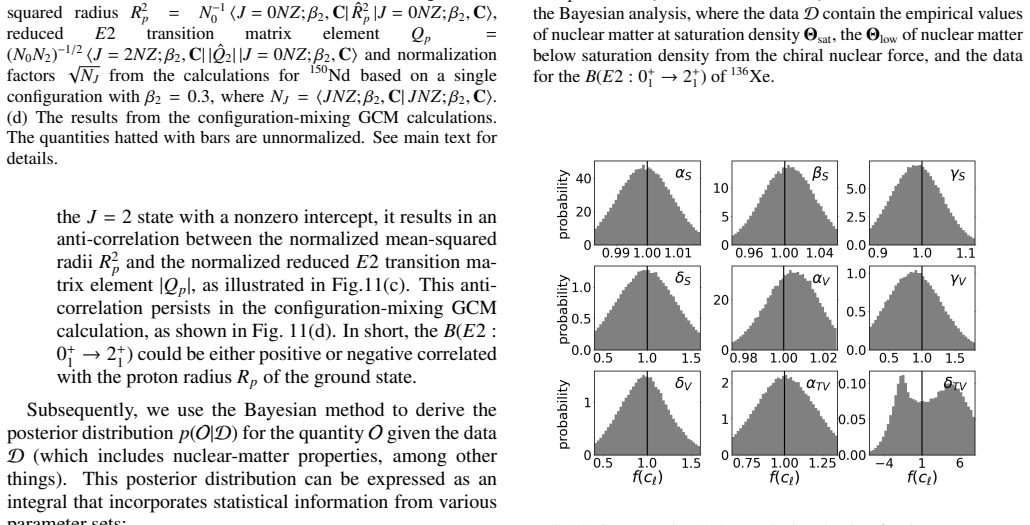
We present a theoretical framework to quantify statistical uncertainties in covariant density functional theory (CDFT) for both nuclear matter and finite nuclei, based on a relativistic point-coupling energy density functional (EDF). By sampling approximately one million parameter sets, with nine parameters varied around their values in the PC-PK1 functional, we construct a probability density function for nuclear matter properties. Incorporating empirical values of nuclear matter at saturation density and those of predictions from chiral nuclear forces, and measured $B(E2)$ values of finite nuclei, we infer posterior distributions for the model parameters within a Bayesian framework. These posterior distributions are then propagated to the low-lying states of finite nuclei using the newly developed subspace-projected (SP)-CDFT approach, in which the wave functions of target EDF parameter sets are expanded in a subspace spanned by low-lying states obtained from a set of training parameterizations. We find that the observables of low-lying states in deformed nuclei $^{150}$Nd and $^{150}$Sm are well reproduced once statistical uncertainties are taken into account. In contrast, those of near spherical nuclei $^{136}$Xe and $^{136}$Ba remain difficult to describe within the present framework, a limitation that is expected to be alleviated by extending the model space to include quasiparticle excitations.
Editorial analysis
A structured set of objections, weighed in public.
Referee Report
Summary. The manuscript develops a Bayesian framework for statistical uncertainty quantification in relativistic point-coupling covariant density functional theory (CDFT). Approximately one million parameter sets are sampled around the PC-PK1 functional; posteriors are conditioned on nuclear-matter saturation properties, chiral-force predictions, and measured B(E2) values. These posteriors are propagated to low-lying states of 150Nd, 150Sm, 136Xe, and 136Ba via the newly introduced subspace-projected CDFT (SP-CDFT), in which target wave functions are expanded in a subspace spanned by low-lying states from a limited set of training parameterizations. The central claim is that observables of the deformed nuclei fall inside the resulting uncertainty bands while those of the near-spherical nuclei do not, indicating that the present model space is insufficient for the latter.
Significance. If the SP-CDFT subspace projection is shown to be accurate for the sampled parameter sets, the work supplies a concrete, statistically grounded test of where CDFT discrepancies can be absorbed by parameter uncertainties (deformed cases) versus where they indicate missing physics (spherical cases). The combination of large-scale Monte Carlo sampling with a reduced-basis propagation method is a practical advance for uncertainty quantification in energy-density-functional calculations.
major comments (2)
- [SP-CDFT method description] The central claim that deformed-nucleus observables are reproduced within uncertainties rests on the assumption that the subspace spanned by low-lying states from the training parameterizations faithfully represents the wave functions of posterior-sampled EDF sets (abstract and final paragraph). No quantitative bound on the projection error is reported for 150Nd or 150Sm, nor is any validation against full calculations for parameter sets distant from the training points provided. This directly affects whether the reported agreement is genuine or an artifact of the reduced basis.
- [Results on finite-nucleus propagation] The manuscript states that ~1 million samples are drawn from the posterior and propagated via SP-CDFT, yet supplies no convergence diagnostics for the Monte Carlo sampling nor any measure of posterior widths or sensitivity to the number of training parameterizations. Without these, the widths of the uncertainty bands used to judge agreement for 150Nd/150Sm versus disagreement for 136Xe/136Ba cannot be assessed.
minor comments (1)
- [Methods] The number and selection criteria for the training parameterizations used to build the SP-CDFT subspace are not stated explicitly; this information should be added to the methods section for reproducibility.
Simulated Author's Rebuttal
We thank the referee for the careful reading of our manuscript and the constructive comments, which have helped identify areas where additional validation and diagnostics will strengthen the presentation. We address each major comment below and will revise the manuscript accordingly.
read point-by-point responses
-
Referee: The central claim that deformed-nucleus observables are reproduced within uncertainties rests on the assumption that the subspace spanned by low-lying states from the training parameterizations faithfully represents the wave functions of posterior-sampled EDF sets (abstract and final paragraph). No quantitative bound on the projection error is reported for 150Nd or 150Sm, nor is any validation against full calculations for parameter sets distant from the training points provided. This directly affects whether the reported agreement is genuine or an artifact of the reduced basis.
Authors: We agree that a quantitative assessment of the projection error is necessary to substantiate the reliability of SP-CDFT for the sampled parameter sets. In the revised manuscript we will add a dedicated subsection that reports the projection error on excitation energies and B(E2) values for 150Nd and 150Sm, obtained by comparing SP-CDFT results against full CDFT calculations performed for a representative subset of posterior samples lying outside the original training set. This will include explicit error bounds and a discussion of how the subspace dimension affects the accuracy. revision: yes
-
Referee: The manuscript states that ~1 million samples are drawn from the posterior and propagated via SP-CDFT, yet supplies no convergence diagnostics for the Monte Carlo sampling nor any measure of posterior widths or sensitivity to the number of training parameterizations. Without these, the widths of the uncertainty bands used to judge agreement for 150Nd/150Sm versus disagreement for 136Xe/136Ba cannot be assessed.
Authors: We acknowledge the need for explicit convergence checks and sensitivity measures. The revised version will include standard MCMC diagnostics (trace plots, autocorrelation times, and effective sample size) for the ~1 million posterior samples, together with the reported posterior widths for the EDF parameters and the propagated observables. We will also add a brief sensitivity study showing how the uncertainty bands change when the number of training parameterizations used to construct the SP-CDFT subspace is varied. revision: yes
Circularity Check
No significant circularity in Bayesian posterior propagation via SP-CDFT
full rationale
The paper constructs a prior by sampling ~1M parameter sets around PC-PK1, builds a PDF for nuclear matter properties, then infers posteriors from independent empirical nuclear-matter data at saturation, chiral-force predictions, and measured B(E2) values. Posteriors are propagated to low-lying observables of the target nuclei using the SP-CDFT subspace expansion, which is a fixed computational approximation based on a separate training set rather than a definitional identity or self-referential fit. The paper explicitly distinguishes outcomes for deformed versus near-spherical nuclei and notes the subspace limitation, confirming that reported agreement is not forced by construction but arises from the independent constraining data and the method's approximations. No step reduces a claimed prediction to its inputs by definition or renames a fit as a prediction.
Axiom & Free-Parameter Ledger
free parameters (1)
- nine point-coupling parameters
axioms (2)
- domain assumption The relativistic point-coupling EDF form is an adequate starting point for the nuclei considered.
- domain assumption The subspace spanned by training calculations captures the essential degrees of freedom for the target states.
Reference graph
Works this paper leans on
-
[1]
M. Bender, P.-H. Heenen, and P.-G. Reinhard, Rev. Mod. Phys. 75, 121 (2003)
work page 2003
-
[2]
D. Vretenar, A. Afanasjev, G. Lalazissis, and P. Ring, Physics Reports 409, 101 (2005)
work page 2005
- [3]
-
[4]
J. E. Drut, R. J. Furnstahl, and L. Platter, Prog. Part. Nucl. Phys. 64, 120 (2010), arXiv:0906.1463 [nucl-th]
work page internal anchor Pith review Pith/arXiv arXiv 2010
- [5]
-
[6]
G. A. Lalazissis, S. Raman, and P. Ring, Atom. Data Nucl. Data Tabl. 71, 1 (1999)
work page 1999
-
[7]
L. Geng, H. Toki, and J. Meng, Progress of Theoretical Physics 113, 785 (2005), https://academic.oup.com/ptp/article- pdf/113/4/785/5123587/113-4-785.pdf
work page 2005
- [8]
-
[9]
S. E. Agbemava, A. V . Afanasjev, and A. Taninah, Phys. Rev. C 99, 014318 (2019), arXiv:1811.11473 [nucl-th]
work page internal anchor Pith review Pith/arXiv arXiv 2019
- [10]
-
[11]
Recent Progress and New Challenges in Isospin Physics with Heavy-Ion Reactions
B.-A. Li, L.-W. Chen, and C. M. Ko, Phys. Rept. 464, 113 (2008), arXiv:0804.3580 [nucl-th]
work page internal anchor Pith review Pith/arXiv arXiv 2008
-
[12]
A. V . Afanasjev and S. E. Agbemava, Phys. Rev. C93, 054310 (2016), arXiv:1604.07296 [nucl-th]
work page internal anchor Pith review Pith/arXiv arXiv 2016
-
[13]
Error Estimates of Theoretical Models: a Guide
J. Dobaczewski, W. Nazarewicz, and P. G. Reinhard, J. Phys. G 41, 074001 (2014), arXiv:1402.4657 [nucl-th]
work page internal anchor Pith review Pith/arXiv arXiv 2014
- [14]
- [15]
- [16]
- [17]
-
[18]
J. D. Walecka, Annals Phys. 83, 491 (1974)
work page 1974
-
[19]
P. G. Reinhard, Rept. Prog. Phys. 52, 439 (1989)
work page 1989
-
[20]
Ring, Progress in Particle and Nuclear Physics 37, 193 (1996)
P. Ring, Progress in Particle and Nuclear Physics 37, 193 (1996)
work page 1996
-
[21]
J. Meng, Relativistic Density Functional for Nuclear Structure (WORLD SCIENTIFIC, 2016) https://www.worldscientific.com/doi/pdf/10.1142/9872
- [22]
-
[23]
D. Gambacurta, L. Li, G. Colo, U. Lombardo, N. Van Giai, and W. Zuo, Phys. Rev. C84, 024301 (2011)
work page 2011
- [24]
-
[25]
C. J. Yang, M. Grasso, and D. Lacroix, Phys. Rev. C96, 034318 (2017), arXiv:1706.00258 [nucl-th]
work page internal anchor Pith review Pith/arXiv arXiv 2017
-
[26]
Energy-density functionals inspired by effective-field theories: Applications to neutron drops
J. Bonnard, M. Grasso, and D. Lacroix, Phys. Rev. C 98, 034319 (2018), [Erratum: Phys.Rev.C 103, 039901 (2021)], arXiv:1806.01084 [nucl-th]
work page internal anchor Pith review Pith/arXiv arXiv 2018
-
[27]
Functional Renormalization Group and Kohn-Sham scheme in Density Functional Theory
H. Liang, Y . Niu, and T. Hatsuda, Phys. Lett. B 779, 436 (2018), arXiv:1710.00650 [cond-mat.str-el]
work page internal anchor Pith review Pith/arXiv arXiv 2018
-
[28]
S. Burrello, J. Bonnard, and M. Grasso, Phys. Rev. C 103, 064317 (2021), arXiv:2103.05996 [nucl-th]
- [29]
-
[30]
R. Navarro Pérez, N. Schunck, A. Dyhdalo, R. J. Furn- stahl, and S. K. Bogner, Phys. Rev. C 97, 054304 (2018), arXiv:1801.08615 [nucl-th]
work page internal anchor Pith review Pith/arXiv arXiv 2018
- [31]
- [32]
-
[33]
Effective density functionals beyond mean field
M. Grasso, Prog. Part. Nucl. Phys. 106, 256 (2019), arXiv:1811.01039 [nucl-th]
work page internal anchor Pith review Pith/arXiv arXiv 2019
- [34]
- [35]
-
[36]
J. D. McDonnell, N. Schunck, D. Higdon, J. Sarich, S. M. Wild, and W. Nazarewicz, Phys. Rev. Lett.114, 122501 (2015), arXiv:1501.03572 [nucl-th]
work page internal anchor Pith review Pith/arXiv arXiv 2015
-
[37]
S. E. Agbemava, A. V . Afanasjev, D. Ray, and P. Ring, Phys. Rev. C 89, 054320 (2014), arXiv:1404.4901 [nucl-th]
work page internal anchor Pith review Pith/arXiv arXiv 2014
-
[38]
P. Giuliani, K. Godbey, E. Bonilla, F. Viens, and J. Piekarewicz, (2022), arXiv:2209.13039 [nucl-th]
-
[39]
M. Salinas and J. Piekarewicz, Phys. Rev. C 107, 045802 (2023), arXiv:2301.09692 [nucl-th]
- [40]
-
[41]
J. M. Yao, “Symmetry Restoration Methods,” in Handbook of Nuclear Physics, edited by I. Tanihata, H. Toki, and T. Kajino (2022) pp. 1–36, arXiv:2204.12126 [nucl-th]
-
[42]
P. Ring and P. Schuck, The nuclear many-body problem (Springer-Verlag, New York, 1980)
work page 1980
- [43]
-
[44]
T. R. Rodríguez and J. L. Egido, Phys. Rev. C 81, 064323 (2010)
work page 2010
-
[45]
J. M. Yao, J. Meng, P. Ring, and D. Vretenar, Phys. Rev. C 81, 044311 (2010)
work page 2010
-
[46]
T. Nikši´c, D. Vretenar, and P. Ring, Prog. Part. Nucl. Phys. 66, 519 (2011)
work page 2011
-
[47]
L. M. Robledo, T. R. Rodríguez, and R. R. Rodríguez-Guzmán, J. Phys. G 46, 013001 (2019), arXiv:1807.02518 [nucl-th]
work page internal anchor Pith review Pith/arXiv arXiv 2019
-
[48]
J. A. Sheikh, J. Dobaczewski, P. Ring, L. M. Robledo, and C. Yannouleas, Journal of Physics G: Nuclear and Particle Physics 48, 123001 (2021)
work page 2021
-
[49]
X.-X. Sun and S.-G. Zhou, Phys. Rev. C 104, 064319 (2021), arXiv:2107.05925 [nucl-th]
- [50]
-
[51]
T. R. Rodríguez and G. Martínez-Pinedo, Phys. Rev. Lett. 105, 252503 (2010)
work page 2010
-
[52]
L. S. Song, J. M. Yao, P. Ring, and J. Meng, Phys. Rev. C 90, 054309 (2014)
work page 2014
- [53]
- [54]
-
[55]
Electric Dipole Moments of the Atoms, Molecules, Nuclei and Particles
T. Chupp, P. Fierlinger, M. Ramsey-Musolf, and J. Singh, Rev. Mod. Phys. 91, 015001 (2019), arXiv:1710.02504 [physics.atom-ph]
work page internal anchor Pith review Pith/arXiv arXiv 2019
-
[56]
G. Arrowsmith-Kron et al., Rept. Prog. Phys. 87, 084301 (2024), arXiv:2302.02165 [nucl-ex]
-
[57]
Tests of the standard electroweak model in beta decay
N. Severijns, M. Beck, and O. Naviliat-Cuncic, Rev. Mod. Phys. 78, 991 (2006), arXiv:nucl-ex/0605029
work page internal anchor Pith review Pith/arXiv arXiv 2006
- [58]
- [60]
- [61]
-
[62]
J. M. Yao, B. Bally, J. Engel, R. Wirth, T. R. Rodríguez, and H. Hergert, Phys. Rev. Lett. 124, 232501 (2020)
work page 2020
- [63]
- [64]
- [65]
- [66]
-
[67]
T. Sowi´nski and M. A. Garcia-March, Phys. Rev. C106, 024002 (2022), arXiv:2202.07493 [cond-mat.quant-gas]
- [68]
- [69]
-
[70]
Q. Y . Luo, X. Zhang, L. H. Chen, and J. M. Yao, Phys. Rev. C 110, 014309 (2024)
work page 2024
-
[71]
A. Ekström and G. Hagen, Phys. Rev. Lett.123, 252501 (2019), arXiv:1910.02922 [nucl-th]
- [72]
- [73]
- [74]
-
[75]
C. Drischler, M. Quinonez, P. G. Giuliani, A. E. Lovell, and F. M. Nunes, Phys. Lett. B 823, 136777 (2021), arXiv:2108.08269 [nucl-th]
- [76]
- [77]
-
[78]
C. Drischler, J. A. Melendez, R. J. Furnstahl, A. J. Gar- cia, and X. Zhang, Front. in Phys. 10, 1092931 (2022), arXiv:2212.04912 [nucl-th]
- [79]
-
[80]
J. M. Yao, J. Meng, P. Ring, and D. P. Arteaga, Phys. Rev. C 79, 044312 (2009)
work page 2009
- [81]
discussion (0)
Sign in with ORCID, Apple, or X to comment. Anyone can read and Pith papers without signing in.