REVIEW 3 major objections 4 minor 75 references
On the Surprising Effectiveness of Attention Transfer for Vision Transformers
T0 review · 3 major / 4 minor · reviewed 2026-08-12 · deepseek-v4-flash
Pith's one-line read Pre-training works because of attention maps, not learned features.
desk verdict Attention transfer is a real finding with a clean causal design, but the headline match to fine-tuning rests on a 200-epoch distillation run versus a 100-epoch baseline; the phenomenon survives, the exact equality does not. read the letter →
The pith
A machine-rendered reading of the paper's core claim, the machinery that carries it, and where it could break.
The reading
What carries the argument
The key object is the attention map in each multi-head self-attention block, defined as $\mathrm{softmax}(QK^\top)$; it is the only computation in a Vision Transformer that exchanges information between tokens, since value projections, MLPs, and normalization act per token. Attention Copy replaces the student's attention maps with frozen teacher maps, fully decoupling inter-token routing from intra-token feature learning. Attention Distillation replaces that hard constraint with a cross-entropy loss that pushes the student's attention maps toward the teacher's, summed over layers and heads, and the teacher is discarded at inference. This decoupling is what lets the experiments attribute the pre-training gain to information flow rather than to the features that flow through it.
What would settle it
Train a ViT-L from scratch on ImageNet-1K while distilling only the attention maps of a MAE-pretrained teacher, reproducing the paper's recipe; if an independent run cannot reach the reported 85.7 in-distribution accuracy, the sufficiency claim fails. A sharper check: if a fixed, input-independent attention pattern also reaches 85.7, then the learned content of the attention maps is not what carries the benefit.
Extended reading notes
Core claim
The central discovery is that for a pre-trained Vision Transformer, the attention map matrix $\mathrm{softmax}(QK^\top)$—the only operation that routes information between tokens—carries enough of the pre-training benefit to recover the full fine-tuning accuracy. With a MAE-pretrained ViT-L on ImageNet-1K, training from scratch reaches 83.0, full weight fine-tuning reaches 85.7, Attention Copy reaches 85.1, and Attention Distillation reaches 85.7. Attention Distillation also recovers most of the pre-training gain in COCO object detection, and ensembling a distilled student with a fine-tuned teacher improves ImageNet accuracy to 86.3, showing the student is not merely relearning the teacher. The same pattern holds for MoCo-v3, FLIP, and DINO teachers and across ViT-B/L/H sizes. The paper states the limits explicitly: attention transfer is consistently worse than fine-tuning on ImageNet-A, ImageNet-R, ImageNet-Sketch, and ImageNet-V2, and the gap widens when pretraining and downstream datasets differ, so pretrained features do add robustness and distribution-mismatch tolerance beyond what attention maps provide.
Load-bearing premise
The load-bearing premise is that 'downstream performance' is in-distribution accuracy on benchmarks similar to the pre-training data; once robustness to distribution shift or transfer to a different dataset is included, the paper's own experiments show attention maps alone do not suffice.
Editorial extensions
If this is right
- If attention maps are sufficient, the features learned in pre-training are not what fine-tuning needs, at least for in-distribution classification.
- Attention Distillation can replace weight fine-tuning with the same inference-time model and no layerwise learning-rate decay, since the student learns its own features from scratch.
- Ensembling an attention-distilled student with a fine-tuned teacher gives a concrete accuracy gain (86.3 on ImageNet-1K), because the two models make different errors.
- The transfer benefit scales with model size and is not specific to MAE, holding for contrastive (MoCo-v3) and image-text (FLIP) pretraining as well.
- Under distribution shift or large pretrain-to-downstream dataset differences, attention transfer underperforms fine-tuning, so pretrained features still carry robustness value.
Reading between the lines
- Inference: attention-map transfer could make cross-size transfer easier than weight fine-tuning, since attention maps are shaped by sequence length rather than embedding width; the paper raises this but does not test it.
- Inference: a hybrid that distills attention maps while also transferring a small amount of feature information might recover the out-of-distribution robustness that pure attention transfer lacks.
- Inference: the sufficiency result is naturally read as a statement about the optimization landscape—a randomly initialized student with good routing can fit in-distribution tasks as well as a pretrained network—so the mechanism is likely tied to the training dynamics of attention, not to the semantic content of the features.
- Inference: if attention maps are the reusable unit, sharing a small set of maps instead of full weights could address settings where weight sharing is undesirable for security or memory reasons.
Editorial analysis
A structured set of objections, weighed in public.
Referee Report
Summary. The paper proposes two methods, Attention Copy and Attention Distillation, to transfer only the attention maps of a pre-trained Vision Transformer teacher to a randomly initialized student, leaving all other weights to be learned from scratch. On ImageNet-1K with a MAE-pretrained ViT-L, Attention Copy reaches 85.1% top-1 accuracy and Attention Distillation reaches 85.7%, compared with 83.0% for training from scratch and 85.7% for full fine-tuning. The authors use these results to argue that pre-trained features are not essential and that the attention patterns alone largely account for the downstream benefit of pre-training. The paper also analyzes which layers, heads, and attention-related activations matter, shows that attention-transfer students are dissimilar to the fine-tuned teacher by CKA and ensembling, and documents settings where attention transfer underperforms fine-tuning, including cross-dataset transfer and out-of-distribution robustness.
Significance. If the central claim holds, the paper is significant: it challenges the standard feature-centric interpretation of pre-training for vision transformers and identifies inter-token attention routing as a separable, transferable component. The Attention Copy method is a genuinely clean decoupling of inter-token and intra-token computation, and the random-teacher control in Table 7 is a strong falsification check. The paper also honestly reports limitations in Section 5, and the code release will facilitate reproduction. However, the headline quantitative claim that Attention Distillation 'matches fine-tuning' currently rests on an unequal training budget, and one supporting baseline in the appendix is inconsistent with the main text. These issues affect the strength of the central claim and require correction before the paper can be accepted.
major comments (3)
- [Section 3; Appendix A.2; Appendix C, Table 16] The headline equality in Table 1 (Attention Distillation 85.7 = fine-tuning 85.7) is not an equal-budget comparison. The Attention Distillation recipe in Table 16 uses 200 epochs, warmup 20, base learning rate 1e-4, weight decay 0.3, drop path 0.2, distillation weight lambda=3, and distillation applied to the first 18 layers, while Appendix A.2 states that fine-tuning is 100 epochs of regular fine-tuning. No 200-epoch fine-tuning result is reported, so the equality may reflect the doubled training budget and selected hyperparameters rather than the sufficiency of attention maps. Please report fine-tuning under the same 200-epoch recipe, or provide an accuracy-versus-epoch curve showing that fine-tuning saturates by epoch 100, and also report Attention Distillation under the 100-epoch recipe used for the baselines. Without this control, the claim that attention transfer 'completely matches fine-tuning on ImageNet-1K' (Section 7) is not established. Note that the cleaner Attention Copy probe at 100 epochs reaches 85.1, recovering 77.8% of the gap, which remains a strong and interesting result even if the equality with fine-tuning is not confirmed.
- [Appendix B.2, Table 13] The scratch baseline in Table 13 is reported as 79.7, while the main text and Tables 1, 7, and 8 report scratch ViT-L accuracy as 83.0. Since Table 13 is used to argue that feature distillation (81.3) is not competitive with attention distillation (85.7), this inconsistency matters: if the 79.7 number comes from a different training recipe, the feature-distillation comparison is not controlled against the main scratch baseline. Please clarify which recipe produced the 79.7 result, or rerun the feature-distillation baseline with the same recipe as Table 15 and the main scratch experiments, and reconcile the discrepancy.
- [Abstract; Section 5.1 and 5.2, Tables 4-6] The abstract states that attention maps are 'sufficient for models to learn high quality features from scratch and achieve comparable downstream performance.' The paper's own Section 5 shows this fails under distribution shift: Attention Distillation is worse than fine-tuning on all four out-of-distribution benchmarks in Table 6, and Attention Copy degrades more than fine-tuning when the pre-training and downstream datasets differ in Tables 4 and 5. Since the authors explicitly acknowledge these limitations, this is not a fatal flaw, but the headline claim should be scoped to in-distribution ImageNet-1K classification or the term 'downstream performance' should be defined to exclude robustness. As written, the abstract overstates the generality of the sufficiency result.
minor comments (4)
- [Appendix C, Table 16] The table header 'layers copied' should read 'layers distilled' for the Attention Distillation recipe; the same wording appears in the surrounding text.
- [Section 4.1, Table 2 and Appendix B.3] The result that copying queries Q (85.6) outperforms copying the full attention map (85.1) is interesting, but the explanation in Appendix B.3 is speculative and the JSD analysis is acknowledged to have limitations. Consider stating more explicitly that Q transfer still transfers part of the attention computation, and that the result does not contradict the central inter-token-flow interpretation.
- [Figure 7 and Appendix B.3] The captions use 'PT' and 'FT' without defining them on first use; please spell out 'pre-trained teacher' and 'fine-tuned model'.
- [Section 5.3, Table 7] In the 'none' row, it would be helpful to state explicitly that the teacher is a randomly initialized ViT and that the student is also randomly initialized, to make the control condition unambiguous.
Circularity Check
No circularity: central attention-transfer claims rest on direct ImageNet accuracy comparisons, not on equations that reduce to their inputs.
full rationale
The paper's central claim is an empirical sufficiency result: a ViT trained with only copied or distilled attention maps from a pre-trained teacher, while learning all other weights from scratch, reaches ImageNet-1K accuracy comparable to full fine-tuning (Table 1: scratch 83.0, attn. copy 85.1, attn. distill 85.7, fine-tune 85.7). The measured quantity, top-1 accuracy on an external benchmark, is independent of the method's definition; neither Eq. (2) nor the training recipes in Tables 15-16 define accuracy in terms of the claim. The only self-citations are to Tian et al. [52, 53], used as background on transformer training dynamics and as an interpretive gloss ('This reinforces the theory from Tian et al. [53]'), not as premises from which the accuracy numbers are derived. The paper also includes controls that break any definitional collapse: copying from a randomly initialized teacher hurts (72.7 vs 83.0 scratch, Table 7); transferring averaged attention maps drops to 79.7-82.7 (Table 12); and feature distillation reaches only 81.3 (Table 13). These falsifiable contrasts confirm that the result is the empirical transfer of specific attention maps, not an identity. The reviewer's observation that Attention Distillation uses 200 epochs and λ=3 (Table 16) against a 100-epoch fine-tune (A.2) is a potential budget-equality confound for the 85.7=85.7 headline, but it is a validity concern, not a circularity: it does not make the claim true by definition or by fitted-parameter renaming. Hence no circular step; the paper is self-contained against external benchmarks.
Assumptions & free parameters
free parameters (2)
- distillation loss weight lambda =
3
- number of distilled layers =
18 of 24
assumptions (3)
- domain assumption Inter-token communication in a ViT is fully captured by the attention maps softmax(QK^T); all other operations are intra-token.
- domain assumption ImageNet-1K top-1 accuracy is an adequate measure of downstream performance for the sufficiency claim.
- domain assumption The selected teachers (MAE, MoCo-v3, FLIP, DINO) are representative of pre-training methods.
Cite this review
Pith. "Pith review of On the Surprising Effectiveness of Attention Transfer for Vision Transformers." pith.science (2026). https://pith.science/paper/OMLDDTTW
@misc{pith2026241109702,
  author       = {Pith},
  title        = {Pith review of: On the Surprising Effectiveness of Attention Transfer for Vision Transformers},
  year         = {2026},
  howpublished = {\url{https://pith.science/paper/OMLDDTTW}},
  note         = {Machine review of arXiv:2411.09702}
}
read the original abstract
Conventional wisdom suggests that pre-training Vision Transformers (ViT) improves downstream performance by learning useful representations. Is this actually true? We investigate this question and find that the features and representations learned during pre-training are not essential. Surprisingly, using only the attention patterns from pre-training (i.e., guiding how information flows between tokens) is sufficient for models to learn high quality features from scratch and achieve comparable downstream performance. We show this by introducing a simple method called attention transfer, where only the attention patterns from a pre-trained teacher ViT are transferred to a student, either by copying or distilling the attention maps. Since attention transfer lets the student learn its own features, ensembling it with a fine-tuned teacher also further improves accuracy on ImageNet. We systematically study various aspects of our findings on the sufficiency of attention maps, including distribution shift settings where they underperform fine-tuning. We hope our exploration provides a better understanding of what pre-training accomplishes and leads to a useful alternative to the standard practice of fine-tuning
Figures


Figures from the paper (7 more)



Reference graph
Works this paper leans on
-
[1]
J. L. Ba, J. R. Kiros, and G. E. Hinton. Layer normalization. arXiv:1607.06450, 2016
arXiv 2016
-
[2]
T. Brown, B. Mann, N. Ryder, M. Subbiah, J. D. Kaplan, P. Dhariwal, A. Neelakantan, P. Shyam, G. Sastry, A. Askell, S. Agarwal, A. Herbert-V oss, G. Krueger, T. Henighan, R. Child, A. Ramesh, D. Ziegler, J. Wu, C. Winter, C. Hesse, M. Chen, E. Sigler, M. Litwin, S. Gray, B. Chess, J. Clark, C. Berner, S. McCandlish, A. Radford, I. Sutskever, and D. Amodei...
work page 2020
- [3]
- [4]
-
[5]
M. Chen, A. Radford, R. Child, J. Wu, H. Jun, D. Luan, and I. Sutskever. Generative pretraining from pixels. In ICML, 2020
2020
-
[6]
T. Chen, S. Kornblith, M. Norouzi, and G. Hinton. A simple framework for contrastive learning of visual representations. In ICML, 2020
work page 2020
-
[7]
X. Chen, S. Xie, and K. He. An empirical study of training self-supervised Vision Transformers. In ICCV, 2021
work page 2021
-
[8]
K. Clark, M.-T. Luong, Q. V . Le, and C. D. Manning. ELECTRA: Pre-training text encoders as discriminators rather than generators. In ICLR, 2020
work page 2020
Show all 75 references
-
[9]
E. D. Cubuk, B. Zoph, J. Shlens, and Q. V . Le. Randaugment: Practical automated data augmentation with a reduced search space. In CVPR Workshops, 2020
2020
-
[10]
J. Deng, W. Dong, R. Socher, L.-J. Li, K. Li, and L. Fei-Fei. ImageNet: A large-scale hierarchical image database. In CVPR, 2009
2009
-
[11]
Devlin, M.-W
J. Devlin, M.-W. Chang, K. Lee, and K. Toutanova. BERT: Pre-training of deep bidirectional transformers for language understanding. In NAACL, 2019
2019
-
[12]
Dosovitskiy, L
A. Dosovitskiy, L. Beyer, A. Kolesnikov, D. Weissenborn, X. Zhai, T. Unterthiner, M. Dehghani, M. Minderer, G. Heigold, S. Gelly, J. Uszkoreit, and N. Houlsby. An image is worth 16x16 words: Transformers for image recognition at scale. In ICLR, 2021
2021
-
[13]
Duval, I
Q. Duval, I. Misra, and N. Ballas. A simple recipe for competitive low-compute self supervised vision models. arXiv preprint arXiv:2301.09451, 2023
2023 arXiv
-
[14]
A. Fang, G. Ilharco, M. Wortsman, Y . Wan, V . Shankar, A. Dave, and L. Schmidt. Data determines distributional robustness in contrastive language image pre-training (clip). In ICML, 2022
2022
-
[15]
Frankle and M
J. Frankle and M. Carbin. The lottery ticket hypothesis: Finding sparse, trainable neural networks. arXiv preprint arXiv:1803.03635, 2018
2018 arXiv
-
[16]
Girshick, J
R. Girshick, J. Donahue, T. Darrell, and J. Malik. Rich feature hierarchies for accurate object detection and semantic segmentation. In CVPR, 2014
2014
-
[17]
I. J. Goodfellow, J. Shlens, and C. Szegedy. Explaining and harnessing adversarial examples. arXiv preprint arXiv:1412.6572, 2014
2014 arXiv
-
[18]
Goyal, P
P. Goyal, P. Dollár, R. Girshick, P. Noordhuis, L. Wesolowski, A. Kyrola, A. Tulloch, Y . Jia, and K. He. Accurate, large minibatch SGD: Training ImageNet in 1 hour. arXiv:1706.02677, 2017
2017 arXiv
-
[19]
Z. Hao, J. Guo, D. Jia, K. Han, Y . Tang, C. Zhang, H. Hu, and Y . Wang. Learning efficient vision transformers via fine-grained manifold distillation. In NeurIPS, 2022
2022
-
[20]
K. He, X. Zhang, S. Ren, and J. Sun. Deep residual learning for image recognition. In CVPR, 2016
2016
-
[21]
K. He, H. Fan, Y . Wu, S. Xie, and R. Girshick. Momentum contrast for unsupervised visual representation learning. In CVPR, 2020
2020
-
[22]
K. He, X. Chen, S. Xie, Y . Li, P. Dollár, and R. Girshick. Masked autoencoders are scalable vision learners. In CVPR, 2022
2022
-
[23]
Hendrycks, S
D. Hendrycks, S. Basart, N. Mu, S. Kadavath, F. Wang, E. Dorundo, R. Desai, T. Zhu, S. Para- juli, M. Guo, et al. The many faces of robustness: A critical analysis of out-of-distribution generalization. In ICCV, 2021. 11
2021
-
[24]
Hendrycks, K
D. Hendrycks, K. Zhao, S. Basart, J. Steinhardt, and D. Song. Natural adversarial examples. In CVPR, 2021
2021
-
[25]
Hertz, R
A. Hertz, R. Mokady, J. Tenenbaum, K. Aberman, Y . Pritch, and D. Cohen-Or. Prompt-to- prompt image editing with cross attention control. arXiv preprint arXiv:2208.01626, 2022
2022 arXiv
-
[26]
Hinton, O
G. Hinton, O. Vinyals, and J. Dean. Distilling the knowledge in a neural network.arXiv preprint arXiv:1503.02531, 2015
2015 arXiv
-
[27]
Howard and S
J. Howard and S. Ruder. Universal language model fine-tuning for text classification. arXiv preprint arXiv:1801.06146, 2018
2018 arXiv
-
[28]
E. J. Hu, Y . Shen, P. Wallis, Z. Allen-Zhu, Y . Li, S. Wang, L. Wang, and W. Chen. Lora: Low-rank adaptation of large language models. arXiv preprint arXiv:2106.09685, 2021
2021 arXiv
-
[29]
Huang, Y
G. Huang, Y . Sun, Z. Liu, D. Sedra, and K. Q. Weinberger. Deep networks with stochastic depth. In ECCV, 2016
2016
-
[30]
Izmailov, P
P. Izmailov, P. Kirichenko, N. Gruver, and A. G. Wilson. On feature learning in the presence of spurious correlations. Advances in Neural Information Processing Systems, 35:38516–38532, 2022
2022
-
[31]
Jelassi, M
S. Jelassi, M. Sander, and Y . Li. Vision transformers provably learn spatial structure.Advances in Neural Information Processing Systems, 35:37822–37836, 2022
2022
-
[32]
Kornblith, M
S. Kornblith, M. Norouzi, H. Lee, and G. Hinton. Similarity of neural network representations revisited. In ICML, 2019
2019
-
[33]
LeCun, B
Y . LeCun, B. Boser, J. S. Denker, D. Henderson, R. E. Howard, W. Hubbard, and L. D. Jackel. Backpropagation applied to handwritten zip code recognition. Neural computation, 1989
1989
-
[34]
Y . Li, X. Lyu, N. Koren, L. Lyu, B. Li, and X. Ma. Neural attention distillation: Erasing backdoor triggers from deep neural networks. arXiv preprint arXiv:2101.05930, 2021
2021 arXiv
-
[35]
Y . Li, H. Mao, R. Girshick, and K. He. Exploring plain vision transformer backbones for object detection. In ECCV, 2022
2022
-
[36]
Y . Li, H. Fan, R. Hu, C. Feichtenhofer, and K. He. Scaling language-image pre-training via masking. In CVPR, 2023
2023
-
[37]
T.-Y . Lin, M. Maire, S. Belongie, J. Hays, P. Perona, D. Ramanan, P. Dollár, and C. L. Zitnick. Microsoft COCO: Common objects in context. In ECCV, 2014
2014
-
[38]
Loshchilov and F
I. Loshchilov and F. Hutter. SGDR: Stochastic gradient descent with warm restarts. In ICLR, 2017
2017
-
[39]
Loshchilov and F
I. Loshchilov and F. Hutter. Decoupled weight decay regularization. In ICLR, 2019
2019
-
[40]
Mahajan, R
D. Mahajan, R. Girshick, V . Ramanathan, K. He, M. Paluri, Y . Li, A. Bharambe, and L. van der Maaten. Exploring the limits of weakly supervised pretraining. In ECCV, 2018
2018
-
[41]
Navaneet, S
K. Navaneet, S. A. Koohpayegani, A. Tejankar, and H. Pirsiavash. Simreg: Regression as a simple yet effective tool for self-supervised knowledge distillation. arXiv preprint arXiv:2201.05131, 2022
2022 arXiv
-
[42]
Orseau, M
L. Orseau, M. Hutter, and O. Rivasplata. Logarithmic pruning is all you need. Advances in Neural Information Processing Systems, 33:2925–2934, 2020
2020
-
[43]
N. Park, W. Kim, B. Heo, T. Kim, and S. Yun. What do self-supervised vision transformers learn? arXiv preprint arXiv:2305.00729, 2023
2023 arXiv
-
[44]
Pensia, S
A. Pensia, S. Rajput, A. Nagle, H. Vishwakarma, and D. Papailiopoulos. Optimal lottery tickets via subset sum: Logarithmic over-parameterization is sufficient. Advances in neural information processing systems, 33:2599–2610, 2020
2020
-
[45]
Radford, J
A. Radford, J. W. Kim, C. Hallacy, A. Ramesh, G. Goh, S. Agarwal, G. Sastry, A. Askell, P. Mishkin, J. Clark, et al. Learning transferable visual models from natural language supervision. In ICML, 2021
2021
-
[46]
Ramanujan, M
V . Ramanujan, M. Wortsman, A. Kembhavi, A. Farhadi, and M. Rastegari. What’s hidden in a randomly weighted neural network? In Proceedings of the IEEE/CVF conference on computer vision and pattern recognition, pages 11893–11902, 2020. 12
2020
-
[47]
Recht, R
B. Recht, R. Roelofs, L. Schmidt, and V . Shankar. Do imagenet classifiers generalize to imagenet? In ICML, 2019
2019
-
[48]
Schuhmann, R
C. Schuhmann, R. Beaumont, R. Vencu, C. Gordon, R. Wightman, M. Cherti, T. Coombes, A. Katta, C. Mullis, M. Wortsman, et al. Laion-5b: An open large-scale dataset for training next generation image-text models. In NeurIPS, 2022
2022
-
[49]
N. Shazeer. Fast transformer decoding: One write-head is all you need. arXiv preprint arXiv:1911.02150, 2019
1911 arXiv
-
[50]
Srivastava, G
N. Srivastava, G. Hinton, A. Krizhevsky, I. Sutskever, and R. Salakhutdinov. Dropout: A simple way to prevent neural networks from overfitting. The Journal of Machine Learning Research, pages 1929–1958, 2014
1929
-
[51]
Szegedy, V
C. Szegedy, V . Vanhoucke, S. Ioffe, J. Shlens, and Z. Wojna. Rethinking the inception architec- ture for computer vision. In CVPR, 2016
2016
-
[52]
Y . Tian, Y . Wang, B. Chen, and S. Du. Scan and snap: Understanding training dynamics and token composition in 1-layer transformer. NeurIPS, 2023
2023
-
[53]
Y . Tian, Y . Wang, Z. Zhang, B. Chen, and S. Du. Joma: Demystifying multilayer transformers via joint dynamics of mlp and attention. ICLR, 2024
2024
-
[54]
Torralba and A
A. Torralba and A. A. Efros. Unbiased look at dataset bias. In CVPR, 2011
2011
-
[55]
Trockman and J
A. Trockman and J. Z. Kolter. Mimetic initialization of self-attention layers. arXiv preprint arXiv:2305.09828, 2023
2023 arXiv
-
[56]
Van Horn, O
G. Van Horn, O. Mac Aodha, Y . Song, Y . Cui, C. Sun, A. Shepard, H. Adam, P. Perona, and S. Belongie. The iNaturalist species classification and detection dataset. In CVPR, 2018
2018
-
[57]
Vaswani, N
A. Vaswani, N. Shazeer, N. Parmar, J. Uszkoreit, L. Jones, A. N. Gomez, L. Kaiser, and I. Polosukhin. Attention is all you need. In NeurIPS, 2017
2017
-
[58]
Venkataramanan, A
S. Venkataramanan, A. Ghodrati, Y . M. Asano, F. Porikli, and A. Habibian. Skip-attention: Improving vision transformers by paying less attention. arXiv preprint arXiv:2301.02240, 2023
2023 arXiv
-
[59]
Walmer, S
M. Walmer, S. Suri, K. Gupta, and A. Shrivastava. Teaching matters: Investigating the role of supervision in vision transformers. In CVPR, 2023
2023
-
[60]
H. Wang, S. Ge, Z. Lipton, and E. P. Xing. Learning robust global representations by penalizing local predictive power. In NeurIPS, 2019
2019
-
[61]
K. Wang, F. Yang, and J. van de Weijer. Attention distillation: self-supervised vision transformer students need more guidance. arXiv preprint arXiv:2210.00944, 2022
2022 arXiv
-
[62]
W. Wang, F. Wei, L. Dong, H. Bao, N. Yang, and M. Zhou. Minilm: Deep self-attention distillation for task-agnostic compression of pre-trained transformers. Advances in Neural Information Processing Systems, 33:5776–5788, 2020
2020
-
[63]
Z. Xie, Z. Geng, J. Hu, Z. Zhang, H. Hu, and Y . Cao. Revealing the dark secrets of masked image modeling. In CVPR, 2023
2023
-
[64]
Z. Yang, J. Zhao, B. Dhingra, K. He, W. W. Cohen, R. Salakhutdinov, and Y . LeCun. Glomo: Unsupervisedly learned relational graphs as transferable representations. arXiv preprint arXiv:1806.05662v1, 2018
2018 arXiv
-
[65]
S. Yun, D. Han, S. J. Oh, S. Chun, J. Choe, and Y . Yoo. Cutmix: Regularization strategy to train strong classifiers with localizable features. In ICCV, 2019
2019
-
[66]
Zagoruyko and N
S. Zagoruyko and N. Komodakis. Paying more attention to attention: Improving the performance of convolutional neural networks via attention transfer. In ICLR, 2017
2017
-
[67]
Zhang, M
H. Zhang, M. Cisse, Y . N. Dauphin, and D. Lopez-Paz. mixup: Beyond empirical risk mini- mization. In ICLR, 2018
2018
-
[68]
feature distill
Y . Zhang, A. Backurs, S. Bubeck, R. Eldan, S. Gunasekar, and T. Wagner. Unveiling transform- ers with lego: a synthetic reasoning task. arXiv preprint arXiv:2206.04301, 2022. 13 Appendix A Key Numbers A.1 Information in Attention Transfer How much information is transferred d...
2022 arXiv
-
[69]
This can fail since similar heads may not be in the same order across models
Direct pair: this is the naive approach of computing the JSD between the ith head of the first model and the ith head of the second model. This can fail since similar heads may not be in the same order across models
-
[70]
We then use bipartite matching to create a one-to-one pairing between the heads that minimizes the cumulative JSD
Bipartite matching: for each layer, we compute the JSD between each of the 16 heads in the first model and the 16 heads in the second model. We then use bipartite matching to create a one-to-one pairing between the heads that minimizes the cumulative JSD. This solves the previ...
-
[71]
We call this Minimum because each head in the first model is paired with the head from the second model with the smallest JSD
Minimum: instead of creating a one-to-one matching, we allow many-to-one matching between heads. We call this Minimum because each head in the first model is paired with the head from the second model with the smallest JSD. This allows our metric to potentially ignore extraneo...
-
[72]
This can still be thrown off by extraneous heads
Averaged maps: we average the attention maps of all heads in a layer and compare the averaged maps across models. This can still be thrown off by extraneous heads. Figure 7 shows the results of comparing models against the pre-trained teacher (top row) or fine-tuned model (bot...
-
[73]
Head 1 attends uniformly over all locations, head 2 attends arbitrarily over locations, and the second head’s values are set to 0
-
[74]
Head 1 attends uniformly over the top half of the image, head 2 attends uniformly over the bottom half of the image, and both use values V /2
-
[75]
sweet spot
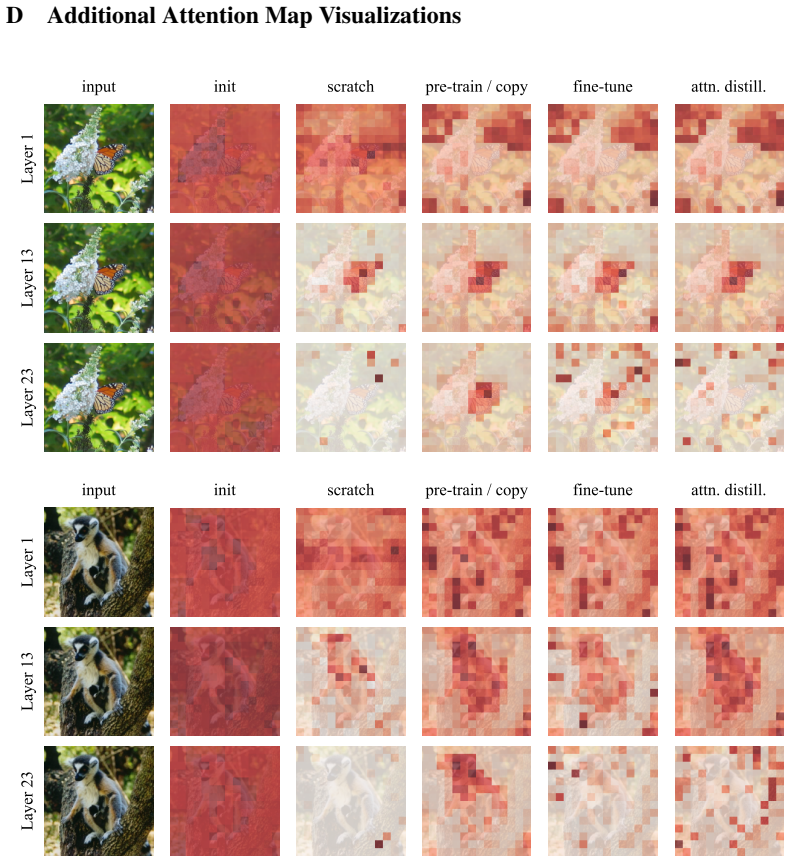
Head 1 attends uniformly over the left half of the image, head 2 attends uniformly over the right half of the image, and both use values V /2. 16 Layer 1 input init scratch pre-train / copy fine-tune attn. distill. Layer 13 Layer 23 Figure 8: Visualization of attention maps fo...
Reviewed August 12, 2026 · model on record in the stance chip above.
Discussion (0). Continue with ORCID to comment.