REVIEW 3 major objections 5 minor 83 references
The Surprising Ineffectiveness of Pre-Trained Visual Representations for Model-Based Reinforcement Learning
T0 review · 3 major / 5 minor · reviewed 2026-08-12 · deepseek-v4-flash
Pith's one-line read On three visual control benchmarks, model-based RL agents with pre-trained visual representations are no more sample-efficient and no better at out-of-distribution generalization than agents that learn their encoder from scratch.
desk verdict A substantial first MBRL-specific PVR benchmark whose headline negative result is plausible but partly confounded by the DreamerV3 decoder-target asymmetry. read the letter →
The pith
A machine-rendered reading of the paper's core claim, the machinery that carries it, and where it could break.
The reading
What carries the argument
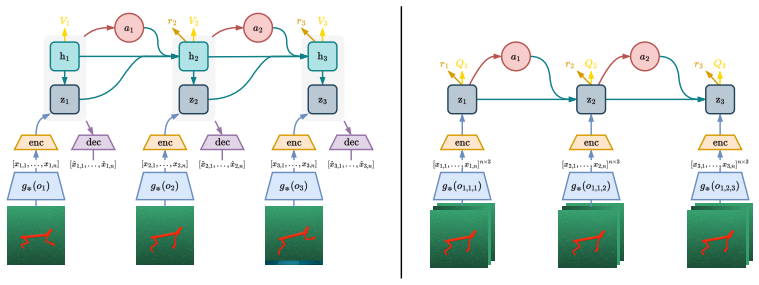
The argument runs through a specific integration scheme: the frozen PVR acts as a fixed feature extractor whose output $x_t$ replaces the raw image as the input to the MBRL agent, with only a single linear layer trained on top to map $x_t$ into the latent state (for DreamerV3, the linear map feeds the discrete-latent encoder; for TD-MPC2, a stack of three embeddings is fed to its encoder). The paper then dissects results with three instruments: normalized ID/OOD return curves, a categorization of PVRs by training properties (ViT vs. non-ViT, diverse data, sequential data, language conditioning), and world-model diagnostics on a pendulum task measuring accumulated dynamics prediction error, accumulated reward error, and UMAP projections of the latent state colored by reward. Notably, in DreamerV3 the decoder reconstructs the frozen embedding $x_t$, not the original image observation.
What would settle it
Train a from-scratch DreamerV3 agent whose decoder reconstructs a low-dimensional embedding of the same size as a PVR output, rather than the raw $64\times64$ image; if performance drops to the PVR level, the reconstruction target is the cause. The reverse test, letting a PVR-based agent reconstruct the raw image through the frozen encoder and showing it beats from scratch, would overturn the paper's conclusion.
Extended reading notes
Core claim
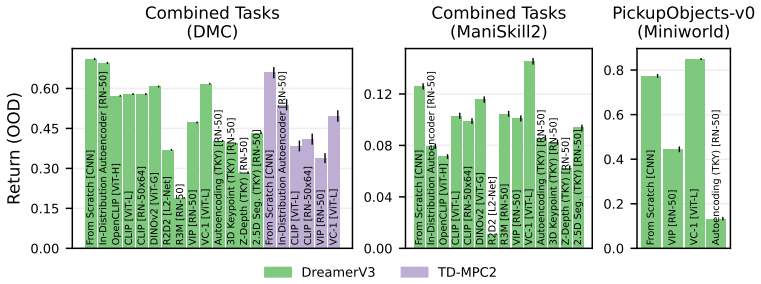
The central discovery, on the paper's own terms, is that for model-based RL the transfer benefits of pre-trained visual representations do not materialize. Across DreamerV3 and TD-MPC2 on DMC, ManiSkill2, and Miniworld, a representation learned from scratch is at least as data-efficient as any of the thirteen PVR variants and often better, and it also wins in held-out out-of-distribution settings. The paper attributes this to the objective mismatch of MBRL and to the information bottleneck of PVRs: frozen features trained without a reward signal do not preserve the reward information the world model needs, so PVR-based agents struggle to predict rewards accurately (reward prediction error correlates negatively with task performance, $r = -0.66$), while dynamics prediction quality is comparable across representations. The authors conclude that the common assumption that PVRs improve model-based agents — carried over from model-free RL and imitation learning — does not hold for current PVRs, and that data diversity and network architecture, not language conditioning or sequential pre-training data, are what drive OOD generalization.
Load-bearing premise
The load-bearing assumption is that decoding the frozen pre-trained features instead of the original image is an equivalent way to train the agent's internal predictor of how the environment evolves; if the reconstruction target changes what that predictor learns, the from-scratch advantage could come from the interface rather than from the representations.
Editorial extensions
If this is right
- Model-based RL practitioners gain nothing, in these settings, from swapping in a frozen CLIP-, DINOv2-, or VC-1-class encoder instead of training a CNN from scratch; data efficiency is equal or worse.
- OOD generalization of the agent is not inherited from the PVR: held-out visual shifts are handled better by the scratch encoder in the benchmark.
- Because reward prediction error, not dynamics prediction error, tracks task performance, improving a PVR-based world model should focus on reward-relevant information, not on more accurate state prediction.
- Data diversity and ViT backbone are the PVR properties that matter most for OOD performance; language conditioning and sequential pre-training data play minor roles.
- Pre-training an encoder on the downstream task's own data distribution does not help either, so the failure is not simply domain mismatch.
Reading between the lines
- The comparison is asymmetric: DreamerV3 with a PVR decodes the frozen embedding, while the from-scratch baseline reconstructs the raw $64\times64$ or $128\times128$ image; if the reconstruction target changes what the world model learns, part of the scratch advantage could be an artifact of this integration rather than of PVRs. This confound is stated in the appendix but never tested.
- A direct test would be to let a from-scratch encoder also decode a low-dimensional embedding instead of pixels, or to train a PVR-based agent with a decoder that reconstructs pixels through the frozen features; either design would isolate the representation from the interface.
- The reward-bottleneck result suggests a concrete recipe for future PVRs aimed at MBRL: pre-training objectives should include reward or value information, such as value-implicit or goal-conditioned losses, rather than only reconstruction or contrastive image-text alignment.
- Because sequential training data helped in manipulation and navigation domains but not in DMC, the usefulness of video pre-training may depend on the structure of the downstream task; testing more control families could reveal when temporal priors matter.
Editorial analysis
A structured set of objections, weighed in public.
Referee Report
Summary. The paper benchmarks a set of pre-trained visual representations (PVRs), including CLIP, DINOv2, OpenCLIP, R3M, VIP, VC-1, Taskonomy variants, and an in-distribution autoencoder, in two model-based RL algorithms (DreamerV3 and TD-MPC2) across 10 tasks in DMC, ManiSkill2, and Miniworld. It measures in-distribution sample efficiency and out-of-distribution generalization under visual randomization shifts, and analyzes world-model quality in terms of accumulated dynamics and reward prediction errors. The headline finding is that frozen PVRs with a linear encoder do not improve sample efficiency or OOD generalization over a from-scratch CNN encoder, and that the from-scratch baseline is often better; the paper further attributes OOD success to data diversity and ViT architecture. The evaluation uses 4-6 seeds per condition and 200 evaluation rollouts per seed (1200 per representation-environment), with standard errors shown.
Significance. If the headline result holds, the paper provides a timely and useful negative result: it challenges the assumption that the benefits of PVRs documented in model-free RL transfer to model-based RL, and it does so with a relatively broad benchmark spanning three domains, two MBRL algorithms, and 14 representation variants. The OOD holdout protocol is principled, the hyperparameter details and code links are provided, and the authors transparently state limitations. However, the strength of the conclusion is moderated by a decoder-target asymmetry in the DreamerV3 integration and by the restriction to frozen backbones; the current phrasing of the abstract overstates the scope of what is actually tested.
major comments (3)
- [Section 3.1 / Appendix A.1] In the DreamerV3 PVR variant, the world model decodes the PVR embedding x_t instead of the full input image o_t, while the from-scratch baseline reconstructs 64x64 (DMC/Miniworld) or 128x128 (ManiSkill2) RGB images. DreamerV3's reconstruction loss is a primary learning signal for the world model, so this changes the training objective between conditions. The scratch advantage may therefore be an artifact of the reconstruction target rather than of the PVR itself. The in-domain autoencoder control uses the same embedding-decoding setup, so it cannot rule out this confound. Since the ManiSkill2 and Miniworld claims rest entirely on DreamerV3, the authors need either a pixel-decoding PVR variant or an explicit control that isolates the decoder target before the central negative claim can be supported.
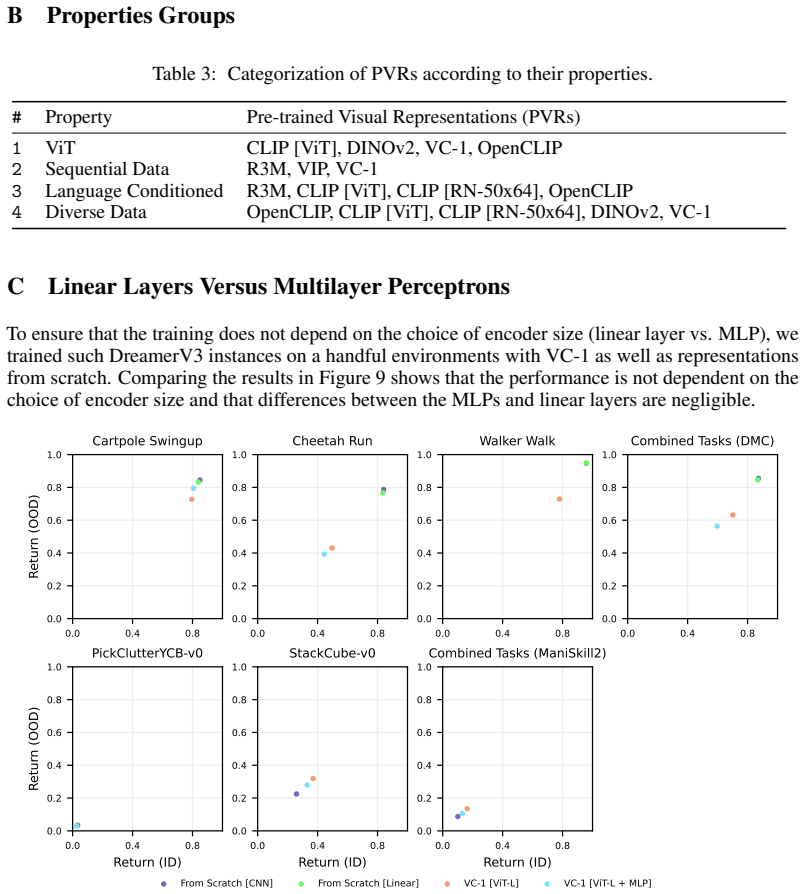
- [Abstract / Section 4.1] The abstract and Section 4.1 claim that 'current PVRs are not more sample efficient' than representations learned from scratch, but the experiments only cover frozen PVRs with a single linear layer. The MLP comparison in Appendix C keeps the backbone frozen and is limited to VC-1 and scratch on a few tasks, so it does not address fine-tuning or other adapter architectures that are commonly used in the PVR-for-RL literature. Fine-tuning can change the objective mismatch dynamics that the paper emphasizes. The conclusions should be scoped to 'frozen PVRs' or supplemented by fine-tuning experiments to match the evidence.
- [Section 4.3 / Table 3] The property analysis groups at most four PVRs per category, with overlapping category memberships and no statistical test. The categories are also confounded: the ViT group largely overlaps with the diverse-data group (DINOv2, OpenCLIP, VC-1, CLIP-ViT), so the claim that data diversity and network architecture are 'the most important contributors' to OOD generalization is stronger than the descriptive IQM plots can support. A formal analysis, such as a regression or permutation test across the PVR-level scores, is needed to separate architecture from data diversity and to quantify uncertainty.
minor comments (5)
- [Appendix A.1] For ManiSkill2, the PVR-based DreamerV3 variants disable symlog while the from-scratch baseline keeps it ('For the ManiSkill environments we found that not applying symlog to the PVR-based instances performs better'); this is a second asymmetric treatment whose effect should be reported and ideally ablated.
- [Figure 4] The caption states that 'the baseline representation learned from scratch outperforms all PVRs, even in the OOD settings,' but the plotted standard errors may overlap with some PVRs. The claim would be strengthened by reporting bootstrap confidence intervals or a paired statistical comparison.
- [Section 4.3] The word 'suprising' should be 'surprising'.
- [Appendix A.1] It would be helpful to state explicitly that the PVR embeddings, rather than raw images, are stored in the replay buffer; this makes the decoder-target difference a design choice rather than a minor implementation detail.
- [Section 4.4] The world-model quality analysis is conducted only on the Pendulum-Swingup task, and the correlations (r = -0.22, p = 0.4; r = -0.66, p = 0.004) are computed over a small number of representation-level points; the text should acknowledge the single-task, small-sample nature of this analysis.
Circularity Check
No circularity: the paper's central negative result is a direct empirical comparison, not a derived or fitted claim.
full rationale
The paper's central claims—that pre-trained visual representations do not improve MBRL sample efficiency or OOD generalization, and that from-scratch representations often outperform PVRs—are supported by measured returns from benchmark runs rather than by a derivation from fitted parameters or by definitions that presuppose the conclusion. The only equations in the paper are standard normalization and exploration-reward modifications (Eqs. 1 and 2), and neither encodes the PVR-ineffectiveness result. The property analysis in Section 4.3 groups PVRs after seeing the measured outcomes; this is a post hoc narrative reading of the same data, but it is explicitly an explanatory analysis and does not make the headline empirical claim circular. The sole self-citation appears to be Watter et al. [14] in Related Work, a historical MBRL reference that is not load-bearing for the benchmark conclusions. Appendix A.1 states that PVR-based DreamerV3 'decodes the encoding x only and not the whole input image o' while the from-scratch baseline reconstructs 64x64 or 128x128 pixel images; this asymmetry is a potential confound, but a confound is not circularity because the result does not reduce to its inputs by construction. No equation, fitted parameter, or self-citation chain forces the negative result, so the circularity score is 0.
Assumptions & free parameters
assumptions (3)
- domain assumption DreamerV3 and TD-MPC2 are representative MBRL algorithms; conclusions about 'MBRL' generalize from these two.
- domain assumption Held-out randomizations of colors, sizes, and object configurations constitute out-of-distribution shifts similar to real-world visual shifts.
- ad hoc to paper Frozen PVR plus a linear layer is an adequate integration of pre-trained representations in MBRL.
Cite this review
Pith. "Pith review of The Surprising Ineffectiveness of Pre-Trained Visual Representations for Model-Based Reinforcement Learning." pith.science (2026). https://pith.science/paper/VKVMD6EW
@misc{pith2026241110175,
  author       = {Pith},
  title        = {Pith review of: The Surprising Ineffectiveness of Pre-Trained Visual Representations for Model-Based Reinforcement Learning},
  year         = {2026},
  howpublished = {\url{https://pith.science/paper/VKVMD6EW}},
  note         = {Machine review of arXiv:2411.10175}
}
read the original abstract
Visual Reinforcement Learning (RL) methods often require extensive amounts of data. As opposed to model-free RL, model-based RL (MBRL) offers a potential solution with efficient data utilization through planning. Additionally, RL lacks generalization capabilities for real-world tasks. Prior work has shown that incorporating pre-trained visual representations (PVRs) enhances sample efficiency and generalization. While PVRs have been extensively studied in the context of model-free RL, their potential in MBRL remains largely unexplored. In this paper, we benchmark a set of PVRs on challenging control tasks in a model-based RL setting. We investigate the data efficiency, generalization capabilities, and the impact of different properties of PVRs on the performance of model-based agents. Our results, perhaps surprisingly, reveal that for MBRL current PVRs are not more sample efficient than learning representations from scratch, and that they do not generalize better to out-of-distribution (OOD) settings. To explain this, we analyze the quality of the trained dynamics model. Furthermore, we show that data diversity and network architecture are the most important contributors to OOD generalization performance.
Figures


Figures from the paper (9 more)




Reference graph
Works this paper leans on
-
[1]
Learning transferable visual models from natural language supervision
Alec Radford, Jong Wook Kim, Chris Hallacy, Aditya Ramesh, Gabriel Goh, Sandhini Agarwal, Girish Sastry, Amanda Askell, Pamela Mishkin, Jack Clark, et al. Learning transferable visual models from natural language supervision. In International Conference on Machine Learning , pages 8748–8763. PMLR, 2021
2021
-
[2]
Cliport: What and where pathways for robotic manipulation
Mohit Shridhar, Lucas Manuelli, and Dieter Fox. Cliport: What and where pathways for robotic manipulation. In Conference on robot learning, pages 894–906. PMLR, 2022
2022
-
[3]
Simple but effective: Clip embeddings for embodied ai
Apoorv Khandelwal, Luca Weihs, Roozbeh Mottaghi, and Aniruddha Kembhavi. Simple but effective: Clip embeddings for embodied ai. In Proceedings of the IEEE/CVF Conference on Computer Vision and Pattern Recognition, pages 14829–14838, 2022
2022
-
[4]
Perceiver-actor: A multi-task transformer for robotic manipulation
Mohit Shridhar, Lucas Manuelli, and Dieter Fox. Perceiver-actor: A multi-task transformer for robotic manipulation. In Conference on Robot Learning, pages 785–799. PMLR, 2023
2023
-
[5]
Objective mismatch in model-based reinforcement learning
Nathan Lambert, Brandon Amos, Omry Yadan, and Roberto Calandra. Objective mismatch in model-based reinforcement learning. In Learning for Dynamics and Control , pages 761–770. PMLR, 2020
work page 2020
-
[6]
Imagenet: A large- scale hierarchical image database
Jia Deng, Wei Dong, Richard Socher, Li-Jia Li, Kai Li, and Li Fei-Fei. Imagenet: A large- scale hierarchical image database. In 2009 IEEE conference on computer vision and pattern recognition, pages 248–255. Ieee, 2009
2009
-
[7]
Ego4d: Around the world in 3,000 hours of egocentric video
Kristen Grauman, Andrew Westbury, Eugene Byrne, Zachary Chavis, Antonino Furnari, Rohit Girdhar, Jackson Hamburger, Hao Jiang, Miao Liu, Xingyu Liu, et al. Ego4d: Around the world in 3,000 hours of egocentric video. In Proceedings of the IEEE/CVF Conference on Computer Vision and Pattern Recognition, pages 18995–19012, 2022
2022
-
[8]
Mas- tering the game of go with deep neural networks and tree search
David Silver, Aja Huang, Chris J Maddison, Arthur Guez, Laurent Sifre, George Van Den Driess- che, Julian Schrittwieser, Ioannis Antonoglou, Veda Panneershelvam, Marc Lanctot, et al. Mas- tering the game of go with deep neural networks and tree search. nature, 529(7587):484–489, 2016
2016
Show all 83 references
-
[9]
A general reinforcement learning algorithm that masters chess, shogi, and go through self-play
David Silver, Thomas Hubert, Julian Schrittwieser, Ioannis Antonoglou, Matthew Lai, Arthur Guez, Marc Lanctot, Laurent Sifre, Dharshan Kumaran, Thore Graepel, et al. A general reinforcement learning algorithm that masters chess, shogi, and go through self-play. Science, 362(64...
2018
-
[10]
Mastering atari, go, chess and shogi by planning with a learned model
Julian Schrittwieser, Ioannis Antonoglou, Thomas Hubert, Karen Simonyan, Laurent Sifre, Si- mon Schmitt, Arthur Guez, Edward Lockhart, Demis Hassabis, Thore Graepel, et al. Mastering atari, go, chess and shogi by planning with a learned model. Nature, 588(7839):604–609, 2020
2020
-
[11]
Mastering diverse domains through world models
Danijar Hafner, Jurgis Pasukonis, Jimmy Ba, and Timothy Lillicrap. Mastering diverse domains through world models. arXiv preprint arXiv:2301.04104, 2023
2023 arXiv
-
[12]
Deep rein- forcement learning in a handful of trials using probabilistic dynamics models
Kurtland Chua, Roberto Calandra, Rowan McAllister, and Sergey Levine. Deep rein- forcement learning in a handful of trials using probabilistic dynamics models. In S. Ben- gio, H. Wallach, H. Larochelle, K. Grauman, N. Cesa-Bianchi, and R. Garnett, edi- tors, Advances in Neural...
2018
-
[13]
Deep dynamics models for learning dexterous manipulation
Anusha Nagabandi, Kurt Konolige, Sergey Levine, and Vikash Kumar. Deep dynamics models for learning dexterous manipulation. In Conference on Robot Learning , pages 1101–1112. PMLR, 2020
2020
-
[14]
Embed to control: A locally linear latent dynamics model for control from raw images
Manuel Watter, Jost Springenberg, Joschka Boedecker, and Martin Riedmiller. Embed to control: A locally linear latent dynamics model for control from raw images. In C. Cortes, N. Lawrence, D. Lee, M. Sugiyama, and R. Garnett, editors, Advances in Neural Information Processing ...
2015
-
[15]
World models
David Ha and J ¨urgen Schmidhuber. World models. arXiv preprint arXiv:1803.10122, 2018
2018 arXiv
-
[16]
Learning latent dynamics for planning from pixels
Danijar Hafner, Timothy Lillicrap, Ian Fischer, Ruben Villegas, David Ha, Honglak Lee, and James Davidson. Learning latent dynamics for planning from pixels. In International Conference on Machine Learning, pages 2555–2565. PMLR, 2019
2019
-
[17]
Dream to control: Learning behaviors by latent imagination
Danijar Hafner, Timothy Lillicrap, Jimmy Ba, and Mohammad Norouzi. Dream to control: Learning behaviors by latent imagination. In International Conference on Learning Representa- tions, 2020. URL https://openreview.net/forum?id=S1lOTC4tDS
2020
-
[18]
Storm: Efficient stochastic transformer based world models for reinforcement learning
Weipu Zhang, Gang Wang, Jian Sun, Yetian Yuan, and Gao Huang. Storm: Efficient stochastic transformer based world models for reinforcement learning. In A. Oh, T. Nau- mann, A. Globerson, K. Saenko, M. Hardt, and S. Levine, editors, Advances in Neu- ral Information Processing S...
2023
-
[19]
Models, pixels, and rewards: Evaluating design trade-offs in visual model-based reinforcement learning
Mohammad Babaeizadeh, Mohammad Taghi Saffar, Danijar Hafner, Harini Kannan, Chelsea Finn, Sergey Levine, and Dumitru Erhan. Models, pixels, and rewards: Evaluating design trade-offs in visual model-based reinforcement learning. arXiv preprint arXiv:2012.04603 , 2020
2012 arXiv
-
[20]
Reinforcement learning with action-free pre-training from videos
Younggyo Seo, Kimin Lee, Stephen L James, and Pieter Abbeel. Reinforcement learning with action-free pre-training from videos. In International Conference on Machine Learning , pages 19561–19579. PMLR, 2022
2022
-
[21]
Pre-training contextual- ized world models with in-the-wild videos for reinforcement learning
Jialong Wu, Haoyu Ma, Chaoyi Deng, and Mingsheng Long. Pre-training contextual- ized world models with in-the-wild videos for reinforcement learning. In A. Oh, T. Nau- mann, A. Globerson, K. Saenko, M. Hardt, and S. Levine, editors, Advances in Neu- ral Information Processing ...
2023
-
[22]
Morel: Model-based offline reinforcement learning
Rahul Kidambi, Aravind Rajeswaran, Praneeth Netrapalli, and Thorsten Joachims. Morel: Model-based offline reinforcement learning. In H. Larochelle, M. Ranzato, R. Hadsell, M.F. Bal- can, and H. Lin, editors, Advances in Neural Information Processing Systems , volume 33, pages ...
2020
-
[23]
Mopo: Model-based offline policy optimization
Tianhe Yu, Garrett Thomas, Lantao Yu, Stefano Ermon, James Y Zou, Sergey Levine, Chelsea Finn, and Tengyu Ma. Mopo: Model-based offline policy optimization. In H. Larochelle, M. Ranzato, R. Hadsell, M.F. Balcan, and H. Lin, editors, Advances in Neu- ral Information Processing ...
2020
-
[24]
Combo: Conservative offline model-based policy optimization
Tianhe Yu, Aviral Kumar, Rafael Rafailov, Aravind Rajeswaran, Sergey Levine, and Chelsea Finn. Combo: Conservative offline model-based policy optimization. In M. Ranzato, A. Beygelzimer, Y . Dauphin, P.S. Liang, and J. Wortman Vaughan, editors, Advances in Neural Information P...
2021
-
[25]
Re- inforcement learning with augmented data
Misha Laskin, Kimin Lee, Adam Stooke, Lerrel Pinto, Pieter Abbeel, and Aravind Srinivas. Re- inforcement learning with augmented data. In H. Larochelle, M. Ranzato, R. Hadsell, M.F. Bal- can, and H. Lin, editors, Advances in Neural Information Processing Systems , volume 33, p...
2020
-
[26]
Image augmentation is all you need: Regu- larizing deep reinforcement learning from pixels
Denis Yarats, Ilya Kostrikov, and Rob Fergus. Image augmentation is all you need: Regu- larizing deep reinforcement learning from pixels. In International Conference on Learning Representations, 2021. URL https://openreview.net/forum?id=GY6-6sTvGaf. 13
2021
-
[27]
Mastering visual continuous control: Improved data-augmented reinforcement learning
Denis Yarats, Rob Fergus, Alessandro Lazaric, and Lerrel Pinto. Mastering visual continuous control: Improved data-augmented reinforcement learning. In International Conference on Learning Representations, 2022. URL https://openreview.net/forum?id=_SJ-_yyes8
2022
-
[28]
Curl: Contrastive unsupervised represen- tations for reinforcement learning
Michael Laskin, Aravind Srinivas, and Pieter Abbeel. Curl: Contrastive unsupervised represen- tations for reinforcement learning. In International Conference on Machine Learning , pages 5639–5650. PMLR, 2020
2020
-
[29]
Pre-trained image encoder for generalizable visual reinforcement learning
Zhecheng Yuan, Zhengrong Xue, Bo Yuan, Xueqian Wang, YI WU, Yang Gao, and Huazhe Xu. Pre-trained image encoder for generalizable visual reinforcement learning. In S. Koyejo, S. Mohamed, A. Agarwal, D. Belgrave, K. Cho, and A. Oh, editors, Advances in Neu- ral Information Proce...
2022
-
[30]
Batch normalization: Accelerating deep network training by reducing internal covariate shift
Sergey Ioffe and Christian Szegedy. Batch normalization: Accelerating deep network training by reducing internal covariate shift. In International Conference on Machine Learning , pages 448–456. PMLR, 2015
2015
-
[31]
R3m: A universal visual representation for robot manipulation
Suraj Nair, Aravind Rajeswaran, Vikash Kumar, Chelsea Finn, and Abhinav Gupta. R3m: A universal visual representation for robot manipulation. In Conference on Robot Learning, pages 892–909. PMLR, 2023
2023
-
[32]
VIP: Towards universal visual reward and representation via value-implicit pre- training
Yecheng Jason Ma, Shagun Sodhani, Dinesh Jayaraman, Osbert Bastani, Vikash Kumar, and Amy Zhang. VIP: Towards universal visual reward and representation via value-implicit pre- training. In The Eleventh International Conference on Learning Representations , 2023. URL https://o...
2023
-
[33]
Real-world robot learning with masked visual pre-training
Ilija Radosavovic, Tete Xiao, Stephen James, Pieter Abbeel, Jitendra Malik, and Trevor Darrell. Real-world robot learning with masked visual pre-training. In Conference on Robot Learning, pages 416–426. PMLR, 2023
2023
-
[34]
Masked visual pre-training for motor control
Tete Xiao, Ilija Radosavovic, Trevor Darrell, and Jitendra Malik. Masked visual pre-training for motor control. arXiv preprint arXiv:2203.06173, 2022
2022 arXiv
-
[35]
Where are we in the search for an artificial visual cortex for embodied intelligence? In A
Arjun Majumdar, Karmesh Yadav, Sergio Arnaud, Jason Ma, Claire Chen, Sneha Silwal, Aryan Jain, Vincent-Pierre Berges, Tingfan Wu, Jay Vakil, Pieter Abbeel, Jitendra Malik, Dhruv Batra, Yixin Lin, Oleksandr Maksymets, Aravind Rajeswaran, and Franziska Meier. Where are we in the...
2023
-
[36]
Masked autoencoders are scalable vision learners
Kaiming He, Xinlei Chen, Saining Xie, Yanghao Li, Piotr Doll´ar, and Ross Girshick. Masked autoencoders are scalable vision learners. In Proceedings of the IEEE/CVF conference on computer vision and pattern recognition , pages 16000–16009, 2022
2022
-
[37]
Mid-level visual representations improve generalization and sample efficiency for learning visuomotor policies
Alexander Sax, Bradley Emi, Amir R Zamir, Leonidas Guibas, Silvio Savarese, and Jitendra Malik. Mid-level visual representations improve generalization and sample efficiency for learning visuomotor policies. arXiv preprint arXiv:1812.11971, 2018
2018 arXiv
-
[38]
Robust policies via mid-level visual representations: An experimental study in manipulation and navigation
Bryan Chen, Alexander Sax, Francis Lewis, Iro Armeni, Silvio Savarese, Amir Zamir, Jitendra Malik, and Lerrel Pinto. Robust policies via mid-level visual representations: An experimental study in manipulation and navigation. In Conference on Robot Learning , pages 2328–2346. P...
2021
-
[39]
Representation matters: Improving perception and exploration for robotics
Markus Wulfmeier, Arunkumar Byravan, Tim Hertweck, Irina Higgins, Ankush Gupta, Te- jas Kulkarni, Malcolm Reynolds, Denis Teplyashin, Roland Hafner, Thomas Lampe, et al. Representation matters: Improving perception and exploration for robotics. In 2021 IEEE International Confe...
2021
-
[40]
The unsur- prising effectiveness of pre-trained vision models for control
Simone Parisi, Aravind Rajeswaran, Senthil Purushwalkam, and Abhinav Gupta. The unsur- prising effectiveness of pre-trained vision models for control. In International Conference on Machine Learning, pages 17359–17371. PMLR, 2022
2022
-
[41]
For pre-trained vision models in motor control, not all policy learning methods are created equal
Yingdong Hu, Renhao Wang, Li Erran Li, and Yang Gao. For pre-trained vision models in motor control, not all policy learning methods are created equal. In International Conference on Machine Learning, pages 13628–13651. PMLR, 2023
2023
-
[42]
Manan Tomar, Utkarsh Aashu Mishra, Amy Zhang, and Matthew E. Taylor. Learning represen- tations for pixel-based control: What matters and why? Transactions on Machine Learning Re- search, 2023. ISSN 2835-8856. URL https://openreview.net/forum?id=wIXHG8LZ2w
2023
-
[43]
The role of pretrained representations for the OOD generalization of RL agents
Frederik Tr¨auble, Andrea Dittadi, Manuel Wuthrich, Felix Widmaier, Peter Vincent Gehler, Ole Winther, Francesco Locatello, Olivier Bachem, Bernhard Sch¨olkopf, and Stefan Bauer. The role of pretrained representations for the OOD generalization of RL agents. In International C...
2022
-
[44]
What makes pre-trained visual representations successful for robust manipulation? In 8th Annual Conference on Robot Learning , 2024
Kaylee Burns, Zach Witzel, Jubayer Ibn Hamid, Tianhe Yu, Chelsea Finn, and Karol Hausman. What makes pre-trained visual representations successful for robust manipulation? In 8th Annual Conference on Robot Learning , 2024. URL https://openreview.net/forum?id= A1hpY5RNiH
2024
-
[45]
On pre-training for visuo-motor control: Revisiting a learning- from-scratch baseline
Nicklas Hansen, Zhecheng Yuan, Yanjie Ze, Tongzhou Mu, Aravind Rajeswaran, Hao Su, Huazhe Xu, and Xiaolong Wang. On pre-training for visuo-motor control: Revisiting a learning- from-scratch baseline. In International Conference on Machine Learning , pages 12511–12526. PMLR, 2023
2023
-
[46]
TD-MPC2: Scalable, robust world models for continuous control
Nicklas Hansen, Hao Su, and Xiaolong Wang. TD-MPC2: Scalable, robust world models for continuous control. In The Twelfth International Conference on Learning Representations, 2024. URL https://openreview.net/forum?id=Oxh5CstDJU
2024
-
[47]
Video prediction models as rewards for re- inforcement learning
Alejandro Escontrela, Ademi Adeniji, Wilson Yan, Ajay Jain, Xue Bin Peng, Ken Goldberg, Youngwoon Lee, Danijar Hafner, and Pieter Abbeel. Video prediction models as rewards for re- inforcement learning. In A. Oh, T. Naumann, A. Globerson, K. Saenko, M. Hardt, and S. Levine, ed...
2023
-
[48]
Learning to model the world with language
Jessy Lin, Yuqing Du, Olivia Watkins, Danijar Hafner, Pieter Abbeel, Dan Klein, and Anca Dragan. Learning to model the world with language. In International Conference on Machine Learning, pages 29992–30017. PMLR, 2024
2024
-
[49]
Transformers are sample-efficient world models
Vincent Micheli, Eloi Alonso, and Franc ¸ois Fleuret. Transformers are sample-efficient world models. In The Eleventh International Conference on Learning Representations , 2023. URL https://openreview.net/forum?id=vhFu1Acb0xb
2023
-
[50]
Modem: Accelerating visual model-based reinforcement learning with demonstrations
Nicklas Hansen, Yixin Lin, Hao Su, Xiaolong Wang, Vikash Kumar, and Aravind Rajeswaran. Modem: Accelerating visual model-based reinforcement learning with demonstrations. In The Eleventh International Conference on Learning Representations , 2023. URL https: //openreview.net/f...
2023
-
[51]
Modem-v2: Visuo- motor world models for real-world robot manipulation
Patrick Lancaster, Nicklas Hansen, Aravind Rajeswaran, and Vikash Kumar. Modem-v2: Visuo- motor world models for real-world robot manipulation. In 2024 IEEE International Conference on Robotics and Automation (ICRA) , pages 7530–7537. IEEE, 2024
2024
-
[52]
Finetuning offline world models in the real world
Yunhai Feng, Nicklas Hansen, Ziyan Xiong, Chandramouli Rajagopalan, and Xiaolong Wang. Finetuning offline world models in the real world. In Conference on Robot Learning , pages 425–445. PMLR, 2023
2023
-
[53]
Maxime Oquab, Timoth ´ee Darcet, Th ´eo Moutakanni, Huy V . V o, Marc Szafraniec, Vasil Khalidov, Pierre Fernandez, Daniel HAZIZA, Francisco Massa, Alaaeldin El-Nouby, Mido Assran, Nicolas Ballas, Wojciech Galuba, Russell Howes, Po-Yao Huang, Shang-Wen Li, 15 Ishan Misra, Mich...
2024
-
[54]
An image is worth 16x16 words: Transformers for image recognition at scale
Alexey Dosovitskiy, Lucas Beyer, Alexander Kolesnikov, Dirk Weissenborn, Xiaohua Zhai, Thomas Unterthiner, Mostafa Dehghani, Matthias Minderer, Georg Heigold, Sylvain Gelly, Jakob Uszkoreit, and Neil Houlsby. An image is worth 16x16 words: Transformers for image recognition at...
2021
-
[55]
Deep residual learning for image recognition
Kaiming He, Xiangyu Zhang, Shaoqing Ren, and Jian Sun. Deep residual learning for image recognition. In Proceedings of the IEEE conference on computer vision and pattern recognition , pages 770–778, 2016
2016
-
[56]
Taskonomy: Disentangling task transfer learning
Amir R Zamir, Alexander Sax, William Shen, Leonidas J Guibas, Jitendra Malik, and Silvio Savarese. Taskonomy: Disentangling task transfer learning. In Proceedings of the IEEE conference on computer vision and pattern recognition , pages 3712–3722, 2018
2018
-
[57]
Open- CLIP
Gabriel Ilharco, Mitchell Wortsman, Ross Wightman, Cade Gordon, Nicholas Carlini, Rohan Taori, Achal Dave, Vaishaal Shankar, Hongseok Namkoong, John Miller, and others. Open- CLIP. Zenodo, 4:5, 2021. doi: 10.5281/zenodo.5143773. URL https://doi.org/10.5281/ zenodo.5143773
2021 doi
-
[58]
R2d2: Reliable and repeatable detector and descriptor
Jerome Revaud, Cesar De Souza, Martin Humenberger, and Philippe Weinzaepfel. R2d2: Reliable and repeatable detector and descriptor. In H. Wallach, H. Larochelle, A. Beygelzimer, F. d'Alch´e-Buc, E. Fox, and R. Garnett, editors, Advances in Neural Information Processing Sys- te...
2019
-
[59]
Deepmind control suite
Yuval Tassa, Yotam Doron, Alistair Muldal, Tom Erez, Yazhe Li, Diego de Las Casas, David Budden, Abbas Abdolmaleki, Josh Merel, Andrew Lefrancq, et al. Deepmind control suite. arXiv preprint arXiv:1801.00690, 2018
2018 arXiv
-
[60]
Maniskill2: A unified benchmark for generalizable manipulation skills
Jiayuan Gu, Fanbo Xiang, Xuanlin Li, Zhan Ling, Xiqiang Liu, Tongzhou Mu, Yihe Tang, Stone Tao, Xinyue Wei, Yunchao Yao, Xiaodi Yuan, Pengwei Xie, Zhiao Huang, Rui Chen, and Hao Su. Maniskill2: A unified benchmark for generalizable manipulation skills. In The Eleventh Internat...
2023
-
[61]
Minigrid & miniworld: Modular & customizable reinforcement learning environments for goal-oriented tasks
Maxime Chevalier-Boisvert, Bolun Dai, Mark Towers, Rodrigo Perez-Vicente, Lucas Willems, Salem Lahlou, Suman Pal, Pablo Samuel Castro, and J Terry. Minigrid & miniworld: Modular & customizable reinforcement learning environments for goal-oriented tasks. In A. Oh, T. Na...
2023
-
[62]
Mujoco: A physics engine for model-based control
Emanuel Todorov, Tom Erez, and Yuval Tassa. Mujoco: A physics engine for model-based control. In 2012 IEEE/RSJ international conference on intelligent robots and systems , pages 5026–5033. IEEE, 2012
2012
-
[63]
Generalization in reinforcement learning by soft data augmentation
Nicklas Hansen and Xiaolong Wang. Generalization in reinforcement learning by soft data augmentation. In 2021 IEEE International Conference on Robotics and Automation (ICRA) , pages 13611–13617. IEEE, 2021
2021
-
[64]
Sapien: A simulated part-based interactive environ- ment
Fanbo Xiang, Yuzhe Qin, Kaichun Mo, Yikuan Xia, Hao Zhu, Fangchen Liu, Minghua Liu, Hanxiao Jiang, Yifu Yuan, He Wang, et al. Sapien: A simulated part-based interactive environ- ment. In Proceedings of the IEEE/CVF conference on computer vision and pattern recognition , pages ...
2020
-
[65]
Vision-based manipula- tors need to also see from their hands
Kyle Hsu, Moo Jin Kim, Rafael Rafailov, Jiajun Wu, and Chelsea Finn. Vision-based manipula- tors need to also see from their hands. In International Conference on Learning Representations,
-
[66]
Deep reinforcement learning at the edge of the statistical precipice
Rishabh Agarwal, Max Schwarzer, Pablo Samuel Castro, Aaron C Courville, and Marc Belle- mare. Deep reinforcement learning at the edge of the statistical precipice. In M. Ranzato, A. Beygelzimer, Y . Dauphin, P.S. Liang, and J. Wortman Vaughan, editors, Advances in Neural Infor...
2021
-
[67]
Foun- dation models for decision making: Problems, methods, and opportunities
Sherry Yang, Ofir Nachum, Yilun Du, Jason Wei, Pieter Abbeel, and Dale Schuurmans. Foun- dation models for decision making: Problems, methods, and opportunities. arXiv preprint arXiv:2303.04129, 2023
2023 arXiv
-
[68]
A generalist agent
Scott Reed, Konrad Zolna, Emilio Parisotto, Sergio G´omez Colmenarejo, Alexander Novikov, Gabriel Barth-maron, Mai Gim´enez, Yury Sulsky, Jackie Kay, Jost Tobias Springenberg, Tom Eccles, Jake Bruce, Ali Razavi, Ashley Edwards, Nicolas Heess, Yutian Chen, Raia Hadsell, Oriol V...
2022
-
[69]
Imagebind: One embedding space to bind them all
Rohit Girdhar, Alaaeldin El-Nouby, Zhuang Liu, Mannat Singh, Kalyan Vasudev Alwala, Armand Joulin, and Ishan Misra. Imagebind: One embedding space to bind them all. In Proceedings of the IEEE/CVF Conference on Computer Vision and Pattern Recognition , pages 15180–15190, 2023
2023
-
[70]
Rt-1: Robotics transformer for real-world control at scale
Anthony Brohan, Noah Brown, Justice Carbajal, Yevgen Chebotar, Joseph Dabis, Chelsea Finn, Keerthana Gopalakrishnan, Karol Hausman, Alex Herzog, Jasmine Hsu, et al. Rt-1: Robotics transformer for real-world control at scale. arXiv preprint arXiv:2212.06817, 2022
2022 arXiv
-
[71]
Rt-2: Vision-language-action models transfer web knowledge to robotic control
Brianna Zitkovich, Tianhe Yu, Sichun Xu, Peng Xu, Ted Xiao, Fei Xia, Jialin Wu, Paul Wohlhart, Stefan Welker, Ayzaan Wahid, et al. Rt-2: Vision-language-action models transfer web knowledge to robotic control. In Conference on Robot Learning, pages 2165–2183. PMLR, 2023
2023
-
[72]
Palm-e: An embodied multimodal language model
Danny Driess, Fei Xia, Mehdi SM Sajjadi, Corey Lynch, Aakanksha Chowdhery, Brian Ichter, Ayzaan Wahid, Jonathan Tompson, Quan Vuong, Tianhe Yu, et al. Palm-e: An embodied multimodal language model. In International Conference on Machine Learning , pages 8469–
-
[73]
Mastering atari with discrete world models
Danijar Hafner, Timothy P Lillicrap, Mohammad Norouzi, and Jimmy Ba. Mastering atari with discrete world models. In International Conference on Learning Representations , 2021. URL https://openreview.net/forum?id=0oabwyZbOu
2021
-
[74]
Temporal difference learning for model predictive control
Nicklas A Hansen, Hao Su, and Xiaolong Wang. Temporal difference learning for model predictive control. In International Conference on Machine Learning, pages 8387–8406. PMLR, 2022
2022
-
[75]
Umap: Uniform manifold approximation and projection
Leland McInnes, John Healy, Nathaniel Saul, and Lukas Großberger. Umap: Uniform manifold approximation and projection. Journal of Open Source Software, 3(29), 2018
2018
-
[76]
Planning to explore via self-supervised world models
Ramanan Sekar, Oleh Rybkin, Kostas Daniilidis, Pieter Abbeel, Danijar Hafner, and Deepak Pathak. Planning to explore via self-supervised world models. In International Conference on Machine Learning, pages 8583–8592. PMLR, 2020
2020
-
[77]
Laion-5b: An open large-scale dataset for training next generation image-text models
Christoph Schuhmann, Romain Beaumont, Richard Vencu, Cade Gordon, Ross Wight- man, Mehdi Cherti, Theo Coombes, Aarush Katta, Clayton Mullis, Mitchell Worts- man, Patrick Schramowski, Srivatsa Kundurthy, Katherine Crowson, Ludwig Schmidt, Robert Kaczmarczyk, and Jenia Jitsev. L...
-
[78]
L2-net: Deep learning of discriminative patch descriptor in euclidean space
Yurun Tian, Bin Fan, and Fuchao Wu. L2-net: Deep learning of discriminative patch descriptor in euclidean space. In Proceedings of the IEEE conference on computer vision and pattern recognition, pages 661–669, 2017
2017
-
[79]
URL https://proceedings.neurips.cc/paper_files/paper/2022/file/ a1859debfb3b59d094f3504d5ebb6c25-Paper-Datasets_and_Benchmarks.pdf. 17
2022
-
[80]
Benchmarking 6dof outdoor visual localization in changing conditions
Torsten Sattler, Will Maddern, Carl Toft, Akihiko Torii, Lars Hammarstrand, Erik Stenborg, Daniel Safari, Masatoshi Okutomi, Marc Pollefeys, Josef Sivic, et al. Benchmarking 6dof outdoor visual localization in changing conditions. In Proceedings of the IEEE conference on compu...
2018
-
[81]
Revisiting oxford and paris: Large-scale image retrieval benchmarking
Filip Radenovi´c, Ahmet Iscen, Giorgos Tolias, Yannis Avrithis, and Ondˇrej Chum. Revisiting oxford and paris: Large-scale image retrieval benchmarking. In Proceedings of the IEEE conference on computer vision and pattern recognition , pages 5706–5715, 2018
2018
-
[83]
Keypoints into the future: Self- supervised correspondence in model-based reinforcement learning
Lucas Manuelli, Yunzhu Li, Pete Florence, and Russ Tedrake. Keypoints into the future: Self- supervised correspondence in model-based reinforcement learning. In Conference on Robot Learning, pages 693–710. PMLR, 2021. 18 A Implementation Details We run all our experiments on a...
2021
-
[2022]
URL https://openreview.net/forum?id=RJkAHKp7kNZ. 16
Reviewed August 12, 2026 · model on record in the stance chip above.
Discussion (0). Continue with ORCID to comment.