REVIEW 2 major objections 4 minor 56 references
Extended Neural Contractive Dynamical Systems: On Multiple Tasks and Riemannian Safety Regions
T0 review · 2 major / 4 minor · reviewed 2026-08-12 · deepseek-v4-flash
Pith's one-line read The paper claims that a neural network whose Jacobian is always negative definite yields robot motion skills that are contractive by construction, and that this same architecture can handle multiple tasks and latent-space obstacle…
desk verdict The paper's central contraction guarantee fails: the line integral in Eq. (4) does not produce a negative definite Jacobian for arbitrary network outputs, so the core stability claim and everything built on it does not hold as stated. read the letter →
The pith
A machine-rendered reading of the paper's core claim, the machinery that carries it, and where it could break.
The reading
What carries the argument
The load-bearing object is the constructed Jacobian $\hat J_f(x)=-(J_\theta(x)^{\mathsf T}J_\theta(x)+\operatorname{diag}(\epsilon))$, a matrix that is negative definite for every network output because it is a negative Gramian minus a positive diagonal shift. The velocity field is the line integral of this Jacobian, so the fundamental theorem of line integrals guarantees that the Jacobian of the resulting field is exactly the constructed one, making contraction a property of the architecture rather than a property of training. Around this core, the paper adds a learned contraction-spread regularizer, a conditioning variable concatenated to the state, and a Riemannian modulation matrix $G_M(z)$ built from the gradient of a distance field rescaled by the inverse volume $\alpha/\sqrt{\det M(z)}$ of the pullback metric; this matrix reshapes the latent field near obstacles and low-density regions.
What would settle it
Compute the symmetric part of the Jacobian of the modulated latent field $\hat f(z)=G_M(z)f(z)$ on a dense grid around a concave obstacle: if any eigenvalue is positive, or if two nearby integral curves starting in the same connected component of the safe set ever separate, the contraction-preservation claim is false.
Extended reading notes
Core claim
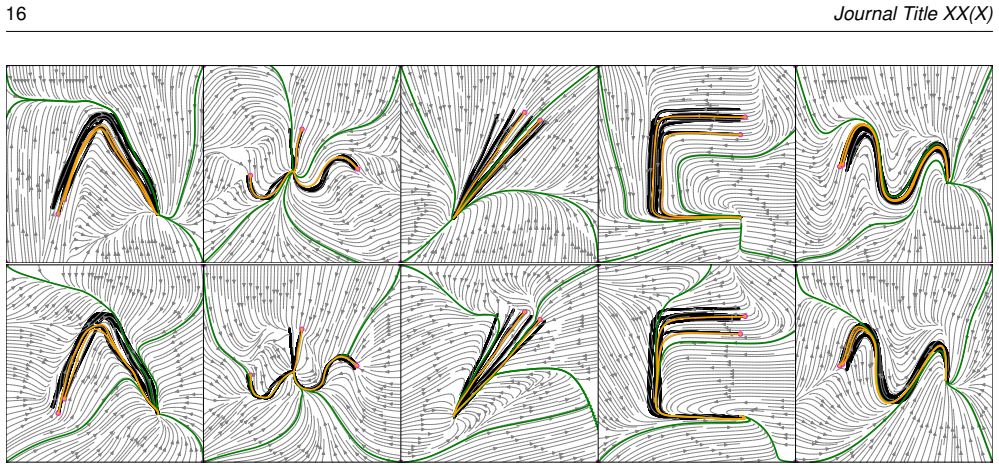
The central claim is that an NCDS—a neural network whose Jacobian is parameterized as $\hat J_f(x)=-(J_\theta(x)^{\mathsf T}J_\theta(x)+\operatorname{diag}(\epsilon))$ and whose output is the line integral of this Jacobian—is contractive for all parameters, so no post-hoc stabilization or constrained optimization is needed. The paper further claims that a state-independent regularization vector, which encourages spread between the Jacobian's eigenvalues, yields faster convergence toward the demonstrated region and better generalization; that conditioning the network on an extra input variable allows a single model to represent multiple motion skills; and that modulating the latent vector field with a matrix built from a distance field rescaled by the inverse pullback metric volume lets the robot avoid obstacles and out-of-data-support regions while retaining contraction. The experiments are presented as showing that only this method among the tested baselines produces monotonically decreasing distances between nearby trajectories, and that the latent structure lets it scale to 8- and 44-dimensional state spaces.
Load-bearing premise
The entire obstacle-avoidance and safety guarantee rests on the assumption that the matrix that reshapes the latent vector field near obstacles preserves contraction and does not pull trajectories into new false targets, and the paper adopts this assumption from earlier work instead of proving it for its learned Riemannian pullback setting.
Editorial extensions
If this is right
- Learned robot skills can be deployed with a certified exponential-convergence guarantee to a target, without solving an optimization problem at execution time.
- A single trained model can switch between different motion skills by changing a conditioning input such as a target state, trajectory shape, or image embedding, which reduces the need to train separate models.
- Obstacle avoidance can be computed in a low-dimensional latent space instead of the high-dimensional ambient space, which lowers computational cost and makes stabilization practical for higher-dimensional robot and human motion.
- Contraction guarantees extend to full-pose motions on $SO(3)$ or quaternions by restricting the decoder's output to the first cover of the Lie algebra, so orientation dynamics remain stable.
- The approach gives a concrete alternative to asymptotic-stability methods: because contraction controls all pairs of trajectories, the system remains stable under perturbations and extrapolation beyond the demonstrations.
Reading between the lines
- The state-independent regularization result suggests that contraction-speed tuning can be separated from reconstruction loss; a curriculum or schedule on contraction spread might improve data efficiency, which the paper does not test.
- The finding that a symmetric Jacobian suffices despite the theoretical expressivity of asymmetric Jacobians may be task-dependent; motions with strong rotational or curl components are a natural place to test whether the skew-symmetric term matters.
- The Gaussian-shaped obstacle model used in the ambient metric limits the approach to smooth obstacle representations; sharp or highly nonconvex obstacles would likely require recomputing the distance field at query time, and the manual alpha-scaling procedure would need to become adaptive.
- If contraction in the latent space is preserved by the injective decoder's pullback, the same guarantee could plausibly extend to other injective generative models such as normalizing flows, though the paper leaves that connection unexplored.
Signed reviews
Editorial analysis
A structured set of objections, weighed in public.
Referee Report
Summary. The paper extends the Neural Contractive Dynamical System (NCDS) architecture for learning contractive dynamical systems from demonstrations. The base construction defines the learned vector field as a straight-line line integral of a matrix-valued network that always outputs negative definite matrices, and the paper claims this yields a contractive vector field by construction. On top of this, the paper adds three regularization strategies, an asymmetric Jacobian variant, a conditional version (CNCDS) for multi-task learning, a latent-space formulation using VAEs with injective decoders, and a Riemannian-modulation mechanism for obstacle avoidance and safety regions. The experimental section evaluates the method on LASA trajectories, a 7-DoF Franka robot, human motion data, and a vision-conditioned grasp-and-drop task.
Significance. If the theoretical guarantee were valid, the paper would make a strong contribution: it would give a neural-network dynamical system with guaranteed contraction, multi-task conditioning, and latent-space obstacle avoidance, supported by extensive robot and human-motion experiments. The experimental effort is substantial, including real robot executions and a public benchmark. However, the central construction does not deliver the claimed guarantee: the line integral in Eq. (4) does not produce a vector field whose Jacobian is the negative definite network output, so the 'contractive by construction' claim is false. This flaw propagates to the CNCDS, latent NCDS, and Riemannian safety-region extensions, which all inherit the base contraction claim. The paper's main novelty and its stated stability guarantees therefore rest on an invalid derivation.
major comments (2)
- [Section 2.2, Eq. (4)] The construction does not produce a vector field with Jacobian Ĵ_f(x). Direct differentiation of Eq. (4) gives ∂f_i/∂x_j = ∫₀¹ [Ĵ_{ij}(c(t)) + t Σ_k ∂Ĵ_{ik}/∂c_j(c(t))(x_k - x0_k)] dt, where c(t)=x0+t(x-x0). The displacement-weighted second term is absent from Ĵ_f(x), and even the first term is an average over the segment rather than the value at x. The fundamental theorem of line integrals invoked after Eq. (4) applies only to exact 1-forms, i.e., only when ∂Ĵ_{ij}/∂x_k = ∂Ĵ_{ik}/∂x_j for all i,j,k; this integrability condition is not enforced by Eq. (3). Hence the Jacobian of f is not guaranteed to be negative definite. For a concrete counterexample within the paper's parameterization, take x0=0, ε<1, and Ĵ_f(x) = -2I + ε[[0, sin x2],[sin x2,0]], which is of the form (3) for Jθ the smooth square root of (2-ε)I - ε[[0, sin x2],[sin x2,0]]. Eq. (4) then yields f(x)=(-2x1 + ε(1-cos x2), -2x2 + εx1(1-cos x2)/x2) (continuous extension at x2=0), whose Jacobian at (L,0) is diag(-2, -2 + εL/2), which has a positive eigenvalue for L>4/ε. Thus the claim 'contractive by construction' is false, and the extensions in Secs. 2.3, 3.2, and 3.4 all inherit this invalid foundation.
- [Section 3.4, Eqs. (32)-(34)] The latent modulation matrix G_M(z) is asserted to preserve contraction and avoid spurious attractors, but no proof is given for the learned pullback-metric setting. The argument simply refers to Huber et al. (2019, 2022) and Koptev (2023), yet the conditions of those proofs are not verified for the distance field S_scaled(z)=α/V(z)S(z). In particular, the safe set induced by the metric volume may not be simply connected, and the gradient of S_scaled may not satisfy the regularity assumptions needed for the modulation theorem. The auxiliary tangential term β(x)G_M(z)g(z) in Eq. (34) is introduced heuristically, and its effect on the contraction properties of the modulated field is not analyzed. Consequently, the obstacle-avoidance and safety-region guarantees claimed in Sec. 4.6 are unsupported.
minor comments (4)
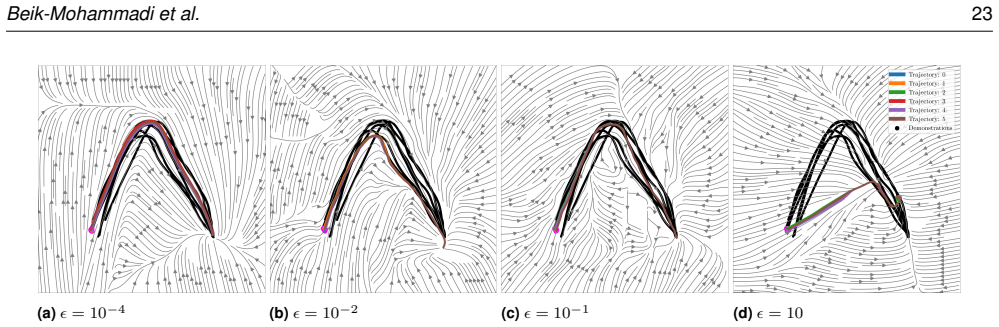
- [Section 2.2.1, Eq. (7)] The regularization loss L_ϵ spreads eigenvalues only relative to ϵ_1 rather than over all pairs; this arbitrary choice should be justified, since it may bias the learned contraction spread. In addition, the '276% faster convergence' claim is based on the convex-hull occupancy metric, which depends on an experimentally chosen hull margin; reporting pointwise Jacobian eigenvalue metrics would provide a more direct check.
- [Appendix 6.2] The scaling factor α is selected experimentally, and it directly controls the alignment of the computed obstacle boundary with the true boundary in Fig. 13. Since this parameter is hand-tuned, the claim of correct boundary alignment is not automatic and should be accompanied by a sensitivity analysis or an automated selection procedure.
- [Section 2.3] In CNCDS, the conditioning variable ϖ is concatenated to the state, but no dynamics are defined for ϖ; it is effectively a constant parameter. The negative definiteness of the augmented matrix in Eq. (11) does not by itself imply contraction of the x-subsystem unless the exact Jacobian property holds, which is already invalid per the first major comment. This point should be clarified.
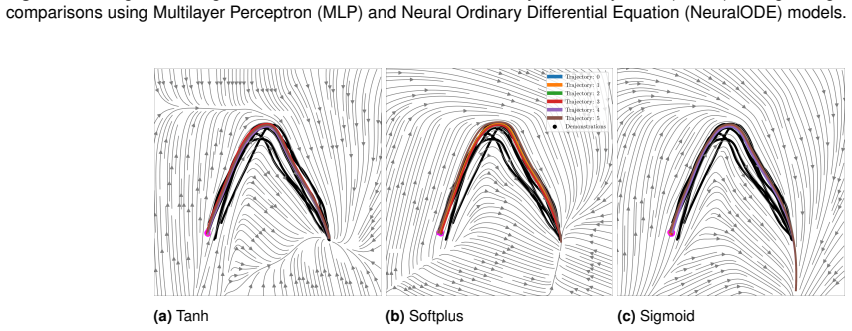
- [Section 4.7] The ablation on activation functions shows that Sigmoid 'fails to reach and stop at its target,' which suggests a violation of the claimed contraction/attraction property. This is worth discussing in light of the theoretical guarantee, since the construction is supposed to be parameter-independent.
Circularity Check
No significant circularity: the contractive-stability claim is an architectural construction, and the main comparisons use external baselines; the self-citations are historical rather than load-bearing.
full rationale
The central NCDS claim is not circular. The paper defines the learned Jacobian as the negative definite matrix -(J_theta^T J_theta + eps I) in Eq. (3) and defines f by the line integral in Eq. (4); the contractivity assertion rests on the fundamental theorem of line integrals and Definition 1, not on any fitted value or on a measured quantity being fed back as a prediction. Whether the line integral in Eq. (4) really has Jacobian equal to the integrand is a mathematical correctness question (the matrix field must satisfy integrability conditions), but a false or unproved step of that kind is not a circularity under the requested definitions. The Riemannian obstacle-avoidance and safety-region extension imports contraction preservation from Huber et al. (2019, 2022) and Koptev (2023); these are external sources, and any failure of those arguments to carry over to the learned pullback metric is an unverified generalization gap, not a self-referential reduction. Self-citations to Beik-Mohammadi et al. (2021, 2023, 2024) are historical and the paper re-derives the NCDS construction in Section 2.2; performance is measured against ELCD, Euclideanizing flow, Imitation flow, SEDS, and public LASA and KIT datasets. The regularization section directly maximizes eigenvalue spread, so the higher spread reported in Table 1 is expected from the loss, but the paper does not rest its central claim on that table and uses an independent time-in-region measure for convergence. Overall, there is at most minor self-referential reporting, no load-bearing circularity.
Assumptions & free parameters
free parameters (6)
- Learned anchor state x0 and initial velocity x_dot0
- Regularization vector epsilon
- beta weight in regularization loss
- alpha scaling factor
- Obstacle Gaussian parameters o, r, w
- Modulation sigmoid parameters rho, nu, k =
rho=1, nu=10, k=2
assumptions (5)
- standard math The line integral of a C^1 matrix field along straight paths is differentiable and its Jacobian equals the field at the endpoint.
- standard math Contraction is invariant under diffeomorphic coordinate changes.
- domain assumption The zero-padding injective flow decoder is a diffeomorphism onto its image.
- domain assumption The modulation matrix G(x) preserves contraction of the modulated vector field.
- ad hoc to paper Out-of-data-support regions are unsafe and should be avoided.
invented entities (1)
-
Riemannian safety region in latent space
Cite this review
Pith. "Pith review of Extended Neural Contractive Dynamical Systems: On Multiple Tasks and Riemannian Safety Regions." pith.science (2026). https://pith.science/paper/QYSMHLQ6
@misc{pith2026241111405,
  author       = {Pith},
  title        = {Pith review of: Extended Neural Contractive Dynamical Systems: On Multiple Tasks and Riemannian Safety Regions},
  year         = {2026},
  howpublished = {\url{https://pith.science/paper/QYSMHLQ6}},
  note         = {Machine review of arXiv:2411.11405}
}
read the original abstract
Stability guarantees are crucial when ensuring that a fully autonomous robot does not take undesirable or potentially harmful actions. We recently proposed the Neural Contractive Dynamical Systems (NCDS), which is a neural network architecture that guarantees contractive stability. With this, learning-from-demonstrations approaches can trivially provide stability guarantees. However, our early work left several unanswered questions, which we here address. Beyond providing an in-depth explanation of NCDS, this paper extends the framework with more careful regularization, a conditional variant of the framework for handling multiple tasks, and an uncertainty-driven approach to latent obstacle avoidance. Experiments verify that the developed system has the flexibility of ordinary neural networks while providing the stability guarantees needed for autonomous robotics.
Figures


Figures from the paper (27 more)







Reference graph
Works this paper leans on
-
[1]
In: The Twelfth International Conference on Learning Representations
Beik-Mohammadi H, Hauberg S, Arvanitidis G, Figueroa N, Neumann G and Rozo L (2024) Neural contractive dynamical systems. In: The Twelfth International Conference on Learning Representations. ://openreview.net/forum?id=iAYIRHOYy8
work page 2024
-
[2]
In: Robotics: Science and Systems (R:SS)
Beik-Mohammadi H, Hauberg S, Arvanitidis G, Neumann G and Rozo L (2021) Learning R iemannian manifolds for geodesic motion skills. In: Robotics: Science and Systems (R:SS). ://roboticsconference.org/2021/program/papers/082/index.html
work page 2021
-
[3]
The International Journal of Robotics Research (IJRR) 42(10): 729--754
Beik-Mohammadi H, Hauberg S, Arvanitidis G, Neumann G and Rozo L (2023) Reactive motion generation on learned riemannian manifolds. The International Journal of Robotics Research (IJRR) 42(10): 729--754. ://doi.org/10.1177/02783649231193046
-
[4]
In: Siciliano B and Khatib O (eds.) Handbook of Robotics, chapter 74
Billard A, Calinon S and Dillmann R (2016) Learning from humans. In: Siciliano B and Khatib O (eds.) Handbook of Robotics, chapter 74. Secaucus, NJ, USA: Springer, pp. 1995--2014. ://doi.org/10.1007/978-3-319-32552-1_74. 2nd Edition
-
[5]
In: IEEE International Conference on Ubiquitous Robots and Ambient Intelligence (URAI)
Blocher C, Saveriano M and Lee D (2017) Learning stable dynamical systems using contraction theory. In: IEEE International Conference on Ubiquitous Robots and Ambient Intelligence (URAI). pp. 124--129. ://ieeexplore.ieee.org/document/7992901
-
[6]
In: Neural Information Processing Systems (NeurIPS
Brehmer J and Cranmer K (2020) Flows for simultaneous manifold learning and density estimation. In: Neural Information Processing Systems (NeurIPS. pp. 442--453. ://proceedings.neurips.cc/paper_files/paper/2020/file/051928341be67dcba03f0e04104d9047-Paper.pdf
-
[7]
Bullo F (2024) Contraction Theory for Dynamical Systems. 1.2 edition. Kindle Direct Publishing. ISBN 979-8836646806. ://fbullo.github.io/ctds
work page 2024
-
[8]
In: IEEE/RSJ International Conference on Intelligent Robots and Systems (IROS)
Chen N, Klushyn A, Paraschos A, Benbouzid D and Van der Smagt P (2018 a ) Active learning based on data uncertainty and model sensitivity. In: IEEE/RSJ International Conference on Intelligent Robots and Systems (IROS). pp. 1547--1554. ://doi.org/10.1109/IROS.2018.8593552
arXiv 2018
Show all 56 references
-
[9]
://github.com/rtqichen/torchdiffeq
Chen RTQ (2018) torchdiffeq. ://github.com/rtqichen/torchdiffeq
2018
-
[10]
In: Neural Information Processing Systems (NeurIPS)
Chen RTQ, Rubanova Y, Bettencourt J and Duvenaud DK (2018 b ) Neural ordinary differential equations. In: Neural Information Processing Systems (NeurIPS). ://proceedings.neurips.cc/paper/2018/file/69386f6bb1dfed68692a24c8686939b9-Paper.pdf
2018
-
[11]
IEEE Transactions on Robotics (T-RO) 39(3): 1749--1767
Dawson C, Gao S and Fan C (2023) Safe control with learned certificates: A survey of neural L yapunov, barrier, and contraction methods for robotics and control. IEEE Transactions on Robotics (T-RO) 39(3): 1749--1767. ://doi.org/10.1109/TRO.2022.3232542
2023
-
[12]
In: arXiv preprint
Eklund D and Hauberg S (2019) Expected path length on random manifolds. In: arXiv preprint. ://arxiv.org/abs/1908.07377
2019 arXiv
-
[13]
In: International Conference on Artificial Intelligence and Statistics (AISTATS)
Falorsi L, de Haan P, Davidson TR and Forr\' e P (2019) Reparameterizing distributions on L ie groups. In: International Conference on Artificial Intelligence and Statistics (AISTATS). pp. 3244--3253. ://proceedings.mlr.press/v89/falorsi19a.html
2019
-
[14]
://arxiv.org/abs/1806.04994
Hauberg S (2019) Only bayes should learn a manifold. ://arxiv.org/abs/1806.04994
2019 arXiv
-
[15]
IEEE Robotics and Automation Letters (RA-L) 4(2): 1462--1469
Huber L, Billard A and Slotine JJ (2019) Avoidance of convex and concave obstacles with convergence ensured through contraction. IEEE Robotics and Automation Letters (RA-L) 4(2): 1462--1469. doi:http://doi.org/10.1109/LRA.2019.2893676
2019
-
[16]
IEEE Transactions on Robotics 38(5): 3113--3132
Huber L, Slotine JJ and Billard A (2022) Avoiding dense and dynamic obstacles in enclosed spaces: Application to moving in crowds. IEEE Transactions on Robotics 38(5): 3113--3132. ://ieeexplore.ieee.org/document/9765824
2022
-
[17]
IEEE Robotics and Automation Letters (RA-L) 7(2): 5334--5341
Hung CM, Zhong S, Goodwin W, Jones OP, Engelcke M, Havoutis I and Posner I (2022) Reaching through latent space: From joint statistics to path planning in manipulation. IEEE Robotics and Automation Letters (RA-L) 7(2): 5334--5341. ://doi.org/10.1109/LRA.2022.3152697
2022
-
[18]
://arxiv.org/abs/2402.08090
Jaffe S, Davydov A, Lapsekili D, Singh A and Bullo F (2024) Learning neural contracting dynamics: Extended linearization and global guarantees. ://arxiv.org/abs/2402.08090
2024 arXiv
-
[19]
Modeling, Identification and Control ://doi.org/10.4173/mic.2010.3.2
Jouffroy J and I Fossen T (2010) A tutorial on incremental stability analysis using contraction theory. Modeling, Identification and Control ://doi.org/10.4173/mic.2010.3.2
2010 doi
-
[20]
IEEE Transactions on Robotics 27(5): 943--957
Khansari-Zadeh SM and Billard A (2011) Learning stable nonlinear dynamical systems with G aussian mixture models. IEEE Transactions on Robotics 27(5): 943--957. doi:10.1109/TRO.2011.2159412
2011
-
[21]
CoRR ://api.semanticscholar.org/CorpusID:6628106
Kingma DP and Ba J (2014) Adam: A method for stochastic optimization. CoRR ://api.semanticscholar.org/CorpusID:6628106
2014
-
[22]
In: International Conference on Learning Representations ( ICLR )
Kingma DP and Welling M (2014) Auto-encoding variational B ayes. In: International Conference on Learning Representations ( ICLR ) . ://openreview.net/forum?id=33X9fd2-9FyZd
2014
-
[23]
://infoscience.epfl.ch/record/305181
Koptev M (2023) Implicit distance functions: Learning and applications in robotics doi:https://doi.org/10.5075/epfl-thesis-10197. ://infoscience.epfl.ch/record/305181
2023 doi
-
[24]
Transactions on Machine Learning Research ://openreview.net/forum?id=Sb6p5mcefw
Kozachkov L, Wensing P and Slotine JJ (2023) Generalization as dynamical robustness--the role of riemannian contraction in supervised learning. Transactions on Machine Learning Research ://openreview.net/forum?id=Sb6p5mcefw
2023
-
[25]
2 edition
Lee J (2018) Introduction to R iemannian Manifolds . 2 edition. Springer. ://sites.math.washington.edu/ lee/Books/RM/
2018
-
[26]
Paladyn, Journal of Behavioral Robotics 6(1)
Lemme A, Meirovitch Y, Khansari-Zadeh M, Flash T, Billard A and Steil JJ (2015) Open-source benchmarking for learned reaching motion generation in robotics. Paladyn, Journal of Behavioral Robotics 6(1). ://doi.org/10.1515/pjbr-2015-0002
2015 doi
-
[27]
Automatica 34(6): 683--696
Lohmiller W and Slotine JJE (1998) On contraction analysis for non-linear systems. Automatica 34(6): 683--696. ://doi.org/10.1016/S0005-1098(98)00019-3
1998 doi
-
[28]
INNF Workshop at the International Conference on Machine Learning (ICML) ://invertibleworkshop.github.io/INNF_2019/accepted_papers/pdfs/INNF_2019_paper_10.pdf
Lorraine J and Hossain S (2019) JacNet : Learning functions with structured J acobians. INNF Workshop at the International Conference on Machine Learning (ICML) ://invertibleworkshop.github.io/INNF_2019/accepted_papers/pdfs/INNF_2019_paper_10.pdf
2019
-
[29]
IEEE Transactions on Automatic Control 62(6): 3046--3053
Manchester IR and Slotine JJE (2017) Control contraction metrics: Convex and intrinsic criteria for nonlinear feedback design. IEEE Transactions on Automatic Control 62(6): 3046--3053. ://doi.org/10.1109/TAC.2017.2668380
2017
-
[30]
IEEE Transactions on Robotics 32(4): 796--809
Mandery C, Terlemez O, Do M, Vahrenkamp N and Asfour T (2016) Unifying representations and large-scale whole-body motion databases for studying human motion. IEEE Transactions on Robotics 32(4): 796--809. ://ieeexplore.ieee.org/document/7506114
2016
-
[31]
In: Workshop on the Symbiosis of Deep Learning and Differential Equations at NeurIPS
Norcliffe ALI, Bodnar C, Day B, Simidjievski N and Lio P (2021) On second order behaviour in augmented neural ODE s: A short summary. In: Workshop on the Symbiosis of Deep Learning and Differential Equations at NeurIPS . ://openreview.net/forum?id=XpmaGtI04ki
2021
-
[32]
://proceedings.neurips.cc/paper/2019/file/bdbca288fee7f92f2bfa9f7012727740-Paper.pdf
Paszke A, Gross S, Massa F, Lerer A, Bradbury J, Chanan G, Killeen T, Lin Z, Gimelshein N, Antiga L, Desmaison A, Kopf A, Yang E, DeVito Z, Raison M, Tejani A, Chilamkurthy S, Steiner B, Fang L, Bai J and Chintala S (2019) Pytorch: An imperative style, high-performance deep le...
2019
-
[33]
Poli M, Massaroli S, Yamashita A, Asama H, Park J and Ermon S (2021) Torchdyn: Implicit models and neural numerical methods in pytorch ://github.com/DiffEqML/torchdyn/
2021
-
[34]
In: Proceedings of the 2nd Conference on Learning for Dynamics and Control, Proceedings of Machine Learning Research, volume 120
Rana MA, Li A, Fox D, Boots B, Ramos F and Ratliff N (2020 a ) E uclideanizing flows: Diffeomorphic reduction for learning stable dynamical systems. In: Proceedings of the 2nd Conference on Learning for Dynamics and Control, Proceedings of Machine Learning Research, volume 120...
2020
-
[35]
In: Conference on Learning for Dynamics and Control (L4DC)
Rana MA, Li A, Fox D, Boots B, Ramos F and Ratliff N (2020 b ) Euclideanizing flows: Diffeomorphic reduction for learning stable dynamical systems. In: Conference on Learning for Dynamics and Control (L4DC). pp. 630--639. ://proceedings.mlr.press/v120/rana20a.html
2020
-
[36]
Autonomous Robots 43(4): 897–912
Ravichandar HC and Dani A (2019) Learning position and orientation dynamics from demonstrations via contraction analysis. Autonomous Robots 43(4): 897–912. ://doi.org/10.1007/s10514-018-9758-x
2019 doi
-
[37]
In: Conference on Robot Learning (CoRL)
Ravichandar HC, Salehi I and Dani A (2017) Learning partially contracting dynamical systems from demonstrations. In: Conference on Robot Learning (CoRL). pp. 369--378. ://proceedings.mlr.press/v78/ravichandar17a.html
2017
-
[38]
IEEE Robotics and Automation Letters 7(2): 2905--2912
Rezazadeh N, Kolarich M, Kia SS and Mehr N (2022) Learning contraction policies from offline data. IEEE Robotics and Automation Letters 7(2): 2905--2912. doi:10.1109/LRA.2022.3145100
2022
-
[39]
Schaal S, Ijspeert A and Billard A (2003) Computational approaches to motor learning by imitation. Phil. Trans. R. Soc. Lond. B 358: 537--547. ://doi.org/10.1098/rstb.2002.1258
2003
-
[40]
Journal of The Astronautical Sciences 41: 439--517
Shuster MD (1993) A survey of attitude representation. Journal of The Astronautical Sciences 41: 439--517
1993
-
[41]
arXiv 1804.04878
Sindhwani V, Tu S and Khansari M (2018) Learning contracting vector fields for stable imitation learning. arXiv 1804.04878. ://arxiv.org/abs/1804.04878
2018 arXiv
-
[42]
The International Journal of Robotics Research 40(10-11): 1123--1150
Singh S, Richards SM, Sindhwani V, Slotine JJE and Pavone M (2021) Learning stabilizable nonlinear dynamics with contraction-based regularization. The International Journal of Robotics Research 40(10-11): 1123--1150. doi:10.1177/0278364920949931. ://doi.org/10.1177/0278364920949931
2021 doi
-
[43]
CoRR abs/1812.01537
Sol \` a J, Deray J and Atchuthan D (2018) A micro lie theory for state estimation in robotics. CoRR abs/1812.01537. ://arxiv.org/abs/1812.01537
2018 arXiv
-
[44]
In: Conference on Robot Learning (CoRL)
Sun D, Jha S and Fan C (2020) Learning certified control using contraction metric. In: Conference on Robot Learning (CoRL). ://arxiv.org/abs/2011.12569
2020 arXiv
-
[45]
Communications on Pure and Applied Mathematics 66(2): 145--164
Tabak EG and Turner CV (2013) A family of nonparametric density estimation algorithms. Communications on Pure and Applied Mathematics 66(2): 145--164
2013
-
[46]
IEEE Control Systems Letters 5: 211--216
Tsukamoto H and Chung SJ (2021 a ) Neural contraction metrics for robust estimation and control: A convex optimization approach. IEEE Control Systems Letters 5: 211--216. ://doi.org/10.1109/LCSYS.2020.3001646
2021
-
[47]
IEEE Transactions on Automatic Control 66(10): 4731--4746
Tsukamoto H and Chung SJ (2021 b ) Robust controller design for stochastic nonlinear systems via convex optimization. IEEE Transactions on Automatic Control 66(10): 4731--4746. doi:10.1109/TAC.2020.3038402
2021
-
[48]
Annual Reviews in Control 52: 135--169
Tsukamoto H, Chung SJ and Slotine JJE (2021) Contraction theory for nonlinear stability analysis and learning-based control: A tutorial overview. Annual Reviews in Control 52: 135--169. ://doi.org/10.1016/j.arcontrol.2021.10.001
2021 doi
-
[49]
In: International Conference on Intelligent Robots and Systems (IROS)
Urain J, Ginesi M, Tateo D and Peters J (2020) Imitationflow: Learning deep stable stochastic dynamic systems by normalizing flows. In: International Conference on Intelligent Robots and Systems (IROS). IEEE, pp. 5231--5237. ://ras.papercept.net/images/temp/IROS/files/1340.pdf
2020
-
[50]
IEEE Robotics and Automation Letters 7(4): 12569--12576
Urain J, Tateo D and Peters J (2022) Learning stable vector fields on lie groups. IEEE Robotics and Automation Letters 7(4): 12569--12576. doi:10.1109/LRA.2022.3219019. ://ieeexplore.ieee.org/document/9935105
2022
-
[51]
In: International Conference on Learning Representations (ICLR)
Xu K, Zhang M, Li J, Du SS, Kawarabayashi KI and Jegelka S (2021) How neural networks extrapolate: From feedforward to graph neural networks. In: International Conference on Learning Representations (ICLR). ://openreview.net/forum?id=UH-cmocLJC
2021
-
[52]
In: Conference on Robot Learning (CoRL)
Zhang J, Beik-Mohammadi H and Rozo L (2022) Learning R iemannian stable dynamical systems via diffeomorphisms. In: Conference on Robot Learning (CoRL). ://openreview.net/pdf?id=o8dLx8OVcNk
2022
-
[53]
, " * write output.state after.block = add.period write newline
ENTRY address author booktitle chapter doi edition editor eid howpublished institution isbn journal key month note number organization pages publisher school series title type url volume year label extra.label sort.label short.list INTEGERS output.state before.all mid.sentence...
-
[54]
write newline
" write newline "" before.all 'output.state := FUNCTION n.dashify 't := "" t empty not t #1 #1 substring "-" = t #1 #2 substring "--" = not "--" * t #2 global.max substring 't := t #1 #1 substring "-" = "-" * t #2 global.max substring 't := while if t #1 #1 substring * t #2 gl...
-
[55]
, " * write output.state after.block = add.period write newline
ENTRY address archive author booktitle chapter doi edition editor eid eprint howpublished institution isbn journal key month note number organization pages publisher school series title type url volume year label INTEGERS output.state before.all mid.sentence after.sentence aft...
-
[56]
write newline
" write newline "" before.all 'output.state := FUNCTION n.dashify 't := "" t empty not t #1 #1 substring "-" = t #1 #2 substring "--" = not "--" * t #2 global.max substring 't := t #1 #1 substring "-" = "-" * t #2 global.max substring 't := while if t #1 #1 substring * t #2 gl...
Reviewed August 12, 2026 · model on record in the stance chip above.
Discussion (0). Continue with ORCID to comment.