REVIEW 3 major objections 4 minor 81 references
Exceptional Points and Stability in Nonlinear Models of Population Dynamics having $\mathcal{PT}$ symmetry
T0 review · 3 major / 4 minor · reviewed 2026-08-12 · deepseek-v4-flash
Pith's one-line read Exceptional points in the linearized dynamics coincide with abrupt global destabilization—species extinction—when the PT symmetry is a global property of the nonlinear population model.
desk verdict The 2D global-vs-local PT symmetry story is clean and worth reading; the 3D tri-trophic generalization is not established because the Lyapunov argument stops well short of the EP and the coexistence equilibrium sits on a singular line of equilibria. read the letter →
The pith
A machine-rendered reading of the paper's core claim, the machinery that carries it, and where it could break.
The reading
What carries the argument
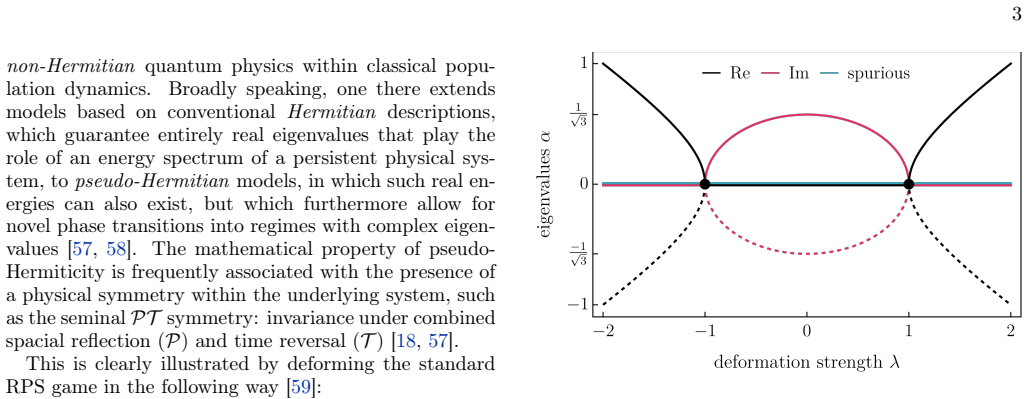
The central object is the local linearization of a globally PT-symmetric replicator or Lotka-Volterra system at its coexistence equilibrium, whose governing matrix is PT-symmetric and whose eigenvalue discriminant $\lambda^2-1$ produces exceptional points at $\lambda=\pm 1$. The argument is carried by two complementary tools: classification of all boundary equilibria of the simplex dynamics, which locates the abrupt change from regional to global instability, and Lyapunov functions derived from constants of motion of the antisymmetrizable payoff matrix $A'_\lambda$, which certify global or regional stability in the unbroken regime. The key contrast is passive PT symmetry: a constant diagonal defect leaves the local exceptional point unchanged but decorrelates it from global stability.
What would settle it
Run a dense numerical search over initial conditions on the 3-simplex for the food-chain models with $\delta=0,\pm1$ at deformation strengths just below and above $|\lambda|=1$, such as $\lambda=0.75$ and $\lambda=1.05$; if any trajectory fails to converge to a boundary sink and instead settles on an interior limit cycle or other attractor, the claimed coincidence with the exceptional point fails.
Extended reading notes
Core claim
The paper's thesis is that the relevance of an exceptional point to a nonlinear system depends on whether the symmetry behind it is inherited from the global dynamics. In the PT-symmetric deformation of the rock-paper-scissors game, the payoff matrix $A_\lambda$ has eigenvalues $0, \pm\sqrt{\lambda^2-1}$ around the coexistence point, so exceptional points appear at $\lambda = \pm 1$; the authors show by classifying all boundary equilibria that the same values mark the boundary between regional stability and global instability, with trajectories ending at single-strategy or edge sinks. In the Lotka-Volterra formulation, a Lyapunov function built from an antisymmetrizable payoff matrix confirms global marginal stability for $-1/2<\lambda<1$ and regional stability for $-1<\lambda<-1/2$, while for $|\lambda|>1$ the function ceases to be a Lyapunov function. For three-species food chains, cyclic food chains, and food chains with omnivory, they construct the analogous Lyapunov function in the antisymmetrizable regime and use numerical simplex portraits to argue that the same coincidence holds: global destabilization begins at $|\lambda|>1$, the exceptional-point threshold. They contrast this with an explicitly PT-broken defect, where the exceptional point at $\lambda=\pm 1$ persists as a passive-PT artifact but the global stability transition shifts to $\lambda=\pm\sqrt{1+\delta^2/3}$.
Load-bearing premise
In the three-species models, the claim of abrupt global destabilization at the exceptional point rests on the untested assumption that no hidden interior attractors (stable cycles, chaotic sets, or other fixed points) exist for deformation strengths beyond the range covered by the Lyapunov function.
Editorial extensions
If this is right
- Exceptional points in the linearization can serve as a local diagnostic: in globally PT-symmetric population models, crossing $|\lambda|=1$ means the coexistence state is not only locally unstable but the whole dynamics head to species extinction.
- The correspondence fails when the symmetry is only local; a passive-PT defect shifts the global destabilization away from the exceptional point, so the exceptional point alone cannot predict global behavior without knowing whether the symmetry is global.
- The two-species rock-paper-scissors and Lotka-Volterra models are exactly solvable: boundary-equilibrium classification plus the Lyapunov function fixes $|\lambda|=1$ as the global-destabilization threshold, with an intermediate continuously stable region for $-1<\lambda<-1/2$.
- The same qualitative scenario appears in three-dimensional tri-trophic food webs with food chain, cyclic, and omnivorous structures, indicating the mechanism is not an artifact of two-dimensional phase spaces.
Reading between the lines
- The paper's explicit proof covers the two-dimensional model, while the tri-trophic claim rests on selected phase portraits; a natural extension is a dense numerical search for hidden interior attractors between the Lyapunov bound and $|\lambda|=1$, since any stable limit cycle or chaotic set there would refine the claimed coincidence.
- If the correspondence holds beyond these examples, a practical implication is that researchers could use the local linearized spectrum at a coexistence equilibrium to forecast imminent regime shifts or extinction events in globally PT-symmetric ecological models without simulating the full nonlinear dynamics.
- The antisymmetrizability construction suggests a broader mechanism: any globally PT-symmetric Lotka-Volterra system whose payoff matrix can be antisymmetrized with a positive diagonal matrix inherits a conserved quantity, so the exceptional-point threshold and the global-stability threshold may coincide whenever this Hamiltonian-like structure is present.
Signed reviews
Editorial analysis
A structured set of objections, weighed in public.
Referee Report
Summary. The paper studies the relation between exceptional points (EPs) in the linearization of nonlinear population dynamics models around coexistence equilibria and global stability changes of the full nonlinear dynamics. Using the replicator equation for rock-paper-scissors games and the generalized Lotka-Volterra (GLV) equation, the authors contrast two situations: (i) when the PT symmetry underlying the EP is a global symmetry of the nonlinear model, the EP location is claimed to coincide with an abrupt global destabilization, typically leading to extinction; and (ii) when the symmetry is only local, this correspondence is lost, as illustrated by an explicitly symmetry-breaking defect. The two-dimensional RPS/GLV analysis is supported by explicit eigenvalue calculations, boundary-equilibrium bifurcations, and a Lyapunov function. The paper then introduces a family of three-species tri-trophic GLV models (Sec. VI) as higher-dimensional test cases, constructing an energy-like function and presenting numerical phase portraits to argue that the same global-destabilization coincidence holds for |λ|>1.
Significance. If fully established, the claimed connection between exceptional points in a local linearization and global stability transitions of nonlinear population dynamics would be a valuable conceptual bridge between non-Hermitian physics and evolutionary/ecological dynamics, potentially providing a local diagnostic for global extinction transitions. The two-dimensional rock-paper-scissors analysis is mathematically clean: the eigenvalue degeneracy, the boundary pitchfork bifurcations, and the Lyapunov-function construction are all presented coherently, and the defect example convincingly demonstrates that a local-only symmetry decouples the EP from global stability. However, the tri-trophic extension in Sec. VI is the load-bearing higher-dimensional evidence for the paper's central claim, and that evidence is incomplete: the coexistence equilibrium is non-isolated, the Lyapunov function is only valid on a restricted parameter interval, and global destabilization for |λ|>1 is asserted without excluding interior attractors. As it stands, the manuscript's central claim is fully supported only in two dimensions, not in the three-dimensional test cases.
major comments (3)
- [Sec. VI, Eq. (36)] The interaction matrix B in Eq. (36) has a zero eigenvalue for every λ, and direct computation gives B(1,1,1)^T = -r, so the interior equilibrium equation r + B y = 0 has an entire line of solutions y = (1,1,1) + s v(λ), not the isolated coexistence point y_c = (1,1,1) claimed in the text. Consequently the linearization at y_c is never hyperbolic, and the standard notion of local stability of a single equilibrium does not apply. This degeneracy is not mentioned in the manuscript; it affects the interpretation of the EP in the transverse spectrum (which is a transition between imaginary and real nonzero eigenvalues while a zero mode persists) and leaves open the possibility of non-extinct interior dynamics along this equilibrium family.
- [Sec. VI, after Eq. (42)] The statement that the function L(y, λ) = H(1, λ) − H(y, λ) 'provides a Lyapunov function that ensures the marginal stability of the coexistence point ... for |λ| < |λ_EP| = 1' is not supported by the construction. The antisymmetrizing diagonal matrix D in Eq. (40) is positive definite only on a restricted interval; for δ = 0 that interval is |λ| < √(3/11) ≈ 0.52, not up to the EP at |λ| = 1. The text later acknowledges this narrower range, but the earlier broad claim is misleading. Moreover, this Lyapunov function, being derived from a constant of motion on the antisymmetrizable interval, cannot certify anything about the fate of trajectories for 0.52 < |λ| < 1, and certainly not for |λ| > 1.
- [Sec. VI, Figs. 8 and 9] The central claim of an abrupt global destabilization at |λ| > |λ_EP| = 1 in the tri-trophic models is asserted on the basis of a small number of phase portraits. Given the non-isolated equilibrium line noted above, and the absence of any global argument (Lyapunov function, monotonic quantity, or exhaustive bifurcation analysis) for |λ| > 1, the possibility of interior limit cycles, heteroclinic cycles, or other interior omega-limit sets is not excluded. The paper's central conclusion—that the EP in the linearization coincides with abrupt global destabilization—is therefore demonstrated only in the two-dimensional models of Secs. III and V, while the three-dimensional test case remains an unproven extrapolation.
minor comments (4)
- [Sec. VII] In the conclusion, 'Schödinger' should be 'Schrödinger'.
- [Sec. VI, Eq. (41)] The expression for the constant of motion C(x, λ) is typeset in a way that is hard to parse; adding brackets or a clearer multi-line layout would improve readability.
- [Sec. III, Fig. 2] The caption describes the bifurcation of additional boundary equilibria as 'dashed lines' but the figure legend does not distinguish dashed lines from the solid separatrices in the panels; please clarify the legend.
- [Sec. V, Eq. (30)] The constant of motion C(x, λ) is written with fractional exponents in a compact form; a brief note on its domain of definition (where the exponents are real) would help the reader.
Circularity Check
No significant circularity: the EP calculations and nonlinear stability analyses are distinct computations; the tri-trophic global-instability claim is underproved but not defined into existence.
full rationale
The 2D RPS/GLV chain is self-contained. The EP is located from the eigenvalues of A_λ (Eq. 6) or B (Eq. 25), while global/regional stability is assessed through boundary equilibria (Eq. 12, Sec. III), phase portraits, and the Lyapunov candidate L (Eq. 35) whose validity is controlled by the antisymmetrizability condition (Eq. 29). These are separate conditions; neither is defined in terms of the other. In Sec. VI the text states that "the normalization of the matrix contributions in (36) are chosen such that the linearization around this equilibrium has eigenvalues β_j ∈ {0, ±√(λ²−1)}"—so |λ_EP|=1 is an input design choice, not a derived prediction. The asserted "abrupt global destabilization" at |λ|>1 is not, however, reduced to that eigenvalue condition: it is argued from the breakdown of antisymmetrizability and from selected 3-simplex trajectories (Figs. 8, 9). This is a rigor/completeness gap—the Lyapunov construction covers only the antisymmetrizable interval (for δ=0, roughly |λ|<0.52), and the phase portraits do not exclude interior attractors for |λ| between that interval and 1 or beyond—but it is not circularity, because no equation makes "global instability" identical to the EP condition by construction. Self-citations (Refs. 21, 22, 61) are background or experimental and are not load-bearing. The central correlation has independent content in the 2D example and remains a genuine (if incompletely supported) claim in 3D.
Assumptions & free parameters
free parameters (1)
- Tri-trophic model normalization and interaction-matrix entries (Eq. 36) =
N = sqrt(11 + 10 delta + 3 delta^2), r = (1,0,-1)/N, B as in (36)
assumptions (4)
- standard math Lyapunov's indirect method and Hartman-Grobman theorem justify classifying equilibria via the linearization when eigenvalues have nonvanishing real part.
- standard math Topological equivalence between the generalized Lotka-Volterra system and the replicator equation via the barycentric transformation (18)-(21).
- standard math An antisymmetrizable payoff matrix (A'D antisymmetric) yields a conserved quantity of the replicator and GLV dynamics.
- ad hoc to paper For the tri-trophic models (36), all trajectories with |lambda| > 1 approach boundary sinks and no other interior attractors exist.
Cite this review
Pith. "Pith review of Exceptional Points and Stability in Nonlinear Models of Population Dynamics having $\mathcal{PT}$ symmetry." pith.science (2026). https://pith.science/paper/TCA47JYO
@misc{pith2026241112167,
  author       = {Pith},
  title        = {Pith review of: Exceptional Points and Stability in Nonlinear Models of Population Dynamics having $\mathcalPT$ symmetry},
  year         = {2026},
  howpublished = {\url{https://pith.science/paper/TCA47JYO}},
  note         = {Machine review of arXiv:2411.12167}
}
abstract
Nonlinearity and non-Hermiticity, for example due to environmental gain-loss processes, are a common occurrence throughout numerous areas of science and lie at the root of many remarkable phenomena. For the latter, parity-time-reflection ($\mathcal{PT}$) symmetry has played an eminent role in understanding exceptional-point structures and phase transitions in these systems. Yet their interplay has remained by-and-large unexplored. We analyze models governed by the replicator equation of evolutionary game theory and related Lotka-Volterra systems of population dynamics. These are foundational nonlinear models that find widespread application and offer a broad platform for non-Hermitian theory beyond physics. In this context we study the emergence of exceptional points in two cases: (a) when the governing symmetry properties are tied to global properties of the models, and, in contrast, (b) when these symmetries emerge locally around stationary states--in which case the connection between the linear non-Hermitian model and an underlying nonlinear system becomes tenuous. We outline further that when the relevant symmetries are related to global properties, the location of exceptional points in the linearization around coexistence equilibria coincides with abrupt global changes in the stability of the nonlinear dynamics. Exceptional points may thus offer a new local characteristic for the understanding of these systems. Tri-trophic models of population ecology serve as test cases for higher-dimensional systems.
Figures


Figures from the paper (5 more)


Reference graph
Works this paper leans on
-
[1]
R. W. Boyd,Nonlinear Optics (Academic Press, 2008)
work page 2008
-
[2]
Here they are connected directly by a separatrix, indicated as dashed line in Fig. 3b, that sep- arates unstable source-sink dynamics at small frequen- cies xR of the rock strategy within the player population from stable cyclic dynamics around the center coexis- tence point. As such, atλ=− 1 2 the global stability of the dynamics continuously transitions...
-
[3]
According to (2), such a disturbance, thetangent flow of the stationary state, evolves as ∂t δx≈ 1 3 A δx
is intu- itively assessed by examining the dynamical reaction to an added small perturbationδx. According to (2), such a disturbance, thetangent flow of the stationary state, evolves as ∂t δx≈ 1 3 A δx . (3) The solution to thislinearization of the nonlinear repli- cator dynamics (2) thus has the general form of a super- position of the three eigenstatesa...
-
[4]
The latter destabi- lizes the systems’ behavior from global stability to only regional stability, with an unstable regime at small fre- quencies of the strategyxR. The additional bifurcating stationary states ¯xrp and ¯xrs are both initially saddle points, but become a sink and a source, respectively, at λ=− √ 1+ δ2/3, which destabilizes the dynamics glob...
-
[5]
S. H. Strogatz, Nonlinear Dynamics and Chaos: With Applications to Physics, Biology, Chemistry and Engi- neering (Westview Press, 2000)
2000
-
[6]
The behavior of the system is visualized in the 3- simplex in the right column of Fig
As before, the deformationλ adjusts this difference between the consumption rate ofy1 by y2 (y2 by y3) and the sustenance rate ofy2 by y1 (y3 by y2). The behavior of the system is visualized in the 3- simplex in the right column of Fig. 8. Again, the sys- tem is globally stable without deformation (λ = 0) and at small deformation strengths, which is also ...
-
[7]
C. Besse and J.-C. Garreau, Nonlinear Optical and Atomic Systems (Springer Cham, 2015)
work page 2015
-
[8]
Kirchgassner, Bifurcation in nonlinear hydrodynamic stability, SIAM Review17, 652 (1975)
K. Kirchgassner, Bifurcation in nonlinear hydrodynamic stability, SIAM Review17, 652 (1975)
work page 1975
Show all 81 references
-
[9]
Cartwright, Nonlinear dynamics determines the ther- modynamic instability of condensed matter in vacuo, Philos
J. Cartwright, Nonlinear dynamics determines the ther- modynamic instability of condensed matter in vacuo, Philos. Trans. R. Soc. A378, 20190534 (2020)
2020
-
[10]
V. W. Noonburg, A neural network modeled by an adap- tive lotka-volterra system, SIAM J. Appl. Math.49, 1779 (1989)
1989
-
[11]
The deformationλ adjusts this difference in the model
Note that without deformation λ, the consumption rate of y1 by y2 and of y2 by y3 does not correspond to an equal sustenance rate ofy2 by y1 and of y3 by y2. The deformationλ adjusts this difference in the model. The behavior of the system is visualized in the 3- simplexinthel...
-
[12]
Clark and A
T. Clark and A. Luis, Nonlinear population dynamics are ubiquitous in animals, Nat. Ecol. Evol.4, 1 (2020)
2020
-
[13]
Sinervo and C
B. Sinervo and C. Lively, The rock-paper-scissors game and the evolution of alternative male strategies, Nature 380, 240 (1996)
1996
-
[14]
May and W
R. May and W. Leonard, Nonlinear aspects of competi- tion between three species, SIAM J. Appl. Math.29, 243 (1975)
1975
-
[15]
B. Kerr, M. Riley, M. Feldman, and B. Bohannan, Local dispersal promotes biodiversity in a real game of rock- paper-scissors, Nature 418, 171 (2002)
2002
-
[16]
Whalen, S
A. Whalen, S. Brennan, T. Sauer, and S. Schiff, Observ- abilityandcontrollabilityofnonlinearnetworks: Therole of symmetry, Phys. Rev. X5, 011005 (2015)
2015
-
[17]
Szabo and G
G. Szabo and G. Fath, Evolutionary games on graphs, Phys. Rep. 446, 97 (2006)
2006
-
[18]
Barnett, A
W. Barnett, A. Medio, and A. Serletis, Nonlinear and complex dynamics in economics, Macroecon. Dyn. 19, 1749 (1997)
1997
-
[19]
Hauert, S
C. Hauert, S. Monte, J. Hofbauer, and K. Sigmund, Vol- unteering as red queen mechanism for cooperation in public goods games, Science296, 1129 (2002)
2002
-
[20]
Tainaka, Paradoxical effect in a three-candidate voter model, Phys
K. Tainaka, Paradoxical effect in a three-candidate voter model, Phys. Lett. A176, 303 (1993)
1993
-
[21]
R. M. Goodwin, A growth cycle, inEssays in Economic Dynamics (Palgrave Macmillan UK, 1982) pp. 165–170
1982
-
[22]
J. M. T. Thompson and H. B. Stewart,Nonlinear dy- namics and chaos (John Wiley & Sons, 2002)
2002
-
[23]
C. M. Bender and S. Boettcher, Real spectra in non- hermitianhamiltonianshaving PT symmetry,Phys.Rev. Lett. 80, 5243 (1998)
1998
-
[24]
Rotter, A non-hermitian hamilton operator and the physics of open quantum systems, J
I. Rotter, A non-hermitian hamilton operator and the physics of open quantum systems, J. Phys. A: Math. Theor. 42, 153001 (2009)
2009
-
[25]
Roccati, G
F. Roccati, G. M. Palma, F. Ciccarello, and F. Bagarello, Non-hermitian physics and master equations, Open Syst. Inf. Dyn. 29, 2250004 (2022)
2022
-
[26]
Bergholtz, J
E. Bergholtz, J. Budich, and F. Kunst, Exceptional topology of non-hermitian systems, Rev. Mod. Phys.93, 015005 (2021)
2021
-
[27]
Kunst, E
F. Kunst, E. Edvardsson, J. Budich, and E. Bergholtz, Biorthogonal bulk-boundary correspondence in non- hermitian systems, Phys. Rev. Lett.121, 026808 (2018). 14
2018
-
[28]
K. Ding, C. Fang, and G. Ma, Non-hermitian topology and exceptional-point geometries, Nat. Rev. Phys.4, 745 (2022)
2022
-
[29]
Okuma and M
N. Okuma and M. Sato, Non-hermitian topological phe- nomena: A review, Annu. Rev. Condens. Matter Phys. 14 (2022)
2022
-
[30]
Christodoulides and J
D. Christodoulides and J. Yang,Parity-time Symmetry and Its Applications (Springer Singapore, 2018)
2018
-
[31]
P. R. Charumathi and K. Senthilnathan, Unravelling pt symmetry: Applications in metamaterials, Plasmonics , 1 (2024)
2024
-
[32]
Ge and R
L. Ge and R. El-Ganainy, Nonlinear modal interactions in parity-time (pt) symmetric lasers, Sci. Rep.6, 24889 (2016)
2016
-
[33]
Ramezani, T
H. Ramezani, T. Kottos, R. El-Ganainy, and D. Christodoulides, Unidirectional nonlinear pt- symmetric optical structures, Phys. Rev. A82, 043803 (2010)
2010
-
[34]
Musslimani, K
Z. Musslimani, K. Makris, R. El-Ganainy, and D. Christodoulides, Optical solitons in pt periodic po- tentials, Phys. Rev. Lett.100, 030402 (2008)
2008
-
[35]
Malzard, E
S. Malzard, E. Cancellieri, and H. Schomerus, Topo- logical dynamics and excitations in lasers and conden- sates with saturable gain or loss, Opt. Express26, 22506 (2018)
2018
-
[36]
Malzard and H
S. Malzard and H. Schomerus, Nonlinear mode competi- tion and symmetry-protected power oscillations in topo- logical lasers, New J. Phys.20, 063044 (2018)
2018
-
[37]
Lumer, Y
Y. Lumer, Y. Plotnik, M. C. Rechtsman, and M. Segev, Nonlinearly induced pt transition in photonic systems, Phys. Rev. Lett.111, 263901 (2013)
2013
-
[38]
Smirnova, D
D. Smirnova, D. Leykam, Y. Chong, and Y. Kivshar, Nonlinear topological photonics, Appl. Phys. Rev. 7, 021306 (2020)
2020
-
[39]
Ezawa, Nonlinear non-hermitian higher-order topo- logical laser, Phys
M. Ezawa, Nonlinear non-hermitian higher-order topo- logical laser, Phys. Rev. Res.4, 013195 (2022)
2022
-
[40]
Yuce, Nonlinear non-hermitian skin effect, Phys
C. Yuce, Nonlinear non-hermitian skin effect, Phys. Lett. A 408, 127484 (2021)
2021
-
[41]
Ma and H
Y.-P. Ma and H. Susanto, Topological edge solitons and their stability in a nonlinear su-schrieffer-heeger model, Phys. Rev. E104, 054206 (2021)
2021
-
[42]
S. Xia, D. Kaltsas, D. Song, I. Komis, J. Xu, A. Szameit, H. Buljan, K. Makris, and Z. Chen, Nonlinear tuning of pt symmetry and non-hermitian topological states, Sci- ence 372, 72 (2021)
2021
-
[43]
Wimmer, A
M. Wimmer, A. Regensburger, M.-A. Miri, C. Bersch, D. Christodoulides, and U. Peschel, Observation of op- tical solitons in pt-symmetric lattices, Nat. Commun.6, 7782 (2015)
2015
-
[44]
D. Haag, D. Dast, A. Löhle, H. Cartarius, J. Main, and G. Wunner, Nonlinear quantum dynamics in a pt- symmetric double well, Physical Review A 89, 023601 (2014)
2014
-
[45]
Graefe, H
E.-M. Graefe, H. J. Korsch, and A. E. Niederle, Quantum-classical correspondence for a non-hermitian bose-hubbard dimer, Physical Review A—Atomic, Molecular, and Optical Physics82, 013629 (2010)
2010
-
[46]
E. Tang, J. Agudo-Canalejo, and R. Golestanian, Topol- ogy protects chiral edge currents in stochastic systems, Phys. Rev. X11, 031015 (2021)
2021
-
[47]
Nelson and E
A. Nelson and E. Tang, Nonreciprocity is necessary for robust dimensional reduction and strong responses in stochastic topological systems, Phys. Rev. B110, 155116 (2024)
2024
-
[48]
Zheng and E
C. Zheng and E. Tang, A topological mechanism for ro- bust and efficient global oscillations in biological net- works, Nat. Commun.15, 6453 (2024)
2024
-
[49]
C. M. Bender, A. Ghatak, and M. Gianfreda, PT - symmetric model of immune response, J. Phys. A Math. 50, 035601 (2016)
2016
-
[50]
Yoshida, T
T. Yoshida, T. Mizoguchi, and Y. Hatsugai, Chiral edge modes in evolutionary game theory: A kagome network of rock-paper-scissors cycles, Phys. Rev. E104, 025003 (2021)
2021
-
[51]
Yoshida, T
T. Yoshida, T. Mizoguchi, and Y. Hatsugai, Non- hermitian topology in rock-paper-scissors games, Sci. Rep. 12, 560 (2022)
2022
-
[52]
J.Knebel, P.Geiger,andE.Frey,Topologicalphasetran- sition in coupled rock-paper-scissors cycles, Phys. Rev. Lett. 125, 258301 (2020)
2020
-
[53]
Liang, Q
J. Liang, Q. Dai, H. Li, H. Li, and J. Yang, Topological phases in population dynamics with rock-paper-scissors interactions, Phys. Rev. E110, 034208 (2024)
2024
-
[54]
Zhang and Z
T. Zhang and Z. Cai, Emergent non-hermitian physics in a generalized lotka-volterra model, Phys. Rev. B108, 104304 (2023)
2023
-
[55]
Hofbauer and K
J. Hofbauer and K. Sigmund, Evolutionary Games and Population Dynamics (Cambridge University Press, 1998)
1998
-
[56]
In general, winning players spawn duplicate players fol- lowing their strategy according to some growth rate, while loosing players are culled according to some decay rate
-
[57]
P. D. Taylor and L. B. Jonker, Evolutionary stable strate- gies and game dynamics, Math. Biosci.40, 145 (1978)
1978
-
[58]
Hofbauer, P
J. Hofbauer, P. Schuster, and K. Sigmund, A note on evo- lutionary stable strategies and game dynamics, J. Theor. Biol. 81, 609 (1979)
1979
-
[59]
Szolnoki, M
A. Szolnoki, M. Mobilia, L.-L. Jiang, B. Szczesny, A. Rucklidge, and M. Perc, Cyclic dominance in evo- lutionary games: A review, J. R. Soc. Interface 11, 20140735 (2014)
2014
-
[60]
O. N. Kirillov, Nonconservative Stability Problems of Modern Physics (Berlin, Boston: De Gruyter, 2013)
2013
-
[61]
Wiggins,Introduction to Applied Nonlinear Dynamical Systems and Chaos (Springer New York, NY, 2010)
S. Wiggins,Introduction to Applied Nonlinear Dynamical Systems and Chaos (Springer New York, NY, 2010)
2010
-
[62]
C. M. Bender, Making sense of non-hermitian hamiltoni- ans, Rep. Prog. Phys.70, 947 (2007)
2007
-
[63]
Brody, Biorthogonal quantum mechanics, J
D. Brody, Biorthogonal quantum mechanics, J. Phys. A: Math. Theor. 47, 035305 (2013)
2013
-
[64]
The model here differs slightly from [46] for clarity, but follows their discussion in keeping with a coexistence point at equidistributed strategies
-
[65]
Guckenheimer and P
J. Guckenheimer and P. Holmes,Nonlinear Oscillations, Dynamical Systems, and Bifurcations of Vector Fields (Springer New York, NY, 1983)
1983
-
[66]
L. Hill, L. Gohsrich, J. Fauman, A. Ghosh, K. Kawa- goe, P. Del’Haye, and F. K. Kunst, Separating spon- taneous symmetry breaking from exceptional points, in Advanced Photonics Congress 2024 (Optica Publishing Group, 2024) p. NpTh2D.4
2024
-
[67]
Feng, Y.-L
L. Feng, Y.-L. Xu, W. Fegadolli, M.-H. Lu, J. Oliveira, V. Almeida, Y.-F. Chen, and A. Scherer, Experimental demonstration of a unidirectional reflectionless parity- time metamaterial at optical frequencies, Nature Mater 12, 108 (2012)
2012
-
[68]
In contrast, the spontaneous symmetry breaking transition, marked by an EP, arises in the lo- cal stability characterization of an isolated fixed-position equilibrium in this study
Note that this differs from the studies [39, 40] of local and global stability inPT -symmetric nonlinear systems, 15 wherein the behavior of the position of stationary states under PT transformation is considered in a globally sym- metric model. In contrast, the spontaneous sy...
-
[69]
Delplace, T
P. Delplace, T. Yoshida, and Y. Hatsugai, Symmetry- protected multifold exceptional points and their topologi- calcharacterization,Phys.Rev.Lett. 127,186602(2021)
2021
-
[70]
Mandal and E
I. Mandal and E. J. Bergholtz, Symmetry and higher- order exceptional points, Phys. Rev. Lett.127, 186601 (2021)
2021
-
[71]
Lotka, Analytical note on certain rhythmic relations in organic systems, Proc
A. Lotka, Analytical note on certain rhythmic relations in organic systems, Proc. Natl. Acad. Sci. U.S.A.6, 410 (1920)
1920
-
[72]
Volterra, Fluctuations in the abundance of a species considered mathematically, Nature118, 558 (1926)
V. Volterra, Fluctuations in the abundance of a species considered mathematically, Nature118, 558 (1926)
1926
-
[73]
Yi, Foundations of implementing the competitive layer model by lotka-volterra recurrent neural networks, IEEE Trans
Z. Yi, Foundations of implementing the competitive layer model by lotka-volterra recurrent neural networks, IEEE Trans. Neural Netw.21, 494 (2010)
2010
-
[74]
Laval and R
G. Laval and R. Pellat, Plasma physics, inProceedings of Summer School of Theoretical Physics (Gordon and Breach, New York, 1975)
1975
-
[75]
Orlando and M
G. Orlando and M. Sportelli, Growth and cycles as a struggle: Lotka-volterra, goodwin and phillips (2021) pp. 191–208
2021
-
[76]
Kon, A note on constants of motion for the lotka- volterraandreplicatorequations,in Hyperbolic Problems, Theory, Numerics and Applications II (Yokohama Pub- lishers, 2004) pp
R. Kon, A note on constants of motion for the lotka- volterraandreplicatorequations,in Hyperbolic Problems, Theory, Numerics and Applications II (Yokohama Pub- lishers, 2004) pp. 109–116
2004
-
[77]
Francois, N
A.Imane, B.Matthieu, H.Maxime, C.andWalid, M.My- lene, M. Francois, N. Jamal, and T. V. Chi, Complex sys- tems in ecology: a guided tour with large lotka-volterra models and random matrices, Proc. R. Soc. A. 480, 20230284 (2024)
2024
-
[78]
D. M. Busiello, S. Suweis, J. Hidalgo, and A. Maritan, Explorability and the origin of network sparsity in living systems, Sci. Rep.7, 12323 (2017)
2017
-
[79]
Yodzis, Trophic levels, inEncyclopedia of Biodiversity (Second Edition) (Academic Press, 2001) pp
P. Yodzis, Trophic levels, inEncyclopedia of Biodiversity (Second Edition) (Academic Press, 2001) pp. 264–268
2001
-
[80]
Abdala-Roberts, A
L. Abdala-Roberts, A. Puentes, D. Finke, R. Marquis, M. Montserrat, E. Poelman, S. Rasmann, A. Sentis, N. Dam, G. Wimp, K. Mooney, and C. Björkman, Tri- trophic interactions: bridging species, communities and ecosystems, Ecol. Lett.22, 2151 (2019)
2019
-
[81]
Y. Liu, D. L. Liu, M. An, Y. Fu, R. S. Zeng, S. M. Luo, H. Wu, and J. Pratley, Modelling tritrophic interactions mediated by induced defence volatiles, ecological mod- elling, Ecol. Model.220, 3241 (2009)
2009
Reviewed August 12, 2026 · model on record in the stance chip above.
Discussion (0). Continue with ORCID to comment.