REVIEW 2 major objections 5 minor 56 references
Higher-dimensional magnetic Skyrmions
T0 review · 2 major / 5 minor · reviewed 2026-08-12 · deepseek-v4-flash
Pith's one-line read The paper proposes lifting magnetic Skyrmions from two dimensions to three by replacing the three-component magnetization with a four-component unit vector, and shows that the generalized Dzyaloshinskii-Moriya interaction that stabilizes…
desk verdict New S3-target magnetic Skyrmion model with a symmetry-derived DMI and a genuine two-solution spectrum; the formal/numerical core is solid, but full stability against non-spherical β-DMI deformations and physical realizability remain open. read the letter →
The pith
A machine-rendered reading of the paper's core claim, the machinery that carries it, and where it could break.
The reading
What carries the argument
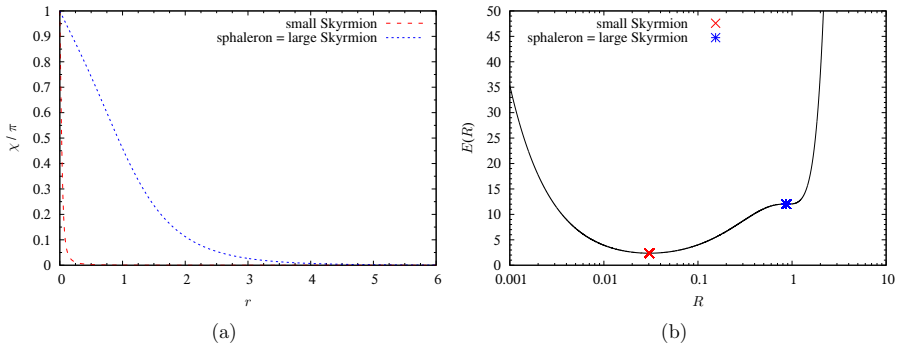
The load-bearing object is the generalized DMI tensor $\Theta_{abi}$, antisymmetric in two $SO(4)$ indices and carrying one spatial index, contracted with the $SO(4)$-invariant tensor $\epsilon^{abcd}$. Its role is to supply a first-order derivative term that can be negative, so that Derrick's theorem is evaded without a higher-derivative stabilizing term. The paper reduces $\Theta$ to its $SO(3)_{\rm diag}$-invariant standard form with two parameters $\alpha$ and $\beta$, inserts the hedgehog Ansatz, a radial profile $\chi(r)$ on $S^3$ with winding phase $\delta$, and reduces the field equations to one ordinary differential equation for $\chi(r)$. From the approximate energy $E(R)=c_2R-c_1\kappa R^2+c_0m^2R^3$, with the Skyrme term adding $c_4/(e^2R)$, it derives two virial radii $R_\pm$, the small one being the sphaleron and the large one the Skyrmion.
What would settle it
A direct test would be to engineer the proposed synthetic-dimension Hamiltonian and search for a localized, spherically symmetric texture carrying topological charge one with a four-component unit vector; the model predicts such a Skyrmion exists only for mass parameter $m \le m_{\rm crit}$, approximately $0.85$, $0.97$, and $1.02$ for potential powers $p=1$, $3/2$, and $2$, and that above that mass all charge-one configurations collapse. In the purely theoretical setting, failing to find two real fixed points of the energy functional $E(R)$ whenever $\tilde{\kappa} > \sqrt{3}$ would falsify the claimed Skyrmion-sphaleron pair.
Extended reading notes
Core claim
The central claim is that the Dzyaloshinskii-Moriya interaction, which in two dimensions is linear in derivatives and uses the antisymmetric tensor $\epsilon^{iab}$, has an $SO(4)$-covariant generalization $\kappa\,\epsilon^{abcd}\Theta_{abi}\partial_i n_c n_d$, where $\Theta$ is a constant tensor carrying two target-space indices and one spatial index. Imposing a locked symmetry $SO(3)_{\rm diag}$ that rotates space together with an $SO(3)$ subgroup of the target leaves only two invariant structures, called the $\alpha$ and $\beta$ parts; under a spherically symmetric hedgehog Ansatz only the $\alpha$ part survives, and both Bloch-type and N\'eel-type generalizations reduce to the same term $\kappa(\chi'+\sin 2\chi/r)$. With kinetic, potential, and this DMI term, the Derrick scaling energy has two fixed points whenever the dimensionless coupling is large enough, producing a large stable Skyrmion and a small unstable sphaleron. The stable solution has negative energy, exists only below a critical mass $m_{\rm crit}$, and disappears at zero mass.
Load-bearing premise
The load-bearing premise is that a physical system can be built in which the magnetization is genuinely a four-component unit vector, using a synthetic dimension, since the paper's own construction of the exact Hamiltonian for that realization is left to future work.
Editorial extensions
If this is right
- If the model is right, three-dimensional magnetic Skyrmions with an $S^3$ target space should exist as static localized textures whenever a four-component magnetization is available.
- The simplest theory has no stable Skyrmion at zero mass or above a critical Zeeman mass, and the stable size diverges as the mass tends to zero, so experiments would need intermediate field strengths.
- The hybrid model with the Skyrme term predicts three distinct topological-charge-one solutions in a narrow band of the parameter plane, with two coalescence lines and a triple point, so counting stable and unstable solutions in a realized system would be a sharp test.
- The $\beta$ part of the DMI, invisible in spherical textures, governs the model's connection to Hopfions, and the sphaleron phenomenon is expected to appear in that Hopfion limit as well.
- The anti-Skyrmion also exists but has higher energy than the Skyrmion, so chirality selects the Skyrmion, just as in two dimensions.
Reading between the lines
- This editor's inference: the Skyrmion-sphaleron pair should appear in any theory whose size-dependent energy has the qualitative form $R-\tilde{\kappa}R^2+R^3$, so the result is likely to transfer beyond the specific tensor $\Theta$ chosen here.
- A testable consequence of the deformation limit is that materials already known to host Hopfions might also show a small, unstable Hopfion solution if a beta-like coupling is present; the paper expects this but leaves the quantitative study to future work.
- One direct falsification route before any synthetic-dimension experiment would be to measure the energy of isolated topological-charge-one textures as a function of applied field, since the model predicts a critical field above which no isolated Skyrmion exists.
Editorial analysis
A structured set of objections, weighed in public.
Referee Report
Summary. The manuscript proposes a three-dimensional generalization of chiral-magnet magnetic Skyrmions, replacing the S^2 target space by S^3 and the three-component magnetization by a four-component unit vector. Section 2.1 classifies the most general one-derivative SO(4) DMI tensor and reduces it under SO(3)_diag symmetry to two structures, the α and β parts; only α contributes to the spherically symmetric hedgehog. The resulting radial equation supports a large negative-energy solution (the '3D magnetic Skyrmion') and a small positive-energy solution (the 'magnetic sphaleron'), as anticipated by a Derrick/virial argument and found numerically by gradient flow and shooting. The restricted model without the kinetic term admits explicit algebraic profiles. Section 3 adds the Skyrme term and derives a Derrick phase diagram with regions hosting one, two, or three solutions, illustrated by numerical profiles. Section 4 discusses synthetic dimensions as a possible realization, and Section 5 connects the model to Hopfion models in a formal limit.
Significance. The paper's symmetry classification and Derrick scaling analysis are clean and rigorous, and the existence of the two radial solutions is supported by two independent numerical methods, with explicit restricted-model solutions as a useful check. If the spherical Skyrmion is confirmed stable against non-spherical perturbations, the paper introduces a genuinely new family of higher-dimensional chiral solitons and a nontrivial phase structure, of interest to both the magnetic-soliton and Skyrme-model communities. The main gaps are that stability is currently established only within the radially symmetric sector, and the condensed-matter realization through a synthetic dimension remains an acknowledged open problem rather than a demonstrated construction.
major comments (2)
- [Sec. 2.2.2 and Sec. 5] The central claim that the spherical hedgehog is a stable Skyrmion is not supported by the analysis shown. Derrick scaling and gradient flow in the radial ODE (Eq. 2.47) probe only the radial sector, while the β-part of the SO(3)_diag DMI (Eq. 2.18) vanishes under angular integration for the symmetric ansatz (Eq. 2.41) but couples to non-spherical perturbations and could in principle lower the energy; the authors explicitly leave this possibility open in the Conclusion. The anti-Skyrmion comparison in Sec. 2.2.4 also uses only angularly integrated quantities. I ask for either a full three-dimensional relaxation of the field equations starting from the hedgehog with perturbations, or a linear-stability/fluctuation analysis around the spherical solution, or a clearly stated weakened claim that the solution is stable only within the radial sector.
- [Secs. 2.2.2 and 2.3.1] The numerical existence of the solutions is not documented with quantitative accuracy measures. The manuscript states only that gradient-flow and shooting results were cross-checked; no mesh sizes, tolerances, conservation residuals, or definitions of rmax and of the numerical criterion for mcrit are provided. This matters because the paper asserts that no solutions exist for m > mcrit and because the sphaleron is unstable, making the numerical determination of the two branches delicate. Please report these numerical controls so that Table 2 and the 'no solution' statements can be independently assessed.
minor comments (5)
- [Sec. 2.2.3, Eq. (2.60)] The p = 2 restricted-model profile is stated as χ = 2 arctan(r/2), which tends to π as r → ∞ and does not satisfy the boundary condition χ(∞) = 0; solving Eq. (2.57) with p = 2 gives χ = 2 arctan(2/r). Please check and correct.
- [Sec. 2.2.3, Eq. (2.58)] The p = 1 profile χ = π − arcsin(r/4) is defined only for r ≤ 4 and ends at χ = π/2; the continuation for r > 4 and the sense in which it satisfies the boundary condition at infinity should be specified explicitly, for instance by declaring it to be a compacton-type solution with an appropriate continuation.
- [Sec. 4 and Sec. 5] The synthetic-dimension realization is presented as a possibility, and the paper correctly notes that the exact Hamiltonian 'still needs to be worked out.' I recommend adding a sentence near the abstract or introduction clarifying that the condensed-matter realization is a conjecture, so that the central results are read as a theoretical soliton model.
- [Secs. 2.4 and 3.3] The statements that the Hopfion model should also possess a sphaleron or a small Hopfion are explicitly flagged as expectations; since no numerical or analytic evidence is given in this paper, I suggest labeling these as conjectures in the respective section headings or in a dedicated paragraph.
- [General] The figures would be more reproducible if the numerical parameters used (grid spacing, number of shooting steps, tolerance, and the criterion for declaring a solution converged) were collected in a short appendix or stated in the captions.
Circularity Check
No significant circularity: the Skyrmion and sphaleron solutions are obtained by solving the reduced radial ODE numerically, not from fitted inputs or a self-citation chain.
full rationale
The paper's central derivation is self-contained. The generalized DMI in Sec. 2.1 is constructed from an SO(4)-antisymmetric tensor Theta and an SO(3)_diag locking condition, yielding Eq. (2.18); the hedgehog Ansatz (2.38) then reduces the energy to the radial functional (2.46) and the Euler-Lagrange equation (2.47). The Skyrmion and sphaleron are found by solving this ODE numerically via gradient flow and shooting, with the sphaleron also motivated by the virial/scaling analysis of Sec. 2.3. No parameter is fitted to a subset of results and then reported as a prediction; m and p are scanned theory parameters. The restricted-model closed forms in Sec. 2.2.3 are stated to be 'formally identical' with Ref. [55] by the same group, but this is a post-solution consistency observation, not a load-bearing input. Ref. [31] is cited only as a preliminary investigation and does not force the model. The explicitly acknowledged limitations -- Sec. 5: 'Deformed solitons, however, may feel the presence of the beta-part of the DM term, which in principle could lower the mass of the soliton,' and Sec. 4: 'The details of whether the exact Hamiltonian corresponding to our model can be constructed, still needs to be worked out' -- are honest statements of missing non-spherical stability and experimental realization, not circular reductions. Therefore no circular step is present.
Assumptions & free parameters
free parameters (4)
- m (mass parameter)
- p (potential power) =
1, 3/2, 2
- e (Skyrme coupling) =
values corresponding to 1/e^2 = 0.001, 0.0222714, etc.
- κ (DMI coefficient)
assumptions (4)
- domain assumption A 4D magnetization vector can be physically realized via a synthetic dimension.
- ad hoc to paper The generalized DMI (2.7) with an antisymmetric Θ tensor is the correct first-order derivative interaction for the S3 target space.
- domain assumption Spherically symmetric hedgehog solutions capture the key physics; the β-part of the DMI is negligible.
- ad hoc to paper Numerical gradient-flow and shooting solutions approximate true field configurations.
invented entities (3)
-
3D magnetic Skyrmion with S3 target space
-
Magnetic sphaleron
-
Small metastable Skyrmion
Cite this review
Pith. "Pith review of Higher-dimensional magnetic Skyrmions." pith.science (2026). https://pith.science/paper/GP4F2CKV
@misc{pith2026241112190,
  author       = {Pith},
  title        = {Pith review of: Higher-dimensional magnetic Skyrmions},
  year         = {2026},
  howpublished = {\url{https://pith.science/paper/GP4F2CKV}},
  note         = {Machine review of arXiv:2411.12190}
}
abstract
We propose a generalization of the theory of magnetic Skyrmions in chiral magnets in two dimensions to a higher-dimensional theory with magnetic Skyrmions in three dimensions and an $S^3$ target space, requiring a 4-dimensional magnetization vector. A physical realization of our theory could be made using a synthetic dimension, recently promoted and realized in condensed matter physics. In the simplest incarnation of the theory, we find a Skyrmion and a sphaleron - the latter being an unstable soliton. Including also the Skyrme term in the theory enriches the spectrum to a small metastable Skyrmion, an unstable sphaleron and a large stable Skyrmion.
Figures


Figures from the paper (11 more)




Reference graph
Works this paper leans on
- [1]
-
[2]
A. Bogdanov, New localized solutions of the nonlinear field equations , Soviet Journal of Experimental and Theoretical Physics Letters 62 (Aug., 1995) 247
work page 1995
-
[3]
N. Nagaosa and Y. Tokura, Topological properties and dynamics of magnetic skyrmions, Nat. Nanotechnol. 8 (2013) 899
work page 2013
-
[4]
S. M¨ uhlbauer, B. Binz, F. Jonietz, C. Pfleiderer, A. Rosch, A. Neubauer, R. Georgii, and P. B¨ oni,Skyrmion lattice in a chiral magnet , Science 323 (2009), no. 5916 915–919
work page 2009
-
[5]
X. Z. Yu, Y. Onose, N. Kanazawa, J. H. Park, J. H. Han, Y. Matsui, N. Nagaosa, and Y. Tokura, Real-space observation of a two-dimensional skyrmion crystal , Nature 465 (Jun, 2010) 901–904
work page 2010
-
[6]
A. Fert, N. Reyren, and V. Cros, Magnetic skyrmions: advances in physics and potential applications, Nature Reviews Materials 2 (Jun, 2017) 17031
work page 2017
-
[7]
K. Everschor-Sitte, J. Masell, R. M. Reeve, and M. Kl¨ aui, Perspective: Magnetic skyrmions—Overview of recent progress in an active research field , Journal of Applied Physics 124 (12, 2018) 240901
work page 2018
- [8]
Show all 56 references
-
[9]
Psaroudaki, E
C. Psaroudaki, E. Peraticos, and C. Panagopoulos, Skyrmion qubits: Challenges for future quantum computing applications , Applied Physics Letters 123 (12, 2023) 260501. 36
2023
-
[10]
T. H. R. Skyrme, A non-linear field theory , Proceedings of the Royal Society of London. Series A. Mathematical and Physical Sciences 260 (1961), no. 1300 127–138
1961
-
[11]
T. H. R. Skyrme, A unified field theory of mesons and baryons , Nuclear Physics 31 (1962) 556–569
1962
-
[12]
Witten, Global Aspects of Current Algebra , Nucl
E. Witten, Global Aspects of Current Algebra , Nucl. Phys. B 223 (1983) 422–432
1983
-
[13]
Witten, Current Algebra, Baryons, and Quark Confinement , Nucl
E. Witten, Current Algebra, Baryons, and Quark Confinement , Nucl. Phys. B 223 (1983) 433–444
1983
-
[14]
Sakai and S
T. Sakai and S. Sugimoto, Low energy hadron physics in holographic QCD , Prog. Theor. Phys. 113 (2005) 843–882, [ hep-th/0412141]
2005 arXiv
-
[15]
U. K. R¨ oßler, A. N. Bogdanov, and C. Pfleiderer, Spontaneous skyrmion ground states in magnetic metals , Nature 442 (Aug, 2006) 797–801
2006
-
[16]
Rossler, A
U. Rossler, A. A. Leonov, and A. N. Bogdanov, Chiral Skyrmionic matter in non-centrosymmetric magnets, J. Phys. Conf. Ser. 303 (2011) 012105, [arXiv:1009.4849]
2011 arXiv
-
[17]
Ezawa, Compact Skyrmions, Merons and Bimerons in Thin Chiral Magnetic Films, Phys
M. Ezawa, Compact Skyrmions, Merons and Bimerons in Thin Chiral Magnetic Films, Phys. Rev. B 83 (2011) 100408, [ arXiv:1010.4119]
2011 arXiv
-
[18]
Banerjee, J
S. Banerjee, J. Rowland, O. Erten, and M. Randeria, Skyrmions in two-dimensional chiral magnets, Phys. Rev. X 4 (2014), no. 3 031045, [ arXiv:1402.7082]
2014 arXiv
-
[19]
Melcher, Chiral skyrmions in the plane , Proceedings of the Royal Society A: Mathematical, Physical and Engineering Sciences 470 (2014), no
C. Melcher, Chiral skyrmions in the plane , Proceedings of the Royal Society A: Mathematical, Physical and Engineering Sciences 470 (2014), no. 2172 20140394
2014
-
[20]
F. N. Rybakov and N. S. Kiselev, Chiral magnetic skyrmions with arbitrary topological charge, Phys. Rev. B 99 (2019), no. 6 064437, [ arXiv:1806.00782]
2019 arXiv
-
[21]
B. J. Schroers, Gauged Sigma Models and Magnetic Skyrmions , SciPost Phys. 7 (2019), no. 3 030, [ arXiv:1905.06285]
2019 arXiv
-
[22]
Barton-Singer, C
B. Barton-Singer, C. Ross, and B. J. Schroers, Magnetic Skyrmions at Critical Coupling, Commun. Math. Phys. 375 (2020), no. 3 2259–2280, [ arXiv:1812.07268]
2020 arXiv
-
[23]
V. M. Kuchkin, B. Barton-Singer, F. N. Rybakov, S. Bl¨ ugel, B. J. Schroers, and N. S. Kiselev, Magnetic skyrmions, chiral kinks and holomorphic functions , Phys. Rev. B 102 (2020), no. 14 144422, [ arXiv:2007.06260]
2020 arXiv
-
[24]
C. Ross, N. Sakai, and M. Nitta, Skyrmion interactions and lattices in chiral magnets: analytical results , JHEP 02 (2021) 095, [ arXiv:2003.07147]. 37
2021 arXiv
-
[25]
D. Hill, V. Slastikov, and O. Tchernyshyov, Chiral magnetism: a geometric perspective, SciPost Phys. 10 (2021) 078
2021
-
[26]
Schroers, Solvable Models of Magnetic Skyrmions , in 11th International Symposium on Quantum Theory and Symmetries , 10, 2019
B. Schroers, Solvable Models of Magnetic Skyrmions , in 11th International Symposium on Quantum Theory and Symmetries , 10, 2019. arXiv:1910.13907
2019 arXiv
-
[27]
Amari, Y
Y. Amari, Y. Akagi, S. B. Gudnason, M. Nitta, and Y. Shnir, CP2 skyrmion crystals in an SU(3) magnet with a generalized Dzyaloshinskii-Moriya interaction , Phys. Rev. B 106 (2022), no. 10 L100406, [ arXiv:2204.01476]
2022 arXiv
-
[28]
Hanada and N
F. Hanada and N. Sawado, A baby Skyrme model with anisotropic DM interaction: Compact skyrmions revisited, Nucl. Phys. B 996 (2023) 116377, [arXiv:2303.15751]
2023 arXiv
-
[29]
V. M. Kuchkin and N. S. Kiselev, Turning a chiral skyrmion inside out , Phys. Rev. B 101 (Feb, 2020) 064408
2020
-
[30]
G. H. Derrick, Comments on nonlinear wave equations as models for elementary particles, J. Math. Phys. 5 (1964) 1252–1254
1964
-
[31]
Menta, Magnetic skyrmions and possible extensions , ETD (Master Thesis) University of Pisa (2023)
R. Menta, Magnetic skyrmions and possible extensions , ETD (Master Thesis) University of Pisa (2023)
2023
-
[32]
G. E. Volovik and V. P. Mineev, Particle-like solitons in superfluid 3he phases , Soviet Journal of Experimental and Theoretical Physics 46 (1977) 401–404
1977
-
[33]
G. E. Volovik, The Universe in a Helium Droplet . Oxford University Press, 02, 2009
2009
-
[34]
Boada, A
O. Boada, A. Celi, J. I. Latorre, and M. Lewenstein, Quantum simulation of an extra dimension, Phys. Rev. Lett. 108 (Mar, 2012) 133001
2012
-
[35]
A. Celi, P. Massignan, J. Ruseckas, N. Goldman, I. B. Spielman, G. Juzeli¯ unas, and M. Lewenstein, Synthetic gauge fields in synthetic dimensions , Phys. Rev. Lett. 112 (Jan, 2014) 043001
2014
-
[36]
Ozawa, H
T. Ozawa, H. M. Price, N. Goldman, O. Zilberberg, and I. Carusotto, Synthetic dimensions in integrated photonics: From optical isolation to four-dimensional quantum Hall physics , Phys. Rev. A 93 (2016), no. 4 043827, [ arXiv:1510.03910]
2016 arXiv
-
[37]
H. M. Price, O. Zilberberg, T. Ozawa, I. Carusotto, and N. Goldman, Four-dimensional quantum hall effect with ultracold atoms , Phys. Rev. Lett. 115 (Nov, 2015) 195303. 38
2015
-
[38]
L. Yuan, Q. Lin, M. Xiao, and S. Fan, Synthetic dimension in photonics , Optica 5 (Nov, 2018) 1396–1405
2018
-
[39]
Ozawa and H
T. Ozawa and H. M. Price, Topological quantum matter in synthetic dimensions , Nature Reviews Physics 1 (May, 2019) 349–357
2019
-
[40]
Y. Wang, H. M. Price, B. Zhang, and Y. D. Chong, Circuit implementation of a four-dimensional topological insulator, Nature Communications 11 (May, 2020) 2356
2020
-
[41]
Price, Simulating four-dimensional physics in the laboratory , Physics Today 75 (04, 2022) 38–44
H. Price, Simulating four-dimensional physics in the laboratory , Physics Today 75 (04, 2022) 38–44
2022
-
[42]
K. R. A. Hazzard and B. Gadway, Synthetic dimensions , Physics Today 76 (04,
-
[43]
Arguello-Luengo, U
J. Arguello-Luengo, U. Bhattacharya, A. Celi, R. W. Chhajlany, T. Grass, M. Plodzien, D. Rakshit, T. Salamon, P. Stornati, L. Tarruell, and M. Lewenstein, Synthetic dimensions for topological and quantum phases , Communications Physics 7 (May, 2024) 143
2024
-
[44]
Sutcliffe, Skyrmion knots in frustrated magnets , Phys
P. Sutcliffe, Skyrmion knots in frustrated magnets , Phys. Rev. Lett. 118 (2017), no. 24 247203, [ arXiv:1705.10966]
2017 arXiv
-
[45]
Sutcliffe, Hopfions in chiral magnets , J
P. Sutcliffe, Hopfions in chiral magnets , J. Phys. A 51 (2018), no. 37 375401, [arXiv:1806.06458]
2018 arXiv
-
[46]
Sutcliffe, Hopfions, Reviews in Mathematical Physics 30 (2018), no
P. Sutcliffe, Hopfions, Reviews in Mathematical Physics 30 (2018), no. 08 1840017
2018
-
[47]
J.-S. B. Tai and I. I. Smalyukh, Static Hopf Solitons and Knotted Emergent Fields in Solid-State Noncentrosymmetric Magnetic Nanostructures , Phys. Rev. Lett. 121 (2018), no. 18 187201, [ arXiv:1806.00453]
2018 arXiv
-
[48]
Y. Liu, R. K. Lake, and J. Zang, Binding a hopfion in a chiral magnet nanodisk , Phys. Rev. B 98 (Nov, 2018) 174437
2018
-
[49]
P. J. Ackerman and I. I. Smalyukh, Static three-dimensional topological solitons in fluid chiral ferromagnets and colloids , Nature Materials 16 (Apr, 2017) 426–432
2017
-
[50]
N. Kent, N. Reynolds, D. Raftrey, I. T. G. Campbell, S. Virasawmy, S. Dhuey, R. V. Chopdekar, A. Hierro-Rodriguez, A. Sorrentino, E. Pereiro, S. Ferrer, F. Hellman, P. Sutcliffe, and P. Fischer, Creation and observation of hopfions in magnetic multilayer systems , Nature Commu...
2021
-
[51]
Dzyaloshinsky, A thermodynamic theory of “weak” ferromagnetism of antiferromagnetics, Journal of Physics and Chemistry of Solids 4 (1958), no
I. Dzyaloshinsky, A thermodynamic theory of “weak” ferromagnetism of antiferromagnetics, Journal of Physics and Chemistry of Solids 4 (1958), no. 4 241–255
1958
-
[52]
Moriya, Anisotropic superexchange interaction and weak ferromagnetism , Phys
T. Moriya, Anisotropic superexchange interaction and weak ferromagnetism , Phys. Rev. 120 (Oct, 1960) 91–98
1960
-
[53]
Moriya, New mechanism of anisotropic superexchange interaction , Phys
T. Moriya, New mechanism of anisotropic superexchange interaction , Phys. Rev. Lett. 4 (Mar, 1960) 228–230
1960
-
[54]
N. S. Manton, The Inevitability of Sphalerons in Field Theory , Phil. Trans. Roy. Soc. Lond. A 377 (2019), no. 2161 20180327, [ arXiv:1903.11573]
2019 arXiv
-
[55]
Bolognesi, S
S. Bolognesi, S. B. Gudnason, and R. Menta, Magnetic skyrmions: From lumps to supercompactons, Phys. Rev. Res. 6 (Nov, 2024) 043162, [ arXiv:2406.03941]
2024 arXiv
-
[56]
L. D. Faddeev, Quantization of solitons , Princeton preprint IAS-75 (1975) QS70. 40
1975
Reviewed August 12, 2026 · model on record in the stance chip above.
Discussion (0). Continue with ORCID to comment.